About the Report
Base Year 2024India Cookware Market Overview
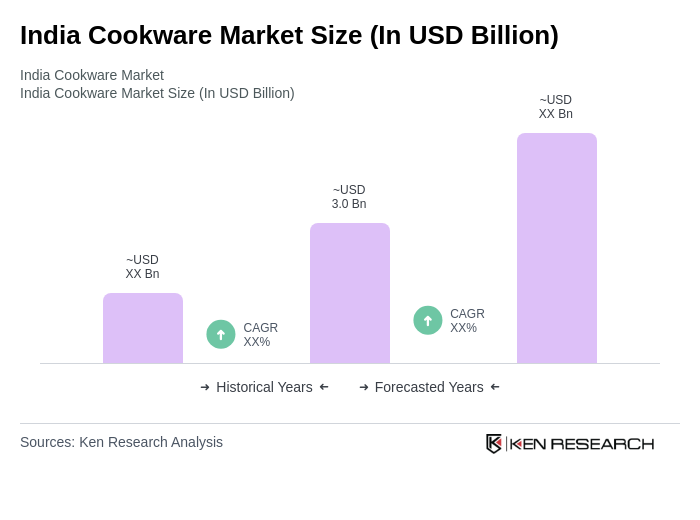
- The India Cookware Market is valued at USD 3.0 billion, based on a five-year historical analysis. This growth is primarily driven by increasing urbanization, rising disposable incomes, and a pronounced shift towards home cooking and branded, durable cookware, with consumers favoring non-stick, stainless steel, and triply products for quality and longevity. Demand is further supported by heightened health consciousness and social media influence, which are encouraging healthier, low-oil cooking and the adoption of safer materials and premium cookware finishes.
- Key cities such as Mumbai, Delhi, and Bangalore dominate the market due to higher purchasing power, dense urban populations, and strong modern retail and e-commerce penetration that expand access to branded cookware. Urban lifestyle shifts toward compact, modern kitchens and convenience-driven products are reinforcing demand for versatile vessels like kadai, tawa, and multi-purpose pans.
- The “Make in India” program is an ongoing national initiative designed to promote domestic manufacturing, including consumer durables and kitchenware; it emphasizes import substitution, job creation, and competitiveness for Indian brands, thereby supporting local cookware production and supply chains. While the initiative predates 2023, continued policy thrust toward local manufacturing has remained relevant for cookware and kitchenware categories.
India Cookware Market Segmentation
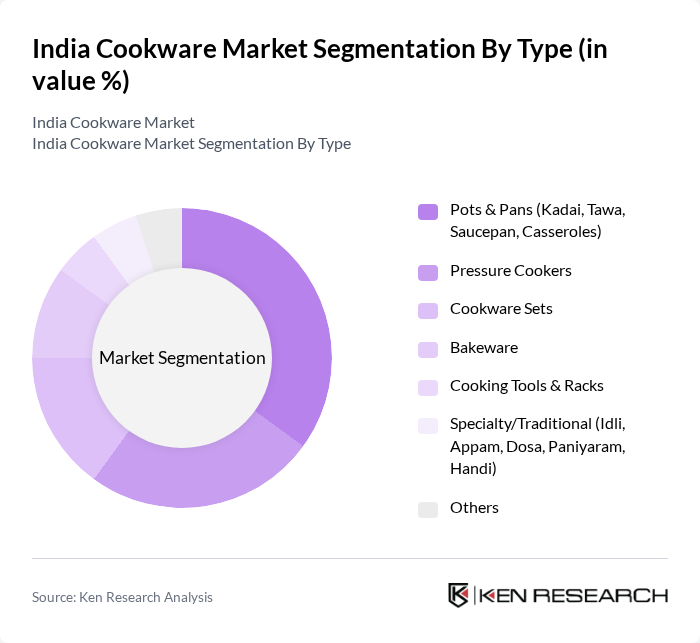
By Type:The cookware market is segmented into various types, including pots and pans, pressure cookers, cookware sets, bakeware, cooking tools and racks, specialty/traditional cookware, and others. Among these, pots and pans, particularly kadai and tawa, dominate the market due to their versatility and essential role in Indian cooking. The increasing trend of home cooking has led to a surge in demand for these products, as they are fundamental for preparing a wide range of traditional dishes.
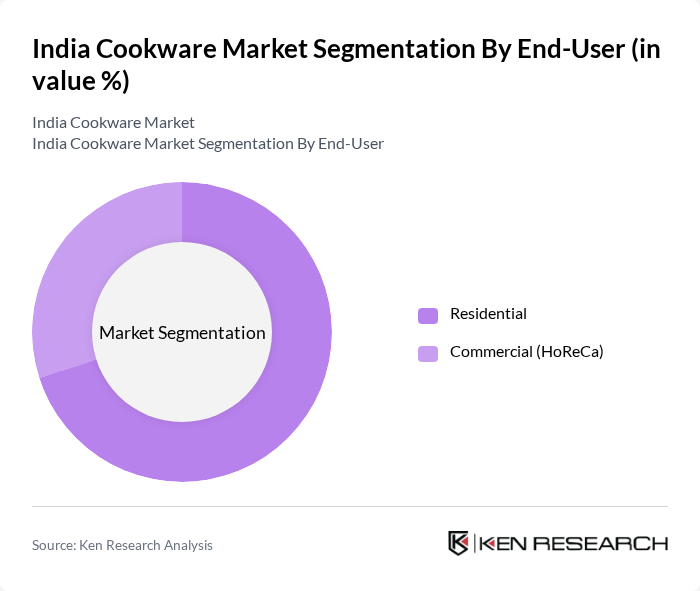
By End-User:The market is segmented into residential and commercial (HoReCa) end-users. The residential segment holds a significant share, driven by the increasing number of households and the growing trend of home cooking. Consumers are investing in quality cookware to enhance their cooking experience, leading to a rise in demand for various cookware products tailored for home use. The commercial segment, while smaller, is also growing as restaurants and hotels seek durable and efficient cookware solutions.
India Cookware Market Competitive Landscape
The India Cookware Market is characterized by a dynamic mix of regional and international players. Leading participants such as Tefal India (Groupe SEB India), TTK Prestige Limited, Hawkins Cookers Limited, Stovekraft Limited (Pigeon, Gilma), Milton (Hamilton Housewares Pvt. Ltd.), Cello World Ltd. (Cello Cookware), Wonderchef Home Appliances Pvt. Ltd., Borosil Limited (Borosil Cookware & Kitchenware), Vinod Intelligent Cookware (Sunraj Industries), Butterfly Gandhimathi Appliances Ltd., Anjali Kitchenware (Anjali) Pvt. Ltd., Meyer Housewares India (Circulon, Anolon), Futura (Hawkins Futura Non-stick), Neelam Stainless Steel (Neelam Cookware), Tupperware India Pvt. Ltd., Nirlep Appliances Pvt. Ltd. (Nirlep Cookware), Bergner India (Bergner, MasterPro), Alda India (Alda Triply Cookware), Pristine Kitchenware (Triply/SS Cookware), Stahl (Taashee Stainless Steel Pvt. Ltd.) contribute to innovation, geographic expansion, and service delivery in this space.
India Cookware Market Industry Analysis
Growth Drivers
- Increasing Urbanization:Urbanization in India is projected to reach 36% in future, with over 500 million people living in urban areas. This demographic shift is driving demand for modern cookware as urban households seek efficient cooking solutions. The rise in urban population correlates with increased kitchen space and the need for versatile cookware, leading to a surge in sales of innovative products. Urban consumers are more inclined to invest in quality cookware, further propelling market growth.
- Rising Disposable Incomes:India's per capita income is expected to rise to approximately $2,500 in future, enhancing consumer purchasing power. As disposable incomes increase, households are more willing to spend on premium cookware products. This trend is particularly evident among the middle class, which is projected to grow to 600 million in future. Higher disposable incomes enable consumers to prioritize quality and brand reputation, driving demand for high-end cookware options.
- Expansion of E-commerce Platforms:The e-commerce sector in India is anticipated to reach $200 billion in future, significantly impacting cookware sales. Online platforms provide consumers with access to a wide range of cookware options, often at competitive prices. The convenience of online shopping, coupled with targeted marketing strategies, has led to increased consumer engagement. E-commerce also facilitates the entry of niche brands, enhancing product diversity and catering to evolving consumer preferences.
Market Challenges
- Intense Competition:The Indian cookware market is characterized by intense competition, with over 1,000 brands vying for market share. Major players like Tefal and Prestige dominate, but numerous local brands also contribute to market fragmentation. This competitive landscape pressures companies to innovate continuously and maintain competitive pricing. As a result, profit margins are often squeezed, making it challenging for smaller brands to sustain operations and grow their market presence.
- Fluctuating Raw Material Prices:The cookware industry is heavily reliant on raw materials such as aluminum and stainless steel, whose prices are subject to volatility. For instance, aluminum prices surged by 20% in future due to supply chain disruptions. Such fluctuations can significantly impact production costs, forcing manufacturers to either absorb costs or pass them onto consumers. This unpredictability complicates pricing strategies and can hinder long-term planning for cookware companies.
India Cookware Market Future Outlook
The India cookware market is poised for significant transformation, driven by technological advancements and changing consumer behaviors. The rise of smart cookware, which integrates IoT technology, is expected to attract tech-savvy consumers. Additionally, the growing trend of health-conscious cooking will likely lead to increased demand for non-toxic, eco-friendly cookware options. As consumers become more aware of sustainability, brands that prioritize environmentally friendly practices will gain a competitive edge in this evolving market landscape.
Market Opportunities
- Growth in Health-Conscious Cooking:With the health and wellness trend gaining momentum, the demand for cookware that supports healthy cooking methods is increasing. Products like non-stick and ceramic cookware are becoming popular as consumers seek to reduce oil usage. This shift presents an opportunity for brands to innovate and market health-oriented cookware, catering to a growing segment of health-conscious consumers.
- Expansion into Tier 2 and Tier 3 Cities:As urbanization spreads, Tier 2 and Tier 3 cities are experiencing rising disposable incomes and changing lifestyles. This demographic shift presents a lucrative opportunity for cookware brands to expand their reach. Targeting these emerging markets with tailored marketing strategies and affordable product lines can significantly enhance brand visibility and sales in previously underserved regions.
Scope of the Report
| Segment | Sub-Segments |
|---|---|
| By Type | Pots & Pans (Kadai, Tawa, Saucepan, Casseroles) Pressure Cookers Cookware Sets Bakeware Cooking Tools & Racks Specialty/Traditional (Idli, Appam, Dosa, Paniyaram, Handi) Others |
| By End-User | Residential Commercial (HoReCa) |
| By Sales Channel | E-commerce Marketplaces Modern Trade (Hypermarkets/Supermarkets) Exclusive Brand Outlets & Company Webstores General Trade (Independent Retailers/Distributors) |
| By Material | Stainless Steel Aluminum (Hard Anodized, Triply) Non-stick Coated (PTFE/Ceramic) Cast Iron & Carbon Steel Copper & Tri-ply/5-ply Clad Glass/Ceramic/Stoneware & Others |
| By Price Range | Budget (Mass) Mid-range Premium (Aspirational/Imported) |
| By Brand Positioning | Mass/Value Bridge to Premium Premium/Luxury |
| By Compatibility/Features | Induction-Compatible Gas/Electric Compatible Dishwasher/Oven Safe Non-toxic/Coating-free |
Key Target Audience
Investors and Venture Capitalist Firms
Government and Regulatory Bodies (e.g., Bureau of Indian Standards, Ministry of Consumer Affairs)
Manufacturers and Producers
Distributors and Retailers
Importers and Exporters
Industry Associations (e.g., All India Kitchenware Association)
Financial Institutions
Raw Material Suppliers
Players Mentioned in the Report:
Tefal India (Groupe SEB India)
TTK Prestige Limited
Hawkins Cookers Limited
Stovekraft Limited (Pigeon, Gilma)
Milton (Hamilton Housewares Pvt. Ltd.)
Cello World Ltd. (Cello Cookware)
Wonderchef Home Appliances Pvt. Ltd.
Borosil Limited (Borosil Cookware & Kitchenware)
Vinod Intelligent Cookware (Sunraj Industries)
Butterfly Gandhimathi Appliances Ltd.
Anjali Kitchenware (Anjali) Pvt. Ltd.
Meyer Housewares India (Circulon, Anolon)
Futura (Hawkins Futura Non-stick)
Neelam Stainless Steel (Neelam Cookware)
Tupperware India Pvt. Ltd.
Nirlep Appliances Pvt. Ltd. (Nirlep Cookware)
Bergner India (Bergner, MasterPro)
Alda India (Alda Triply Cookware)
Pristine Kitchenware (Triply/SS Cookware)
Stahl (Taashee Stainless Steel Pvt. Ltd.)
Table of Contents
Market Assessment Phase
1. Executive Summary and Approach
2. India Cookware Market Overview
2.1 Key Insights and Strategic Recommendations
2.2 India Cookware Market Overview
2.3 Definition and Scope
2.4 Evolution of Market Ecosystem
2.5 Timeline of Key Regulatory Milestones
2.6 Value Chain & Stakeholder Mapping
2.7 Business Cycle Analysis
2.8 Policy & Incentive Landscape
3. India Cookware Market Analysis
3.1 Growth Drivers
3.1.1 Increasing Urbanization
3.1.2 Rising Disposable Incomes
3.1.3 Growing Interest in Cooking and Culinary Arts
3.1.4 Expansion of E-commerce Platforms
3.2 Market Challenges
3.2.1 Intense Competition
3.2.2 Fluctuating Raw Material Prices
3.2.3 Changing Consumer Preferences
3.2.4 Regulatory Compliance Issues
3.3 Market Opportunities
3.3.1 Growth in Health-Conscious Cooking
3.3.2 Innovations in Cookware Technology
3.3.3 Expansion into Tier 2 and Tier 3 Cities
3.3.4 Sustainable and Eco-friendly Products
3.4 Market Trends
3.4.1 Rise of Smart Cookware
3.4.2 Increasing Demand for Non-stick Cookware
3.4.3 Popularity of Multi-functional Cookware
3.4.4 Growth of Online Cooking Classes and Influencers
3.5 Government Regulation
3.5.1 Standards for Cookware Safety
3.5.2 Import Tariffs on Cookware
3.5.3 Environmental Regulations on Manufacturing
3.5.4 Consumer Protection Laws
4. SWOT Analysis
5. Stakeholder Analysis
6. Porter's Five Forces Analysis
7. India Cookware Market Market Size, 2019-2024
7.1 By Value
7.2 By Volume
7.3 By Average Selling Price
8. India Cookware Market Segmentation
8.1 By Type
8.1.1 Pots & Pans (Kadai, Tawa, Saucepan, Casseroles)
8.1.2 Pressure Cookers
8.1.3 Cookware Sets
8.1.4 Bakeware
8.1.5 Cooking Tools & Racks
8.1.6 Specialty/Traditional (Idli, Appam, Dosa, Paniyaram, Handi)
8.1.7 Others
8.2 By End-User
8.2.1 Residential
8.2.2 Commercial (HoReCa)
8.3 By Sales Channel
8.3.1 E-commerce Marketplaces
8.3.2 Modern Trade (Hypermarkets/Supermarkets)
8.3.3 Exclusive Brand Outlets & Company Webstores
8.3.4 General Trade (Independent Retailers/Distributors)
8.4 By Material
8.4.1 Stainless Steel
8.4.2 Aluminum (Hard Anodized, Triply)
8.4.3 Non-stick Coated (PTFE/Ceramic)
8.4.4 Cast Iron & Carbon Steel
8.4.5 Copper & Tri-ply/5-ply Clad
8.4.6 Glass/Ceramic/Stoneware & Others
8.5 By Price Range
8.5.1 Budget (Mass)
8.5.2 Mid-range
8.5.3 Premium (Aspirational/Imported)
8.6 By Brand Positioning
8.6.1 Mass/Value
8.6.2 Bridge to Premium
8.6.3 Premium/Luxury
8.7 By Compatibility/Features
8.7.1 Induction-Compatible
8.7.2 Gas/Electric Compatible
8.7.3 Dishwasher/Oven Safe
8.7.4 Non-toxic/Coating-free
9. India Cookware Market Competitive Analysis
9.1 Market Share of Key Players(Micro, Small, Medium, Large Enterprises)
9.2 Cross Comparison of Key Players
9.2.1 Company Name
9.2.2 Organization Size (Large/Medium/Small)
9.2.3 India Cookware Revenue (Latest FY)
9.2.4 3-year Revenue CAGR (India)
9.2.5 Market Share (By Product/Material Segment)
9.2.6 ASP and Price Band Coverage
9.2.7 Product Portfolio Breadth (SKUs, Materials, Sets vs Singles)
9.2.8 Channel Mix (E-commerce, Modern Trade, General Trade, EBO)
9.2.9 Regional Penetration (North/West/South/East)
9.2.10 Brand Metrics (Awareness/Preference/NPS)
9.2.11 Warranty & Service Coverage (No. of Service Centers)
9.2.12 Innovation & Certifications (Induction, Triply, Food-grade/BIS)
9.3 SWOT Analysis of Top Players
9.4 Pricing Analysis(By Class and Payload)
9.5 Detailed Profile of Major Companies
9.5.1 Tefal India (Groupe SEB India)
9.5.2 TTK Prestige Limited
9.5.3 Hawkins Cookers Limited
9.5.4 Stovekraft Limited (Pigeon, Gilma)
9.5.5 Milton (Hamilton Housewares Pvt. Ltd.)
9.5.6 Cello World Ltd. (Cello Cookware)
9.5.7 Wonderchef Home Appliances Pvt. Ltd.
9.5.8 Borosil Limited (Borosil Cookware & Kitchenware)
9.5.9 Vinod Intelligent Cookware (Sunraj Industries)
9.5.10 Butterfly Gandhimathi Appliances Ltd.
9.5.11 Anjali Kitchenware (Anjali) Pvt. Ltd.
9.5.12 Meyer Housewares India (Circulon, Anolon)
9.5.13 Futura (Hawkins Futura Non-stick)
9.5.14 Neelam Stainless Steel (Neelam Cookware)
9.5.15 Tupperware India Pvt. Ltd.
9.5.16 Nirlep Appliances Pvt. Ltd. (Nirlep Cookware)
9.5.17 Bergner India (Bergner, MasterPro)
9.5.18 Alda India (Alda Triply Cookware)
9.5.19 Pristine Kitchenware (Triply/SS Cookware)
9.5.20 Stahl (Taashee Stainless Steel Pvt. Ltd.)
10. India Cookware Market End-User Analysis
10.1 Procurement Behavior of Key Ministries
10.1.1 Government Procurement Policies
10.1.2 Budget Allocations for Cookware
10.1.3 Supplier Selection Criteria
10.1.4 Contract Management Practices
10.2 Corporate Spend on Infrastructure & Energy
10.2.1 Investment in Kitchen Infrastructure
10.2.2 Energy-efficient Cookware Purchases
10.2.3 Budgeting for Employee Welfare
10.3 Pain Point Analysis by End-User Category
10.3.1 Quality Concerns
10.3.2 Availability of Products
10.3.3 Price Sensitivity
10.4 User Readiness for Adoption
10.4.1 Awareness of New Products
10.4.2 Willingness to Experiment
10.4.3 Feedback Mechanisms
10.5 Post-Deployment ROI and Use Case Expansion
10.5.1 Measurement of Cost Savings
10.5.2 User Satisfaction Surveys
10.5.3 Opportunities for Upselling
11. India Cookware Market Future Size, 2025-2030
11.1 By Value
11.2 By Volume
11.3 By Average Selling Price
Go-To-Market Strategy Phase
1. Whitespace Analysis + Business Model Canvas
1.1 Market Gaps Identification
1.2 Value Proposition Development
1.3 Revenue Streams
1.4 Cost Structure Analysis
1.5 Key Partnerships
1.6 Customer Segments
1.7 Channels
2. Marketing and Positioning Recommendations
2.1 Branding Strategies
2.2 Product USPs
3. Distribution Plan
3.1 Urban Retail vs Rural NGO Tie-ups
4. Channel & Pricing Gaps
4.1 Underserved Routes
4.2 Pricing Bands
5. Unmet Demand & Latent Needs
5.1 Category Gaps
5.2 Consumer Segments
6. Customer Relationship
6.1 Loyalty Programs
6.2 After-sales Service
7. Value Proposition
7.1 Sustainability
7.2 Integrated Supply Chains
8. Key Activities
8.1 Regulatory Compliance
8.2 Branding
8.3 Distribution Setup
9. Entry Strategy Evaluation
9.1 Domestic Market Entry Strategy
9.1.1 Product Mix
9.1.2 Pricing Band
9.1.3 Packaging
9.2 Export Entry Strategy
9.2.1 Target Countries
9.2.2 Compliance Roadmap
10. Entry Mode Assessment
10.1 JV
10.2 Greenfield
10.3 M&A
10.4 Distributor Model
11. Capital and Timeline Estimation
11.1 Capital Requirements
11.2 Timelines
12. Control vs Risk Trade-Off
12.1 Ownership vs Partnerships
13. Profitability Outlook
13.1 Breakeven Analysis
13.2 Long-term Sustainability
14. Potential Partner List
14.1 Distributors
14.2 JVs
14.3 Acquisition Targets
15. Execution Roadmap
15.1 Phased Plan for Market Entry
15.1.1 Market Setup
15.1.2 Market Entry
15.1.3 Growth Acceleration
15.1.4 Scale & Stabilize
15.2 Key Activities and Milestones
15.2.1 Activity Planning
15.2.2 Milestone Tracking
Research Methodology
Phase 1: Approach1
Desk Research
- Market reports from industry associations such as the Indian Cookware Manufacturers Association
- Government publications on manufacturing and import/export statistics related to cookware
- Academic journals and articles focusing on consumer behavior and trends in the cookware market
Primary Research
- Interviews with key stakeholders including manufacturers, retailers, and distributors in the cookware sector
- Surveys targeting consumers to understand preferences, buying behavior, and brand loyalty
- Field visits to retail outlets to observe product placement, pricing strategies, and customer interactions
Validation & Triangulation
- Cross-validation of findings through multiple data sources including sales data and consumer feedback
- Triangulation of insights from interviews, surveys, and observational research
- Sanity checks conducted through expert reviews and feedback from industry veterans
Phase 2: Market Size Estimation1
Top-down Assessment
- Analysis of national cookware market size based on overall kitchenware spending trends
- Segmentation of the market by product type (e.g., non-stick, stainless steel, cast iron) and distribution channel
- Incorporation of demographic data to assess potential market growth in urban vs. rural areas
Bottom-up Modeling
- Estimation of production volumes from leading cookware manufacturers in India
- Cost analysis based on raw material prices and manufacturing processes
- Sales data from major retail chains and e-commerce platforms to establish market penetration rates
Forecasting & Scenario Analysis
- Multi-variable forecasting models incorporating economic indicators, consumer trends, and technological advancements
- Scenario analysis based on potential shifts in consumer preferences towards sustainable cookware options
- Projections for market growth through 2030 under various economic conditions and regulatory frameworks
Phase 3: CATI Sample Composition1
| Scope Item/Segment | Sample Size | Target Respondent Profiles |
|---|---|---|
| Consumer Preferences in Cookware | 150 | Homeowners, Cooking Enthusiasts |
| Retail Insights on Cookware Sales | 100 | Store Managers, Sales Executives |
| Manufacturing Trends in Cookware | 80 | Production Managers, Quality Control Officers |
| Distribution Channel Effectiveness | 70 | Logistics Coordinators, Supply Chain Analysts |
| Market Entry Strategies for New Brands | 60 | Brand Managers, Marketing Directors |
Frequently Asked Questions
What is the current value of the India Cookware Market?
The India Cookware Market is valued at approximately USD 3.0 billion, driven by factors such as urbanization, rising disposable incomes, and a growing preference for home cooking and durable cookware options.
What types of cookware are most popular in India?
How is the India Cookware Market segmented?
What factors are driving growth in the India Cookware Market?
Other Regional/Country Reports
Indonesia Cookware Market
Malaysia Cookware Market
APAC Cookware Market
Why Buy From Us?

What makes us stand out is that our consultants follow Robust, Refine and Result (RRR) methodology. Robust for clear definitions, approaches and sanity checking, Refine for differentiating respondents' facts and opinions, and Result for presenting data with story.

We have set a benchmark in the industry by offering our clients with syndicated and customized market research reports featuring coverage of entire market as well as meticulous research and analyst insights.

While we don't replace traditional research, we flip the method upside down. Our dual approach of Top Bottom & Bottom Top ensures quality deliverable by not just verifying company fundamentals but also looking at the sector and macroeconomic factors.

With one step in the future, our research team constantly tries to show you the bigger picture. We help with some of the tough questions you may encounter along the way: How is the industry positioned? Best marketing channel? KPI's of competitors? By aligning every element, we help maximize success.

Our report gives you instant access to the answers and sources that other companies might choose to hide. We elaborate each steps of research methodology we have used and showcase you the sample size to earn your trust.

If you need any support, we are here! We pride ourselves on universe strength, data quality, and quick, friendly, and professional service.