About the Report
Base Year 2024India Mutual Fund Industry Market Overview
- The India Mutual Fund Industry Market is valued at approximately INR 72 trillion, based on a five-year historical analysis. This growth is primarily driven by increasing retail participation, rapid adoption of systematic investment plans (SIPs), digital distribution through fintech platforms, and a growing awareness of investment options among the Indian populace. The rise in disposable income, favorable tax incentives for equity funds, and a nationwide push for financial literacy have also contributed significantly to the market's expansion.
- Key cities such as Mumbai, Delhi, and Bengaluru continue to dominate the market due to their status as financial hubs, housing major asset management companies and financial institutions. These cities benefit from a concentration of wealth, a large population of potential investors, and robust infrastructure that supports financial services, making them pivotal in the mutual fund landscape.
- The Securities and Exchange Board of India (SEBI) issued the SEBI (Mutual Funds) (Amendment) Regulations, 2023, mandating that all mutual funds must disclose their total expense ratios (TER) clearly to investors. This regulation, issued by SEBI in 2023, aims to enhance transparency and ensure that investors are fully informed about the costs associated with their investments, thereby promoting fair practices in the mutual fund industry. The regulation requires AMCs to display TER on their websites and in all scheme-related documents, and to update investors of any changes within three working days.

India Mutual Fund Industry Market Segmentation
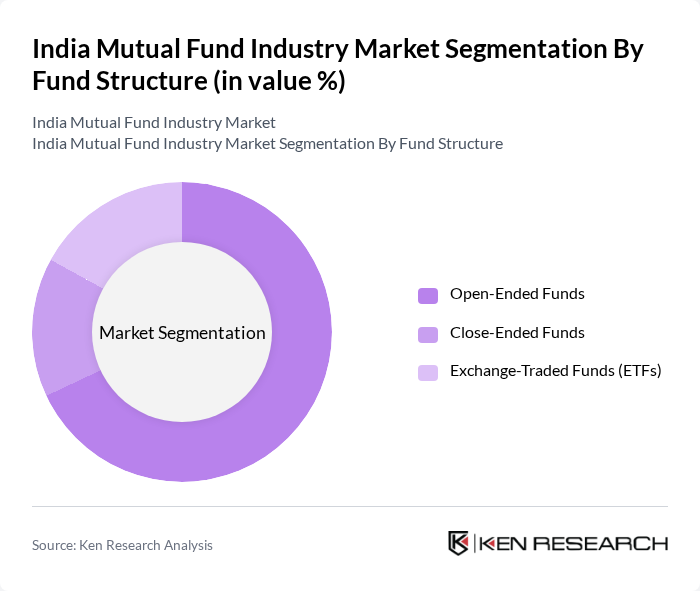
By Fund Structure:The fund structure segmentation includes Open-Ended Funds, Close-Ended Funds, and Exchange-Traded Funds (ETFs). Open-Ended Funds dominate the market due to their flexibility and liquidity, allowing investors to buy and sell units at any time. Close-Ended Funds, while less popular, attract investors looking for a fixed investment period. ETFs have gained significant traction in recent years due to their low expense ratios, transparency, and ease of trading on stock exchanges, with the passive investment segment now accounting for a notable share of industry assets.
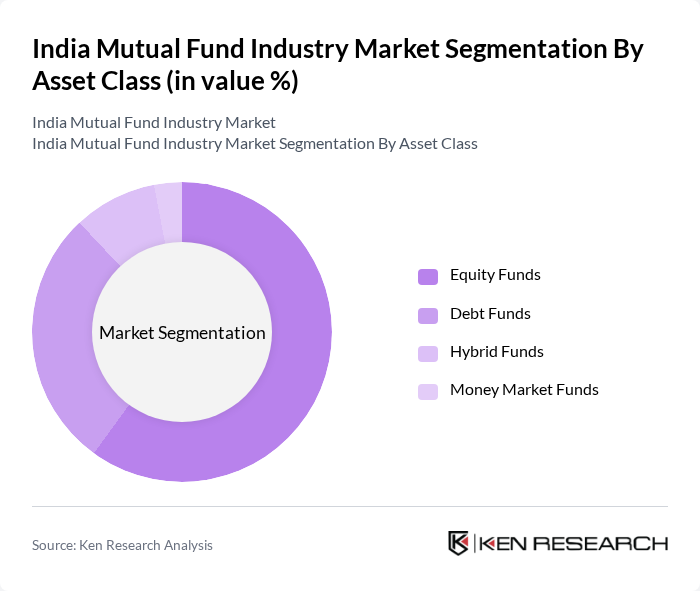
By Asset Class:The asset class segmentation comprises Equity Funds, Debt Funds, Hybrid Funds, and Money Market Funds. Equity Funds lead the market, driven by a growing appetite for equity investments among retail investors seeking higher returns. Debt Funds are favored for their stability and lower risk, while Hybrid Funds attract those looking for a balanced approach. Money Market Funds serve as a safe haven for conservative investors seeking liquidity. The equity-oriented segment constitutes the largest share of total AUM, reflecting strong investor confidence in long-term capital appreciation.
India Mutual Fund Industry Market Competitive Landscape
The India Mutual Fund Industry Market is characterized by a dynamic mix of regional and international players. Leading participants such as HDFC Asset Management Company Ltd., ICICI Prudential Asset Management Company Ltd., SBI Funds Management Ltd. (SBI Mutual Fund), Aditya Birla Sun Life AMC Ltd., UTI Asset Management Company Ltd., Kotak Mahindra Asset Management Company Ltd., Axis Asset Management Company Ltd. (Axis Mutual Fund), Franklin Templeton Asset Management (India) Pvt. Ltd., Nippon Life India Asset Management Ltd. (Nippon India Mutual Fund), DSP Asset Managers Pvt. Ltd. (DSP Mutual Fund), L&T Investment Management Ltd. (L&T Mutual Fund), Bandhan Mutual Fund (formerly IDFC Mutual Fund), Invesco Asset Management (India) Pvt. Ltd. (Invesco Mutual Fund), Mirae Asset Investment Managers (India) Pvt. Ltd. (Mirae Asset Mutual Fund), Sundaram Asset Management Company Ltd. (Sundaram Mutual Fund) contribute to innovation, geographic expansion, and service delivery in this space.
India Mutual Fund Industry Market Industry Analysis
Growth Drivers
- Increasing Retail Participation:The number of mutual fund folios in India reached approximately 160 million in future, reflecting a significant increase from 130 million in previous years. This surge indicates a growing interest among retail investors, driven by favorable market conditions and increased accessibility to investment platforms. The average investment per folio has also risen, with retail investors contributing around ?1.8 trillion in net inflows in future, showcasing a robust appetite for mutual funds.
- Rise in Financial Literacy:Financial literacy initiatives have led to a notable increase in awareness about mutual funds, with the National Financial Literacy Assessment Survey reporting that 27% of adults in India are financially literate in future. This improvement has empowered individuals to make informed investment decisions, resulting in a notable increase in mutual fund investments among first-time investors. Enhanced understanding of financial products is crucial for the sustained growth of the mutual fund industry.
- Government Initiatives for Investment:The Indian government has implemented various initiatives to promote mutual fund investments, including tax incentives under Section 80C, which allows deductions of up to ?1.5 lakh for investments in Equity Linked Savings Schemes (ELSS). Additionally, the introduction of the National Pension System (NPS) has encouraged long-term savings through mutual funds. The NPS has attracted over ?10 trillion in assets in future, further driving the growth of the mutual fund sector by diversifying investment options for citizens.
Market Challenges
- Regulatory Compliance Burdens:The mutual fund industry in India faces significant regulatory compliance challenges, with the Securities and Exchange Board of India (SEBI) imposing stringent guidelines. Compliance costs for fund houses are estimated to exceed ?1,000 crore in future, impacting profitability. These regulations, while aimed at protecting investors, can hinder operational flexibility and increase the cost of doing business, particularly for smaller fund houses that may struggle to meet these requirements.
- Market Volatility:The Indian mutual fund market is susceptible to volatility, influenced by global economic conditions and domestic factors. The Nifty 50 index has experienced fluctuations, with a high of approximately 22,000 and a low of approximately 17,000 in future, leading to investor uncertainty. Such volatility can deter potential investors, particularly retail participants who may prefer stable investment avenues. The unpredictable nature of the market poses a challenge for fund managers in maintaining investor confidence and attracting new capital.
India Mutual Fund Industry Market Future Outlook
The future of the India mutual fund industry appears promising, driven by increasing retail participation and a growing emphasis on financial literacy. As more individuals become aware of the benefits of mutual funds, the industry is likely to see sustained inflows. Additionally, technological advancements will facilitate easier access to investment platforms, enhancing user experience. The trend towards sustainable investing and the rise of ESG funds will further shape the market, attracting environmentally conscious investors and diversifying the product offerings available to consumers.
Market Opportunities
- Growth of Systematic Investment Plans (SIPs):The SIP segment has gained immense popularity, with monthly contributions reaching ?19,000 crore in future. This growth is attributed to the convenience and disciplined approach SIPs offer to investors. As more individuals opt for SIPs, fund houses can capitalize on this trend to enhance their assets under management, providing a stable inflow of capital and fostering long-term investment habits among retail investors.
- Expansion into Tier 2 and Tier 3 Cities:The mutual fund industry is increasingly focusing on expanding its reach into Tier 2 and Tier 3 cities, where financial inclusion is on the rise. These regions account for approximately 35% of new mutual fund accounts in future. Targeted marketing strategies and localized financial education initiatives can tap into this growing market, potentially increasing the investor base and driving significant growth in assets under management.
Scope of the Report
| Segment | Sub-Segments |
|---|---|
| By Fund Structure | Open-Ended Funds Close-Ended Funds Exchange-Traded Funds (ETFs) |
| By Asset Class | Equity Funds Debt Funds Hybrid Funds Money Market Funds |
| By Investment Strategy | Active Management Passive Management Tactical Asset Allocation Specialized Investment Funds (e.g., sectoral, thematic, long-short) |
| By Investor Type | Retail Investors Institutional Investors Corporates Non-Resident Indians (NRIs) |
| By Distribution Channel | Direct Sales Financial Advisors Online Platforms Banks and Financial Institutions |
| By Fund Size | Small-Cap Funds Mid-Cap Funds Large-Cap Funds |
| By Policy Support | Tax Benefits Regulatory Support Investor Education Initiatives |
Key Target Audience
Investors and Venture Capitalist Firms
Government and Regulatory Bodies (e.g., Securities and Exchange Board of India, Reserve Bank of India)
Asset Management Companies
Wealth Management Firms
Financial Advisors and Planners
Insurance Companies
Pension Funds
Family Offices
Players Mentioned in the Report:
HDFC Asset Management Company Ltd.
ICICI Prudential Asset Management Company Ltd.
SBI Funds Management Ltd. (SBI Mutual Fund)
Aditya Birla Sun Life AMC Ltd.
UTI Asset Management Company Ltd.
Kotak Mahindra Asset Management Company Ltd.
Axis Asset Management Company Ltd. (Axis Mutual Fund)
Franklin Templeton Asset Management (India) Pvt. Ltd.
Nippon Life India Asset Management Ltd. (Nippon India Mutual Fund)
DSP Asset Managers Pvt. Ltd. (DSP Mutual Fund)
L&T Investment Management Ltd. (L&T Mutual Fund)
Bandhan Mutual Fund (formerly IDFC Mutual Fund)
Invesco Asset Management (India) Pvt. Ltd. (Invesco Mutual Fund)
Mirae Asset Investment Managers (India) Pvt. Ltd. (Mirae Asset Mutual Fund)
Sundaram Asset Management Company Ltd. (Sundaram Mutual Fund)
Table of Contents
Market Assessment Phase
1. Executive Summary and Approach
2. India Mutual Fund Industry Market Overview
2.1 Key Insights and Strategic Recommendations
2.2 India Mutual Fund Industry Market Overview
2.3 Definition and Scope
2.4 Evolution of Market Ecosystem
2.5 Timeline of Key Regulatory Milestones
2.6 Value Chain & Stakeholder Mapping
2.7 Business Cycle Analysis
2.8 Policy & Incentive Landscape
3. India Mutual Fund Industry Market Analysis
3.1 Growth Drivers
3.1.1 Increasing Retail Participation
3.1.2 Rise in Financial Literacy
3.1.3 Government Initiatives for Investment
3.1.4 Technological Advancements in Fund Management
3.2 Market Challenges
3.2.1 Regulatory Compliance Burdens
3.2.2 Market Volatility
3.2.3 Limited Awareness of Mutual Fund Products
3.2.4 Competition from Alternative Investment Avenues
3.3 Market Opportunities
3.3.1 Growth of Systematic Investment Plans (SIPs)
3.3.2 Expansion into Tier 2 and Tier 3 Cities
3.3.3 Increasing Demand for ESG Funds
3.3.4 Digital Transformation in Fund Distribution
3.4 Market Trends
3.4.1 Shift Towards Passive Investment Strategies
3.4.2 Rise of Robo-Advisors
3.4.3 Focus on Sustainable Investing
3.4.4 Integration of AI in Fund Management
3.5 Government Regulation
3.5.1 SEBI Guidelines on Mutual Funds
3.5.2 Taxation Policies for Mutual Fund Investments
3.5.3 Disclosure Norms for Fund Managers
3.5.4 Investor Protection Regulations
4. SWOT Analysis
5. Stakeholder Analysis
6. Porter's Five Forces Analysis
7. India Mutual Fund Industry Market Market Size, 2019-2024
7.1 By Value
7.2 By Volume
7.3 By Average Selling Price
8. India Mutual Fund Industry Market Segmentation
8.1 By Fund Structure
8.1.1 Open-Ended Funds
8.1.2 Close-Ended Funds
8.1.3 Exchange-Traded Funds (ETFs)
8.2 By Asset Class
8.2.1 Equity Funds
8.2.2 Debt Funds
8.2.3 Hybrid Funds
8.2.4 Money Market Funds
8.3 By Investment Strategy
8.3.1 Active Management
8.3.2 Passive Management
8.3.3 Tactical Asset Allocation
8.3.4 Specialized Investment Funds (e.g., sectoral, thematic, long-short)
8.4 By Investor Type
8.4.1 Retail Investors
8.4.2 Institutional Investors
8.4.3 Corporates
8.4.4 Non-Resident Indians (NRIs)
8.5 By Distribution Channel
8.5.1 Direct Sales
8.5.2 Financial Advisors
8.5.3 Online Platforms
8.5.4 Banks and Financial Institutions
8.6 By Fund Size
8.6.1 Small-Cap Funds
8.6.2 Mid-Cap Funds
8.6.3 Large-Cap Funds
8.7 By Policy Support
8.7.1 Tax Benefits
8.7.2 Regulatory Support
8.7.3 Investor Education Initiatives
9. India Mutual Fund Industry Market Competitive Analysis
9.1 Market Share of Key Players
9.2 Cross Comparison of Key Players
9.2.1 Company Name
9.2.2 Group Size (Large, Medium, or Small as per industry convention)
9.2.3 Assets Under Management (AUM)
9.2.4 Number of Active Schemes
9.2.5 Net Inflows/Outflows
9.2.6 Average Return (1-year, 3-year, 5-year CAGR)
9.2.7 Expense Ratio
9.2.8 Fund Performance Consistency (Quartile Ranking)
9.2.9 Customer Acquisition Cost (CAC)
9.2.10 Client Retention Rate
9.2.11 Market Penetration Rate
9.2.12 Digital Adoption Rate
9.3 SWOT Analysis of Top Players
9.4 Pricing Analysis
9.5 Detailed Profile of Major Companies
9.5.1 HDFC Asset Management Company Ltd.
9.5.2 ICICI Prudential Asset Management Company Ltd.
9.5.3 SBI Funds Management Ltd. (SBI Mutual Fund)
9.5.4 Aditya Birla Sun Life AMC Ltd.
9.5.5 UTI Asset Management Company Ltd.
9.5.6 Kotak Mahindra Asset Management Company Ltd.
9.5.7 Axis Asset Management Company Ltd. (Axis Mutual Fund)
9.5.8 Franklin Templeton Asset Management (India) Pvt. Ltd.
9.5.9 Nippon Life India Asset Management Ltd. (Nippon India Mutual Fund)
9.5.10 DSP Asset Managers Pvt. Ltd. (DSP Mutual Fund)
9.5.11 L&T Investment Management Ltd. (L&T Mutual Fund)
9.5.12 Bandhan Mutual Fund (formerly IDFC Mutual Fund)
9.5.13 Invesco Asset Management (India) Pvt. Ltd. (Invesco Mutual Fund)
9.5.14 Mirae Asset Investment Managers (India) Pvt. Ltd. (Mirae Asset Mutual Fund)
9.5.15 Sundaram Asset Management Company Ltd. (Sundaram Mutual Fund)
10. India Mutual Fund Industry Market End-User Analysis
10.1 Procurement Behavior of Key Ministries
10.1.1 Investment Strategies
10.1.2 Budget Allocation
10.1.3 Risk Management Practices
10.2 Corporate Spend on Infrastructure & Energy
10.2.1 Investment in Mutual Funds
10.2.2 Allocation to ESG Funds
10.2.3 Trends in Corporate Investments
10.3 Pain Point Analysis by End-User Category
10.3.1 Lack of Awareness
10.3.2 Complexity of Products
10.3.3 Regulatory Challenges
10.4 User Readiness for Adoption
10.4.1 Digital Literacy
10.4.2 Trust in Financial Institutions
10.4.3 Accessibility of Information
10.5 Post-Deployment ROI and Use Case Expansion
10.5.1 Performance Tracking
10.5.2 Reinvestment Strategies
10.5.3 Long-term Financial Planning
11. India Mutual Fund Industry Market Future Size, 2025-2030
11.1 By Value
11.2 By Volume
11.3 By Average Selling Price
Go-To-Market Strategy Phase
1. Whitespace Analysis + Business Model Canvas
1.1 Market Gaps Identification
1.2 Value Proposition Development
1.3 Revenue Streams Analysis
1.4 Cost Structure Evaluation
1.5 Key Partnerships Exploration
1.6 Customer Segmentation
1.7 Channels of Distribution
2. Marketing and Positioning Recommendations
2.1 Branding Strategies
2.2 Product USPs
2.3 Target Audience Identification
2.4 Communication Strategy
2.5 Digital Marketing Approaches
2.6 Offline Marketing Strategies
2.7 Performance Metrics
3. Distribution Plan
3.1 Urban Retail Strategies
3.2 Rural NGO Tie-ups
3.3 Online Distribution Channels
3.4 Partnerships with Financial Advisors
3.5 Direct Sales Approaches
3.6 Customer Support Mechanisms
4. Channel & Pricing Gaps
4.1 Underserved Routes
4.2 Pricing Bands Analysis
4.3 Competitor Pricing Strategies
4.4 Customer Sensitivity to Pricing
4.5 Value-Based Pricing Models
5. Unmet Demand & Latent Needs
5.1 Category Gaps
5.2 Consumer Segments Analysis
5.3 Emerging Trends in Investment
5.4 Feedback Mechanisms
6. Customer Relationship
6.1 Loyalty Programs
6.2 After-sales Service
6.3 Customer Engagement Strategies
6.4 Feedback and Improvement Processes
7. Value Proposition
7.1 Sustainability Initiatives
7.2 Integrated Supply Chains
7.3 Customer-Centric Approaches
7.4 Innovation in Product Offerings
8. Key Activities
8.1 Regulatory Compliance
8.2 Branding Initiatives
8.3 Distribution Setup
8.4 Training and Development
9. Entry Strategy Evaluation
9.1 Domestic Market Entry Strategy
9.1.1 Product Mix
9.1.2 Pricing Band
9.1.3 Packaging Strategies
9.2 Export Entry Strategy
9.2.1 Target Countries
9.2.2 Compliance Roadmap
10. Entry Mode Assessment
10.1 Joint Ventures
10.2 Greenfield Investments
10.3 Mergers & Acquisitions
10.4 Distributor Model
11. Capital and Timeline Estimation
11.1 Capital Requirements
11.2 Timelines for Implementation
12. Control vs Risk Trade-Off
12.1 Ownership vs Partnerships
13. Profitability Outlook
13.1 Breakeven Analysis
13.2 Long-term Sustainability
14. Potential Partner List
14.1 Distributors
14.2 Joint Ventures
14.3 Acquisition Targets
15. Execution Roadmap
15.1 Phased Plan for Market Entry
15.1.1 Market Setup
15.1.2 Market Entry
15.1.3 Growth Acceleration
15.1.4 Scale & Stabilize
15.2 Key Activities and Milestones
15.2.1 Activity Planning
15.2.2 Milestone Tracking
Research Methodology
Phase 1: Approach1
Desk Research
- Analysis of mutual fund industry reports from SEBI and AMFI
- Review of financial statements and annual reports of leading mutual fund houses
- Examination of market trends and investment patterns from financial news portals
Primary Research
- Interviews with fund managers and investment analysts from top mutual fund companies
- Surveys targeting retail investors to understand investment preferences and behaviors
- Focus group discussions with financial advisors to gauge market sentiment
Validation & Triangulation
- Cross-validation of data through multiple industry reports and expert opinions
- Triangulation of findings from primary interviews and secondary data sources
- Sanity checks through peer reviews and expert panel discussions
Phase 2: Market Size Estimation1
Top-down Assessment
- Estimation of total assets under management (AUM) in the mutual fund industry
- Segmentation of AUM by equity, debt, and hybrid funds
- Incorporation of macroeconomic indicators such as GDP growth and inflation rates
Bottom-up Modeling
- Analysis of inflow and outflow trends from various mutual fund categories
- Estimation of average ticket sizes and investor demographics
- Volume x average return basis for projecting future growth rates
Forecasting & Scenario Analysis
- Multi-factor regression analysis incorporating interest rates, market volatility, and investor sentiment
- Scenario modeling based on regulatory changes and economic conditions
- Baseline, optimistic, and pessimistic projections for the next 5 years
Phase 3: CATI Sample Composition1
| Scope Item/Segment | Sample Size | Target Respondent Profiles |
|---|---|---|
| Retail Investor Insights | 120 | Individual Investors, Financial Planners |
| Institutional Investment Strategies | 60 | Institutional Fund Managers, Pension Fund Administrators |
| Mutual Fund Distribution Channels | 50 | Wealth Managers, Distributors, Brokers |
| Regulatory Impact Assessment | 40 | Compliance Officers, Regulatory Analysts |
| Market Trends and Sentiment | 45 | Market Analysts, Economic Researchers |
Frequently Asked Questions
What is the current value of the India Mutual Fund Industry Market?
The India Mutual Fund Industry Market is valued at approximately INR 72 trillion, reflecting significant growth driven by increased retail participation, systematic investment plans (SIPs), and digital distribution through fintech platforms.
What factors are driving the growth of the India Mutual Fund Industry?
Which cities are the main hubs for the India Mutual Fund Industry?
What are the different types of mutual funds available in India?
Other Regional/Country Reports
Indonesia Mutual Fund Industry Market
Malaysia Mutual Fund Industry Market
KSA Mutual Fund Industry Market
APAC Mutual Fund Industry Market
SEA Mutual Fund Industry Market
Why Buy From Us?

What makes us stand out is that our consultants follow Robust, Refine and Result (RRR) methodology. Robust for clear definitions, approaches and sanity checking, Refine for differentiating respondents' facts and opinions, and Result for presenting data with story.

We have set a benchmark in the industry by offering our clients with syndicated and customized market research reports featuring coverage of entire market as well as meticulous research and analyst insights.

While we don't replace traditional research, we flip the method upside down. Our dual approach of Top Bottom & Bottom Top ensures quality deliverable by not just verifying company fundamentals but also looking at the sector and macroeconomic factors.

With one step in the future, our research team constantly tries to show you the bigger picture. We help with some of the tough questions you may encounter along the way: How is the industry positioned? Best marketing channel? KPI's of competitors? By aligning every element, we help maximize success.

Our report gives you instant access to the answers and sources that other companies might choose to hide. We elaborate each steps of research methodology we have used and showcase you the sample size to earn your trust.

If you need any support, we are here! We pride ourselves on universe strength, data quality, and quick, friendly, and professional service.