About the Report
Base Year 2024India Office Real Estate Market Overview
- The India Office Real Estate Market is valued at approximately USD 180–190 billion, based on a five-year analysis of institutional-grade office stock value across the top Indian cities, reflecting the scale of developed Grade A supply and investment depth in the segment.
- Growth is primarily driven by rapid urbanization and formalization of occupier demand, strong leasing from IT-BPM and Global Capability Centers (GCCs), the resilience of BFSI and engineering/manufacturing occupiers, and the rise of flexible workspaces as a core portfolio strategy for enterprises. Robust gross leasing volumes in recent periods underscore sustained occupier confidence and depth of demand.
- Key players in this market include major cities like Bengaluru, Delhi NCR, and Mumbai, which dominate due to their status as technology and financial hubs; these markets collectively account for a substantial share of national office stock and leasing, supported by deep talent pools, infrastructure, and policy support that attract both domestic and international occupiers.
- In 2023, the Indian government continued to promote adoption of the Model Tenancy Act (originally notified in 2021 at the central level) by encouraging states to align their laws; while implementation is state-led, the framework aims to streamline rental agreements, improve transparency, and strengthen dispute resolution—measures seen as supportive of investment sentiment across rental markets, including commercial real estate.
India Office Real Estate Market Segmentation
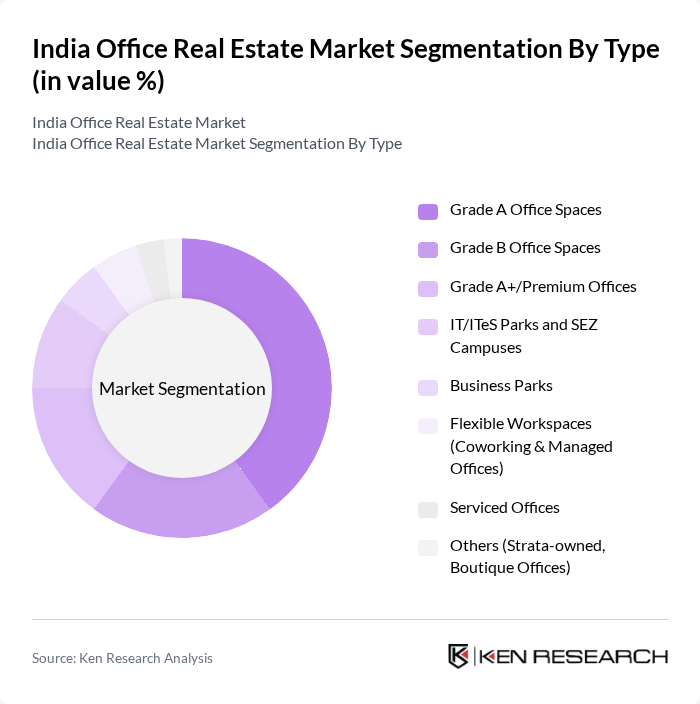
By Type:The office real estate market in India is segmented into various types, including Grade A Office Spaces, Grade B Office Spaces, Grade A+/Premium Offices, IT/ITeS Parks and SEZ Campuses, Business Parks, Flexible Workspaces (Coworking & Managed Offices), Serviced Offices, and Others (Strata-owned, Boutique Offices). Grade A Office Spaces dominate active leasing and institutional investment, driven by multinational corporations and GCCs prioritizing modern specifications, ESG-compliant buildings, wellness features, and transit-proximate locations; flexible workspaces have become a structural demand driver as enterprises use hybrid footprints and core-flex strategies within Grade A assets.
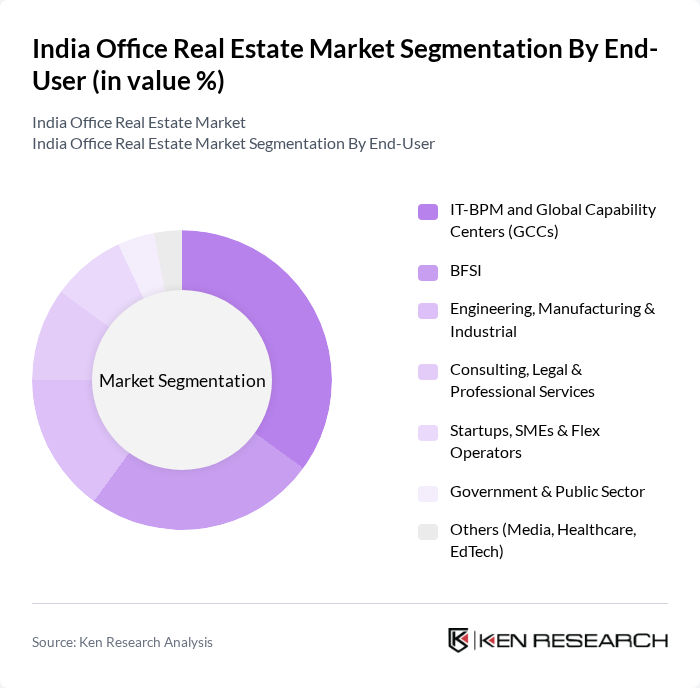
By End-User:The end-user segmentation of the office real estate market includes IT-BPM and Global Capability Centers (GCCs), BFSI, Engineering, Manufacturing & Industrial, Consulting, Legal & Professional Services, Startups, SMEs & Flex Operators, Government & Public Sector, and Others (Media, Healthcare, EdTech). IT-BPM and GCCs lead leasing activity, with material contributions from flex operators, engineering/manufacturing, and BFSI; this reflects occupier diversification and India’s role as a global talent hub for high-value services and product development.
India Office Real Estate Market Competitive Landscape
The India Office Real Estate Market is characterized by a dynamic mix of regional and international players. Leading participants such as DLF Limited, Godrej Properties Limited, Brigade Enterprises Limited, Oberoi Realty Limited, The Phoenix Mills Limited, K Raheja Corp (Mindspace Business Parks REIT), Prestige Estates Projects Limited, Embassy Group (Embassy REIT), Tata Realty and Infrastructure Limited, Indiabulls Real Estate Limited, Hiranandani Group, Sunteck Realty Limited, Mahindra Lifespace Developers Limited, Brookfield India Real Estate Trust (Brookfield Properties), Blackstone (Nexus Select Trust; commercial office portfolio) contribute to innovation, geographic expansion, and service delivery in this space.
India Office Real Estate Market Industry Analysis
Growth Drivers
- Increasing Demand for Flexible Workspaces:The demand for flexible workspaces in India has surged, with over 25 million square feet of flexible office space leased in recent times. This trend is driven by companies seeking to reduce overhead costs while maintaining operational flexibility. The rise of remote work has led to a 35% increase in the adoption of flexible office solutions, as businesses adapt to changing workforce dynamics and employee preferences for hybrid work environments.
- Urbanization and Infrastructure Development:India is experiencing rapid urbanization, with urban population growth projected to reach 700 million in future. This urban influx is driving demand for office spaces in metropolitan areas. Infrastructure investments, such as the $1.5 trillion National Infrastructure Pipeline, are enhancing connectivity and accessibility, making urban centers more attractive for businesses. Consequently, this development is expected to increase office space demand by approximately 20% annually in key cities.
- Government Initiatives for Real Estate Development:The Indian government has implemented several initiatives to boost real estate, including the Smart Cities Mission, which aims to develop 100 smart cities in future. Additionally, the introduction of the Real Estate (Regulation and Development) Act (RERA) has increased transparency and investor confidence. These initiatives are projected to attract $15 billion in foreign direct investment (FDI) into the real estate sector, further stimulating office space demand.
Market Challenges
- Regulatory Hurdles:The Indian office real estate market faces significant regulatory challenges, including complex land acquisition processes and inconsistent state-level regulations. For instance, the average time to obtain construction permits can exceed 250 days, hindering project timelines. These regulatory bottlenecks can deter potential investors and slow down the development of new office spaces, impacting overall market growth.
- High Vacancy Rates in Certain Regions:Despite overall growth, certain regions in India are experiencing high vacancy rates, particularly in Tier-2 cities, where rates can reach 25%. This oversupply is attributed to speculative developments and a mismatch between supply and demand. As companies increasingly prefer established markets, these high vacancy rates pose a challenge for landlords and developers, leading to potential revenue losses.
India Office Real Estate Market Future Outlook
The future of the India office real estate market appears promising, driven by ongoing urbanization and the increasing adoption of hybrid work models. As businesses continue to embrace flexible work arrangements, demand for adaptable office spaces is expected to rise. Additionally, advancements in smart building technologies will enhance operational efficiency and tenant satisfaction, further attracting investments. The market is likely to witness a shift towards sustainable office developments, aligning with global environmental standards and tenant preferences.
Market Opportunities
- Growth in IT and Tech Startups:The burgeoning IT and tech startup ecosystem in India, with over 60,000 startups registered in recent times, presents significant opportunities for office space demand. These companies require modern, flexible workspaces to foster innovation and collaboration, driving the need for new office developments in tech hubs like Bengaluru and Hyderabad.
- Demand for Sustainable Office Spaces:There is a growing emphasis on sustainability in the office real estate sector, with a projected increase in demand for green buildings. In future, it is estimated that 35% of new office developments will be certified green, driven by corporate sustainability goals and tenant preferences for energy-efficient spaces, creating a lucrative market segment for developers.
Scope of the Report
| Segment | Sub-Segments |
|---|---|
| By Type | Grade A Office Spaces Grade B Office Spaces Grade A+/Premium Offices IT/ITeS Parks and SEZ Campuses Business Parks Flexible Workspaces (Coworking & Managed Offices) Serviced Offices Others (Strata-owned, Boutique Offices) |
| By End-User | IT-BPM and Global Capability Centers (GCCs) BFSI Engineering, Manufacturing & Industrial Consulting, Legal & Professional Services Startups, SMEs & Flex Operators Government & Public Sector Others (Media, Healthcare, EdTech) |
| By Region/City Cluster | Bengaluru Delhi NCR (Gurugram, Noida) Mumbai Metropolitan Region (MMR) Hyderabad Pune Chennai Kolkata Tier-II Cities (Ahmedabad, Coimbatore, Kochi, Jaipur, etc.) |
| By Investment Source | Domestic Institutional/Developer Capital Foreign Direct Investment (FDI) REITs and REIT-aligned Platforms Private Equity and Credit Public-Private Partnerships (PPP) Government Schemes |
| By Sustainability & Wellness Certifications | IGBC/LEED/BREEAM Certified Net-Zero/Green Energy Enabled WELL/Health & Safety Focused Others |
| By Lease Structure | Long-term Leases (5–9 years) Short-term Leases (1–3 years) Flexible/Managed Leases Pre-commitments/Pre-leasing |
| By Building Age/Quality | New Completions (?5 years) Recently Refurbished (5–10 years) Legacy Stock (10+ years) Strata vs. Developer-held |
Key Target Audience
Investors and Venture Capitalist Firms
Government and Regulatory Bodies (e.g., Ministry of Housing and Urban Affairs, Real Estate Regulatory Authority)
Real Estate Developers and Builders
Property Management Companies
Corporate Occupiers and Tenants
Financial Institutions and Banks
Real Estate Investment Trusts (REITs)
Construction and Infrastructure Firms
Players Mentioned in the Report:
DLF Limited
Godrej Properties Limited
Brigade Enterprises Limited
Oberoi Realty Limited
The Phoenix Mills Limited
K Raheja Corp (Mindspace Business Parks REIT)
Prestige Estates Projects Limited
Embassy Group (Embassy REIT)
Tata Realty and Infrastructure Limited
Indiabulls Real Estate Limited
Hiranandani Group
Sunteck Realty Limited
Mahindra Lifespace Developers Limited
Brookfield India Real Estate Trust (Brookfield Properties)
Blackstone (Nexus Select Trust; commercial office portfolio)
Table of Contents
Market Assessment Phase
1. Executive Summary and Approach
2. India Office Real Estate Market Overview
2.1 Key Insights and Strategic Recommendations
2.2 India Office Real Estate Market Overview
2.3 Definition and Scope
2.4 Evolution of Market Ecosystem
2.5 Timeline of Key Regulatory Milestones
2.6 Value Chain & Stakeholder Mapping
2.7 Business Cycle Analysis
2.8 Policy & Incentive Landscape
3. India Office Real Estate Market Analysis
3.1 Growth Drivers
3.1.1 Increasing Demand for Flexible Workspaces
3.1.2 Rise of Co-Working Spaces
3.1.3 Urbanization and Infrastructure Development
3.1.4 Government Initiatives for Real Estate Development
3.2 Market Challenges
3.2.1 Regulatory Hurdles
3.2.2 Economic Uncertainty
3.2.3 High Vacancy Rates in Certain Regions
3.2.4 Competition from Alternative Workspaces
3.3 Market Opportunities
3.3.1 Growth in IT and Tech Startups
3.3.2 Demand for Sustainable Office Spaces
3.3.3 Expansion of E-commerce and Logistics Hubs
3.3.4 Foreign Direct Investment in Real Estate
3.4 Market Trends
3.4.1 Increased Adoption of Smart Building Technologies
3.4.2 Shift Towards Hybrid Work Models
3.4.3 Focus on Employee Well-being and Amenities
3.4.4 Growth of Suburban Office Markets
3.5 Government Regulation
3.5.1 RERA Implementation
3.5.2 GST Impact on Real Estate Transactions
3.5.3 Land Use Regulations
3.5.4 Environmental Compliance Standards
4. SWOT Analysis
5. Stakeholder Analysis
6. Porter's Five Forces Analysis
7. India Office Real Estate Market Market Size, 2019-2024
7.1 By Value
7.2 By Volume
7.3 By Average Selling Price
8. India Office Real Estate Market Segmentation
8.1 By Type
8.1.1 Grade A Office Spaces
8.1.2 Grade B Office Spaces
8.1.3 Grade A+/Premium Offices
8.1.4 IT/ITeS Parks and SEZ Campuses
8.1.5 Business Parks
8.1.6 Flexible Workspaces (Coworking & Managed Offices)
8.1.7 Serviced Offices
8.1.8 Others (Strata-owned, Boutique Offices)
8.2 By End-User
8.2.1 IT-BPM and Global Capability Centers (GCCs)
8.2.2 BFSI
8.2.3 Engineering, Manufacturing & Industrial
8.2.4 Consulting, Legal & Professional Services
8.2.5 Startups, SMEs & Flex Operators
8.2.6 Government & Public Sector
8.2.7 Others (Media, Healthcare, EdTech)
8.3 By Region/City Cluster
8.3.1 Bengaluru
8.3.2 Delhi NCR (Gurugram, Noida)
8.3.3 Mumbai Metropolitan Region (MMR)
8.3.4 Hyderabad
8.3.5 Pune
8.3.6 Chennai
8.3.7 Kolkata
8.3.8 Tier-II Cities (Ahmedabad, Coimbatore, Kochi, Jaipur, etc.)
8.4 By Investment Source
8.4.1 Domestic Institutional/Developer Capital
8.4.2 Foreign Direct Investment (FDI)
8.4.3 REITs and REIT-aligned Platforms
8.4.4 Private Equity and Credit
8.4.5 Public-Private Partnerships (PPP)
8.4.6 Government Schemes
8.5 By Sustainability & Wellness Certifications
8.5.1 IGBC/LEED/BREEAM Certified
8.5.2 Net-Zero/Green Energy Enabled
8.5.3 WELL/Health & Safety Focused
8.5.4 Others
8.6 By Lease Structure
8.6.1 Long-term Leases (5–9 years)
8.6.2 Short-term Leases (1–3 years)
8.6.3 Flexible/Managed Leases
8.6.4 Pre-commitments/Pre-leasing
8.7 By Building Age/Quality
8.7.1 New Completions (?5 years)
8.7.2 Recently Refurbished (5–10 years)
8.7.3 Legacy Stock (10+ years)
8.7.4 Strata vs. Developer-held
9. India Office Real Estate Market Competitive Analysis
9.1 Market Share of Key Players
9.2 KPIs for Cross Comparison of Key Players
9.2.1 Portfolio Size (MSF) – completed and under development
9.2.2 Gross Leasing Volume (MSF) and Net Absorption (MSF)
9.2.3 Occupancy Rate (%) by city/park
9.2.4 Average Effective Rentals (INR/sq ft/month)
9.2.5 Weighted Average Lease Tenure (years)
9.2.6 Pre-commitment Ratio on New Supply (%)
9.2.7 Renewal/Retention Rate (%)
9.2.8 Cap Rate (%) and Implied Yield
9.2.9 Same-store Rental Growth (%)
9.2.10 Net Operating Income (NOI) and NOI Margin (%)
9.2.11 Development Pipeline Visibility (years) and Land Bank (acre/MSF)
9.2.12 Sustainability Metrics (share of green-certified area, energy intensity kWh/sq ft)
9.2.13 REIT Metrics (DPU growth, LTV, occupancy) where applicable
9.3 SWOT Analysis of Top Players
9.4 Pricing Analysis
9.5 Detailed Profile of Major Companies
9.5.1 DLF Limited
9.5.2 Godrej Properties Limited
9.5.3 Brigade Enterprises Limited
9.5.4 Oberoi Realty Limited
9.5.5 The Phoenix Mills Limited
9.5.6 K Raheja Corp (Mindspace Business Parks REIT)
9.5.7 Prestige Estates Projects Limited
9.5.8 Embassy Group (Embassy REIT)
9.5.9 Tata Realty and Infrastructure Limited
9.5.10 Indiabulls Real Estate Limited
9.5.11 Hiranandani Group
9.5.12 Sunteck Realty Limited
9.5.13 Mahindra Lifespace Developers Limited
9.5.14 Brookfield India Real Estate Trust (Brookfield Properties)
9.5.15 Blackstone (Nexus Select Trust; commercial office portfolio)
10. India Office Real Estate Market End-User Analysis
10.1 Procurement Behavior of Key Ministries
10.1.1 Government Office Space Requirements
10.1.2 Budget Allocation Trends
10.1.3 Procurement Processes and Regulations
10.2 Corporate Spend on Infrastructure & Energy
10.2.1 Investment in Office Infrastructure
10.2.2 Energy Efficiency Initiatives
10.2.3 Corporate Sustainability Goals
10.3 Pain Point Analysis by End-User Category
10.3.1 Space Utilization Challenges
10.3.2 Cost Management Issues
10.3.3 Compliance with Regulations
10.4 User Readiness for Adoption
10.4.1 Technology Adoption Rates
10.4.2 Training and Support Needs
10.4.3 Change Management Strategies
10.5 Post-Deployment ROI and Use Case Expansion
10.5.1 Measurement of ROI
10.5.2 Expansion of Use Cases
10.5.3 Long-term Value Assessment
11. India Office Real Estate Market Future Size, 2025-2030
11.1 By Value
11.2 By Volume
11.3 By Average Selling Price
Go-To-Market Strategy Phase
1. Whitespace Analysis + Business Model Canvas
1.1 Market Gaps Identification
1.2 Business Model Framework
1.3 Value Proposition Development
1.4 Revenue Streams Analysis
1.5 Cost Structure Evaluation
1.6 Key Partnerships
1.7 Customer Segmentation
2. Marketing and Positioning Recommendations
2.1 Branding Strategies
2.2 Product USPs
2.3 Target Audience Identification
2.4 Marketing Channels
2.5 Messaging and Communication
3. Distribution Plan
3.1 Urban Retail Strategies
3.2 Rural NGO Tie-ups
3.3 Online vs Offline Distribution
3.4 Logistics and Supply Chain
4. Channel & Pricing Gaps
4.1 Underserved Routes
4.2 Pricing Bands Analysis
4.3 Competitor Pricing Strategies
5. Unmet Demand & Latent Needs
5.1 Category Gaps
5.2 Consumer Segments
5.3 Emerging Trends
6. Customer Relationship
6.1 Loyalty Programs
6.2 After-sales Service
6.3 Customer Feedback Mechanisms
7. Value Proposition
7.1 Sustainability Initiatives
7.2 Integrated Supply Chains
7.3 Competitive Advantages
8. Key Activities
8.1 Regulatory Compliance
8.2 Branding Efforts
8.3 Distribution Setup
9. Entry Strategy Evaluation
9.1 Domestic Market Entry Strategy
9.1.1 Product Mix
9.1.2 Pricing Band
9.1.3 Packaging
9.2 Export Entry Strategy
9.2.1 Target Countries
9.2.2 Compliance Roadmap
10. Entry Mode Assessment
10.1 Joint Ventures
10.2 Greenfield Investments
10.3 Mergers & Acquisitions
10.4 Distributor Model
11. Capital and Timeline Estimation
11.1 Capital Requirements
11.2 Timelines
12. Control vs Risk Trade-Off
12.1 Ownership vs Partnerships
13. Profitability Outlook
13.1 Breakeven Analysis
13.2 Long-term Sustainability
14. Potential Partner List
14.1 Distributors
14.2 Joint Ventures
14.3 Acquisition Targets
15. Execution Roadmap
15.1 Phased Plan for Market Entry
15.1.1 Market Setup
15.1.2 Market Entry
15.1.3 Growth Acceleration
15.1.4 Scale & Stabilize
15.2 Key Activities and Milestones
15.2.1 Milestone Planning
15.2.2 Activity Tracking
Research Methodology
Phase 1: Approach1
Desk Research
- Analysis of real estate market reports from the National Association of Realtors and local real estate boards
- Review of government publications on urban development and housing policies
- Examination of economic indicators and demographic data from the Ministry of Housing and Urban Affairs
Primary Research
- Interviews with real estate developers and property managers in major metropolitan areas
- Surveys with commercial real estate brokers to gather insights on market trends
- Field visits to key office locations to assess occupancy rates and tenant profiles
Validation & Triangulation
- Cross-validation of findings with data from industry associations and real estate analytics firms
- Triangulation of primary data with secondary sources to ensure consistency
- Sanity checks through expert panel discussions with industry veterans
Phase 2: Market Size Estimation1
Top-down Assessment
- Estimation of total office space based on urban population growth and employment rates
- Segmentation of market size by city tiers and office types (co-working, traditional, etc.)
- Incorporation of government initiatives promoting smart cities and infrastructure development
Bottom-up Modeling
- Data collection on rental rates and occupancy levels from leading real estate firms
- Estimation of total leasable area based on building permits and construction data
- Calculation of market size using average rental rates multiplied by total occupied space
Forecasting & Scenario Analysis
- Multi-variable regression analysis incorporating economic growth, remote work trends, and urbanization
- Scenario modeling based on potential regulatory changes and shifts in corporate real estate strategies
- Development of baseline, optimistic, and pessimistic forecasts through 2030
Phase 3: CATI Sample Composition1
| Scope Item/Segment | Sample Size | Target Respondent Profiles |
|---|---|---|
| Commercial Office Space in Tier 1 Cities | 120 | Real Estate Developers, Property Managers |
| Co-working Space Providers | 90 | Co-working Space Managers, Business Development Heads |
| Corporate Tenants in IT Sector | 80 | Facility Managers, Corporate Real Estate Executives |
| Investment Firms Focused on Real Estate | 70 | Investment Analysts, Portfolio Managers |
| Government Urban Development Officials | 60 | Urban Planners, Policy Makers |
Frequently Asked Questions
What is the current value of the India Office Real Estate Market?
The India Office Real Estate Market is valued at approximately USD 180190 billion, reflecting the significant scale of developed Grade A supply and investment depth across major Indian cities.
What factors are driving growth in the India Office Real Estate Market?
Which cities dominate the India Office Real Estate Market?
What is the Model Tenancy Act and its significance?
Other Regional/Country Reports
Why Buy From Us?

What makes us stand out is that our consultants follow Robust, Refine and Result (RRR) methodology. Robust for clear definitions, approaches and sanity checking, Refine for differentiating respondents' facts and opinions, and Result for presenting data with story.

We have set a benchmark in the industry by offering our clients with syndicated and customized market research reports featuring coverage of entire market as well as meticulous research and analyst insights.

While we don't replace traditional research, we flip the method upside down. Our dual approach of Top Bottom & Bottom Top ensures quality deliverable by not just verifying company fundamentals but also looking at the sector and macroeconomic factors.

With one step in the future, our research team constantly tries to show you the bigger picture. We help with some of the tough questions you may encounter along the way: How is the industry positioned? Best marketing channel? KPI's of competitors? By aligning every element, we help maximize success.

Our report gives you instant access to the answers and sources that other companies might choose to hide. We elaborate each steps of research methodology we have used and showcase you the sample size to earn your trust.

If you need any support, we are here! We pride ourselves on universe strength, data quality, and quick, friendly, and professional service.