India Sodium Reduction Ingredient Market

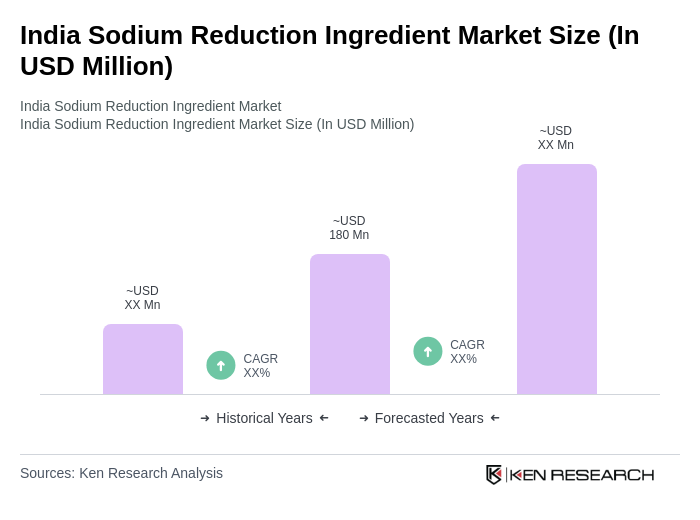
India sodium reduction ingredient market, valued at USD 180 Mn, is growing due to rising health consciousness, FSSAI regulations, and demand in bakery and confectionery applications.

Region:Asia

Author(s):Shubham

Product Code:KRAC0892

Pages:83

Published On:August 2025
About the Report

Base Year 2024

India Sodium Reduction Ingredient Market Overview

  • The India Sodium Reduction Ingredient Market is valued at USD 180 million, based on a five-year historical analysis. This growth is primarily driven by increasing health awareness among consumers, regulatory pressures to reduce sodium intake, and the rising prevalence of lifestyle-related diseases. The demand for sodium reduction ingredients is further fueled by the food and beverage industry's shift towards healthier product formulations .
  • Key cities such asMumbai, Delhi, and Bengalurudominate the market due to their large population bases, urbanization, and the presence of major food processing companies. These cities are also hubs for innovation and product development, making them critical for the growth of sodium reduction ingredients in India .
  • TheFood Safety and Standards (Food Products Standards and Food Additives) Regulations, 2011(as amended by the Food Safety and Standards Authority of India, FSSAI, in 2022) mandate maximum sodium content thresholds for processed foods and require food manufacturers to comply with sodium reduction targets. These regulations aim to address rising health issues related to high sodium consumption and are a significant driver for sodium reduction ingredient adoption in the Indian market .
India Sodium Reduction Ingredient Market Size

India Sodium Reduction Ingredient Market Segmentation

By Product Type:The product type segmentation includes various ingredients used for sodium reduction. The subsegments are Amino Acids and Glutamates, Mineral Salts (Potassium Chloride, Magnesium Sulphate, Potassium Lactate, Calcium Chloride), Yeast Extracts, and Other Product Types. Among these,Mineral Saltsare currently dominating the market due to their effectiveness in mimicking the taste of sodium while providing essential minerals. The growing trend of health-conscious consumers is pushing food manufacturers to adopt these ingredients, leading to increased usage in various food applications .
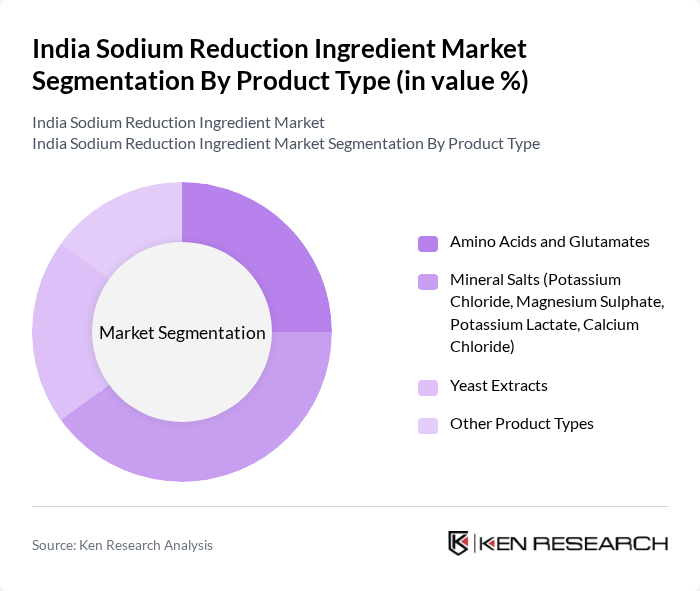
India Sodium Reduction Ingredient Market segmentation by Product Type.

By Application:The application segmentation encompasses various sectors where sodium reduction ingredients are utilized, including Bakery and Confectionery, Condiments, Seasonings, and Sauces, Dairy and Frozen Foods, Meat and Meat Products, Snacks, and Other Applications. TheBakery and Confectionerysegment is leading the market, driven by the increasing demand for healthier baked goods and snacks. Consumers are increasingly seeking products with lower sodium content, prompting manufacturers to innovate and reformulate their offerings .
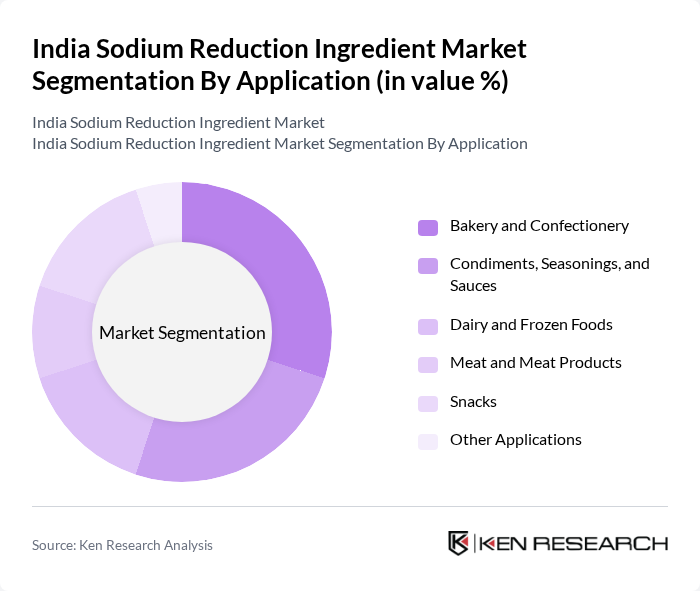
India Sodium Reduction Ingredient Market segmentation by Application.

India Sodium Reduction Ingredient Market Competitive Landscape

The India Sodium Reduction Ingredient Market is characterized by a dynamic mix of regional and international players. Leading participants such as Tata Chemicals Limited, DSM Nutritional Products, Kerry Group plc, Cargill India Pvt. Ltd., Ingredion India Pvt. Ltd., Archer Daniels Midland Company (ADM), Ajinomoto Co., Inc., Givaudan, BASF SE, Tate & Lyle PLC, Bunge Limited, Sensient Technologies Corporation, Corbion N.V., Biospringer (Lesaffre Group), E.I. du Pont de Nemours and Company (DuPont) contribute to innovation, geographic expansion, and service delivery in this space .

Tata Chemicals Limited

1939

Mumbai, India

DSM Nutritional Products

1902

Heerlen, Netherlands

Kerry Group plc

1972

Tralee, Ireland

Cargill India Pvt. Ltd.

1987

Bangalore, India

Ingredion India Pvt. Ltd.

2000

Gurgaon, India

Company

Establishment Year

Headquarters

Group Size (Large, Medium, or Small as per industry convention)

Revenue Growth Rate (YoY %)

Market Share (%) in India Sodium Reduction Ingredient Market

Product Portfolio Breadth (Number of SRI SKUs)

Penetration in Key Applications (Bakery, Dairy, Meat, Snacks)

Distribution Network Coverage (Number of States/Regions)

India Sodium Reduction Ingredient Market Industry Analysis

Growth Drivers

  • Increasing Health Awareness:The rise in health consciousness among Indian consumers is a significant driver for the sodium reduction ingredient market. According to the National Family Health Survey, 40% of adults in India are now aware of the health risks associated with high sodium intake, leading to a growing demand for low-sodium products. This trend is further supported by the World Health Organization's recommendation to reduce sodium intake to less than 2,000 mg per day, influencing consumer choices towards healthier options.
  • Government Initiatives for Health Improvement:The Indian government has implemented various initiatives aimed at reducing sodium consumption. The National Health Mission has allocated approximately ?1,800 crore (around $240 million) for health promotion activities, including sodium reduction campaigns. These initiatives are designed to educate the public on the dangers of excessive sodium intake, thereby increasing the demand for sodium reduction ingredients in food products across the country.
  • Rising Demand for Processed Foods:The processed food sector in India is projected to reach ?8 lakh crore (approximately $107 billion) in future, driven by urbanization and changing lifestyles. This surge in processed food consumption is creating a substantial market for sodium reduction ingredients, as manufacturers seek to reformulate products to meet health standards and consumer preferences for lower sodium content, thus enhancing market growth opportunities.

Market Challenges

  • High Cost of Sodium Reduction Ingredients:The cost of sodium reduction ingredients remains a significant barrier to market growth. For instance, certain potassium-based substitutes can be up to 35% more expensive than traditional sodium chloride. This price differential can deter food manufacturers from adopting these alternatives, especially in a price-sensitive market like India, where cost-effective solutions are crucial for maintaining competitive pricing.
  • Limited Consumer Awareness:Despite increasing health awareness, a substantial portion of the Indian population remains unaware of sodium reduction ingredients. A survey by the Food Safety and Standards Authority of India (FSSAI) indicated that only 30% of consumers actively seek low-sodium options. This lack of awareness poses a challenge for manufacturers trying to market sodium reduction products, as consumer education is essential for driving demand and acceptance.

India Sodium Reduction Ingredient Market Future Outlook

The future of the sodium reduction ingredient market in India appears promising, driven by a combination of health trends and regulatory support. As consumer preferences shift towards healthier food options, manufacturers are likely to invest in innovative sodium reduction technologies. Additionally, government policies aimed at promoting public health will further encourage the adoption of low-sodium products. This evolving landscape presents opportunities for growth, particularly in the development of new product lines that cater to health-conscious consumers.

Market Opportunities

  • Expansion of Health-Conscious Consumer Base:The increasing number of health-conscious consumers, projected to reach 400 million in future, presents a significant opportunity for sodium reduction ingredient manufacturers. This demographic shift is likely to drive demand for healthier food options, encouraging companies to innovate and expand their product offerings to meet these evolving consumer preferences.
  • Strategic Partnerships with Food Manufacturers:Collaborations between sodium reduction ingredient suppliers and food manufacturers can enhance product development and market reach. By forming strategic alliances, companies can leverage each other's strengths, leading to the creation of innovative low-sodium products that appeal to health-conscious consumers, thereby capturing a larger market share.

Scope of the Report

SegmentSub-Segments
By Product Type

Amino Acids and Glutamates

Mineral Salts (Potassium Chloride, Magnesium Sulphate, Potassium Lactate, Calcium Chloride)

Yeast Extracts

Other Product Types

By Application

Bakery and Confectionery

Condiments, Seasonings, and Sauces

Dairy and Frozen Foods

Meat and Meat Products

Snacks

Other Applications

By End-User

Food Processing Industry

Beverage Industry

Catering Services

By Distribution Channel

Direct Sales

Online Retail

Wholesale Distributors

By Region

North India

South India

East India

West India

By Price Range

Economy Range

Mid-Range

Premium Range

By Others

Specialty Ingredients

Custom Blends

Key Target Audience

Investors and Venture Capitalist Firms

Government and Regulatory Bodies (e.g., Food Safety and Standards Authority of India, Ministry of Health and Family Welfare)

Manufacturers and Producers of Sodium Reduction Ingredients

Food and Beverage Companies

Health and Nutrition Organizations

Retail Chains and Supermarkets

Food Technology and Ingredient Suppliers

Pharmaceutical Companies focusing on Dietary Supplements

Players Mentioned in the Report:

Tata Chemicals Limited

DSM Nutritional Products

Kerry Group plc

Cargill India Pvt. Ltd.

Ingredion India Pvt. Ltd.

Archer Daniels Midland Company (ADM)

Ajinomoto Co., Inc.

Givaudan

BASF SE

Tate & Lyle PLC

Bunge Limited

Sensient Technologies Corporation

Corbion N.V.

Biospringer (Lesaffre Group)

E.I. du Pont de Nemours and Company (DuPont)

Table of Contents

Market Assessment Phase

1. Executive Summary and Approach


2. India Sodium Reduction Ingredient Market Overview

2.1 Key Insights and Strategic Recommendations

2.2 India Sodium Reduction Ingredient Market Overview

2.3 Definition and Scope

2.4 Evolution of Market Ecosystem

2.5 Timeline of Key Regulatory Milestones

2.6 Value Chain & Stakeholder Mapping

2.7 Business Cycle Analysis

2.8 Policy & Incentive Landscape


3. India Sodium Reduction Ingredient Market Analysis

3.1 Growth Drivers

3.1.1 Increasing Health Awareness
3.1.2 Government Initiatives for Health Improvement
3.1.3 Rising Demand for Processed Foods
3.1.4 Innovations in Food Technology

3.2 Market Challenges

3.2.1 High Cost of Sodium Reduction Ingredients
3.2.2 Limited Consumer Awareness
3.2.3 Regulatory Compliance Issues
3.2.4 Competition from Traditional Ingredients

3.3 Market Opportunities

3.3.1 Expansion of Health-Conscious Consumer Base
3.3.2 Development of New Product Lines
3.3.3 Strategic Partnerships with Food Manufacturers
3.3.4 Export Potential to Other Markets

3.4 Market Trends

3.4.1 Shift Towards Natural Ingredients
3.4.2 Increased Focus on Clean Label Products
3.4.3 Growth of Functional Foods
3.4.4 Adoption of Innovative Flavoring Solutions

3.5 Government Regulation

3.5.1 Food Safety and Standards Authority of India (FSSAI) Guidelines
3.5.2 National Health Policy Initiatives
3.5.3 Labeling Regulations for Sodium Content
3.5.4 Import Regulations for Sodium Reduction Ingredients

4. SWOT Analysis


5. Stakeholder Analysis


6. Porter's Five Forces Analysis


7. India Sodium Reduction Ingredient Market Market Size, 2019-2024

7.1 By Value

7.2 By Volume

7.3 By Average Selling Price


8. India Sodium Reduction Ingredient Market Segmentation

8.1 By Product Type

8.1.1 Amino Acids and Glutamates
8.1.2 Mineral Salts (Potassium Chloride, Magnesium Sulphate, Potassium Lactate, Calcium Chloride)
8.1.3 Yeast Extracts
8.1.4 Other Product Types

8.2 By Application

8.2.1 Bakery and Confectionery
8.2.2 Condiments, Seasonings, and Sauces
8.2.3 Dairy and Frozen Foods
8.2.4 Meat and Meat Products
8.2.5 Snacks
8.2.6 Other Applications

8.3 By End-User

8.3.1 Food Processing Industry
8.3.2 Beverage Industry
8.3.3 Catering Services

8.4 By Distribution Channel

8.4.1 Direct Sales
8.4.2 Online Retail
8.4.3 Wholesale Distributors

8.5 By Region

8.5.1 North India
8.5.2 South India
8.5.3 East India
8.5.4 West India

8.6 By Price Range

8.6.1 Economy Range
8.6.2 Mid-Range
8.6.3 Premium Range

8.7 Others

8.7.1 Specialty Ingredients
8.7.2 Custom Blends

9. India Sodium Reduction Ingredient Market Competitive Analysis

9.1 Market Share of Key Players

9.2 KPIs for Cross Comparison of Key Players

9.2.1 Company Name
9.2.2 Group Size (Large, Medium, or Small as per industry convention)
9.2.3 Revenue Growth Rate (YoY %)
9.2.4 Market Share (%) in India Sodium Reduction Ingredient Market
9.2.5 Product Portfolio Breadth (Number of SRI SKUs)
9.2.6 Penetration in Key Applications (Bakery, Dairy, Meat, Snacks)
9.2.7 Distribution Network Coverage (Number of States/Regions)
9.2.8 R&D Investment (% of Revenue)
9.2.9 Regulatory Compliance Score (FSSAI/Global Certifications)
9.2.10 Innovation Index (New Product Launches per Year)

9.3 SWOT Analysis of Top Players

9.4 Pricing Analysis

9.5 Detailed Profile of Major Companies

9.5.1 Tata Chemicals Limited
9.5.2 DSM Nutritional Products
9.5.3 Kerry Group plc
9.5.4 Cargill India Pvt. Ltd.
9.5.5 Ingredion India Pvt. Ltd.
9.5.6 Archer Daniels Midland Company (ADM)
9.5.7 Ajinomoto Co., Inc.
9.5.8 Givaudan
9.5.9 BASF SE
9.5.10 Tate & Lyle PLC
9.5.11 Bunge Limited
9.5.12 Sensient Technologies Corporation
9.5.13 Corbion N.V.
9.5.14 Biospringer (Lesaffre Group)
9.5.15 E.I. du Pont de Nemours and Company (DuPont)

10. India Sodium Reduction Ingredient Market End-User Analysis

10.1 Procurement Behavior of Key Ministries

10.1.1 Health Ministry Initiatives
10.1.2 Food Safety Standards Compliance
10.1.3 Budget Allocations for Health Programs

10.2 Corporate Spend on Infrastructure & Energy

10.2.1 Investment in Healthier Food Options
10.2.2 Funding for Research and Development

10.3 Pain Point Analysis by End-User Category

10.3.1 Cost Sensitivity in Food Production
10.3.2 Quality Assurance Challenges

10.4 User Readiness for Adoption

10.4.1 Training and Education Needs
10.4.2 Infrastructure Readiness

10.5 Post-Deployment ROI and Use Case Expansion

10.5.1 Measurement of Health Outcomes
10.5.2 Expansion into New Product Lines

11. India Sodium Reduction Ingredient Market Future Size, 2025-2030

11.1 By Value

11.2 By Volume

11.3 By Average Selling Price


Go-To-Market Strategy Phase

1. Whitespace Analysis + Business Model Canvas

1.1 Market Gaps Identification

1.2 Business Model Framework


2. Marketing and Positioning Recommendations

2.1 Branding Strategies

2.2 Product USPs


3. Distribution Plan

3.1 Urban Retail Strategies

3.2 Rural NGO Tie-ups


4. Channel & Pricing Gaps

4.1 Underserved Routes

4.2 Pricing Bands Analysis


5. Unmet Demand & Latent Needs

5.1 Category Gaps

5.2 Consumer Segments


6. Customer Relationship

6.1 Loyalty Programs

6.2 After-sales Service


7. Value Proposition

7.1 Sustainability Initiatives

7.2 Integrated Supply Chains


8. Key Activities

8.1 Regulatory Compliance

8.2 Branding Efforts

8.3 Distribution Setup


9. Entry Strategy Evaluation

9.1 Domestic Market Entry Strategy

9.1.1 Product Mix Considerations
9.1.2 Pricing Band Strategy
9.1.3 Packaging Innovations

9.2 Export Entry Strategy

9.2.1 Target Countries Identification
9.2.2 Compliance Roadmap Development

10. Entry Mode Assessment

10.1 Joint Ventures

10.2 Greenfield Investments

10.3 Mergers & Acquisitions

10.4 Distributor Model Evaluation


11. Capital and Timeline Estimation

11.1 Capital Requirements

11.2 Timelines for Implementation


12. Control vs Risk Trade-Off

12.1 Ownership Considerations

12.2 Partnerships Evaluation


13. Profitability Outlook

13.1 Breakeven Analysis

13.2 Long-term Sustainability Strategies


14. Potential Partner List

14.1 Distributors

14.2 Joint Ventures

14.3 Acquisition Targets


15. Execution Roadmap

15.1 Phased Plan for Market Entry

15.1.1 Market Setup
15.1.2 Market Entry
15.1.3 Growth Acceleration
15.1.4 Scale & Stabilize

15.2 Key Activities and Milestones

15.2.1 Milestone Planning
15.2.2 Activity Tracking

Research Methodology

ApproachModellingSample

Phase 1: Approach1

Desk Research

  • Analysis of market reports from industry associations such as the Indian Institute of Packaging
  • Review of government publications on sodium reduction initiatives and health guidelines
  • Examination of academic journals and articles focusing on sodium reduction ingredients and their applications

Primary Research

  • Interviews with food technologists and product developers in the food and beverage industry
  • Surveys with nutritionists and health experts regarding consumer awareness and preferences
  • Field interviews with procurement managers at major food processing companies

Validation & Triangulation

  • Cross-validation of findings through multiple data sources including trade publications and market surveys
  • Triangulation of insights from primary interviews with secondary data trends
  • Sanity checks conducted through expert panels comprising industry veterans and academic researchers

Phase 2: Market Size Estimation1

Top-down Assessment

  • Estimation of market size based on national health statistics and sodium consumption data
  • Segmentation of the market by application areas such as processed foods, snacks, and condiments
  • Incorporation of government health initiatives promoting sodium reduction in food products

Bottom-up Modeling

  • Collection of sales data from leading sodium reduction ingredient manufacturers
  • Estimation of market penetration rates based on product adoption in various food categories
  • Volume and pricing analysis to derive revenue estimates for sodium reduction ingredients

Forecasting & Scenario Analysis

  • Multi-factor regression analysis incorporating health trends, regulatory changes, and consumer behavior
  • Scenario modeling based on potential shifts in dietary guidelines and public health campaigns
  • Development of baseline, optimistic, and pessimistic forecasts through 2030

Phase 3: CATI Sample Composition1

Scope Item/SegmentSample SizeTarget Respondent Profiles
Food Processing Industry120Product Development Managers, Quality Assurance Officers
Retail Sector Insights80Category Managers, Retail Buyers
Health and Nutrition Experts60Registered Dietitians, Public Health Officials
Consumer Behavior Analysis100Health-Conscious Consumers, Food Enthusiasts
Regulatory Bodies Feedback40Policy Makers, Health Regulators

Frequently Asked Questions

What is the current value of the India Sodium Reduction Ingredient Market?

The India Sodium Reduction Ingredient Market is valued at approximately USD 180 million, driven by increasing health awareness, regulatory pressures, and the rising prevalence of lifestyle-related diseases among consumers.

What are the main drivers of growth in the India Sodium Reduction Ingredient Market?

Which cities are leading in the India Sodium Reduction Ingredient Market?

What regulations impact the sodium reduction ingredient market in India?

Other Regional/Country Reports

Mexico Sodium Reduction Ingredient Market

Indonesia Sodium Reduction Ingredient Market

Malaysia Sodium Reduction Ingredient Market

KSA Sodium Reduction Ingredient Market

APAC Sodium Reduction Ingredient Market

SEA Sodium Reduction Ingredient Market

Why Buy From Us?

Refine Robust Result (RRR) Framework

What makes us stand out is that our consultants follow Robust, Refine and Result (RRR) methodology. Robust for clear definitions, approaches and sanity checking, Refine for differentiating respondents' facts and opinions, and Result for presenting data with story.

Our Reach Is Unmatched

We have set a benchmark in the industry by offering our clients with syndicated and customized market research reports featuring coverage of entire market as well as meticulous research and analyst insights.

Shifting the Research Paradigm

While we don't replace traditional research, we flip the method upside down. Our dual approach of Top Bottom & Bottom Top ensures quality deliverable by not just verifying company fundamentals but also looking at the sector and macroeconomic factors.

More Insights-Better Decisions

With one step in the future, our research team constantly tries to show you the bigger picture. We help with some of the tough questions you may encounter along the way: How is the industry positioned? Best marketing channel? KPI's of competitors? By aligning every element, we help maximize success.

Transparency and Trust

Our report gives you instant access to the answers and sources that other companies might choose to hide. We elaborate each steps of research methodology we have used and showcase you the sample size to earn your trust.

Round the Clock Support

If you need any support, we are here! We pride ourselves on universe strength, data quality, and quick, friendly, and professional service.

Why Clients Choose Us?

400000+
Reports in repository
150+
Consulting projects a year
100+
Analysts
8000+
Client Queries in 2022








