About the Report
Base Year 2024Indonesia Electronic Materials and Chemicals Market Overview
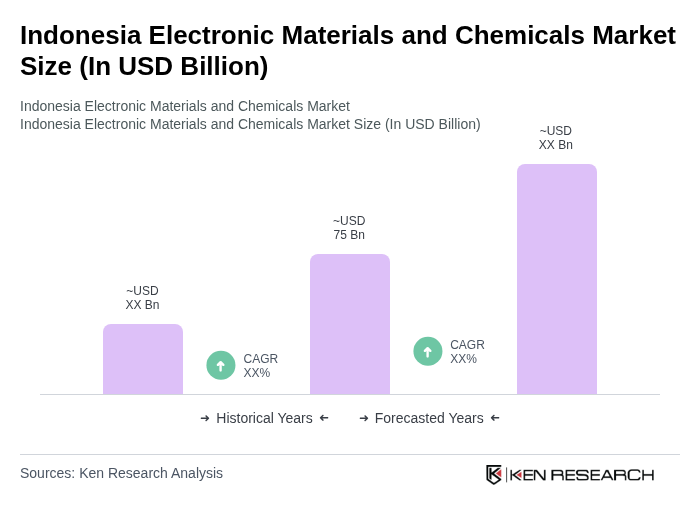
- The Indonesia Electronic Materials and Chemicals Market is valued at USD 75 billion, based on a five-year historical analysis. This substantial growth is primarily driven by the increasing demand for electronic devices, advancements in technology, and the expansion of the telecommunications sector. The rise in consumer electronics and automotive electronics has significantly contributed to the market's expansion, reflecting the country's growing industrial capabilities. Additionally, government incentives and silica-downstreaming roadmap initiatives are accelerating market development, with domestic consumer-electronics and smartphone demand surging due to rising disposable income among Indonesia's 280 million population.
- Key players in this market include Jakarta, Surabaya, and Bandung, which dominate due to their robust industrial infrastructure, skilled workforce, and proximity to major manufacturing hubs. Jakarta, as the capital, serves as a central business district, while Surabaya and Bandung are known for their technological advancements and educational institutions, fostering innovation and attracting investments. These regions have become focal points for electronics manufacturing, with major companies establishing assembly and production facilities to serve both domestic and regional markets.
- The Indonesian government has implemented comprehensive industrial policies to enhance the local production of electronic materials and chemicals. These policies include incentives for domestic manufacturers and aim to reduce dependency on imports, thereby promoting sustainable growth in the electronic materials sector. Strategic investments such as PT Lotte Chemical Indonesia's Cilegon plant, expected to commence production with an investment of approximately USD 3.6 billion, and Chandra Asri's Chlor Alkali - Ethylene Dichloride plant exemplify how targeted government support is reshaping Indonesia's petrochemical and electronic materials landscape.
Indonesia Electronic Materials and Chemicals Market Segmentation
By Type:The market is segmented into various types of electronic materials and chemicals, including conductive materials, insulating materials, adhesives and sealants, coatings, specialty gases, photoresists and etchants, and others. Each of these subsegments plays a crucial role in the manufacturing and functionality of electronic devices.
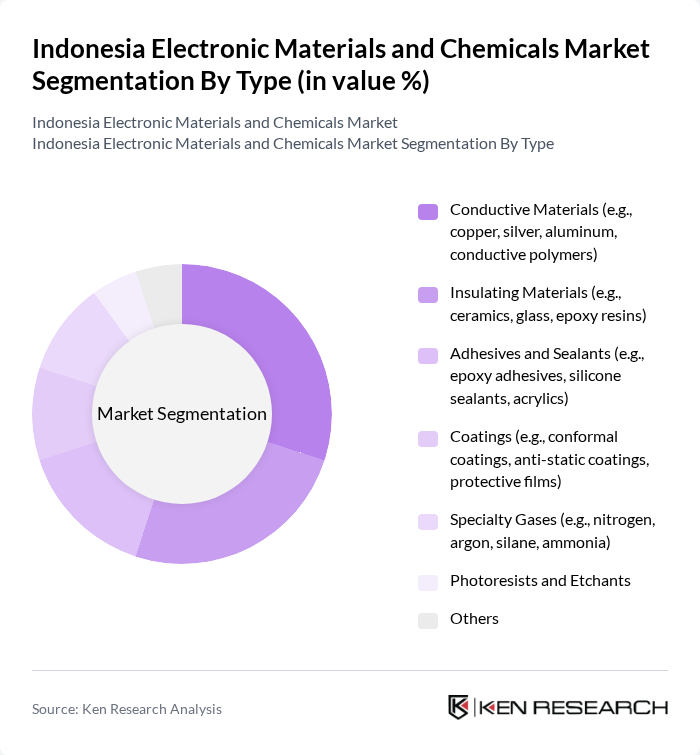
The conductive materials segment is currently dominating the market due to the increasing demand for high-performance electronic devices. Conductive materials such as copper and silver are essential for efficient electrical conduction in various applications, including consumer electronics and automotive components. The trend towards miniaturization and the need for lightweight materials further drive the demand for advanced conductive materials, making this subsegment a key player in the overall market.
By End-User:The market is segmented by end-user applications, including consumer electronics, telecommunications equipment, automotive electronics, industrial electronics & automation, renewable energy, and others. Each segment reflects the diverse applications of electronic materials and chemicals across various industries.
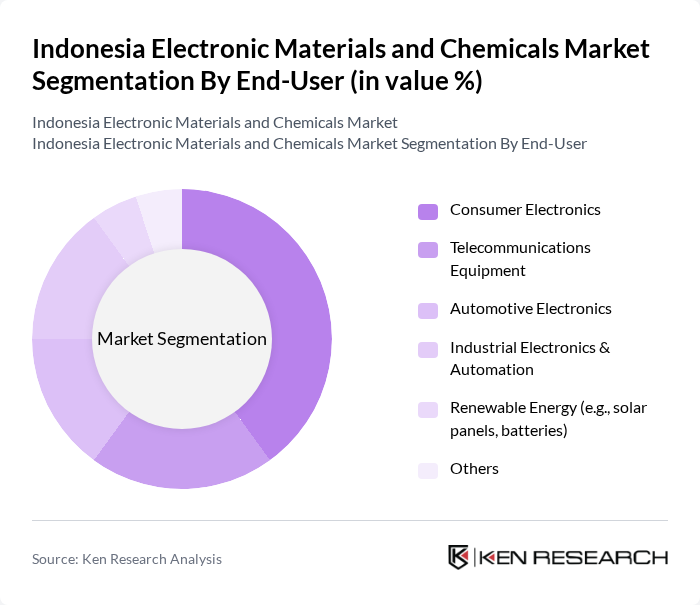
The consumer electronics segment is the largest end-user of electronic materials and chemicals, driven by the rapid growth of smartphones, tablets, and other personal devices. The increasing consumer demand for advanced features and functionalities in electronic devices has led to a surge in the use of high-quality materials, making this segment a significant contributor to the overall market growth. Samsung's launch of the Galaxy S25 with 37.5% local content, surpassing the 35% threshold and shipping 1.56 million units from its Cikarang plant during 2024, exemplifies the robust domestic consumer electronics demand driving material consumption.
Indonesia Electronic Materials and Chemicals Market Competitive Landscape
The Indonesia Electronic Materials and Chemicals Market is characterized by a dynamic mix of regional and international players. Leading participants such as PT. Indopoly Swakarsa Industry Tbk, PT. Asahimas Flat Glass Tbk, PT. Samsung Electronics Indonesia, PT. LG Electronics Indonesia, PT. Panasonic Gobel Indonesia, PT. Sharp Electronics Indonesia, PT. Mitsubishi Electric Indonesia, PT. Toshiba Indonesia, PT. Epson Indonesia, PT. Sony Indonesia, PT. Nitto Denko Indonesia, PT. Chemstar Indonesia, PT. Denso Indonesia, PT. Hitachi Chemical Indonesia, PT. Aisin Indonesia, PT. Linde Indonesia, PT. BASF Indonesia, PT. Dow Indonesia, PT. Solvay Manyar Indonesia, PT. Showa Denko Materials Indonesia contribute to innovation, geographic expansion, and service delivery in this space.
Indonesia Electronic Materials and Chemicals Market Industry Analysis
Growth Drivers
- Increasing Demand for Consumer Electronics:The consumer electronics sector in Indonesia is projected to reach a value of IDR 200 trillion in future, driven by a growing middle class and increased smartphone penetration, which is expected to exceed 70% of the population. This surge in demand for devices such as smartphones, tablets, and laptops is propelling the need for electronic materials and chemicals, thereby stimulating market growth significantly.
- Expansion of the Automotive Electronics Sector:The automotive electronics market in Indonesia is anticipated to grow to IDR 50 trillion in future, fueled by the rising production of electric vehicles (EVs) and smart automotive technologies. With the government targeting 20% of all vehicles to be electric in future, the demand for advanced electronic materials is set to increase, creating substantial opportunities for manufacturers in this sector.
- Government Initiatives Promoting Electronic Manufacturing:The Indonesian government has allocated IDR 10 trillion for initiatives aimed at boosting local electronic manufacturing in future. This includes tax incentives and infrastructure development to attract foreign investment. Such initiatives are expected to enhance the domestic supply chain for electronic materials, reducing dependency on imports and fostering local industry growth.
Market Challenges
- Supply Chain Disruptions:The Indonesian electronic materials market faces significant supply chain disruptions, exacerbated by global events such as the COVID-19 pandemic. In future, delays in shipping and logistics led to a 30% increase in lead times for raw materials. This has resulted in production halts and increased costs for manufacturers, hindering market growth and stability.
- High Import Dependency for Raw Materials:Indonesia relies heavily on imports for over 60% of its raw materials used in electronic manufacturing. This dependency poses risks, particularly in times of global supply chain instability. In future, the country spent approximately IDR 40 trillion on imports of electronic components, highlighting the vulnerability of local manufacturers to international market fluctuations and trade policies.
Indonesia Electronic Materials and Chemicals Market Future Outlook
The future of the Indonesian electronic materials and chemicals market appears promising, driven by technological advancements and government support. The shift towards sustainable manufacturing practices is expected to gain momentum, with a projected increase in investments in eco-friendly materials. Additionally, the rise of smart city initiatives will further stimulate demand for innovative electronic solutions, creating a conducive environment for local manufacturers to thrive and expand their market presence.
Market Opportunities
- Growth in E-commerce and Online Retail:The e-commerce sector in Indonesia is projected to reach IDR 500 trillion in future, providing a significant opportunity for electronic materials suppliers. As online retail expands, the demand for packaging and electronic components for logistics will increase, creating new avenues for growth in the electronic materials market.
- Development of Smart City Projects:Indonesia's commitment to developing smart cities is expected to generate investments exceeding IDR 100 trillion in future. This initiative will drive demand for advanced electronic materials and technologies, particularly in areas such as smart grids and IoT applications, presenting lucrative opportunities for local manufacturers to engage in innovative projects.
Scope of the Report
| Segment | Sub-Segments |
|---|---|
| By Type | Conductive Materials (e.g., copper, silver, aluminum, conductive polymers) Insulating Materials (e.g., ceramics, glass, epoxy resins) Adhesives and Sealants (e.g., epoxy adhesives, silicone sealants, acrylics) Coatings (e.g., conformal coatings, anti-static coatings, protective films) Specialty Gases (e.g., nitrogen, argon, silane, ammonia) Photoresists and Etchants Others |
| By End-User | Consumer Electronics Telecommunications Equipment Automotive Electronics Industrial Electronics & Automation Renewable Energy (e.g., solar panels, batteries) Others |
| By Application | Printed Circuit Boards (PCBs) Semiconductors & Integrated Circuits Sensors & MEMS Displays (LCD, OLED, LED) Power Devices Others |
| By Material Source | Petrochemical-derived Materials Bio-based Materials Recycled Materials Others |
| By Distribution Channel | Direct Sales Distributors/Agents Online Sales Retail Outlets Others |
| By Technology | Traditional Manufacturing Advanced Manufacturing Techniques (e.g., cleanroom, photolithography) Automation & Industry 4.0 Technologies Others |
| By Regulatory Compliance | ISO Standards (e.g., ISO 9001, ISO 14001) Environmental Compliance (e.g., RoHS, REACH) Safety Standards (e.g., OHSAS 18001, SNI) Others |
Key Target Audience
Investors and Venture Capitalist Firms
Government and Regulatory Bodies (e.g., Badan Pengawas Obat dan Makanan, Kementerian Perindustrian)
Manufacturers and Producers
Distributors and Retailers
Technology Providers
Industry Associations
Financial Institutions
Importers and Exporters
Players Mentioned in the Report:
PT. Indopoly Swakarsa Industry Tbk
PT. Asahimas Flat Glass Tbk
PT. Samsung Electronics Indonesia
PT. LG Electronics Indonesia
PT. Panasonic Gobel Indonesia
PT. Sharp Electronics Indonesia
PT. Mitsubishi Electric Indonesia
PT. Toshiba Indonesia
PT. Epson Indonesia
PT. Sony Indonesia
PT. Nitto Denko Indonesia
PT. Chemstar Indonesia
PT. Denso Indonesia
PT. Hitachi Chemical Indonesia
PT. Aisin Indonesia
PT. Linde Indonesia
PT. BASF Indonesia
PT. Dow Indonesia
PT. Solvay Manyar Indonesia
PT. Showa Denko Materials Indonesia
Table of Contents
Market Assessment Phase
1. Executive Summary and Approach
2. Indonesia Electronic Materials and Chemicals Market Overview
2.1 Key Insights and Strategic Recommendations
2.2 Indonesia Electronic Materials and Chemicals Market Overview
2.3 Definition and Scope
2.4 Evolution of Market Ecosystem
2.5 Timeline of Key Regulatory Milestones
2.6 Value Chain & Stakeholder Mapping
2.7 Business Cycle Analysis
2.8 Policy & Incentive Landscape
3. Indonesia Electronic Materials and Chemicals Market Analysis
3.1 Growth Drivers
3.1.1 Increasing demand for consumer electronics
3.1.2 Expansion of the automotive electronics sector
3.1.3 Government initiatives promoting electronic manufacturing
3.1.4 Rising investments in renewable energy technologies
3.2 Market Challenges
3.2.1 Supply chain disruptions
3.2.2 High import dependency for raw materials
3.2.3 Regulatory compliance complexities
3.2.4 Intense competition from international players
3.3 Market Opportunities
3.3.1 Growth in e-commerce and online retail
3.3.2 Development of smart city projects
3.3.3 Increasing focus on sustainable materials
3.3.4 Potential for local manufacturing hubs
3.4 Market Trends
3.4.1 Shift towards miniaturization of electronic components
3.4.2 Adoption of IoT in consumer products
3.4.3 Growth of electric vehicles
3.4.4 Rising demand for advanced semiconductor materials
3.5 Government Regulation
3.5.1 Import tariffs on electronic components
3.5.2 Environmental regulations for chemical manufacturing
3.5.3 Standards for electronic waste management
3.5.4 Incentives for local production of electronic materials
4. SWOT Analysis
5. Stakeholder Analysis
6. Porter's Five Forces Analysis
7. Indonesia Electronic Materials and Chemicals Market Market Size, 2019-2024
7.1 By Value
7.2 By Volume
7.3 By Average Selling Price
8. Indonesia Electronic Materials and Chemicals Market Segmentation
8.1 By Type
8.1.1 Conductive Materials (e.g., copper, silver, aluminum, conductive polymers)
8.1.2 Insulating Materials (e.g., ceramics, glass, epoxy resins)
8.1.3 Adhesives and Sealants (e.g., epoxy adhesives, silicone sealants, acrylics)
8.1.4 Coatings (e.g., conformal coatings, anti-static coatings, protective films)
8.1.5 Specialty Gases (e.g., nitrogen, argon, silane, ammonia)
8.1.6 Photoresists and Etchants
8.1.7 Others
8.2 By End-User
8.2.1 Consumer Electronics
8.2.2 Telecommunications Equipment
8.2.3 Automotive Electronics
8.2.4 Industrial Electronics & Automation
8.2.5 Renewable Energy (e.g., solar panels, batteries)
8.2.6 Others
8.3 By Application
8.3.1 Printed Circuit Boards (PCBs)
8.3.2 Semiconductors & Integrated Circuits
8.3.3 Sensors & MEMS
8.3.4 Displays (LCD, OLED, LED)
8.3.5 Power Devices
8.3.6 Others
8.4 By Material Source
8.4.1 Petrochemical-derived Materials
8.4.2 Bio-based Materials
8.4.3 Recycled Materials
8.4.4 Others
8.5 By Distribution Channel
8.5.1 Direct Sales
8.5.2 Distributors/Agents
8.5.3 Online Sales
8.5.4 Retail Outlets
8.5.5 Others
8.6 By Technology
8.6.1 Traditional Manufacturing
8.6.2 Advanced Manufacturing Techniques (e.g., cleanroom, photolithography)
8.6.3 Automation & Industry 4.0 Technologies
8.6.4 Others
8.7 By Regulatory Compliance
8.7.1 ISO Standards (e.g., ISO 9001, ISO 14001)
8.7.2 Environmental Compliance (e.g., RoHS, REACH)
8.7.3 Safety Standards (e.g., OHSAS 18001, SNI)
8.7.4 Others
9. Indonesia Electronic Materials and Chemicals Market Competitive Analysis
9.1 Market Share of Key Players
9.2 Cross Comparison of Key Players
9.2.1 Company Name
9.2.2 Group Size (Large, Medium, or Small as per industry convention)
9.2.3 Revenue (USD, latest fiscal year)
9.2.4 Revenue Growth Rate (YoY %)
9.2.5 Market Share (%)
9.2.6 Product Portfolio Breadth (number of product categories)
9.2.7 R&D Intensity (% of revenue spent on R&D)
9.2.8 Local Manufacturing Footprint (number of Indonesian facilities)
9.2.9 Supply Chain Reliability (on-time delivery %)
9.2.10 ESG Performance (Environmental, Social, Governance rating or initiatives)
9.2.11 Customer Satisfaction Index (survey-based score)
9.2.12 Innovation Index (patents filed, new product launches)
9.3 SWOT Analysis of Top Players
9.4 Pricing Analysis
9.5 Detailed Profile of Major Companies
9.5.1 PT. Indopoly Swakarsa Industry Tbk
9.5.2 PT. Asahimas Flat Glass Tbk
9.5.3 PT. Samsung Electronics Indonesia
9.5.4 PT. LG Electronics Indonesia
9.5.5 PT. Panasonic Gobel Indonesia
9.5.6 PT. Sharp Electronics Indonesia
9.5.7 PT. Mitsubishi Electric Indonesia
9.5.8 PT. Toshiba Indonesia
9.5.9 PT. Epson Indonesia
9.5.10 PT. Sony Indonesia
9.5.11 PT. Nitto Denko Indonesia
9.5.12 PT. Chemstar Indonesia
9.5.13 PT. Denso Indonesia
9.5.14 PT. Hitachi Chemical Indonesia
9.5.15 PT. Aisin Indonesia
9.5.16 PT. Linde Indonesia
9.5.17 PT. BASF Indonesia
9.5.18 PT. Dow Indonesia
9.5.19 PT. Solvay Manyar Indonesia
9.5.20 PT. Showa Denko Materials Indonesia
10. Indonesia Electronic Materials and Chemicals Market End-User Analysis
10.1 Procurement Behavior of Key Ministries
10.1.1 Key Procurement Policies
10.1.2 Budget Allocation Trends
10.1.3 Preferred Suppliers
10.1.4 Procurement Challenges
10.2 Corporate Spend on Infrastructure & Energy
10.2.1 Investment Trends
10.2.2 Major Projects
10.2.3 Spending Priorities
10.2.4 Cost Management Strategies
10.3 Pain Point Analysis by End-User Category
10.3.1 Common Challenges Faced
10.3.2 Impact of Regulations
10.3.3 Technology Adoption Barriers
10.3.4 Supply Chain Issues
10.4 User Readiness for Adoption
10.4.1 Awareness Levels
10.4.2 Training Needs
10.4.3 Infrastructure Readiness
10.4.4 Adoption Rates
10.5 Post-Deployment ROI and Use Case Expansion
10.5.1 ROI Measurement Techniques
10.5.2 Successful Use Cases
10.5.3 Expansion Opportunities
10.5.4 Long-term Benefits
11. Indonesia Electronic Materials and Chemicals Market Future Size, 2025-2030
11.1 By Value
11.2 By Volume
11.3 By Average Selling Price
Go-To-Market Strategy Phase
1. Whitespace Analysis + Business Model Canvas
1.1 Market Gaps Identification
1.2 Business Model Components
1.3 Value Proposition Canvas
1.4 Competitive Landscape Analysis
1.5 Customer Segmentation
1.6 Revenue Streams
1.7 Cost Structure
2. Marketing and Positioning Recommendations
2.1 Branding Strategies
2.2 Product USPs
2.3 Target Audience Identification
2.4 Marketing Channels
2.5 Messaging Framework
3. Distribution Plan
3.1 Urban Retail Strategies
3.2 Rural NGO Tie-ups
3.3 E-commerce Integration
3.4 Logistics and Supply Chain Management
4. Channel & Pricing Gaps
4.1 Underserved Routes
4.2 Pricing Bands
4.3 Competitive Pricing Analysis
4.4 Value-based Pricing Strategies
5. Unmet Demand & Latent Needs
5.1 Category Gaps
5.2 Consumer Segments
5.3 Emerging Trends
5.4 Future Demand Projections
6. Customer Relationship
6.1 Loyalty Programs
6.2 After-sales Service
6.3 Customer Feedback Mechanisms
6.4 Community Engagement
7. Value Proposition
7.1 Sustainability Initiatives
7.2 Integrated Supply Chains
7.3 Innovation in Product Development
7.4 Customer-Centric Approaches
8. Key Activities
8.1 Regulatory Compliance
8.2 Branding Efforts
8.3 Distribution Setup
8.4 Market Research Activities
9. Entry Strategy Evaluation
9.1 Domestic Market Entry Strategy
9.1.1 Product Mix
9.1.2 Pricing Band
9.1.3 Packaging
9.2 Export Entry Strategy
9.2.1 Target Countries
9.2.2 Compliance Roadmap
10. Entry Mode Assessment
10.1 Joint Ventures
10.2 Greenfield Investments
10.3 Mergers & Acquisitions
10.4 Distributor Model
11. Capital and Timeline Estimation
11.1 Capital Requirements
11.2 Timelines
12. Control vs Risk Trade-Off
12.1 Ownership vs Partnerships
12.2 Risk Mitigation Strategies
13. Profitability Outlook
13.1 Breakeven Analysis
13.2 Long-term Sustainability
14. Potential Partner List
14.1 Distributors
14.2 Joint Ventures
14.3 Acquisition Targets
15. Execution Roadmap
15.1 Phased Plan for Market Entry
15.1.1 Market Setup
15.1.2 Market Entry
15.1.3 Growth Acceleration
15.1.4 Scale & Stabilize
15.2 Key Activities and Milestones
15.2.1 Milestone Planning
15.2.2 Activity Tracking
Research Methodology
Phase 1: Approach1
Desk Research
- Analysis of industry reports from government agencies and trade associations in Indonesia
- Review of academic publications and market studies focusing on electronic materials and chemicals
- Examination of import/export data and trade statistics from Indonesian customs
Primary Research
- Interviews with key stakeholders in the electronic materials sector, including manufacturers and suppliers
- Surveys targeting R&D managers and product development teams in electronics firms
- Focus group discussions with industry experts and consultants specializing in chemical applications
Validation & Triangulation
- Cross-validation of findings through multiple data sources, including trade publications and market surveys
- Triangulation of insights from primary interviews with secondary data trends
- Sanity checks conducted through expert panel reviews to ensure data accuracy
Phase 2: Market Size Estimation1
Top-down Assessment
- Estimation of market size based on national electronics production and consumption statistics
- Segmentation of the market by product type, including semiconductors, polymers, and specialty chemicals
- Incorporation of government initiatives promoting local manufacturing and sustainability
Bottom-up Modeling
- Collection of sales data from leading electronic materials manufacturers in Indonesia
- Estimation of market share based on production capacity and sales volume
- Analysis of pricing strategies and cost structures across different product categories
Forecasting & Scenario Analysis
- Development of forecasting models based on historical growth rates and market trends
- Scenario analysis considering factors such as technological advancements and regulatory changes
- Projections for market growth through 2030 under various economic conditions
Phase 3: CATI Sample Composition1
| Scope Item/Segment | Sample Size | Target Respondent Profiles |
|---|---|---|
| Electronic Materials Manufacturing | 100 | Production Managers, Quality Control Supervisors |
| Chemicals for Electronics Applications | 60 | Product Development Engineers, R&D Managers |
| Supply Chain Management in Electronics | 50 | Logistics Coordinators, Procurement Managers |
| Market Trends in Electronic Components | 70 | Market Analysts, Business Development Executives |
| Regulatory Compliance in Chemical Usage | 40 | Compliance Officers, Environmental Managers |
Frequently Asked Questions
What is the current value of the Indonesia Electronic Materials and Chemicals Market?
The Indonesia Electronic Materials and Chemicals Market is valued at approximately USD 75 billion, reflecting significant growth driven by increasing demand for electronic devices, advancements in technology, and the expansion of the telecommunications sector.
What factors are driving the growth of the electronic materials market in Indonesia?
Which regions in Indonesia are key players in the electronic materials market?
What types of electronic materials are included in the market segmentation?
Other Regional/Country Reports
Malaysia Electronic Materials and Chemicals Market
KSA Electronic Materials and Chemicals Market
APAC Electronic Materials and Chemicals Market
SEA Electronic Materials and Chemicals Market
Vietnam Electronic Materials and Chemicals Market
Thailand Electronic Materials and Chemicals Market
Other Adjacent Reports
Malaysia Telecommunications Equipment Market
Malaysia Industrial Electronics Market
North America Renewable Energy Market Outlook to 2030: Size, Share, Growth and TrendsUAE Semiconductor Materials MarketGlobal Petrochemicals Market Outlook to 2030South Africa Specialty Gases Market
Brazil Photoresists Market
UAE Electronic Components MarketWhy Buy From Us?

What makes us stand out is that our consultants follow Robust, Refine and Result (RRR) methodology. Robust for clear definitions, approaches and sanity checking, Refine for differentiating respondents' facts and opinions, and Result for presenting data with story.

We have set a benchmark in the industry by offering our clients with syndicated and customized market research reports featuring coverage of entire market as well as meticulous research and analyst insights.

While we don't replace traditional research, we flip the method upside down. Our dual approach of Top Bottom & Bottom Top ensures quality deliverable by not just verifying company fundamentals but also looking at the sector and macroeconomic factors.

With one step in the future, our research team constantly tries to show you the bigger picture. We help with some of the tough questions you may encounter along the way: How is the industry positioned? Best marketing channel? KPI's of competitors? By aligning every element, we help maximize success.

Our report gives you instant access to the answers and sources that other companies might choose to hide. We elaborate each steps of research methodology we have used and showcase you the sample size to earn your trust.

If you need any support, we are here! We pride ourselves on universe strength, data quality, and quick, friendly, and professional service.