








Ken Research Logo

Indonesia Film Dressing Market Report Size, Share, Growth Drivers, Trends, Opportunities & Forecast 2025–2030

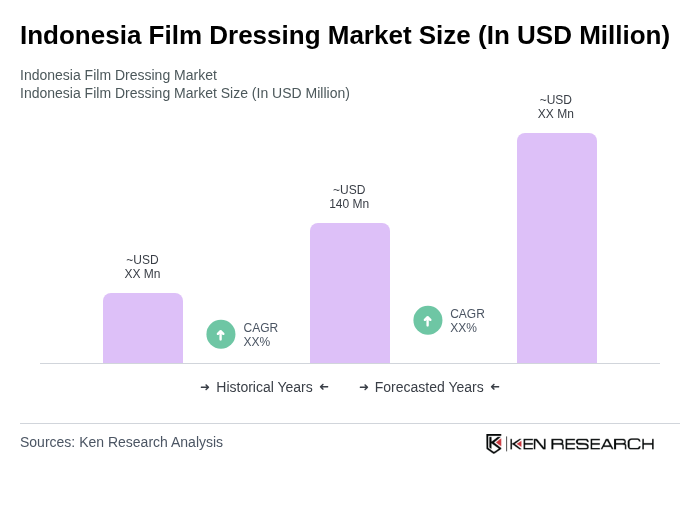
The Indonesia film dressing market, valued at USD 140 million, is growing due to rising chronic wounds, geriatric population, and advanced wound care awareness.

Region:Asia

Author(s):Shubham

Product Code:KRAD5353

Pages:96

Published On:December 2025
About the Report

Base Year 2024

Indonesia Film Dressing Market Overview

  • The Indonesia Film Dressing Market is valued at USD 140 million, based on a five-year historical analysis. This growth is primarily driven by the increasing prevalence of chronic wounds such as diabetic ulcers, rising surgical procedures, expanding healthcare infrastructure, a growing geriatric population, and increasing awareness of advanced wound care products among healthcare professionals and patients alike.
  • Key cities such as Jakarta, Surabaya, and Bandung dominate the market due to their high population density, advanced healthcare infrastructure, and the presence of numerous hospitals and clinics. These urban centers are also the focal points for healthcare innovations and the distribution of medical supplies.
  • The Minister of Health Regulation No. 27 of 2022 issued by the Ministry of Health requires hospitals to adhere to standardized wound care protocols, including the adoption of advanced dressings meeting specific quality and safety standards for managing chronic and surgical wounds in public facilities. This initiative aims to improve patient outcomes and reduce healthcare costs associated with wound management, thereby boosting the demand for film dressings in the market.
Indonesia Film Dressing Market Size

Indonesia Film Dressing Market Segmentation

By Type:The film dressing market can be segmented into various types, including Transparent Film Dressings, Adhesive Film Dressings, Non-adhesive Film Dressings, Antimicrobial Film Dressings, Silicone-coated Film Dressings, Island Film Dressings, and Others. Each type serves specific needs in wound management, with varying levels of adhesion, permeability, and antimicrobial properties.
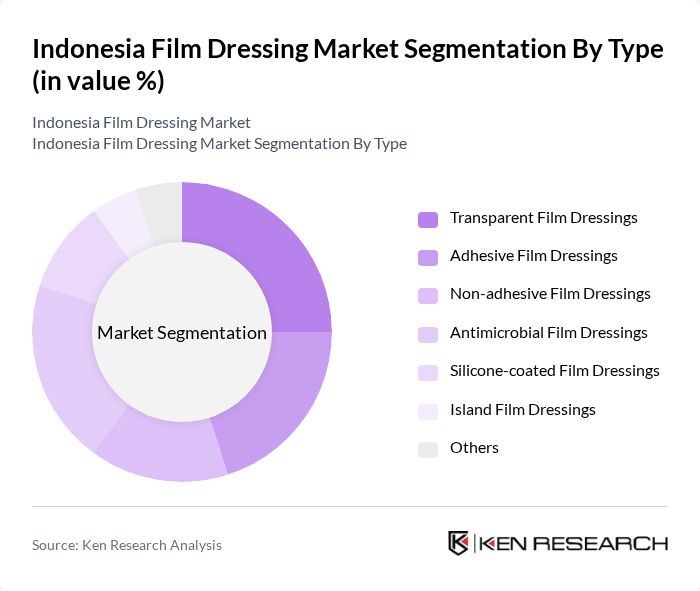
Indonesia Film Dressing Market segmentation by Type.

By End-User:The end-user segmentation includes Public Hospitals, Private Hospitals, Outpatient & Specialty Clinics, Home Healthcare, Long-term Care Facilities, and Others. Each segment reflects the diverse settings in which film dressings are utilized, catering to different patient demographics and healthcare needs.
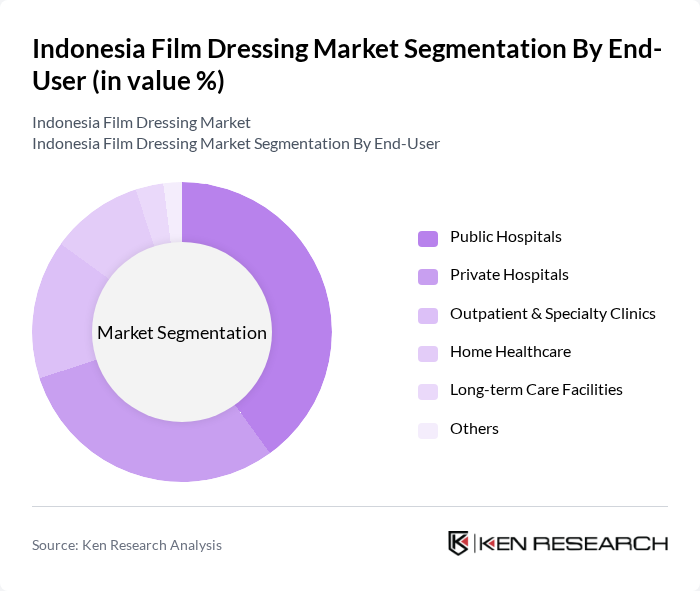
Indonesia Film Dressing Market segmentation by End-User.

Indonesia Film Dressing Market Competitive Landscape

The Indonesia Film Dressing Market is characterized by a dynamic mix of regional and international players. Leading participants such as 3M Company, Smith & Nephew plc, Johnson & Johnson (including Ethicon), Paul Hartmann AG, Mölnlycke Health Care AB, Coloplast A/S, ConvaTec Group plc, Medline Industries, LP, B. Braun Melsungen AG, Winner Medical Co., Ltd., Lohmann & Rauscher GmbH & Co. KG, BSN medical GmbH (Essity), PT Oneject Indonesia, PT Jayamas Medica Industri Tbk (OneMed), PT Phapros Tbk contribute to innovation, geographic expansion, and service delivery in this space.

3M Company

1902

Maplewood, Minnesota, USA

Smith & Nephew plc

1856

London, UK

Johnson & Johnson (Ethicon)

1886

New Brunswick, New Jersey, USA

Paul Hartmann AG

1818

Heidenheim, Germany

Mölnlycke Health Care AB

1849

Gothenburg, Sweden

Company

Establishment Year

Headquarters

Group Size (Global Multinational, Regional, or Local Manufacturer)

Indonesia Film Dressing Revenue (USD million)

Revenue Growth Rate in Indonesia Film Dressing Segment (%)

Market Share in Indonesia Film Dressing Market (%)

Geographic Coverage within Indonesia (Number of Provinces / Cities Served)

Hospital & Klinik Jaringan Partnerships (Number of Institutional Accounts)

Indonesia Film Dressing Market Industry Analysis

Growth Drivers

  • Increasing Prevalence of Chronic Wounds:The rise in chronic wounds, such as diabetic ulcers and pressure sores, is a significant growth driver for the film dressing market in Indonesia. According to the World Health Organization and the International Diabetes Federation, approximately 19–20 million adults in Indonesia are living with diabetes, indicating a substantial population at risk of diabetic foot ulcers and other chronic wounds. This growing patient population necessitates advanced wound care solutions, driving demand for film dressings that promote healing and reduce infection risk.
  • Rising Healthcare Expenditure:Indonesia's healthcare expenditure is projected to reach around IDR 1,000 trillion (approximately USD 65 billion) in future, reflecting a commitment to improving healthcare services. This increase in spending facilitates the adoption of advanced medical technologies, including film dressings. Enhanced funding allows healthcare facilities to invest in high-quality wound care products, thereby improving patient outcomes and driving market growth in the film dressing sector.
  • Growing Awareness of Advanced Wound Care Products:There is a notable increase in awareness regarding advanced wound care products among healthcare professionals and patients in Indonesia. Educational initiatives and training programs have been implemented, leading to a better understanding of the benefits of film dressings. As a result, hospitals and clinics are increasingly adopting these products, contributing to a projected increase in usage by 20% annually, according to local health authorities.

Market Challenges

  • High Cost of Advanced Film Dressings:The high cost associated with advanced film dressings poses a significant challenge in Indonesia. Many healthcare facilities, particularly in rural areas, struggle to afford these products due to limited budgets. For instance, the average cost of a single advanced dressing can range from IDR 50,000 to IDR 100,000 (USD 3.50 to USD 7), which can be prohibitive for smaller clinics, limiting their availability and accessibility to patients.
  • Limited Availability in Rural Areas:Access to advanced wound care products, including film dressings, is often limited in Indonesia's rural regions. Approximately 56–60% of the population resides in these areas, where healthcare infrastructure is underdeveloped. This lack of availability restricts patients' access to necessary treatments, leading to poorer health outcomes and increased complications from chronic wounds, thereby hindering overall market growth.

Indonesia Film Dressing Market Future Outlook

The future of the Indonesia film dressing market appears promising, driven by technological advancements and a growing focus on patient-centric care. As healthcare providers increasingly adopt digital health technologies, the integration of telemedicine and remote monitoring will enhance wound management. Additionally, the shift towards biodegradable materials aligns with global sustainability trends, appealing to environmentally conscious consumers. These developments are expected to foster innovation and improve patient outcomes, ultimately expanding the market landscape in the coming years.

Market Opportunities

  • Increasing Demand for Home Healthcare Solutions:The demand for home healthcare solutions is on the rise, particularly among the aging population in Indonesia. With an estimated share of the population aged 60 and above at around 10–12%, there is a growing need for accessible wound care products. This trend presents an opportunity for film dressing manufacturers to develop products tailored for home use, enhancing patient convenience and care.
  • Expansion of E-commerce in Healthcare Products:The rapid growth of e-commerce in Indonesia is transforming the healthcare landscape. With online sales of goods and services, including healthcare-related products, growing strongly and the gross merchandise value of Indonesia’s e-commerce sector estimated at over USD 60 billion in future, film dressing companies can leverage this trend to reach a broader audience. E-commerce platforms provide an effective channel for distributing advanced wound care products, increasing accessibility for consumers across the country.

Scope of the Report

SegmentSub-Segments
By Type

Transparent Film Dressings

Adhesive Film Dressings

Non-adhesive Film Dressings

Antimicrobial Film Dressings

Silicone-coated Film Dressings

Island Film Dressings

Others

By End-User

Public Hospitals

Private Hospitals

Outpatient & Specialty Clinics

Home Healthcare

Long-term Care Facilities

Others

By Application

IV Site & Catheter Securement

Post-operative Surgical Incisions

Minor Cuts, Lacerations, and Abrasions

Pressure Ulcers and Diabetic Foot Ulcers (Secondary Dressing)

Burns and Donor Sites

Others

By Distribution Channel

Hospital Pharmacies

Retail Pharmacies & Drug Stores

Medical Supply Stores

Online Channels (E-pharmacies & Marketplaces)

Others

By Region

Java

Sumatra

Bali & Nusa Tenggara

Kalimantan

Sulawesi

Papua & Maluku

By Patient Demographics

Pediatric Patients

Adult Patients

Geriatric Patients

Others

By Product Formulation

Semi-permeable Polyurethane Film Dressings

Silicone-based Film Dressings

Antimicrobial-coated Film Dressings

Others

Key Target Audience

Investors and Venture Capitalist Firms

Government and Regulatory Bodies (e.g., Ministry of Industry, Ministry of Trade)

Film Production Companies

Film Distribution Companies

Packaging Manufacturers

Advertising Agencies

Film Festivals and Event Organizers

Retail Chains and Supermarkets

Players Mentioned in the Report:

3M Company

Smith & Nephew plc

Johnson & Johnson (including Ethicon)

Paul Hartmann AG

Molnlycke Health Care AB

Coloplast A/S

ConvaTec Group plc

Medline Industries, LP

B. Braun Melsungen AG

Winner Medical Co., Ltd.

Lohmann & Rauscher GmbH & Co. KG

BSN medical GmbH (Essity)

PT Oneject Indonesia

PT Jayamas Medica Industri Tbk (OneMed)

PT Phapros Tbk

Table of Contents

Market Assessment Phase

1. Executive Summary and Approach


2. Indonesia Film Dressing Market Overview

2.1 Key Insights and Strategic Recommendations

2.2 Indonesia Film Dressing Market Overview

2.3 Definition and Scope

2.4 Evolution of Market Ecosystem

2.5 Timeline of Key Regulatory Milestones

2.6 Value Chain & Stakeholder Mapping

2.7 Business Cycle Analysis

2.8 Policy & Incentive Landscape


3. Indonesia Film Dressing Market Analysis

3.1 Growth Drivers

3.1.1 Increasing prevalence of chronic wounds
3.1.2 Rising healthcare expenditure
3.1.3 Growing awareness of advanced wound care products
3.1.4 Expansion of healthcare infrastructure

3.2 Market Challenges

3.2.1 High cost of advanced film dressings
3.2.2 Limited availability in rural areas
3.2.3 Lack of trained healthcare professionals
3.2.4 Regulatory hurdles in product approval

3.3 Market Opportunities

3.3.1 Increasing demand for home healthcare solutions
3.3.2 Technological advancements in wound care
3.3.3 Growing geriatric population
3.3.4 Expansion of e-commerce in healthcare products

3.4 Market Trends

3.4.1 Shift towards biodegradable and sustainable materials
3.4.2 Integration of digital health technologies
3.4.3 Customization of wound care products
3.4.4 Increased focus on patient-centric care

3.5 Government Regulation

3.5.1 Compliance with BPOM regulations
3.5.2 Standards set by the Ministry of Health
3.5.3 Import regulations for medical devices
3.5.4 Guidelines for clinical trials and product testing

4. SWOT Analysis


5. Stakeholder Analysis


6. Porter's Five Forces Analysis


7. Indonesia Film Dressing Market Market Size, 2019-2024

7.1 By Value

7.2 By Volume

7.3 By Average Selling Price


8. Indonesia Film Dressing Market Segmentation

8.1 By Type

8.1.1 Transparent Film Dressings
8.1.2 Adhesive Film Dressings
8.1.3 Non-adhesive Film Dressings
8.1.4 Antimicrobial Film Dressings
8.1.5 Silicone-coated Film Dressings
8.1.6 Island Film Dressings
8.1.7 Others

8.2 By End-User

8.2.1 Public Hospitals
8.2.2 Private Hospitals
8.2.3 Outpatient & Specialty Clinics
8.2.4 Home Healthcare
8.2.5 Long-term Care Facilities
8.2.6 Others

8.3 By Application

8.3.1 IV Site & Catheter Securement
8.3.2 Post-operative Surgical Incisions
8.3.3 Minor Cuts, Lacerations, and Abrasions
8.3.4 Pressure Ulcers and Diabetic Foot Ulcers (Secondary Dressing)
8.3.5 Burns and Donor Sites
8.3.6 Others

8.4 By Distribution Channel

8.4.1 Hospital Pharmacies
8.4.2 Retail Pharmacies & Drug Stores
8.4.3 Medical Supply Stores
8.4.4 Online Channels (E-pharmacies & Marketplaces)
8.4.5 Others

8.5 By Region

8.5.1 Java
8.5.2 Sumatra
8.5.3 Bali & Nusa Tenggara
8.5.4 Kalimantan
8.5.5 Sulawesi
8.5.6 Papua & Maluku

8.6 By Patient Demographics

8.6.1 Pediatric Patients
8.6.2 Adult Patients
8.6.3 Geriatric Patients
8.6.4 Others

8.7 By Product Formulation

8.7.1 Semi-permeable Polyurethane Film Dressings
8.7.2 Silicone-based Film Dressings
8.7.3 Antimicrobial-coated Film Dressings
8.7.4 Others

9. Indonesia Film Dressing Market Competitive Analysis

9.1 Market Share of Key Players

9.2 Cross Comparison of Key Players

9.2.1 Company Name
9.2.2 Group Size (Global Multinational, Regional, or Local Manufacturer)
9.2.3 Indonesia Film Dressing Revenue (USD million)
9.2.4 Revenue Growth Rate in Indonesia Film Dressing Segment (%)
9.2.5 Market Share in Indonesia Film Dressing Market (%)
9.2.6 Geographic Coverage within Indonesia (Number of Provinces / Cities Served)
9.2.7 Hospital & Klinik Jaringan Partnerships (Number of Institutional Accounts)
9.2.8 Product Portfolio Breadth (Number of Film Dressing SKUs)
9.2.9 Share of Advanced / Antimicrobial Film Products in Portfolio (%)
9.2.10 Average Selling Price Band (Premium / Mid-range / Economy)
9.2.11 Primary Distribution Channels Used
9.2.12 Local Manufacturing vs Import Dependence (%)
9.2.13 Regulatory Approvals & Certifications (BPOM/Ministry of Health, ISO)
9.2.14 Marketing & KOL Engagement Intensity (Number of CME / Training Programs per Year)
9.2.15 Customer Satisfaction / Net Promoter Score (NPS)

9.3 SWOT Analysis of Top Players

9.4 Pricing Analysis

9.5 Detailed Profile of Major Companies

9.5.1 3M Company
9.5.2 Smith & Nephew plc
9.5.3 Johnson & Johnson (including Ethicon)
9.5.4 Paul Hartmann AG
9.5.5 Mölnlycke Health Care AB
9.5.6 Coloplast A/S
9.5.7 ConvaTec Group plc
9.5.8 Medline Industries, LP
9.5.9 B. Braun Melsungen AG
9.5.10 Winner Medical Co., Ltd.
9.5.11 Lohmann & Rauscher GmbH & Co. KG
9.5.12 BSN medical GmbH (Essity)
9.5.13 PT Oneject Indonesia
9.5.14 PT Jayamas Medica Industri Tbk (OneMed)
9.5.15 PT Phapros Tbk

10. Indonesia Film Dressing Market End-User Analysis

10.1 Procurement Behavior of Key Ministries

10.1.1 Budget Allocation for Wound Care
10.1.2 Procurement Processes
10.1.3 Supplier Selection Criteria
10.1.4 Contract Management Practices

10.2 Corporate Spend on Infrastructure & Energy

10.2.1 Investment in Healthcare Facilities
10.2.2 Spending on Medical Equipment
10.2.3 Budget for Training Healthcare Staff
10.2.4 Others

10.3 Pain Point Analysis by End-User Category

10.3.1 Accessibility to Quality Products
10.3.2 Affordability of Advanced Dressings
10.3.3 Availability of Trained Personnel
10.3.4 Others

10.4 User Readiness for Adoption

10.4.1 Awareness of Product Benefits
10.4.2 Training and Support Needs
10.4.3 Adoption Barriers
10.4.4 Others

10.5 Post-Deployment ROI and Use Case Expansion

10.5.1 Cost Savings from Efficient Wound Care
10.5.2 Improvement in Patient Outcomes
10.5.3 Expansion into New Applications
10.5.4 Others

11. Indonesia Film Dressing Market Future Size, 2025-2030

11.1 By Value

11.2 By Volume

11.3 By Average Selling Price


Go-To-Market Strategy Phase

1. Whitespace Analysis + Business Model Canvas

1.1 Market Gaps Identification

1.2 Business Model Development


2. Marketing and Positioning Recommendations

2.1 Branding Strategies

2.2 Product USPs


3. Distribution Plan

3.1 Urban Retail vs Rural NGO Tie-ups


4. Channel & Pricing Gaps

4.1 Underserved Routes

4.2 Pricing Bands


5. Unmet Demand & Latent Needs

5.1 Category Gaps

5.2 Consumer Segments


6. Customer Relationship

6.1 Loyalty Programs

6.2 After-sales Service


7. Value Proposition

7.1 Sustainability

7.2 Integrated Supply Chains


8. Key Activities

8.1 Regulatory Compliance

8.2 Branding

8.3 Distribution Setup


9. Entry Strategy Evaluation

9.1 Domestic Market Entry Strategy

9.1.1 Product Mix
9.1.2 Pricing Band
9.1.3 Packaging

9.2 Export Entry Strategy

9.2.1 Target Countries
9.2.2 Compliance Roadmap

10. Entry Mode Assessment

10.1 JV

10.2 Greenfield

10.3 M&A

10.4 Distributor Model


11. Capital and Timeline Estimation

11.1 Capital Requirements

11.2 Timelines


12. Control vs Risk Trade-Off

12.1 Ownership vs Partnerships


13. Profitability Outlook

13.1 Breakeven Analysis

13.2 Long-term Sustainability


14. Potential Partner List

14.1 Distributors

14.2 JVs

14.3 Acquisition Targets


15. Execution Roadmap

15.1 Phased Plan for Market Entry

15.1.1 Market Setup
15.1.2 Market Entry
15.1.3 Growth Acceleration
15.1.4 Scale & Stabilize

15.2 Key Activities and Milestones

15.2.1 Milestone Planning

Research Methodology

ApproachModellingSample

Phase 1: Approach1

Desk Research

  • Industry reports from Indonesian film associations and government publications
  • Market analysis from trade journals focusing on the film dressing sector
  • Statistical data from the Central Bureau of Statistics of Indonesia

Primary Research

  • Interviews with key stakeholders in the film dressing supply chain, including manufacturers and distributors
  • Surveys targeting film production companies to understand their dressing needs and preferences
  • Field visits to film dressing facilities to gather insights on operational practices and challenges

Validation & Triangulation

  • Cross-validation of findings through multiple data sources, including industry reports and expert opinions
  • Triangulation of market trends with historical data and current market dynamics
  • Sanity checks conducted through expert panel discussions to ensure data reliability

Phase 2: Market Size Estimation1

Top-down Assessment

  • Analysis of the overall film industry growth in Indonesia to estimate the film dressing market size
  • Segmentation of the market by film type, including feature films, documentaries, and advertisements
  • Incorporation of government initiatives promoting local film production and dressing standards

Bottom-up Modeling

  • Volume estimates based on production data from leading film studios and independent filmmakers
  • Cost analysis of film dressing materials and services provided by local suppliers
  • Calculation of market size based on average spending per film project on dressing

Forecasting & Scenario Analysis

  • Multi-factor regression analysis considering factors such as technological advancements and consumer trends in film
  • Scenario planning based on potential changes in government policies and funding for the film industry
  • Development of baseline, optimistic, and pessimistic forecasts through 2030

Phase 3: CATI Sample Composition1

Scope Item/SegmentSample SizeTarget Respondent Profiles
Feature Film Production120Producers, Directors, Production Managers
Documentary Filmmaking80Documentary Filmmakers, Editors, Cinematographers
Advertising Film Projects70Creative Directors, Account Managers, Production Coordinators
Film Dressing Suppliers60Sales Managers, Product Development Specialists
Film Industry Associations50Policy Makers, Industry Analysts, Marketing Executives

Frequently Asked Questions

What is the current value of the Indonesia Film Dressing Market?

The Indonesia Film Dressing Market is valued at approximately USD 140 million, driven by factors such as the increasing prevalence of chronic wounds, rising surgical procedures, and expanding healthcare infrastructure.

What are the main growth drivers for the Indonesia Film Dressing Market?

Which cities are the primary markets for film dressings in Indonesia?

What types of film dressings are available in the Indonesian market?

Other Regional/Country Reports

Malaysia Film Dressing Market

KSA Film Dressing Market

APAC Film Dressing Market

SEA Film Dressing Market

Vietnam Film Dressing Market

Thailand Film Dressing Market

Why Buy From Us?

Refine Robust Result (RRR) Framework

What makes us stand out is that our consultants follow Robust, Refine and Result (RRR) methodology. Robust for clear definitions, approaches and sanity checking, Refine for differentiating respondents' facts and opinions, and Result for presenting data with story.

Our Reach Is Unmatched

We have set a benchmark in the industry by offering our clients with syndicated and customized market research reports featuring coverage of entire market as well as meticulous research and analyst insights.

Shifting the Research Paradigm

While we don't replace traditional research, we flip the method upside down. Our dual approach of Top Bottom & Bottom Top ensures quality deliverable by not just verifying company fundamentals but also looking at the sector and macroeconomic factors.

More Insights-Better Decisions

With one step in the future, our research team constantly tries to show you the bigger picture. We help with some of the tough questions you may encounter along the way: How is the industry positioned? Best marketing channel? KPI's of competitors? By aligning every element, we help maximize success.

Transparency and Trust

Our report gives you instant access to the answers and sources that other companies might choose to hide. We elaborate each steps of research methodology we have used and showcase you the sample size to earn your trust.

Round the Clock Support

If you need any support, we are here! We pride ourselves on universe strength, data quality, and quick, friendly, and professional service.

Why Clients Choose Us?

400000+
Reports in repository
150+
Consulting projects a year
100+
Analysts
8000+
Client Queries in 2022