








Ken Research Logo

Indonesia Hyaluronic Acid Personal Care Products Market Report Size, Share, Growth Drivers, Trends, Opportunities & Forecast 2025–2030

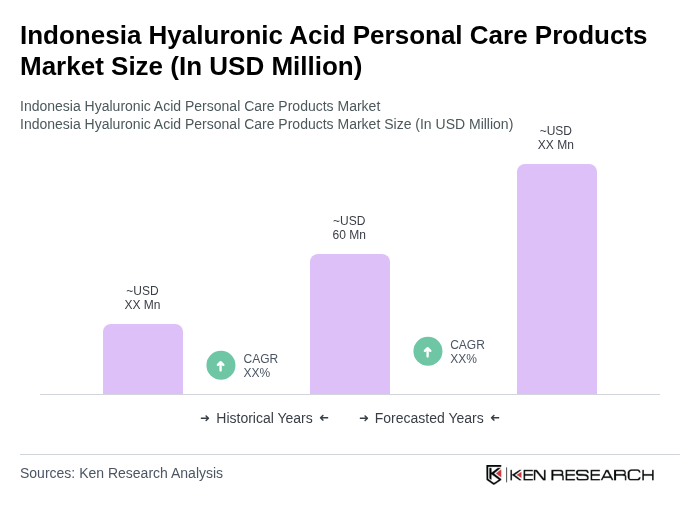
The Indonesia Hyaluronic Acid Personal Care Products Market, worth USD 60 million, grows due to rising consumer interest in anti-aging and hydrating skincare via e-commerce.

Region:Asia

Author(s):Shubham

Product Code:KRAD5464

Pages:91

Published On:December 2025
About the Report

Base Year 2024

Indonesia Hyaluronic Acid Personal Care Products Market Overview

  • The Indonesia Hyaluronic Acid Personal Care Products Market is valued at USD 60 million, based on a five-year historical analysis of the broader national hyaluronic acid market where aesthetics and cosmetics account for the leading share. This growth is primarily driven by increasing consumer awareness of skincare benefits, the rising popularity of anti-aging and hydrating products featuring active ingredients such as hyaluronic acid, niacinamide, and ceramides, and the expanding e-commerce sector and social?commerce platforms, which facilitate easier access to a wide range of local and international personal care brands.
  • Key cities such as Jakarta, Surabaya, and Bandung dominate the market due to their high population density, urban lifestyle, and growing middle-class consumers who are increasingly investing in differentiated skincare routines and premium products. The presence of numerous beauty retailers, modern trade channels, specialty beauty chains, and robust online platforms in these cities further enhances market growth by enabling rapid launch cycles and strong promotional activity for hyaluronic acid-based formats.
  • In 2023, the Indonesian government reinforced regulations to ensure the safety and efficacy of cosmetic products, including those containing hyaluronic acid, under the Indonesian National Agency of Drug and Food Control (BPOM) framework. The primary binding instrument is the Regulation of the Head of BPOM No. 23 of 2019 on Technical Requirements for Cosmetic Ingredients, which specifies positive and negative lists of ingredients, concentration limits, and safety conditions for use in cosmetics, alongside BPOM Regulation No. 12 of 2020 on Cosmetics Notification that mandates notification, safety assessment, and product information files before products can be marketed, thereby enhancing consumer trust and product quality.
Indonesia Hyaluronic Acid Personal Care Products Market Size

Indonesia Hyaluronic Acid Personal Care Products Market Segmentation

By Product Type:The product type segmentation includes various forms of hyaluronic acid products, each catering to different consumer needs. The market is primarily driven by the popularity of hyaluronic acid serums and moisturizing creams, which are favored for their hydrating, barrier-supporting, and plumping properties and are widely positioned for anti-aging, brightening, and intensive moisturizing benefits. Sheet masks and toners are also gaining traction, particularly among younger consumers influenced by K?beauty and multi?step skincare routines, who are seeking quick and effective skincare solutions that layer multiple hydrating ingredients including hyaluronic acid. The demand for cleansers and other topical formats such as facial mists and essences is growing as consumers become more aware of ingredient-led skincare and the importance of a comprehensive, stepwise skincare routine that maintains skin barrier function and addresses dehydration.
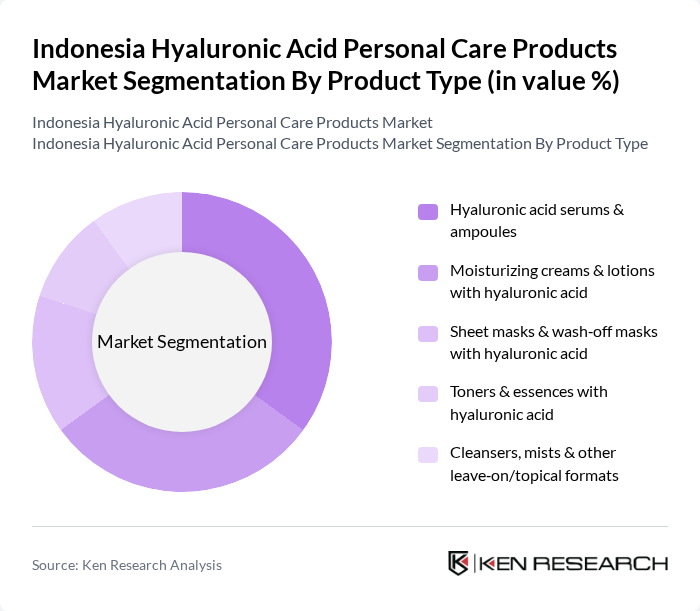
Indonesia Hyaluronic Acid Personal Care Products Market segmentation by Product Type.

By Consumer Group:The consumer group segmentation highlights the diverse demographics engaging with hyaluronic acid products. Women represent the largest consumer base, driven by a strong interest in skincare and beauty routines, ingredient-conscious purchasing, and a high uptake of multi-step facial care that incorporates hydrating actives. Men are increasingly adopting these products, particularly serums and moisturizers, as societal norms around male grooming evolve and brands actively promote simple yet effective routines targeted to male skin concerns such as dullness, oil imbalance, and early aging. Additionally, teens and young adults are becoming significant consumers, attracted by social media-driven trends, K?beauty and local brand campaigns, and the marketing of hydrating and anti-aging benefits at earlier ages, while niche groups such as those with sensitive, acne-prone, or mature skin are also catered to with specialized low-irritant or barrier-repair formulations that combine hyaluronic acid with soothing or exfoliating actives.
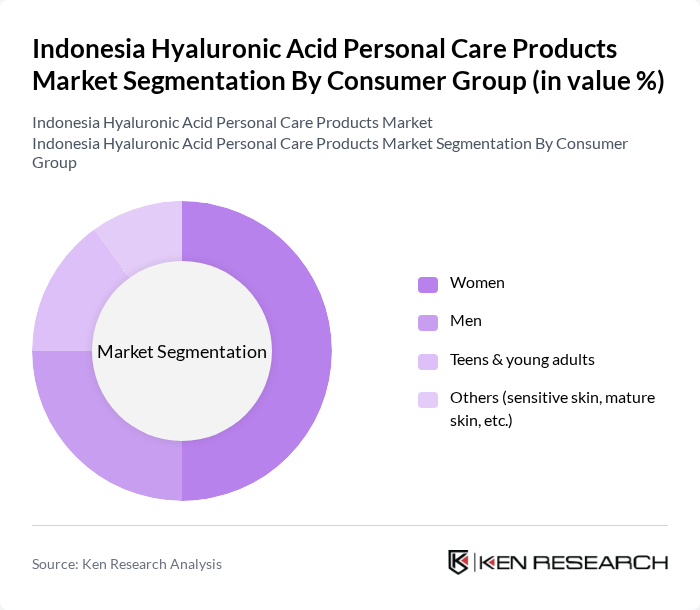
Indonesia Hyaluronic Acid Personal Care Products Market segmentation by Consumer Group.

Indonesia Hyaluronic Acid Personal Care Products Market Competitive Landscape

The Indonesia Hyaluronic Acid Personal Care Products Market is characterized by a dynamic mix of regional and international players. Leading participants such as PT Mandom Indonesia Tbk (Biore, Gatsby, etc.), PT Unilever Indonesia Tbk (Pond’s, Vaseline, etc.), PT L’Oréal Indonesia (L’Oréal Paris, Garnier, etc.), PT Procter & Gamble Home Products Indonesia (Olay, etc.), PT Paragon Technology and Innovation (Wardah, Emina, Make Over), PT Mustika Ratu Tbk, PT Martina Berto Tbk (Sariayu Martha Tilaar), PT AVO Innovation Technology (Avoskin), PT Social Bella Indonesia (Somethinc, Glowinc, etc.), PT ERHA Skincare (ERHA Dermatology Clinics & products), PT Kellos Beaute International (Whitelab), PT Bio Beauty Lab (Skin Bae and related HA products), PT Kalbe Farma Tbk – cosmetics & dermatology division, PT Kimia Farma Tbk – skincare & dermocosmetic lines, PT Sensatia Botanicals contribute to innovation, geographic expansion, and service delivery in this space.

PT Mandom Indonesia Tbk

1969

Jakarta, Indonesia

PT Unilever Indonesia Tbk

1933

Jakarta, Indonesia

PT L’Oréal Indonesia

1979

Jakarta, Indonesia

PT Procter & Gamble Home Products Indonesia

1989

Jakarta, Indonesia

PT Paragon Technology and Innovation

1985

Jakarta, Indonesia

Company

Establishment Year

Headquarters

Group size (local indie, national, regional, global)

Indonesia hyaluronic acid personal care revenue (IDR / USD)

Revenue CAGR in Indonesia HA personal care segment

Market share in Indonesia HA facial skincare (%)

Average selling price positioning (economy / mass / premium)

Number of hyaluronic acid SKUs in portfolio (Indonesia)

Indonesia Hyaluronic Acid Personal Care Products Market Industry Analysis

Growth Drivers

  • Increasing Consumer Awareness of Skincare Benefits:The Indonesian skincare market is projected to reach IDR 30 trillion in future, driven by heightened consumer awareness regarding skincare benefits. A survey by the Indonesian Cosmetic Association revealed that 70% of consumers actively seek products with hyaluronic acid due to its hydrating properties. This growing knowledge is fostering a culture of skincare, leading to increased demand for products that feature this ingredient, thus propelling market growth.
  • Rising Demand for Anti-Aging Products:The anti-aging segment in Indonesia is expected to grow significantly, with sales projected to reach IDR 10 trillion in future. This surge is attributed to an aging population, with 9% of Indonesians aged 60 and above. As consumers prioritize youthful skin, products containing hyaluronic acid are increasingly favored for their proven efficacy in reducing wrinkles and improving skin elasticity, driving market expansion.
  • Growth of E-Commerce Platforms for Personal Care:E-commerce sales in Indonesia's personal care sector are anticipated to exceed IDR 15 trillion in future, reflecting a 25% annual growth rate. The rise of online shopping has made skincare products more accessible, particularly among younger consumers. This trend is further supported by the increasing penetration of smartphones, with over 70% of the population using mobile devices, facilitating the purchase of hyaluronic acid products online.

Market Challenges

  • High Competition Among Local and International Brands:The Indonesian hyaluronic acid personal care market is characterized by intense competition, with over 200 brands vying for market share. This saturation leads to price wars and challenges in brand differentiation. Local brands, which account for 40% of the market, are increasingly innovating to compete with established international players, making it difficult for new entrants to gain traction.
  • Regulatory Hurdles in Product Approvals:Navigating Indonesia's regulatory landscape poses significant challenges for personal care brands. The National Agency of Drug and Food Control (BPOM) requires extensive documentation and testing for product approvals, which can take up to 12 months. This lengthy process can delay product launches and increase costs, hindering the ability of companies to respond swiftly to market trends and consumer demands.

Indonesia Hyaluronic Acid Personal Care Products Market Future Outlook

The future of the Indonesian hyaluronic acid personal care market appears promising, driven by evolving consumer preferences and technological advancements. As consumers increasingly seek personalized skincare solutions, brands are likely to invest in innovative formulations that cater to specific skin types. Additionally, the rise of social media as a marketing tool will continue to shape consumer behavior, encouraging brands to engage with their audience through targeted campaigns and influencer partnerships, enhancing brand loyalty and market penetration.

Market Opportunities

  • Increasing Trend Towards Natural and Organic Products:The demand for natural and organic personal care products is on the rise, with the market expected to reach IDR 5 trillion in future. This trend presents an opportunity for brands to develop hyaluronic acid products that emphasize natural ingredients, appealing to health-conscious consumers and enhancing brand reputation in a competitive landscape.
  • Growth in Male Grooming Products:The male grooming market in Indonesia is projected to grow to IDR 3 trillion in future, driven by changing perceptions of skincare among men. This presents a significant opportunity for brands to introduce hyaluronic acid-based products tailored for male consumers, tapping into a previously underrepresented segment and expanding their product offerings.

Scope of the Report

SegmentSub-Segments
By Product Type

Hyaluronic acid serums & ampoules

Moisturizing creams & lotions with hyaluronic acid

Sheet masks & wash?off masks with hyaluronic acid

Toners & essences with hyaluronic acid

Cleansers, mists & other leave?on/topical formats

By Consumer Group

Women

Men

Teens & young adults

Others (sensitive skin, mature skin, etc.)

By Distribution Channel

Online platforms (marketplaces & brand e?commerce)

Supermarkets/Hypermarkets

Specialty beauty stores

Pharmacies & drugstores

Beauty clinics, med?spas & others

By Packaging Type

Pump bottles & droppers

Tubes

Jars

Sachets & single?use packs

Others (airless, refill pouches, etc.)

By Price Range

Premium

Mass/mid?range

Economy

Others (dermatologist/clinic brands)

By Ingredient & Formulation Type

Pure / single?focus hyaluronic acid formulations

Multi?functional blends (HA with niacinamide, ceramides, etc.)

Natural & clean?label hyaluronic acid products

Others (encapsulated, cross?linked, etc.)

By Brand Type

Local Indonesian brands

International & K?beauty/J?beauty brands

Clinic/dermatologist & private?label brands

Key Target Audience

Investors and Venture Capitalist Firms

Government and Regulatory Bodies (e.g., Badan Pengawas Obat dan Makanan - BPOM)

Manufacturers and Producers

Distributors and Retailers

Cosmetic and Personal Care Brands

Raw Material Suppliers

Industry Associations (e.g., Asosiasi Perusahaan Kosmetik Indonesia - Apkos)

Financial Institutions

Players Mentioned in the Report:

PT Mandom Indonesia Tbk (Biore, Gatsby, etc.)

PT Unilever Indonesia Tbk (Ponds, Vaseline, etc.)

PT LOreal Indonesia (LOreal Paris, Garnier, etc.)

PT Procter & Gamble Home Products Indonesia (Olay, etc.)

PT Paragon Technology and Innovation (Wardah, Emina, Make Over)

PT Mustika Ratu Tbk

PT Martina Berto Tbk (Sariayu Martha Tilaar)

PT AVO Innovation Technology (Avoskin)

PT Social Bella Indonesia (Somethinc, Glowinc, etc.)

PT ERHA Skincare (ERHA Dermatology Clinics & products)

PT Kellos Beaute International (Whitelab)

PT Bio Beauty Lab (Skin Bae and related HA products)

PT Kalbe Farma Tbk cosmetics & dermatology division

PT Kimia Farma Tbk skincare & dermocosmetic lines

PT Sensatia Botanicals

Table of Contents

Market Assessment Phase

1. Executive Summary and Approach


2. Indonesia Hyaluronic Acid Personal Care Products Market Overview

2.1 Key Insights and Strategic Recommendations

2.2 Indonesia Hyaluronic Acid Personal Care Products Market Overview

2.3 Definition and Scope

2.4 Evolution of Market Ecosystem

2.5 Timeline of Key Regulatory Milestones

2.6 Value Chain & Stakeholder Mapping

2.7 Business Cycle Analysis

2.8 Policy & Incentive Landscape


3. Indonesia Hyaluronic Acid Personal Care Products Market Analysis

3.1 Growth Drivers

3.1.1 Increasing consumer awareness of skincare benefits
3.1.2 Rising demand for anti-aging products
3.1.3 Growth of e-commerce platforms for personal care
3.1.4 Expansion of beauty and wellness industry

3.2 Market Challenges

3.2.1 High competition among local and international brands
3.2.2 Regulatory hurdles in product approvals
3.2.3 Fluctuating raw material prices
3.2.4 Consumer skepticism towards product efficacy

3.3 Market Opportunities

3.3.1 Increasing trend towards natural and organic products
3.3.2 Potential for product innovation and diversification
3.3.3 Growth in male grooming products
3.3.4 Expansion into rural markets

3.4 Market Trends

3.4.1 Rise of personalized skincare solutions
3.4.2 Increasing use of social media for product promotion
3.4.3 Shift towards sustainable packaging
3.4.4 Growth of subscription-based models

3.5 Government Regulation

3.5.1 Stricter regulations on cosmetic ingredients
3.5.2 Mandatory labeling requirements
3.5.3 Import tariffs on foreign products
3.5.4 Compliance with local health and safety standards

4. SWOT Analysis


5. Stakeholder Analysis


6. Porter's Five Forces Analysis


7. Indonesia Hyaluronic Acid Personal Care Products Market Market Size, 2019-2024

7.1 By Value

7.2 By Volume

7.3 By Average Selling Price


8. Indonesia Hyaluronic Acid Personal Care Products Market Segmentation

8.1 By Product Type

8.1.1 Hyaluronic acid serums & ampoules
8.1.2 Moisturizing creams & lotions with hyaluronic acid
8.1.3 Sheet masks & wash?off masks with hyaluronic acid
8.1.4 Toners & essences with hyaluronic acid
8.1.5 Cleansers, mists & other leave?on/topical formats

8.2 By Consumer Group

8.2.1 Women
8.2.2 Men
8.2.3 Teens & young adults
8.2.4 Others (sensitive skin, mature skin, etc.)

8.3 By Distribution Channel

8.3.1 Online platforms (marketplaces & brand e?commerce)
8.3.2 Supermarkets/Hypermarkets
8.3.3 Specialty beauty stores
8.3.4 Pharmacies & drugstores
8.3.5 Beauty clinics, med?spas & others

8.4 By Packaging Type

8.4.1 Pump bottles & droppers
8.4.2 Tubes
8.4.3 Jars
8.4.4 Sachets & single?use packs
8.4.5 Others (airless, refill pouches, etc.)

8.5 By Price Range

8.5.1 Premium
8.5.2 Mass/mid?range
8.5.3 Economy
8.5.4 Others (dermatologist/clinic brands)

8.6 By Ingredient & Formulation Type

8.6.1 Pure / single?focus hyaluronic acid formulations
8.6.2 Multi?functional blends (HA with niacinamide, ceramides, etc.)
8.6.3 Natural & clean?label hyaluronic acid products
8.6.4 Others (encapsulated, cross?linked, etc.)

8.7 By Brand Type

8.7.1 Local Indonesian brands
8.7.2 International & K?beauty/J?beauty brands
8.7.3 Clinic/dermatologist & private?label brands

9. Indonesia Hyaluronic Acid Personal Care Products Market Competitive Analysis

9.1 Market Share of Key Players

9.2 Cross Comparison of Key Players

9.2.1 Company name
9.2.2 Group size (local indie, national, regional, global)
9.2.3 Indonesia hyaluronic acid personal care revenue (IDR / USD)
9.2.4 Revenue CAGR in Indonesia HA personal care segment
9.2.5 Market share in Indonesia HA facial skincare (%)
9.2.6 Average selling price positioning (economy / mass / premium)
9.2.7 Number of hyaluronic acid SKUs in portfolio (Indonesia)
9.2.8 Online channel contribution to HA sales (%)
9.2.9 Offline retail & clinic coverage (cities / doors)
9.2.10 New product launches with hyaluronic acid (last 3 years)
9.2.11 Marketing intensity (KOL/Influencer spend share, campaign frequency)
9.2.12 Average customer rating for HA products (e?commerce score)

9.3 SWOT Analysis of Top Players

9.4 Pricing Analysis

9.5 Detailed Profile of Major Companies

9.5.1 PT Mandom Indonesia Tbk (Biore, Gatsby, etc.)
9.5.2 PT Unilever Indonesia Tbk (Pond’s, Vaseline, etc.)
9.5.3 PT L’Oréal Indonesia (L’Oréal Paris, Garnier, etc.)
9.5.4 PT Procter & Gamble Home Products Indonesia (Olay, etc.)
9.5.5 PT Paragon Technology and Innovation (Wardah, Emina, Make Over)
9.5.6 PT Mustika Ratu Tbk
9.5.7 PT Martina Berto Tbk (Sariayu Martha Tilaar)
9.5.8 PT AVO Innovation Technology (Avoskin)
9.5.9 PT Social Bella Indonesia (Somethinc, Glowinc, etc.)
9.5.10 PT ERHA Skincare (ERHA Dermatology Clinics & products)
9.5.11 PT Kellos Beaute International (Whitelab)
9.5.12 PT Bio Beauty Lab (Skin Bae and related HA products)
9.5.13 PT Kalbe Farma Tbk – cosmetics & dermatology division
9.5.14 PT Kimia Farma Tbk – skincare & dermocosmetic lines
9.5.15 PT Sensatia Botanicals

10. Indonesia Hyaluronic Acid Personal Care Products Market End-User Analysis

10.1 Procurement Behavior of Key Ministries

10.1.1 Budget Allocation for Personal Care Products
10.1.2 Preference for Local vs. International Brands
10.1.3 Evaluation Criteria for Product Selection
10.1.4 Frequency of Procurement

10.2 Corporate Spend on Infrastructure & Energy

10.2.1 Investment in Sustainable Practices
10.2.2 Budget for Employee Wellness Programs
10.2.3 Spending on Personal Care Products
10.2.4 Trends in Corporate Gifting

10.3 Pain Point Analysis by End-User Category

10.3.1 Quality Concerns
10.3.2 Price Sensitivity
10.3.3 Availability of Products
10.3.4 Brand Loyalty Issues

10.4 User Readiness for Adoption

10.4.1 Awareness of Hyaluronic Acid Benefits
10.4.2 Willingness to Try New Products
10.4.3 Access to Information
10.4.4 Influence of Social Media

10.5 Post-Deployment ROI and Use Case Expansion

10.5.1 Measurement of Product Effectiveness
10.5.2 Customer Feedback Mechanisms
10.5.3 Opportunities for Upselling
10.5.4 Long-term Customer Engagement Strategies

11. Indonesia Hyaluronic Acid Personal Care Products Market Future Size, 2025-2030

11.1 By Value

11.2 By Volume

11.3 By Average Selling Price


Go-To-Market Strategy Phase

1. Whitespace Analysis + Business Model Canvas

1.1 Market Gaps Identification

1.2 Business Model Development


2. Marketing and Positioning Recommendations

2.1 Branding Strategies

2.2 Product USPs


3. Distribution Plan

3.1 Urban Retail Strategies

3.2 Rural NGO Tie-ups


4. Channel & Pricing Gaps

4.1 Underserved Routes

4.2 Pricing Bands


5. Unmet Demand & Latent Needs

5.1 Category Gaps

5.2 Consumer Segments


6. Customer Relationship

6.1 Loyalty Programs

6.2 After-sales Service


7. Value Proposition

7.1 Sustainability Initiatives

7.2 Integrated Supply Chains


8. Key Activities

8.1 Regulatory Compliance

8.2 Branding

8.3 Distribution Setup


9. Entry Strategy Evaluation

9.1 Domestic Market Entry Strategy

9.1.1 Product Mix
9.1.2 Pricing Band
9.1.3 Packaging

9.2 Export Entry Strategy

9.2.1 Target Countries
9.2.2 Compliance Roadmap

10. Entry Mode Assessment

10.1 JV

10.2 Greenfield

10.3 M&A

10.4 Distributor Model


11. Capital and Timeline Estimation

11.1 Capital Requirements

11.2 Timelines


12. Control vs Risk Trade-Off

12.1 Ownership vs Partnerships


13. Profitability Outlook

13.1 Breakeven Analysis

13.2 Long-term Sustainability


14. Potential Partner List

14.1 Distributors

14.2 JVs

14.3 Acquisition Targets


15. Execution Roadmap

15.1 Phased Plan for Market Entry

15.1.1 Market Setup
15.1.2 Market Entry
15.1.3 Growth Acceleration
15.1.4 Scale & Stabilize

15.2 Key Activities and Milestones

15.2.1 Activity Planning
15.2.2 Milestone Tracking

Research Methodology

ApproachModellingSample

Phase 1: Approach1

Desk Research

  • Analysis of market reports from industry associations and trade publications focused on personal care products in Indonesia
  • Review of government publications and regulatory frameworks related to cosmetic and personal care product safety standards
  • Examination of consumer behavior studies and market trends from reputable market research firms

Primary Research

  • In-depth interviews with product development managers at leading personal care brands
  • Surveys conducted with dermatologists and skincare professionals to understand consumer preferences
  • Focus group discussions with end-users to gather insights on product usage and satisfaction

Validation & Triangulation

  • Cross-validation of findings through comparison with historical sales data and market growth rates
  • Triangulation of insights from primary interviews with secondary data sources to ensure consistency
  • Sanity checks performed by consulting industry experts to validate assumptions and projections

Phase 2: Market Size Estimation1

Top-down Assessment

  • Estimation of the overall personal care market size in Indonesia, focusing on the hyaluronic acid segment
  • Analysis of demographic trends and their impact on market demand for personal care products
  • Incorporation of growth rates from related sectors such as skincare and cosmetics

Bottom-up Modeling

  • Collection of sales data from key distributors and retailers of hyaluronic acid personal care products
  • Estimation of average selling prices and volume sold across various product categories
  • Calculation of market size based on product penetration rates and consumer purchasing behavior

Forecasting & Scenario Analysis

  • Development of forecasting models based on historical growth trends and market dynamics
  • Scenario analysis considering factors such as economic conditions, consumer trends, and regulatory changes
  • Projections of market growth through 2030 under different market conditions (baseline, optimistic, and pessimistic scenarios)

Phase 3: CATI Sample Composition1

Scope Item/SegmentSample SizeTarget Respondent Profiles
Retail Sales of Hyaluronic Acid Products120Retail Managers, Beauty Advisors
Consumer Preferences in Skincare140Skincare Enthusiasts, General Consumers
Dermatological Insights on Product Efficacy100Dermatologists, Skincare Specialists
Market Trends in Personal Care80Market Analysts, Industry Experts
Distribution Channels for Personal Care Products70Supply Chain Managers, Distributors

Frequently Asked Questions

What is the current value of the Indonesia Hyaluronic Acid Personal Care Products Market?

The Indonesia Hyaluronic Acid Personal Care Products Market is valued at approximately USD 60 million, driven by increasing consumer awareness of skincare benefits and the rising popularity of products featuring active ingredients like hyaluronic acid.

What factors are driving the growth of the hyaluronic acid market in Indonesia?

Which cities in Indonesia are leading in the hyaluronic acid personal care market?

What regulatory measures are in place for hyaluronic acid products in Indonesia?

Other Regional/Country Reports

Malaysia Hyaluronic Acid Personal Care Products Market

KSA Hyaluronic Acid Personal Care Products Market

APAC Hyaluronic Acid Personal Care Products Market

SEA Hyaluronic Acid Personal Care Products Market

Vietnam Hyaluronic Acid Personal Care Products Market

Thailand Hyaluronic Acid Personal Care Products Market

Other Adjacent Reports

Thailand Anti-Aging Skincare Market

Singapore Hydrating Cosmetics Market

Vietnam Natural Ingredients Personal Care Market

Belgium E-Commerce Beauty Products Market

India Male Grooming Products Market Outlook to 2030

UAE K-Beauty Products Market

Kuwait Dermatological Skincare Market

South Korea Organic Skincare Market

Mexico Facial Serums Market

Japan Moisturizing Creams Market

Why Buy From Us?

Refine Robust Result (RRR) Framework

What makes us stand out is that our consultants follow Robust, Refine and Result (RRR) methodology. Robust for clear definitions, approaches and sanity checking, Refine for differentiating respondents' facts and opinions, and Result for presenting data with story.

Our Reach Is Unmatched

We have set a benchmark in the industry by offering our clients with syndicated and customized market research reports featuring coverage of entire market as well as meticulous research and analyst insights.

Shifting the Research Paradigm

While we don't replace traditional research, we flip the method upside down. Our dual approach of Top Bottom & Bottom Top ensures quality deliverable by not just verifying company fundamentals but also looking at the sector and macroeconomic factors.

More Insights-Better Decisions

With one step in the future, our research team constantly tries to show you the bigger picture. We help with some of the tough questions you may encounter along the way: How is the industry positioned? Best marketing channel? KPI's of competitors? By aligning every element, we help maximize success.

Transparency and Trust

Our report gives you instant access to the answers and sources that other companies might choose to hide. We elaborate each steps of research methodology we have used and showcase you the sample size to earn your trust.

Round the Clock Support

If you need any support, we are here! We pride ourselves on universe strength, data quality, and quick, friendly, and professional service.

Why Clients Choose Us?

400000+
Reports in repository
150+
Consulting projects a year
100+
Analysts
8000+
Client Queries in 2022