About the Report
Base Year 2024Indonesia Infrastructure Asset Management Market Overview
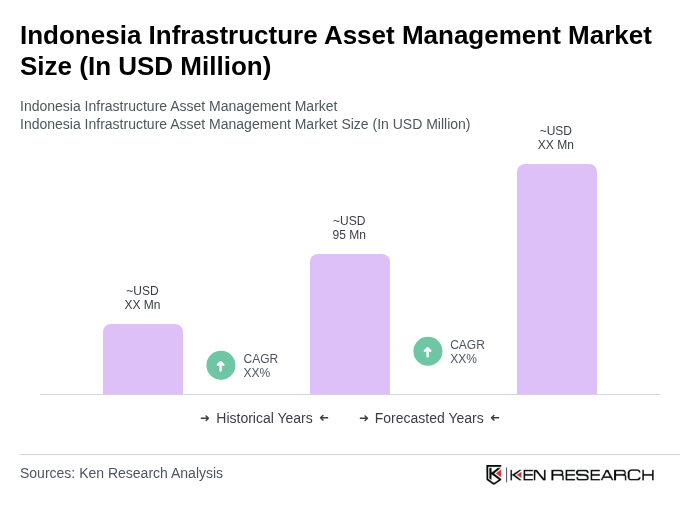
- The Indonesia Infrastructure Asset Management Market is valued at USD 95 million, based on a five-year historical analysis. This growth is primarily driven by the increasing need for efficient management of public assets, rapid urbanization, and substantial government initiatives aimed at improving infrastructure quality and sustainability. Key growth drivers include the rising demand for smart infrastructure solutions, integration of digital technologies such as IoT and AI in asset management, and robust government spending on transportation, utilities, and social infrastructure. The market is also benefiting from increased private sector participation through Public-Private Partnerships (PPPs) and foreign direct investment, which are accelerating development and innovation in asset management practices.
- Key cities such asJakarta, Surabaya, and Bandungcontinue to dominate the market due to their rapid urbanization, high population density, and concentration of major infrastructure projects. Jakarta leads in government infrastructure spending, while Surabaya and Bandung play pivotal roles in regional development, attracting significant investments and fostering public-private partnerships. Java island, where these cities are located, receives the majority of infrastructure investment, though government efforts to develop Sumatra, Kalimantan, and Sulawesi are increasing.
- The Indonesian government’sNational Strategic Projects (NSP) regulation, issued under Presidential Regulation No. 109 of 2020 by the President of the Republic of Indonesia, aims to accelerate infrastructure development nationwide. This binding instrument prioritizes key projects, streamlines approval processes, and encourages foreign investment, thereby enhancing the efficiency and effectiveness of infrastructure asset management. The regulation covers transportation, energy, water, and social infrastructure, requiring compliance with project selection criteria, expedited permitting, and investment facilitation.
Indonesia Infrastructure Asset Management Market Segmentation
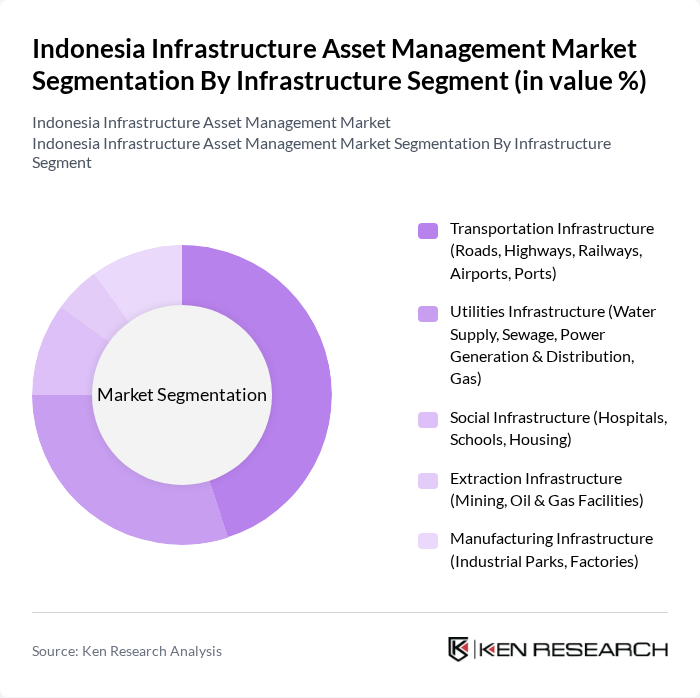
By Infrastructure Segment:The infrastructure segment of the market includes transportation, utilities, social, extraction, and manufacturing infrastructure. Transportation infrastructure—comprising roads, highways, railways, airports, and ports—remains the largest segment due to Indonesia’s focus on improving logistics and connectivity for economic growth. Utilities infrastructure, including water supply, sewage, power generation and distribution, and gas, is critical for supporting urban expansion and sustainability. Social infrastructure such as hospitals, schools, and housing is expanding to meet the needs of a growing population and improve living standards. Extraction infrastructure (mining, oil & gas facilities) and manufacturing infrastructure (industrial parks, factories) are also important, with moderate growth driven by industrialization and resource development.
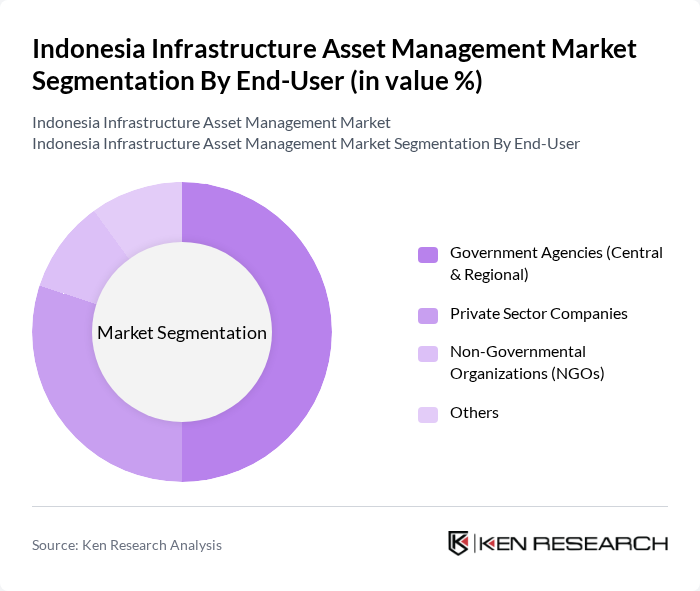
By End-User:The end-user segmentation includes government agencies, private sector companies, non-governmental organizations (NGOs), and others. Government agencies are the primary users of infrastructure asset management services, responsible for public infrastructure development and maintenance. Private sector companies play an increasingly significant role, especially in PPPs and project execution. NGOs contribute to social infrastructure projects, focusing on community development and sustainability. The “Others” category includes multilateral organizations and local community groups involved in infrastructure initiatives.
Indonesia Infrastructure Asset Management Market Competitive Landscape
The Indonesia Infrastructure Asset Management Market is characterized by a dynamic mix of regional and international players. Leading participants such as PT Waskita Karya (Persero) Tbk, PT Jasa Marga (Persero) Tbk, PT Adhi Karya (Persero) Tbk, PT Pembangunan Perumahan (Persero) Tbk, PT Wijaya Karya (Persero) Tbk, PT Hutama Karya (Persero), PT Kereta Api Indonesia (Persero), PT Angkasa Pura I (Persero), PT Angkasa Pura II (Persero), PT Perusahaan Gas Negara Tbk, PT PLN (Persero), PT Sarana Multi Infrastruktur (Persero), PT Transjakarta, PT Citra Marga Nusaphala Persada Tbk, PT Pembangunan Infrastruktur Nasional, PT PP Properti Tbk, PT Summarecon Agung Tbk, PT Astra Infra, PT Nusantara Infrastructure Tbk, PT SMI (Sarana Multi Infrastruktur) contribute to innovation, geographic expansion, and service delivery in this space.
Indonesia Infrastructure Asset Management Market Industry Analysis
Growth Drivers
- Increasing Urbanization:Indonesia's urban population is projected to reach 68% in the future, up from 56% in 2020, according to the World Bank. This rapid urbanization drives demand for infrastructure development, including transportation, housing, and utilities. The government aims to accommodate this growth by investing approximately IDR 500 trillion (around USD 33.5 billion) in urban infrastructure projects, enhancing asset management practices to ensure sustainability and efficiency in urban areas.
- Government Infrastructure Spending:The Indonesian government allocated IDR 500 trillion (approximately USD 33.5 billion) for infrastructure development in the future budget, a significant increase from IDR 370 trillion in 2023. This funding focuses on transportation, energy, and water management projects, which are crucial for economic growth. Enhanced infrastructure spending is expected to improve asset management practices, ensuring that projects are completed on time and within budget, thereby boosting overall market growth.
- Technological Advancements:The adoption of advanced technologies in asset management, such as Building Information Modeling (BIM) and Geographic Information Systems (GIS), is transforming Indonesia's infrastructure landscape. In the future, investments in digital technologies are expected to exceed IDR 60 trillion (around USD 4.2 billion), facilitating better planning, monitoring, and maintenance of infrastructure assets. These advancements enhance operational efficiency and reduce costs, driving growth in the asset management market.
Market Challenges
- Regulatory Hurdles:Indonesia's complex regulatory environment poses significant challenges for infrastructure asset management. The country has over 1,000 regulations affecting infrastructure projects, leading to delays and increased costs. In the future, the government aims to streamline these regulations, but the existing bureaucratic processes can still hinder timely project execution, impacting overall market efficiency and investor confidence.
- Funding Limitations:Despite increased government spending, funding limitations remain a critical challenge for infrastructure projects in Indonesia. The country faces a financing gap of approximately IDR 1,200 trillion (around USD 84 billion) for infrastructure needs in the future. Limited access to financing options for private investors and public-private partnerships (PPPs) can impede the development and management of essential infrastructure assets, affecting market growth.
Indonesia Infrastructure Asset Management Market Future Outlook
The future of Indonesia's infrastructure asset management market appears promising, driven by ongoing urbanization and government initiatives. In the future, the integration of smart technologies and sustainable practices is expected to reshape asset management strategies. Enhanced collaboration between public and private sectors will likely lead to innovative financing solutions, addressing funding gaps. As the government prioritizes infrastructure development, the market is poised for growth, with a focus on efficiency, sustainability, and resilience in asset management practices.
Market Opportunities
- Sustainable Infrastructure Development:The Indonesian government is increasingly prioritizing sustainable infrastructure projects, with an investment target of IDR 250 trillion (approximately USD 17.5 billion) in the future. This focus on sustainability presents opportunities for asset management firms to implement eco-friendly practices, enhancing their market position and attracting environmentally conscious investors.
- Digital Asset Management Solutions:The demand for digital asset management solutions is expected to grow significantly, with investments projected to reach IDR 40 trillion (around USD 2.8 billion) in the future. Companies that offer innovative digital solutions can capitalize on this trend, improving operational efficiency and providing better data analytics for infrastructure management, thus enhancing their competitive edge.
Scope of the Report
| Segment | Sub-Segments |
|---|---|
| By Infrastructure Segment | Transportation Infrastructure (Roads, Highways, Railways, Airports, Ports) Utilities Infrastructure (Water Supply, Sewage, Power Generation & Distribution, Gas) Social Infrastructure (Hospitals, Schools, Housing) Extraction Infrastructure (Mining, Oil & Gas Facilities) Manufacturing Infrastructure (Industrial Parks, Factories) |
| By End-User | Government Agencies (Central & Regional) Private Sector Companies Non-Governmental Organizations (NGOs) Others |
| By Region | Java Sumatra Kalimantan Sulawesi Bali and Nusa Tenggara |
| By Technology | Asset Management Software & Platforms Geographic Information Systems (GIS) Drones and Aerial Imaging Predictive Maintenance Tools IoT & Sensor Networks Others |
| By Application | Infrastructure Planning & Design Asset Monitoring & Condition Assessment Risk Management & Compliance Performance Optimization & Lifecycle Management Others |
| By Investment Source | Domestic Investment Foreign Direct Investment (FDI) Public-Private Partnerships (PPP) Government Grants Others |
| By Policy Support | Subsidies Tax Incentives Regulatory Support Others |
Key Target Audience
Investors and Venture Capitalist Firms
Government and Regulatory Bodies (e.g., Ministry of Public Works and Housing, National Development Planning Agency)
Infrastructure Development Companies
Public-Private Partnership (PPP) Units
Real Estate Investment Trusts (REITs)
Construction and Engineering Firms
Local Government Authorities
Financial Institutions and Banks
Players Mentioned in the Report:
PT Waskita Karya (Persero) Tbk
PT Jasa Marga (Persero) Tbk
PT Adhi Karya (Persero) Tbk
PT Pembangunan Perumahan (Persero) Tbk
PT Wijaya Karya (Persero) Tbk
PT Hutama Karya (Persero)
PT Kereta Api Indonesia (Persero)
PT Angkasa Pura I (Persero)
PT Angkasa Pura II (Persero)
PT Perusahaan Gas Negara Tbk
PT PLN (Persero)
PT Sarana Multi Infrastruktur (Persero)
PT Transjakarta
PT Citra Marga Nusaphala Persada Tbk
PT Pembangunan Infrastruktur Nasional
PT PP Properti Tbk
PT Summarecon Agung Tbk
PT Astra Infra
PT Nusantara Infrastructure Tbk
PT SMI (Sarana Multi Infrastruktur)
Table of Contents
Market Assessment Phase
1. Executive Summary and Approach
2. Indonesia Infrastructure Asset Management Market Overview
2.1 Key Insights and Strategic Recommendations
2.2 Indonesia Infrastructure Asset Management Market Overview
2.3 Definition and Scope
2.4 Evolution of Market Ecosystem
2.5 Timeline of Key Regulatory Milestones
2.6 Value Chain & Stakeholder Mapping
2.7 Business Cycle Analysis
2.8 Policy & Incentive Landscape
3. Indonesia Infrastructure Asset Management Market Analysis
3.1 Growth Drivers
3.1.1 Increasing Urbanization
3.1.2 Government Infrastructure Spending
3.1.3 Technological Advancements
3.1.4 Public-Private Partnerships (PPPs)
3.2 Market Challenges
3.2.1 Regulatory Hurdles
3.2.2 Funding Limitations
3.2.3 Lack of Skilled Workforce
3.2.4 Infrastructure Maintenance Issues
3.3 Market Opportunities
3.3.1 Sustainable Infrastructure Development
3.3.2 Digital Asset Management Solutions
3.3.3 Expansion of Renewable Energy Projects
3.3.4 International Investment Influx
3.4 Market Trends
3.4.1 Smart Infrastructure Solutions
3.4.2 Increased Focus on Sustainability
3.4.3 Integration of IoT in Asset Management
3.4.4 Enhanced Data Analytics Usage
3.5 Government Regulation
3.5.1 Infrastructure Development Law
3.5.2 Environmental Regulations
3.5.3 Investment Incentives for Foreign Investors
3.5.4 Local Content Requirements
4. SWOT Analysis
5. Stakeholder Analysis
6. Porter's Five Forces Analysis
7. Indonesia Infrastructure Asset Management Market Market Size, 2019-2024
7.1 By Value
7.2 By Volume
7.3 By Average Selling Price
8. Indonesia Infrastructure Asset Management Market Segmentation
8.1 By Infrastructure Segment
8.1.1 Transportation Infrastructure (Roads, Highways, Railways, Airports, Ports)
8.1.2 Utilities Infrastructure (Water Supply, Sewage, Power Generation & Distribution, Gas)
8.1.3 Social Infrastructure (Hospitals, Schools, Housing)
8.1.4 Extraction Infrastructure (Mining, Oil & Gas Facilities)
8.1.5 Manufacturing Infrastructure (Industrial Parks, Factories)
8.2 By End-User
8.2.1 Government Agencies (Central & Regional)
8.2.2 Private Sector Companies
8.2.3 Non-Governmental Organizations (NGOs)
8.2.4 Others
8.3 By Region
8.3.1 Java
8.3.2 Sumatra
8.3.3 Kalimantan
8.3.4 Sulawesi
8.3.5 Bali and Nusa Tenggara
8.4 By Technology
8.4.1 Asset Management Software & Platforms
8.4.2 Geographic Information Systems (GIS)
8.4.3 Drones and Aerial Imaging
8.4.4 Predictive Maintenance Tools
8.4.5 IoT & Sensor Networks
8.4.6 Others
8.5 By Application
8.5.1 Infrastructure Planning & Design
8.5.2 Asset Monitoring & Condition Assessment
8.5.3 Risk Management & Compliance
8.5.4 Performance Optimization & Lifecycle Management
8.5.5 Others
8.6 By Investment Source
8.6.1 Domestic Investment
8.6.2 Foreign Direct Investment (FDI)
8.6.3 Public-Private Partnerships (PPP)
8.6.4 Government Grants
8.6.5 Others
8.7 By Policy Support
8.7.1 Subsidies
8.7.2 Tax Incentives
8.7.3 Regulatory Support
8.7.4 Others
9. Indonesia Infrastructure Asset Management Market Competitive Analysis
9.1 Market Share of Key Players
9.2 KPIs for Cross Comparison of Key Players
9.2.1 Company Name
9.2.2 Group Size (Large, Medium, Small)
9.2.3 Revenue Growth Rate (YoY %)
9.2.4 Asset Portfolio Value (USD)
9.2.5 Market Share (%)
9.2.6 Project Delivery Timeliness (% On-Time)
9.2.7 Operational Efficiency (Cost per Asset Managed)
9.2.8 Customer Satisfaction Score (Net Promoter Score or Equivalent)
9.2.9 Innovation Index (Patents, Digital Adoption Rate)
9.2.10 ESG Performance (Environmental, Social, Governance Ratings)
9.3 SWOT Analysis of Top Players
9.4 Pricing Analysis
9.5 Detailed Profile of Major Companies
9.5.1 PT Waskita Karya (Persero) Tbk
9.5.2 PT Jasa Marga (Persero) Tbk
9.5.3 PT Adhi Karya (Persero) Tbk
9.5.4 PT Pembangunan Perumahan (Persero) Tbk
9.5.5 PT Wijaya Karya (Persero) Tbk
9.5.6 PT Hutama Karya (Persero)
9.5.7 PT Kereta Api Indonesia (Persero)
9.5.8 PT Angkasa Pura I (Persero)
9.5.9 PT Angkasa Pura II (Persero)
9.5.10 PT Perusahaan Gas Negara Tbk
9.5.11 PT PLN (Persero)
9.5.12 PT Sarana Multi Infrastruktur (Persero)
9.5.13 PT Transjakarta
9.5.14 PT Citra Marga Nusaphala Persada Tbk
9.5.15 PT Pembangunan Infrastruktur Nasional
9.5.16 PT PP Properti Tbk
9.5.17 PT Summarecon Agung Tbk
9.5.18 PT Astra Infra
9.5.19 PT Nusantara Infrastructure Tbk
9.5.20 PT SMI (Sarana Multi Infrastruktur)
10. Indonesia Infrastructure Asset Management Market End-User Analysis
10.1 Procurement Behavior of Key Ministries
10.1.1 Ministry of Public Works and Housing
10.1.2 Ministry of Transportation
10.1.3 Ministry of Energy and Mineral Resources
10.1.4 Ministry of Finance
10.2 Corporate Spend on Infrastructure & Energy
10.2.1 Infrastructure Development Budgets
10.2.2 Energy Sector Investments
10.3 Pain Point Analysis by End-User Category
10.3.1 Government Agencies
10.3.2 Private Sector Companies
10.3.3 NGOs
10.4 User Readiness for Adoption
10.4.1 Technology Adoption Rates
10.4.2 Training and Development Needs
10.5 Post-Deployment ROI and Use Case Expansion
10.5.1 Performance Metrics
10.5.2 Case Studies of Successful Implementations
11. Indonesia Infrastructure Asset Management Market Future Size, 2025-2030
11.1 By Value
11.2 By Volume
11.3 By Average Selling Price
Go-To-Market Strategy Phase
1. Whitespace Analysis + Business Model Canvas
1.1 Market Gaps Identification
1.2 Business Model Development
2. Marketing and Positioning Recommendations
2.1 Branding Strategies
2.2 Product USPs
3. Distribution Plan
3.1 Urban Retail vs Rural NGO Tie-ups
4. Channel & Pricing Gaps
4.1 Underserved Routes
4.2 Pricing Bands
5. Unmet Demand & Latent Needs
5.1 Category Gaps
5.2 Consumer Segments
6. Customer Relationship
6.1 Loyalty Programs
6.2 After-sales Service
7. Value Proposition
7.1 Sustainability
7.2 Integrated Supply Chains
8. Key Activities
8.1 Regulatory Compliance
8.2 Branding
8.3 Distribution Setup
9. Entry Strategy Evaluation
9.1 Domestic Market Entry Strategy
9.1.1 Product Mix
9.1.2 Pricing Band
9.1.3 Packaging
9.2 Export Entry Strategy
9.2.1 Target Countries
9.2.2 Compliance Roadmap
10. Entry Mode Assessment
10.1 JV
10.2 Greenfield
10.3 M&A
10.4 Distributor Model
11. Capital and Timeline Estimation
11.1 Capital Requirements
11.2 Timelines
12. Control vs Risk Trade-Off
12.1 Ownership vs Partnerships
13. Profitability Outlook
13.1 Breakeven Analysis
13.2 Long-term Sustainability
14. Potential Partner List
14.1 Distributors
14.2 JVs
14.3 Acquisition Targets
15. Execution Roadmap
15.1 Phased Plan for Market Entry
15.1.1 Market Setup
15.1.2 Market Entry
15.1.3 Growth Acceleration
15.1.4 Scale & Stabilize
15.2 Key Activities and Milestones
15.2.1 Milestone Planning
Research Methodology
Phase 1: Approach1
Desk Research
- Analysis of government reports on infrastructure development and investment trends in Indonesia
- Review of industry publications and white papers from infrastructure management organizations
- Examination of financial reports and press releases from key players in the Indonesian infrastructure sector
Primary Research
- Interviews with senior executives from infrastructure asset management firms operating in Indonesia
- Surveys targeting government officials involved in infrastructure planning and management
- Field interviews with project managers overseeing major infrastructure projects
Validation & Triangulation
- Cross-validation of findings through multiple data sources including government and private sector reports
- Triangulation of qualitative insights from interviews with quantitative data from market reports
- Sanity checks conducted through expert panel reviews comprising industry veterans
Phase 2: Market Size Estimation1
Top-down Assessment
- Estimation of total infrastructure spending in Indonesia as a basis for market size
- Segmentation of the market by asset type, including transportation, utilities, and social infrastructure
- Incorporation of government initiatives and foreign investments in infrastructure projects
Bottom-up Modeling
- Collection of data on asset management contracts from leading infrastructure firms
- Estimation of operational costs based on service pricing models in the sector
- Volume x cost analysis for various asset classes to derive market size
Forecasting & Scenario Analysis
- Multi-factor regression analysis incorporating GDP growth, urbanization rates, and infrastructure needs
- Scenario modeling based on potential changes in government policy and investment levels
- Development of baseline, optimistic, and pessimistic forecasts through 2030
Phase 3: CATI Sample Composition1
| Scope Item/Segment | Sample Size | Target Respondent Profiles |
|---|---|---|
| Transportation Infrastructure Management | 100 | Infrastructure Managers, Project Directors |
| Utility Asset Management | 80 | Operations Managers, Regulatory Affairs Specialists |
| Public-Private Partnership Projects | 70 | Government Officials, Financial Analysts |
| Social Infrastructure Development | 60 | Community Development Officers, Urban Planners |
| Investment in Smart Infrastructure | 90 | Technology Officers, Strategic Planners |
Frequently Asked Questions
What is the current value of the Indonesia Infrastructure Asset Management Market?
The Indonesia Infrastructure Asset Management Market is valued at approximately USD 95 million, reflecting a five-year historical analysis. This growth is driven by urbanization, government initiatives, and the demand for efficient public asset management.
What are the key drivers of growth in the Indonesia Infrastructure Asset Management Market?
Which cities are leading in infrastructure asset management in Indonesia?
What role do Public-Private Partnerships (PPPs) play in Indonesia's infrastructure?
Other Regional/Country Reports
Malaysia Infrastructure Asset Management Market
KSA Infrastructure Asset Management Market
APAC Infrastructure Asset Management Market
SEA Infrastructure Asset Management Market
Vietnam Infrastructure Asset Management Market
Thailand Infrastructure Asset Management Market
Other Adjacent Reports
South Africa Construction Management Market
United Arab Emirates Facilities Management Market Outlook to 2026FQatar Smart Infrastructure Technology Market
Brazil Public-Private Partnership Market
Germany Urban Planning Market
South Korea Transportation Infrastructure Market
Belgium Utility Management Market
Indonesia Sustainable Development Market
Malaysia Engineering Services Market
APAC Digital Transformation Market Report Size Share Growth Drivers Trends Opportunities & Forecast 2025–2030Why Buy From Us?

What makes us stand out is that our consultants follow Robust, Refine and Result (RRR) methodology. Robust for clear definitions, approaches and sanity checking, Refine for differentiating respondents' facts and opinions, and Result for presenting data with story.

We have set a benchmark in the industry by offering our clients with syndicated and customized market research reports featuring coverage of entire market as well as meticulous research and analyst insights.

While we don't replace traditional research, we flip the method upside down. Our dual approach of Top Bottom & Bottom Top ensures quality deliverable by not just verifying company fundamentals but also looking at the sector and macroeconomic factors.

With one step in the future, our research team constantly tries to show you the bigger picture. We help with some of the tough questions you may encounter along the way: How is the industry positioned? Best marketing channel? KPI's of competitors? By aligning every element, we help maximize success.

Our report gives you instant access to the answers and sources that other companies might choose to hide. We elaborate each steps of research methodology we have used and showcase you the sample size to earn your trust.

If you need any support, we are here! We pride ourselves on universe strength, data quality, and quick, friendly, and professional service.