Indonesia loitering munition market report Size, Share, Growth Drivers, Trends, Opportunities & Forecast 2025–2030

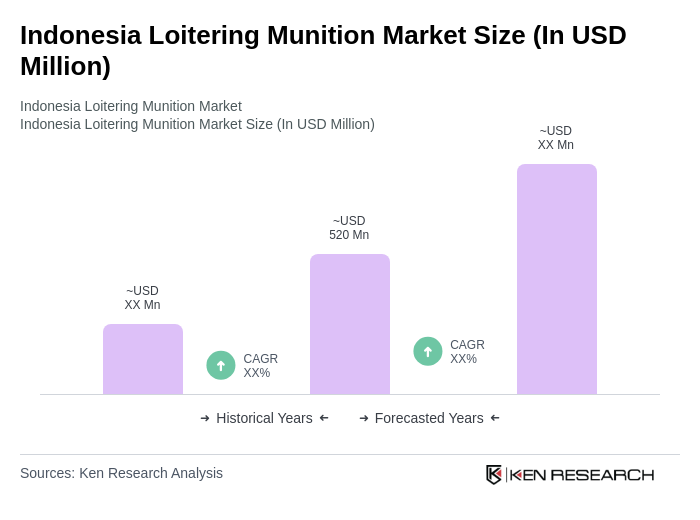
The Indonesia Loitering Munition Market, valued at USD 520 million, is growing due to military modernization, precision strikes, and UAV advancements.

Region:Asia

Author(s):Geetanshi

Product Code:KRAC3067

Pages:81

Published On:October 2025
About the Report

Base Year 2024

Indonesia Loitering Munition Market Overview

  • The Indonesia Loitering Munition Market is valued at USD 520 million, based on a five-year historical analysis. This growth is primarily driven by increasing defense budgets, modernization of military capabilities, and the rising need for advanced warfare technologies. The demand for loitering munitions has surged as they provide enhanced surveillance and precision strike capabilities, making them essential for contemporary military operations .
  • Key players in this market include Jakarta, Surabaya, and Bandung, which dominate due to their strategic military installations and defense industry presence. Jakarta, as the capital, is the hub for defense procurement and policy-making, while Surabaya and Bandung host significant military bases and research facilities, fostering innovation and collaboration in loitering munition development .
  • The Presidential Regulation No. 18 of 2020 on the National Medium-Term Development Plan (RPJMN) 2020–2024, issued by the Government of Indonesia, mandates the modernization and integration of advanced defense technologies, including unmanned systems and loitering munitions, into the national defense strategy. This regulation emphasizes indigenous development and procurement of advanced military technologies to enhance the operational capabilities of the Indonesian Armed Forces and reduce reliance on foreign defense systems .
Indonesia Loitering Munition Market Size

Indonesia Loitering Munition Market Segmentation

By Type:The market is segmented into various types of loitering munitions, including Expendable Loitering Munitions, Recoverable Loitering Munitions, Tactical Loitering Munitions, Strategic Loitering Munitions, Miniature Loitering Munitions, and Others. Among these, Tactical Loitering Munitions are currently dominating the market due to their versatility and effectiveness in various military operations. The increasing focus on precision strikes and real-time intelligence gathering has led to a higher demand for tactical systems, which can be deployed in diverse combat scenarios .
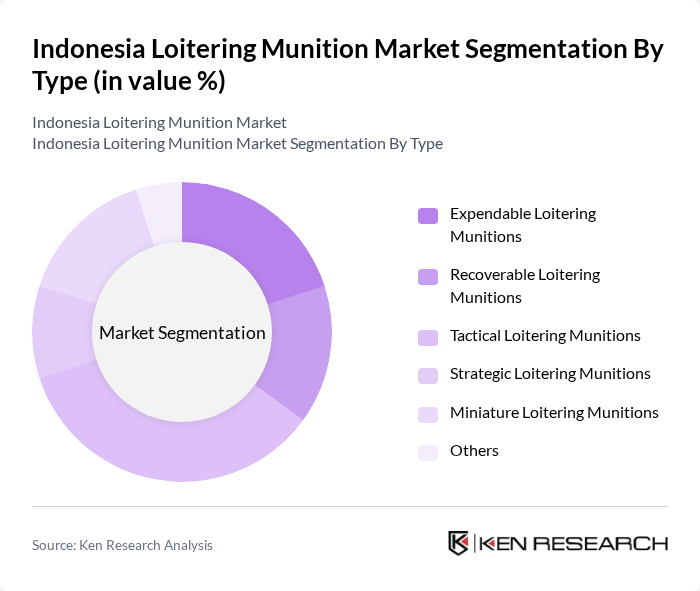
Indonesia Loitering Munition Market segmentation by Type.

By Launch Mode:The market is also segmented by launch mode, which includes Air-Launched Effect, Vertical Take-Off, Catapult Launched, Canister Launched, Hand Launched, and Others. The Air-Launched Effect is currently the leading segment due to its operational flexibility and the ability to deploy loitering munitions from various aircraft platforms. This method allows for rapid deployment and enhances the tactical advantage in combat situations .
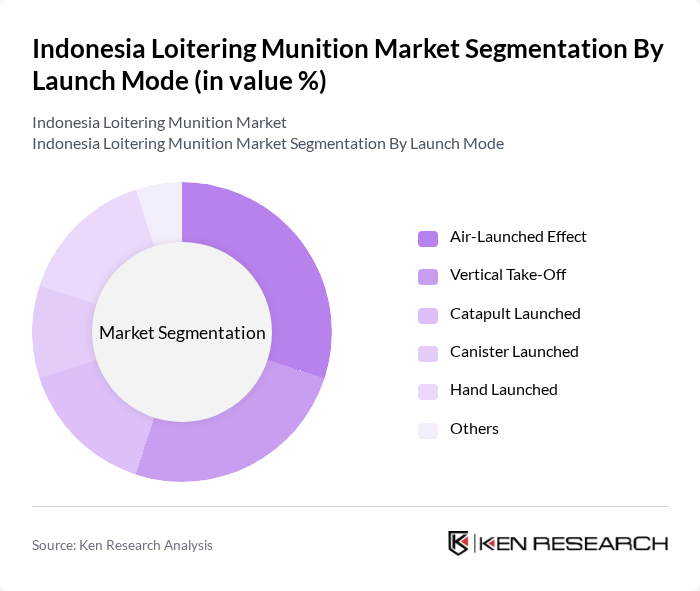
Indonesia Loitering Munition Market segmentation by Launch Mode.

Indonesia Loitering Munition Market Competitive Landscape

The Indonesia Loitering Munition Market is characterized by a dynamic mix of regional and international players. Leading participants such as PT Dirgantara Indonesia (Persero), PT Pindad (Persero), PT Bhinneka Mentari Dimensi, Elbit Systems Ltd., AeroVironment, Inc., Israel Aerospace Industries Ltd. (IAI), UVision Air Ltd., MBDA, Northrop Grumman Corporation, General Atomics Aeronautical Systems, Inc., Lockheed Martin Corporation, Raytheon Technologies Corporation, Thales Group, Boeing Defense, Space & Security, Saab AB, Leonardo S.p.A., Rheinmetall AG contribute to innovation, geographic expansion, and service delivery in this space.

PT Dirgantara Indonesia (Persero)

1976

Bandung, Indonesia

PT Pindad (Persero)

1983

Bandung, Indonesia

Elbit Systems Ltd.

1966

Haifa, Israel

AeroVironment, Inc.

1971

Arlington, Virginia, USA

Israel Aerospace Industries Ltd. (IAI)

1953

Lod, Israel

Company

Establishment Year

Headquarters

Group Size (Large, Medium, or Small as per industry convention)

Revenue Growth Rate (YoY %)

Market Penetration Rate (Indonesia-specific share)

Number of Active Contracts/Programs in Indonesia

R&D Expenditure (% of revenue)

Product Portfolio Breadth (Number of LM variants)

Indonesia Loitering Munition Market Industry Analysis

Growth Drivers

  • Increasing Defense Budgets:Indonesia's defense budget is projected to reach approximately IDR 134.3 trillion (USD 8.9 billion) in future, reflecting a moderate increase from the previous period. This rise is driven by the government's commitment to modernizing its military capabilities, particularly in response to regional security threats. Enhanced funding allows for the procurement of advanced loitering munitions, which are essential for maintaining strategic deterrence and operational effectiveness in asymmetric warfare scenarios.
  • Rising Demand for Precision Strike Capabilities:The Indonesian military is increasingly focused on enhancing its precision strike capabilities, with an estimated allocation of IDR 30 trillion (USD 2.1 billion) specifically for advanced weaponry in future. This demand is fueled by the need for effective counter-terrorism operations and maritime security. Loitering munitions, known for their accuracy and reduced collateral damage, are becoming a critical component of Indonesia's defense strategy, aligning with global trends in military modernization.
  • Technological Advancements in UAVs:The Indonesian government is investing heavily in unmanned aerial vehicle (UAV) technology, with an expected expenditure of IDR 20 trillion (USD 1.4 billion) in future. This investment is aimed at developing indigenous UAV systems that can integrate loitering munitions. The advancements in UAV technology enhance operational capabilities, allowing for real-time intelligence, surveillance, and reconnaissance, which are vital for effective military operations in diverse terrains.

Market Challenges

  • High Development Costs:The development of loitering munitions involves significant financial investment, with estimated costs ranging from IDR 5 trillion to IDR 10 trillion (USD 350 million to USD 700 million) for advanced systems. These high costs can deter local manufacturers and limit the number of projects initiated. Additionally, the need for specialized technology and skilled personnel further exacerbates the financial burden, making it challenging for Indonesia to establish a competitive domestic industry.
  • Regulatory Hurdles:Indonesia's defense sector faces stringent regulatory frameworks that can impede the rapid development and deployment of loitering munitions. Compliance with export control regulations and national security legislation can delay project timelines and increase costs. In future, the government is expected to implement new defense procurement policies that may further complicate the acquisition process, creating uncertainty for both local and foreign defense contractors looking to invest in the loitering munition market.

Indonesia Loitering Munition Market Future Outlook

The future of the Indonesia loitering munition market appears promising, driven by ongoing investments in defense modernization and technological advancements. As the Indonesian military continues to prioritize precision strike capabilities, the integration of loitering munitions into its arsenal will likely increase. Furthermore, collaborations with local defense contractors and the exploration of export opportunities to neighboring countries will enhance market dynamics, fostering innovation and competitiveness in the sector while addressing regional security challenges.

Market Opportunities

  • Collaborations with Local Defense Contractors:Partnering with local defense firms can facilitate knowledge transfer and reduce development costs. By leveraging existing infrastructure and expertise, these collaborations can accelerate the production of loitering munitions, making them more accessible to the Indonesian military and enhancing national defense capabilities.
  • Export Potential to Neighboring Countries:Indonesia's strategic location and growing defense capabilities present significant export opportunities for loitering munitions. Neighboring countries, facing similar security challenges, may seek to procure advanced systems, creating a lucrative market for Indonesian manufacturers. This potential can stimulate economic growth and strengthen regional defense partnerships.

Scope of the Report

SegmentSub-Segments
By Type

Expendable Loitering Munitions

Recoverable Loitering Munitions

Tactical Loitering Munitions

Strategic Loitering Munitions

Miniature Loitering Munitions

Others

By Launch Mode

Air-Launched Effect

Vertical Take-Off

Catapult Launched

Canister Launched

Hand Launched

Others

By Application

Military Operations

Counter-Terrorism

Reconnaissance Missions

Suppression of Enemy Air Defenses (SEAD)

Anti-Armor Roles

Others

By End-User

Armed Forces

Special Operations Forces

Paramilitary Units

Government Agencies

Private Defense Contractors

Others

By Payload Capacity

Light Payload

Medium Payload

Heavy Payload

Others

By Technology

GPS Guided

Laser Guided

Electro-Optical Guided

AI-Enabled Targeting

Swarm Capabilities

Others

By Price Range

Low-End

Mid-Range

High-End

Others

Key Target Audience

Investors and Venture Capitalist Firms

Government and Regulatory Bodies (e.g., Indonesian Ministry of Defense, Indonesian National Armed Forces)

Manufacturers and Producers

Defense Contractors

Military Procurement Agencies

Security and Defense Analysts

Industry Associations (e.g., Indonesian Defense Industry Association)

Financial Institutions

Players Mentioned in the Report:

PT Dirgantara Indonesia (Persero)

PT Pindad (Persero)

PT Bhinneka Mentari Dimensi

Elbit Systems Ltd.

AeroVironment, Inc.

Israel Aerospace Industries Ltd. (IAI)

UVision Air Ltd.

MBDA

Northrop Grumman Corporation

General Atomics Aeronautical Systems, Inc.

Lockheed Martin Corporation

Raytheon Technologies Corporation

Thales Group

Boeing Defense, Space & Security

Saab AB

Leonardo S.p.A.

Rheinmetall AG

Table of Contents

Market Assessment Phase

1. Executive Summary and Approach


2. Indonesia Loitering Munition Market Overview

2.1 Key Insights and Strategic Recommendations

2.2 Indonesia Loitering Munition Market Overview

2.3 Definition and Scope

2.4 Evolution of Market Ecosystem

2.5 Timeline of Key Regulatory Milestones

2.6 Value Chain & Stakeholder Mapping

2.7 Business Cycle Analysis

2.8 Policy & Incentive Landscape


3. Indonesia Loitering Munition Market Analysis

3.1 Growth Drivers

3.1.1 Increasing Defense Budgets
3.1.2 Rising Demand for Precision Strike Capabilities
3.1.3 Technological Advancements in UAVs
3.1.4 Strategic Geopolitical Positioning

3.2 Market Challenges

3.2.1 High Development Costs
3.2.2 Regulatory Hurdles
3.2.3 Limited Awareness and Understanding
3.2.4 Competition from Established Defense Systems

3.3 Market Opportunities

3.3.1 Collaborations with Local Defense Contractors
3.3.2 Export Potential to Neighboring Countries
3.3.3 Integration with Emerging Technologies
3.3.4 Growing Interest in Asymmetric Warfare Solutions

3.4 Market Trends

3.4.1 Shift Towards Autonomous Systems
3.4.2 Increased Focus on Cybersecurity Measures
3.4.3 Enhanced Training and Simulation Programs
3.4.4 Development of Multi-Domain Operations

3.5 Government Regulation

3.5.1 Export Control Regulations
3.5.2 Defense Procurement Policies
3.5.3 Environmental Compliance Standards
3.5.4 National Security Legislation

4. SWOT Analysis


5. Stakeholder Analysis


6. Porter's Five Forces Analysis


7. Indonesia Loitering Munition Market Market Size, 2019-2024

7.1 By Value

7.2 By Volume

7.3 By Average Selling Price


8. Indonesia Loitering Munition Market Segmentation

8.1 By Type

8.1.1 Expendable Loitering Munitions
8.1.2 Recoverable Loitering Munitions
8.1.3 Tactical Loitering Munitions
8.1.4 Strategic Loitering Munitions
8.1.5 Miniature Loitering Munitions
8.1.6 Others

8.2 By Launch Mode

8.2.1 Air-Launched Effect
8.2.2 Vertical Take-Off
8.2.3 Catapult Launched
8.2.4 Canister Launched
8.2.5 Hand Launched
8.2.6 Others

8.3 By Application

8.3.1 Military Operations
8.3.2 Counter-Terrorism
8.3.3 Reconnaissance Missions
8.3.4 Suppression of Enemy Air Defenses (SEAD)
8.3.5 Anti-Armor Roles
8.3.6 Others

8.4 By End-User

8.4.1 Armed Forces
8.4.2 Special Operations Forces
8.4.3 Paramilitary Units
8.4.4 Government Agencies
8.4.5 Private Defense Contractors
8.4.6 Others

8.5 By Payload Capacity

8.5.1 Light Payload
8.5.2 Medium Payload
8.5.3 Heavy Payload
8.5.4 Others

8.6 By Technology

8.6.1 GPS Guided
8.6.2 Laser Guided
8.6.3 Electro-Optical Guided
8.6.4 AI-Enabled Targeting
8.6.5 Swarm Capabilities
8.6.6 Others

8.7 By Price Range

8.7.1 Low-End
8.7.2 Mid-Range
8.7.3 High-End
8.7.4 Others

9. Indonesia Loitering Munition Market Competitive Analysis

9.1 Market Share of Key Players

9.2 KPIs for Cross Comparison of Key Players

9.2.1 Company Name
9.2.2 Group Size (Large, Medium, or Small as per industry convention)
9.2.3 Revenue Growth Rate (YoY %)
9.2.4 Market Penetration Rate (Indonesia-specific share)
9.2.5 Number of Active Contracts/Programs in Indonesia
9.2.6 R&D Expenditure (% of revenue)
9.2.7 Product Portfolio Breadth (Number of LM variants)
9.2.8 Technology Innovation Index (patents, AI integration, autonomy)
9.2.9 Local Partnership/Offset Score
9.2.10 Delivery Lead Time (average in months)
9.2.11 Supply Chain Reliability (on-time delivery %)
9.2.12 Customer Satisfaction Index (Indonesia defense clients)
9.2.13 Pricing Strategy (relative to market average)
9.2.14 After-Sales Support Quality

9.3 SWOT Analysis of Top Players

9.4 Pricing Analysis

9.5 Detailed Profile of Major Companies

9.5.1 PT Dirgantara Indonesia (Persero)
9.5.2 PT Pindad (Persero)
9.5.3 PT Bhinneka Mentari Dimensi
9.5.4 Elbit Systems Ltd.
9.5.5 AeroVironment, Inc.
9.5.6 Israel Aerospace Industries Ltd. (IAI)
9.5.7 UVision Air Ltd.
9.5.8 MBDA
9.5.9 Northrop Grumman Corporation
9.5.10 General Atomics Aeronautical Systems, Inc.
9.5.11 Lockheed Martin Corporation
9.5.12 Raytheon Technologies Corporation
9.5.13 Thales Group
9.5.14 Boeing Defense, Space & Security
9.5.15 Saab AB
9.5.16 Leonardo S.p.A.
9.5.17 Rheinmetall AG

10. Indonesia Loitering Munition Market End-User Analysis

10.1 Procurement Behavior of Key Ministries

10.1.1 Ministry of Defense
10.1.2 Ministry of Interior
10.1.3 Ministry of Foreign Affairs
10.1.4 Others

10.2 Corporate Spend on Infrastructure & Energy

10.2.1 Defense Infrastructure Investments
10.2.2 Research and Development Expenditure
10.2.3 Training and Simulation Budget
10.2.4 Others

10.3 Pain Point Analysis by End-User Category

10.3.1 Budget Constraints
10.3.2 Technology Integration Issues
10.3.3 Operational Limitations
10.3.4 Others

10.4 User Readiness for Adoption

10.4.1 Training Requirements
10.4.2 Infrastructure Readiness
10.4.3 Regulatory Compliance Awareness
10.4.4 Others

10.5 Post-Deployment ROI and Use Case Expansion

10.5.1 Performance Metrics Evaluation
10.5.2 Cost-Benefit Analysis
10.5.3 Future Use Case Identification
10.5.4 Others

11. Indonesia Loitering Munition Market Future Size, 2025-2030

11.1 By Value

11.2 By Volume

11.3 By Average Selling Price


Go-To-Market Strategy Phase

1. Whitespace Analysis + Business Model Canvas

1.1 Market Gaps Identification

1.2 Value Proposition Development

1.3 Revenue Streams Analysis

1.4 Cost Structure Evaluation

1.5 Key Partnerships Exploration

1.6 Customer Segmentation

1.7 Channels and Customer Relationships


2. Marketing and Positioning Recommendations

2.1 Branding Strategies

2.2 Product USPs


3. Distribution Plan

3.1 Urban Retail vs Rural NGO Tie-ups


4. Channel & Pricing Gaps

4.1 Underserved Routes

4.2 Pricing Bands


5. Unmet Demand & Latent Needs

5.1 Category Gaps

5.2 Consumer Segments


6. Customer Relationship

6.1 Loyalty Programs

6.2 After-sales Service


7. Value Proposition

7.1 Sustainability

7.2 Integrated Supply Chains


8. Key Activities

8.1 Regulatory Compliance

8.2 Branding

8.3 Distribution Setup


9. Entry Strategy Evaluation

9.1 Domestic Market Entry Strategy

9.1.1 Product Mix
9.1.2 Pricing Band
9.1.3 Packaging

9.2 Export Entry Strategy

9.2.1 Target Countries
9.2.2 Compliance Roadmap

10. Entry Mode Assessment

10.1 JV

10.2 Greenfield

10.3 M&A

10.4 Distributor Model


11. Capital and Timeline Estimation

11.1 Capital Requirements

11.2 Timelines


12. Control vs Risk Trade-Off

12.1 Ownership vs Partnerships


13. Profitability Outlook

13.1 Breakeven Analysis

13.2 Long-term Sustainability


14. Potential Partner List

14.1 Distributors

14.2 JVs

14.3 Acquisition Targets


15. Execution Roadmap

15.1 Phased Plan for Market Entry

15.1.1 Market Setup
15.1.2 Market Entry
15.1.3 Growth Acceleration
15.1.4 Scale & Stabilize

15.2 Key Activities and Milestones


Research Methodology

ApproachModellingSample

Phase 1: Approach1

Desk Research

  • Analysis of government defense procurement reports and military expenditure data
  • Review of industry publications and white papers on loitering munitions technology
  • Examination of market trends and forecasts from defense market research firms

Primary Research

  • Interviews with defense procurement officials from the Indonesian military
  • Surveys with defense contractors and manufacturers specializing in loitering munitions
  • Field interviews with military strategists and defense analysts

Validation & Triangulation

  • Cross-validation of findings through multiple expert interviews and industry reports
  • Triangulation of data from government sources, industry reports, and expert opinions
  • Sanity checks through feedback from a panel of defense industry experts

Phase 2: Market Size Estimation1

Top-down Assessment

  • Estimation of total defense budget allocation for unmanned systems in Indonesia
  • Analysis of regional defense spending trends and their impact on loitering munitions
  • Incorporation of geopolitical factors influencing military procurement decisions

Bottom-up Modeling

  • Volume estimates based on projected military exercises and operational needs
  • Cost analysis of loitering munitions based on production and operational expenses
  • Assessment of potential market penetration rates among Indonesian defense forces

Forecasting & Scenario Analysis

  • Multi-factor regression analysis considering defense budget growth and regional security threats
  • Scenario modeling based on potential shifts in defense policy and international relations
  • Baseline, optimistic, and pessimistic forecasts through 2030

Phase 3: CATI Sample Composition1

Scope Item/SegmentSample SizeTarget Respondent Profiles
Indonesian Military Procurement100Procurement Officers, Defense Analysts
Defense Contractors and Manufacturers80Business Development Managers, Product Engineers
Military Strategy and Operations60Military Strategists, Operations Commanders
Defense Technology Experts50Research Scientists, Technology Officers
Regulatory and Policy Makers40Government Officials, Policy Advisors

Frequently Asked Questions

What is the current value of the Indonesia Loitering Munition Market?

The Indonesia Loitering Munition Market is valued at approximately USD 520 million, reflecting a significant increase driven by rising defense budgets and the modernization of military capabilities, particularly in advanced warfare technologies.

What factors are driving the growth of the Indonesia Loitering Munition Market?

Which cities are key players in the Indonesia Loitering Munition Market?

What types of loitering munitions are available in the Indonesian market?

Other Regional/Country Reports

Malaysia Loitering Munition Market

KSA Loitering Munition Market

APAC Loitering Munition Market

SEA Loitering Munition Market

Vietnam Loitering Munition Market

Thailand Loitering Munition Market

Other Adjacent Reports

KSA Unmanned Aerial Vehicle Market Outlook to 2030Oman precision guided munition market size, share, growth drivers, trends, opportunities & forecast 2025–2030India Military Drone Market Outlook to 2030

Germany Defense Electronics Market

South Korea Surveillance and Reconnaissance Market

Thailand Tactical Missile Market

Singapore Autonomous Weapon System Market

Germany Aerospace and Defense Market

Bahrain Military Robotics Market

UAE Electronic Warfare Market

Why Buy From Us?

Refine Robust Result (RRR) Framework

What makes us stand out is that our consultants follow Robust, Refine and Result (RRR) methodology. Robust for clear definitions, approaches and sanity checking, Refine for differentiating respondents' facts and opinions, and Result for presenting data with story.

Our Reach Is Unmatched

We have set a benchmark in the industry by offering our clients with syndicated and customized market research reports featuring coverage of entire market as well as meticulous research and analyst insights.

Shifting the Research Paradigm

While we don't replace traditional research, we flip the method upside down. Our dual approach of Top Bottom & Bottom Top ensures quality deliverable by not just verifying company fundamentals but also looking at the sector and macroeconomic factors.

More Insights-Better Decisions

With one step in the future, our research team constantly tries to show you the bigger picture. We help with some of the tough questions you may encounter along the way: How is the industry positioned? Best marketing channel? KPI's of competitors? By aligning every element, we help maximize success.

Transparency and Trust

Our report gives you instant access to the answers and sources that other companies might choose to hide. We elaborate each steps of research methodology we have used and showcase you the sample size to earn your trust.

Round the Clock Support

If you need any support, we are here! We pride ourselves on universe strength, data quality, and quick, friendly, and professional service.

Why Clients Choose Us?

400000+
Reports in repository
150+
Consulting projects a year
100+
Analysts
8000+
Client Queries in 2022








