About the Report
Base Year 2024Indonesia Noninvasive Prenatal Testing Market Overview
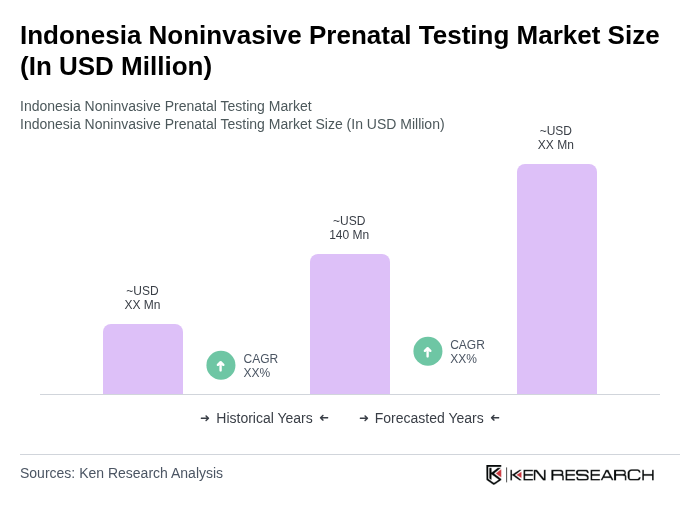
- The Indonesia Noninvasive Prenatal Testing market is valued at USD 140 million, based on a five-year historical analysis of global and regional market penetration and Indonesia’s share within the Asia-Pacific NIPT market. This growth is primarily driven by increasing awareness of prenatal health, advancements in genetic testing technologies such as next-generation sequencing–based cell-free DNA assays, and a rising number of expectant mothers opting for noninvasive procedures over traditional invasive methods. The market has seen a significant uptick in demand for early detection of genetic disorders, especially aneuploidies, supported by broader availability of NIPT in private hospitals and diagnostic laboratories across major Indonesian cities.
- Key cities such as Jakarta, Surabaya, and Bandung dominate the market due to their high population density, advanced healthcare infrastructure, and access to specialized medical services, including tertiary hospitals and reference laboratories. These urban centers are also home to a growing number of maternity and fertility clinics and private diagnostic chains, which further enhances the availability and adoption of noninvasive prenatal testing services among middle- and upper?income populations.
- In 2023, the Indonesian government implemented regulations mandating that all prenatal testing facilities must adhere to strict quality control standards. This regulation aims to ensure the accuracy and reliability of noninvasive prenatal tests, thereby enhancing patient safety and trust in these medical services. A key binding instrument is the Regulation of the Minister of Health of the Republic of Indonesia Number 3 of 2020 on Clinical Laboratory Services, issued by the Ministry of Health, which sets requirements for licensing, quality management systems, external quality assurance participation, and the use of validated in vitro diagnostic methods for laboratory-based prenatal testing services. Compliance with these standards is crucial for facilities to maintain their operational licenses under the national health laboratory accreditation and supervision framework.
Indonesia Noninvasive Prenatal Testing Market Segmentation
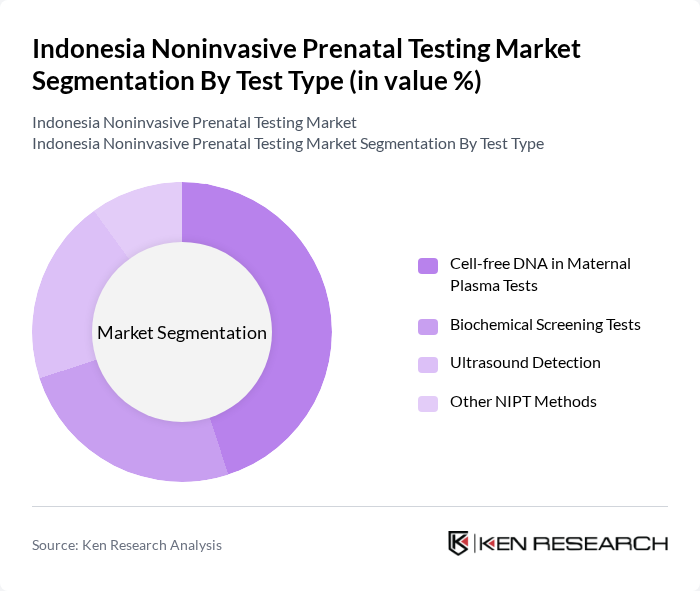
By Test Type:The market is segmented into various test types, including Cell-free DNA in Maternal Plasma Tests, Biochemical Screening Tests, Ultrasound Detection, and Other NIPT Methods. Among these, Cell-free DNA in Maternal Plasma Tests is the leading subsegment due to its high sensitivity and specificity for common chromosomal aneuploidies and its noninvasive nature, making it the preferred choice for high-risk and increasingly average-risk expectant mothers. The increasing preference for advanced genetic testing methods, supported by declining sequencing costs, integration of next-generation sequencing platforms, and clinical guidelines in Asia-Pacific that favor NIPT for trisomy 21 screening, is driving the growth of this subsegment.
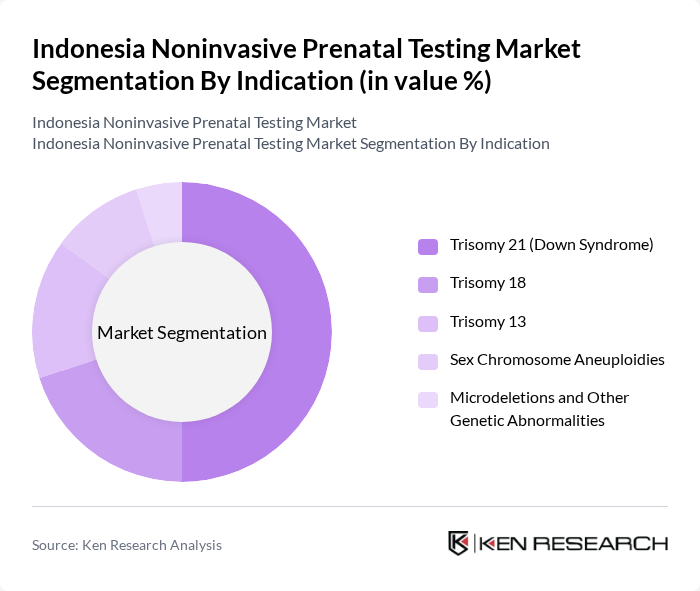
By Indication:The market is categorized based on indications such as Trisomy 21 (Down Syndrome), Trisomy 18, Trisomy 13, Sex Chromosome Aneuploidies, and Microdeletions and Other Genetic Abnormalities. Trisomy 21 testing is the most prevalent indication, driven by heightened awareness and the importance of early detection of genetic disorders, in line with global and Asia-Pacific practice patterns where NIPT is primarily adopted for trisomy 21 risk assessment. This segment's dominance is attributed to the increasing number of parents seeking information about potential genetic conditions in their unborn children, as well as clinician preference to use NIPT as a first-line or contingent test for common autosomal trisomies before considering invasive diagnostic procedures.
Indonesia Noninvasive Prenatal Testing Market Competitive Landscape
The Indonesia Noninvasive Prenatal Testing Market is characterized by a dynamic mix of regional and international players. Leading participants such as PT. Genomik Solidaritas Indonesia, PT. Prodia Widyahusada Tbk, PT. Laboratorium Klinik Prodia, PT. Bina Sehat Lestari, PT. Siloam International Hospitals Tbk, PT. Bundamedik Tbk (RSIA Bunda Group), PT. Mitra Keluarga Karyasehat Tbk, PT. Cito Putra Utama Tbk (Laboratorium Cito), PT. Morula Indonesia (Morula IVF Clinics), PT. Kalbe Genexine Biologics, PT. Diagnos Laboratorium Utama Tbk, PT. Bio Farma (Persero), PT. Kimia Farma Diagnostika, PT. Eka Hospital, PT. Mayapada Healthcare Tbk contribute to innovation, geographic expansion, and service delivery in this space.
Indonesia Noninvasive Prenatal Testing Market Industry Analysis
Growth Drivers
- Increasing Awareness of Prenatal Health:The Indonesian government has prioritized maternal health, leading to a 30% increase in prenatal health awareness campaigns since 2020. This has resulted in more expectant parents seeking noninvasive prenatal testing (NIPT) options. According to the Ministry of Health, approximately 4 million pregnancies are registered annually, with a growing number of parents opting for advanced testing methods to ensure fetal health, reflecting a significant shift in public perception towards prenatal care.
- Rising Disposable Income Among Expectant Parents:Indonesia's GDP per capita is projected to reach $4,500 in future, indicating a 5% increase from the previous period. This economic growth has led to higher disposable incomes, allowing more families to invest in prenatal health services. As a result, the demand for NIPT is expected to rise, with more parents willing to pay for advanced testing options that provide peace of mind regarding their baby's health, thus driving market growth.
- Technological Advancements in Testing Methods:The introduction of next-generation sequencing (NGS) technology has revolutionized NIPT in Indonesia, enhancing accuracy and reducing turnaround times. In future, it is estimated that over 70% of NIPT procedures will utilize NGS, compared to just 40% in the past. This technological shift not only improves testing reliability but also attracts more expectant parents to opt for noninvasive methods, significantly boosting market demand.
Market Challenges
- High Cost of Testing Procedures:The average cost of NIPT in Indonesia ranges from $500 to $1,000, which is prohibitive for many families, especially in lower-income brackets. With approximately 9% of the population living below the poverty line, many expectant parents are unable to afford these tests. This financial barrier limits access to essential prenatal care, hindering the overall growth of the NIPT market in the region.
- Limited Access in Rural Areas:Approximately 50% of Indonesia's population resides in rural areas, where healthcare infrastructure is often inadequate. Many rural clinics lack the necessary equipment and trained personnel to offer NIPT services. This disparity in access creates a significant challenge, as expectant parents in these regions may not receive timely prenatal testing, ultimately affecting maternal and fetal health outcomes across the country.
Indonesia Noninvasive Prenatal Testing Market Future Outlook
The future of the NIPT market in Indonesia appears promising, driven by ongoing advancements in technology and increasing healthcare investments. As the government continues to enhance healthcare infrastructure, more expectant parents will gain access to essential prenatal testing services. Additionally, the integration of telemedicine and home-based testing solutions is expected to further facilitate access, making NIPT more widely available and affordable for families across the country, ultimately improving maternal health outcomes.
Market Opportunities
- Expansion of Healthcare Infrastructure:The Indonesian government plans to invest $2 billion in healthcare infrastructure by future, focusing on rural areas. This investment will enhance access to NIPT services, allowing more expectant parents to benefit from advanced prenatal testing, thereby driving market growth and improving maternal health outcomes across the nation.
- Development of Cost-Effective Testing Solutions:With rising demand for affordable healthcare, companies are exploring innovative, cost-effective NIPT solutions. In future, it is anticipated that new testing methods will reduce costs by up to 30%, making NIPT more accessible to a broader demographic. This shift will likely increase market penetration and improve prenatal health awareness among expectant parents.
Scope of the Report
| Segment | Sub-Segments |
|---|---|
| By Test Type | Cell-free DNA in Maternal Plasma Tests Biochemical Screening Tests Ultrasound Detection Other NIPT Methods |
| By Indication | Trisomy 21 (Down Syndrome) Trisomy 18 Trisomy 13 Sex Chromosome Aneuploidies Microdeletions and Other Genetic Abnormalities |
| By Gestational Age | First Trimester (10–13 Weeks) Second Trimester (14–24 Weeks) Above 24 Weeks |
| By Risk Category | High-Risk Pregnancies Average- and Low-Risk Pregnancies |
| By End-User | Hospitals Diagnostic Laboratories Maternity and Fertility Clinics Others |
| By Region (Indonesia) | Java Sumatra Kalimantan Sulawesi Others |
Key Target Audience
Investors and Venture Capitalist Firms
Government and Regulatory Bodies (e.g., Ministry of Health, National Agency of Drug and Food Control)
Manufacturers and Producers of NIPT Kits
Healthcare Providers and Hospitals
Laboratory Service Providers
Medical Device Distributors
Health Insurance Companies
Biotechnology Firms
Players Mentioned in the Report:
PT. Genomik Solidaritas Indonesia
PT. Prodia Widyahusada Tbk
PT. Laboratorium Klinik Prodia
PT. Bina Sehat Lestari
PT. Siloam International Hospitals Tbk
PT. Bundamedik Tbk (RSIA Bunda Group)
PT. Mitra Keluarga Karyasehat Tbk
PT. Cito Putra Utama Tbk (Laboratorium Cito)
PT. Morula Indonesia (Morula IVF Clinics)
PT. Kalbe Genexine Biologics
PT. Diagnos Laboratorium Utama Tbk
PT. Bio Farma (Persero)
PT. Kimia Farma Diagnostika
PT. Eka Hospital
PT. Mayapada Healthcare Tbk
Table of Contents
Market Assessment Phase
1. Executive Summary and Approach
2. Indonesia Noninvasive Prenatal Testing Market Overview
2.1 Key Insights and Strategic Recommendations
2.2 Indonesia Noninvasive Prenatal Testing Market Overview
2.3 Definition and Scope
2.4 Evolution of Market Ecosystem
2.5 Timeline of Key Regulatory Milestones
2.6 Value Chain & Stakeholder Mapping
2.7 Business Cycle Analysis
2.8 Policy & Incentive Landscape
3. Indonesia Noninvasive Prenatal Testing Market Analysis
3.1 Growth Drivers
3.1.1 Increasing awareness of prenatal health
3.1.2 Rising disposable income among expectant parents
3.1.3 Technological advancements in testing methods
3.1.4 Government initiatives promoting maternal health
3.2 Market Challenges
3.2.1 High cost of testing procedures
3.2.2 Limited access in rural areas
3.2.3 Regulatory hurdles and compliance issues
3.2.4 Lack of trained professionals
3.3 Market Opportunities
3.3.1 Expansion of healthcare infrastructure
3.3.2 Increasing partnerships with healthcare providers
3.3.3 Development of cost-effective testing solutions
3.3.4 Growing demand for personalized healthcare
3.4 Market Trends
3.4.1 Shift towards home-based testing solutions
3.4.2 Integration of AI in prenatal testing
3.4.3 Rise in telemedicine for prenatal consultations
3.4.4 Focus on non-invasive methods over invasive procedures
3.5 Government Regulation
3.5.1 Implementation of national health policies
3.5.2 Guidelines for prenatal testing standards
3.5.3 Regulations on data privacy and patient consent
3.5.4 Licensing requirements for testing facilities
4. SWOT Analysis
5. Stakeholder Analysis
6. Porter's Five Forces Analysis
7. Indonesia Noninvasive Prenatal Testing Market Market Size, 2019-2024
7.1 By Value
7.2 By Volume
7.3 By Average Selling Price
8. Indonesia Noninvasive Prenatal Testing Market Segmentation
8.1 By Test Type
8.1.1 Cell-free DNA in Maternal Plasma Tests
8.1.2 Biochemical Screening Tests
8.1.3 Ultrasound Detection
8.1.4 Other NIPT Methods
8.2 By Indication
8.2.1 Trisomy 21 (Down Syndrome)
8.2.2 Trisomy 18
8.2.3 Trisomy 13
8.2.4 Sex Chromosome Aneuploidies
8.2.5 Microdeletions and Other Genetic Abnormalities
8.3 By Gestational Age
8.3.1 First Trimester (10–13 Weeks)
8.3.2 Second Trimester (14–24 Weeks)
8.3.3 Above 24 Weeks
8.4 By Risk Category
8.4.1 High-Risk Pregnancies
8.4.2 Average- and Low-Risk Pregnancies
8.5 By End-User
8.5.1 Hospitals
8.5.2 Diagnostic Laboratories
8.5.3 Maternity and Fertility Clinics
8.5.4 Others
8.6 By Region (Indonesia)
8.6.1 Java
8.6.2 Sumatra
8.6.3 Kalimantan
8.6.4 Sulawesi
8.6.5 Others
9. Indonesia Noninvasive Prenatal Testing Market Competitive Analysis
9.1 Market Share of Key Players
9.2 Cross Comparison of Key Players
9.2.1 Company Name
9.2.2 Group Size (Large, Medium, or Small as per industry convention)
9.2.3 Indonesia NIPT Revenue (USD Mn)
9.2.4 Indonesia NIPT Revenue CAGR (Historical & Forecast)
9.2.5 NIPT Test Volume (Number of Tests per Year)
9.2.6 Market Share in Indonesia NIPT (%)
9.2.7 Average Selling Price per Test (USD)
9.2.8 Gross Margin from NIPT Business (%)
9.2.9 R&D and Innovation Intensity (% of Revenue)
9.2.10 Geographic Coverage (Number of Cities / Provinces Served)
9.2.11 Key Hospital & Clinic Partnerships (Number)
9.2.12 Turnaround Time (Average Days per Test)
9.2.13 Test Menu Breadth (Number of Indications Covered)
9.3 SWOT Analysis of Top Players
9.4 Pricing Analysis
9.5 Detailed Profile of Major Companies
9.5.1 PT. Genomik Solidaritas Indonesia
9.5.2 PT. Prodia Widyahusada Tbk
9.5.3 PT. Laboratorium Klinik Prodia
9.5.4 PT. Bina Sehat Lestari
9.5.5 PT. Siloam International Hospitals Tbk
9.5.6 PT. Bundamedik Tbk (RSIA Bunda Group)
9.5.7 PT. Mitra Keluarga Karyasehat Tbk
9.5.8 PT. Cito Putra Utama Tbk (Laboratorium Cito)
9.5.9 PT. Morula Indonesia (Morula IVF Clinics)
9.5.10 PT. Kalbe Genexine Biologics
9.5.11 PT. Diagnos Laboratorium Utama Tbk
9.5.12 PT. Bio Farma (Persero)
9.5.13 PT. Kimia Farma Diagnostika
9.5.14 PT. Eka Hospital
9.5.15 PT. Mayapada Healthcare Tbk
10. Indonesia Noninvasive Prenatal Testing Market End-User Analysis
10.1 Procurement Behavior of Key Ministries
10.1.1 Ministry of Health
10.1.2 Ministry of Education
10.1.3 Ministry of Social Affairs
10.1.4 Others
10.2 Corporate Spend on Infrastructure & Energy
10.2.1 Investment in Healthcare Facilities
10.2.2 Funding for Prenatal Programs
10.2.3 Others
10.3 Pain Point Analysis by End-User Category
10.3.1 Expectant Mothers
10.3.2 Healthcare Providers
10.3.3 Insurance Companies
10.3.4 Others
10.4 User Readiness for Adoption
10.4.1 Awareness Levels
10.4.2 Accessibility of Services
10.4.3 Others
10.5 Post-Deployment ROI and Use Case Expansion
10.5.1 Cost Savings
10.5.2 Improved Health Outcomes
10.5.3 Others
11. Indonesia Noninvasive Prenatal Testing Market Future Size, 2025-2030
11.1 By Value
11.2 By Volume
11.3 By Average Selling Price
Go-To-Market Strategy Phase
1. Whitespace Analysis + Business Model Canvas
1.1 Market Gaps Identification
1.2 Business Model Development
2. Marketing and Positioning Recommendations
2.1 Branding Strategies
2.2 Product USPs
3. Distribution Plan
3.1 Urban Retail vs Rural NGO Tie-ups
4. Channel & Pricing Gaps
4.1 Underserved Routes
4.2 Pricing Bands
5. Unmet Demand & Latent Needs
5.1 Category Gaps
5.2 Consumer Segments
6. Customer Relationship
6.1 Loyalty Programs
6.2 After-sales Service
7. Value Proposition
7.1 Sustainability
7.2 Integrated Supply Chains
8. Key Activities
8.1 Regulatory Compliance
8.2 Branding
8.3 Distribution Setup
9. Entry Strategy Evaluation
9.1 Domestic Market Entry Strategy
9.1.1 Product Mix
9.1.2 Pricing Band
9.1.3 Packaging
9.2 Export Entry Strategy
9.2.1 Target Countries
9.2.2 Compliance Roadmap
10. Entry Mode Assessment
10.1 JV
10.2 Greenfield
10.3 M&A
10.4 Distributor Model
11. Capital and Timeline Estimation
11.1 Capital Requirements
11.2 Timelines
12. Control vs Risk Trade-Off
12.1 Ownership vs Partnerships
13. Profitability Outlook
13.1 Breakeven Analysis
13.2 Long-term Sustainability
14. Potential Partner List
14.1 Distributors
14.2 JVs
14.3 Acquisition Targets
15. Execution Roadmap
15.1 Phased Plan for Market Entry
15.1.1 Market Setup
15.1.2 Market Entry
15.1.3 Growth Acceleration
15.1.4 Scale & Stabilize
15.2 Key Activities and Milestones
15.2.1 Activity Planning
15.2.2 Milestone Tracking
Research Methodology
Phase 1: Approach1
Desk Research
- Analysis of existing market reports and publications on noninvasive prenatal testing (NIPT) in Indonesia
- Review of demographic and health statistics from the Indonesian Ministry of Health and World Health Organization
- Examination of regulatory frameworks and guidelines from the Indonesian Food and Drug Authority (BPOM)
Primary Research
- Interviews with obstetricians and gynecologists specializing in prenatal care
- Surveys with laboratory managers and technicians involved in NIPT services
- Focus groups with expectant parents to understand awareness and acceptance of NIPT
Validation & Triangulation
- Cross-validation of findings through multiple expert interviews and stakeholder feedback
- Triangulation of data from healthcare providers, patients, and industry reports
- Sanity checks through consultations with a panel of healthcare experts and market analysts
Phase 2: Market Size Estimation1
Top-down Assessment
- Estimation of the total addressable market based on national birth rates and prenatal testing uptake
- Segmentation of the market by urban vs. rural healthcare access and socioeconomic status
- Incorporation of trends in maternal health and increasing demand for genetic testing
Bottom-up Modeling
- Collection of data on the number of NIPT tests conducted by leading laboratories in Indonesia
- Estimation of average pricing for NIPT services across different healthcare facilities
- Calculation of market size based on volume of tests and average revenue per test
Forecasting & Scenario Analysis
- Development of growth projections based on historical data and emerging healthcare trends
- Scenario analysis considering factors such as regulatory changes and technological advancements
- Creation of baseline, optimistic, and pessimistic forecasts through 2030
Phase 3: CATI Sample Composition1
| Scope Item/Segment | Sample Size | Target Respondent Profiles |
|---|---|---|
| Obstetricians and Gynecologists | 60 | Healthcare Providers, Prenatal Care Specialists |
| Laboratory Managers | 50 | Laboratory Directors, Technical Supervisors |
| Expectant Parents | 120 | First-time Parents, Couples Considering NIPT |
| Healthcare Policy Makers | 40 | Government Officials, Health Program Coordinators |
| Genetic Counselors | 45 | Geneticists, Patient Educators |
Frequently Asked Questions
What is the current value of the Indonesia Noninvasive Prenatal Testing market?
The Indonesia Noninvasive Prenatal Testing (NIPT) market is valued at approximately USD 140 million, reflecting significant growth driven by increased awareness of prenatal health and advancements in genetic testing technologies.
What factors are driving the growth of the NIPT market in Indonesia?
Which cities in Indonesia are leading in NIPT services?
What regulations govern prenatal testing facilities in Indonesia?
Other Regional/Country Reports
Other Adjacent Reports
Philippines Prenatal Diagnostics Market
Belgium Maternal Health Market
Kuwait Next-Generation Sequencing Market
Global In Vitro Diagnostics Market Size, Share & Forecast, By Product Type, Technology & End User, 2026-2031Apac Fertility Services Market Report Size, Share, Growth Drivers, Trends, Opportunities & Forecast 2025–2030Global Clinical Laboratory Services Market Size, Share & Forecast, By Service Type, Care Setting & End User, 2025-2032Philippines Ultrasound Equipment Market
Japan Biochemical Testing Market
Mexico Reproductive Genetics Market
Why Buy From Us?

What makes us stand out is that our consultants follow Robust, Refine and Result (RRR) methodology. Robust for clear definitions, approaches and sanity checking, Refine for differentiating respondents' facts and opinions, and Result for presenting data with story.

We have set a benchmark in the industry by offering our clients with syndicated and customized market research reports featuring coverage of entire market as well as meticulous research and analyst insights.

While we don't replace traditional research, we flip the method upside down. Our dual approach of Top Bottom & Bottom Top ensures quality deliverable by not just verifying company fundamentals but also looking at the sector and macroeconomic factors.

With one step in the future, our research team constantly tries to show you the bigger picture. We help with some of the tough questions you may encounter along the way: How is the industry positioned? Best marketing channel? KPI's of competitors? By aligning every element, we help maximize success.

Our report gives you instant access to the answers and sources that other companies might choose to hide. We elaborate each steps of research methodology we have used and showcase you the sample size to earn your trust.

If you need any support, we are here! We pride ourselves on universe strength, data quality, and quick, friendly, and professional service.