About the Report
Base Year 2024Japan Noninvasive Prenatal Testing Market Overview
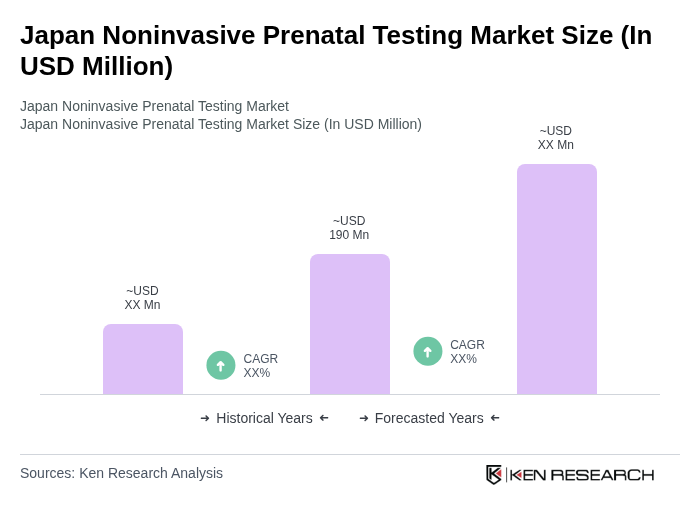
- The Japan Noninvasive Prenatal Testing Market is valued at USD 190 million, based on a five-year historical analysis and triangulation from regional noninvasive prenatal diagnostics revenue data and Asia-Pacific NIPT benchmarks. This growth is primarily driven by increasing awareness of prenatal health, advancements in next-generation sequencing (NGS)–based genetic testing technologies, and a rising number of expectant mothers opting for noninvasive procedures over traditional invasive methods due to lower miscarriage risk and higher detection accuracy for common aneuploidies. The market's expansion is also supported by the growing prevalence of chromosomal abnormalities associated with advanced maternal age and the demand for early diagnosis to guide pregnancy management.
- Tokyo and Osaka are the dominant cities in the Japan Noninvasive Prenatal Testing Market due to their advanced healthcare infrastructure, high population density, and a significant number of tertiary hospitals and specialty clinics offering prenatal genetic testing services. The concentration of leading medical institutions and research centers in these metropolitan areas, along with early adoption of high-throughput sequencing platforms and academic–industry collaborations, further enhances their market dominance and makes them key hubs for the introduction and uptake of innovative prenatal testing technologies.
- The Japanese government and relevant professional bodies have issued regulations and practice frameworks to enhance the quality and accessibility of prenatal testing services, including noninvasive prenatal testing. The Clinical Research Act, 2017 issued by the Ministry of Health, Labour and Welfare (MHLW) sets binding requirements for the ethical and scientific conduct of clinical research using human specimens, including genomic testing, specifying institutional review board approval, data protection, and safety management obligations for facilities that implement NIPT. In addition, the noninvasive prenatal genetic testing guidelines jointly developed by the Japan Society of Obstetrics and Gynecology (JSOG) and related professional societies define facility accreditation, genetic counseling, and informed consent standards for NIPT use in high?risk pregnancies, aiming to promote appropriate adoption of advanced testing technologies while safeguarding maternal and fetal health.
Japan Noninvasive Prenatal Testing Market Segmentation
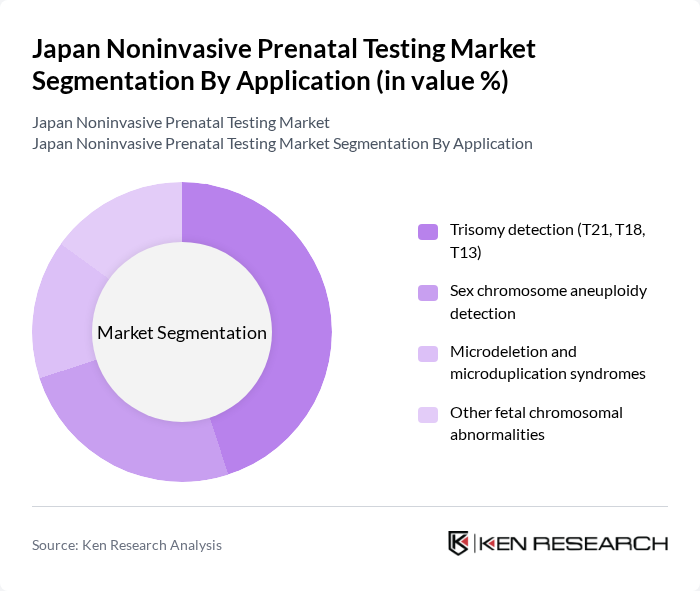
By Application:The application segment of the Japan Noninvasive Prenatal Testing Market includes various subsegments such as Trisomy detection (T21, T18, T13), Sex chromosome aneuploidy detection, Microdeletion and microduplication syndromes, and Other fetal chromosomal abnormalities. Trisomy detection is a core and widely adopted indication for NIPT, reflecting the strong clinical focus on conditions like Down syndrome (trisomy 21), Edwards syndrome (trisomy 18), and Patau syndrome (trisomy 13), which are among the most common chromosomal abnormalities screened in routine practice. The increasing awareness among expectant parents about the benefits of early detection, the integration of NIPT into risk-based prenatal screening pathways, and improvements in assay sensitivity and specificity for aneuploidies continue to bolster this subsegment's growth.
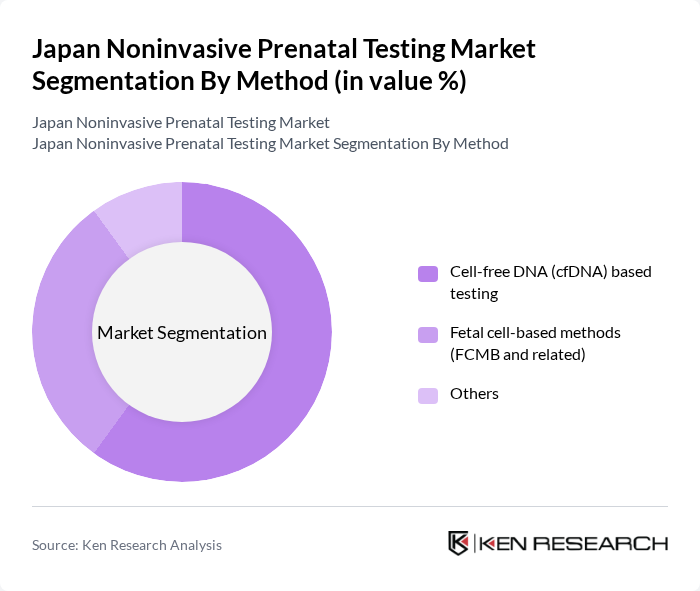
By Method:The method segment encompasses Cell-free DNA (cfDNA) based testing, Fetal cell-based methods (FCMB and related), and Others. Cell-free DNA (cfDNA) based testing is the dominant method globally and in Asia-Pacific because it relies on analysis of circulating fetal DNA fragments in maternal blood, offering a highly accurate and noninvasive approach for detecting common aneuploidies and selected microdeletions. The growing preference for cfDNA testing among healthcare providers and patients, supported by improvements in sequencing chemistry, bioinformatics pipelines, and turnaround time, as well as increasing inclusion of cfDNA-based NIPT in clinical guidelines for high-risk pregnancies, contributes to its leading position in the market.
Japan Noninvasive Prenatal Testing Market Competitive Landscape
The Japan Noninvasive Prenatal Testing Market is characterized by a dynamic mix of regional and international players. Leading participants such as Natera, Inc., Illumina, Inc., Roche Diagnostics (F. Hoffmann-La Roche Ltd.), Ariosa Diagnostics, Inc. (Roche), Myriad Genetics, Inc., Sequenom, Inc. (Labcorp), Laboratory Corporation of America Holdings (Labcorp), Quest Diagnostics Incorporated, PerkinElmer, Inc., Fulgent Genetics, Inc., BGI Genomics Co., Ltd., Eurofins Scientific SE, CENTOGENE N.V., SRL Inc., Miraca Holdings Inc. (H.U. Group Holdings, Inc.) contribute to innovation, geographic expansion, and service delivery in this space.
Japan Noninvasive Prenatal Testing Market Industry Analysis
Growth Drivers
- Increasing Awareness of Prenatal Health:The Japanese government has invested approximately ¥1.5 trillion (around $14 billion) in maternal health initiatives, significantly raising public awareness about prenatal health. This investment has led to a 30% increase in prenatal check-ups over the past five years, as more expectant mothers seek noninvasive prenatal testing (NIPT) to ensure the health of their babies. Educational campaigns have also contributed to a more informed population regarding the benefits of early detection of genetic disorders.
- Rising Demand for Early Diagnosis:In Japan, the number of prenatal tests conducted annually has surged to over 500,000, reflecting a growing demand for early diagnosis of potential genetic conditions. This trend is driven by an increasing number of women over 35, who are at higher risk for chromosomal abnormalities. The emphasis on early diagnosis is further supported by healthcare providers, who advocate for NIPT as a safer alternative to invasive procedures, thus enhancing its adoption among expectant mothers.
- Technological Advancements in Testing Methods:The Japanese NIPT market has seen significant technological advancements, with over 10 new testing methods introduced in the last three years. These innovations have improved accuracy rates to over 99% for detecting conditions like Down syndrome. Additionally, the integration of next-generation sequencing (NGS) technology has reduced testing times to as little as five days, making NIPT more appealing to expectant parents seeking timely results and peace of mind.
Market Challenges
- High Cost of Testing Procedures:The average cost of NIPT in Japan is approximately ¥100,000 (around $900), which can be prohibitive for many families. Despite the benefits, this high cost limits accessibility, particularly for lower-income households. As a result, only about 20% of expectant mothers opt for NIPT, compared to invasive methods that are often covered by insurance. This financial barrier poses a significant challenge to the widespread adoption of noninvasive testing.
- Limited Access in Rural Areas:Approximately 30% of Japan's population resides in rural areas, where access to advanced prenatal testing facilities is limited. Many rural healthcare providers lack the necessary equipment or expertise to offer NIPT, leading to disparities in maternal healthcare. This geographic limitation results in a reliance on traditional methods, which may not provide the same level of accuracy, thereby hindering the overall growth of the NIPT market in these regions.
Japan Noninvasive Prenatal Testing Market Future Outlook
The future of the NIPT market in Japan appears promising, driven by ongoing technological advancements and increasing public awareness. As telemedicine continues to expand, remote consultations and home-based testing solutions are likely to become more prevalent, enhancing accessibility. Furthermore, the integration of artificial intelligence in diagnostic processes is expected to streamline testing and improve accuracy. These trends indicate a shift towards more personalized and efficient prenatal care, positioning NIPT as a cornerstone of maternal health in Japan.
Market Opportunities
- Expansion of Telemedicine Services:The rise of telemedicine in Japan presents a significant opportunity for NIPT providers. With over 70% of healthcare consultations now being conducted online, integrating NIPT into telehealth platforms can enhance accessibility for expectant mothers, particularly in rural areas. This shift could lead to increased adoption rates and improved maternal health outcomes across the country.
- Development of New Testing Technologies:Continuous innovation in testing technologies offers substantial growth potential for the NIPT market. Companies investing in research and development can create more accurate, faster, and cost-effective testing solutions. This focus on innovation is likely to attract partnerships with healthcare providers, further expanding the reach and impact of NIPT in Japan's maternal healthcare landscape.
Scope of the Report
| Segment | Sub-Segments |
|---|---|
| By Application | Trisomy detection (T21, T18, T13) Sex chromosome aneuploidy detection Microdeletion and microduplication syndromes Other fetal chromosomal abnormalities |
| By Method | Cell-free DNA (cfDNA) based testing Fetal cell-based methods (FCMB and related) Others |
| By Platform / Technology | Next-generation sequencing (NGS) PCR-based platforms Other sequencing and microarray platforms |
| By Gestation Period | –12 weeks –24 weeks –36 weeks |
| By End-User | Hospitals Diagnostic laboratories Specialty clinics and maternity centers Others |
| By Testing Indication | Advanced maternal age Positive first?trimester / combined screening Family / genetic history–based high risk Other high?risk pregnancy indications |
Key Target Audience
Investors and Venture Capitalist Firms
Government and Regulatory Bodies (e.g., Ministry of Health, Labour and Welfare)
Manufacturers and Producers of NIPT Kits
Distributors and Retailers of Medical Devices
Healthcare Providers and Hospitals
Laboratory Service Providers
Industry Associations (e.g., Japan Society of Obstetrics and Gynecology)
Health Insurance Companies
Players Mentioned in the Report:
Natera, Inc.
Illumina, Inc.
Roche Diagnostics (F. Hoffmann-La Roche Ltd.)
Ariosa Diagnostics, Inc. (Roche)
Myriad Genetics, Inc.
Sequenom, Inc. (Labcorp)
Laboratory Corporation of America Holdings (Labcorp)
Quest Diagnostics Incorporated
PerkinElmer, Inc.
Fulgent Genetics, Inc.
BGI Genomics Co., Ltd.
Eurofins Scientific SE
CENTOGENE N.V.
SRL Inc.
Miraca Holdings Inc. (H.U. Group Holdings, Inc.)
Table of Contents
Market Assessment Phase
1. Executive Summary and Approach
2. Japan Noninvasive Prenatal Testing Market Overview
2.1 Key Insights and Strategic Recommendations
2.2 Japan Noninvasive Prenatal Testing Market Overview
2.3 Definition and Scope
2.4 Evolution of Market Ecosystem
2.5 Timeline of Key Regulatory Milestones
2.6 Value Chain & Stakeholder Mapping
2.7 Business Cycle Analysis
2.8 Policy & Incentive Landscape
3. Japan Noninvasive Prenatal Testing Market Analysis
3.1 Growth Drivers
3.1.1 Increasing awareness of prenatal health
3.1.2 Rising demand for early diagnosis
3.1.3 Technological advancements in testing methods
3.1.4 Government support for maternal health initiatives
3.2 Market Challenges
3.2.1 High cost of testing procedures
3.2.2 Limited access in rural areas
3.2.3 Regulatory hurdles and compliance issues
3.2.4 Competition from invasive testing methods
3.3 Market Opportunities
3.3.1 Expansion of telemedicine services
3.3.2 Development of new testing technologies
3.3.3 Increasing partnerships with healthcare providers
3.3.4 Growing interest in personalized medicine
3.4 Market Trends
3.4.1 Shift towards home-based testing solutions
3.4.2 Integration of AI in diagnostic processes
3.4.3 Focus on non-invasive methods for prenatal screening
3.4.4 Rising consumer preference for genetic testing
3.5 Government Regulation
3.5.1 Guidelines for prenatal testing procedures
3.5.2 Regulations on data privacy and patient consent
3.5.3 Standards for laboratory accreditation
3.5.4 Policies promoting maternal health programs
4. SWOT Analysis
5. Stakeholder Analysis
6. Porter's Five Forces Analysis
7. Japan Noninvasive Prenatal Testing Market Market Size, 2019-2024
7.1 By Value
7.2 By Volume
7.3 By Average Selling Price
8. Japan Noninvasive Prenatal Testing Market Segmentation
8.1 By Application
8.1.1 Trisomy detection (T21, T18, T13)
8.1.2 Sex chromosome aneuploidy detection
8.1.3 Microdeletion and microduplication syndromes
8.1.4 Other fetal chromosomal abnormalities
8.2 By Method
8.2.1 Cell-free DNA (cfDNA) based testing
8.2.2 Fetal cell-based methods (FCMB and related)
8.2.3 Others
8.3 By Platform / Technology
8.3.1 Next-generation sequencing (NGS)
8.3.2 PCR-based platforms
8.3.3 Other sequencing and microarray platforms
8.4 By Gestation Period
8.4.1 0–12 weeks
8.4.2 13–24 weeks
8.4.3 25–36 weeks
8.5 By End-User
8.5.1 Hospitals
8.5.2 Diagnostic laboratories
8.5.3 Specialty clinics and maternity centers
8.5.4 Others
8.6 By Testing Indication
8.6.1 Advanced maternal age
8.6.2 Positive first?trimester / combined screening
8.6.3 Family / genetic history–based high risk
8.6.4 Other high?risk pregnancy indications
9. Japan Noninvasive Prenatal Testing Market Competitive Analysis
9.1 Market Share of Key Players
9.2 Cross Comparison of Key Players
9.2.1 Company Name
9.2.2 Company size (global and Japan NIPT revenue)
9.2.3 Japan NIPT revenue CAGR (historical and forecast)
9.2.4 Japan market share (%) in NIPT
9.2.5 Japan test volume share (%)
9.2.6 Average selling price (ASP) per test in Japan
9.2.7 Gross margin (%) on NIPT in Japan
9.2.8 R&D intensity (% of revenue allocated to NIPT R&D)
9.2.9 Test menu breadth (number of NIPT assays/applications offered)
9.2.10 Geographic coverage in Japan (number of partner hospitals / labs)
9.2.11 Reimbursement coverage (share of tests reimbursed / payer contracts)
9.2.12 Turnaround time (average days from sample collection to report)
9.2.13 Test failure / redraw rate (%)
9.2.14 Japan-specific marketing & medical liaison spend (% of sales)
9.3 SWOT Analysis of Top Players
9.4 Pricing Analysis
9.5 Detailed Profile of Major Companies
9.5.1 Natera, Inc.
9.5.2 Illumina, Inc.
9.5.3 Roche Diagnostics (F. Hoffmann-La Roche Ltd.)
9.5.4 Ariosa Diagnostics, Inc. (Roche)
9.5.5 Myriad Genetics, Inc.
9.5.6 Sequenom, Inc. (Labcorp)
9.5.7 Laboratory Corporation of America Holdings (Labcorp)
9.5.8 Quest Diagnostics Incorporated
9.5.9 PerkinElmer, Inc.
9.5.10 Fulgent Genetics, Inc.
9.5.11 BGI Genomics Co., Ltd.
9.5.12 Eurofins Scientific SE
9.5.13 CENTOGENE N.V.
9.5.14 SRL Inc.
9.5.15 Miraca Holdings Inc. (H.U. Group Holdings, Inc.)
10. Japan Noninvasive Prenatal Testing Market End-User Analysis
10.1 Procurement Behavior of Key Ministries
10.1.1 Budget allocation for maternal health
10.1.2 Decision-making processes
10.1.3 Preferred suppliers and vendors
10.1.4 Others
10.2 Corporate Spend on Infrastructure & Energy
10.2.1 Investment in healthcare facilities
10.2.2 Funding for research and development
10.2.3 Others
10.3 Pain Point Analysis by End-User Category
10.3.1 Access to testing services
10.3.2 Affordability of tests
10.3.3 Awareness and education
10.3.4 Others
10.4 User Readiness for Adoption
10.4.1 Familiarity with noninvasive testing
10.4.2 Willingness to pay for services
10.4.3 Others
10.5 Post-Deployment ROI and Use Case Expansion
10.5.1 Evaluation of testing outcomes
10.5.2 Expansion into new markets
10.5.3 Others
11. Japan Noninvasive Prenatal Testing Market Future Size, 2025-2030
11.1 By Value
11.2 By Volume
11.3 By Average Selling Price
Go-To-Market Strategy Phase
1. Whitespace Analysis + Business Model Canvas
1.1 Market Gaps Identification
1.2 Business Model Development
2. Marketing and Positioning Recommendations
2.1 Branding strategies
2.2 Product USPs
3. Distribution Plan
3.1 Urban retail vs rural NGO tie-ups
4. Channel & Pricing Gaps
4.1 Underserved routes
4.2 Pricing bands
5. Unmet Demand & Latent Needs
5.1 Category gaps
5.2 Consumer segments
6. Customer Relationship
6.1 Loyalty programs
6.2 After-sales service
7. Value Proposition
7.1 Sustainability
7.2 Integrated supply chains
8. Key Activities
8.1 Regulatory compliance
8.2 Branding
8.3 Distribution setup
9. Entry Strategy Evaluation
9.1 Domestic Market Entry Strategy
9.1.1 Product mix
9.1.2 Pricing band
9.1.3 Packaging
9.2 Export Entry Strategy
9.2.1 Target countries
9.2.2 Compliance roadmap
10. Entry Mode Assessment
10.1 JV
10.2 Greenfield
10.3 M&A
10.4 Distributor Model
11. Capital and Timeline Estimation
11.1 Capital requirements
11.2 Timelines
12. Control vs Risk Trade-Off
12.1 Ownership vs Partnerships
13. Profitability Outlook
13.1 Breakeven analysis
13.2 Long-term sustainability
14. Potential Partner List
14.1 Distributors
14.2 JVs
14.3 Acquisition targets
15. Execution Roadmap
15.1 Phased Plan for Market Entry
15.1.1 Market Setup
15.1.2 Market Entry
15.1.3 Growth Acceleration
15.1.4 Scale & Stabilize
15.2 Key Activities and Milestones
15.2.1 Activity Planning
15.2.2 Milestone Tracking
Research Methodology
Phase 1: Approach1
Desk Research
- Analysis of existing market reports and publications on noninvasive prenatal testing (NIPT) in Japan
- Review of demographic data and birth rates from Japan's Ministry of Health, Labour and Welfare
- Examination of regulatory frameworks and guidelines from the Japanese Society of Obstetrics and Gynecology
Primary Research
- Interviews with obstetricians and gynecologists specializing in prenatal care
- Surveys conducted with expectant parents regarding their awareness and acceptance of NIPT
- Focus groups with healthcare providers to understand the adoption barriers and facilitators for NIPT
Validation & Triangulation
- Cross-validation of findings through multiple expert interviews and stakeholder feedback
- Triangulation of data from healthcare providers, patients, and industry reports
- Sanity checks through comparison with international NIPT market trends and adoption rates
Phase 2: Market Size Estimation1
Top-down Assessment
- Estimation of the total addressable market based on Japan's annual birth statistics
- Segmentation of the market by type of NIPT tests available and their respective pricing
- Incorporation of trends in maternal age and genetic testing awareness into market projections
Bottom-up Modeling
- Collection of data on the number of NIPT tests performed by leading laboratories in Japan
- Estimation of average revenue per test based on pricing strategies of key players
- Analysis of growth rates in test adoption among different demographics and regions
Forecasting & Scenario Analysis
- Development of predictive models based on historical growth rates and market drivers
- Scenario analysis considering potential changes in healthcare policies and insurance coverage
- Creation of baseline, optimistic, and pessimistic forecasts through 2030
Phase 3: CATI Sample Composition1
| Scope Item/Segment | Sample Size | Target Respondent Profiles |
|---|---|---|
| Obstetricians and Gynecologists | 60 | Healthcare Providers, Specialists in Prenatal Care |
| Expectant Parents | 120 | Parents-to-be, Couples Considering NIPT |
| Laboratory Technicians | 50 | Laboratory Managers, Genetic Testing Specialists |
| Healthcare Policy Makers | 40 | Government Officials, Health Insurance Representatives |
| Medical Researchers | 45 | Academics, Researchers in Prenatal Genetics |
Frequently Asked Questions
What is the current value of the Japan Noninvasive Prenatal Testing Market?
The Japan Noninvasive Prenatal Testing Market is valued at approximately USD 190 million, reflecting a significant growth driven by advancements in genetic testing technologies and increasing awareness of prenatal health among expectant mothers.
What are the main applications of noninvasive prenatal testing in Japan?
Which cities dominate the Japan Noninvasive Prenatal Testing Market?
What factors are driving the growth of the NIPT market in Japan?
Other Regional/Country Reports
Other Adjacent Reports
Indonesia Prenatal Diagnostics Market
Philippines Molecular Diagnostics Market Size Share Growth Drivers Trends Opportunities & Forecast 2025–2030Malaysia Next-Generation Sequencing Market
South Africa Reproductive Health Market
Germany Maternal Health Market
UAE Clinical Genomics Market Size, Share, Growth Drivers, Trends, Opportunities & Forecast 2025–2030Saudi Arabia biotechnology market Size, Share, Growth Drivers, Trends, Opportunities & Forecast 2025–2030Belgium Newborn Screening Market
Apac Fertility Services Market Report Size, Share, Growth Drivers, Trends, Opportunities & Forecast 2025–2030Why Buy From Us?

What makes us stand out is that our consultants follow Robust, Refine and Result (RRR) methodology. Robust for clear definitions, approaches and sanity checking, Refine for differentiating respondents' facts and opinions, and Result for presenting data with story.

We have set a benchmark in the industry by offering our clients with syndicated and customized market research reports featuring coverage of entire market as well as meticulous research and analyst insights.

While we don't replace traditional research, we flip the method upside down. Our dual approach of Top Bottom & Bottom Top ensures quality deliverable by not just verifying company fundamentals but also looking at the sector and macroeconomic factors.

With one step in the future, our research team constantly tries to show you the bigger picture. We help with some of the tough questions you may encounter along the way: How is the industry positioned? Best marketing channel? KPI's of competitors? By aligning every element, we help maximize success.

Our report gives you instant access to the answers and sources that other companies might choose to hide. We elaborate each steps of research methodology we have used and showcase you the sample size to earn your trust.

If you need any support, we are here! We pride ourselves on universe strength, data quality, and quick, friendly, and professional service.