About the Report
Base Year 2024Indonesia Nonstick Cookware Market Overview
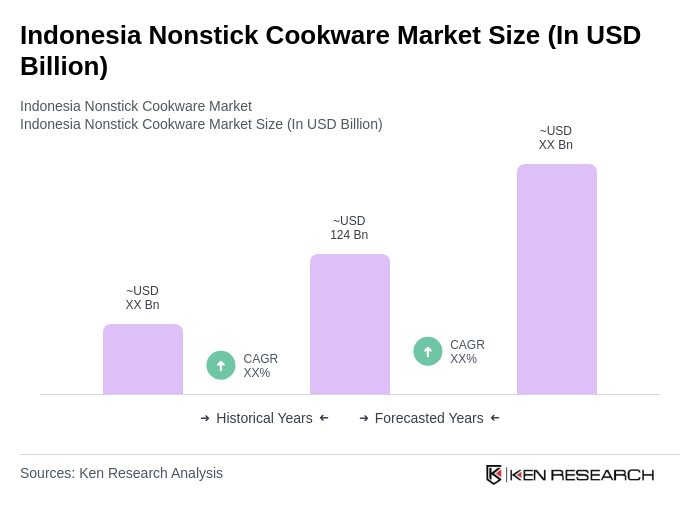
- The Indonesia Nonstick Cookware Market is valued at USD 124 billion, based on a five-year historical analysis. This growth is primarily driven by increasing consumer demand for convenient cooking solutions, rising disposable income, and rapid urbanization. The market is further bolstered by a growing preference for healthier cooking methods, the popularity of nonstick cookware among younger households, and a shift toward eco-friendly and toxin-free materials. Enhanced distribution networks and the expansion of e-commerce platforms have also contributed to the market's expansion, making nonstick cookware more accessible across Indonesia .
- Key cities such as Jakarta, Surabaya, and Bandung dominate the market due to their high population density and urban lifestyle. These cities have a growing middle class that prioritizes quality kitchenware, leading to increased sales of nonstick cookware. The presence of major retail chains, supermarkets, and e-commerce platforms in these urban areas further supports market growth by providing consumers with a wide range of product choices and convenient purchasing options .
- In 2023, the Indonesian government implemented regulations to ensure the safety and quality of cookware products, mandating compliance with national standards. The main regulatory instrument is SNI 7069.5:2018 (Standar Nasional Indonesia for Non-Stick Cookware), issued by the National Standardization Agency of Indonesia (BSN). This standard sets requirements for material safety, performance, and labeling, and manufacturers must obtain SNI certification to market nonstick cookware products in Indonesia. The regulation aims to protect consumers from harmful substances in cookware materials, enhance product safety, and promote the use of certified nonstick cookware in the market .
Indonesia Nonstick Cookware Market Segmentation
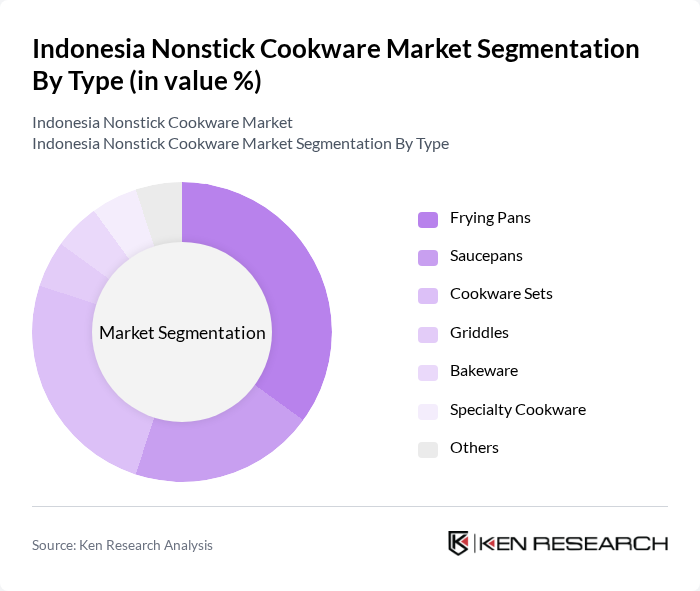
By Type:The market is segmented into various types of nonstick cookware, including frying pans, saucepans, cookware sets, griddles, bakeware, specialty cookware, and others. Among these, frying pans and cookware sets are particularly popular due to their versatility and ease of use in everyday cooking. The demand for these products is driven by consumer preferences for convenience, efficiency, and the adoption of modern cooking practices. Manufacturers are also introducing innovative designs and advanced nonstick coatings to cater to evolving consumer needs .
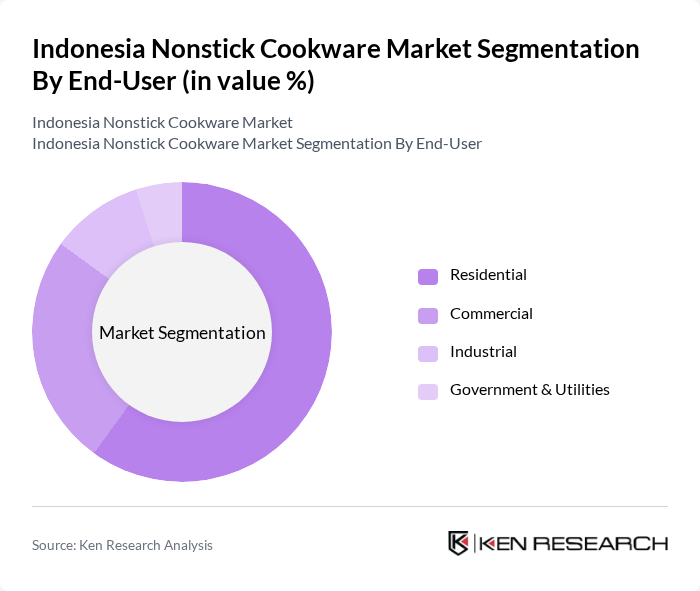
By End-User:The end-user segmentation includes residential, commercial, industrial, and government & utilities. The residential segment is the largest and fastest-growing, driven by the increasing number of households, the trend toward home cooking, and rising health awareness. Consumers are investing in quality cookware to enhance their cooking experience, with a strong preference for nonstick products that offer convenience, durability, and easy maintenance. The commercial segment is also expanding, supported by the growth of the hospitality sector and foodservice establishments .
Indonesia Nonstick Cookware Market Competitive Landscape
The Indonesia Nonstick Cookware Market is characterized by a dynamic mix of regional and international players. Leading participants such as Tefal, Maxim (PT Maspion Group), Oxone, Supra (PT Supra Boga Lestari), IKEA Indonesia, Happycall, Lock&Lock Indonesia, Maspion, Kirin Indonesia, Miyako Indonesia, GreenPan, Scanpan, Cuisinart, Meyer Corporation, and Fissler contribute to innovation, geographic expansion, and service delivery in this space.
Indonesia Nonstick Cookware Market Industry Analysis
Growth Drivers
- Increasing Consumer Preference for Healthy Cooking Options:The Indonesian market is witnessing a significant shift towards healthier cooking methods, with a reported 62% of consumers prioritizing nonstick cookware for its ability to reduce oil usage. This trend is supported by the World Health Organization's findings that link healthy cooking practices to improved public health outcomes. As awareness of health issues rises, the demand for nonstick cookware that facilitates low-fat cooking is expected to grow, driving market expansion.
- Rising Disposable Income and Urbanization:Indonesia's GDP per capita is projected to reach approximately $5,000 in the near future, reflecting a 6% increase from previous estimates. This economic growth, coupled with urbanization rates exceeding 4% annually, is leading to higher disposable incomes. As urban consumers seek modern kitchen solutions, the demand for nonstick cookware is expected to rise, as these products are perceived as essential for contemporary cooking practices in urban households.
- Expansion of E-commerce Platforms for Cookware:E-commerce sales in Indonesia are anticipated to surpass $60 billion in the near future, driven by increased internet penetration and smartphone usage. This growth in online shopping is facilitating easier access to nonstick cookware, allowing consumers to compare products and prices conveniently. As more consumers turn to online platforms for their kitchen needs, the nonstick cookware market is likely to benefit from enhanced visibility and sales opportunities.
Market Challenges
- Intense Competition from Low-Cost Alternatives:The Indonesian nonstick cookware market faces significant pressure from low-cost alternatives, particularly from local manufacturers. With prices for basic cookware starting as low as $12, consumers may opt for cheaper options, impacting the sales of premium nonstick products. This competition is exacerbated by the influx of imported goods, which often undercut local prices, challenging established brands to differentiate their offerings effectively.
- Environmental Concerns Regarding Nonstick Coatings:Growing awareness of environmental issues has led to scrutiny over the safety and sustainability of nonstick coatings, particularly those containing PFOA and PFOS. In the near future, regulatory bodies are expected to enforce stricter guidelines on these chemicals, which could limit the production of certain nonstick cookware. This regulatory environment poses a challenge for manufacturers to innovate and adapt to eco-friendly alternatives while maintaining product performance.
Indonesia Nonstick Cookware Market Future Outlook
The future of the Indonesian nonstick cookware market appears promising, driven by evolving consumer preferences and technological advancements. As health-conscious cooking continues to gain traction, manufacturers are likely to innovate with eco-friendly materials and multifunctional designs. Additionally, the rise of smart cookware technology, which integrates connectivity features, is expected to attract tech-savvy consumers. These trends indicate a dynamic market landscape that will adapt to meet the changing needs of Indonesian households.
Market Opportunities
- Introduction of Innovative and Eco-Friendly Products:There is a growing opportunity for manufacturers to develop nonstick cookware using sustainable materials, such as ceramic or plant-based coatings. This shift not only addresses environmental concerns but also appeals to the increasing consumer demand for eco-friendly kitchenware, potentially capturing a significant market share in the coming years.
- Collaborations with Local Chefs and Influencers:Partnering with renowned local chefs and social media influencers can enhance brand visibility and credibility. By showcasing the benefits of nonstick cookware through cooking demonstrations and endorsements, brands can effectively engage with consumers, driving sales and fostering brand loyalty in a competitive market.
Scope of the Report
| Segment | Sub-Segments |
|---|---|
| By Type | Frying Pans Saucepans Cookware Sets Griddles Bakeware Specialty Cookware Others |
| By End-User | Residential (largest and fastest-growing segment) Commercial Industrial Government & Utilities |
| By Sales Channel | Supermarkets/Hypermarkets (largest and fastest-growing channel) Online Retail Specialty Stores Direct Sales |
| By Material | Teflon Ceramic Anodized Aluminum Stainless Steel |
| By Price Range | Budget Mid-Range Premium |
| By Brand Positioning | Luxury Brands Mass Market Brands Value Brands |
| By Distribution Mode | Direct Distribution Indirect Distribution Franchise Distribution Others |
Key Target Audience
Investors and Venture Capitalist Firms
Government and Regulatory Bodies (e.g., Badan Standardisasi Nasional, Kementerian Perdagangan)
Manufacturers and Producers
Distributors and Retailers
Importers and Exporters
Industry Associations (e.g., Asosiasi Perusahaan Peralatan Dapur Indonesia)
Financial Institutions
Trade Associations
Players Mentioned in the Report:
Tefal
Maxim (PT Maspion Group)
Oxone
Supra (PT Supra Boga Lestari)
IKEA Indonesia
Happycall
Lock&Lock Indonesia
Maspion
Kirin Indonesia
Miyako Indonesia
GreenPan
Scanpan
Cuisinart
Meyer Corporation
Fissler
Table of Contents
Market Assessment Phase
1. Executive Summary and Approach
2. Indonesia Nonstick Cookware Market Overview
2.1 Key Insights and Strategic Recommendations
2.2 Indonesia Nonstick Cookware Market Overview
2.3 Definition and Scope
2.4 Evolution of Market Ecosystem
2.5 Timeline of Key Regulatory Milestones
2.6 Value Chain & Stakeholder Mapping
2.7 Business Cycle Analysis
2.8 Policy & Incentive Landscape
3. Indonesia Nonstick Cookware Market Analysis
3.1 Growth Drivers
3.1.1 Increasing consumer preference for healthy cooking options
3.1.2 Rising disposable income and urbanization
3.1.3 Growth in the culinary tourism sector
3.1.4 Expansion of e-commerce platforms for cookware
3.2 Market Challenges
3.2.1 Intense competition from low-cost alternatives
3.2.2 Environmental concerns regarding nonstick coatings
3.2.3 Fluctuating raw material prices
3.2.4 Regulatory compliance and safety standards
3.3 Market Opportunities
3.3.1 Introduction of innovative and eco-friendly products
3.3.2 Collaborations with local chefs and influencers
3.3.3 Expansion into untapped rural markets
3.3.4 Development of premium product lines
3.4 Market Trends
3.4.1 Increasing demand for multifunctional cookware
3.4.2 Shift towards online shopping and direct-to-consumer sales
3.4.3 Growing interest in sustainable and ethical products
3.4.4 Rise of smart cookware technology
3.5 Government Regulation
3.5.1 Standards for food safety and nonstick coatings
3.5.2 Import tariffs on cookware materials
3.5.3 Environmental regulations on manufacturing processes
3.5.4 Consumer protection laws regarding product labeling
4. SWOT Analysis
5. Stakeholder Analysis
6. Porter's Five Forces Analysis
7. Indonesia Nonstick Cookware Market Market Size, 2019-2024
7.1 By Value
7.2 By Volume
7.3 By Average Selling Price
8. Indonesia Nonstick Cookware Market Segmentation
8.1 By Type
8.1.1 Frying Pans
8.1.2 Saucepans
8.1.3 Cookware Sets
8.1.4 Griddles
8.1.5 Bakeware
8.1.6 Specialty Cookware
8.1.7 Others
8.2 By End-User
8.2.1 Residential (largest and fastest-growing segment)
8.2.2 Commercial
8.2.3 Industrial
8.2.4 Government & Utilities
8.3 By Sales Channel
8.3.1 Supermarkets/Hypermarkets (largest and fastest-growing channel)
8.3.2 Online Retail
8.3.3 Specialty Stores
8.3.4 Direct Sales
8.4 By Material
8.4.1 Teflon
8.4.2 Ceramic
8.4.3 Anodized Aluminum
8.4.4 Stainless Steel
8.5 By Price Range
8.5.1 Budget
8.5.2 Mid-Range
8.5.3 Premium
8.6 By Brand Positioning
8.6.1 Luxury Brands
8.6.2 Mass Market Brands
8.6.3 Value Brands
8.7 By Distribution Mode
8.7.1 Direct Distribution
8.7.2 Indirect Distribution
8.7.3 Franchise Distribution
8.7.4 Others
9. Indonesia Nonstick Cookware Market Competitive Analysis
9.1 Market Share of Key Players
9.2 KPIs for Cross Comparison of Key Players
9.2.1 Company Name
9.2.2 Group Size (Large, Medium, or Small as per industry convention)
9.2.3 Revenue Growth Rate (annual %)
9.2.4 Market Share (%)
9.2.5 Distribution Reach (number of retail outlets, e-commerce platforms)
9.2.6 Product Portfolio Breadth (number of SKUs, product categories)
9.2.7 Brand Recognition Index (survey-based score)
9.2.8 Customer Satisfaction Score (NPS or equivalent)
9.2.9 Innovation Rate (number of new product launches per year)
9.2.10 Pricing Competitiveness (average price vs. market average)
9.3 SWOT Analysis of Top Players
9.4 Pricing Analysis
9.5 Detailed Profile of Major Companies
9.5.1 Tefal
9.5.2 Maxim (PT Maspion Group)
9.5.3 Oxone
9.5.4 Supra (PT Supra Boga Lestari)
9.5.5 IKEA Indonesia
9.5.6 Happycall
9.5.7 Lock&Lock Indonesia
9.5.8 Maspion
9.5.9 Kirin Indonesia
9.5.10 Miyako Indonesia
9.5.11 GreenPan
9.5.12 Scanpan
9.5.13 Cuisinart
9.5.14 Meyer Corporation
9.5.15 Fissler
10. Indonesia Nonstick Cookware Market End-User Analysis
10.1 Procurement Behavior of Key Ministries
10.1.1 Government procurement policies
10.1.2 Budget allocation for kitchenware
10.1.3 Supplier selection criteria
10.1.4 Sustainability considerations
10.2 Corporate Spend on Infrastructure & Energy
10.2.1 Investment in kitchen infrastructure
10.2.2 Energy-efficient cookware preferences
10.2.3 Budgeting for corporate kitchens
10.3 Pain Point Analysis by End-User Category
10.3.1 Quality concerns
10.3.2 Price sensitivity
10.3.3 Availability of products
10.4 User Readiness for Adoption
10.4.1 Awareness of nonstick benefits
10.4.2 Willingness to switch brands
10.4.3 Readiness for online purchasing
10.5 Post-Deployment ROI and Use Case Expansion
10.5.1 Evaluation of product performance
10.5.2 Customer feedback mechanisms
10.5.3 Opportunities for upselling
11. Indonesia Nonstick Cookware Market Future Size, 2025-2030
11.1 By Value
11.2 By Volume
11.3 By Average Selling Price
Go-To-Market Strategy Phase
1. Whitespace Analysis + Business Model Canvas
1.1 Market gaps identification
1.2 Value proposition development
1.3 Revenue model exploration
1.4 Customer segmentation analysis
1.5 Competitive landscape overview
1.6 Key partnerships identification
1.7 Resource allocation strategy
2. Marketing and Positioning Recommendations
2.1 Branding strategies
2.2 Product USPs
2.3 Target audience definition
2.4 Marketing channels selection
2.5 Promotional tactics
2.6 Customer engagement strategies
3. Distribution Plan
3.1 Urban retail strategies
3.2 Rural NGO tie-ups
3.3 E-commerce integration
3.4 Logistics and supply chain management
3.5 Distribution partnerships
4. Channel & Pricing Gaps
4.1 Underserved routes
4.2 Pricing bands analysis
4.3 Competitor pricing comparison
4.4 Value-based pricing strategies
5. Unmet Demand & Latent Needs
5.1 Category gaps identification
5.2 Consumer segments analysis
5.3 Product development opportunities
5.4 Market entry strategies
6. Customer Relationship
6.1 Loyalty programs
6.2 After-sales service
6.3 Customer feedback loops
6.4 Community building initiatives
7. Value Proposition
7.1 Sustainability initiatives
7.2 Integrated supply chains
7.3 Customer-centric product design
7.4 Competitive differentiation
8. Key Activities
8.1 Regulatory compliance
8.2 Branding efforts
8.3 Distribution setup
8.4 Market research activities
9. Entry Strategy Evaluation
9.1 Domestic Market Entry Strategy
9.1.1 Product mix considerations
9.1.2 Pricing band analysis
9.1.3 Packaging strategies
9.2 Export Entry Strategy
9.2.1 Target countries identification
9.2.2 Compliance roadmap development
10. Entry Mode Assessment
10.1 Joint Ventures
10.2 Greenfield investments
10.3 Mergers & Acquisitions
10.4 Distributor Model
11. Capital and Timeline Estimation
11.1 Capital requirements
11.2 Timelines for market entry
12. Control vs Risk Trade-Off
12.1 Ownership considerations
12.2 Partnerships evaluation
13. Profitability Outlook
13.1 Breakeven analysis
13.2 Long-term sustainability strategies
14. Potential Partner List
14.1 Distributors
14.2 Joint Ventures
14.3 Acquisition targets
15. Execution Roadmap
15.1 Phased Plan for Market Entry
15.1.1 Market Setup
15.1.2 Market Entry
15.1.3 Growth Acceleration
15.1.4 Scale & Stabilize
15.2 Key Activities and Milestones
15.2.1 Activity timelines
15.2.2 Milestone tracking
Research Methodology
Phase 1: Approach1
Desk Research
- Market reports from industry associations such as the Indonesian Chamber of Commerce
- Government publications on manufacturing and trade statistics related to cookware
- Academic journals and articles focusing on consumer behavior in the cookware segment
Primary Research
- Interviews with key stakeholders in the nonstick cookware supply chain, including manufacturers and distributors
- Surveys targeting consumers to understand preferences and purchasing behavior
- Focus group discussions with culinary experts and home cooks to gather qualitative insights
Validation & Triangulation
- Cross-validation of findings through multiple data sources, including sales data and consumer feedback
- Triangulation of insights from primary interviews with secondary data trends
- Sanity checks conducted through expert reviews from industry veterans and market analysts
Phase 2: Market Size Estimation1
Top-down Assessment
- Analysis of national cookware market size and growth rates from government economic reports
- Segmentation of the market by product type, including frying pans, saucepans, and specialty cookware
- Incorporation of demographic trends influencing cookware purchases, such as urbanization and income levels
Bottom-up Modeling
- Estimation of production volumes based on data from leading nonstick cookware manufacturers
- Cost analysis of raw materials and production processes specific to nonstick cookware
- Sales projections derived from historical sales data and market penetration rates
Forecasting & Scenario Analysis
- Multi-variable forecasting models incorporating economic indicators and consumer trends
- Scenario analysis based on potential regulatory changes affecting nonstick materials
- Development of best-case, worst-case, and most-likely market scenarios through 2030
Phase 3: CATI Sample Composition1
| Scope Item/Segment | Sample Size | Target Respondent Profiles |
|---|---|---|
| Consumer Preferences in Nonstick Cookware | 120 | Home Cooks, Culinary Enthusiasts |
| Retail Insights on Cookware Sales | 60 | Store Managers, Retail Buyers |
| Manufacturing Perspectives on Nonstick Technology | 50 | Production Managers, R&D Specialists |
| Distribution Channel Effectiveness | 40 | Logistics Coordinators, Supply Chain Analysts |
| Market Trends and Consumer Behavior | 70 | Market Researchers, Industry Analysts |
Frequently Asked Questions
What is the current value of the Indonesia Nonstick Cookware Market?
The Indonesia Nonstick Cookware Market is valued at approximately USD 124 billion, reflecting significant growth driven by consumer demand for convenient cooking solutions, rising disposable incomes, and urbanization trends.
What factors are driving the growth of the nonstick cookware market in Indonesia?
Which cities in Indonesia dominate the nonstick cookware market?
What are the main types of nonstick cookware available in Indonesia?
Other Regional/Country Reports
Malaysia Nonstick Cookware Market
KSA Nonstick Cookware Market
APAC Nonstick Cookware Market
SEA Nonstick Cookware Market
Vietnam Nonstick Cookware Market
Other Adjacent Reports
South Africa Kitchen Utensils Market
United States Tableware Market Size, Share & Forecast, By Product Type, Material & Distribution Channel, 2025-2032South Africa Home Furnishings Market
Indonesia Food Service Equipment Market Size, Share, Growth Drivers, Trends, Opportunities & Forecast 2025–2030Egypt E-Commerce Retail Market
Thailand Healthy Lifestyle Products Market
Why Buy From Us?

What makes us stand out is that our consultants follow Robust, Refine and Result (RRR) methodology. Robust for clear definitions, approaches and sanity checking, Refine for differentiating respondents' facts and opinions, and Result for presenting data with story.

We have set a benchmark in the industry by offering our clients with syndicated and customized market research reports featuring coverage of entire market as well as meticulous research and analyst insights.

While we don't replace traditional research, we flip the method upside down. Our dual approach of Top Bottom & Bottom Top ensures quality deliverable by not just verifying company fundamentals but also looking at the sector and macroeconomic factors.

With one step in the future, our research team constantly tries to show you the bigger picture. We help with some of the tough questions you may encounter along the way: How is the industry positioned? Best marketing channel? KPI's of competitors? By aligning every element, we help maximize success.

Our report gives you instant access to the answers and sources that other companies might choose to hide. We elaborate each steps of research methodology we have used and showcase you the sample size to earn your trust.

If you need any support, we are here! We pride ourselves on universe strength, data quality, and quick, friendly, and professional service.