About the Report
Base Year 2024Indonesia Plywood Market Overview
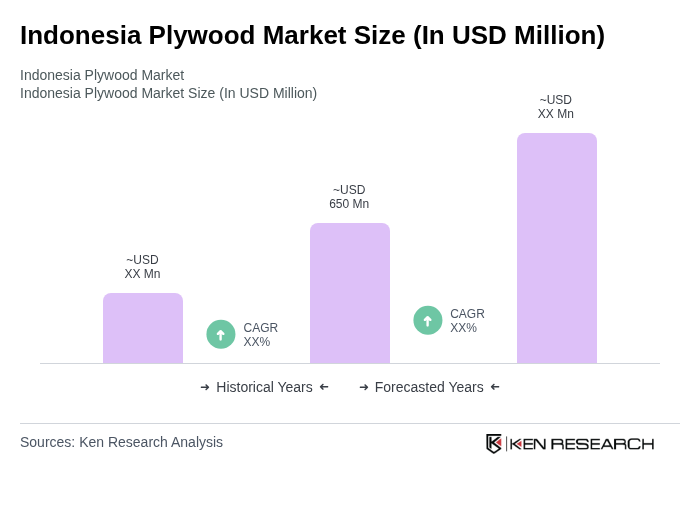
- The Indonesia Plywood Market is valued at USD 650 million, based on a five-year historical analysis. This growth is primarily driven by the increasing demand for plywood in construction, furniture, packaging, marine and shipbuilding sectors, alongside the rise in urbanization, infrastructure development, e-commerce logistics, and abundant timber resources across the country.
- Key regions dominating the market include Java, Sumatra, Kalimantan, Sulawesi, and others. Java, being the most populous island, has a high demand for plywood due to extensive construction activities and urban development. Sumatra and Kalimantan are significant for their abundant timber resources, which support plywood production.
- The Minister of Environment and Forestry Regulation No. P.21/MENLHK/SETJEN/KUM.1/4/2021 issued by the Ministry of Environment and Forestry mandates sustainable forest management practices for plywood production. This regulation requires timber businesses to implement selective logging systems, maintain minimum cutting diameters, achieve reforestation targets at 150% of harvested volume, and obtain SVLK certification for legal compliance and traceability.
Indonesia Plywood Market Segmentation
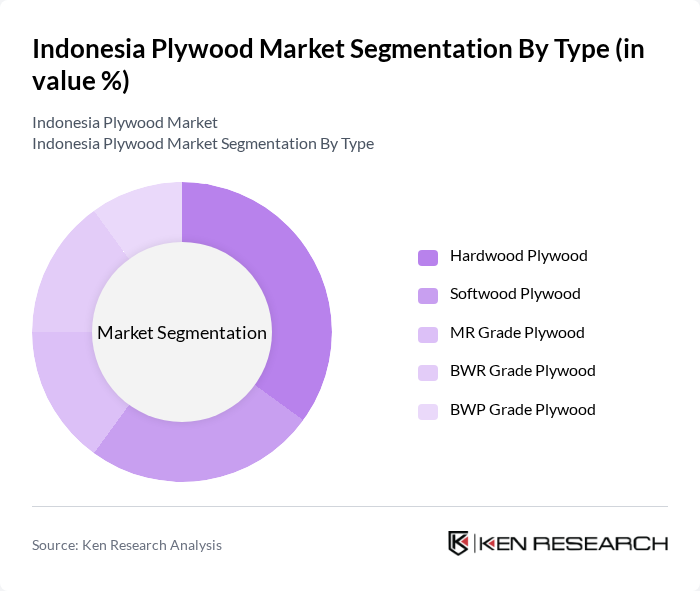
By Type:The plywood market can be segmented into various types, including Hardwood Plywood, Softwood Plywood, MR Grade Plywood, BWR Grade Plywood, and BWP Grade Plywood. Each type serves different applications based on their properties and suitability for specific uses. Hardwood plywood is often preferred for furniture due to its durability, while softwood plywood is commonly used in construction. MR, BWR, and BWP grades are essential for moisture-resistant applications, making them popular in areas with high humidity.
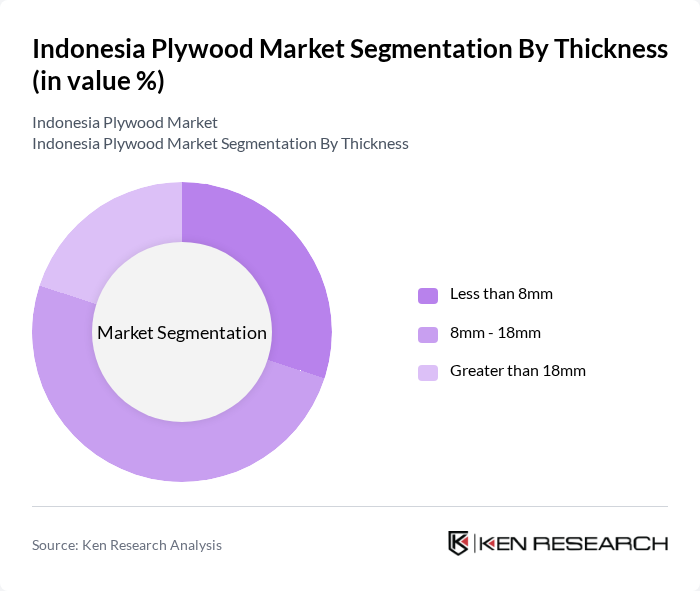
By Thickness:The plywood market is also categorized by thickness, which includes Less than 8mm, 8mm - 18mm, and Greater than 18mm. Thicker plywood is generally used for structural applications, while thinner sheets are preferred for furniture and decorative purposes. The choice of thickness often depends on the specific requirements of the project, such as load-bearing capacity and aesthetic appeal.
Indonesia Plywood Market Competitive Landscape
The Indonesia Plywood Market is characterized by a dynamic mix of regional and international players. Leading participants such as PT. Kayu Lapis Indonesia, PT. Wahana Lestari, PT. Sumber Mas Indah, PT. Bumi Plywood, PT. Rimba Lestari, PT. Indah Kiat Pulp & Paper, PT. Tanjung Enim Lestari, PT. Sinar Mas Forestry, PT. Plywood Nusantara, PT. Bina Karya, PT. Mitra Plywood, PT. Citra Lestari, PT. Karya Indah, PT. Sumber Alam, PT. Harapan Lestari contribute to innovation, geographic expansion, and service delivery in this space.
Indonesia Plywood Market Industry Analysis
Growth Drivers
- Increasing Demand for Sustainable Building Materials:The Indonesian plywood market is experiencing a surge in demand for sustainable building materials, driven by a growing awareness of environmental issues. In future, the construction sector is projected to utilize approximately 16 million cubic meters of plywood, reflecting a 7% increase from the previous year. This shift is supported by the World Bank's report indicating that sustainable construction practices can reduce carbon emissions by up to 30%, further incentivizing the use of eco-friendly materials.
- Expansion of the Construction Industry:Indonesia's construction industry is expected to grow significantly, with investments projected to reach IDR 1,300 trillion (approximately USD 85 billion) in future. This growth is fueled by government infrastructure projects, including the development of new roads and housing, which are anticipated to require an additional 6 million cubic meters of plywood. The construction sector's expansion is vital for the plywood market, as it directly correlates with increased demand for wood-based products.
- Government Initiatives Promoting Local Timber Usage:The Indonesian government has implemented various initiatives to promote the use of locally sourced timber, aiming to reduce reliance on imported materials. In future, the government plans to allocate IDR 600 billion (approximately USD 40 million) to support local timber producers. This initiative is expected to boost the domestic plywood market by 25%, as it encourages sustainable forestry practices and enhances the competitiveness of local manufacturers.
Market Challenges
- Deforestation and Environmental Regulations:The plywood industry faces significant challenges due to stringent environmental regulations aimed at combating deforestation. In future, Indonesia's Ministry of Environment and Forestry is expected to enforce stricter logging quotas, limiting timber extraction to 55 million cubic meters annually. This regulation poses a challenge for plywood manufacturers, as it may lead to raw material shortages and increased production costs, impacting overall market stability.
- Fluctuating Raw Material Prices:The plywood market is also challenged by the volatility of raw material prices, particularly for timber. In future, the price of logs is projected to fluctuate between IDR 1.6 million to IDR 2.1 million per cubic meter, influenced by global demand and supply chain disruptions. This price instability can significantly affect profit margins for plywood manufacturers, making it difficult to maintain competitive pricing in the market.
Indonesia Plywood Market Future Outlook
The future of the Indonesian plywood market appears promising, driven by increasing consumer demand for sustainable products and the expansion of the construction sector. As the government continues to support local timber usage and eco-friendly practices, manufacturers are likely to innovate and adapt to these trends. Additionally, the rise of online sales channels is expected to enhance market accessibility, allowing producers to reach a broader customer base and improve overall sales performance in the coming years.
Market Opportunities
- Growth in Eco-Friendly Product Demand:The demand for eco-friendly plywood products is anticipated to rise, with an estimated market value of IDR 350 trillion (approximately USD 23 billion) in future. This trend presents a significant opportunity for manufacturers to develop and market sustainable plywood options, catering to environmentally conscious consumers and businesses.
- Technological Advancements in Plywood Production:Innovations in plywood production technology are expected to enhance efficiency and reduce waste. In future, investments in advanced manufacturing techniques are projected to increase by 20%, allowing producers to improve product quality and reduce costs. This technological shift can create a competitive edge for manufacturers in the Indonesian plywood market.
Scope of the Report
| Segment | Sub-Segments |
|---|---|
| By Type | Hardwood Plywood Softwood Plywood MR Grade Plywood BWR Grade Plywood BWP Grade Plywood |
| By Thickness | Less than 8mm 8mm - 18mm Greater than 18mm |
| By Number of Ply | 1-Ply 2-Ply 3-Ply 4-Ply and Above |
| By Application | Furniture Construction and Flooring Packaging Marine Use Others |
| By Sales Channel | Direct Sales Distributors/Retailers |
| By Region | Java Sumatra Kalimantan Sulawesi Others |
Key Target Audience
Investors and Venture Capitalist Firms
Government and Regulatory Bodies (e.g., Ministry of Environment and Forestry, Ministry of Trade)
Manufacturers and Producers
Distributors and Retailers
Exporters and Importers
Industry Associations (e.g., Indonesian Wood Panel Association)
Financial Institutions
Logistics and Supply Chain Companies
Players Mentioned in the Report:
PT. Kayu Lapis Indonesia
PT. Wahana Lestari
PT. Sumber Mas Indah
PT. Bumi Plywood
PT. Rimba Lestari
PT. Indah Kiat Pulp & Paper
PT. Tanjung Enim Lestari
PT. Sinar Mas Forestry
PT. Plywood Nusantara
PT. Bina Karya
PT. Mitra Plywood
PT. Citra Lestari
PT. Karya Indah
PT. Sumber Alam
PT. Harapan Lestari
Table of Contents
Market Assessment Phase
1. Executive Summary and Approach
2. Indonesia Plywood Market Overview
2.1 Key Insights and Strategic Recommendations
2.2 Indonesia Plywood Market Overview
2.3 Definition and Scope
2.4 Evolution of Market Ecosystem
2.5 Timeline of Key Regulatory Milestones
2.6 Value Chain & Stakeholder Mapping
2.7 Business Cycle Analysis
2.8 Policy & Incentive Landscape
3. Indonesia Plywood Market Analysis
3.1 Growth Drivers
3.1.1 Increasing demand for sustainable building materials
3.1.2 Expansion of the construction industry
3.1.3 Government initiatives promoting local timber usage
3.1.4 Rising export opportunities in Asia-Pacific
3.2 Market Challenges
3.2.1 Deforestation and environmental regulations
3.2.2 Fluctuating raw material prices
3.2.3 Competition from alternative materials
3.2.4 Supply chain disruptions
3.3 Market Opportunities
3.3.1 Growth in eco-friendly product demand
3.3.2 Technological advancements in plywood production
3.3.3 Expansion into international markets
3.3.4 Development of value-added plywood products
3.4 Market Trends
3.4.1 Shift towards engineered wood products
3.4.2 Increasing focus on sustainability and certifications
3.4.3 Rise in online sales channels
3.4.4 Growing consumer awareness of product quality
3.5 Government Regulation
3.5.1 Timber Legality Assurance System (TLAS)
3.5.2 Export regulations on timber products
3.5.3 Environmental impact assessments
3.5.4 Local content requirements for construction projects
4. SWOT Analysis
5. Stakeholder Analysis
6. Porter's Five Forces Analysis
7. Indonesia Plywood Market Market Size, 2019-2024
7.1 By Value
7.2 By Volume
7.3 By Average Selling Price
8. Indonesia Plywood Market Segmentation
8.1 By Type
8.1.1 Hardwood Plywood
8.1.2 Softwood Plywood
8.1.3 MR Grade Plywood
8.1.4 BWR Grade Plywood
8.1.5 BWP Grade Plywood
8.2 By Thickness
8.2.1 Less than 8mm
8.2.2 8mm - 18mm
8.2.3 Greater than 18mm
8.3 By Number of Ply
8.3.1 3 Ply
8.3.2 5 Ply
8.3.3 7 Ply and More
8.4 By Application
8.4.1 Furniture
8.4.2 Construction and Flooring
8.4.3 Packaging
8.4.4 Marine Use
8.4.5 Others
8.5 By Sales Channel
8.5.1 Direct Sales
8.5.2 Distributors/Retailers
8.6 By Region
8.6.1 Java
8.6.2 Sumatra
8.6.3 Kalimantan
8.6.4 Sulawesi
8.6.5 Others
9. Indonesia Plywood Market Competitive Analysis
9.1 Market Share of Key Players
9.2 Cross Comparison of Key Players
9.2.1 Company Name
9.2.2 Revenue Growth Rate (CAGR 2020-2024)
9.2.3 Market Share (%)
9.2.4 EBITDA Margin (%)
9.2.5 Production Capacity (Million m³)
9.2.6 Capacity Utilization Rate (%)
9.2.7 Export Volume (Million m³)
9.2.8 R&D Investment (% of Revenue)
9.2.9 Sustainability Certification Coverage (%)
9.2.10 ROIC (Return on Invested Capital)
9.3 SWOT Analysis of Top Players
9.4 Pricing Analysis
9.5 Detailed Profile of Major Companies
9.5.1 PT. Kayu Lapis Indonesia
9.5.2 PT. Wahana Lestari
9.5.3 PT. Sumber Mas Indah
9.5.4 PT. Bumi Plywood
9.5.5 PT. Rimba Lestari
9.5.6 PT. Indah Kiat Pulp & Paper
9.5.7 PT. Tanjung Enim Lestari
9.5.8 PT. Sinar Mas Forestry
9.5.9 PT. Plywood Nusantara
9.5.10 PT. Bina Karya
9.5.11 PT. Mitra Plywood
9.5.12 PT. Citra Lestari
9.5.13 PT. Karya Indah
9.5.14 PT. Sumber Alam
9.5.15 PT. Harapan Lestari
10. Indonesia Plywood Market End-User Analysis
10.1 Procurement Behavior of Key Ministries
10.1.1 Ministry of Public Works
10.1.2 Ministry of Environment and Forestry
10.1.3 Ministry of Trade
10.1.4 Ministry of Industry
10.2 Corporate Spend on Infrastructure & Energy
10.2.1 Corporate Investments in Construction
10.2.2 Budget Allocations for Sustainable Materials
10.3 Pain Point Analysis by End-User Category
10.3.1 Residential Sector Challenges
10.3.2 Commercial Sector Challenges
10.3.3 Industrial Sector Challenges
10.4 User Readiness for Adoption
10.4.1 Awareness of Sustainable Options
10.4.2 Willingness to Pay for Quality
10.5 Post-Deployment ROI and Use Case Expansion
10.5.1 Evaluation of Cost Savings
10.5.2 Expansion into New Applications
11. Indonesia Plywood Market Future Size, 2025-2030
11.1 By Value
11.2 By Volume
11.3 By Average Selling Price
Go-To-Market Strategy Phase
1. Whitespace Analysis + Business Model Canvas
1.1 Market Gaps Identification
1.2 Business Model Development
2. Marketing and Positioning Recommendations
2.1 Branding Strategies
2.2 Product USPs
3. Distribution Plan
3.1 Urban Retail Strategies
3.2 Rural NGO Tie-ups
4. Channel & Pricing Gaps
4.1 Underserved Routes
4.2 Pricing Bands Analysis
5. Unmet Demand & Latent Needs
5.1 Category Gaps
5.2 Consumer Segments
6. Customer Relationship
6.1 Loyalty Programs
6.2 After-sales Service
7. Value Proposition
7.1 Sustainability Initiatives
7.2 Integrated Supply Chains
8. Key Activities
8.1 Regulatory Compliance
8.2 Branding Efforts
8.3 Distribution Setup
9. Entry Strategy Evaluation
9.1 Domestic Market Entry Strategy
9.1.1 Product Mix Considerations
9.1.2 Pricing Band Strategy
9.1.3 Packaging Solutions
9.2 Export Entry Strategy
9.2.1 Target Countries Identification
9.2.2 Compliance Roadmap Development
10. Entry Mode Assessment
10.1 Joint Ventures
10.2 Greenfield Investments
10.3 Mergers & Acquisitions
10.4 Distributor Model
11. Capital and Timeline Estimation
11.1 Capital Requirements
11.2 Timelines for Implementation
12. Control vs Risk Trade-Off
12.1 Ownership Considerations
12.2 Partnerships Evaluation
13. Profitability Outlook
13.1 Breakeven Analysis
13.2 Long-term Sustainability Strategies
14. Potential Partner List
14.1 Distributors
14.2 Joint Ventures
14.3 Acquisition Targets
15. Execution Roadmap
15.1 Phased Plan for Market Entry
15.1.1 Market Setup
15.1.2 Market Entry
15.1.3 Growth Acceleration
15.1.4 Scale & Stabilize
15.2 Key Activities and Milestones
15.2.1 Milestone Planning
Research Methodology
Phase 1: Approach1
Desk Research
- Analysis of industry reports from Indonesian trade associations and government publications
- Review of market trends and forecasts from reputable market research firms
- Examination of import/export data and statistics from customs authorities
Primary Research
- Interviews with key stakeholders in the plywood manufacturing sector, including factory owners and managers
- Surveys conducted with distributors and retailers to understand market dynamics and consumer preferences
- Field visits to plywood production facilities to gather firsthand insights on operational practices
Validation & Triangulation
- Cross-validation of findings through multiple data sources, including trade publications and expert opinions
- Triangulation of market data with insights from industry experts and academic research
- Sanity checks through feedback from a panel of industry veterans and market analysts
Phase 2: Market Size Estimation1
Top-down Assessment
- Estimation of total market size based on national construction and furniture industry growth rates
- Segmentation of the plywood market by application, including construction, furniture, and interior design
- Incorporation of government policies promoting sustainable forestry and their impact on market size
Bottom-up Modeling
- Collection of production volume data from leading plywood manufacturers in Indonesia
- Analysis of pricing trends across different plywood grades and types
- Estimation of market size based on production volume multiplied by average selling prices
Forecasting & Scenario Analysis
- Development of forecasting models based on historical growth rates and economic indicators
- Scenario analysis considering factors such as environmental regulations and international trade agreements
- Projections of market growth under various economic conditions through 2030
Phase 3: CATI Sample Composition1
| Scope Item/Segment | Sample Size | Target Respondent Profiles |
|---|---|---|
| Plywood Manufacturers | 45 | Production Managers, Quality Control Supervisors |
| Distributors and Wholesalers | 40 | Sales Managers, Supply Chain Coordinators |
| Retailers in Furniture Sector | 35 | Store Managers, Merchandising Directors |
| Construction Companies | 40 | Project Managers, Procurement Officers |
| Interior Designers and Architects | 30 | Design Consultants, Project Architects |
Frequently Asked Questions
What is the current value of the Indonesia Plywood Market?
The Indonesia Plywood Market is valued at approximately USD 650 million, reflecting a five-year historical analysis. This growth is driven by increasing demand in various sectors, including construction, furniture, and packaging.
Which regions in Indonesia dominate the plywood market?
What types of plywood are available in the Indonesian market?
How does the Indonesian government regulate plywood production?
Other Regional/Country Reports
Indonesia Plywood Market Report Size Share Growth Drivers Trends Opportunities & Forecast 2025–2030
Malaysia Plywood Market Report Size Share Growth Drivers Trends Opportunities & Forecast 2025–2030
Other Adjacent Reports
Vietnam Timber Market
UAE Engineered Wood MarketEgypt Particleboard Market
Egypt MDF Market
Egypt Furniture Manufacturing Market
India Construction Materials Market Size, Share & Forecast, By Material Type, Application & End User, 2026-2031KSA packaging materials market report size, share, growth drivers, trends, opportunities & forecast 2025–2030UAE Shipbuilding Materials Market
Forestry Management MarketKuwait Sustainable Building Materials Market
Why Buy From Us?

What makes us stand out is that our consultants follow Robust, Refine and Result (RRR) methodology. Robust for clear definitions, approaches and sanity checking, Refine for differentiating respondents' facts and opinions, and Result for presenting data with story.

We have set a benchmark in the industry by offering our clients with syndicated and customized market research reports featuring coverage of entire market as well as meticulous research and analyst insights.

While we don't replace traditional research, we flip the method upside down. Our dual approach of Top Bottom & Bottom Top ensures quality deliverable by not just verifying company fundamentals but also looking at the sector and macroeconomic factors.

With one step in the future, our research team constantly tries to show you the bigger picture. We help with some of the tough questions you may encounter along the way: How is the industry positioned? Best marketing channel? KPI's of competitors? By aligning every element, we help maximize success.

Our report gives you instant access to the answers and sources that other companies might choose to hide. We elaborate each steps of research methodology we have used and showcase you the sample size to earn your trust.

If you need any support, we are here! We pride ourselves on universe strength, data quality, and quick, friendly, and professional service.