Indonesia Portable Lithium Power Station Market Size, Share, Growth Drivers, Trends, Opportunities & Forecast 2025–2030

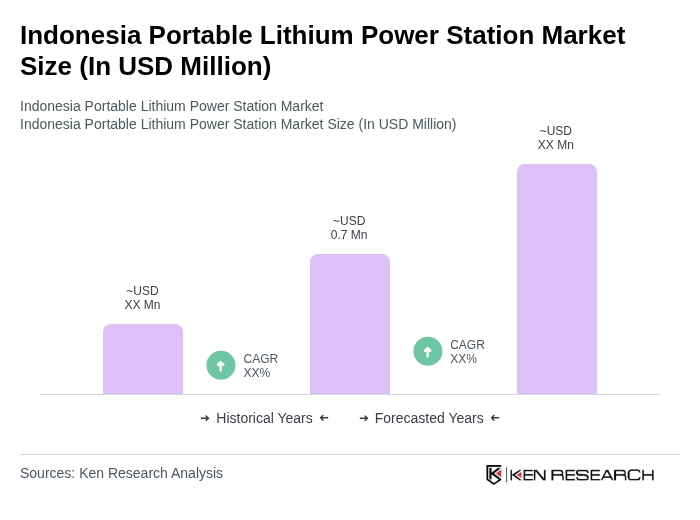
Indonesia Portable Lithium Power Station Market, valued at USD 0.7 million, sees growth from renewable energy push, outdoor recreation, and tech advancements in lithium-ion batteries.

Region:Asia

Author(s):Shubham

Product Code:KRAD6695

Pages:94

Published On:December 2025
About the Report

Base Year 2024

Indonesia Portable Lithium Power Station Market Overview

  • The Indonesia Portable Lithium Power Station Market is valued at USD 0.7 million, based on a five-year historical analysis, in line with the broader Indonesia portable energy storage system market which is dominated by lithium-ion technologies. This growth is primarily driven by the increasing demand for renewable energy solutions, rising outdoor recreational activities, and the need for reliable backup power sources in residential and commercial sectors. The market has seen a significant uptick in consumer awareness regarding energy independence and sustainability, supported by the growing penetration of lithium-ion–based storage for off-grid and backup applications in Indonesia.
  • Key cities such as Jakarta, Surabaya, and Bandung dominate the market due to their high population density, urbanization, and growing middle-class consumers who are increasingly investing in portable power solutions. The concentration of outdoor activities, events, and higher digital device usage in these regions further fuels the demand for portable lithium power stations, as consumers seek backup and mobile power for electronics during travel, recreational activities, and power interruptions.
  • In 2023, the Indonesian government strengthened policies to promote the use of renewable energy sources, including lithium-based storage systems used in portable applications, through the implementation of the Presidential Regulation No. 112 of 2022 on the Acceleration of Renewable Energy Development for Electricity Supply issued by the President of the Republic of Indonesia. This framework, together with implementing regulations under the National Energy Policy and power sector planning, supports incentives and facilitative measures for renewable generation and associated storage, encouraging the adoption of clean energy technologies and gradually reducing reliance on fossil-fuel-based power.
Indonesia Portable Lithium Power Station Market Size

Indonesia Portable Lithium Power Station Market Segmentation

By Capacity:The capacity of portable lithium power stations is a crucial factor influencing consumer choice. The market is segmented into various capacity ranges, including up to 300 Wh, 301–500 Wh, 501–1,000 Wh, 1,001–2,000 Wh, and above 2,000 Wh. The demand for higher capacity units is driven by the increasing need for power in outdoor activities, work-at-site applications, and emergency situations, with Indonesian users in remote and island regions often preferring units above 1 kWh to support essential loads during outages and off-grid use.
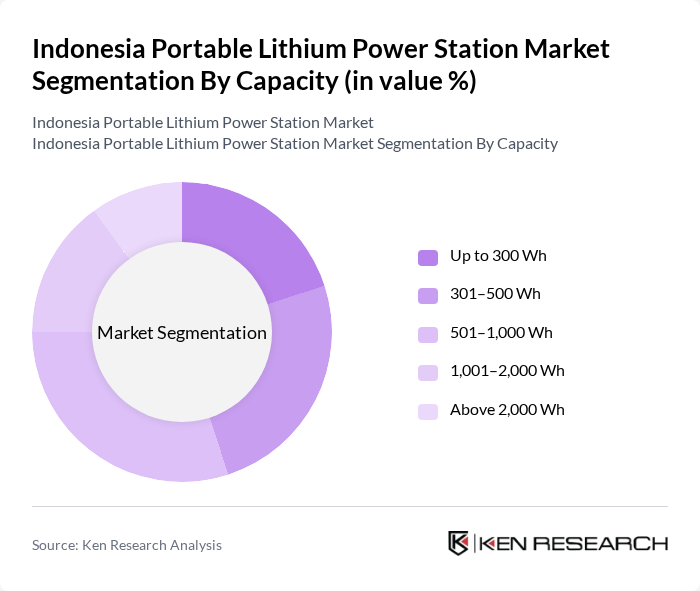
Indonesia Portable Lithium Power Station Market segmentation by Capacity.

The 501–1,000 Wh capacity segment is currently dominating the market due to its versatility and suitability for a wide range of applications, from camping and mobile work sites to emergency power supply. Consumers are increasingly opting for this capacity range as it provides a balance between portability and power output, making it ideal for both recreational and practical uses. The growing trend of outdoor activities, frequent localized power interruptions, and the need for reliable backup power solutions for electronic devices and small appliances are key drivers for this segment's leadership.

By Battery Type:The battery type is another significant factor in the portable lithium power station market, with segments including Lithium-ion (NMC, NCA), Lithium iron phosphate (LFP), and others (including lead-acid backup units). The choice of battery type affects performance, safety, and cost, influencing consumer preferences.
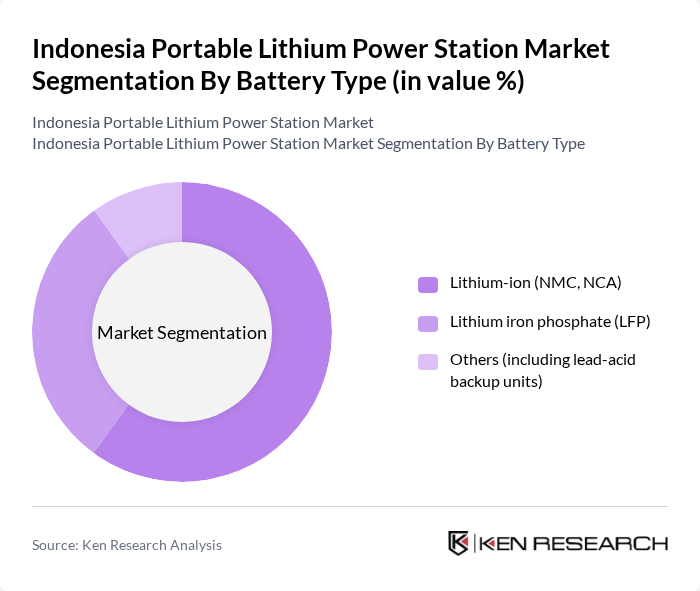
Indonesia Portable Lithium Power Station Market segmentation by Battery Type.

The Lithium-ion (NMC, NCA) battery type is leading the market due to its high energy density, longer lifespan, and lightweight characteristics, making it the preferred choice for consumers seeking efficient and portable power solutions. The increasing awareness of the benefits of lithium-ion technology in Indonesia, coupled with advancements in battery management systems and the country’s broader push for lithium-ion deployment in energy storage and mobility, has further solidified its dominance in the market.

Indonesia Portable Lithium Power Station Market Competitive Landscape

The Indonesia Portable Lithium Power Station Market is characterized by a dynamic mix of regional and international players. Leading participants such as EcoFlow Inc., Jackery Inc., Goal Zero LLC, Shenzhen Poweroak Newener Co., Ltd. (Bluetti / PowerOak), Anker Innovations Co., Ltd., ALLPOWERS Industrial International Limited, Shenzhen Suaoki New Energy Co., Ltd., Renogy (Renogy Power / RNG Group Inc.), Aiper Energy Co., Ltd., MAXOAK Corporation, PT V2 Indonesia, PT Petrosea Tbk – portable power & site energy solutions, PT Panasonic Gobel Indonesia, PT Changhong Electric Indonesia, PT SolarKita Indonesia contribute to innovation, geographic expansion, and service delivery in this space.

EcoFlow Inc.

2017

Shenzhen, China

Jackery Inc.

2012

California, USA

Goal Zero LLC

2009

Utah, USA

Shenzhen Poweroak Newener Co., Ltd. (Bluetti / PowerOak)

2019

Shenzhen, China

Anker Innovations Co., Ltd.

2011

Shenzhen, China

Company

Establishment Year

Headquarters

Product portfolio breadth (capacity & chemistry coverage)

Indonesia portable power station revenue (latest year)

Revenue CAGR in Indonesia portable segment (3–5 years)

Installed base / units in operation in Indonesia

Market share in Indonesia portable lithium power stations

Channel strength (online vs offline reach)

Indonesia Portable Lithium Power Station Market Industry Analysis

Growth Drivers

  • Increasing Demand for Renewable Energy Solutions:The Indonesian government aims to increase the share of renewable energy in the national energy mix to 23% by 2025, up from 13% in 2020. This shift is driven by a commitment to reduce greenhouse gas emissions by 29% by 2030. The growing awareness of climate change impacts is propelling consumers and businesses to seek portable lithium power stations as sustainable energy alternatives, thus driving market growth.
  • Rising Adoption of Portable Power Solutions for Outdoor Activities:Indonesia's outdoor tourism sector is projected to grow by 10% annually, with over 15 million domestic tourists engaging in outdoor activities in the future. This trend is increasing the demand for portable power solutions, as adventurers and campers require reliable energy sources for devices. The convenience and efficiency of lithium power stations are appealing to this expanding consumer base, further boosting market potential.
  • Technological Advancements in Battery Efficiency:The average energy density of lithium batteries has improved significantly, reaching approximately 250 Wh/kg in the future, compared to 150 Wh/kg in the past. These advancements enhance the performance and longevity of portable power stations, making them more attractive to consumers. As battery technology continues to evolve, the market is expected to benefit from increased efficiency and reduced costs, driving further adoption in Indonesia.

Market Challenges

  • High Initial Investment Costs:The average cost of a portable lithium power station in Indonesia is around IDR 5 million (approximately USD 350), which can be prohibitive for many consumers. This high upfront cost limits accessibility, particularly in rural areas where disposable income is lower. As a result, the market faces challenges in reaching a broader audience, hindering overall growth potential in the sector.
  • Limited Consumer Awareness:Despite the growing interest in renewable energy, consumer awareness regarding portable lithium power stations remains low. A survey indicated that only 30% of Indonesian consumers are familiar with these products. This lack of knowledge can lead to hesitance in purchasing decisions, as potential buyers may not fully understand the benefits and applications of portable power solutions, posing a significant challenge for market penetration.

Indonesia Portable Lithium Power Station Market Future Outlook

The future of the portable lithium power station market in Indonesia appears promising, driven by increasing environmental awareness and technological advancements. As the government continues to promote renewable energy initiatives, consumer interest in sustainable solutions is expected to rise. Additionally, the integration of smart energy management systems will enhance user experience, making these products more appealing. The market is likely to witness innovative financing models that will further facilitate access to these energy solutions, broadening their reach across various consumer segments.

Market Opportunities

  • Expansion into Rural Electrification Projects:With approximately 12 million Indonesians lacking access to electricity, portable lithium power stations present a viable solution for rural electrification. Collaborating with local governments and NGOs can facilitate the deployment of these systems, improving energy access and enhancing quality of life in underserved areas, thus creating significant market opportunities.
  • Partnerships with Outdoor and Recreational Brands:Collaborating with outdoor brands can enhance market visibility and credibility. As the outdoor recreation market grows, partnerships can lead to bundled offerings, increasing sales. By leveraging established brand loyalty, companies can effectively penetrate the market, tapping into a consumer base that values convenience and sustainability in their outdoor experiences.

Scope of the Report

SegmentSub-Segments
By Capacity

Up to 300 Wh

–500 Wh

–1,000 Wh

,001–2,000 Wh

Above 2,000 Wh

By Battery Type

Lithium-ion (NMC, NCA)

Lithium iron phosphate (LFP)

Others (including lead-acid backup units)

By Power Source / Charging Method

AC charging

Solar charging

Vehicle (DC / carport) charging

Hybrid (multi?input)

By Application

Residential backup power

Outdoor recreation & camping

Construction & field operations

Emergency & disaster preparedness

Commercial & SOHO (small office / home office)

By Sales Channel

Online (marketplaces & brand webstores)

Offline – modern retail & electronics chains

Offline – specialty / outdoor & solar dealers

B2B project & institutional sales

By Region

Java (incl. Greater Jakarta)

Sumatra

Bali & Nusa Tenggara

Kalimantan

Sulawesi

Papua & Maluku Islands

Key Target Audience

Investors and Venture Capitalist Firms

Government and Regulatory Bodies (e.g., Ministry of Energy and Mineral Resources, Ministry of Environment and Forestry)

Manufacturers and Producers

Distributors and Retailers

Energy Service Companies (ESCOs)

Utility Companies

Industry Associations (e.g., Indonesian Battery Association)

Financial Institutions

Players Mentioned in the Report:

EcoFlow Inc.

Jackery Inc.

Goal Zero LLC

Shenzhen Poweroak Newener Co., Ltd. (Bluetti / PowerOak)

Anker Innovations Co., Ltd.

ALLPOWERS Industrial International Limited

Shenzhen Suaoki New Energy Co., Ltd.

Renogy (Renogy Power / RNG Group Inc.)

Aiper Energy Co., Ltd.

MAXOAK Corporation

PT V2 Indonesia

PT Petrosea Tbk portable power & site energy solutions

PT Panasonic Gobel Indonesia

PT Changhong Electric Indonesia

PT SolarKita Indonesia

Table of Contents

Market Assessment Phase

1. Executive Summary and Approach


2. Indonesia Portable Lithium Power Station Market Overview

2.1 Key Insights and Strategic Recommendations

2.2 Indonesia Portable Lithium Power Station Market Overview

2.3 Definition and Scope

2.4 Evolution of Market Ecosystem

2.5 Timeline of Key Regulatory Milestones

2.6 Value Chain & Stakeholder Mapping

2.7 Business Cycle Analysis

2.8 Policy & Incentive Landscape


3. Indonesia Portable Lithium Power Station Market Analysis

3.1 Growth Drivers

3.1.1 Increasing demand for renewable energy solutions
3.1.2 Rising adoption of portable power solutions for outdoor activities
3.1.3 Government initiatives promoting clean energy
3.1.4 Technological advancements in battery efficiency

3.2 Market Challenges

3.2.1 High initial investment costs
3.2.2 Limited consumer awareness
3.2.3 Competition from traditional power sources
3.2.4 Regulatory hurdles in product certification

3.3 Market Opportunities

3.3.1 Expansion into rural electrification projects
3.3.2 Partnerships with outdoor and recreational brands
3.3.3 Development of innovative financing models
3.3.4 Increasing interest in disaster preparedness solutions

3.4 Market Trends

3.4.1 Growing popularity of eco-friendly products
3.4.2 Shift towards smart energy management systems
3.4.3 Rise in e-commerce for portable power solutions
3.4.4 Increased focus on product sustainability and recyclability

3.5 Government Regulation

3.5.1 Standards for battery safety and performance
3.5.2 Incentives for renewable energy adoption
3.5.3 Import tariffs on lithium batteries
3.5.4 Environmental regulations on waste disposal

4. SWOT Analysis


5. Stakeholder Analysis


6. Porter's Five Forces Analysis


7. Indonesia Portable Lithium Power Station Market Market Size, 2019-2024

7.1 By Value

7.2 By Volume

7.3 By Average Selling Price


8. Indonesia Portable Lithium Power Station Market Segmentation

8.1 By Capacity

8.1.1 Up to 300 Wh
8.1.2 301–500 Wh
8.1.3 501–1,000 Wh
8.1.4 1,001–2,000 Wh
8.1.5 Above 2,000 Wh

8.2 By Battery Type

8.2.1 Lithium-ion (NMC, NCA)
8.2.2 Lithium iron phosphate (LFP)
8.2.3 Others (including lead-acid backup units)

8.3 By Power Source / Charging Method

8.3.1 AC charging
8.3.2 Solar charging
8.3.3 Vehicle (DC / carport) charging
8.3.4 Hybrid (multi?input)

8.4 By Application

8.4.1 Residential backup power
8.4.2 Outdoor recreation & camping
8.4.3 Construction & field operations
8.4.4 Emergency & disaster preparedness
8.4.5 Commercial & SOHO (small office / home office)

8.5 By Sales Channel

8.5.1 Online (marketplaces & brand webstores)
8.5.2 Offline – modern retail & electronics chains
8.5.3 Offline – specialty / outdoor & solar dealers
8.5.4 B2B project & institutional sales

8.6 By Region

8.6.1 Java (incl. Greater Jakarta)
8.6.2 Sumatra
8.6.3 Bali & Nusa Tenggara
8.6.4 Kalimantan
8.6.5 Sulawesi
8.6.6 Papua & Maluku Islands

9. Indonesia Portable Lithium Power Station Market Competitive Analysis

9.1 Market Share of Key Players

9.2 Cross Comparison of Key Players

9.2.1 Company name and ownership (global / local)
9.2.2 Product portfolio breadth (capacity & chemistry coverage)
9.2.3 Indonesia portable power station revenue (latest year)
9.2.4 Revenue CAGR in Indonesia portable segment (3–5 years)
9.2.5 Installed base / units in operation in Indonesia
9.2.6 Market share in Indonesia portable lithium power stations
9.2.7 Channel strength (online vs offline reach)
9.2.8 Geographic coverage within Indonesia (number of provinces / islands served)
9.2.9 Average selling price (ASP) by key capacity bands
9.2.10 R&D intensity (% of revenue spent on product development)
9.2.11 Product certification & compliance status (SNI, IEC, safety)
9.2.12 Warranty terms & after?sales network coverage
9.2.13 Local partnerships (distributors, installers, e?commerce alliances)
9.2.14 Customization / OEM / ODM capability for Indonesian clients

9.3 SWOT Analysis of Top Players

9.4 Pricing Analysis

9.5 Detailed Profile of Major Companies

9.5.1 EcoFlow Inc.
9.5.2 Jackery Inc.
9.5.3 Goal Zero LLC
9.5.4 Shenzhen Poweroak Newener Co., Ltd. (Bluetti / PowerOak)
9.5.5 Anker Innovations Co., Ltd.
9.5.6 ALLPOWERS Industrial International Limited
9.5.7 Shenzhen Suaoki New Energy Co., Ltd.
9.5.8 Renogy (Renogy Power / RNG Group Inc.)
9.5.9 Aiper Energy Co., Ltd.
9.5.10 MAXOAK Corporation
9.5.11 PT V2 Indonesia
9.5.12 PT Petrosea Tbk – portable power & site energy solutions
9.5.13 PT Panasonic Gobel Indonesia
9.5.14 PT Changhong Electric Indonesia
9.5.15 PT SolarKita Indonesia

10. Indonesia Portable Lithium Power Station Market End-User Analysis

10.1 Procurement Behavior of Key Ministries

10.1.1 Government procurement processes
10.1.2 Budget allocation for energy projects
10.1.3 Evaluation criteria for suppliers
10.1.4 Collaboration with private sector

10.2 Corporate Spend on Infrastructure & Energy

10.2.1 Investment trends in energy infrastructure
10.2.2 Corporate sustainability initiatives
10.2.3 Budgeting for renewable energy solutions
10.2.4 Partnerships with energy providers

10.3 Pain Point Analysis by End-User Category

10.3.1 Residential user challenges
10.3.2 Commercial user challenges
10.3.3 Industrial user challenges
10.3.4 Government user challenges

10.4 User Readiness for Adoption

10.4.1 Awareness of portable power solutions
10.4.2 Perceived benefits of lithium power stations
10.4.3 Barriers to adoption
10.4.4 User education and training needs

10.5 Post-Deployment ROI and Use Case Expansion

10.5.1 Measurement of ROI
10.5.2 Case studies of successful deployments
10.5.3 Expansion into new use cases
10.5.4 Long-term benefits analysis

11. Indonesia Portable Lithium Power Station Market Future Size, 2025-2030

11.1 By Value

11.2 By Volume

11.3 By Average Selling Price


Go-To-Market Strategy Phase

1. Whitespace Analysis + Business Model Canvas

1.1 Market gaps identification

1.2 Business model components

1.3 Value proposition development

1.4 Revenue streams analysis

1.5 Cost structure evaluation

1.6 Key partnerships

1.7 Customer segments


2. Marketing and Positioning Recommendations

2.1 Branding strategies

2.2 Product USPs

2.3 Target audience identification

2.4 Communication channels

2.5 Promotional tactics

2.6 Market positioning

2.7 Customer engagement strategies


3. Distribution Plan

3.1 Urban retail strategies

3.2 Rural NGO tie-ups

3.3 Online distribution channels

3.4 Partnerships with local distributors

3.5 Logistics and supply chain management

3.6 Inventory management

3.7 Customer service integration


4. Channel & Pricing Gaps

4.1 Underserved routes

4.2 Pricing bands analysis

4.3 Competitor pricing strategies

4.4 Customer willingness to pay

4.5 Value-based pricing models

4.6 Discount strategies

4.7 Price elasticity considerations


5. Unmet Demand & Latent Needs

5.1 Category gaps identification

5.2 Consumer segments analysis

5.3 Emerging trends in consumer preferences

5.4 Product development opportunities

5.5 Market entry barriers

5.6 Customer feedback mechanisms

5.7 Future demand forecasting


6. Customer Relationship

6.1 Loyalty programs

6.2 After-sales service

6.3 Customer feedback loops

6.4 Community engagement initiatives

6.5 Customer education programs

6.6 Relationship management tools

6.7 Customer satisfaction measurement


7. Value Proposition

7.1 Sustainability initiatives

7.2 Integrated supply chains

7.3 Unique selling points

7.4 Customer-centric approach

7.5 Competitive advantages

7.6 Long-term value creation

7.7 Brand loyalty factors


8. Key Activities

8.1 Regulatory compliance

8.2 Branding efforts

8.3 Distribution setup

8.4 Marketing campaigns

8.5 Training and development

8.6 Performance monitoring

8.7 Stakeholder engagement


9. Entry Strategy Evaluation

9.1 Domestic Market Entry Strategy

9.1.1 Product mix considerations
9.1.2 Pricing band analysis
9.1.3 Packaging strategies

9.2 Export Entry Strategy

9.2.1 Target countries identification
9.2.2 Compliance roadmap development

10. Entry Mode Assessment

10.1 JV opportunities

10.2 Greenfield investments

10.3 M&A considerations

10.4 Distributor model evaluation


11. Capital and Timeline Estimation

11.1 Capital requirements analysis

11.2 Timelines for market entry


12. Control vs Risk Trade-Off

12.1 Ownership considerations

12.2 Partnerships evaluation


13. Profitability Outlook

13.1 Breakeven analysis

13.2 Long-term sustainability strategies


14. Potential Partner List

14.1 Distributors identification

14.2 JV opportunities

14.3 Acquisition targets


15. Execution Roadmap

15.1 Phased Plan for Market Entry

15.1.1 Market Setup
15.1.2 Market Entry
15.1.3 Growth Acceleration
15.1.4 Scale & Stabilize

15.2 Key Activities and Milestones

15.2.1 Milestone tracking
15.2.2 Activity scheduling

Research Methodology

ApproachModellingSample

Phase 1: Approach1

Desk Research

  • Analysis of industry reports from government agencies and market research firms
  • Review of academic publications and white papers on lithium battery technology
  • Examination of trade publications and news articles related to the portable power station market

Primary Research

  • Interviews with product managers at leading portable power station manufacturers
  • Surveys with retailers and distributors in the Indonesian market
  • Field interviews with end-users, including outdoor enthusiasts and emergency preparedness organizations

Validation & Triangulation

  • Cross-validation of findings through multiple data sources, including sales data and market trends
  • Triangulation of insights from primary interviews with secondary research findings
  • Sanity checks conducted through expert panel reviews and feedback sessions

Phase 2: Market Size Estimation1

Top-down Assessment

  • Estimation of market size based on national energy consumption and portable power needs
  • Segmentation by application areas such as camping, emergency backup, and commercial use
  • Incorporation of government initiatives promoting renewable energy solutions

Bottom-up Modeling

  • Collection of sales data from key distributors and retailers in the portable power station sector
  • Estimation of average selling prices and unit sales across different product categories
  • Volume x price analysis to derive total market revenue figures

Forecasting & Scenario Analysis

  • Multi-variable forecasting using trends in outdoor activities and renewable energy adoption
  • Scenario analysis based on potential regulatory changes and market entry of new technologies
  • Development of baseline, optimistic, and pessimistic market growth projections through 2030

Phase 3: CATI Sample Composition1

Scope Item/SegmentSample SizeTarget Respondent Profiles
Consumer Market for Portable Power Stations120Outdoor Enthusiasts, Homeowners
Commercial Applications in Construction100Project Managers, Site Supervisors
Emergency Services Utilization80Emergency Response Coordinators, Fire Department Officials
Retail Distribution Channels70Retail Managers, Supply Chain Coordinators
Technological Adoption in Renewable Energy60Energy Consultants, Sustainability Officers

Frequently Asked Questions

What is the current value of the Indonesia Portable Lithium Power Station Market?

The Indonesia Portable Lithium Power Station Market is valued at approximately USD 0.7 million, reflecting a growing interest in renewable energy solutions and portable power sources for both residential and commercial applications.

What factors are driving the growth of the portable lithium power station market in Indonesia?

Which cities in Indonesia are leading in the portable lithium power station market?

What are the main applications of portable lithium power stations in Indonesia?

Other Regional/Country Reports

Malaysia Portable Lithium Power Station Market

KSA Portable Lithium Power Station Market

APAC Portable Lithium Power Station Market

SEA Portable Lithium Power Station Market

Vietnam Portable Lithium Power Station Market

Thailand Portable Lithium Power Station Market

Other Adjacent Reports

Mexico Portable Energy Storage System Market

Global Lithium-Ion Battery Market Outlook to 2030

Oman Renewable Energy Solutions Market

Bahrain Outdoor Recreational Power Market

KSA Solar Power Accessories Market

Japan Emergency Backup Power Market

Germany Consumer Electronics Charging Market

Mexico Off-Grid Power Solutions Market

Saudi Arabia electric vehicle battery market Size, Share, Growth Drivers, Trends, Opportunities & Forecast 2025–2030

Belgium Smart Home Energy Management Market

Why Buy From Us?

Refine Robust Result (RRR) Framework

What makes us stand out is that our consultants follow Robust, Refine and Result (RRR) methodology. Robust for clear definitions, approaches and sanity checking, Refine for differentiating respondents' facts and opinions, and Result for presenting data with story.

Our Reach Is Unmatched

We have set a benchmark in the industry by offering our clients with syndicated and customized market research reports featuring coverage of entire market as well as meticulous research and analyst insights.

Shifting the Research Paradigm

While we don't replace traditional research, we flip the method upside down. Our dual approach of Top Bottom & Bottom Top ensures quality deliverable by not just verifying company fundamentals but also looking at the sector and macroeconomic factors.

More Insights-Better Decisions

With one step in the future, our research team constantly tries to show you the bigger picture. We help with some of the tough questions you may encounter along the way: How is the industry positioned? Best marketing channel? KPI's of competitors? By aligning every element, we help maximize success.

Transparency and Trust

Our report gives you instant access to the answers and sources that other companies might choose to hide. We elaborate each steps of research methodology we have used and showcase you the sample size to earn your trust.

Round the Clock Support

If you need any support, we are here! We pride ourselves on universe strength, data quality, and quick, friendly, and professional service.

Why Clients Choose Us?

400000+
Reports in repository
150+
Consulting projects a year
100+
Analysts
8000+
Client Queries in 2022








