About the Report
Base Year 2024Indonesia Private LTE 5G Network Market Overview
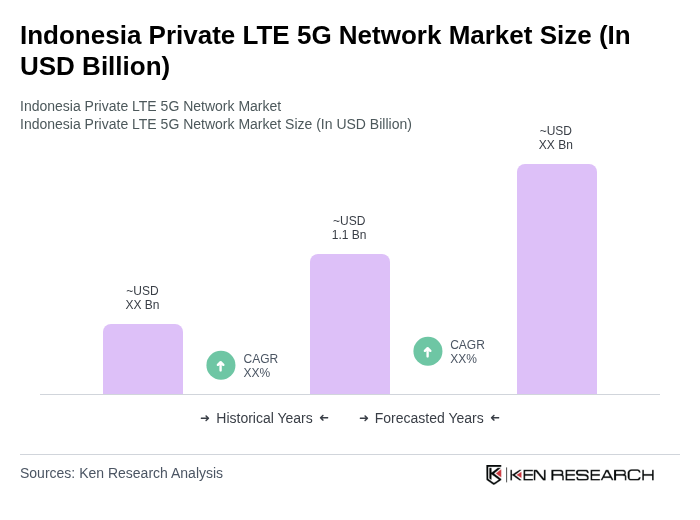
- The Indonesia Private LTE 5G Network Market is valued at USD 1.1 billion, based on a five-year historical analysis, in line with the rapid growth of private wireless and 5G private networks across Asia Pacific and Southeast Asia. This growth is primarily driven by the increasing demand for high-speed connectivity, the rise of Industry 4.0, and the need for secure and reliable communication networks across various sectors. The expansion of digital infrastructure, accelerated enterprise digital transformation, and government initiatives to promote 5G technology and smart manufacturing have further fueled market growth.
- Key cities such as Jakarta, Surabaya, and Bandung dominate the market due to their status as economic and technological hubs, hosting major industrial clusters, logistics corridors, and ICT investments. Jakarta, being the capital, leads in digital transformation initiatives and early 5G and private network trials, while Surabaya and Bandung are rapidly adopting advanced technologies in manufacturing, logistics, and smart city projects. The concentration of industries, data centers, and infrastructure investments in these cities significantly contributes to the market's expansion.
- In 2023, the Indonesian government, through the Ministry of Communication and Informatics (Kementerian Komunikasi dan Informatika/Kominfo), advanced spectrum planning for enterprise and industrial connectivity, including allocations in bands such as 2.3 GHz and 3.5 GHz that support private LTE and 5G deployments. A key framework is the Minister of Communication and Informatics Regulation No. 5 of 2021 on the Operation of Telecommunication, which sets licensing, spectrum use, and quality-of-service obligations for cellular and broadband networks used as the foundation for enterprise and industrial 4G/5G services. This regulatory framework facilitates the establishment of dedicated and semi-dedicated networks for industries, ensuring defined service quality, security, and compliance for sectors such as manufacturing, healthcare, transportation, ports, and logistics.
Indonesia Private LTE 5G Network Market Segmentation
By Network Type:
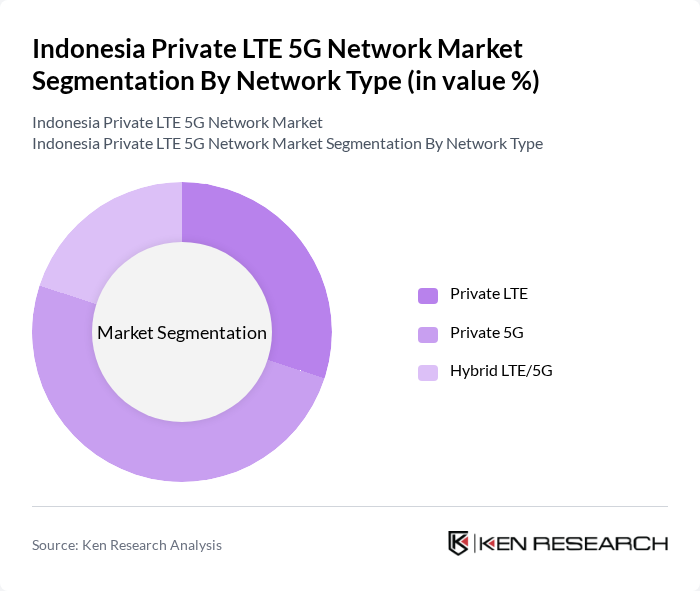
The segmentation by network type includes Private LTE, Private 5G, and Hybrid LTE/5G. Among these, Private 5G is currently emerging as the leading growth segment in new deployments due to its ability to provide higher data rates, lower latency, network slicing, and enhanced security features compared to traditional Private LTE. Industries in Indonesia and broader Southeast Asia are increasingly piloting and adopting Private 5G networks to support advanced applications such as IoT, industrial automation, smart factories, predictive maintenance, ports and mining connectivity, and real-time data analytics, which are essential for operational efficiency and competitive advantage.
By Spectrum Type:
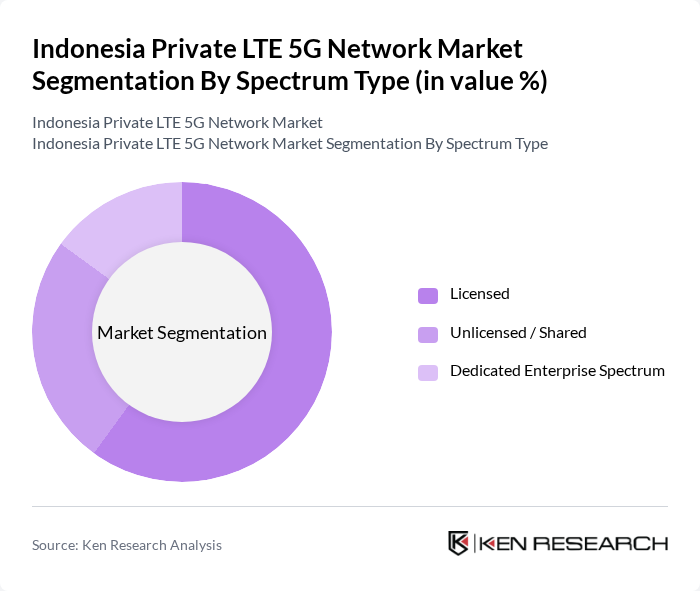
This segmentation includes Licensed, Unlicensed/Shared, and Dedicated Enterprise Spectrum. The Licensed spectrum is leading the market as it provides exclusive or prioritized access and better performance for private and industrial networks, especially when delivered via mobile network operators’ licensed bands. Enterprises prefer licensed spectrum for critical applications that require guaranteed bandwidth, deterministic latency, and low interference, making it the preferred choice for sectors like manufacturing, utilities, oil and gas, ports, and healthcare.
Indonesia Private LTE 5G Network Market Competitive Landscape
The Indonesia Private LTE 5G Network Market is characterized by a dynamic mix of regional and international players. Leading participants such as Telkomsel, Indosat Ooredoo Hutchison, XL Axiata, Smartfren, PT Telekomunikasi Indonesia (Telkom Indonesia), Huawei Technologies, Ericsson, Nokia, ZTE Corporation, Cisco Systems, NEC Corporation, Samsung Electronics, Qualcomm Technologies, Fujitsu, Mavenir, CommScope contribute to innovation, geographic expansion, and service delivery in this space.
Indonesia Private LTE 5G Network Market Industry Analysis
Growth Drivers
- Increasing Demand for High-Speed Connectivity:The demand for high-speed connectivity in Indonesia is surging, driven by a projected 10% annual increase in internet users, reaching approximately 190 million in future. This growth is fueled by the rising consumption of data-intensive applications, such as video streaming and online gaming, which are expected to account for over 75% of total internet traffic. Enhanced connectivity is essential for businesses to remain competitive in a digital economy, thus propelling the private LTE 5G network market.
- Expansion of Industrial IoT Applications:The industrial IoT sector in Indonesia is anticipated to grow significantly, with an estimated market value of $12 billion in future. This expansion is driven by the increasing adoption of smart manufacturing and automation technologies across various industries, including manufacturing, agriculture, and logistics. The integration of private LTE 5G networks will facilitate real-time data transmission and analytics, enhancing operational efficiency and productivity in these sectors, thereby driving market growth.
- Government Initiatives for Digital Transformation:The Indonesian government has committed to investing $2 billion in digital infrastructure in future, aiming to enhance connectivity and promote digital transformation across the nation. Initiatives such as the "100 Smart Cities" program are designed to foster the development of smart urban environments, which will rely heavily on private LTE 5G networks. This government support is crucial for accelerating the deployment of advanced telecommunications infrastructure, thus driving market growth.
Market Challenges
- High Initial Investment Costs:The deployment of private LTE 5G networks requires substantial initial investments, estimated at around $3 billion for infrastructure development in Indonesia. This financial barrier poses a significant challenge for many enterprises, particularly small and medium-sized businesses, which may struggle to allocate sufficient resources for such advanced technologies. Consequently, this limits the overall market penetration and adoption of private LTE 5G networks in the region.
- Limited Spectrum Availability:The availability of spectrum for private LTE 5G networks in Indonesia is constrained, with only 250 MHz allocated for commercial use in future. This limitation hampers the ability of operators to expand their services and meet the growing demand for high-speed connectivity. Regulatory challenges surrounding spectrum allocation further complicate the situation, making it difficult for new entrants to compete effectively in the market.
Indonesia Private LTE 5G Network Market Future Outlook
The future of the private LTE 5G network market in Indonesia appears promising, driven by technological advancements and increasing digitalization across various sectors. As industries continue to embrace automation and IoT solutions, the demand for robust and secure connectivity will rise. Additionally, the government's commitment to enhancing digital infrastructure will likely facilitate the growth of private networks, enabling enterprises to leverage advanced technologies for improved operational efficiency and innovation in service delivery.
Market Opportunities
- Growth in Smart City Projects:The Indonesian government's focus on developing smart cities presents a significant opportunity for private LTE 5G networks. With an investment of $1.5 billion in smart city initiatives in future, these projects will require advanced connectivity solutions to support various applications, including traffic management and public safety, thereby driving demand for private networks.
- Adoption of Private Networks in Enterprises:As enterprises increasingly recognize the benefits of private LTE 5G networks, the market is poised for growth. With an estimated 35% of large enterprises planning to implement private networks in future, this trend will create substantial opportunities for service providers to cater to the specific needs of businesses seeking enhanced security and control over their communications infrastructure.
Scope of the Report
| Segment | Sub-Segments |
|---|---|
| By Network Type | Private LTE Private 5G Hybrid LTE/5G |
| By Spectrum Type | Licensed Unlicensed / Shared Dedicated Enterprise Spectrum |
| By Component | Hardware (RAN, Core, Edge, CPE) Software (Network Management, Orchestration) Services (Consulting, Integration, Managed Services) |
| By Deployment Model | On-Premises Cloud / Hosted Hybrid |
| By Frequency Band | Sub-6 GHz mmWave |
| By End-User Industry | Manufacturing & Industry 4.0 Mining, Oil & Gas Transport, Ports & Logistics Utilities & Energy Public Sector, Smart City & Safety Healthcare & Campus Others |
| By Use Case | Mission-Critical Communications Industrial Automation & Robotics Video Surveillance & Analytics Asset Tracking & Fleet Management Remote Operations & Maintenance AR/VR and Advanced Applications |
Key Target Audience
Investors and Venture Capitalist Firms
Government and Regulatory Bodies (e.g., Ministry of Communication and Information Technology, Indonesian Telecommunication Regulatory Authority)
Telecommunication Network Operators
Private Enterprises and Corporations
Infrastructure Providers
Technology Solution Developers
Telecom Equipment Manufacturers
Industry Associations and Trade Organizations
Players Mentioned in the Report:
Telkomsel
Indosat Ooredoo Hutchison
XL Axiata
Smartfren
PT Telekomunikasi Indonesia (Telkom Indonesia)
Huawei Technologies
Ericsson
Nokia
ZTE Corporation
Cisco Systems
NEC Corporation
Samsung Electronics
Qualcomm Technologies
Fujitsu
Mavenir
CommScope
Table of Contents
Market Assessment Phase
1. Executive Summary and Approach
2. Indonesia Private LTE 5G Network Market Overview
2.1 Key Insights and Strategic Recommendations
2.2 Indonesia Private LTE 5G Network Market Overview
2.3 Definition and Scope
2.4 Evolution of Market Ecosystem
2.5 Timeline of Key Regulatory Milestones
2.6 Value Chain & Stakeholder Mapping
2.7 Business Cycle Analysis
2.8 Policy & Incentive Landscape
3. Indonesia Private LTE 5G Network Market Analysis
3.1 Growth Drivers
3.1.1 Increasing demand for high-speed connectivity
3.1.2 Expansion of industrial IoT applications
3.1.3 Government initiatives for digital transformation
3.1.4 Rising investments in telecommunications infrastructure
3.2 Market Challenges
3.2.1 High initial investment costs
3.2.2 Limited spectrum availability
3.2.3 Regulatory hurdles
3.2.4 Competition from alternative technologies
3.3 Market Opportunities
3.3.1 Growth in smart city projects
3.3.2 Adoption of private networks in enterprises
3.3.3 Partnerships with technology providers
3.3.4 Development of edge computing solutions
3.4 Market Trends
3.4.1 Shift towards network slicing
3.4.2 Increased focus on cybersecurity
3.4.3 Integration of AI and machine learning
3.4.4 Emergence of 5G-enabled applications
3.5 Government Regulation
3.5.1 Spectrum allocation policies
3.5.2 Data privacy regulations
3.5.3 Infrastructure investment incentives
3.5.4 Compliance requirements for operators
4. SWOT Analysis
5. Stakeholder Analysis
6. Porter's Five Forces Analysis
7. Indonesia Private LTE 5G Network Market Market Size, 2019-2024
7.1 By Value
7.2 By Volume
7.3 By Average Selling Price
8. Indonesia Private LTE 5G Network Market Segmentation
8.1 By Network Type
8.1.1 Private LTE
8.1.2 Private 5G
8.1.3 Hybrid LTE/5G
8.2 By Spectrum Type
8.2.1 Licensed
8.2.2 Unlicensed / Shared
8.2.3 Dedicated Enterprise Spectrum
8.3 By Component
8.3.1 Hardware (RAN, Core, Edge, CPE)
8.3.2 Software (Network Management, Orchestration)
8.3.3 Services (Consulting, Integration, Managed Services)
8.4 By Deployment Model
8.4.1 On-Premises
8.4.2 Cloud / Hosted
8.4.3 Hybrid
8.5 By Frequency Band
8.5.1 Sub-6 GHz
8.5.2 mmWave
8.6 By End-User Industry
8.6.1 Manufacturing & Industry 4.0
8.6.2 Mining, Oil & Gas
8.6.3 Transport, Ports & Logistics
8.6.4 Utilities & Energy
8.6.5 Public Sector, Smart City & Safety
8.6.6 Healthcare & Campus
8.6.7 Others
8.7 By Use Case
8.7.1 Mission-Critical Communications
8.7.2 Industrial Automation & Robotics
8.7.3 Video Surveillance & Analytics
8.7.4 Asset Tracking & Fleet Management
8.7.5 Remote Operations & Maintenance
8.7.6 AR/VR and Advanced Applications
9. Indonesia Private LTE 5G Network Market Competitive Analysis
9.1 Market Share of Key Players
9.2 Cross Comparison of Key Players
9.2.1 Company Name
9.2.2 Addressable Indonesia Private LTE / 5G Revenue (USD Mn)
9.2.3 3-Year CAGR in Indonesia Private Networks Revenue
9.2.4 Number of Live / Trial Private LTE & 5G Deployments in Indonesia
9.2.5 Share of Revenue from Industrial & Enterprise Use Cases (%)
9.2.6 Average Contract Value per Deployment (USD)
9.2.7 EBITDA Margin for Indonesia Private Network Business (%)
9.2.8 Capex Intensity for Private Network Infrastructure (%)
9.2.9 Average Payback Period for Enterprise Projects (Years)
9.2.10 Net Promoter Score (NPS) / Customer Satisfaction Index
9.2.11 SLA Compliance (% of Contracts Meeting KPIs)
9.2.12 Network Availability / Uptime (%) in Deployed Sites
9.3 SWOT Analysis of Top Players
9.4 Pricing Analysis
9.5 Detailed Profile of Major Companies
9.5.1 Telkomsel
9.5.2 Indosat Ooredoo Hutchison
9.5.3 XL Axiata
9.5.4 Smartfren
9.5.5 PT Telekomunikasi Indonesia (Telkom Indonesia)
9.5.6 Huawei Technologies
9.5.7 Ericsson
9.5.8 Nokia
9.5.9 ZTE Corporation
9.5.10 Cisco Systems
9.5.11 NEC Corporation
9.5.12 Samsung Electronics
9.5.13 Qualcomm Technologies
9.5.14 Fujitsu
9.5.15 Mavenir
9.5.16 CommScope
10. Indonesia Private LTE 5G Network Market End-User Analysis
10.1 Procurement Behavior of Key Ministries
10.1.1 Ministry of Communication and Information Technology
10.1.2 Ministry of Industry
10.1.3 Ministry of Transportation
10.1.4 Ministry of Health
10.2 Corporate Spend on Infrastructure & Energy
10.2.1 Investment Trends in Telecommunications
10.2.2 Budget Allocation for Digital Infrastructure
10.3 Pain Point Analysis by End-User Category
10.3.1 Connectivity Issues
10.3.2 Data Security Concerns
10.3.3 Integration Challenges
10.3.4 Cost Management
10.4 User Readiness for Adoption
10.4.1 Awareness Levels
10.4.2 Training and Support Needs
10.5 Post-Deployment ROI and Use Case Expansion
10.5.1 Performance Metrics
10.5.2 Scalability Opportunities
11. Indonesia Private LTE 5G Network Market Future Size, 2025-2030
11.1 By Value
11.2 By Volume
11.3 By Average Selling Price
Go-To-Market Strategy Phase
1. Whitespace Analysis + Business Model Canvas
1.1 Market Gaps Identification
1.2 Business Model Development
2. Marketing and Positioning Recommendations
2.1 Branding Strategies
2.2 Product USPs
3. Distribution Plan
3.1 Urban Retail Strategies
3.2 Rural NGO Tie-ups
4. Channel & Pricing Gaps
4.1 Underserved Routes
4.2 Pricing Bands
5. Unmet Demand & Latent Needs
5.1 Category Gaps
5.2 Consumer Segments
6. Customer Relationship
6.1 Loyalty Programs
6.2 After-sales Service
7. Value Proposition
7.1 Sustainability Initiatives
7.2 Integrated Supply Chains
8. Key Activities
8.1 Regulatory Compliance
8.2 Branding Efforts
8.3 Distribution Setup
9. Entry Strategy Evaluation
9.1 Domestic Market Entry Strategy
9.1.1 Product Mix
9.1.2 Pricing Band
9.1.3 Packaging
9.2 Export Entry Strategy
9.2.1 Target Countries
9.2.2 Compliance Roadmap
10. Entry Mode Assessment
10.1 Joint Ventures
10.2 Greenfield Investments
10.3 Mergers & Acquisitions
10.4 Distributor Model
11. Capital and Timeline Estimation
11.1 Capital Requirements
11.2 Timelines
12. Control vs Risk Trade-Off
12.1 Ownership vs Partnerships
13. Profitability Outlook
13.1 Breakeven Analysis
13.2 Long-term Sustainability
14. Potential Partner List
14.1 Distributors
14.2 Joint Ventures
14.3 Acquisition Targets
15. Execution Roadmap
15.1 Phased Plan for Market Entry
15.1.1 Market Setup
15.1.2 Market Entry
15.1.3 Growth Acceleration
15.1.4 Scale & Stabilize
15.2 Key Activities and Milestones
15.2.1 Milestone Planning
Research Methodology
Phase 1: Approach1
Desk Research
- Analysis of government reports on telecommunications infrastructure in Indonesia
- Review of industry publications and white papers on private LTE and 5G technology
- Examination of market trends and forecasts from telecommunications regulatory bodies
Primary Research
- Interviews with network engineers and technical leads at major telecom operators
- Surveys with enterprise clients utilizing private LTE and 5G networks
- Focus groups with industry experts and consultants in telecommunications
Validation & Triangulation
- Cross-validation of findings through multiple data sources including market reports and expert opinions
- Triangulation of quantitative data with qualitative insights from interviews
- Sanity checks through expert panel reviews to ensure data accuracy
Phase 2: Market Size Estimation1
Top-down Assessment
- Estimation of market size based on national telecommunications expenditure
- Segmentation by industry verticals adopting private LTE and 5G solutions
- Incorporation of government initiatives promoting digital transformation
Bottom-up Modeling
- Data collection from leading private LTE and 5G service providers on service uptake
- Cost analysis based on deployment and operational expenses of private networks
- Volume estimates based on projected enterprise demand for connectivity solutions
Forecasting & Scenario Analysis
- Multi-factor regression analysis considering economic growth and technology adoption rates
- Scenario modeling based on regulatory changes and market entry of new players
- Development of baseline, optimistic, and pessimistic forecasts through 2030
Phase 3: CATI Sample Composition1
| Scope Item/Segment | Sample Size | Target Respondent Profiles |
|---|---|---|
| Manufacturing Sector Adoption | 120 | IT Managers, Operations Directors |
| Healthcare Network Implementation | 90 | Healthcare IT Specialists, Network Administrators |
| Logistics and Supply Chain Solutions | 80 | Logistics Managers, Supply Chain Analysts |
| Smart City Initiatives | 70 | Urban Planners, Technology Officers |
| Energy Sector Connectivity | 100 | Energy Managers, Telecommunications Engineers |
Frequently Asked Questions
What is the current value of the Indonesia Private LTE 5G Network Market?
The Indonesia Private LTE 5G Network Market is valued at approximately USD 1.1 billion, reflecting significant growth driven by the demand for high-speed connectivity and advancements in digital infrastructure across various sectors.
What factors are driving the growth of the Private LTE 5G Network Market in Indonesia?
Which cities in Indonesia are leading in Private LTE 5G Network adoption?
What regulatory framework supports the deployment of Private LTE and 5G networks in Indonesia?
Other Regional/Country Reports
Other Adjacent Reports
Kuwait Industrial IoT Market
United States Smart Manufacturing Market Outlook to 2030: Size, Share, Growth and TrendsSouth Africa 5G Infrastructure Market
India Telecom Equipment Market Outlook to 2030US Network Security MarketEurope Edge Computing Market Outlook to 2030: Size, Share, Growth and TrendsUnited States Industrial Automation Market Outlook to 2030: Size, Share, Growth and TrendsJapan Smart City Technology Market
Germany Logistics Technology MarketSaudi Arabia Digital Transformation Market Outlook to 2030: Size, Share, Growth and TrendsWhy Buy From Us?

What makes us stand out is that our consultants follow Robust, Refine and Result (RRR) methodology. Robust for clear definitions, approaches and sanity checking, Refine for differentiating respondents' facts and opinions, and Result for presenting data with story.

We have set a benchmark in the industry by offering our clients with syndicated and customized market research reports featuring coverage of entire market as well as meticulous research and analyst insights.

While we don't replace traditional research, we flip the method upside down. Our dual approach of Top Bottom & Bottom Top ensures quality deliverable by not just verifying company fundamentals but also looking at the sector and macroeconomic factors.

With one step in the future, our research team constantly tries to show you the bigger picture. We help with some of the tough questions you may encounter along the way: How is the industry positioned? Best marketing channel? KPI's of competitors? By aligning every element, we help maximize success.

Our report gives you instant access to the answers and sources that other companies might choose to hide. We elaborate each steps of research methodology we have used and showcase you the sample size to earn your trust.

If you need any support, we are here! We pride ourselves on universe strength, data quality, and quick, friendly, and professional service.