About the Report
Base Year 2024Listen to the audio summary
Indonesia Sailboat Market Overview
- The Indonesia Sailboat Market is valued at approximatelyUSD 1.1 billion, based on a five-year historical analysis. This valuation aligns with the regional share of the global sailboat market, which is estimated at USD 6.4 billion globally, with Asia-Pacific representing a significant portion . Growth is primarily driven by the increasing popularity of recreational sailing, expansion of marine tourism, and Indonesia’s extensive coastline, which offers abundant opportunities for sailing activities. The rise in disposable income among the middle class, a surge in water sports participation, and government support for maritime tourism have further fueled demand for sailboats .
- Key regions dominating the market includeBali, Java, and Sumatra. Bali is renowned for its vibrant tourism sector, attracting both local and international sailing enthusiasts. Java, as the most populous island, hosts a significant number of sailing schools and charter companies. Sumatra’s natural beauty and diverse marine life make it a popular destination for sailing and water sports .
- In 2023, the Indonesian government implemented regulations to promote sustainable tourism and marine conservation. TheRegulation of the Minister of Transportation No. PM 13 of 2023issued by the Ministry of Transportation mandates that all new sailboats registered in Indonesia must comply with eco-friendly standards, including requirements for low-emission engines, use of sustainable materials, and waste management systems. This policy aims to reduce environmental impact and promote responsible sailing practices, enhancing Indonesia’s reputation as a premier sailing destination .

Indonesia Sailboat Market Segmentation
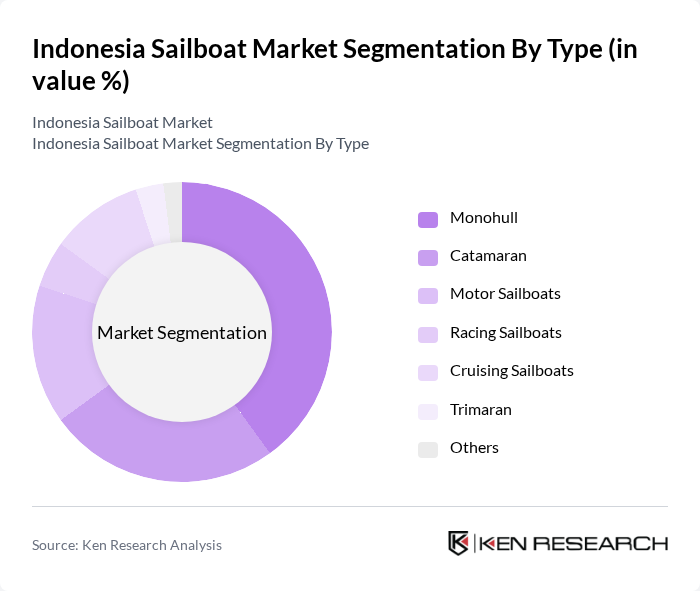
By Type:The sailboat market in Indonesia is segmented into Monohull, Catamaran, Motor Sailboats, Racing Sailboats, Cruising Sailboats, Trimaran, and Others.Monohull sailboatsare the most popular due to their traditional design and versatility, suitable for both recreational and competitive sailing.Catamaransare gaining traction, especially among tourists and charter companies, due to their stability and spaciousness.Motor Sailboatsare increasingly in demand as they offer the convenience of motorized travel combined with the sailing experience. These trends are supported by the rising interest in leisure boating and the expansion of charter operations in Indonesia .
By End-User:The sailboat market is also segmented by end-users, including Individual Consumers, Sailing Schools, Charter Companies, Government Agencies, Yacht Clubs, and Others.Individual consumersdominate the market, as more people invest in personal sailboats for leisure and recreation.Charter companiesplay a significant role, catering to the growing tourism sector.Sailing schoolsare increasingly popular, promoting sailing as a sport and recreational activity, which supports overall market growth .

Indonesia Sailboat Market Competitive Landscape
The Indonesia Sailboat Market is characterized by a dynamic mix of regional and international players. Leading participants such as Beneteau, Jeanneau, Hanse Yachts, Lagoon, Bavaria Yachts, Dufour Yachts, Catalina Yachts, Elan Yachts, X-Yachts, Nautor's Swan, Fountaine Pajot, Seawind Catamarans, Outremer Yachting, Aventura Catamarans, Corsair Marine, PT. Batavia Marine Indonesia, PT. Samudra Marine Indonesia, PT. Palindo Marine, PT. Dumas Tanjung Perak Shipyards, PT. Irian Marine Indonesia contribute to innovation, geographic expansion, and service delivery in this space.
Indonesia Sailboat Market Industry Analysis
Growth Drivers
- Increasing Tourism and Recreational Sailing:Indonesia's tourism sector is projected to reach 15 million international visitors in future, significantly boosting demand for recreational sailing. The government aims to enhance marine tourism, with investments of approximately $1.5 billion in infrastructure. This influx of tourists, particularly in regions like Bali and Komodo, is expected to drive the sailboat market, as visitors seek unique sailing experiences amidst Indonesia's stunning archipelagos.
- Government Initiatives for Maritime Development:The Indonesian government has allocated $2 billion for maritime development initiatives in future, focusing on enhancing coastal infrastructure and promoting sailing as a key tourism activity. These initiatives include the establishment of new marinas and support for local boat manufacturers, which are expected to stimulate the sailboat market. Such government backing is crucial for creating a conducive environment for both local and international sailing enthusiasts.
- Rising Disposable Income Among Consumers:With Indonesia's GDP per capita projected to reach $4,580 in future, rising disposable incomes are enabling more consumers to invest in leisure activities, including sailing. The growing middle class, estimated at 150 million people, is increasingly seeking recreational options. This trend is expected to drive demand for sailboats, as more individuals prioritize experiences like sailing trips and ownership of personal vessels.
Market Challenges
- High Initial Investment Costs:The average cost of a new sailboat in Indonesia ranges from $30,000 to $200,000, presenting a significant barrier for potential buyers. This high initial investment can deter many consumers, especially in a market where disposable income is still growing. Additionally, financing options for sailboat purchases are limited, further complicating access for interested buyers and stunting market growth.
- Limited Infrastructure for Sailing Activities:Despite government investments, Indonesia still faces challenges with inadequate marina facilities, which number only around 50 nationwide. This limited infrastructure restricts sailing activities and discourages potential boat owners. The lack of proper docking, maintenance services, and safety measures can hinder the growth of the sailboat market, as enthusiasts may be reluctant to invest without adequate support systems in place.
Indonesia Sailboat Market Future Outlook
The Indonesia sailboat market is poised for significant growth, driven by increasing tourism and government support for maritime development. As the middle class expands, more consumers are likely to invest in recreational sailing, enhancing market dynamics. Additionally, the trend towards eco-friendly sailing options and technological advancements in boat design will further shape the industry. The focus on sustainable practices will attract environmentally conscious consumers, creating a vibrant market landscape in the coming years.
Market Opportunities
- Expansion of Sailing Schools and Training Programs:The establishment of sailing schools is a promising opportunity, with an estimated 20 new schools projected to open in future. This expansion will cater to the growing interest in sailing, providing training and certification for enthusiasts. Increased participation in sailing courses can lead to higher demand for sailboats, positively impacting the market.
- Development of Eco-Friendly Sailboats:The rising consumer interest in sustainability presents an opportunity for manufacturers to innovate eco-friendly sailboats. With a projected market for electric and hybrid sailboats expected to grow by 30% in future, companies that invest in sustainable technologies can capture a significant share of environmentally conscious consumers, enhancing their competitive edge in the market.
Scope of the Report
| Segment | Sub-Segments |
|---|---|
| By Type | Monohull Catamaran Motor Sailboats Racing Sailboats Cruising Sailboats Trimaran Others |
| By End-User | Individual Consumers Sailing Schools Charter Companies Government Agencies Yacht Clubs Others |
| By Usage | Recreational Competitive Educational Commercial Tourism Others |
| By Material | Fiberglass Wood Aluminum Composite Steel Others |
| By Price Range | Budget Mid-Range Luxury Others |
| By Distribution Channel | Direct Sales Online Retail Dealerships Auctions Boat Shows & Exhibitions Others |
| By Region | Java Sumatra Bali Sulawesi Kalimantan Others |
Key Target Audience
Investors and Venture Capitalist Firms
Government and Regulatory Bodies (e.g., Ministry of Maritime Affairs and Fisheries, Ministry of Tourism and Creative Economy)
Manufacturers and Producers
Distributors and Retailers
Marina Operators and Management Companies
Tourism Operators and Travel Agencies
Environmental Organizations and NGOs
Insurance Companies and Underwriters
Players Mentioned in the Report:
Beneteau
Jeanneau
Hanse Yachts
Lagoon
Bavaria Yachts
Dufour Yachts
Catalina Yachts
Elan Yachts
X-Yachts
Nautor's Swan
Fountaine Pajot
Seawind Catamarans
Outremer Yachting
Aventura Catamarans
Corsair Marine
PT. Batavia Marine Indonesia
PT. Samudra Marine Indonesia
PT. Palindo Marine
PT. Dumas Tanjung Perak Shipyards
PT. Irian Marine Indonesia
Table of Contents
Market Assessment Phase
1. Executive Summary and Approach
2. Indonesia Sailboat Market Overview
2.1 Key Insights and Strategic Recommendations
2.2 Indonesia Sailboat Market Overview
2.3 Definition and Scope
2.4 Evolution of Market Ecosystem
2.5 Timeline of Key Regulatory Milestones
2.6 Value Chain & Stakeholder Mapping
2.7 Business Cycle Analysis
2.8 Policy & Incentive Landscape
3. Indonesia Sailboat Market Analysis
3.1 Growth Drivers
3.1.1 Increasing tourism and recreational sailing
3.1.2 Government initiatives for maritime development
3.1.3 Rising disposable income among consumers
3.1.4 Growing interest in sustainable sailing options
3.2 Market Challenges
3.2.1 High initial investment costs
3.2.2 Limited infrastructure for sailing activities
3.2.3 Regulatory hurdles and compliance issues
3.2.4 Environmental concerns and sustainability pressures
3.3 Market Opportunities
3.3.1 Expansion of sailing schools and training programs
3.3.2 Development of eco-friendly sailboats
3.3.3 Partnerships with tourism operators
3.3.4 Investment in marina and docking facilities
3.4 Market Trends
3.4.1 Increasing popularity of sailing events and competitions
3.4.2 Technological advancements in sailboat design
3.4.3 Shift towards electric and hybrid sailboats
3.4.4 Growing online platforms for sailboat rentals
3.5 Government Regulation
3.5.1 Maritime safety regulations
3.5.2 Environmental protection laws
3.5.3 Licensing requirements for sailboat operators
3.5.4 Tax incentives for local manufacturers
4. SWOT Analysis
5. Stakeholder Analysis
6. Porter's Five Forces Analysis
7. Indonesia Sailboat Market Market Size, 2019-2024
7.1 By Value
7.2 By Volume
7.3 By Average Selling Price
8. Indonesia Sailboat Market Segmentation
8.1 By Type
8.1.1 Monohull
8.1.2 Catamaran
8.1.3 Motor Sailboats
8.1.4 Racing Sailboats
8.1.5 Cruising Sailboats
8.1.6 Trimaran
8.1.7 Others
8.2 By End-User
8.2.1 Individual Consumers
8.2.2 Sailing Schools
8.2.3 Charter Companies
8.2.4 Government Agencies
8.2.5 Yacht Clubs
8.2.6 Others
8.3 By Usage
8.3.1 Recreational
8.3.2 Competitive
8.3.3 Educational
8.3.4 Commercial
8.3.5 Tourism
8.3.6 Others
8.4 By Material
8.4.1 Fiberglass
8.4.2 Wood
8.4.3 Aluminum
8.4.4 Composite
8.4.5 Steel
8.4.6 Others
8.5 By Price Range
8.5.1 Budget
8.5.2 Mid-Range
8.5.3 Luxury
8.5.4 Others
8.6 By Distribution Channel
8.6.1 Direct Sales
8.6.2 Online Retail
8.6.3 Dealerships
8.6.4 Auctions
8.6.5 Boat Shows & Exhibitions
8.6.6 Others
8.7 By Region
8.7.1 Java
8.7.2 Sumatra
8.7.3 Bali
8.7.4 Sulawesi
8.7.5 Kalimantan
8.7.6 Others
9. Indonesia Sailboat Market Competitive Analysis
9.1 Market Share of Key Players
9.2 Cross Comparison of Key Players
9.2.1 Company Name
9.2.2 Group Size (Large, Medium, or Small as per industry convention)
9.2.3 Revenue Growth Rate
9.2.4 Market Penetration Rate (Indonesia sailboat registrations, % share of imported vs. locally built)
9.2.5 Fleet Size (number of sailboats in operation or available for charter)
9.2.6 Customer Retention Rate
9.2.7 Pricing Strategy (average selling price, discounting practices)
9.2.8 Product Diversification Index (number of sailboat models/types offered)
9.2.9 Brand Recognition Score (survey-based or digital presence metrics)
9.2.10 Distribution Efficiency (number of dealerships, geographic coverage)
9.2.11 Customer Satisfaction Index (NPS or equivalent)
9.2.12 After-Sales Service Coverage (service centers, warranty terms)
9.3 SWOT Analysis of Top Players
9.4 Pricing Analysis
9.5 Detailed Profile of Major Companies
9.5.1 Beneteau
9.5.2 Jeanneau
9.5.3 Hanse Yachts
9.5.4 Lagoon
9.5.5 Bavaria Yachts
9.5.6 Dufour Yachts
9.5.7 Catalina Yachts
9.5.8 Elan Yachts
9.5.9 X-Yachts
9.5.10 Nautor's Swan
9.5.11 Fountaine Pajot
9.5.12 Seawind Catamarans
9.5.13 Outremer Yachting
9.5.14 Aventura Catamarans
9.5.15 Corsair Marine
9.5.16 PT. Batavia Marine Indonesia
9.5.17 PT. Samudra Marine Indonesia
9.5.18 PT. Palindo Marine
9.5.19 PT. Dumas Tanjung Perak Shipyards
9.5.20 PT. Irian Marine Indonesia
10. Indonesia Sailboat Market End-User Analysis
10.1 Procurement Behavior of Key Ministries
10.1.1 Budget Allocation Trends
10.1.2 Decision-Making Processes
10.1.3 Preferred Suppliers
10.1.4 Compliance Requirements
10.2 Corporate Spend on Infrastructure & Energy
10.2.1 Investment Trends
10.2.2 Key Projects
10.2.3 Funding Sources
10.2.4 Strategic Partnerships
10.3 Pain Point Analysis by End-User Category
10.3.1 Individual Consumers
10.3.2 Sailing Schools
10.3.3 Charter Companies
10.3.4 Government Agencies
10.4 User Readiness for Adoption
10.4.1 Awareness Levels
10.4.2 Training Needs
10.4.3 Financial Readiness
10.4.4 Infrastructure Availability
10.5 Post-Deployment ROI and Use Case Expansion
10.5.1 Performance Metrics
10.5.2 User Feedback
10.5.3 Expansion Opportunities
10.5.4 Long-term Sustainability
11. Indonesia Sailboat Market Future Size, 2025-2030
11.1 By Value
11.2 By Volume
11.3 By Average Selling Price
Go-To-Market Strategy Phase
1. Whitespace Analysis + Business Model Canvas
1.1 Market Gaps Identification
1.2 Value Proposition Development
1.3 Revenue Streams
1.4 Cost Structure Analysis
1.5 Key Partnerships
1.6 Customer Segments
1.7 Channels
2. Marketing and Positioning Recommendations
2.1 Branding Strategies
2.2 Product USPs
2.3 Target Audience Identification
2.4 Communication Strategy
2.5 Digital Marketing Tactics
3. Distribution Plan
3.1 Urban Retail Strategies
3.2 Rural NGO Tie-ups
3.3 Online Distribution Channels
3.4 Partnerships with Local Dealers
4. Channel & Pricing Gaps
4.1 Underserved Routes
4.2 Pricing Bands Analysis
4.3 Competitor Pricing Strategies
4.4 Customer Willingness to Pay
5. Unmet Demand & Latent Needs
5.1 Category Gaps
5.2 Consumer Segments
5.3 Product Development Opportunities
5.4 Market Entry Strategies
6. Customer Relationship
6.1 Loyalty Programs
6.2 After-sales Service
6.3 Customer Feedback Mechanisms
6.4 Community Engagement
7. Value Proposition
7.1 Sustainability Initiatives
7.2 Integrated Supply Chains
7.3 Customer-Centric Innovations
7.4 Competitive Advantages
8. Key Activities
8.1 Regulatory Compliance
8.2 Branding Efforts
8.3 Distribution Setup
8.4 Training and Development
9. Entry Strategy Evaluation
9.1 Domestic Market Entry Strategy
9.1.1 Product Mix
9.1.2 Pricing Band
9.1.3 Packaging
9.2 Export Entry Strategy
9.2.1 Target Countries
9.2.2 Compliance Roadmap
10. Entry Mode Assessment
10.1 Joint Ventures
10.2 Greenfield Investments
10.3 Mergers & Acquisitions
10.4 Distributor Model
11. Capital and Timeline Estimation
11.1 Capital Requirements
11.2 Timelines
12. Control vs Risk Trade-Off
12.1 Ownership vs Partnerships
13. Profitability Outlook
13.1 Breakeven Analysis
13.2 Long-term Sustainability
14. Potential Partner List
14.1 Distributors
14.2 Joint Ventures
14.3 Acquisition Targets
15. Execution Roadmap
15.1 Phased Plan for Market Entry
15.1.1 Market Setup
15.1.2 Market Entry
15.1.3 Growth Acceleration
15.1.4 Scale & Stabilize
15.2 Key Activities and Milestones
15.2.1 Milestone Planning
15.2.2 Performance Tracking
Research Methodology
Phase 1: Approach1
Desk Research
- Analysis of industry reports from maritime associations and government publications
- Review of trade statistics and import/export data specific to sailboats in Indonesia
- Examination of market trends and consumer behavior studies related to recreational boating
Primary Research
- Interviews with sailboat manufacturers and dealers operating in Indonesia
- Surveys with sailing clubs and associations to gauge participation and interest levels
- Field interviews with boat owners to understand usage patterns and preferences
Validation & Triangulation
- Cross-validation of findings through multiple data sources including sales data and consumer feedback
- Triangulation of insights from industry experts and market analysts
- Sanity checks through expert panel reviews to ensure data reliability
Phase 2: Market Size Estimation1
Top-down Assessment
- Estimation of market size based on national marine tourism and recreational spending
- Segmentation of the market by sailboat types, including monohulls and multihulls
- Incorporation of government initiatives promoting maritime tourism and local manufacturing
Bottom-up Modeling
- Collection of sales data from leading sailboat manufacturers and dealers
- Estimation of average selling prices and volume sold across different regions
- Analysis of customer demographics and purchasing behavior to refine market estimates
Forecasting & Scenario Analysis
- Multi-factor regression analysis incorporating tourism growth, disposable income, and environmental factors
- Scenario modeling based on potential regulatory changes affecting boat ownership and usage
- Development of baseline, optimistic, and pessimistic market projections through 2030
Phase 3: CATI Sample Composition1
| Scope Item/Segment | Sample Size | Target Respondent Profiles |
|---|---|---|
| Recreational Sailboat Owners | 45 | Individual Sailboat Owners, Sailing Enthusiasts |
| Sailboat Manufacturers | 28 | Production Managers, Sales Directors |
| Marina Operators | 22 | Marina Managers, Operations Supervisors |
| Sailing Clubs and Associations | 18 | Club Presidents, Event Coordinators |
| Marine Tourism Operators | 15 | Tour Operators, Customer Experience Managers |
Frequently Asked Questions
What is the current value of the Indonesia sailboat market?
The Indonesia sailboat market is valued at approximately USD 1.1 billion, reflecting its significant share in the global sailboat market, which is estimated at USD 6.4 billion. This valuation is based on a five-year historical analysis.
What factors are driving the growth of the Indonesia sailboat market?
Which regions in Indonesia are most prominent for sailing activities?
What regulations has the Indonesian government implemented for sailboats?
Other Regional/Country Reports
Malaysia Sailboat Market
KSA Sailboat Market
APAC Sailboat Market
SEA Sailboat Market
Vietnam Sailboat Market
Thailand Sailboat Market
Other Adjacent Reports
UAE Marine Tourism Market
Indonesia Water Sports Equipment Market
Thailand Sailing School Market
Philippines Boat Maintenance Market
UAE Marine Electronics MarketEgypt Eco-Friendly Vessel Market
Thailand Maritime Infrastructure Market
Oman Luxury Boat Market
Why Buy From Us?

What makes us stand out is that our consultants follow Robust, Refine and Result (RRR) methodology. Robust for clear definitions, approaches and sanity checking, Refine for differentiating respondents' facts and opinions, and Result for presenting data with story.

We have set a benchmark in the industry by offering our clients with syndicated and customized market research reports featuring coverage of entire market as well as meticulous research and analyst insights.

While we don't replace traditional research, we flip the method upside down. Our dual approach of Top Bottom & Bottom Top ensures quality deliverable by not just verifying company fundamentals but also looking at the sector and macroeconomic factors.

With one step in the future, our research team constantly tries to show you the bigger picture. We help with some of the tough questions you may encounter along the way: How is the industry positioned? Best marketing channel? KPI's of competitors? By aligning every element, we help maximize success.

Our report gives you instant access to the answers and sources that other companies might choose to hide. We elaborate each steps of research methodology we have used and showcase you the sample size to earn your trust.

If you need any support, we are here! We pride ourselves on universe strength, data quality, and quick, friendly, and professional service.