About the Report
Base Year 2024Indonesia Security Testing Market Overview
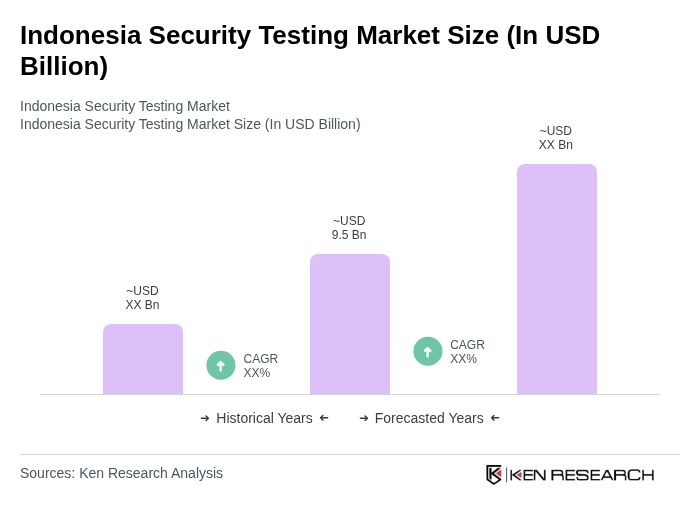
- The Indonesia Security Testing Market is valued at USD 9.5 billion, based on a five-year historical analysis. This growth is primarily driven by the increasing frequency of cyber threats, the rising adoption of digital technologies, and the growing awareness of data privacy regulations among businesses. Organizations are investing significantly in security testing to protect their sensitive information and maintain customer trust. The integration of AI, automation, and machine learning into security testing tools is further enhancing detection capabilities and reducing manual intervention, while the adoption of DevSecOps practices is embedding security testing into continuous integration and deployment pipelines .
- Key cities such asJakarta, Surabaya, and Bandungdominate the market due to their robust IT infrastructure and concentration of businesses across various sectors. Jakarta, being the capital, serves as a hub for technology firms and startups, while Surabaya and Bandung are emerging as significant players in the tech ecosystem, fostering innovation and attracting investments in cybersecurity .
- TheElectronic Information and Transactions Law (ITE Law), Law No. 11 of 2008 as amended by Law No. 19 of 2016, issued by the Government of Indonesia, mandates strict compliance for organizations handling electronic data. This regulation requires organizations to implement adequate cybersecurity measures, protect personal data, and report incidents, thereby driving the demand for security testing services across various industries .
Indonesia Security Testing Market Segmentation
By Type:The market is segmented into various types of security testing services, including Network Security Testing, Application Security Testing, Cloud Security Testing, IoT Security Testing, Social Engineering Testing, Device Security Testing, and Others. Each of these sub-segments plays a crucial role in addressing specific security challenges faced by organizations. Network Security Testing focuses on identifying vulnerabilities in network infrastructure, Application Security Testing assesses software and web applications for flaws, Cloud Security Testing ensures the security of cloud-based assets, IoT Security Testing addresses risks in connected devices, Social Engineering Testing evaluates human-related vulnerabilities, and Device Security Testing targets endpoint security. These services are increasingly being tailored to industry-specific regulatory and operational needs .
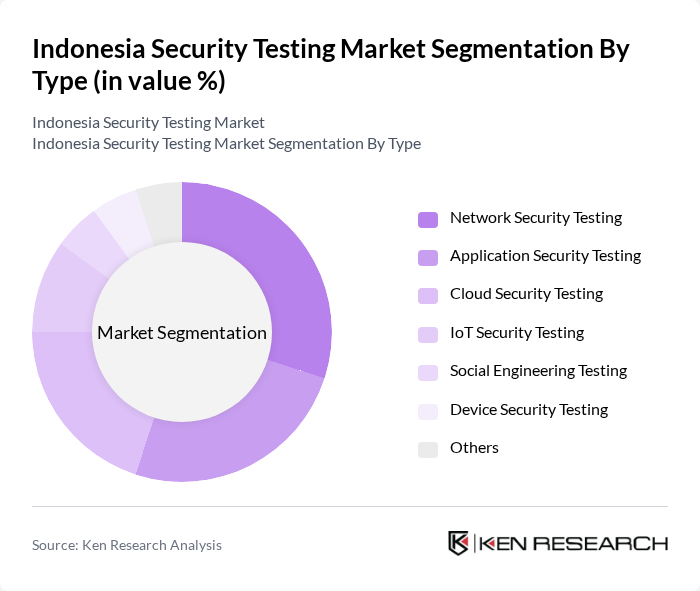
TheNetwork Security Testingsub-segment is currently leading the market due to the increasing number of cyberattacks targeting networks. Organizations are prioritizing the protection of their network infrastructure, which is critical for maintaining operational continuity. The rise in remote work and cloud adoption has further amplified the need for robust network security measures, making this sub-segment a focal point for security investments. The integration of automated penetration testing and continuous monitoring is also driving growth in this area .
By End-User:The market is segmented by end-users, including Banking, Financial Services & Insurance (BFSI), Healthcare & Life Sciences, IT & Telecommunications, Retail & E-Commerce, Government & Public Sector, Manufacturing & Distribution, Education, and Others. Each sector has unique security requirements that drive the demand for tailored security testing solutions. BFSI organizations require advanced testing to comply with financial regulations and protect sensitive data, Healthcare & Life Sciences focus on safeguarding patient information, IT & Telecommunications prioritize network and data integrity, while Retail & E-Commerce address payment security and customer privacy. Government and public sector entities are investing in security testing to protect critical infrastructure and citizen data .
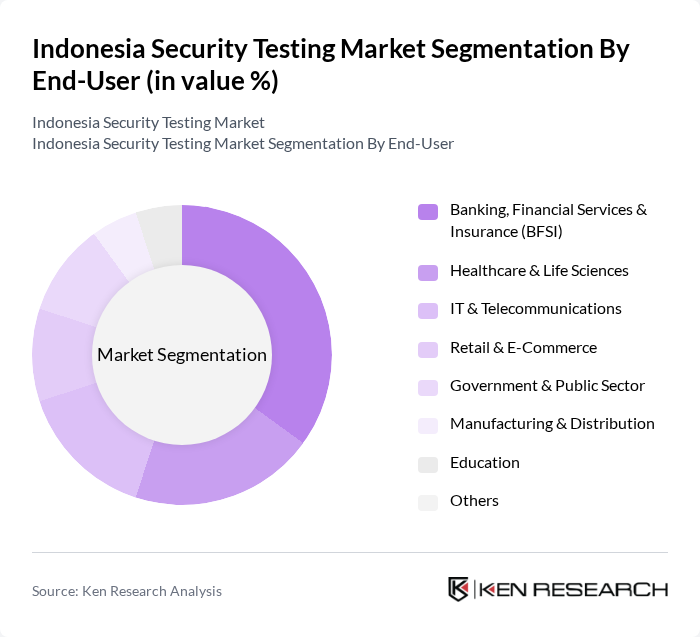
TheBanking, Financial Services & Insurance (BFSI)sector is the dominant end-user in the market, driven by stringent regulatory requirements and the critical need to protect sensitive financial data. With the increasing sophistication of cyber threats, financial institutions are investing heavily in security testing to safeguard their systems and maintain customer trust. This sector's high stakes and regulatory scrutiny make it a key driver of growth in the security testing market. The adoption of AI-driven threat detection and automated compliance validation is particularly prominent in this segment .
Indonesia Security Testing Market Competitive Landscape
The Indonesia Security Testing Market is characterized by a dynamic mix of regional and international players. Leading participants such as PT. Cyberindo Aditama (CBN), PT. Vaksincom, PT. Mitra Integrasi Informatika (MII), PT. Dwi Tunggal Putra, PT. Solusi247, PT. Synnex Metrodata Indonesia, PT. Indosat Ooredoo Hutchison, PT. Telkom Indonesia (Persero) Tbk, PT. Aplikanusa Lintasarta, PT. Cipta Sarana Informatika, PT. Astra Graphia Information Technology, PT. Bhinneka Mentari Dimensi, PT. Cybertech, PT. Infinys System Indonesia, PT. Securitas Indonesia, PT. Andalan Securindo, PT. Bravo Satria Perkasa, PT. Prosegur Indonesia contribute to innovation, geographic expansion, and service delivery in this space .
Indonesia Security Testing Market Industry Analysis
Growth Drivers
- Increasing Cybersecurity Threats:The rise in cyberattacks in Indonesia has been alarming, with the number of reported incidents increasing by 30% in future, according to the Indonesian National Cyber and Crypto Agency (BSSN). This surge has prompted businesses to invest heavily in security testing solutions to safeguard sensitive data. The estimated cost of cybercrime in Indonesia reached IDR 1.5 trillion (approximately USD 100 million) in future, highlighting the urgent need for robust security measures.
- Government Initiatives for Digital Security:The Indonesian government has launched several initiatives to enhance digital security, including the National Cybersecurity Strategy, which allocates IDR 500 billion (around USD 33 million) for cybersecurity improvements in future. These initiatives aim to bolster the nation’s defenses against cyber threats, encouraging businesses to adopt security testing services to comply with new regulations and standards, thereby driving market growth.
- Rising Adoption of Cloud Services:The cloud services market in Indonesia is projected to grow to IDR 20 trillion (approximately USD 1.3 billion) in future, as reported by the Indonesian Cloud Computing Association. This rapid adoption necessitates enhanced security testing to protect cloud-based applications and data. As organizations migrate to the cloud, the demand for comprehensive security testing solutions is expected to rise significantly, further propelling market growth.
Market Challenges
- Lack of Skilled Professionals:The cybersecurity workforce in Indonesia is facing a significant skills gap, with an estimated shortage of 1.5 million professionals in future, according to the World Economic Forum. This shortage hampers the effective implementation of security testing solutions, as organizations struggle to find qualified personnel to manage and execute these critical services, ultimately limiting market growth potential.
- High Costs of Security Solutions:The financial burden of implementing comprehensive security testing solutions can be substantial, with costs ranging from IDR 100 million to IDR 1 billion (USD 6,600 to USD 66,000) depending on the complexity of the systems involved. Many small and medium-sized enterprises (SMEs) in Indonesia find these costs prohibitive, which can deter them from investing in necessary security measures, thus posing a challenge to market expansion.
Indonesia Security Testing Market Future Outlook
The Indonesia security testing market is poised for significant growth as organizations increasingly recognize the importance of cybersecurity in a digital-first world. With the government’s commitment to enhancing cybersecurity infrastructure and the rising threat landscape, businesses are expected to prioritize security investments. Additionally, the integration of advanced technologies such as AI and machine learning will likely transform security testing methodologies, making them more efficient and effective in combating evolving threats.
Market Opportunities
- Expansion of E-commerce Platforms:The e-commerce sector in Indonesia is projected to reach IDR 500 trillion (approximately USD 33 billion) in future, according to Statista. This growth presents a significant opportunity for security testing providers to offer tailored solutions that protect online transactions and customer data, ensuring consumer trust and compliance with regulations.
- Development of AI-Driven Security Solutions:The increasing complexity of cyber threats is driving demand for AI-driven security solutions, which are expected to grow by 25% annually. Companies investing in these technologies can enhance their security testing capabilities, providing more robust defenses against sophisticated attacks, thus creating a lucrative market opportunity for innovative security firms.
Scope of the Report
| Segment | Sub-Segments |
|---|---|
| By Type | Network Security Testing Application Security Testing Cloud Security Testing IoT Security Testing Social Engineering Testing Device Security Testing Others |
| By End-User | Banking, Financial Services & Insurance (BFSI) Healthcare & Life Sciences IT & Telecommunications Retail & E-Commerce Government & Public Sector Manufacturing & Distribution Education Others |
| By Industry Vertical | BFSI IT & Telecommunications Healthcare Retail Manufacturing Government Others |
| By Deployment Model | On-Premises Cloud-Based Hybrid Others |
| By Service Type | Consulting Services Managed Security Testing Services Training and Support Compliance & Audit Services Others |
| By Security Testing Methodology | Manual Testing Automated Testing Penetration Testing Vulnerability Assessment Red Teaming Others |
| By Compliance Standards | ISO/IEC 27001 PCI DSS GDPR OJK Regulations (Indonesia Financial Services Authority) HIPAA (for Healthcare) Others |
Key Target Audience
Investors and Venture Capitalist Firms
Government and Regulatory Bodies (e.g., Badan Siber dan Sandi Negara, Kementerian Komunikasi dan Informatika)
Cybersecurity Solution Providers
Telecommunications Companies
Financial Institutions
Insurance Companies
Large Enterprises and Corporations
Industry Associations and Trade Organizations
Players Mentioned in the Report:
PT. Cyberindo Aditama (CBN)
PT. Vaksincom
PT. Mitra Integrasi Informatika (MII)
PT. Dwi Tunggal Putra
PT. Solusi247
PT. Synnex Metrodata Indonesia
PT. Indosat Ooredoo Hutchison
PT. Telkom Indonesia (Persero) Tbk
PT. Aplikanusa Lintasarta
PT. Cipta Sarana Informatika
PT. Astra Graphia Information Technology
PT. Bhinneka Mentari Dimensi
PT. Cybertech
PT. Infinys System Indonesia
PT. Securitas Indonesia
PT. Andalan Securindo
PT. Bravo Satria Perkasa
PT. Prosegur Indonesia
Table of Contents
Market Assessment Phase
1. Executive Summary and Approach
2. Indonesia Security Testing Market Overview
2.1 Key Insights and Strategic Recommendations
2.2 Indonesia Security Testing Market Overview
2.3 Definition and Scope
2.4 Evolution of Market Ecosystem
2.5 Timeline of Key Regulatory Milestones
2.6 Value Chain & Stakeholder Mapping
2.7 Business Cycle Analysis
2.8 Policy & Incentive Landscape
3. Indonesia Security Testing Market Analysis
3.1 Growth Drivers
3.1.1 Increasing Cybersecurity Threats
3.1.2 Government Initiatives for Digital Security
3.1.3 Rising Adoption of Cloud Services
3.1.4 Growing Awareness of Data Privacy Regulations
3.2 Market Challenges
3.2.1 Lack of Skilled Professionals
3.2.2 High Costs of Security Solutions
3.2.3 Rapidly Evolving Threat Landscape
3.2.4 Compliance with Local Regulations
3.3 Market Opportunities
3.3.1 Expansion of E-commerce Platforms
3.3.2 Increased Investment in IT Infrastructure
3.3.3 Development of AI-Driven Security Solutions
3.3.4 Partnerships with Local Enterprises
3.4 Market Trends
3.4.1 Shift Towards Managed Security Services
3.4.2 Integration of AI and Machine Learning
3.4.3 Focus on Mobile Security Solutions
3.4.4 Emphasis on Compliance and Regulatory Standards
3.5 Government Regulation
3.5.1 Data Protection Law Compliance
3.5.2 Cybersecurity Framework Implementation
3.5.3 National Cybersecurity Strategy
3.5.4 Regulations on Digital Transactions
4. SWOT Analysis
5. Stakeholder Analysis
6. Porter's Five Forces Analysis
7. Indonesia Security Testing Market Market Size, 2019-2024
7.1 By Value
7.2 By Volume
7.3 By Average Selling Price
8. Indonesia Security Testing Market Segmentation
8.1 By Type
8.1.1 Network Security Testing
8.1.2 Application Security Testing
8.1.3 Cloud Security Testing
8.1.4 IoT Security Testing
8.1.5 Social Engineering Testing
8.1.6 Device Security Testing
8.1.7 Others
8.2 By End-User
8.2.1 Banking, Financial Services & Insurance (BFSI)
8.2.2 Healthcare & Life Sciences
8.2.3 IT & Telecommunications
8.2.4 Retail & E-Commerce
8.2.5 Government & Public Sector
8.2.6 Manufacturing & Distribution
8.2.7 Education
8.2.8 Others
8.3 By Industry Vertical
8.3.1 BFSI
8.3.2 IT & Telecommunications
8.3.3 Healthcare
8.3.4 Retail
8.3.5 Manufacturing
8.3.6 Government
8.3.7 Others
8.4 By Deployment Model
8.4.1 On-Premises
8.4.2 Cloud-Based
8.4.3 Hybrid
8.4.4 Others
8.5 By Service Type
8.5.1 Consulting Services
8.5.2 Managed Security Testing Services
8.5.3 Training and Support
8.5.4 Compliance & Audit Services
8.5.5 Others
8.6 By Security Testing Methodology
8.6.1 Manual Testing
8.6.2 Automated Testing
8.6.3 Penetration Testing
8.6.4 Vulnerability Assessment
8.6.5 Red Teaming
8.6.6 Others
8.7 By Compliance Standards
8.7.1 ISO/IEC 27001
8.7.2 PCI DSS
8.7.3 GDPR
8.7.4 OJK Regulations (Indonesia Financial Services Authority)
8.7.5 HIPAA (for Healthcare)
8.7.6 Others
9. Indonesia Security Testing Market Competitive Analysis
9.1 Market Share of Key Players
9.2 KPIs for Cross Comparison of Key Players
9.2.1 Company Name
9.2.2 Group Size (Large, Medium, or Small as per industry convention)
9.2.3 Annual Revenue (USD)
9.2.4 Revenue Growth Rate (%)
9.2.5 Number of Security Testing Engagements (per year)
9.2.6 Customer Retention Rate (%)
9.2.7 Market Penetration Rate (%)
9.2.8 Average Deal Size (USD)
9.2.9 Pricing Strategy (Premium, Value, Volume)
9.2.10 Service Portfolio Breadth (Number of Testing Types Offered)
9.2.11 Brand Recognition (Survey Score or Index)
9.2.12 Innovation Index (R&D Spend as % of Revenue or Number of Patents)
9.2.13 Customer Satisfaction Score (CSAT/NPS)
9.2.14 Compliance Certifications Held
9.2.15 Incident Response Time (Average, in hours)
9.3 SWOT Analysis of Top Players
9.4 Pricing Analysis
9.5 Detailed Profile of Major Companies
9.5.1 PT. Cyberindo Aditama (CBN)
9.5.2 PT. Vaksincom
9.5.3 PT. Mitra Integrasi Informatika (MII)
9.5.4 PT. Dwi Tunggal Putra
9.5.5 PT. Solusi247
9.5.6 PT. Synnex Metrodata Indonesia
9.5.7 PT. Indosat Ooredoo Hutchison
9.5.8 PT. Telkom Indonesia (Persero) Tbk
9.5.9 PT. Aplikanusa Lintasarta
9.5.10 PT. Cipta Sarana Informatika
9.5.11 PT. Astra Graphia Information Technology
9.5.12 PT. Bhinneka Mentari Dimensi
9.5.13 PT. Cybertech
9.5.14 PT. Infinys System Indonesia
9.5.15 PT. Securitas Indonesia
9.5.16 PT. Andalan Securindo
9.5.17 PT. Bravo Satria Perkasa
9.5.18 PT. Prosegur Indonesia
10. Indonesia Security Testing Market End-User Analysis
10.1 Procurement Behavior of Key Ministries
10.1.1 Ministry of Communication and Information Technology
10.1.2 Ministry of Finance
10.1.3 Ministry of Defense
10.1.4 Ministry of Health
10.2 Corporate Spend on Infrastructure & Energy
10.2.1 IT Infrastructure Investments
10.2.2 Cybersecurity Budget Allocations
10.2.3 Training and Development Expenditures
10.2.4 Compliance and Regulatory Costs
10.3 Pain Point Analysis by End-User Category
10.3.1 Financial Sector
10.3.2 Healthcare Sector
10.3.3 Government Sector
10.3.4 Retail Sector
10.4 User Readiness for Adoption
10.4.1 Awareness of Cybersecurity Risks
10.4.2 Availability of Resources
10.4.3 Training and Skill Development
10.4.4 Infrastructure Readiness
10.5 Post-Deployment ROI and Use Case Expansion
10.5.1 Measurement of Security Effectiveness
10.5.2 Cost Savings from Prevented Breaches
10.5.3 Expansion of Security Services
10.5.4 User Feedback and Improvement
11. Indonesia Security Testing Market Future Size, 2025-2030
11.1 By Value
11.2 By Volume
11.3 By Average Selling Price
Go-To-Market Strategy Phase
1. Whitespace Analysis + Business Model Canvas
1.1 Market Gaps Identification
1.2 Value Proposition Development
1.3 Revenue Streams Analysis
1.4 Customer Segmentation
1.5 Key Partnerships
1.6 Cost Structure Analysis
1.7 Channels of Distribution
2. Marketing and Positioning Recommendations
2.1 Branding Strategies
2.2 Product USPs
2.3 Target Audience Identification
2.4 Communication Strategy
2.5 Digital Marketing Tactics
2.6 Offline Marketing Strategies
2.7 Performance Metrics
3. Distribution Plan
3.1 Urban Retail Strategies
3.2 Rural NGO Tie-Ups
3.3 Online Distribution Channels
3.4 Partnerships with Local Distributors
3.5 Logistics and Supply Chain Management
3.6 Customer Service and Support
3.7 Performance Evaluation
4. Channel & Pricing Gaps
4.1 Underserved Routes
4.2 Pricing Bands Analysis
4.3 Competitor Pricing Strategies
4.4 Customer Willingness to Pay
4.5 Value-Based Pricing Models
4.6 Discount and Promotion Strategies
4.7 Pricing Optimization Techniques
5. Unmet Demand & Latent Needs
5.1 Category Gaps
5.2 Consumer Segments Analysis
5.3 Emerging Trends and Needs
5.4 Product Development Opportunities
5.5 Market Entry Strategies
5.6 Customer Feedback Mechanisms
5.7 Future Demand Projections
6. Customer Relationship
6.1 Loyalty Programs
6.2 After-Sales Service
6.3 Customer Engagement Strategies
6.4 Feedback and Improvement Processes
6.5 Community Building Initiatives
6.6 Customer Retention Strategies
6.7 Performance Metrics
7. Value Proposition
7.1 Sustainability Initiatives
7.2 Integrated Supply Chains
7.3 Unique Selling Points
7.4 Customer-Centric Approach
7.5 Competitive Advantage Analysis
7.6 Value Delivery Mechanisms
7.7 Performance Metrics
8. Key Activities
8.1 Regulatory Compliance
8.2 Branding Initiatives
8.3 Distribution Setup
8.4 Training and Development
8.5 Marketing Campaigns
8.6 Performance Monitoring
8.7 Continuous Improvement Processes
9. Entry Strategy Evaluation
9.1 Domestic Market Entry Strategy
9.1.1 Product Mix
9.1.2 Pricing Band
9.1.3 Packaging
9.2 Export Entry Strategy
9.2.1 Target Countries
9.2.2 Compliance Roadmap
10. Entry Mode Assessment
10.1 JV
10.2 Greenfield
10.3 M&A
10.4 Distributor Model
11. Capital and Timeline Estimation
11.1 Capital Requirements
11.2 Timelines
12. Control vs Risk Trade-Off
12.1 Ownership vs Partnerships
13. Profitability Outlook
13.1 Breakeven Analysis
13.2 Long-Term Sustainability
14. Potential Partner List
14.1 Distributors
14.2 JVs
14.3 Acquisition Targets
15. Execution Roadmap
15.1 Phased Plan for Market Entry
15.1.1 Market Setup
15.1.2 Market Entry
15.1.3 Growth Acceleration
15.1.4 Scale & Stabilize
15.2 Key Activities and Milestones
15.2.1 Activity Planning
15.2.2 Milestone Tracking</
Research Methodology
Phase 1: Approach1
Desk Research
- Analysis of industry reports from government agencies and market research firms
- Review of published articles and white papers on security testing trends in Indonesia
- Examination of regulatory frameworks and compliance requirements affecting the security testing market
Primary Research
- Interviews with cybersecurity experts and consultants specializing in security testing
- Surveys targeting IT managers and security officers in various sectors
- Focus groups with software developers and QA teams to understand testing methodologies
Validation & Triangulation
- Cross-validation of findings through multiple expert interviews and industry reports
- Triangulation of data from primary and secondary sources to ensure consistency
- Sanity checks through feedback from industry panels and advisory boards
Phase 2: Market Size Estimation1
Top-down Assessment
- Estimation of market size based on national IT spending and cybersecurity budgets
- Segmentation of the market by industry verticals such as finance, healthcare, and e-commerce
- Incorporation of growth rates from related sectors and emerging technologies
Bottom-up Modeling
- Collection of data on the number of security testing firms and their service offerings
- Estimation of average contract values and service pricing across different testing types
- Volume analysis based on the number of security assessments conducted annually
Forecasting & Scenario Analysis
- Utilization of historical growth trends to project future market developments
- Scenario modeling based on potential regulatory changes and market disruptions
- Development of best-case, worst-case, and most-likely scenarios through 2030
Phase 3: CATI Sample Composition1
| Scope Item/Segment | Sample Size | Target Respondent Profiles |
|---|---|---|
| Financial Sector Security Testing | 45 | IT Security Managers, Compliance Officers |
| Healthcare Data Protection | 38 | Healthcare IT Directors, Risk Management Officers |
| E-commerce Platform Security | 42 | eCommerce Security Analysts, Operations Managers |
| Government Cybersecurity Initiatives | 35 | Government IT Officials, Cybersecurity Policy Makers |
| Telecommunications Network Testing | 40 | Network Security Engineers, Compliance Managers |
Frequently Asked Questions
What is the current value of the Indonesia Security Testing Market?
The Indonesia Security Testing Market is valued at approximately USD 9.5 billion, driven by increasing cyber threats, digital technology adoption, and heightened awareness of data privacy regulations among businesses.
What are the main drivers of growth in the Indonesia Security Testing Market?
Which cities are leading in the Indonesia Security Testing Market?
What types of security testing services are available in Indonesia?
Other Regional/Country Reports
Malaysia Security Testing Market
APAC Security Testing Market
Other Adjacent Reports
Thailand Cybersecurity Services Market
Oman penetration testing market report size, share, growth drivers, trends, opportunities & forecast 2025–2030Thailand Vulnerability Assessment Market
Bahrain cloud security market Size, Share, Growth Drivers, Trends, Opportunities & Forecast 2025–2030US Network Security MarketGCC application security market size, share, growth drivers, trends, opportunities & forecast 2025–2030USA IoT Security Market Outlook to 2030Bahrain Data Privacy Solutions Market
Mexico Compliance and Risk Management Market
Qatar Incident Response and Forensics Market
Why Buy From Us?

What makes us stand out is that our consultants follow Robust, Refine and Result (RRR) methodology. Robust for clear definitions, approaches and sanity checking, Refine for differentiating respondents' facts and opinions, and Result for presenting data with story.

We have set a benchmark in the industry by offering our clients with syndicated and customized market research reports featuring coverage of entire market as well as meticulous research and analyst insights.

While we don't replace traditional research, we flip the method upside down. Our dual approach of Top Bottom & Bottom Top ensures quality deliverable by not just verifying company fundamentals but also looking at the sector and macroeconomic factors.

With one step in the future, our research team constantly tries to show you the bigger picture. We help with some of the tough questions you may encounter along the way: How is the industry positioned? Best marketing channel? KPI's of competitors? By aligning every element, we help maximize success.

Our report gives you instant access to the answers and sources that other companies might choose to hide. We elaborate each steps of research methodology we have used and showcase you the sample size to earn your trust.

If you need any support, we are here! We pride ourselves on universe strength, data quality, and quick, friendly, and professional service.