








Ken Research Logo

Indonesia Water Bottle Market

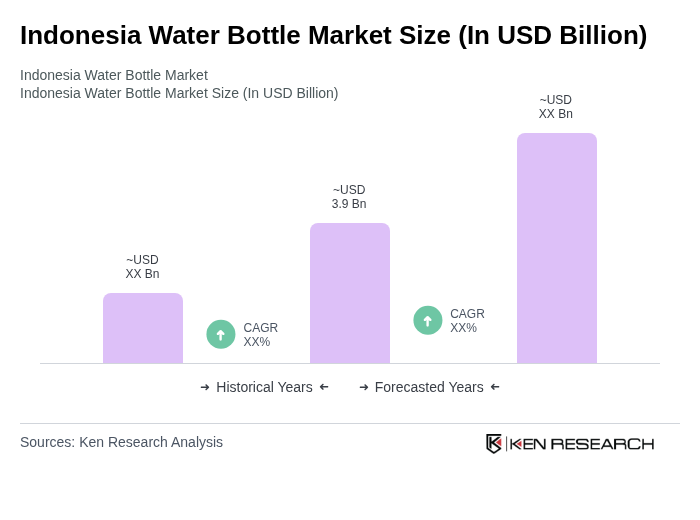
The Indonesia Water Bottle Market, valued at USD 3.9 billion, is growing due to rising health awareness and urban lifestyles, with projections for sustainable packaging and e-commerce expansion.

Region:Africa

Author(s):Geetanshi

Product Code:KRAD3954

Pages:100

Published On:December 2025
About the Report

Base Year 2024

Indonesia Water Bottle Market Overview

  • The Indonesia Water Bottle Market is valued at USD 3.9 billion, based on a five-year historical analysis. This growth is primarily driven by increasing health consciousness among consumers, urbanization, and the rising demand for convenient hydration solutions. The market has seen a significant shift towards bottled water consumption, with consumers preferring packaged water for its perceived safety and convenience. Health consciousness has driven a 12% increase in demand, particularly among urban populations, while rising disposable income within the middle class continues to fuel premium product adoption.
  • Key cities such as Jakarta, Surabaya, and Bandung dominate the market due to their high population density and urban lifestyle. Jakarta accounts for nearly 40% of bottled water sales nationally, driven by its dense population and extensive distribution network. These cities have a growing middle class that is increasingly aware of health and wellness, leading to a surge in bottled water consumption. Additionally, the presence of major distribution channels in these urban areas facilitates easy access to bottled water products. The expansion of e-commerce platforms such as Tokopedia, Shopee, and Lazada has increased online retail sales by 20% in 2023, establishing new distribution channels for bottled water brands.
  • The Indonesian government has implemented comprehensive regulations addressing plastic waste management and environmental sustainability. These regulatory frameworks mandate that bottled water companies adopt sustainable packaging practices and implement waste reduction measures. This initiative is part of a broader strategy to promote sustainability and reduce environmental impact, encouraging companies to innovate in their packaging methods. The regulatory environment supports the transition towards eco-friendly alternatives, with glass bottles and alternative packaging formats gaining traction in the premium segment.
Indonesia Water Bottle Market Size

Indonesia Water Bottle Market Segmentation

By Product Type:The product type segmentation includes various categories such as Still Water, Sparkling Water, Flavored Water, Mineral Water, Alkaline Water, and Functional Water. Still Water is the most dominant segment, commanding an 88.72% market share in 2024, driven by its widespread acceptance and preference among consumers for hydration. The increasing health awareness and the need for safe drinking water have further propelled the demand for Still Water, making it a staple in households and on-the-go consumption. Functional and flavored water segments are experiencing rapid growth at an 8.46% CAGR through 2030, fueled by health-conscious millennials and Gen Z consumers seeking added nutritional benefits.
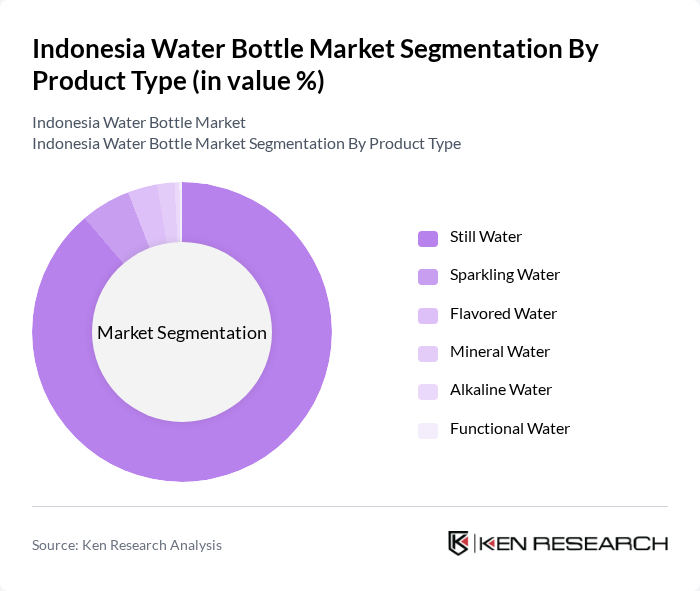
Indonesia Water Bottle Market segmentation by Product Type.

By Packaging Type:The packaging type segmentation includes Plastic Bottles (PET), Glass Bottles, Tetra Packs, and Canned Bottled Water. Plastic Bottles (PET) dominate the market due to their lightweight, convenience, and cost-effectiveness, with PET bottles ranging from small single-serve sizes to large gallon containers for household use. The growing trend of on-the-go consumption and the preference for single-serve packaging have further solidified the position of PET bottles as the leading choice among consumers. Glass bottles, while smaller in market share, are gaining traction in the premium segment and high-end hospitality sector, driven by environmental consciousness and perceived quality.
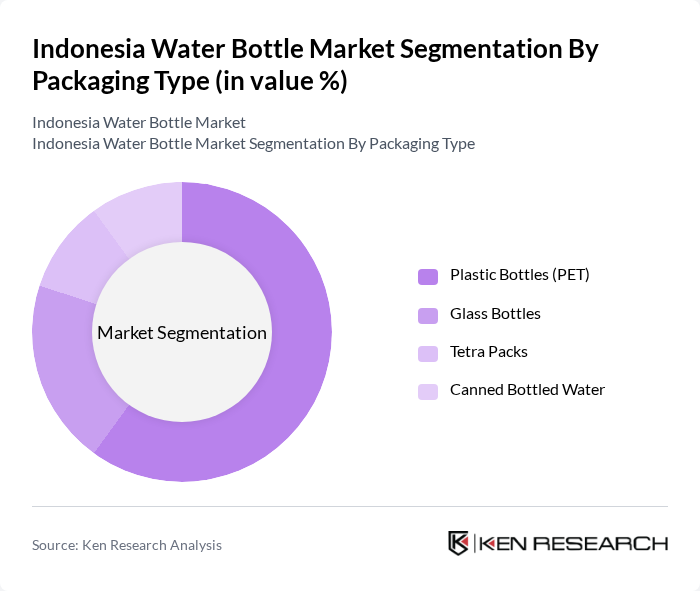
Indonesia Water Bottle Market segmentation by Packaging Type.

Indonesia Water Bottle Market Competitive Landscape

The Indonesia Water Bottle Market is characterized by a dynamic mix of regional and international players. Leading participants such as Aqua (Danone), Nestlé Waters Indonesia, Ades (Coca-Cola), Le Minerale, VIT (Danone), Pristine, Indomaret (Distribution Partner), Alfamart (Distribution Partner), Sinar Mas Group, Mayora Indah, Indofood Sukses Makmur, Kalbe Farma contribute to innovation, geographic expansion, and service delivery in this space.

Aqua (Danone)

1973

Jakarta, Indonesia

Nestlé Waters Indonesia

1992

Jakarta, Indonesia

Ades (Coca-Cola)

1993

Jakarta, Indonesia

Le Minerale

1998

Jakarta, Indonesia

VIT (Danone)

2000

Jakarta, Indonesia

Company

Establishment Year

Headquarters

Company Size (Large, Medium, or Small)

Revenue Growth Rate (%)

Market Share (%)

Distribution Channel Coverage

Pricing Strategy (Economy/Mid-Range/Premium)

Product Portfolio Breadth

Indonesia Water Bottle Market Industry Analysis

Growth Drivers

  • Increasing Health Consciousness Among Consumers:The Indonesian population is increasingly prioritizing health, with a reported 60% of adults actively seeking healthier lifestyle choices. This trend is supported by the World Health Organization's findings that indicate a rise in health-related awareness, leading to a surge in bottled water consumption. In future, the bottled water market is projected to reach 16 billion liters, driven by consumers opting for hydration solutions that align with their health goals.
  • Rising Disposable Income:Indonesia's GDP per capita is expected to rise to approximately $4,600 in future, reflecting a growing middle class with increased purchasing power. This economic growth enables consumers to spend more on premium bottled water brands, which are perceived as healthier and more convenient. As disposable income rises, the demand for bottled water is anticipated to grow, with an estimated increase of 11% in sales volume over the next year.
  • Urbanization and Lifestyle Changes:Urbanization in Indonesia is accelerating, with over 57% of the population living in urban areas in future. This shift is accompanied by lifestyle changes that favor convenience, such as on-the-go hydration solutions. The urban population's demand for bottled water is projected to increase by 13% annually, as busy lifestyles drive the need for accessible and portable drinking options, further boosting market growth.

Market Challenges

  • Environmental Concerns Regarding Plastic Waste:Indonesia is one of the largest contributors to plastic waste globally, generating approximately 6.5 million tons annually. This environmental challenge has led to increased scrutiny and pressure on bottled water companies to adopt sustainable practices. In future, regulatory bodies are expected to enforce stricter regulations on plastic usage, which may impact production costs and operational strategies for water bottle manufacturers.
  • Intense Competition Among Local and International Brands:The Indonesian bottled water market is highly competitive, with over 210 brands vying for market share. Major players like Aqua and Nestlé dominate, but numerous local brands are emerging, intensifying price competition. In future, the market is expected to see a 16% increase in new entrants, making it crucial for established brands to innovate and differentiate their offerings to maintain market position.

Indonesia Water Bottle Market Future Outlook

The Indonesia water bottle market is poised for significant transformation, driven by evolving consumer preferences and technological advancements. As health consciousness continues to rise, the demand for innovative and sustainable products will shape market dynamics. Companies are likely to invest in eco-friendly packaging and smart water bottle technologies, enhancing user experience. Additionally, the expansion of e-commerce platforms will facilitate greater access to diverse bottled water options, further propelling market growth in the coming years.

Market Opportunities

  • Growth in Eco-Friendly and Reusable Water Bottles:The increasing awareness of environmental issues presents a significant opportunity for brands to develop eco-friendly and reusable water bottles. With a projected market growth of 21% in this segment in future, companies that prioritize sustainability can capture a loyal customer base seeking environmentally responsible products.
  • Collaborations with Health and Fitness Sectors:Partnerships with gyms, wellness centers, and health influencers can enhance brand visibility and credibility. As the fitness industry in Indonesia is expected to grow by 16% in future, water bottle brands that align with health and fitness initiatives can tap into a lucrative market segment, driving sales and brand loyalty.

Scope of the Report

SegmentSub-Segments
By Product Type

Still Water

Sparkling Water

Flavored Water

Mineral Water

Alkaline Water

Functional Water

By Packaging Type

Plastic Bottles (PET)

Glass Bottles

Tetra Packs

Canned Bottled Water

By Price Range

Economy

Mid-Range

Premium

Luxury

By Distribution Channel

Supermarkets/Hypermarkets

Convenience Stores

Online Retail

HoReCa (Hotels, Restaurants, Cafés)

Vending Machines

Direct Sales

By End-User

Residential

Commercial

Hospitality

Events and Catering

By Brand Positioning

Luxury Brands

Mass Market Brands

Niche Brands

By Geographic Region

Java

Sumatra

Kalimantan

Sulawesi

Bali

Others

Key Target Audience

Investors and Venture Capitalist Firms

Government and Regulatory Bodies (e.g., Ministry of Health, Ministry of Environment and Forestry)

Manufacturers and Producers

Distributors and Retailers

Water Quality Testing Laboratories

Environmental NGOs and Advocacy Groups

Packaging Suppliers and Innovators

Logistics and Supply Chain Companies

Players Mentioned in the Report:

Aqua (Danone)

Nestle Waters Indonesia

Ades (Coca-Cola)

Le Minerale

VIT (Danone)

Pristine

Indomaret (Distribution Partner)

Alfamart (Distribution Partner)

Sinar Mas Group

Mayora Indah

Indofood Sukses Makmur

Kalbe Farma

Table of Contents

Market Assessment Phase

1. Executive Summary and Approach


2. Indonesia Water Bottle Market Overview

2.1 Key Insights and Strategic Recommendations

2.2 Indonesia Water Bottle Market Overview

2.3 Definition and Scope

2.4 Evolution of Market Ecosystem

2.5 Timeline of Key Regulatory Milestones

2.6 Value Chain & Stakeholder Mapping

2.7 Business Cycle Analysis

2.8 Policy & Incentive Landscape


3. Indonesia Water Bottle Market Analysis

3.1 Growth Drivers

3.1.1 Increasing health consciousness among consumers
3.1.2 Rising disposable income
3.1.3 Urbanization and lifestyle changes
3.1.4 Expansion of retail and e-commerce channels

3.2 Market Challenges

3.2.1 Environmental concerns regarding plastic waste
3.2.2 Intense competition among local and international brands
3.2.3 Regulatory hurdles and compliance issues
3.2.4 Fluctuating raw material prices

3.3 Market Opportunities

3.3.1 Growth in eco-friendly and reusable water bottles
3.3.2 Expansion into rural markets
3.3.3 Collaborations with health and fitness sectors
3.3.4 Innovations in product design and functionality

3.4 Market Trends

3.4.1 Increasing demand for personalized water bottles
3.4.2 Shift towards sustainable packaging solutions
3.4.3 Rise of smart water bottles with technology integration
3.4.4 Growth of subscription-based water delivery services

3.5 Government Regulation

3.5.1 Implementation of plastic waste management policies
3.5.2 Regulations on bottled water quality standards
3.5.3 Incentives for sustainable packaging initiatives
3.5.4 Compliance requirements for import/export of bottled water

4. SWOT Analysis


5. Stakeholder Analysis


6. Porter's Five Forces Analysis


7. Indonesia Water Bottle Market Market Size, 2019-2024

7.1 By Value

7.2 By Volume

7.3 By Average Selling Price


8. Indonesia Water Bottle Market Segmentation

8.1 By Product Type

8.1.1 Still Water
8.1.2 Sparkling Water
8.1.3 Flavored Water
8.1.4 Mineral Water
8.1.5 Alkaline Water
8.1.6 Functional Water

8.2 By Packaging Type

8.2.1 Plastic Bottles (PET)
8.2.2 Glass Bottles
8.2.3 Tetra Packs
8.2.4 Canned Bottled Water

8.3 By Price Range

8.3.1 Economy
8.3.2 Mid-Range
8.3.3 Premium
8.3.4 Luxury

8.4 By Distribution Channel

8.4.1 Supermarkets/Hypermarkets
8.4.2 Convenience Stores
8.4.3 Online Retail
8.4.4 HoReCa (Hotels, Restaurants, Cafés)
8.4.5 Vending Machines
8.4.6 Direct Sales

8.5 By End-User

8.5.1 Residential
8.5.2 Commercial
8.5.3 Hospitality
8.5.4 Events and Catering

8.6 By Brand Positioning

8.6.1 Luxury Brands
8.6.2 Mass Market Brands
8.6.3 Niche Brands

8.7 By Geographic Region

8.7.1 Java
8.7.2 Sumatra
8.7.3 Kalimantan
8.7.4 Sulawesi
8.7.5 Bali
8.7.6 Others

9. Indonesia Water Bottle Market Competitive Analysis

9.1 Market Share of Key Players

9.2 Cross Comparison of Key Players

9.2.1 Company Name
9.2.2 Company Size (Large, Medium, or Small)
9.2.3 Revenue Growth Rate (%)
9.2.4 Market Share (%)
9.2.5 Distribution Channel Coverage
9.2.6 Pricing Strategy (Economy/Mid-Range/Premium)
9.2.7 Product Portfolio Breadth
9.2.8 Geographic Presence (Regional Coverage)
9.2.9 Brand Recognition Score
9.2.10 Sustainability Initiatives

9.3 SWOT Analysis of Top Players

9.4 Pricing Analysis

9.5 Detailed Profile of Major Companies

9.5.1 Aqua (Danone)
9.5.2 Nestlé Waters Indonesia
9.5.3 Ades (Coca-Cola)
9.5.4 Le Minerale
9.5.5 VIT (Danone)
9.5.6 Pristine
9.5.7 Indomaret (Distribution Partner)
9.5.8 Alfamart (Distribution Partner)
9.5.9 Sinar Mas Group
9.5.10 Mayora Indah
9.5.11 Indofood Sukses Makmur
9.5.12 Kalbe Farma

10. Indonesia Water Bottle Market End-User Analysis

10.1 Procurement Behavior of Key Ministries

10.1.1 Government procurement policies
10.1.2 Budget allocation for bottled water
10.1.3 Supplier selection criteria
10.1.4 Sustainability considerations

10.2 Corporate Spend on Infrastructure & Energy

10.2.1 Investment in water infrastructure
10.2.2 Corporate social responsibility initiatives
10.2.3 Partnerships with local suppliers
10.2.4 Budgeting for employee wellness programs

10.3 Pain Point Analysis by End-User Category

10.3.1 Quality assurance issues
10.3.2 Supply chain disruptions
10.3.3 Cost management challenges
10.3.4 Regulatory compliance difficulties

10.4 User Readiness for Adoption

10.4.1 Awareness of health benefits
10.4.2 Availability of products
10.4.3 Price sensitivity
10.4.4 Brand loyalty factors

10.5 Post-Deployment ROI and Use Case Expansion

10.5.1 Measurement of cost savings
10.5.2 User feedback mechanisms
10.5.3 Opportunities for product upgrades
10.5.4 Expansion into new user segments

11. Indonesia Water Bottle Market Future Size, 2025-2030

11.1 By Value

11.2 By Volume

11.3 By Average Selling Price


Go-To-Market Strategy Phase

1. Whitespace Analysis + Business Model Canvas

1.1 Market gaps identification

1.2 Value proposition development

1.3 Revenue model exploration

1.4 Customer segmentation analysis

1.5 Competitive landscape overview

1.6 Key partnerships identification

1.7 Risk assessment


2. Marketing and Positioning Recommendations

2.1 Branding strategies

2.2 Product USPs

2.3 Target audience definition

2.4 Marketing channels selection

2.5 Promotional tactics

2.6 Customer engagement strategies

2.7 Performance metrics


3. Distribution Plan

3.1 Urban retail vs rural NGO tie-ups

3.2 Distribution channel optimization

3.3 Logistics and supply chain management

3.4 Partnership opportunities

3.5 Inventory management strategies

3.6 Sales force deployment

3.7 Performance tracking


4. Channel & Pricing Gaps

4.1 Underserved routes

4.2 Pricing bands

4.3 Competitor pricing analysis

4.4 Customer willingness to pay

4.5 Price elasticity assessment

4.6 Discount strategies

4.7 Pricing model innovation


5. Unmet Demand & Latent Needs

5.1 Category gaps

5.2 Consumer segments

5.3 Product feature enhancements

5.4 Service improvements

5.5 Market entry barriers

5.6 Future trends anticipation

5.7 Customer feedback integration


6. Customer Relationship

6.1 Loyalty programs

6.2 After-sales service

6.3 Customer support strategies

6.4 Feedback collection mechanisms

6.5 Community engagement initiatives

6.6 Brand advocacy development

6.7 Relationship management tools


7. Value Proposition

7.1 Sustainability

7.2 Integrated supply chains

7.3 Customer-centric innovations

7.4 Competitive differentiation

7.5 Value-added services

7.6 Long-term partnerships

7.7 Market positioning


8. Key Activities

8.1 Regulatory compliance

8.2 Branding

8.3 Distribution setup

8.4 Marketing execution

8.5 Performance monitoring

8.6 Stakeholder engagement

8.7 Continuous improvement


9. Entry Strategy Evaluation

9.1 Domestic Market Entry Strategy

9.1.1 Product mix
9.1.2 Pricing band
9.1.3 Packaging

9.2 Export Entry Strategy

9.2.1 Target countries
9.2.2 Compliance roadmap

10. Entry Mode Assessment

10.1 JV


Research Methodology

ApproachModellingSample

Phase 1: Approach1

Desk Research

  • Analysis of industry reports from government agencies and trade associations related to the water bottle market in Indonesia
  • Review of market trends and consumer behavior studies published by local research firms
  • Examination of import/export data and statistics from the Indonesian Customs Office

Primary Research

  • Interviews with key stakeholders in the bottled water industry, including manufacturers and distributors
  • Surveys conducted with consumers to understand preferences, purchasing habits, and brand loyalty
  • Focus group discussions with health and wellness experts to gauge perceptions of bottled water quality and sustainability

Validation & Triangulation

  • Cross-validation of findings through comparison with historical sales data and market growth rates
  • Triangulation of insights from primary interviews with secondary data sources to ensure consistency
  • Sanity checks through expert panel reviews involving industry veterans and market analysts

Phase 2: Market Size Estimation1

Top-down Assessment

  • Estimation of total market size based on national consumption statistics and demographic data
  • Segmentation of the market by product type (e.g., PET bottles, glass bottles) and distribution channel (e.g., retail, online)
  • Incorporation of growth projections based on urbanization trends and health awareness campaigns

Bottom-up Modeling

  • Collection of sales data from leading bottled water companies to establish baseline volumes
  • Analysis of pricing strategies and cost structures to determine average selling prices
  • Calculation of market size by multiplying estimated volume by average price across different segments

Forecasting & Scenario Analysis

  • Development of forecasting models using historical growth rates and market drivers such as environmental regulations
  • Scenario analysis based on potential shifts in consumer preferences towards eco-friendly packaging
  • Creation of multiple projections (baseline, optimistic, and pessimistic) through 2030 to account for market volatility

Phase 3: CATI Sample Composition1

Scope Item/SegmentSample SizeTarget Respondent Profiles
Consumer Preferences in Urban Areas120Health-conscious Consumers, Young Professionals
Retail Distribution Insights85Retail Managers, Store Owners
Environmental Impact Awareness65Sustainability Advocates, Eco-conscious Consumers
Market Trends in E-commerce95eCommerce Managers, Digital Marketing Specialists
Industry Expert Opinions45Industry Analysts, Market Researchers

Frequently Asked Questions

What is the current value of the Indonesia Water Bottle Market?

The Indonesia Water Bottle Market is valued at approximately USD 3.9 billion, reflecting significant growth driven by health consciousness, urbanization, and the demand for convenient hydration solutions among consumers.

Which cities are the largest markets for bottled water in Indonesia?

What factors are driving the growth of the bottled water market in Indonesia?

What are the main product types in the Indonesia Water Bottle Market?

Other Regional/Country Reports

India Water Bottle Market Outlook to 2030

Malaysia Water Bottle Market

KSA Water Bottle Market

APAC Water Bottle Market

SEA Water Bottle Market

Vietnam Water Bottle Market

Other Adjacent Reports

Vietnam Beverage Packaging Market

Vietnam Sustainable Packaging Market

Malaysia Non-Alcoholic Beverage Market

Brazil Functional Beverage Market

KSA Mineral Water Market

South Africa Plastic Recycling Market

Belgium Water Purification Market

Qatar E-Commerce Grocery Market

Belgium Health and Wellness Beverage Market

Mexico Bottling Equipment Market

Why Buy From Us?

Refine Robust Result (RRR) Framework

What makes us stand out is that our consultants follow Robust, Refine and Result (RRR) methodology. Robust for clear definitions, approaches and sanity checking, Refine for differentiating respondents' facts and opinions, and Result for presenting data with story.

Our Reach Is Unmatched

We have set a benchmark in the industry by offering our clients with syndicated and customized market research reports featuring coverage of entire market as well as meticulous research and analyst insights.

Shifting the Research Paradigm

While we don't replace traditional research, we flip the method upside down. Our dual approach of Top Bottom & Bottom Top ensures quality deliverable by not just verifying company fundamentals but also looking at the sector and macroeconomic factors.

More Insights-Better Decisions

With one step in the future, our research team constantly tries to show you the bigger picture. We help with some of the tough questions you may encounter along the way: How is the industry positioned? Best marketing channel? KPI's of competitors? By aligning every element, we help maximize success.

Transparency and Trust

Our report gives you instant access to the answers and sources that other companies might choose to hide. We elaborate each steps of research methodology we have used and showcase you the sample size to earn your trust.

Round the Clock Support

If you need any support, we are here! We pride ourselves on universe strength, data quality, and quick, friendly, and professional service.

Why Clients Choose Us?

400000+
Reports in repository
150+
Consulting projects a year
100+
Analysts
8000+
Client Queries in 2022