Global In Vitro Fertilization Market

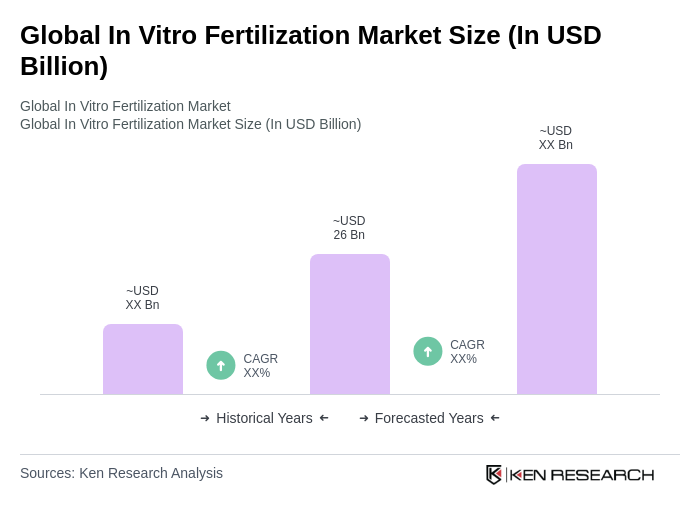
The global In Vitro Fertilization market, valued at USD 26 billion, is driven by increasing infertility, reproductive tech innovations, and growing acceptance of fertility treatments worldwide.

Region:Global

Author(s):Dev

Product Code:KRAA2605

Pages:91

Published On:August 2025
About the Report

Base Year 2024

Global In Vitro Fertilization Market Overview

  • The Global In Vitro Fertilization Market is valued at approximatelyUSD 26 billion, based on a five-year historical analysis. This growth is primarily driven by increasing infertility rates, advancements in reproductive technologies, and rising awareness regarding fertility treatments. The market has seen a significant uptick in demand for IVF procedures, particularly in urban areas where lifestyle factors such as delayed childbearing, obesity, stress, and medical conditions like polycystic ovary syndrome contribute to fertility challenges. Recent innovations in embryo selection and laboratory technology, along with supportive government policies and insurance coverage, are further accelerating market expansion .
  • Countries such as the United States, Germany, and Japan dominate the Global In Vitro Fertilization Market due to their advanced healthcare infrastructure, high disposable incomes, and strong emphasis on reproductive health. These regions have established numerous fertility clinics and research institutions, making them leaders in IVF technology and treatment options .
  • In 2023, the U.S. government implemented regulations to enhance the quality and accessibility of fertility treatments. This includes the establishment of guidelines for fertility clinics to ensure standardized practices and patient safety, aiming to improve success rates and patient outcomes in IVF procedures. Specifically, the "Assisted Reproductive Technology (ART) Laboratory Certification Program, 2023" issued by the Centers for Medicare & Medicaid Services (CMS) mandates laboratory certification, quality control standards, and periodic compliance audits for all ART clinics operating in the United States. The regulation covers laboratory processes, personnel qualifications, and reporting requirements to ensure patient safety and consistent clinical outcomes .
Global In Vitro Fertilization Market Size

Global In Vitro Fertilization Market Segmentation

By Type:The market is segmented into various types, including Fresh non-donor IVF cycles, Frozen embryo transfer cycles, Donor egg IVF cycles, Preimplantation Genetic Testing (PGT), and Others (e.g., donor sperm cycles, gestational surrogacy). Among these,Fresh non-donor IVF cyclesremain the most prevalent due to their higher success rates and the preference of couples to use their own eggs and sperm.Frozen embryo transfer cyclesare gaining traction as they offer flexibility, improved pregnancy rates, and convenience for patients. The demand forDonor egg IVF cyclescontinues to rise, particularly among older women or those with diminished ovarian reserve, whilePGTis increasingly adopted by couples concerned about genetic disorders or recurrent pregnancy loss .

Global In Vitro Fertilization Market segmentation by Type.

By End-User:The end-user segmentation includes Fertility clinics and surgical centers, Hospitals and research laboratories, Cryobanks, and Others.Fertility clinics and surgical centersdominate this segment due to their specialized services and focus on reproductive health. These facilities are equipped with advanced technologies and skilled professionals, making them the preferred choice for couples seeking IVF treatments.Hospitals and research laboratoriesalso play a significant role, particularly in providing comprehensive care and conducting clinical research to improve IVF outcomes.Cryobanksare essential for the storage and management of reproductive cells and embryos, supporting both clinical and research applications .

Global In Vitro Fertilization Market segmentation by End-User.

Global In Vitro Fertilization Market Competitive Landscape

The Global In Vitro Fertilization Market is characterized by a dynamic mix of regional and international players. Leading participants such as IVI RMA Global, CCRM Fertility, Shady Grove Fertility, Boston IVF, CARE Fertility, Virtus Health, Genea Limited, Monash IVF Group, HRC Fertility, Reproductive Medicine Associates of New Jersey (RMA New Jersey), Fertility Centers of Illinois, New Hope Fertility Center, The Fertility Institute, Prelude Fertility, OvaScience contribute to innovation, geographic expansion, and service delivery in this space.

IVI RMA Global

1990

Valencia, Spain

CCRM Fertility

1987

Denver, Colorado, USA

Shady Grove Fertility

1991

Rockville, Maryland, USA

Boston IVF

1986

Waltham, Massachusetts, USA

CARE Fertility

1997

Nottingham, UK

Company

Establishment Year

Headquarters

Group Size (Large, Medium, or Small as per industry convention)

Revenue Growth Rate (IVF segment)

Market Penetration Rate (number of clinics/regions served)

Number of IVF Procedures Performed Annually

Average IVF Success Rate (%)

Average Treatment Cost (per cycle)

Global In Vitro Fertilization Market Industry Analysis

Growth Drivers

  • Increasing Infertility Rates:The global infertility rate has risen significantly, with approximately 15% of couples facing challenges in conceiving. In regions like None, this translates to over 1.6 million couples seeking assisted reproductive technologies annually. Factors contributing to this increase include lifestyle changes, delayed childbearing, and environmental influences. The World Health Organization reported that infertility affects around 48 million couples worldwide, highlighting a pressing need for effective solutions like IVF.
  • Advancements in Reproductive Technologies:Technological innovations in IVF, such as preimplantation genetic testing (PGT) and cryopreservation, have improved success rates. In None, clinics are increasingly adopting these technologies, leading to a 32% increase in successful live births per cycle. The integration of advanced laboratory techniques and equipment has also enhanced embryo quality, making IVF a more viable option for couples. As a result, the demand for these advanced services continues to grow, driving market expansion.
  • Rising Awareness and Acceptance of IVF:Public awareness regarding infertility and available treatments has surged, with educational campaigns reaching millions. In None, over 65% of the population is now aware of IVF as a treatment option, compared to just 31% a decade ago. This shift is supported by increased media coverage and advocacy from healthcare professionals. As societal stigma diminishes, more couples are willing to pursue IVF, further propelling market growth and acceptance of fertility treatments.

Market Challenges

  • High Treatment Costs:The financial burden of IVF treatments remains a significant barrier, with average costs ranging from $10,500 to $15,500 per cycle in None. Many insurance plans do not cover these expenses, leading to out-of-pocket payments that can deter couples from seeking treatment. This challenge is exacerbated by the economic conditions, where disposable income levels are fluctuating, making it difficult for many to afford necessary fertility services.
  • Ethical and Legal Issues Surrounding IVF:The IVF industry faces numerous ethical dilemmas, including embryo selection and the use of donor gametes. In None, regulations are evolving, but inconsistencies remain, leading to confusion among patients and providers. Legal challenges regarding donor anonymity and embryo disposition can complicate treatment processes. These ethical concerns can deter potential patients from pursuing IVF, impacting overall market growth and acceptance.

Global In Vitro Fertilization Market Future Outlook

The future of the IVF market in None appears promising, driven by technological advancements and increasing public acceptance. As telemedicine becomes more integrated into fertility treatments, patients will benefit from remote consultations and monitoring, enhancing accessibility. Additionally, the rise of personalized medicine in fertility will likely lead to tailored treatment plans, improving success rates. These trends indicate a robust growth trajectory for the IVF market, addressing both patient needs and ethical considerations effectively.

Market Opportunities

  • Growth in Medical Tourism for IVF:None is emerging as a popular destination for medical tourism, particularly for IVF treatments. With competitive pricing and high-quality services, the region attracts international patients seeking affordable options. In future, it is estimated that medical tourism for IVF could generate over $600 million in revenue, presenting a significant opportunity for local clinics to expand their services and reach.
  • Expansion of Fertility Preservation Services:The demand for fertility preservation, particularly among younger individuals and cancer patients, is on the rise. In None, the market for egg and sperm freezing is projected to grow, with an estimated 22% increase in services offered by clinics. This trend reflects a growing awareness of reproductive health, creating opportunities for clinics to diversify their offerings and cater to a broader audience.

Scope of the Report

SegmentSub-Segments
By Type

Fresh non-donor IVF cycles

Frozen embryo transfer cycles

Donor egg IVF cycles

Preimplantation Genetic Testing (PGT)

Others (e.g., donor sperm cycles, gestational surrogacy)

By End-User

Fertility clinics and surgical centers

Hospitals and research laboratories

Cryobanks

Others

By Treatment Type

Intracytoplasmic Sperm Injection (ICSI)

Intrauterine Insemination (IUI)

Egg donation

Surrogacy

Others (e.g., assisted hatching, sperm retrieval techniques)

By Age Group

Under 30

35

40

Over 40

By Geographic Region

North America

Europe

Asia-Pacific

Latin America

Middle East & Africa

By Insurance Coverage

Fully covered

Partially covered

Not covered

By Service Provider

Private clinics

Public hospitals

Non-profit organizations

Others

Key Target Audience

Investors and Venture Capitalist Firms

Government and Regulatory Bodies (e.g., Food and Drug Administration, European Medicines Agency)

Manufacturers and Producers of IVF Equipment

Pharmaceutical Companies specializing in Fertility Drugs

Healthcare Providers and Fertility Clinics

Biotechnology Firms focused on Reproductive Health

Insurance Companies offering Fertility Treatment Coverage

Industry Associations related to Reproductive Medicine

Players Mentioned in the Report:

IVI RMA Global

CCRM Fertility

Shady Grove Fertility

Boston IVF

CARE Fertility

Virtus Health

Genea Limited

Monash IVF Group

HRC Fertility

Reproductive Medicine Associates of New Jersey (RMA New Jersey)

Fertility Centers of Illinois

New Hope Fertility Center

The Fertility Institute

Prelude Fertility

OvaScience

Table of Contents

Market Assessment Phase

1. Executive Summary and Approach


2. Global In Vitro Fertilization Market Overview

2.1 Key Insights and Strategic Recommendations

2.2 Global In Vitro Fertilization Market Overview

2.3 Definition and Scope

2.4 Evolution of Market Ecosystem

2.5 Timeline of Key Regulatory Milestones

2.6 Value Chain & Stakeholder Mapping

2.7 Business Cycle Analysis

2.8 Policy & Incentive Landscape


3. Global In Vitro Fertilization Market Analysis

3.1 Growth Drivers

3.1.1 Increasing infertility rates
3.1.2 Advancements in reproductive technologies
3.1.3 Rising awareness and acceptance of IVF
3.1.4 Government support and funding for fertility treatments

3.2 Market Challenges

3.2.1 High treatment costs
3.2.2 Ethical and legal issues surrounding IVF
3.2.3 Limited access in rural areas
3.2.4 Variability in success rates

3.3 Market Opportunities

3.3.1 Growth in medical tourism for IVF
3.3.2 Development of personalized medicine in fertility
3.3.3 Expansion of fertility preservation services
3.3.4 Increasing partnerships between clinics and technology providers

3.4 Market Trends

3.4.1 Rise of telemedicine in fertility treatments
3.4.2 Integration of AI in IVF procedures
3.4.3 Focus on holistic approaches to fertility
3.4.4 Growing demand for egg and sperm donation services

3.5 Government Regulation

3.5.1 Regulations on embryo selection
3.5.2 Licensing requirements for IVF clinics
3.5.3 Guidelines for donor anonymity
3.5.4 Policies on fertility preservation

4. SWOT Analysis


5. Stakeholder Analysis


6. Porter's Five Forces Analysis


7. Global In Vitro Fertilization Market Market Size, 2019-2024

7.1 By Value

7.2 By Volume

7.3 By Average Selling Price


8. Global In Vitro Fertilization Market Segmentation

8.1 By Type

8.1.1 Fresh non-donor IVF cycles
8.1.2 Frozen embryo transfer cycles
8.1.3 Donor egg IVF cycles
8.1.4 Preimplantation Genetic Testing (PGT)
8.1.5 Others (e.g., donor sperm cycles, gestational surrogacy)

8.2 By End-User

8.2.1 Fertility clinics and surgical centers
8.2.2 Hospitals and research laboratories
8.2.3 Cryobanks
8.2.4 Others

8.3 By Treatment Type

8.3.1 Intracytoplasmic Sperm Injection (ICSI)
8.3.2 Intrauterine Insemination (IUI)
8.3.3 Egg donation
8.3.4 Surrogacy
8.3.5 Others (e.g., assisted hatching, sperm retrieval techniques)

8.4 By Age Group

8.4.1 Under 30
8.4.2 30-35
8.4.3 36-40
8.4.4 Over 40

8.5 By Geographic Region

8.5.1 North America
8.5.2 Europe
8.5.3 Asia-Pacific
8.5.4 Latin America
8.5.5 Middle East & Africa

8.6 By Insurance Coverage

8.6.1 Fully covered
8.6.2 Partially covered
8.6.3 Not covered

8.7 By Service Provider

8.7.1 Private clinics
8.7.2 Public hospitals
8.7.3 Non-profit organizations
8.7.4 Others

9. Global In Vitro Fertilization Market Competitive Analysis

9.1 Market Share of Key Players

9.2 Cross Comparison of Key Players

9.2.1 Company Name
9.2.2 Group Size (Large, Medium, or Small as per industry convention)
9.2.3 Revenue Growth Rate (IVF segment)
9.2.4 Market Penetration Rate (number of clinics/regions served)
9.2.5 Number of IVF Procedures Performed Annually
9.2.6 Average IVF Success Rate (%)
9.2.7 Average Treatment Cost (per cycle)
9.2.8 Patient Satisfaction Score
9.2.9 R&D Investment as % of Revenue
9.2.10 Number of Patents/Innovations in IVF Technology

9.3 SWOT Analysis of Top Players

9.4 Pricing Analysis

9.5 Detailed Profile of Major Companies

9.5.1 IVI RMA Global
9.5.2 CCRM Fertility
9.5.3 Shady Grove Fertility
9.5.4 Boston IVF
9.5.5 CARE Fertility
9.5.6 Virtus Health
9.5.7 Genea Limited
9.5.8 Monash IVF Group
9.5.9 HRC Fertility
9.5.10 Reproductive Medicine Associates of New Jersey (RMA New Jersey)
9.5.11 Fertility Centers of Illinois
9.5.12 New Hope Fertility Center
9.5.13 The Fertility Institute
9.5.14 Prelude Fertility
9.5.15 OvaScience

10. Global In Vitro Fertilization Market End-User Analysis

10.1 Procurement Behavior of Key Ministries

10.1.1 Budget allocation for fertility treatments
10.1.2 Policy frameworks for IVF funding
10.1.3 Collaboration with private sectors

10.2 Corporate Spend on Infrastructure & Energy

10.2.1 Investment in fertility clinics
10.2.2 Funding for research in reproductive health
10.2.3 Partnerships with technology providers

10.3 Pain Point Analysis by End-User Category

10.3.1 Accessibility of IVF services
10.3.2 Affordability of treatments
10.3.3 Emotional and psychological support

10.4 User Readiness for Adoption

10.4.1 Awareness of IVF options
10.4.2 Acceptance of assisted reproductive technologies
10.4.3 Readiness to invest in fertility treatments

10.5 Post-Deployment ROI and Use Case Expansion

10.5.1 Success rates of IVF treatments
10.5.2 Long-term patient follow-up
10.5.3 Expansion of services offered

11. Global In Vitro Fertilization Market Future Size, 2025-2030

11.1 By Value

11.2 By Volume

11.3 By Average Selling Price


Go-To-Market Strategy Phase

1. Whitespace Analysis + Business Model Canvas

1.1 Market gaps identification

1.2 Value proposition development

1.3 Revenue model exploration


2. Marketing and Positioning Recommendations

2.1 Branding strategies

2.2 Product USPs


3. Distribution Plan

3.1 Urban retail vs rural NGO tie-ups


4. Channel & Pricing Gaps

4.1 Underserved routes

4.2 Pricing bands


5. Unmet Demand & Latent Needs

5.1 Category gaps

5.2 Consumer segments


6. Customer Relationship

6.1 Loyalty programs

6.2 After-sales service


7. Value Proposition

7.1 Sustainability

7.2 Integrated supply chains


8. Key Activities

8.1 Regulatory compliance

8.2 Branding

8.3 Distribution setup


9. Entry Strategy Evaluation

9.1 Domestic Market Entry Strategy

9.1.1 Product mix
9.1.2 Pricing band
9.1.3 Packaging

9.2 Export Entry Strategy

9.2.1 Target countries
9.2.2 Compliance roadmap

10. Entry Mode Assessment

10.1 JV

10.2 Greenfield

10.3 M&A

10.4 Distributor Model


11. Capital and Timeline Estimation

11.1 Capital requirements

11.2 Timelines


12. Control vs Risk Trade-Off

12.1 Ownership vs Partnerships


13. Profitability Outlook

13.1 Breakeven analysis

13.2 Long-term sustainability


14. Potential Partner List

14.1 Distributors

14.2 JVs

14.3 Acquisition targets


15. Execution Roadmap

15.1 Phased Plan for Market Entry

15.1.1 Market Setup
15.1.2 Market Entry
15.1.3 Growth Acceleration
15.1.4 Scale & Stabilize

15.2 Key Activities and Milestones

15.2.1 Activity planning
15.2.2 Milestone tracking

Research Methodology

ApproachModellingSample

Phase 1: Approach1

Desk Research

  • Analysis of global fertility trends and statistics from WHO and CDC
  • Review of market reports and white papers from fertility clinics and IVF centers
  • Examination of regulatory frameworks and guidelines from health authorities

Primary Research

  • Interviews with reproductive endocrinologists and fertility specialists
  • Surveys with IVF clinic administrators and healthcare providers
  • Focus groups with patients who have undergone IVF treatments

Validation & Triangulation

  • Cross-validation of findings through multiple expert interviews
  • Triangulation of data from clinical outcomes and patient satisfaction surveys
  • Sanity checks through peer reviews and expert panel discussions

Phase 2: Market Size Estimation1

Top-down Assessment

  • Estimation of global IVF market size based on healthcare expenditure data
  • Segmentation by geographical regions and treatment types
  • Incorporation of demographic factors influencing fertility rates

Bottom-up Modeling

  • Data collection from leading IVF clinics regarding treatment volumes
  • Cost analysis of IVF procedures including medication and laboratory services
  • Estimation of market share based on clinic performance metrics

Forecasting & Scenario Analysis

  • Multi-variable regression analysis incorporating socio-economic factors
  • Scenario modeling based on advancements in reproductive technologies
  • Projections of market growth under varying regulatory environments

Phase 3: CATI Sample Composition1

Scope Item/SegmentSample SizeTarget Respondent Profiles
IVF Clinic Administrators100Clinic Managers, Operations Directors
Reproductive Endocrinologists80Fertility Specialists, Medical Directors
Patients Undergoing IVF120IVF Patients, Fertility Treatment Seekers
Healthcare Policy Makers60Health Administrators, Policy Analysts
Pharmaceutical Representatives70Sales Managers, Product Specialists

Frequently Asked Questions

What is the current value of the Global In Vitro Fertilization Market?

The Global In Vitro Fertilization Market is valued at approximately USD 26 billion, driven by increasing infertility rates, advancements in reproductive technologies, and rising awareness regarding fertility treatments.

What factors are driving the growth of the IVF market?

Which countries are leading in the IVF market?

What are the main types of IVF procedures available?

Other Regional/Country Reports

Indonesia Global In Vitro Fertilization Market

Malaysia Global In Vitro Fertilization Market

KSA Global In Vitro Fertilization Market

APAC Global In Vitro Fertilization Market

SEA Global In Vitro Fertilization Market

Vietnam Global In Vitro Fertilization Market

Other Adjacent Reports

Global genetic testing market report size, share, growth drivers, trends, opportunities & forecast 2025–2030

Mexico Fertility Drugs Market

Mexico Cryopreservation Market

Belgium Reproductive Health Services Market

Singapore Preimplantation Genetic Diagnosis Market

Thailand Egg Donation Market

UAE Sperm Bank Market

South Africa Surrogacy Services Market

Kuwait Fertility Clinics Market

Indonesia Medical Tourism for Fertility Market

Why Buy From Us?

Refine Robust Result (RRR) Framework

What makes us stand out is that our consultants follow Robust, Refine and Result (RRR) methodology. Robust for clear definitions, approaches and sanity checking, Refine for differentiating respondents' facts and opinions, and Result for presenting data with story.

Our Reach Is Unmatched

We have set a benchmark in the industry by offering our clients with syndicated and customized market research reports featuring coverage of entire market as well as meticulous research and analyst insights.

Shifting the Research Paradigm

While we don't replace traditional research, we flip the method upside down. Our dual approach of Top Bottom & Bottom Top ensures quality deliverable by not just verifying company fundamentals but also looking at the sector and macroeconomic factors.

More Insights-Better Decisions

With one step in the future, our research team constantly tries to show you the bigger picture. We help with some of the tough questions you may encounter along the way: How is the industry positioned? Best marketing channel? KPI's of competitors? By aligning every element, we help maximize success.

Transparency and Trust

Our report gives you instant access to the answers and sources that other companies might choose to hide. We elaborate each steps of research methodology we have used and showcase you the sample size to earn your trust.

Round the Clock Support

If you need any support, we are here! We pride ourselves on universe strength, data quality, and quick, friendly, and professional service.

Why Clients Choose Us?

400000+
Reports in repository
150+
Consulting projects a year
100+
Analysts
8000+
Client Queries in 2022








