Italy Furniture & Luxury Interiors Market

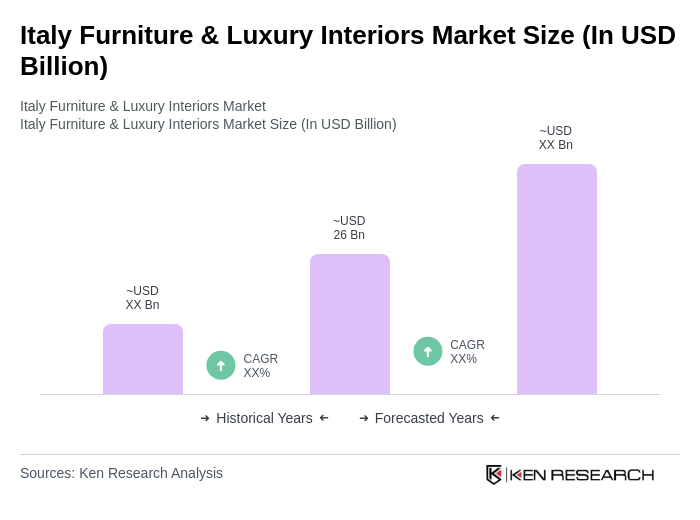
Italy Furniture & Luxury Interiors Market is valued at USD 26 billion, with trends in eco-friendly designs, artisanal craftsmanship, and smart technology integration.

Region:Europe

Author(s):Shubham

Product Code:KRAB4953

Pages:82

Published On:October 2025
About the Report

Base Year 2024

Italy Furniture & Luxury Interiors Market Overview

  • The Italy Furniture & Luxury Interiors Market is valued at USD 26 billion, based on a five-year historical analysis. This growth is primarily driven by increasing consumer demand for high-quality, aesthetically pleasing furniture and luxury interior designs, alongside a resurgence in home renovation projects, strong export performance, and a growing interest in sustainable materials and smart furniture solutions. Notable trends include the integration of eco-friendly materials, artisanal craftsmanship, and smart technology in furniture design, reflecting evolving consumer preferences for both luxury and sustainability .
  • Key cities such as Milan, Florence, and Rome continue to dominate the market due to their rich cultural heritage, leadership in design innovation, and status as fashion capitals. These cities are home to numerous renowned furniture brands and design studios, attracting both local and international consumers seeking luxury and bespoke furniture solutions. Milan, in particular, hosts major design fairs and exhibitions that further reinforce its position as a global hub for luxury interiors .
  • In 2023, the Italian government implemented the “National Recovery and Resilience Plan (PNRR)” and updated the “Minimum Environmental Criteria for Furniture” (CAM Arredi, Ministero della Transizione Ecologica, 2022), which require manufacturers supplying public contracts to comply with eco-design standards, use recycled and certified sustainable materials, and adopt energy-efficient production processes. These instruments incentivize manufacturers to adopt greener production methods and enhance the overall sustainability of the market .
Italy Furniture & Luxury Interiors Market Size

Italy Furniture & Luxury Interiors Market Segmentation

By Type:The market is segmented into various types of furniture and decor items, including living room furniture, bedroom furniture, office furniture, outdoor furniture, kitchen furniture, luxury decor items, contract furniture, custom/bespoke furniture, and others. Among these, living room furniture and luxury decor items are particularly dominant due to their essential role in home aesthetics and consumer preferences for stylish, high-quality products. The rise of e-commerce and specialty retailers has further boosted demand for customizable and functional furniture, with modular and smart furniture gaining popularity among urban consumers .
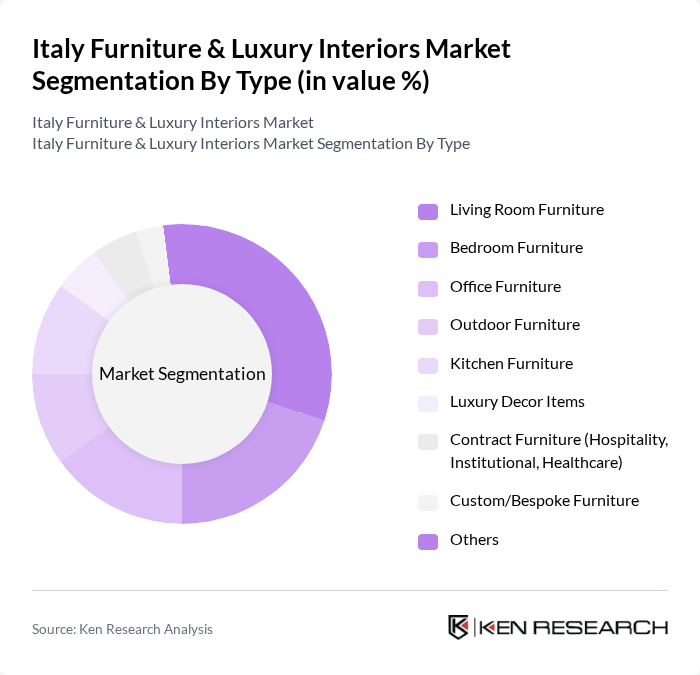
Italy Furniture & Luxury Interiors Market segmentation by Type.

By End-User:The market is segmented by end-user categories, including residential, commercial, hospitality, institutional, and government/public sector. The residential segment remains the largest, driven by increasing home ownership, renovation trends, and the expansion of e-commerce. The commercial segment is also significant due to the demand for stylish office spaces and hospitality environments, with contract furniture for hotels, restaurants, and public spaces showing steady growth .
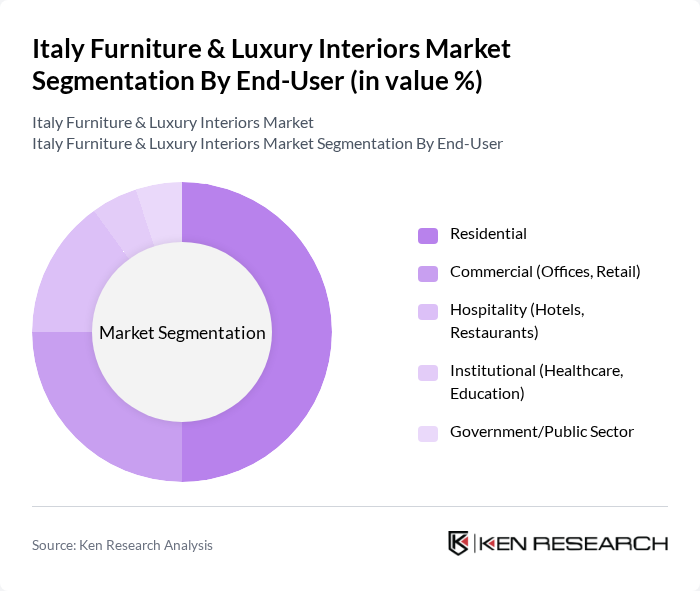
Italy Furniture & Luxury Interiors Market segmentation by End-User.

Italy Furniture & Luxury Interiors Market Competitive Landscape

The Italy Furniture & Luxury Interiors Market is characterized by a dynamic mix of regional and international players. Leading participants such as Poltrona Frau, B&B Italia, Cassina, Minotti, Molteni & C, Flexform, Giorgetti, Fendi Casa, Armani Casa, Roche Bobois, Kartell, Lema, Riva 1920, Cattelan Italia, Zanotta, Natuzzi, Scavolini, Duresta, Laura Ashley, Henredon Furniture contribute to innovation, geographic expansion, and service delivery in this space.

Poltrona Frau

1912

Turin, Italy

B&B Italia

1966

Novedrate, Italy

Cassina

1927

Meda, Italy

Minotti

1948

Meda, Italy

Molteni & C

1934

Giussano, Italy

Company

Establishment Year

Headquarters

Group Size (Large, Medium, Small)

Annual Revenue (EUR/USD)

Revenue Growth Rate (YoY %)

Market Share (%)

Export Ratio (%)

Customer Retention Rate (%)

Italy Furniture & Luxury Interiors Market Industry Analysis

Growth Drivers

  • Increasing Disposable Income:The rise in disposable income in Italy, projected to reach €34,000 per capita in future, is a significant growth driver for the furniture and luxury interiors market. As consumers have more financial flexibility, they are more inclined to invest in high-quality furnishings. This trend is supported by a 4% annual increase in household income, which enhances purchasing power and encourages spending on luxury home products, thereby stimulating market growth.
  • Rising Demand for Luxury Home Furnishings:The demand for luxury home furnishings in Italy is expected to grow, with the market value estimated at €12 billion in future. This surge is driven by a cultural shift towards home aesthetics, where consumers prioritize quality and design. The luxury segment is experiencing a 6% annual growth rate, reflecting a growing preference for premium materials and bespoke designs, which are increasingly sought after by affluent consumers.
  • Growth in Real Estate and Construction Sectors:The Italian real estate market is projected to see a 5% increase in new housing starts in future, contributing to the demand for furniture and luxury interiors. As the construction sector expands, particularly in urban areas, there is a corresponding rise in the need for stylish and functional home furnishings. This growth is further supported by government initiatives aimed at boosting housing development, which directly benefits the furniture market.

Market Challenges

  • High Competition Among Local and International Brands:The Italian furniture market is characterized by intense competition, with over 1,800 brands vying for market share. This saturation leads to price wars and challenges in brand differentiation. Local artisans and international luxury brands compete fiercely, making it difficult for new entrants to establish a foothold. The competitive landscape necessitates innovative marketing strategies and unique product offerings to capture consumer attention.
  • Fluctuating Raw Material Prices:The furniture industry faces challenges due to fluctuating raw material prices, particularly wood and metals, which have seen price increases of up to 12% in the past period. These fluctuations can significantly impact production costs and profit margins for manufacturers. As global supply chains remain volatile, companies must navigate these challenges to maintain competitive pricing while ensuring product quality and sustainability.

Italy Furniture & Luxury Interiors Market Future Outlook

The future of the Italy furniture and luxury interiors market appears promising, driven by evolving consumer preferences and technological advancements. As sustainability becomes a priority, manufacturers are increasingly adopting eco-friendly practices, which will likely enhance brand loyalty. Additionally, the integration of smart technology into furniture design is expected to attract tech-savvy consumers, creating new market segments. Overall, the industry is poised for innovation and growth, adapting to changing lifestyles and consumer demands.

Market Opportunities

  • Expansion of E-commerce Platforms:The growth of e-commerce in Italy, projected to reach €35 billion in future, presents a significant opportunity for furniture retailers. Online shopping offers convenience and access to a broader customer base, allowing brands to showcase their products effectively. This shift towards digital sales channels can enhance market reach and drive revenue growth for companies willing to invest in robust online platforms.
  • Increasing Interest in Custom-Made Furniture:The trend towards personalization in home decor is creating opportunities for custom-made furniture solutions. With a market segment valued at €3 billion in future, consumers are increasingly seeking unique, tailored products that reflect their individual styles. This demand encourages manufacturers to innovate and offer bespoke services, enhancing customer satisfaction and loyalty in a competitive landscape.

Scope of the Report

SegmentSub-Segments
By Type

Living Room Furniture

Bedroom Furniture

Office Furniture

Outdoor Furniture

Kitchen Furniture

Luxury Decor Items

Contract Furniture (Hospitality, Institutional, Healthcare)

Custom/Bespoke Furniture

Others

By End-User

Residential

Commercial (Offices, Retail)

Hospitality (Hotels, Restaurants)

Institutional (Healthcare, Education)

Government/Public Sector

By Distribution Channel

Online Retail (E-commerce)

Offline Retail (Specialty Stores, Department Stores)

Direct Sales (Manufacturer to Client)

Showrooms & Flagship Stores

Export/International Sales

By Price Range

Budget

Mid-Range

Premium

Ultra-Luxury

By Material

Wood (Solid, Veneer, FSC-certified)

Metal

Glass

Fabric

Leather

Plastic/Polymer

By Style

Modern

Traditional

Contemporary

Rustic

Minimalist

Artisanal/Handcrafted

By Functionality

Multi-functional

Single-purpose

Customizable/Modular

Smart/Connected Furniture

Key Target Audience

Investors and Venture Capitalist Firms

Government and Regulatory Bodies (e.g., Ministry of Economic Development, Italian Trade Agency)

Manufacturers and Producers

Distributors and Retailers

Interior Designers and Architects

Luxury Real Estate Developers

Trade Associations (e.g., Federlegno Arredo)

Financial Institutions

Players Mentioned in the Report:

Poltrona Frau

B&B Italia

Cassina

Minotti

Molteni & C

Flexform

Giorgetti

Fendi Casa

Armani Casa

Roche Bobois

Kartell

Lema

Riva 1920

Cattelan Italia

Zanotta

Natuzzi

Scavolini

Duresta

Laura Ashley

Henredon Furniture

Table of Contents

Market Assessment Phase

1. Executive Summary and Approach


2. Italy Furniture & Luxury Interiors Market Overview

2.1 Key Insights and Strategic Recommendations

2.2 Italy Furniture & Luxury Interiors Market Overview

2.3 Definition and Scope

2.4 Evolution of Market Ecosystem

2.5 Timeline of Key Regulatory Milestones

2.6 Value Chain & Stakeholder Mapping

2.7 Business Cycle Analysis

2.8 Policy & Incentive Landscape


3. Italy Furniture & Luxury Interiors Market Analysis

3.1 Growth Drivers

3.1.1 Increasing disposable income
3.1.2 Rising demand for luxury home furnishings
3.1.3 Growth in real estate and construction sectors
3.1.4 Shift towards sustainable and eco-friendly products

3.2 Market Challenges

3.2.1 High competition among local and international brands
3.2.2 Fluctuating raw material prices
3.2.3 Economic uncertainties affecting consumer spending
3.2.4 Supply chain disruptions

3.3 Market Opportunities

3.3.1 Expansion of e-commerce platforms
3.3.2 Increasing interest in custom-made furniture
3.3.3 Growth in the hospitality sector
3.3.4 Rising trend of home renovation and interior design

3.4 Market Trends

3.4.1 Emphasis on smart furniture solutions
3.4.2 Popularity of minimalist and multifunctional designs
3.4.3 Integration of technology in furniture
3.4.4 Focus on artisanal and handcrafted products

3.5 Government Regulation

3.5.1 Compliance with environmental standards
3.5.2 Regulations on product safety and quality
3.5.3 Import tariffs on foreign furniture
3.5.4 Incentives for sustainable manufacturing practices

4. SWOT Analysis


5. Stakeholder Analysis


6. Porter's Five Forces Analysis


7. Italy Furniture & Luxury Interiors Market Market Size, 2019-2024

7.1 By Value

7.2 By Volume

7.3 By Average Selling Price


8. Italy Furniture & Luxury Interiors Market Segmentation

8.1 By Type

8.1.1 Living Room Furniture
8.1.2 Bedroom Furniture
8.1.3 Office Furniture
8.1.4 Outdoor Furniture
8.1.5 Kitchen Furniture
8.1.6 Luxury Decor Items
8.1.7 Contract Furniture (Hospitality, Institutional, Healthcare)
8.1.8 Custom/Bespoke Furniture
8.1.9 Others

8.2 By End-User

8.2.1 Residential
8.2.2 Commercial (Offices, Retail)
8.2.3 Hospitality (Hotels, Restaurants)
8.2.4 Institutional (Healthcare, Education)
8.2.5 Government/Public Sector

8.3 By Distribution Channel

8.3.1 Online Retail (E-commerce)
8.3.2 Offline Retail (Specialty Stores, Department Stores)
8.3.3 Direct Sales (Manufacturer to Client)
8.3.4 Showrooms & Flagship Stores
8.3.5 Export/International Sales

8.4 By Price Range

8.4.1 Budget
8.4.2 Mid-Range
8.4.3 Premium
8.4.4 Ultra-Luxury

8.5 By Material

8.5.1 Wood (Solid, Veneer, FSC-certified)
8.5.2 Metal
8.5.3 Glass
8.5.4 Fabric
8.5.5 Leather
8.5.6 Plastic/Polymer

8.6 By Style

8.6.1 Modern
8.6.2 Traditional
8.6.3 Contemporary
8.6.4 Rustic
8.6.5 Minimalist
8.6.6 Artisanal/Handcrafted

8.7 By Functionality

8.7.1 Multi-functional
8.7.2 Single-purpose
8.7.3 Customizable/Modular
8.7.4 Smart/Connected Furniture

9. Italy Furniture & Luxury Interiors Market Competitive Analysis

9.1 Market Share of Key Players

9.2 KPIs for Cross Comparison of Key Players

9.2.1 Company Name
9.2.2 Group Size (Large, Medium, Small)
9.2.3 Annual Revenue (EUR/USD)
9.2.4 Revenue Growth Rate (YoY %)
9.2.5 Market Share (%)
9.2.6 Export Ratio (%)
9.2.7 Customer Retention Rate (%)
9.2.8 Average Order Value (EUR/USD)
9.2.9 Pricing Strategy (Premium, Value, Custom)
9.2.10 Product Return Rate (%)
9.2.11 Brand Awareness Index
9.2.12 Distribution Channel Coverage
9.2.13 Sustainability Score (e.g., % FSC-certified, eco-materials)
9.2.14 Innovation Index (e.g., % revenue from new products)

9.3 SWOT Analysis of Top Players

9.4 Pricing Analysis

9.5 Detailed Profile of Major Companies

9.5.1 Poltrona Frau
9.5.2 B&B Italia
9.5.3 Cassina
9.5.4 Minotti
9.5.5 Molteni & C
9.5.6 Flexform
9.5.7 Giorgetti
9.5.8 Fendi Casa
9.5.9 Armani Casa
9.5.10 Roche Bobois
9.5.11 Kartell
9.5.12 Lema
9.5.13 Riva 1920
9.5.14 Cattelan Italia
9.5.15 Zanotta
9.5.16 Natuzzi
9.5.17 Scavolini
9.5.18 Duresta
9.5.19 Laura Ashley
9.5.20 Henredon Furniture

10. Italy Furniture & Luxury Interiors Market End-User Analysis

10.1 Procurement Behavior of Key Ministries

10.1.1 Budget Allocation Trends
10.1.2 Preferred Suppliers
10.1.3 Procurement Processes

10.2 Corporate Spend on Infrastructure & Energy

10.2.1 Investment Trends
10.2.2 Key Projects
10.2.3 Spending Priorities

10.3 Pain Point Analysis by End-User Category

10.3.1 Quality Concerns
10.3.2 Delivery Timeliness
10.3.3 Customization Needs

10.4 User Readiness for Adoption

10.4.1 Awareness Levels
10.4.2 Training Requirements
10.4.3 Adoption Barriers

10.5 Post-Deployment ROI and Use Case Expansion

10.5.1 Performance Metrics
10.5.2 User Feedback
10.5.3 Future Expansion Plans

11. Italy Furniture & Luxury Interiors Market Future Size, 2025-2030

11.1 By Value

11.2 By Volume

11.3 By Average Selling Price


Go-To-Market Strategy Phase

1. Whitespace Analysis + Business Model Canvas

1.1 Market Gaps Identification

1.2 Value Proposition Development

1.3 Revenue Streams Analysis

1.4 Cost Structure Evaluation

1.5 Key Partnerships Exploration

1.6 Customer Segments Definition

1.7 Channels Strategy


2. Marketing and Positioning Recommendations

2.1 Branding Strategies

2.2 Product USPs

2.3 Target Audience Identification

2.4 Communication Strategy

2.5 Digital Marketing Tactics


3. Distribution Plan

3.1 Urban Retail Strategy

3.2 Rural NGO Tie-ups

3.3 E-commerce Integration

3.4 Logistics and Supply Chain Management


4. Channel & Pricing Gaps

4.1 Underserved Routes

4.2 Pricing Bands Analysis

4.3 Competitor Pricing Comparison


5. Unmet Demand & Latent Needs

5.1 Category Gaps

5.2 Consumer Segments Analysis

5.3 Emerging Trends Identification


6. Customer Relationship

6.1 Loyalty Programs

6.2 After-sales Service

6.3 Customer Feedback Mechanisms


7. Value Proposition

7.1 Sustainability Initiatives

7.2 Integrated Supply Chains

7.3 Unique Selling Points


8. Key Activities

8.1 Regulatory Compliance

8.2 Branding Efforts

8.3 Distribution Setup


9. Entry Strategy Evaluation

9.1 Domestic Market Entry Strategy

9.1.1 Product Mix
9.1.2 Pricing Band
9.1.3 Packaging

9.2 Export Entry Strategy

9.2.1 Target Countries
9.2.2 Compliance Roadmap

10. Entry Mode Assessment

10.1 Joint Ventures

10.2 Greenfield Investments

10.3 Mergers & Acquisitions

10.4 Distributor Model


11. Capital and Timeline Estimation

11.1 Capital Requirements

11.2 Timelines


12. Control vs Risk Trade-Off

12.1 Ownership vs Partnerships


13. Profitability Outlook

13.1 Breakeven Analysis

13.2 Long-term Sustainability


14. Potential Partner List

14.1 Distributors

14.2 Joint Ventures

14.3 Acquisition Targets


15. Execution Roadmap

15.1 Phased Plan for Market Entry

15.1.1 Market Setup
15.1.2 Market Entry
15.1.3 Growth Acceleration
15.1.4 Scale & Stabilize

15.2 Key Activities and Milestones

15.2.1 Milestone Planning
15.2.2 Activity Tracking

Research Methodology

ApproachModellingSample

Phase 1: Approach1

Desk Research

  • Analysis of industry reports from Italian furniture associations and trade bodies
  • Review of market trends and consumer behavior studies published by design magazines
  • Examination of economic indicators and real estate developments impacting luxury interiors

Primary Research

  • Interviews with interior designers and architects specializing in luxury projects
  • Surveys with high-end furniture retailers and distributors across Italy
  • Focus groups with affluent consumers to understand preferences and purchasing behavior

Validation & Triangulation

  • Cross-validation of findings through multiple data sources, including sales data and consumer insights
  • Triangulation of qualitative insights from interviews with quantitative data from surveys
  • Sanity checks conducted through expert panel reviews comprising industry veterans

Phase 2: Market Size Estimation1

Top-down Assessment

  • Estimation of market size based on national furniture sales and luxury goods expenditure
  • Segmentation by product categories such as sofas, tables, and cabinetry
  • Incorporation of growth rates from historical data and economic forecasts

Bottom-up Modeling

  • Collection of sales data from leading luxury furniture manufacturers and retailers
  • Estimation of average transaction values and volume sold in key segments
  • Analysis of distribution channels and their contribution to overall market revenue

Forecasting & Scenario Analysis

  • Multi-factor regression analysis incorporating GDP growth, consumer confidence, and design trends
  • Scenario modeling based on potential impacts of economic fluctuations and market disruptions
  • Development of baseline, optimistic, and pessimistic forecasts through 2030

Phase 3: CATI Sample Composition1

Scope Item/SegmentSample SizeTarget Respondent Profiles
Luxury Furniture Retailers60Store Managers, Sales Directors
Interior Design Firms50Lead Designers, Project Managers
High-End Consumers100Affluent Homeowners, Luxury Apartment Dwellers
Architectural Firms40Senior Architects, Design Principals
Furniture Manufacturers45Product Development Managers, Marketing Executives

Frequently Asked Questions

What is the current value of the Italy Furniture & Luxury Interiors Market?

The Italy Furniture & Luxury Interiors Market is valued at approximately USD 26 billion, reflecting a robust growth driven by consumer demand for high-quality and aesthetically pleasing furniture, alongside trends in home renovation and sustainable materials.

Which cities are the main hubs for the Italy Furniture & Luxury Interiors Market?

What are the main growth drivers for the Italy Furniture & Luxury Interiors Market?

What challenges does the Italy Furniture & Luxury Interiors Market face?

Other Regional/Country Reports

Indonesia Furniture & Luxury Interiors Market

Malaysia Furniture & Luxury Interiors Market

KSA Furniture & Luxury Interiors Market

APAC Furniture & Luxury Interiors Market

SEA Furniture & Luxury Interiors Market

Vietnam Furniture & Luxury Interiors Market

Other Adjacent Reports

India Home Decor Market Outlook to 2030UAE Interior Design Services MarketGlobal Lighting Fixtures Market Size, Share, Growth Drivers, Trends, Opportunities & Forecast 2025–2030

Egypt Textile and Upholstery Market

Malaysia Kitchen Cabinetry Market

Philippines Bathroom Furnishings Market

South Korea Sustainable Furniture Materials Market

Thailand Smart Home Integration Market

South Korea Hospitality Furniture Market

Qatar Office Furniture Market Report Size Share Growth Drivers Trends Opportunities & Forecast 2025–2030

Why Buy From Us?

Refine Robust Result (RRR) Framework

What makes us stand out is that our consultants follow Robust, Refine and Result (RRR) methodology. Robust for clear definitions, approaches and sanity checking, Refine for differentiating respondents' facts and opinions, and Result for presenting data with story.

Our Reach Is Unmatched

We have set a benchmark in the industry by offering our clients with syndicated and customized market research reports featuring coverage of entire market as well as meticulous research and analyst insights.

Shifting the Research Paradigm

While we don't replace traditional research, we flip the method upside down. Our dual approach of Top Bottom & Bottom Top ensures quality deliverable by not just verifying company fundamentals but also looking at the sector and macroeconomic factors.

More Insights-Better Decisions

With one step in the future, our research team constantly tries to show you the bigger picture. We help with some of the tough questions you may encounter along the way: How is the industry positioned? Best marketing channel? KPI's of competitors? By aligning every element, we help maximize success.

Transparency and Trust

Our report gives you instant access to the answers and sources that other companies might choose to hide. We elaborate each steps of research methodology we have used and showcase you the sample size to earn your trust.

Round the Clock Support

If you need any support, we are here! We pride ourselves on universe strength, data quality, and quick, friendly, and professional service.

Why Clients Choose Us?

400000+
Reports in repository
150+
Consulting projects a year
100+
Analysts
8000+
Client Queries in 2022








