About the Report
Base Year 2024Italy Real Estate and PropTech Solutions Market Overview
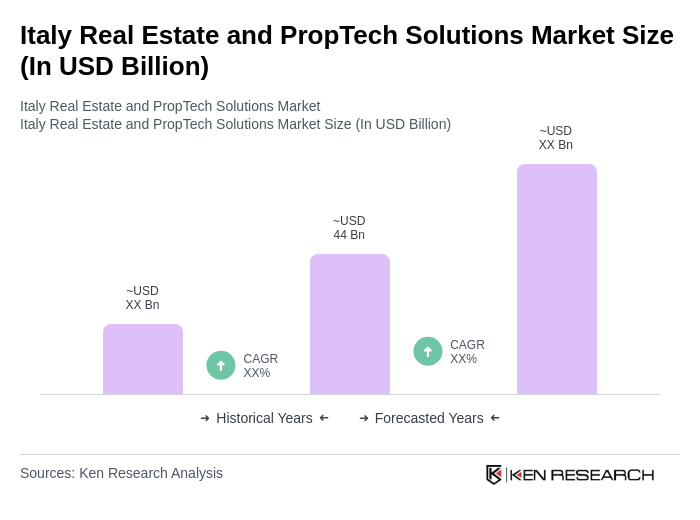
- The Italy Real Estate and PropTech Solutions Market is valued at approximately USD 44 billion, based on a five-year historical analysis. This growth is primarily driven by urbanization, increasing demand for residential and commercial properties, and the integration of technology in real estate transactions. The rise of digital platforms and innovative solutions has transformed traditional practices, making the market more accessible and efficient. Recent trends show strong momentum in residential transactions, with over 201,000 sales in Q2 2025, up 8.1% year-on-year, and robust investment volumes, particularly in Milan and Rome. The market also benefits from declining mortgage rates, now between 3.2% and 3.8%, which have improved affordability and stimulated buyer activity. Foreign investment is active, especially in energy-efficient and renovated properties, while domestic buyers are driving demand for both primary residences and investment properties.
- Key cities such as Milan, Rome, and Turin dominate the market due to their economic significance, cultural heritage, and robust infrastructure. Milan, as a financial hub, attracts significant investments and accounted for around 60% of Q2 2025 investment volumes, with Rome following at 20%. Milan’s residential prices grew 5.1% year-on-year, while Rome saw a 3.4% increase. Turin’s industrial base and recent double-digit growth in residential transactions further reinforce its importance in the national market. These cities are pivotal in shaping the market landscape, with Milan and Rome also leading in commercial and hospitality investments.
- In 2023, the Italian government implemented the Energy Performance of Buildings Directive (EPBD) recast, transposed into national law as Legislative Decree No. 48/2023, issued by the Ministry of Ecological Transition. This regulation mandates that all new constructions must achieve at least energy class B, with stricter requirements for public buildings, and existing buildings undergoing major renovations must improve their energy performance. The initiative includes incentives for energy-efficient retrofits and renewable energy integration, supporting Italy’s commitment to reducing carbon emissions and enhancing environmental sustainability. Compliance is enforced through mandatory energy performance certificates (APE) and penalties for non-compliance, with the regulation applying to both residential and non-residential buildings.
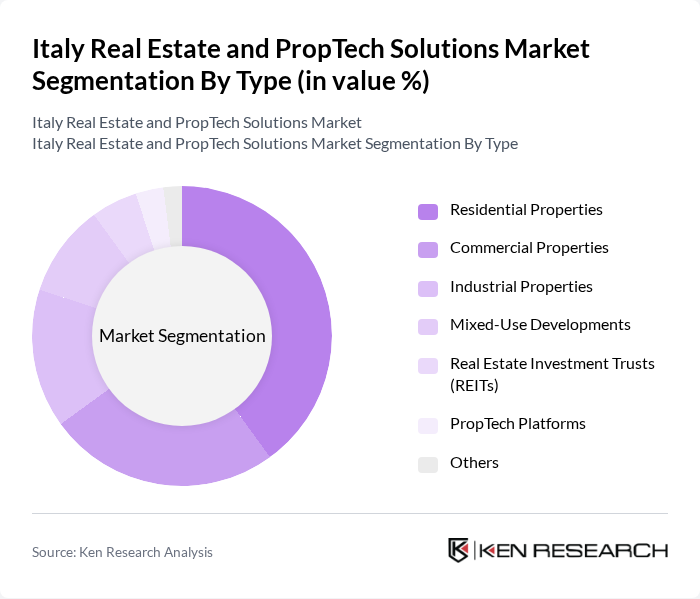
Italy Real Estate and PropTech Solutions Market Segmentation
By Type:The market can be segmented into various types, including Residential Properties, Commercial Properties, Industrial Properties, Mixed-Use Developments, Real Estate Investment Trusts (REITs), PropTech Platforms, and Others. Among these, Residential Properties are currently leading the market due to the increasing demand for housing driven by urban migration, changing demographics, and improved financing conditions. Commercial Properties also hold a significant share, supported by the growth of businesses, the need for office spaces, and strong retail and hospitality investment—hospitality alone attracted EUR 1.5 billion in H1 2025, up 77% year-on-year. Industrial and logistics assets are gaining attention, while Mixed-Use Developments are emerging in urban centers to meet diverse lifestyle needs. REITs and PropTech Platforms, though smaller in share, are growing as investors seek diversified exposure and tech-driven efficiencies.
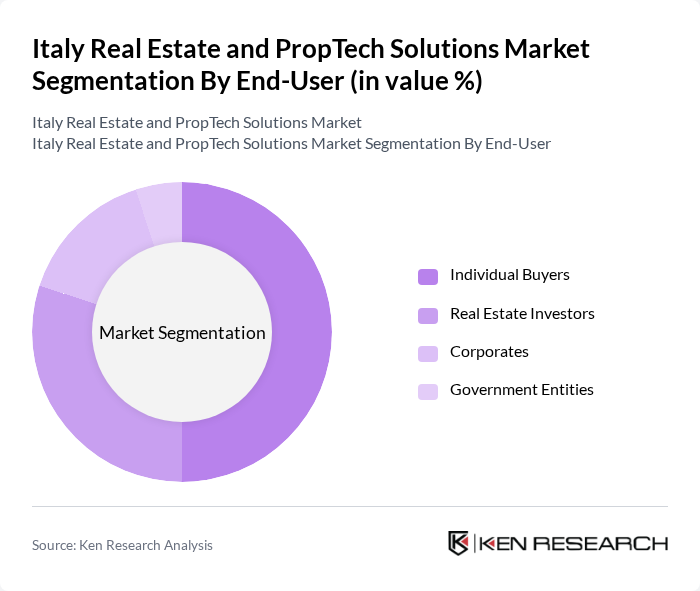
By End-User:The end-user segmentation includes Individual Buyers, Real Estate Investors, Corporates, and Government Entities. Individual Buyers dominate the market, driven by the increasing trend of homeownership and investment in residential properties, supported by favorable mortgage rates and a strong sales market. Real Estate Investors follow closely, capitalizing on the growing demand for rental properties—especially in student and short-term segments—and commercial spaces, with southern cities offering rental yields above 8%. Corporates and Government Entities contribute to the market through large-scale projects, infrastructure development, and public-private partnerships, particularly in urban renewal and sustainable development initiatives.
Italy Real Estate and PropTech Solutions Market Competitive Landscape
The Italy Real Estate and PropTech Solutions Market is characterized by a dynamic mix of regional and international players. Leading participants such as RE/MAX Italy, Gabetti Property Solutions, Tecnocasa, Engel & Völkers Italy, Casa.it, Idealista, Immobiliare.it, Housers, Casavo, Bnp Paribas Real Estate, Cbre Italy, Jll Italy, Colliers International Italy, Sigest, Scenari Immobiliari contribute to innovation, geographic expansion, and service delivery in this space.
Italy Real Estate and PropTech Solutions Market Industry Analysis
Growth Drivers
- Increasing Urbanization:Italy's urban population is projected to reach approximately 60 million in the future, up from 58 million in the past, indicating a significant shift towards urban living. This urbanization trend drives demand for residential and commercial properties, particularly in metropolitan areas like Milan and Rome. The World Bank reports that urbanization contributes to economic growth, with urban areas generating over 80% of Italy's GDP, further fueling real estate investments and developments.
- Technological Advancements in Real Estate:The integration of technology in real estate is transforming the industry, with investments in PropTech solutions expected to exceed €1 billion in the future. Innovations such as blockchain for property transactions and AI for property management are gaining traction. According to the Italian National Institute of Statistics, 45% of real estate firms are adopting digital tools, enhancing operational efficiency and customer engagement, thus driving market growth.
- Demand for Smart Homes:The smart home market in Italy is anticipated to grow to €3.5 billion in the future, driven by consumer interest in energy efficiency and convenience. A survey by the Italian Association of Smart Home Technologies indicates that 60% of homeowners are willing to invest in smart home technologies. This demand is pushing developers to incorporate smart features into new properties, aligning with consumer preferences and sustainability goals.
Market Challenges
- Regulatory Hurdles:The Italian real estate market faces significant regulatory challenges, with over 200 laws governing property transactions and development. These regulations can lead to delays and increased costs for developers. The European Commission has highlighted that compliance with these regulations can add up to 20% to project costs, deterring investment and slowing down the pace of new developments in the sector.
- High Property Prices:Property prices in major Italian cities have surged, with Milan experiencing a 10% increase in average prices recently, reaching €3,500 per square meter. This trend makes homeownership increasingly unattainable for many, particularly first-time buyers. According to the Bank of Italy, the affordability index has worsened, with average household income growth lagging behind property price increases, creating a barrier to market entry.
Italy Real Estate and PropTech Solutions Market Future Outlook
The future of the Italy real estate and PropTech solutions market appears promising, driven by ongoing urbanization and technological integration. As cities expand, the demand for innovative housing solutions will likely increase. Additionally, the focus on sustainability and energy efficiency will shape new developments. The rise of remote work is expected to influence property design and location preferences, creating opportunities for flexible living and working spaces that cater to evolving consumer needs.
Market Opportunities
- Growth of Co-Working Spaces:The co-working space market in Italy is projected to grow to €1.2 billion in the future, driven by the rise of remote work and the gig economy. This trend presents opportunities for real estate developers to create flexible office solutions that cater to freelancers and startups, enhancing property utilization and generating new revenue streams.
- Adoption of Green Building Practices:With Italy's commitment to reducing carbon emissions by 55% in the future, the demand for green buildings is set to rise. The market for sustainable construction materials is expected to reach €4 billion in the future. This shift offers developers the chance to differentiate their projects and attract environmentally conscious buyers, aligning with national sustainability goals.
Scope of the Report
| Segment | Sub-Segments |
|---|---|
| By Type | Residential Properties Commercial Properties Industrial Properties Mixed-Use Developments Real Estate Investment Trusts (REITs) PropTech Platforms Others |
| By End-User | Individual Buyers Real Estate Investors Corporates Government Entities |
| By Application | Property Management Real Estate Brokerage Investment Analysis Market Research Data Analytics and AI Integration |
| By Sales Channel | Direct Sales Online Platforms Real Estate Agents |
| By Distribution Mode | Offline Distribution Online Distribution |
| By Price Range | Low-End Properties Mid-Range Properties High-End Properties |
| By Investment Source | Domestic Investments Foreign Direct Investments (FDI) Public-Private Partnerships (PPP) Government Schemes |
Key Target Audience
Investors and Venture Capitalist Firms
Government and Regulatory Bodies (e.g., Agenzia delle Entrate, Ministero delle Infrastrutture e dei Trasporti)
Real Estate Developers
Property Management Companies
Construction Firms
Technology Providers
Real Estate Investment Trusts (REITs)
Financial Institutions
Players Mentioned in the Report:
RE/MAX Italy
Gabetti Property Solutions
Tecnocasa
Engel & Volkers Italy
Casa.it
Idealista
Immobiliare.it
Housers
Casavo
Bnp Paribas Real Estate
Cbre Italy
Jll Italy
Colliers International Italy
Sigest
Scenari Immobiliari
Table of Contents
Market Assessment Phase
1. Executive Summary and Approach
2. Italy Real Estate and PropTech Solutions Market Overview
2.1 Key Insights and Strategic Recommendations
2.2 Italy Real Estate and PropTech Solutions Market Overview
2.3 Definition and Scope
2.4 Evolution of Market Ecosystem
2.5 Timeline of Key Regulatory Milestones
2.6 Value Chain & Stakeholder Mapping
2.7 Business Cycle Analysis
2.8 Policy & Incentive Landscape
3. Italy Real Estate and PropTech Solutions Market Analysis
3.1 Growth Drivers
3.1.1 Increasing Urbanization
3.1.2 Technological Advancements in Real Estate
3.1.3 Demand for Smart Homes
3.1.4 Government Initiatives for Housing Development
3.2 Market Challenges
3.2.1 Regulatory Hurdles
3.2.2 Economic Uncertainty
3.2.3 High Property Prices
3.2.4 Limited Access to Financing
3.3 Market Opportunities
3.3.1 Growth of Co-Working Spaces
3.3.2 Expansion of E-commerce Logistics
3.3.3 Adoption of Green Building Practices
3.3.4 Integration of AI in Property Management
3.4 Market Trends
3.4.1 Rise of Virtual Tours and Digital Showings
3.4.2 Increased Focus on Sustainability
3.4.3 Shift Towards Remote Workspaces
3.4.4 Growth of Real Estate Crowdfunding
3.5 Government Regulation
3.5.1 Building Code Revisions
3.5.2 Tax Incentives for Renovation
3.5.3 Zoning Law Updates
3.5.4 Energy Efficiency Standards
4. SWOT Analysis
5. Stakeholder Analysis
6. Porter's Five Forces Analysis
7. Italy Real Estate and PropTech Solutions Market Market Size, 2019-2024
7.1 By Value
7.2 By Volume
7.3 By Average Selling Price
8. Italy Real Estate and PropTech Solutions Market Segmentation
8.1 By Type
8.1.1 Residential Properties
8.1.2 Commercial Properties
8.1.3 Industrial Properties
8.1.4 Mixed-Use Developments
8.1.5 Real Estate Investment Trusts (REITs)
8.1.6 PropTech Platforms
8.1.7 Others
8.2 By End-User
8.2.1 Individual Buyers
8.2.2 Real Estate Investors
8.2.3 Corporates
8.2.4 Government Entities
8.3 By Application
8.3.1 Property Management
8.3.2 Real Estate Brokerage
8.3.3 Investment Analysis
8.3.4 Market Research
8.3.5 Data Analytics and AI Integration
8.4 By Sales Channel
8.4.1 Direct Sales
8.4.2 Online Platforms
8.4.3 Real Estate Agents
8.5 By Distribution Mode
8.5.1 Offline Distribution
8.5.2 Online Distribution
8.6 By Price Range
8.6.1 Low-End Properties
8.6.2 Mid-Range Properties
8.6.3 High-End Properties
8.7 By Investment Source
8.7.1 Domestic Investments
8.7.2 Foreign Direct Investments (FDI)
8.7.3 Public-Private Partnerships (PPP)
8.7.4 Government Schemes
9. Italy Real Estate and PropTech Solutions Market Competitive Analysis
9.1 Market Share of Key Players
9.2 Cross Comparison of Key Players
9.2.1 Company Name
9.2.2 Group Size (Large, Medium, or Small as per industry convention)
9.2.3 Revenue Growth Rate
9.2.4 Market Penetration Rate
9.2.5 Customer Acquisition Cost (CAC)
9.2.6 Customer Retention Rate
9.2.7 Average Deal Size
9.2.8 Pricing Strategy
9.2.9 Return on Investment (ROI)
9.2.10 Net Promoter Score (NPS)
9.2.11 Technology Adoption Rate
9.2.12 Sustainability Initiatives
9.3 SWOT Analysis of Top Players
9.4 Pricing Analysis
9.5 Detailed Profile of Major Companies
9.5.1 RE/MAX Italy
9.5.2 Gabetti Property Solutions
9.5.3 Tecnocasa
9.5.4 Engel & Völkers Italy
9.5.5 Casa.it
9.5.6 Idealista
9.5.7 Immobiliare.it
9.5.8 Housers
9.5.9 Casavo
9.5.10 Bnp Paribas Real Estate
9.5.11 Cbre Italy
9.5.12 Jll Italy
9.5.13 Colliers International Italy
9.5.14 Sigest
9.5.15 Scenari Immobiliari
10. Italy Real Estate and PropTech Solutions Market End-User Analysis
10.1 Procurement Behavior of Key Ministries
10.1.1 Ministry of Infrastructure
10.1.2 Ministry of Economic Development
10.1.3 Ministry of Environment
10.2 Corporate Spend on Infrastructure & Energy
10.2.1 Corporate Real Estate Investments
10.2.2 Infrastructure Development Budgets
10.3 Pain Point Analysis by End-User Category
10.3.1 Residential Buyers
10.3.2 Commercial Tenants
10.3.3 Real Estate Investors
10.4 User Readiness for Adoption
10.4.1 Technology Adoption Rates
10.4.2 Training and Support Needs
10.5 Post-Deployment ROI and Use Case Expansion
10.5.1 Performance Metrics
10.5.2 Case Studies of Successful Implementations
11. Italy Real Estate and PropTech Solutions Market Future Size, 2025-2030
11.1 By Value
11.2 By Volume
11.3 By Average Selling Price
Go-To-Market Strategy Phase
1. Whitespace Analysis + Business Model Canvas
1.1 Market Gaps Identification
1.2 Business Model Framework
2. Marketing and Positioning Recommendations
2.1 Branding Strategies
2.2 Product USPs
3. Distribution Plan
3.1 Urban Retail vs Rural NGO Tie-ups
4. Channel & Pricing Gaps
4.1 Underserved Routes
4.2 Pricing Bands
5. Unmet Demand & Latent Needs
5.1 Category Gaps
5.2 Consumer Segments
6. Customer Relationship
6.1 Loyalty Programs
6.2 After-sales Service
7. Value Proposition
7.1 Sustainability
7.2 Integrated Supply Chains
8. Key Activities
8.1 Regulatory Compliance
8.2 Branding
8.3 Distribution Setup
9. Entry Strategy Evaluation
9.1 Domestic Market Entry Strategy
9.1.1 Product Mix
9.1.2 Pricing Band
9.1.3 Packaging
9.2 Export Entry Strategy
9.2.1 Target Countries
9.2.2 Compliance Roadmap
10. Entry Mode Assessment
10.1 Joint Ventures
10.2 Greenfield Investments
10.3 Mergers & Acquisitions
10.4 Distributor Model
11. Capital and Timeline Estimation
11.1 Capital Requirements
11.2 Timelines
12. Control vs Risk Trade-Off
12.1 Ownership vs Partnerships
13. Profitability Outlook
13.1 Breakeven Analysis
13.2 Long-term Sustainability
14. Potential Partner List
14.1 Distributors
14.2 Joint Ventures
14.3 Acquisition Targets
15. Execution Roadmap
15.1 Phased Plan for Market Entry
15.1.1 Market Setup
15.1.2 Market Entry
15.1.3 Growth Acceleration
15.1.4 Scale & Stabilize
15.2 Key Activities and Milestones
15.2.1 Milestone Planning
15.2.2 Activity Tracking
Research Methodology
Phase 1: Approach1
Desk Research
- Analysis of real estate market reports from Italian government agencies and industry associations
- Review of PropTech investment trends and funding data from venture capital firms and financial institutions
- Examination of demographic and economic indicators from ISTAT and Eurostat relevant to real estate demand
Primary Research
- Interviews with real estate developers and property managers to understand market dynamics
- Surveys with PropTech startups to gauge technology adoption and innovation trends
- Focus groups with real estate investors to assess sentiment and future outlook
Validation & Triangulation
- Cross-validation of findings through multiple data sources including market reports and expert opinions
- Triangulation of qualitative insights from interviews with quantitative data from surveys
- Sanity checks through expert panel reviews comprising industry veterans and analysts
Phase 2: Market Size Estimation1
Top-down Assessment
- Estimation of the overall real estate market size based on GDP contribution and sectoral analysis
- Segmentation of the market by residential, commercial, and industrial real estate sectors
- Incorporation of growth rates from historical data and projected economic indicators
Bottom-up Modeling
- Collection of data on transaction volumes and property prices from real estate listings and registries
- Estimation of PropTech market size based on technology adoption rates and service pricing models
- Volume x price analysis for different property types and PropTech solutions
Forecasting & Scenario Analysis
- Multi-factor regression analysis incorporating economic growth, urbanization rates, and technology trends
- Scenario modeling based on regulatory changes, market disruptions, and consumer behavior shifts
- Development of baseline, optimistic, and pessimistic forecasts through 2030
Phase 3: CATI Sample Composition1
| Scope Item/Segment | Sample Size | Target Respondent Profiles |
|---|---|---|
| Residential Real Estate Developers | 90 | Project Managers, Business Development Managers |
| Commercial Property Managers | 70 | Operations Managers, Asset Managers |
| PropTech Startups | 50 | Founders, Product Managers |
| Real Estate Investors | 65 | Investment Analysts, Portfolio Managers |
| Urban Planning Authorities | 40 | Urban Planners, Policy Makers |
Frequently Asked Questions
What is the current value of the Italy Real Estate and PropTech Solutions Market?
The Italy Real Estate and PropTech Solutions Market is valued at approximately USD 44 billion, reflecting significant growth driven by urbanization, demand for properties, and technological integration in real estate transactions.
Which cities are the main hubs for real estate investment in Italy?
What factors are driving growth in the Italian real estate market?
How has urbanization impacted the real estate market in Italy?
Other Regional/Country Reports
Indonesia Real Estate and PropTech Solutions Market
Malaysia Real Estate and PropTech Solutions Market
KSA Real Estate and PropTech Solutions Market
APAC Real Estate and PropTech Solutions Market
Other Adjacent Reports
Mexico Construction Technology Market
Kuwait Property Management Software Market Report Size Share Growth Drivers Trends Opportunities & Forecast 2025–2030Vietnam Real Estate Investment Platforms Market
Egypt Smart Building Solutions Market
Singapore Sustainable Building Materials Market
Qatar Home Automation Systems Market
Belgium Virtual Reality Real Estate Market
Mexico Blockchain Property Transactions Market
Singapore Mortgage Technology Market
Qatar Urban Planning Services Market
Why Buy From Us?

What makes us stand out is that our consultants follow Robust, Refine and Result (RRR) methodology. Robust for clear definitions, approaches and sanity checking, Refine for differentiating respondents' facts and opinions, and Result for presenting data with story.

We have set a benchmark in the industry by offering our clients with syndicated and customized market research reports featuring coverage of entire market as well as meticulous research and analyst insights.

While we don't replace traditional research, we flip the method upside down. Our dual approach of Top Bottom & Bottom Top ensures quality deliverable by not just verifying company fundamentals but also looking at the sector and macroeconomic factors.

With one step in the future, our research team constantly tries to show you the bigger picture. We help with some of the tough questions you may encounter along the way: How is the industry positioned? Best marketing channel? KPI's of competitors? By aligning every element, we help maximize success.

Our report gives you instant access to the answers and sources that other companies might choose to hide. We elaborate each steps of research methodology we have used and showcase you the sample size to earn your trust.

If you need any support, we are here! We pride ourselves on universe strength, data quality, and quick, friendly, and professional service.