About the Report
Base Year 2024Japan Agro Textile Market Overview
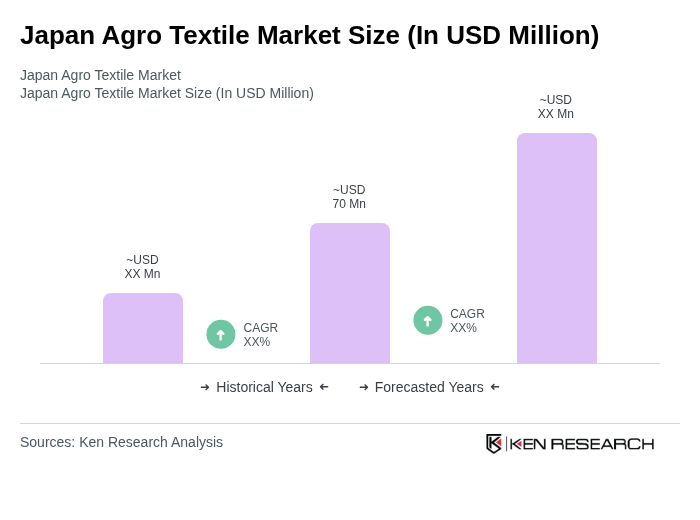
- The Japan Agro Textile Market is valued at USD 70 million, based on a five-year historical analysis. This growth is primarily driven by the increasing demand for sustainable agricultural practices, advancements in agro textile technology, and the rising awareness of crop protection methods among farmers. The market has seen a significant uptick in the adoption of agro textiles, which are essential for enhancing crop yield, improving input efficiency, and protecting against environmental factors such as excess solar radiation, hail, wind, and pests.
- Key regions contributing to the market include Kanto and Kansai, which combine dense population centers with surrounding prefectures that support intensive horticulture, fruit, and high-value crop cultivation. These areas benefit from advanced agricultural practices, strong logistics and distribution networks for technical textiles, and a high level of investment in agricultural and smart-farming technology. The presence of major universities, research institutes, and corporate R&D centers focused on materials science, technical textiles, and agri-tech in these regions further supports product innovation and the adoption of agro textiles.
- Regulatory support for materials used in agriculture is guided by instruments such as the Fertilizer Control Act (Act No. 127 of 1952) administered by the Ministry of Agriculture, Forestry and Fisheries (MAFF) and the Act on the Evaluation of Chemical Substances and Regulation of Their Manufacture (Chemical Substances Control Act, Act No. 117 of 1973), which set safety and environmental standards for chemical substances and additives used in products including agricultural films, nets, and related agro textile materials. These frameworks, together with MAFF guidelines on eco-friendly agricultural materials and resource-efficient farming, incentivize the development and use of durable, low-environmental-impact agro textiles and support R&D collaboration between textile manufacturers and the agricultural sector.
Japan Agro Textile Market Segmentation
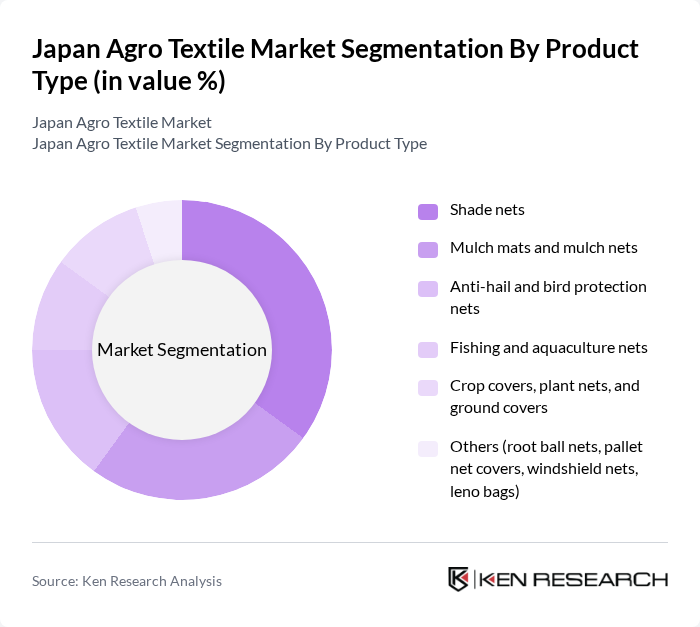
By Product Type:The product type segmentation includes various categories such as shade nets, mulch mats and mulch nets, anti-hail and bird protection nets, fishing and aquaculture nets, crop covers, plant nets, and ground covers, as well as other products like root ball nets, pallet net covers, windshield nets, and leno bags. Among these, shade nets are particularly important due to their widespread application in protecting vegetables, fruits, and nursery crops from excessive sunlight, heat stress, and harsh weather conditions, while also supporting greenhouse and tunnel cultivation. The increasing focus on sustainable agriculture, climate-resilient production, and the need for efficient crop management and water-use optimization has further propelled the demand for shade nets, ground covers, and mulch-related products in Japan.
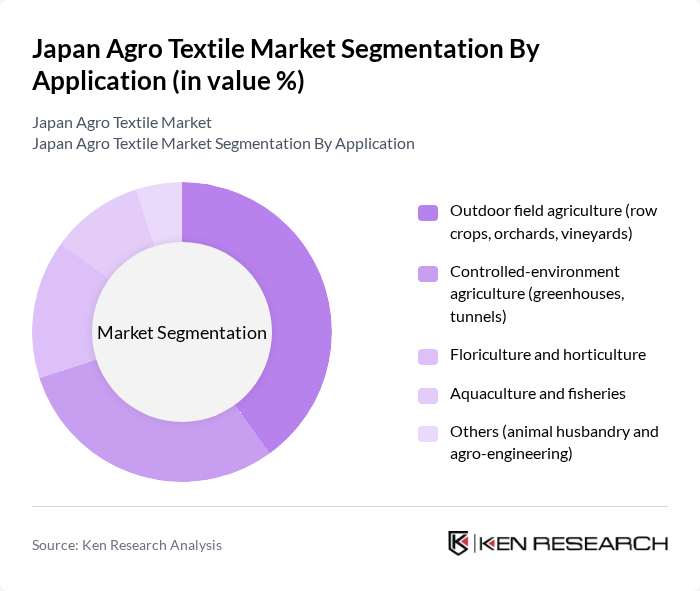
By Application:The application segmentation encompasses outdoor field agriculture, controlled-environment agriculture, floriculture and horticulture, aquaculture and fisheries, and other applications such as animal husbandry and agro-engineering. Outdoor field agriculture is a major application segment, driven by the need for effective crop protection, yield enhancement, and reduced agrochemical usage in open fields through the adoption of mulching, windbreak, and bird-protection solutions. The increasing adoption of controlled-environment agriculture, particularly greenhouses, plant factories, and tunnel cultivation in and around urban areas, is also contributing strongly to the growth of agro textile usage in Japan as growers seek precise control over light, temperature, and moisture.
Japan Agro Textile Market Competitive Landscape
The Japan Agro Textile Market is characterized by a dynamic mix of regional and international players. Leading participants such as Unitika Ltd., Toyobo Co., Ltd., Toray Industries, Inc., Asahi Kasei Corporation, Teijin Limited, Kuraray Co., Ltd., Mitsui Chemicals, Inc., Nitto Denko Corporation, Kaneka Corporation, Sumitomo Chemical Co., Ltd., Daicel Corporation, Seiren Co., Ltd., JNC Corporation, and other relevant domestic agro textile converters and fabricators contribute to innovation, geographic expansion, and service delivery in this space.
Japan Agro Textile Market Industry Analysis
Growth Drivers
- Increasing Demand for Sustainable Agricultural Practices:The Japanese agricultural sector is increasingly adopting sustainable practices, with over 30% of farmers implementing eco-friendly methods in future. This shift is driven by consumer preferences for organic produce, which has seen a 15% rise in demand. The government’s commitment to reducing carbon emissions by 46% in future further supports this trend, encouraging the use of agro textiles that promote sustainability and resource efficiency in farming.
- Technological Advancements in Agro Textiles:The integration of advanced materials in agro textiles is revolutionizing the industry. Innovations such as UV-resistant fabrics and moisture-retaining textiles are projected to enhance crop yields by up to 20%. The Japanese agro textile market is expected to invest approximately ¥10 billion in R&D in future, fostering the development of smart textiles that can monitor soil conditions and optimize resource usage, thus driving market growth.
- Government Initiatives Promoting Agro Textile Usage:The Japanese government has allocated ¥5 billion in subsidies for sustainable farming practices, including the adoption of agro textiles. This initiative aims to support farmers transitioning to eco-friendly materials, with over 40% of agricultural producers expected to utilize these textiles in future. Additionally, regulatory frameworks are being established to facilitate the approval of innovative agro textile products, further enhancing market penetration and growth.
Market Challenges
- High Initial Investment Costs:The adoption of agro textiles often requires significant upfront investment, with costs averaging around ¥1 million per hectare for implementation. Many small-scale farmers, who constitute approximately 60% of the agricultural sector, struggle to afford these expenses. This financial barrier limits the widespread adoption of agro textiles, hindering market growth despite their long-term benefits in yield enhancement and sustainability.
- Limited Awareness Among Farmers:Despite the benefits of agro textiles, awareness remains low, with only 25% of farmers familiar with their advantages. This lack of knowledge is particularly pronounced in rural areas, where traditional farming practices dominate. Educational initiatives and outreach programs are essential to bridge this gap, as increasing awareness could potentially lead to a 30% rise in adoption rates in future, significantly impacting market dynamics.
Japan Agro Textile Market Future Outlook
The future of the Japan agro textile market appears promising, driven by a growing emphasis on sustainability and technological innovation. As farmers increasingly recognize the benefits of eco-friendly materials, the market is likely to witness a surge in demand for multifunctional agro textiles. Additionally, the integration of smart technologies will enhance efficiency in agricultural practices, positioning Japan as a leader in agro textile innovation. Collaborative efforts between government and industry stakeholders will further accelerate growth, ensuring a robust market landscape.
Market Opportunities
- Expansion into Organic Farming Sectors:The organic farming sector in Japan is projected to grow by 20% annually, presenting a significant opportunity for agro textile manufacturers. By developing products tailored to organic farming needs, companies can tap into this expanding market, enhancing their competitive edge and driving revenue growth.
- Development of Biodegradable Agro Textiles:With increasing environmental concerns, the demand for biodegradable agro textiles is on the rise. In future, the market for these products is expected to reach ¥3 billion, offering manufacturers a lucrative opportunity to innovate and cater to eco-conscious consumers, thereby enhancing sustainability in agriculture.
Scope of the Report
| Segment | Sub-Segments |
|---|---|
| By Product Type | Shade nets Mulch mats and mulch nets Anti-hail and bird protection nets Fishing and aquaculture nets Crop covers, plant nets, and ground covers Others (root ball nets, pallet net covers, windshield nets, leno bags) |
| By Application | Outdoor field agriculture (row crops, orchards, vineyards) Controlled-environment agriculture (greenhouses, tunnels) Floriculture and horticulture Aquaculture and fisheries Others (animal husbandry and agro-engineering) |
| By Material / Fiber | Polyethylene (HDPE, LDPE) Polypropylene Polyester and nylon Natural fibers (jute, cotton, coir, others) Biodegradable and bio-based polymers Others |
| By Fabric Construction | Woven agro textiles Non-woven agro textiles Knitted agro textiles Others (composites and laminated structures) |
| By End-User Segment | Commercial farms and agribusinesses Cooperatives and producer organizations Smallholder farmers Government and municipal bodies Research institutes and universities Others |
| By Distribution Channel | Agro-dealers and input retailers Direct sales and project-based tenders Online and e-commerce platforms Cooperatives and buying groups Others |
| By Region | Hokkaido Kanto Chubu Kansai Kyushu Others (Tohoku, Chugoku, Shikoku, Okinawa) |
Key Target Audience
Investors and Venture Capitalist Firms
Government and Regulatory Bodies (e.g., Ministry of Agriculture, Forestry and Fisheries)
Manufacturers and Producers
Distributors and Retailers
Agro Textile Exporters
Industry Associations (e.g., Japan Textile Federation)
Financial Institutions
Research and Development Organizations
Players Mentioned in the Report:
Unitika Ltd.
Toyobo Co., Ltd.
Toray Industries, Inc.
Asahi Kasei Corporation
Teijin Limited
Kuraray Co., Ltd.
Mitsui Chemicals, Inc.
Nitto Denko Corporation
Kaneka Corporation
Sumitomo Chemical Co., Ltd.
Daicel Corporation
Seiren Co., Ltd.
JNC Corporation
Other relevant domestic agro textile converters and fabricators
Selected international suppliers active in Japan market
Table of Contents
Market Assessment Phase
1. Executive Summary and Approach
2. Japan Agro Textile Market Overview
2.1 Key Insights and Strategic Recommendations
2.2 Japan Agro Textile Market Overview
2.3 Definition and Scope
2.4 Evolution of Market Ecosystem
2.5 Timeline of Key Regulatory Milestones
2.6 Value Chain & Stakeholder Mapping
2.7 Business Cycle Analysis
2.8 Policy & Incentive Landscape
3. Japan Agro Textile Market Analysis
3.1 Growth Drivers
3.1.1 Increasing demand for sustainable agricultural practices
3.1.2 Technological advancements in agro textiles
3.1.3 Government initiatives promoting agro textile usage
3.1.4 Rising awareness of crop protection and yield enhancement
3.2 Market Challenges
3.2.1 High initial investment costs
3.2.2 Limited awareness among farmers
3.2.3 Competition from traditional materials
3.2.4 Regulatory hurdles in product approvals
3.3 Market Opportunities
3.3.1 Expansion into organic farming sectors
3.3.2 Development of biodegradable agro textiles
3.3.3 Collaborations with agricultural technology firms
3.3.4 Export potential to neighboring countries
3.4 Market Trends
3.4.1 Shift towards eco-friendly materials
3.4.2 Integration of smart technology in agro textiles
3.4.3 Increasing use of agro textiles in urban farming
3.4.4 Growth in demand for multifunctional agro textiles
3.5 Government Regulation
3.5.1 Standards for agro textile materials
3.5.2 Subsidies for sustainable farming practices
3.5.3 Regulations on chemical usage in agro textiles
3.5.4 Compliance requirements for import/export
4. SWOT Analysis
5. Stakeholder Analysis
6. Porter's Five Forces Analysis
7. Japan Agro Textile Market Market Size, 2019-2024
7.1 By Value
7.2 By Volume
7.3 By Average Selling Price
8. Japan Agro Textile Market Segmentation
8.1 By Product Type
8.1.1 Shade nets
8.1.2 Mulch mats and mulch nets
8.1.3 Anti-hail and bird protection nets
8.1.4 Fishing and aquaculture nets
8.1.5 Crop covers, plant nets, and ground covers
8.1.6 Others (root ball nets, pallet net covers, windshield nets, leno bags)
8.2 By Application
8.2.1 Outdoor field agriculture (row crops, orchards, vineyards)
8.2.2 Controlled-environment agriculture (greenhouses, tunnels)
8.2.3 Floriculture and horticulture
8.2.4 Aquaculture and fisheries
8.2.5 Others (animal husbandry and agro-engineering)
8.3 By Material / Fiber
8.3.1 Polyethylene (HDPE, LDPE)
8.3.2 Polypropylene
8.3.3 Polyester and nylon
8.3.4 Natural fibers (jute, cotton, coir, others)
8.3.5 Biodegradable and bio-based polymers
8.3.6 Others
8.4 By Fabric Construction
8.4.1 Woven agro textiles
8.4.2 Non-woven agro textiles
8.4.3 Knitted agro textiles
8.4.4 Others (composites and laminated structures)
8.5 By End-User Segment
8.5.1 Commercial farms and agribusinesses
8.5.2 Cooperatives and producer organizations
8.5.3 Smallholder farmers
8.5.4 Government and municipal bodies
8.5.5 Research institutes and universities
8.5.6 Others
8.6 By Distribution Channel
8.6.1 Agro-dealers and input retailers
8.6.2 Direct sales and project-based tenders
8.6.3 Online and e-commerce platforms
8.6.4 Cooperatives and buying groups
8.6.5 Others
8.7 By Region
8.7.1 Hokkaido
8.7.2 Kanto
8.7.3 Chubu
8.7.4 Kansai
8.7.5 Kyushu
8.7.6 Others (Tohoku, Chugoku, Shikoku, Okinawa)
9. Japan Agro Textile Market Competitive Analysis
9.1 Market Share of Key Players
9.2 Cross Comparison of Key Players
9.2.1 Company name
9.2.2 Group size (large, medium, or small as per industry convention)
9.2.3 Japan agro textile revenue (latest year, USD million)
9.2.4 3-year revenue CAGR in agro textiles (%)
9.2.5 EBITDA margin from agro textile portfolio (%)
9.2.6 R&D intensity for agro / technical textiles (% of sales)
9.2.7 Share of exports in agro textile revenue (%)
9.2.8 Market penetration (number of prefectures / regions served)
9.2.9 Key product coverage (no. of major product types served)
9.2.10 Average realized price vs market benchmark (%)
9.2.11 Capacity utilization in agro textile facilities (%)
9.2.12 On-time delivery performance (%)
9.2.13 Strategic partnerships and JV count (Japan-focused)
9.2.14 Patents / protected technologies in agro textiles (count)
9.2.15 Sustainability metrics (share of recycled / bio-based inputs, %)
9.3 SWOT Analysis of Top Players
9.4 Pricing Analysis
9.5 Detailed Profile of Major Companies
9.5.1 Unitika Ltd.
9.5.2 Toyobo Co., Ltd.
9.5.3 Toray Industries, Inc.
9.5.4 Asahi Kasei Corporation
9.5.5 Teijin Limited
9.5.6 Kuraray Co., Ltd.
9.5.7 Mitsui Chemicals, Inc.
9.5.8 Nitto Denko Corporation
9.5.9 Kaneka Corporation
9.5.10 Sumitomo Chemical Co., Ltd.
9.5.11 Daicel Corporation
9.5.12 Seiren Co., Ltd.
9.5.13 JNC Corporation
9.5.14 Other relevant domestic agro textile converters and fabricators
9.5.15 Selected international suppliers active in Japan market
10. Japan Agro Textile Market End-User Analysis
10.1 Procurement Behavior of Key Ministries
10.1.1 Ministry of Agriculture, Forestry and Fisheries
10.1.2 Ministry of the Environment
10.1.3 Ministry of Economy, Trade and Industry
10.1.4 Others
10.2 Corporate Spend on Infrastructure & Energy
10.2.1 Investment in sustainable practices
10.2.2 Budget allocation for agro textile projects
10.2.3 Partnerships with research institutions
10.2.4 Others
10.3 Pain Point Analysis by End-User Category
10.3.1 Cost of materials
10.3.2 Availability of quality products
10.3.3 Technical support and training
10.3.4 Others
10.4 User Readiness for Adoption
10.4.1 Awareness of benefits
10.4.2 Financial readiness
10.4.3 Technical capability
10.4.4 Others
10.5 Post-Deployment ROI and Use Case Expansion
10.5.1 Measurement of yield improvements
10.5.2 Cost savings analysis
10.5.3 Expansion into new applications
10.5.4 Others
11. Japan Agro Textile Market Future Size, 2025-2030
11.1 By Value
11.2 By Volume
11.3 By Average Selling Price
Go-To-Market Strategy Phase
1. Whitespace Analysis + Business Model Canvas
1.1 Market gaps identification
1.2 Value proposition development
1.3 Revenue model exploration
1.4 Customer segmentation analysis
1.5 Competitive landscape overview
1.6 Key partnerships identification
1.7 Risk assessment
2. Marketing and Positioning Recommendations
2.1 Branding strategies
2.2 Product USPs
2.3 Target audience definition
2.4 Communication strategy
2.5 Digital marketing approach
2.6 Trade show participation
2.7 Customer engagement tactics
3. Distribution Plan
3.1 Urban retail strategy
3.2 Rural NGO tie-ups
3.3 E-commerce integration
3.4 Logistics optimization
3.5 Channel partner selection
3.6 Inventory management
3.7 Customer service framework
4. Channel & Pricing Gaps
4.1 Underserved routes
4.2 Pricing bands analysis
4.3 Competitor pricing comparison
4.4 Value-based pricing strategy
4.5 Discount and promotion strategies
4.6 Price elasticity assessment
4.7 Customer feedback on pricing
5. Unmet Demand & Latent Needs
5.1 Category gaps identification
5.2 Consumer segments analysis
5.3 Product development opportunities
5.4 Market entry barriers
5.5 Customer pain points
5.6 Future trends forecasting
5.7 Innovation opportunities
6. Customer Relationship
6.1 Loyalty programs
6.2 After-sales service
6.3 Customer feedback mechanisms
6.4 Community engagement
6.5 Customer education initiatives
6.6 Relationship management tools
6.7 Customer satisfaction metrics
7. Value Proposition
7.1 Sustainability initiatives
7.2 Integrated supply chains
7.3 Cost-effectiveness
7.4 Quality assurance
7.5 Innovation in product offerings
7.6 Customer-centric approach
7.7 Long-term partnerships
8. Key Activities
8.1 Regulatory compliance
8.2 Branding efforts
8.3 Distribution setup
8.4 Market research
8.5 Training and development
8.6 Performance monitoring
8.7 Stakeholder engagement
9. Entry Strategy Evaluation
9.1 Domestic Market Entry Strategy
9.1.1 Product mix
9.1.2 Pricing band
9.1.3 Packaging considerations
9.2 Export Entry Strategy
9.2.1 Target countries
9.2.2 Compliance roadmap
10. Entry Mode Assessment
10.1 Joint Ventures
10.2 Greenfield investments
10.3 Mergers & Acquisitions
10.4 Distributor Model
11. Capital and Timeline Estimation
11.1 Capital requirements
11.2 Timelines for market entry
12. Control vs Risk Trade-Off
12.1 Ownership considerations
12.2 Partnerships evaluation
13. Profitability Outlook
13.1 Breakeven analysis
13.2 Long-term sustainability
14. Potential Partner List
14.1 Distributors
14.2 Joint Ventures
14.3 Acquisition targets
15. Execution Roadmap
15.1 Phased Plan for Market Entry
15.1.1 Market Setup
15.1.2 Market Entry
15.1.3 Growth Acceleration
15.1.4 Scale & Stabilize
15.2 Key Activities and Milestones
15.2.1 Milestone tracking
15.2.2 Activity scheduling
15.2.3 Resource allocation
Research Methodology
Phase 1: Approach1
Desk Research
- Analysis of industry reports from Japanese textile associations and agricultural bodies
- Review of market trends and forecasts from government publications and trade journals
- Examination of academic papers and case studies on agro textiles and their applications
Primary Research
- Interviews with key stakeholders in the agro textile supply chain, including manufacturers and distributors
- Surveys targeting farmers and agricultural cooperatives utilizing agro textiles
- Focus group discussions with end-users to understand preferences and challenges
Validation & Triangulation
- Cross-verification of data from multiple sources, including trade statistics and expert opinions
- Triangulation of findings from primary interviews with secondary data insights
- Sanity checks through expert panel reviews to ensure data reliability
Phase 2: Market Size Estimation1
Top-down Assessment
- Estimation of market size based on national agricultural output and textile consumption rates
- Segmentation of the market by product type, including shade nets, mulch films, and geotextiles
- Incorporation of government initiatives promoting sustainable agricultural practices
Bottom-up Modeling
- Collection of sales data from leading agro textile manufacturers in Japan
- Estimation of market penetration rates based on regional agricultural practices
- Volume and pricing analysis to derive revenue projections for each product segment
Forecasting & Scenario Analysis
- Utilization of time-series analysis to project market growth based on historical data
- Scenario modeling considering factors such as climate change impacts and technological advancements
- Development of baseline, optimistic, and pessimistic forecasts through 2030
Phase 3: CATI Sample Composition1
| Scope Item/Segment | Sample Size | Target Respondent Profiles |
|---|---|---|
| Agro Textile Manufacturers | 90 | Production Managers, R&D Heads |
| Farmers Utilizing Agro Textiles | 140 | Smallholder Farmers, Agricultural Cooperatives |
| Distributors and Retailers | 80 | Supply Chain Managers, Sales Directors |
| Research Institutions and Universities | 50 | Academic Researchers, Extension Officers |
| Government Agricultural Bodies | 60 | Policy Makers, Agricultural Advisors |
Frequently Asked Questions
What is the current value of the Japan Agro Textile Market?
The Japan Agro Textile Market is valued at approximately USD 70 million, reflecting a significant growth trend driven by sustainable agricultural practices and advancements in agro textile technology.
What are the main drivers of growth in the Japan Agro Textile Market?
Which regions in Japan are most significant for the Agro Textile Market?
What types of products are included in the Japan Agro Textile Market?
Other Regional/Country Reports
Other Adjacent Reports
Malaysia Greenhouse Technology Market
Kuwait Aquaculture Equipment Market
Mexico Horticulture Supplies Market
Oman Sustainable Agriculture Market
UAE Precision Farming MarketBrazil Biodegradable Materials Market
Bahrain nonwoven fabrics market size, share, growth drivers, trends, opportunities & forecast 2025–2030Why Buy From Us?

What makes us stand out is that our consultants follow Robust, Refine and Result (RRR) methodology. Robust for clear definitions, approaches and sanity checking, Refine for differentiating respondents' facts and opinions, and Result for presenting data with story.

We have set a benchmark in the industry by offering our clients with syndicated and customized market research reports featuring coverage of entire market as well as meticulous research and analyst insights.

While we don't replace traditional research, we flip the method upside down. Our dual approach of Top Bottom & Bottom Top ensures quality deliverable by not just verifying company fundamentals but also looking at the sector and macroeconomic factors.

With one step in the future, our research team constantly tries to show you the bigger picture. We help with some of the tough questions you may encounter along the way: How is the industry positioned? Best marketing channel? KPI's of competitors? By aligning every element, we help maximize success.

Our report gives you instant access to the answers and sources that other companies might choose to hide. We elaborate each steps of research methodology we have used and showcase you the sample size to earn your trust.

If you need any support, we are here! We pride ourselves on universe strength, data quality, and quick, friendly, and professional service.