About the Report
Base Year 2024Japan Boom Lifts Market Overview
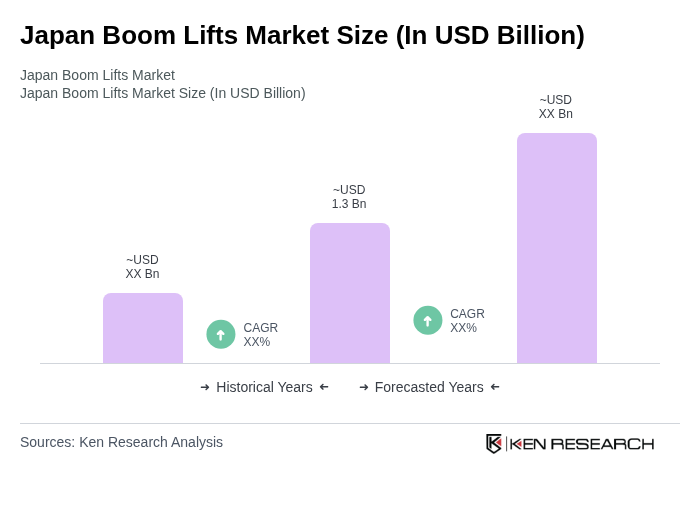
- The Japan Boom Lifts Market is valued at USD 1.3 billion, based on a five-year historical analysis. This growth is primarily driven by the increasing demand for aerial work platforms in construction, maintenance, and industrial applications, alongside expansion of equipment rental services and rising investments in urban infrastructure. The market has seen a surge in investments in infrastructure and urban development, leading to a higher adoption of boom lifts for various tasks, including construction and maintenance of high-rise buildings.
- Key cities such as Tokyo, Osaka, and Yokohama dominate the market due to their extensive construction activities and urbanization. These metropolitan areas are experiencing rapid infrastructure development, which necessitates the use of boom lifts for efficient and safe access to elevated work sites. The concentration of major construction firms and rental companies in these cities further enhances their market dominance.
- The Industrial Safety and Health Act, 1972 amended by the Ministry of Health, Labour and Welfare requires operators of construction equipment including boom lifts to obtain specified skills certifications and mandates annual safety inspections for aerial work platforms exceeding certain load capacities. This regulation covers equipment used in workplaces with fall risks, requiring compliance through certified training programs and periodic third-party verifications to uphold operational safety standards.
Japan Boom Lifts Market Segmentation
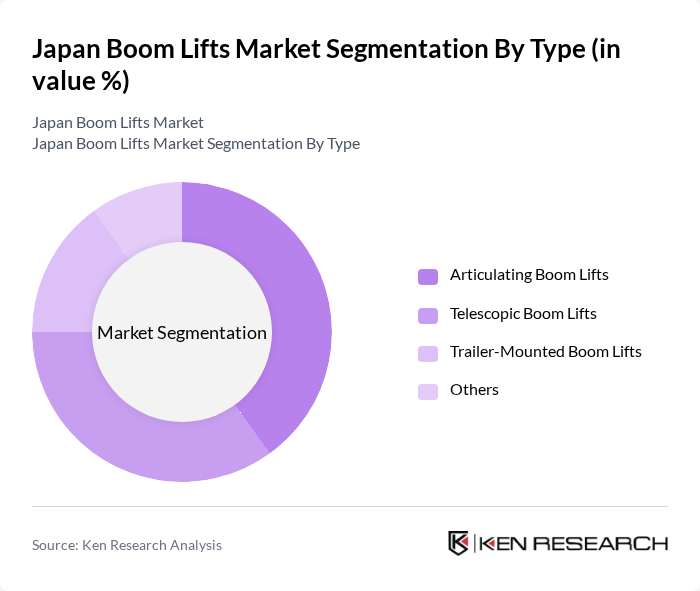
By Type:The market is segmented into various types of boom lifts, including articulating boom lifts, telescopic boom lifts, trailer-mounted boom lifts, and others. Articulating boom lifts are particularly popular due to their versatility and ability to navigate tight spaces, making them ideal for urban construction projects. Telescopic boom lifts are favored for their reach and stability, while trailer-mounted options are preferred for their portability and ease of transport. The demand for these types is influenced by specific project requirements and operational efficiency.
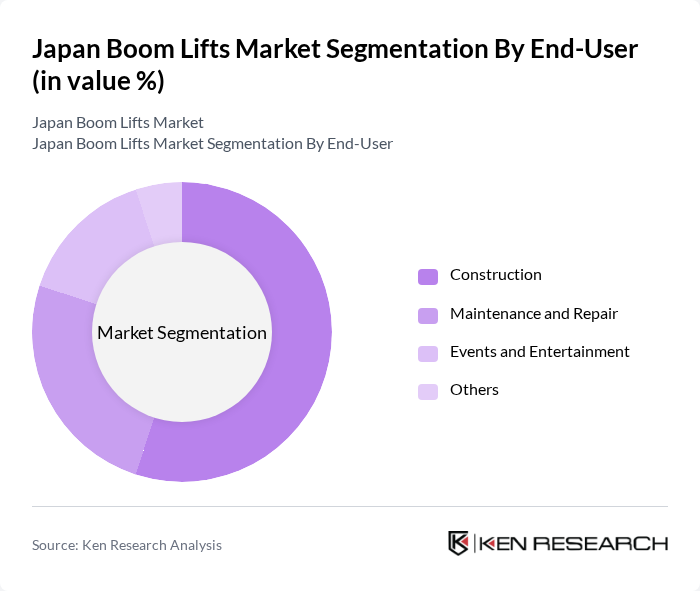
By End-User:The end-user segmentation includes construction, maintenance and repair, events and entertainment, and others. The construction sector is the largest end-user, driven by ongoing infrastructure projects and urban development. Maintenance and repair services also contribute significantly, as boom lifts are essential for accessing hard-to-reach areas for repairs. The events and entertainment sector utilizes boom lifts for staging and lighting setups, showcasing the diverse applications of these machines across various industries.
Japan Boom Lifts Market Competitive Landscape
The Japan Boom Lifts Market is characterized by a dynamic mix of regional and international players. Leading participants such as Toyota Industries Corporation, Komatsu Ltd., Hitachi Construction Machinery Co., Ltd., TADANO Ltd., Aichi Corporation, Genie Industries (Terex Corporation), JLG Industries (a subsidiary of Oshkosh Corporation), Snorkel, Niftylift, Skyjack, Manitou Group, Altec Industries, XCMG Group, SANY Group, JCB contribute to innovation, geographic expansion, and service delivery in this space.
Japan Boom Lifts Market Industry Analysis
Growth Drivers
- Increasing Urbanization:Japan's urban population is projected to reach approximately 92% in the future, according to World Bank data. This rapid urbanization drives the demand for boom lifts, as construction projects in urban areas require efficient aerial work platforms. The government’s focus on developing urban infrastructure, including residential and commercial buildings, further fuels this growth. With urban areas expanding, the need for advanced lifting equipment becomes critical to meet construction timelines and safety standards.
- Rising Construction Activities:The construction sector in Japan is expected to see an investment of around ¥20 trillion (approximately $180 billion) in the future, as reported by the Ministry of Land, Infrastructure, Transport and Tourism. This surge in construction activities, driven by both public and private sector projects, necessitates the use of boom lifts for efficient material handling and worker safety. The ongoing reconstruction efforts following natural disasters also contribute significantly to the demand for these machines.
- Technological Advancements in Equipment:The boom lift market is witnessing significant technological innovations, with advancements in electric and hybrid models. In the future, it is estimated that electric boom lifts will account for 30% of the market, driven by their lower operational costs and environmental benefits. These innovations enhance productivity and safety, making boom lifts more appealing to construction companies. The integration of IoT technology for real-time monitoring and maintenance further supports this growth trend.
Market Challenges
- High Initial Investment Costs:The average cost of a new boom lift in Japan ranges from ¥5 million to ¥15 million ($45,000 to $135,000), which poses a significant barrier for small and medium-sized enterprises. This high initial investment can deter companies from purchasing new equipment, leading to a reliance on older, less efficient models. As a result, many businesses may opt for rental services, which can limit long-term growth in the market for new equipment sales.
- Stringent Safety Regulations:Japan has some of the most rigorous safety regulations in the world, with compliance costs for boom lift operators reaching up to ¥1 million ($9,000) annually. These regulations require regular inspections, operator training, and adherence to safety standards, which can be burdensome for companies. While these regulations are essential for worker safety, they can also slow down the adoption of new technologies and equipment, impacting overall market growth.
Japan Boom Lifts Market Future Outlook
The Japan boom lifts market is poised for significant growth, driven by urbanization and technological advancements. As the construction sector continues to expand, the demand for efficient and safe lifting solutions will increase. Companies are likely to invest in electric and hybrid boom lifts, aligning with sustainability goals. Additionally, the integration of IoT technology will enhance operational efficiency. Overall, the market is expected to adapt to evolving regulations and safety standards while capitalizing on emerging trends in construction and infrastructure development.
Market Opportunities
- Expansion in Rental Services:The rental market for boom lifts is projected to grow significantly, with an estimated value of ¥3 trillion ($27 billion) in the future. This growth is driven by construction companies seeking to minimize capital expenditures while maintaining access to modern equipment. The flexibility and cost-effectiveness of rental services make them an attractive option for many businesses, particularly in fluctuating economic conditions.
- Adoption of Electric Boom Lifts:With increasing environmental awareness, the demand for electric boom lifts is expected to rise, potentially reaching a market share of 30% in the future. These models offer lower emissions and reduced operational costs, appealing to companies focused on sustainability. As regulations become stricter regarding emissions, the shift towards electric boom lifts presents a significant opportunity for manufacturers and rental companies alike.
Scope of the Report
| Segment | Sub-Segments |
|---|---|
| By Type | Articulating Boom Lifts Telescopic Boom Lifts Trailer-Mounted Boom Lifts Others |
| By End-User | Construction Maintenance and Repair Events and Entertainment Others |
| By Application | Indoor Use Outdoor Use Specialized Applications Others |
| By Payload Capacity | Up to 200 kg kg to 400 kg Above 400 kg Others |
| By Drive Type | Electric Diesel Hybrid Others |
| By Region | Kanto Kansai Chubu Others |
| By Rental vs. Purchase | Rental Purchase Others |
Key Target Audience
Investors and Venture Capitalist Firms
Government and Regulatory Bodies (e.g., Ministry of Land, Infrastructure, Transport and Tourism)
Manufacturers and Producers
Distributors and Retailers
Construction and Infrastructure Companies
Rental and Leasing Companies
Industry Associations (e.g., Japan Construction Equipment Manufacturers Association)
Financial Institutions
Players Mentioned in the Report:
Toyota Industries Corporation
Komatsu Ltd.
Hitachi Construction Machinery Co., Ltd.
TADANO Ltd.
Aichi Corporation
Genie Industries (Terex Corporation)
JLG Industries (a subsidiary of Oshkosh Corporation)
Snorkel
Niftylift
Skyjack
Manitou Group
Altec Industries
XCMG Group
SANY Group
JCB
Table of Contents
Market Assessment Phase
1. Executive Summary and Approach
2. Japan Boom Lifts Market Overview
2.1 Key Insights and Strategic Recommendations
2.2 Japan Boom Lifts Market Overview
2.3 Definition and Scope
2.4 Evolution of Market Ecosystem
2.5 Timeline of Key Regulatory Milestones
2.6 Value Chain & Stakeholder Mapping
2.7 Business Cycle Analysis
2.8 Policy & Incentive Landscape
3. Japan Boom Lifts Market Analysis
3.1 Growth Drivers
3.1.1 Increasing Urbanization
3.1.2 Rising Construction Activities
3.1.3 Technological Advancements in Equipment
3.1.4 Government Infrastructure Initiatives
3.2 Market Challenges
3.2.1 High Initial Investment Costs
3.2.2 Stringent Safety Regulations
3.2.3 Limited Skilled Workforce
3.2.4 Economic Fluctuations
3.3 Market Opportunities
3.3.1 Expansion in Rental Services
3.3.2 Adoption of Electric Boom Lifts
3.3.3 Growth in Green Building Projects
3.3.4 Technological Integration with IoT
3.4 Market Trends
3.4.1 Shift Towards Sustainable Equipment
3.4.2 Increasing Demand for Aerial Work Platforms
3.4.3 Focus on Safety and Compliance
3.4.4 Rise of Digital Platforms for Equipment Management
3.5 Government Regulation
3.5.1 Safety Standards Compliance
3.5.2 Environmental Regulations
3.5.3 Licensing Requirements for Operators
3.5.4 Tax Incentives for Green Equipment
4. SWOT Analysis
5. Stakeholder Analysis
6. Porter's Five Forces Analysis
7. Japan Boom Lifts Market Market Size, 2019-2024
7.1 By Value
7.2 By Volume
7.3 By Average Selling Price
8. Japan Boom Lifts Market Segmentation
8.1 By Type
8.1.1 Articulating Boom Lifts
8.1.2 Telescopic Boom Lifts
8.1.3 Trailer-Mounted Boom Lifts
8.1.4 Others
8.2 By End-User
8.2.1 Construction
8.2.2 Maintenance and Repair
8.2.3 Events and Entertainment
8.2.4 Others
8.3 By Application
8.3.1 Indoor Use
8.3.2 Outdoor Use
8.3.3 Specialized Applications
8.3.4 Others
8.4 By Payload Capacity
8.4.1 Up to 200 kg
8.4.2 200 kg to 400 kg
8.4.3 Above 400 kg
8.4.4 Others
8.5 By Drive Type
8.5.1 Electric
8.5.2 Diesel
8.5.3 Hybrid
8.5.4 Others
8.6 By Region
8.6.1 Kanto
8.6.2 Kansai
8.6.3 Chubu
8.6.4 Others
8.7 By Rental vs. Purchase
8.7.1 Rental
8.7.2 Purchase
8.7.3 Others
9. Japan Boom Lifts Market Competitive Analysis
9.1 Market Share of Key Players
9.2 Cross Comparison of Key Players
9.2.1 Company Name
9.2.2 Group Size (Large, Medium, or Small as per industry convention)
9.2.3 Revenue Growth Rate
9.2.4 Market Penetration Rate
9.2.5 Customer Retention Rate
9.2.6 Pricing Strategy
9.2.7 Product Diversification Index
9.2.8 Operational Efficiency Ratio
9.2.9 Brand Recognition Score
9.2.10 Customer Satisfaction Index
9.3 SWOT Analysis of Top Players
9.4 Pricing Analysis
9.5 Detailed Profile of Major Companies
9.5.1 Toyota Industries Corporation
9.5.2 Komatsu Ltd.
9.5.3 Hitachi Construction Machinery Co., Ltd.
9.5.4 TADANO Ltd.
9.5.5 Aichi Corporation
9.5.6 Genie Industries (Terex Corporation)
9.5.7 JLG Industries (a subsidiary of Oshkosh Corporation)
9.5.8 Snorkel
9.5.9 Niftylift
9.5.10 Skyjack
9.5.11 Manitou Group
9.5.12 Altec Industries
9.5.13 XCMG Group
9.5.14 SANY Group
9.5.15 JCB
10. Japan Boom Lifts Market End-User Analysis
10.1 Procurement Behavior of Key Ministries
10.1.1 Ministry of Land, Infrastructure, Transport and Tourism
10.1.2 Ministry of Economy, Trade and Industry
10.1.3 Ministry of the Environment
10.1.4 Others
10.2 Corporate Spend on Infrastructure & Energy
10.2.1 Construction Sector Spending
10.2.2 Industrial Sector Investments
10.2.3 Government Infrastructure Projects
10.2.4 Others
10.3 Pain Point Analysis by End-User Category
10.3.1 Construction Companies
10.3.2 Maintenance Providers
10.3.3 Event Organizers
10.3.4 Others
10.4 User Readiness for Adoption
10.4.1 Awareness of Boom Lift Benefits
10.4.2 Training and Certification Availability
10.4.3 Financial Readiness
10.4.4 Others
10.5 Post-Deployment ROI and Use Case Expansion
10.5.1 Efficiency Gains
10.5.2 Cost Savings
10.5.3 Expanded Service Offerings
10.5.4 Others
11. Japan Boom Lifts Market Future Size, 2025-2030
11.1 By Value
11.2 By Volume
11.3 By Average Selling Price
Go-To-Market Strategy Phase
1. Whitespace Analysis + Business Model Canvas
1.1 Market Gaps Identification
1.2 Business Model Development
2. Marketing and Positioning Recommendations
2.1 Branding Strategies
2.2 Product USPs
3. Distribution Plan
3.1 Urban Retail Strategies
3.2 Rural NGO Tie-ups
4. Channel & Pricing Gaps
4.1 Underserved Routes
4.2 Pricing Bands Analysis
5. Unmet Demand & Latent Needs
5.1 Category Gaps
5.2 Consumer Segments
6. Customer Relationship
6.1 Loyalty Programs
6.2 After-sales Service
7. Value Proposition
7.1 Sustainability Initiatives
7.2 Integrated Supply Chains
8. Key Activities
8.1 Regulatory Compliance
8.2 Branding Efforts
8.3 Distribution Setup
9. Entry Strategy Evaluation
9.1 Domestic Market Entry Strategy
9.1.1 Product Mix Considerations
9.1.2 Pricing Band Strategy
9.1.3 Packaging Options
9.2 Export Entry Strategy
9.2.1 Target Countries Identification
9.2.2 Compliance Roadmap Development
10. Entry Mode Assessment
10.1 Joint Ventures
10.2 Greenfield Investments
10.3 Mergers & Acquisitions
10.4 Distributor Model
11. Capital and Timeline Estimation
11.1 Capital Requirements
11.2 Timelines for Implementation
12. Control vs Risk Trade-Off
12.1 Ownership Considerations
12.2 Partnerships Evaluation
13. Profitability Outlook
13.1 Breakeven Analysis
13.2 Long-term Sustainability Strategies
14. Potential Partner List
14.1 Distributors
14.2 Joint Ventures
14.3 Acquisition Targets
15. Execution Roadmap
15.1 Phased Plan for Market Entry
15.1.1 Market Setup
15.1.2 Market Entry
15.1.3 Growth Acceleration
15.1.4 Scale & Stabilize
15.2 Key Activities and Milestones
15.2.1 Milestone Planning
15.2.2 Activity Tracking
Research Methodology
Phase 1: Approach1
Desk Research
- Industry reports from Japanese construction and equipment associations
- Market analysis publications focusing on boom lift technologies and trends
- Government publications on infrastructure development and investment in Japan
Primary Research
- Interviews with key stakeholders in the construction and rental sectors
- Surveys targeting equipment operators and maintenance professionals
- Field visits to construction sites utilizing boom lifts for firsthand insights
Validation & Triangulation
- Cross-validation of data from multiple industry sources and reports
- Triangulation of findings from primary interviews and secondary data
- Sanity checks through expert panel discussions with industry veterans
Phase 2: Market Size Estimation1
Top-down Assessment
- Analysis of Japan's overall construction market size and growth rates
- Segmentation of boom lift usage by construction type and project scale
- Incorporation of government infrastructure spending forecasts
Bottom-up Modeling
- Estimation of rental rates and sales volumes from leading boom lift manufacturers
- Operational cost analysis based on maintenance and service requirements
- Volume x pricing model to determine revenue potential across segments
Forecasting & Scenario Analysis
- Multi-factor regression analysis incorporating economic indicators and construction trends
- Scenario modeling based on potential regulatory changes and technological advancements
- Baseline, optimistic, and pessimistic forecasts through 2030
Phase 3: CATI Sample Composition1
| Scope Item/Segment | Sample Size | Target Respondent Profiles |
|---|---|---|
| Construction Project Managers | 100 | Project Managers, Site Supervisors |
| Equipment Rental Companies | 80 | Rental Managers, Business Development Executives |
| Manufacturers of Boom Lifts | 45 | Product Managers, Sales Directors |
| Construction Safety Officers | 50 | Safety Managers, Compliance Officers |
| Maintenance and Repair Services | 70 | Service Technicians, Operations Managers |
Frequently Asked Questions
What is the current value of the Japan Boom Lifts Market?
The Japan Boom Lifts Market is valued at approximately USD 1.3 billion, driven by increasing demand for aerial work platforms in construction, maintenance, and industrial applications, along with significant investments in urban infrastructure and equipment rental services.
Which cities are the primary markets for boom lifts in Japan?
What types of boom lifts are available in the Japan market?
What are the main end-user segments for boom lifts in Japan?
Other Regional/Country Reports
Indonesia Boom Lifts Market Report
KSA Boom Lifts Market Report
APAC Boom Lifts Market Report
SEA Boom Lifts Market Report
Other Adjacent Reports
Kuwait Aerial Work Platforms Market
Kuwait Scissor Lifts Market
APAC mobile cranes market size, share, growth drivers, trends, opportunities & forecast 2025–2030Belgium Forklifts Market
Thailand Material Handling Equipment Market
Philippines Equipment Rental Market
Indonesia Telescopic Handlers Market
Bahrain Industrial Maintenance Equipment Market
Germany Urban Infrastructure Equipment Market
Why Buy From Us?

What makes us stand out is that our consultants follow Robust, Refine and Result (RRR) methodology. Robust for clear definitions, approaches and sanity checking, Refine for differentiating respondents' facts and opinions, and Result for presenting data with story.

We have set a benchmark in the industry by offering our clients with syndicated and customized market research reports featuring coverage of entire market as well as meticulous research and analyst insights.

While we don't replace traditional research, we flip the method upside down. Our dual approach of Top Bottom & Bottom Top ensures quality deliverable by not just verifying company fundamentals but also looking at the sector and macroeconomic factors.

With one step in the future, our research team constantly tries to show you the bigger picture. We help with some of the tough questions you may encounter along the way: How is the industry positioned? Best marketing channel? KPI's of competitors? By aligning every element, we help maximize success.

Our report gives you instant access to the answers and sources that other companies might choose to hide. We elaborate each steps of research methodology we have used and showcase you the sample size to earn your trust.

If you need any support, we are here! We pride ourselves on universe strength, data quality, and quick, friendly, and professional service.