About the Report
Base Year 2024Japan Dynamic Random Access Memory Market Overview
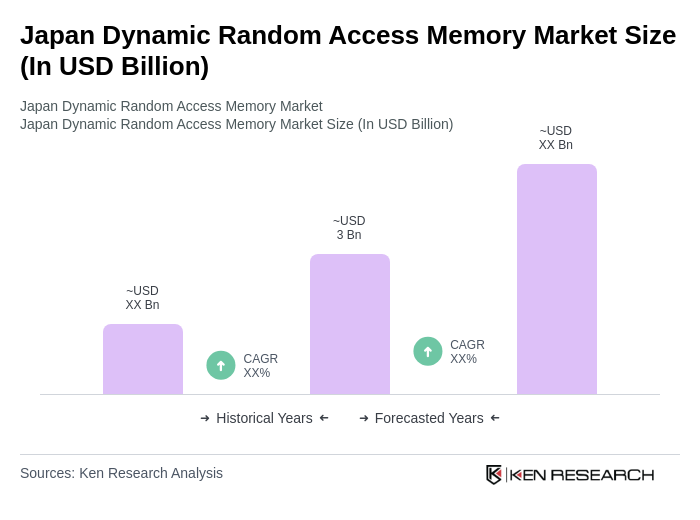
- The Japan Dynamic Random Access Memory market is valued at USD 3 billion, based on a five-year historical analysis. This growth is primarily driven by increasing demand for high-performance computing, mobile innovation, and expanding data center deployments, consistent with broader DRAM demand drivers in Asia-Pacific and Japan’s electronics ecosystem.
- Key cities such as Tokyo, Osaka, and Yokohama dominate the Japan Dynamic Random Access Memory market due to their robust technological infrastructure and concentration of major electronics and semiconductor-related companies, R&D centers, and downstream OEMs, reinforcing the role of metropolitan clusters in Japan’s semiconductor value chain.
- In 2023, the Japanese government advanced measures to promote domestic semiconductor manufacturing via large-scale subsidies for cutting-edge memory and logic projects to strengthen supply security and competitiveness. Support packages—spanning multiple billions of US dollars across programs and recipients—were directed to expand domestic capacity (including advanced memory and related ecosystems), reduce foreign dependency, and reinforce Japan’s role in global semiconductors.
Japan Dynamic Random Access Memory Market Segmentation
By Type:
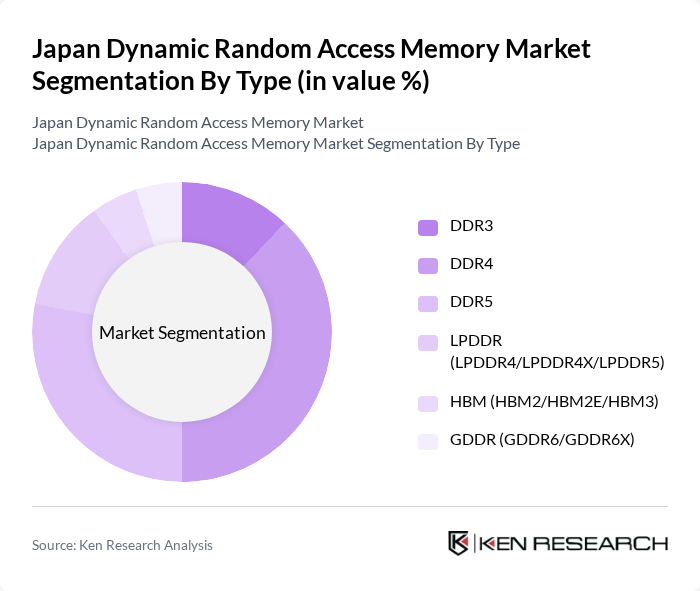
The Japan Dynamic Random Access Memory market is significantly influenced by the DDR4 and DDR5 segments, which are dominating due to their widespread adoption in consumer PCs/PC OEM channels and data centers, with DDR5 rapidly gaining share as platform transitions by CPU vendors accelerate. DDR4 remains prevalent for cost/performance, while DDR5 adoption is buoyed by higher bandwidth/efficiency benefits, and AI/gaming workloads further drive higher?end memory, including HBM and GDDR, albeit from a smaller base.
By End-User:
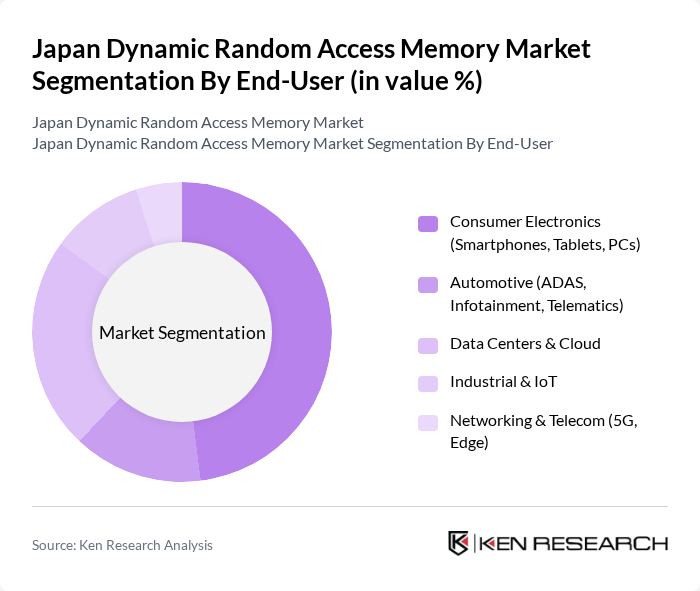
The consumer electronics segment is the largest end-user of dynamic random access memory in Japan, reflecting robust demand for smartphones, tablets, and PCs, while data centers increasingly adopt higher-density DRAM for cloud and AI workloads. The automotive sector is an emerging user with growing DRAM needs for ADAS, infotainment, and domain/zone controllers, supported by Japan’s strong auto OEM/ Tier?1 base.
Japan Dynamic Random Access Memory Market Competitive Landscape
The Japan Dynamic Random Access Memory market is characterized by a dynamic mix of regional and international players. Leading participants such as Samsung Electronics Co., Ltd., SK hynix Inc., Micron Technology, Inc. (incl. Micron Memory Japan K.K.), Nanya Technology Corporation, Winbond Electronics Corporation, Elpida Memory, Inc. (now Micron Memory Japan), Kioxia Holdings Corporation, Renesas Electronics Corporation, Rohm Co., Ltd. (ROHM Semiconductor), Socionext Inc., Fujitsu Limited, Infineon Technologies AG, STMicroelectronics N.V., Texas Instruments Incorporated, Alliance Memory, Inc. contribute to innovation, geographic expansion, and service delivery in this space.
Japan Dynamic Random Access Memory Market Industry Analysis
Growth Drivers
- Increasing Demand for High-Performance Computing:The Japanese market for high-performance computing (HPC) is projected to reach ¥1.2 trillion in the future, driven by sectors such as finance, healthcare, and research. The need for faster data processing and analysis is pushing organizations to invest in advanced DRAM solutions. According to the Ministry of Internal Affairs and Communications, Japan's HPC market is expected to grow at a rate of 8% annually, highlighting the critical role of DRAM in meeting these demands.
- Growth in Mobile Device Usage:Japan's mobile device market is anticipated to exceed 200 million units in the future, with smartphones accounting for a significant share. The increasing reliance on mobile applications and services necessitates higher memory capacities, driving demand for DRAM. The Japan Electronics and Information Technology Industries Association reported that mobile data traffic is expected to grow by 30% annually, further emphasizing the need for efficient and high-capacity memory solutions in mobile devices.
- Expansion of Data Centers:The number of data centers in Japan is projected to increase by 15% in the future, fueled by the rising demand for cloud services and big data analytics. This expansion is expected to require an additional 1.5 million terabytes of DRAM to support the growing data processing needs. According to the Japan Data Center Council, investments in data center infrastructure are expected to reach ¥500 billion, significantly boosting the DRAM market as data centers seek to enhance their performance and efficiency.
Market Challenges
- Supply Chain Disruptions:The Japanese DRAM market faces significant challenges due to ongoing supply chain disruptions, particularly in semiconductor manufacturing. The global semiconductor shortage has led to delays and increased lead times, with some manufacturers reporting a 20% reduction in output capacity. According to the Japan Semiconductor Manufacturing Association, these disruptions could hinder the timely delivery of DRAM products, impacting overall market growth and customer satisfaction.
- Intense Competition Among Manufacturers:The competitive landscape in Japan's DRAM market is characterized by fierce rivalry among major players, including Samsung, SK Hynix, and Micron. This competition has led to aggressive pricing strategies, with some manufacturers reducing prices by up to 15% to gain market share. The Japan Electronics and Information Technology Industries Association indicates that this price war could squeeze profit margins, making it challenging for smaller manufacturers to sustain operations and invest in innovation.
Japan Dynamic Random Access Memory Market Future Outlook
The future of the Japan DRAM market appears promising, driven by technological advancements and increasing demand across various sectors. The integration of DRAM in AI applications is expected to enhance processing capabilities, while the development of 5G technology will further boost data transmission speeds. Additionally, the focus on energy-efficient memory solutions aligns with global sustainability trends, positioning the Japanese DRAM market for growth. As manufacturers adapt to these trends, they will likely explore innovative solutions to meet evolving consumer needs.
Market Opportunities
- Rising Adoption of Cloud Computing:The cloud computing market in Japan is projected to reach ¥3 trillion in the future, creating significant opportunities for DRAM manufacturers. As businesses increasingly migrate to cloud-based solutions, the demand for high-capacity memory to support data storage and processing will rise, providing a lucrative avenue for growth in the DRAM sector.
- Growth in Automotive Electronics:The automotive electronics market in Japan is expected to grow to ¥4 trillion in the future, driven by advancements in electric and autonomous vehicles. This growth presents an opportunity for DRAM manufacturers to supply memory solutions for advanced driver-assistance systems (ADAS) and infotainment systems, enhancing vehicle performance and safety features.
Scope of the Report
| Segment | Sub-Segments |
|---|---|
| By Type | DDR3 DDR4 DDR5 LPDDR (LPDDR4/LPDDR4X/LPDDR5) HBM (HBM2/HBM2E/HBM3) GDDR (GDDR6/GDDR6X) |
| By End-User | Consumer Electronics (Smartphones, Tablets, PCs) Automotive (ADAS, Infotainment, Telematics) Data Centers & Cloud Industrial & IoT Networking & Telecom (5G, Edge) |
| By Application | Mobile Devices Personal Computers & Laptops Servers & Enterprise Storage Gaming Consoles & Graphics Automotive Electronics |
| By Distribution Channel | Direct Sales (OEM/ODM) Authorized Distributors Online B2B Platforms Retail/Aftermarket |
| By Price Range | Value Tier (Commodity DRAM) Performance Tier (Mainstream DDR/LPDDR) Premium Tier (HBM/GDDR/High-capacity ECC) |
| By Technology | DDR4 DDR5 LPDDR4/LPDDR5 HBM2E/HBM3 |
| By Region | Kanto Kansai Chubu Kyushu (incl. Kumamoto) |
Key Target Audience
Investors and Venture Capitalist Firms
Government and Regulatory Bodies (e.g., Ministry of Economy, Trade and Industry, Japan Fair Trade Commission)
Manufacturers and Producers
Distributors and Retailers
Technology Providers
Industry Associations (e.g., Japan Electronics and Information Technology Industries Association)
Financial Institutions
Telecommunications Companies
Players Mentioned in the Report:
Samsung Electronics Co., Ltd.
SK hynix Inc.
Micron Technology, Inc. (incl. Micron Memory Japan K.K.)
Nanya Technology Corporation
Winbond Electronics Corporation
Elpida Memory, Inc. (now Micron Memory Japan)
Kioxia Holdings Corporation
Renesas Electronics Corporation
Rohm Co., Ltd. (ROHM Semiconductor)
Socionext Inc.
Fujitsu Limited
Infineon Technologies AG
STMicroelectronics N.V.
Texas Instruments Incorporated
Alliance Memory, Inc.
Table of Contents
Market Assessment Phase
1. Executive Summary and Approach
2. Japan Dynamic Random Access Memory Market Overview
2.1 Key Insights and Strategic Recommendations
2.2 Japan Dynamic Random Access Memory Market Overview
2.3 Definition and Scope
2.4 Evolution of Market Ecosystem
2.5 Timeline of Key Regulatory Milestones
2.6 Value Chain & Stakeholder Mapping
2.7 Business Cycle Analysis
2.8 Policy & Incentive Landscape
3. Japan Dynamic Random Access Memory Market Analysis
3.1 Growth Drivers
3.1.1 Increasing demand for high-performance computing
3.1.2 Growth in mobile device usage
3.1.3 Expansion of data centers
3.1.4 Advancements in AI and machine learning technologies
3.2 Market Challenges
3.2.1 Supply chain disruptions
3.2.2 Intense competition among manufacturers
3.2.3 Rapid technological changes
3.2.4 Price volatility of raw materials
3.3 Market Opportunities
3.3.1 Rising adoption of cloud computing
3.3.2 Increasing investment in IoT devices
3.3.3 Growth in automotive electronics
3.3.4 Expansion into emerging markets
3.4 Market Trends
3.4.1 Shift towards energy-efficient memory solutions
3.4.2 Integration of DRAM in AI applications
3.4.3 Development of 5G technology
3.4.4 Focus on sustainability in manufacturing
3.5 Government Regulation
3.5.1 Compliance with environmental standards
3.5.2 Import/export regulations on semiconductor materials
3.5.3 Incentives for R&D in semiconductor technology
3.5.4 Regulations on data privacy affecting memory usage
4. SWOT Analysis
5. Stakeholder Analysis
6. Porter's Five Forces Analysis
7. Japan Dynamic Random Access Memory Market Market Size, 2019-2024
7.1 By Value
7.2 By Volume
7.3 By Average Selling Price
8. Japan Dynamic Random Access Memory Market Segmentation
8.1 By Type
8.1.1 DDR3
8.1.2 DDR4
8.1.3 DDR5
8.1.4 LPDDR (LPDDR4/LPDDR4X/LPDDR5)
8.1.5 HBM (HBM2/HBM2E/HBM3)
8.1.6 GDDR (GDDR6/GDDR6X)
8.2 By End-User
8.2.1 Consumer Electronics (Smartphones, Tablets, PCs)
8.2.2 Automotive (ADAS, Infotainment, Telematics)
8.2.3 Data Centers & Cloud
8.2.4 Industrial & IoT
8.2.5 Networking & Telecom (5G, Edge)
8.3 By Application
8.3.1 Mobile Devices
8.3.2 Personal Computers & Laptops
8.3.3 Servers & Enterprise Storage
8.3.4 Gaming Consoles & Graphics
8.3.5 Automotive Electronics
8.4 By Distribution Channel
8.4.1 Direct Sales (OEM/ODM)
8.4.2 Authorized Distributors
8.4.3 Online B2B Platforms
8.4.4 Retail/Aftermarket
8.5 By Price Range
8.5.1 Value Tier (Commodity DRAM)
8.5.2 Performance Tier (Mainstream DDR/LPDDR)
8.5.3 Premium Tier (HBM/GDDR/High-capacity ECC)
8.6 By Technology
8.6.1 DDR4
8.6.2 DDR5
8.6.3 LPDDR4/LPDDR5
8.6.4 HBM2E/HBM3
8.7 By Region
8.7.1 Kanto
8.7.2 Kansai
8.7.3 Chubu
8.7.4 Kyushu (incl. Kumamoto)
9. Japan Dynamic Random Access Memory Market Competitive Analysis
9.1 Market Share of Key Players
9.2 Cross Comparison of Key Players
9.2.1 Company Name (Japan market participation)
9.2.2 Group Size (Global scale: Large/Medium/Small)
9.2.3 Japan DRAM Revenue and Growth (YoY)
9.2.4 Japan Market Share (%) by Application (Mobile/PC/Server/Auto)
9.2.5 ASP Trend in Japan (DDR4/DDR5/LPDDR/HBM)
9.2.6 Production Capacity/Allocation for Japan (Gb/month or % of output)
9.2.7 Wafer Node/Technology Mix (1?/1?/1?; TSV for HBM)
9.2.8 R&D Intensity (R&D as % of revenue; DDR5/HBM roadmap)
9.2.9 Supply Chain & Localization (local disti, JIT lead times, inventory turns)
9.2.10 Design Wins in Japan (OEM/ODM, auto-grade AEC?Q100)
9.2.11 Channel Mix in Japan (direct vs distributor %)
9.2.12 Quality/Reliability Metrics (RMA rate, FIT, JEDEC/AEC compliance)
9.3 SWOT Analysis of Top Players
9.4 Pricing Analysis
9.5 Detailed Profile of Major Companies
9.5.1 Samsung Electronics Co., Ltd.
9.5.2 SK hynix Inc.
9.5.3 Micron Technology, Inc. (incl. Micron Memory Japan K.K.)
9.5.4 Nanya Technology Corporation
9.5.5 Winbond Electronics Corporation
9.5.6 Elpida Memory, Inc. (now Micron Memory Japan)
9.5.7 Kioxia Holdings Corporation
9.5.8 Renesas Electronics Corporation
9.5.9 Rohm Co., Ltd. (ROHM Semiconductor)
9.5.10 Socionext Inc.
9.5.11 Fujitsu Limited
9.5.12 Infineon Technologies AG
9.5.13 STMicroelectronics N.V.
9.5.14 Texas Instruments Incorporated
9.5.15 Alliance Memory, Inc.
10. Japan Dynamic Random Access Memory Market End-User Analysis
10.1 Procurement Behavior of Key Ministries
10.1.1 Government contracts for technology procurement
10.1.2 Budget allocation for IT infrastructure
10.1.3 Evaluation criteria for suppliers
10.2 Corporate Spend on Infrastructure & Energy
10.2.1 Investment in data center upgrades
10.2.2 Spending on energy-efficient technologies
10.2.3 Budget for R&D in memory technologies
10.3 Pain Point Analysis by End-User Category
10.3.1 Performance bottlenecks in existing systems
10.3.2 Cost constraints in procurement
10.3.3 Need for faster data processing
10.4 User Readiness for Adoption
10.4.1 Awareness of new memory technologies
10.4.2 Training and support requirements
10.4.3 Integration challenges with existing systems
10.5 Post-Deployment ROI and Use Case Expansion
10.5.1 Metrics for measuring ROI
10.5.2 Case studies of successful deployments
10.5.3 Opportunities for scaling solutions
11. Japan Dynamic Random Access Memory Market Future Size, 2025-2030
11.1 By Value
11.2 By Volume
11.3 By Average Selling Price
Go-To-Market Strategy Phase
1. Whitespace Analysis + Business Model Canvas
1.1
2. Marketing and Positioning Recommendations
2.1
3. Distribution Plan
3.1
4. Channel & Pricing Gaps
4.1
5. Unmet Demand & Latent Needs
5.1
6. Customer Relationship
7.1
7. Value Proposition
8.1
8. Key Activities
9.1
9. Entry Strategy Evaluation
9.1 Domestic Market Entry Strategy
10.1.1
9.2 Export Entry Strategy
10.2.1
10. Entry Mode Assessment
11.1
11. Capital and Timeline Estimation
12.1
12. Control vs Risk Trade-Off
13.1
13. Profitability Outlook
14.1
14. Potential Partner List
15.1
15. Execution Roadmap
15.1 Phased Plan for Market Entry
16.1.1
15.2 Key Activities and Milestones
16.2.1
Research Methodology
Phase 1: Approach1
Desk Research
- Analysis of industry reports from Japanese semiconductor associations and market research firms
- Review of government publications and trade statistics related to DRAM production and consumption
- Examination of academic journals and white papers focusing on technological advancements in DRAM technology
Primary Research
- Interviews with key stakeholders in the semiconductor industry, including manufacturers and suppliers
- Surveys targeting R&D managers and product development teams within leading DRAM companies
- Field interviews with industry analysts and market experts to gather insights on market trends
Validation & Triangulation
- Cross-validation of data through multiple sources, including trade publications and financial reports
- Triangulation of findings from primary interviews with secondary data to ensure consistency
- Sanity checks conducted through expert panel reviews to validate market assumptions and forecasts
Phase 2: Market Size Estimation1
Top-down Assessment
- Estimation of total market size based on national semiconductor sales and export data
- Segmentation of the market by application areas such as consumer electronics, automotive, and data centers
- Incorporation of macroeconomic indicators and technology adoption rates in Japan
Bottom-up Modeling
- Collection of sales data from leading DRAM manufacturers to establish baseline volumes
- Analysis of pricing trends and cost structures within the DRAM supply chain
- Volume x price calculations to derive revenue estimates for different market segments
Forecasting & Scenario Analysis
- Utilization of time-series analysis to project future market growth based on historical data
- Scenario modeling based on potential shifts in technology, consumer demand, and global supply chain dynamics
- Development of baseline, optimistic, and pessimistic forecasts through 2030
Phase 3: CATI Sample Composition1
| Scope Item/Segment | Sample Size | Target Respondent Profiles |
|---|---|---|
| Consumer Electronics Manufacturers | 100 | Product Managers, Supply Chain Analysts |
| Automotive DRAM Applications | 75 | Engineering Managers, Procurement Specialists |
| Data Center Operators | 90 | IT Managers, Operations Directors |
| Research Institutions and Universities | 50 | Academic Researchers, Technology Analysts |
| Government Regulatory Bodies | 40 | Policy Makers, Industry Regulators |
Frequently Asked Questions
What is the current value of the Japan Dynamic Random Access Memory market?
The Japan Dynamic Random Access Memory market is valued at approximately USD 3 billion, reflecting a five-year historical analysis. This growth is driven by increasing demand for high-performance computing, mobile innovation, and expanding data center deployments.
Which cities are key players in the Japan Dynamic Random Access Memory market?
What measures is the Japanese government taking to support semiconductor manufacturing?
What types of DRAM are most prevalent in the Japan market?
Other Regional/Country Reports
Indonesia Dynamic Random Access Memory Market
Malaysia Dynamic Random Access Memory Market
KSA Dynamic Random Access Memory Market
APAC Dynamic Random Access Memory Market
SEA Dynamic Random Access Memory Market
Why Buy From Us?

What makes us stand out is that our consultants follow Robust, Refine and Result (RRR) methodology. Robust for clear definitions, approaches and sanity checking, Refine for differentiating respondents' facts and opinions, and Result for presenting data with story.

We have set a benchmark in the industry by offering our clients with syndicated and customized market research reports featuring coverage of entire market as well as meticulous research and analyst insights.

While we don't replace traditional research, we flip the method upside down. Our dual approach of Top Bottom & Bottom Top ensures quality deliverable by not just verifying company fundamentals but also looking at the sector and macroeconomic factors.

With one step in the future, our research team constantly tries to show you the bigger picture. We help with some of the tough questions you may encounter along the way: How is the industry positioned? Best marketing channel? KPI's of competitors? By aligning every element, we help maximize success.

Our report gives you instant access to the answers and sources that other companies might choose to hide. We elaborate each steps of research methodology we have used and showcase you the sample size to earn your trust.

If you need any support, we are here! We pride ourselves on universe strength, data quality, and quick, friendly, and professional service.