About the Report
Base Year 2024Japan Satellite Communication Market Overview
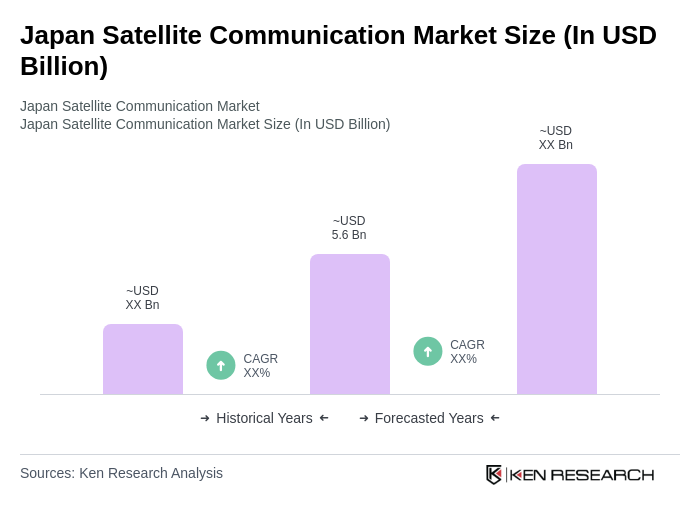
- The Japan Satellite Communication Market is valued at USD 5.6 billion, based on a five-year historical analysis. This growth is primarily driven by increasing demand for high-speed connectivity, expansion of mobile broadband and enterprise networks into remote areas, and advancements such as HTS/Ka-band, software-defined payloads, and LEO–GEO multi-orbit services. The market is also supported by government programs to harden national communications, space policy priorities, and use of satellites in disaster resilience and emergency communications.
- Tokyo and Osaka are the dominant cities in the Japan Satellite Communication Market due to their roles as major economic and technology hubs hosting leading operators, integrators, equipment vendors, and research institutions, which concentrate investment and innovation in satellite platforms and services. High population density and enterprise concentration in these metropolitan areas sustain demand for broadcast, backhaul, and mobility connectivity, reinforcing market leadership.
- The Japanese government has implemented regulations and policies promoting satellite communications for disaster management and emergency response, with frameworks that enable public–private collaboration to maintain critical connectivity during earthquakes, tsunamis, and other natural hazards. Initiatives span use of MSS, satellite phones, and satcom backhaul for public safety and continuity of operations.
Japan Satellite Communication Market Segmentation
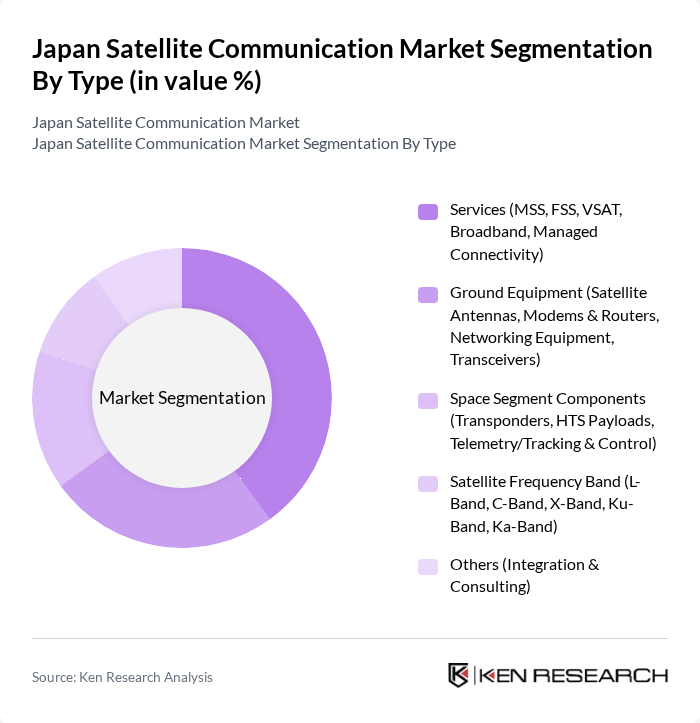
By Type:The market is segmented into various types, including services, ground equipment, space segment components, satellite frequency bands, and others. Each of these segments plays a crucial role in the overall functionality and efficiency of satellite communication systems.
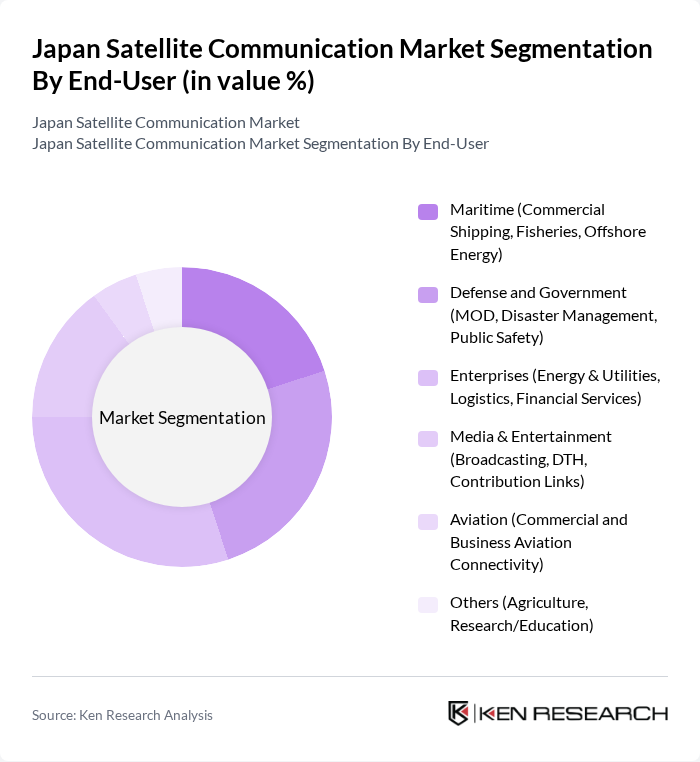
By End-User:The end-user segmentation includes various sectors such as maritime, defense and government, enterprises, media and entertainment, aviation, and others. Each sector utilizes satellite communication for different applications, contributing to the overall market growth.
Japan Satellite Communication Market Competitive Landscape
The Japan Satellite Communication Market is characterized by a dynamic mix of regional and international players. Leading participants such as SKY Perfect JSAT Corporation, NEC Corporation, KDDI Corporation, SoftBank Corp., NTT DOCOMO, Inc., Mitsubishi Electric Corporation, Fujitsu Limited, Panasonic Avionics Corporation, Intelsat, SES, Eutelsat Group, Inmarsat (a Viasat company), Viasat, Inc., Telesat, and Iridium Communications Inc. contribute to innovation, geographic expansion, and service delivery in this space.
Japan Satellite Communication Market Industry Analysis
Growth Drivers
- Increasing Demand for Broadband Connectivity:The demand for broadband connectivity in Japan is projected to reach 45 million subscriptions in future, driven by the need for high-speed internet in urban and rural areas. The Japanese government aims to achieve universal broadband access, with investments exceeding USD 9 billion in infrastructure development. This push is further supported by the rising number of remote workers, which has increased internet usage by 30% in the last two years, highlighting the critical role of satellite communication in bridging connectivity gaps.
- Expansion of IoT Applications:The Internet of Things (IoT) market in Japan is expected to grow to USD 31.5 billion in future, with satellite communication playing a vital role in connecting devices in remote locations. The increasing adoption of smart agriculture, smart cities, and industrial IoT applications necessitates reliable communication networks. Over 1.2 billion IoT devices are operational in Japan, with satellite technology providing essential connectivity for these devices, particularly in areas lacking terrestrial infrastructure.
- Government Initiatives for Satellite Technology:The Japanese government has committed USD 5.4 billion to enhance satellite technology and infrastructure in future. This includes funding for research and development in satellite communications, aiming to improve capabilities and reduce costs. The government’s national space strategy emphasizes the importance of satellite technology for national security and disaster management, which is expected to drive further investments and innovations in the satellite communication sector, fostering a robust market environment.
Market Challenges
- High Operational Costs:The operational costs associated with satellite communication in Japan are significant, with estimates reaching USD 1.8 billion annually for maintenance and deployment. Additionally, the capital-intensive nature of satellite launches, averaging USD 270 million per launch, poses a financial barrier, making it challenging for companies to achieve profitability in a competitive market.
- Regulatory Hurdles:Navigating the regulatory landscape in Japan presents challenges for satellite communication providers. The Ministry of Internal Affairs and Communications imposes licensing requirements for radio stations and satellite services; specific average approval times for new satellite operators could not be confirmed. Compliance with international treaties, such as the Outer Space Treaty, adds complexity to operations. These regulatory hurdles can delay market entry and increase operational uncertainty, impacting the overall growth of the satellite communication sector.
Japan Satellite Communication Market Future Outlook
The future of the satellite communication market in Japan appears promising, driven by technological advancements and increasing demand for connectivity. The shift towards low Earth orbit (LEO) satellites is expected to enhance service delivery and reduce latency, making satellite communication more competitive with terrestrial options. Additionally, the integration of artificial intelligence in satellite operations will optimize resource management and improve data analytics, further enhancing service offerings and operational efficiency in the coming years.
Market Opportunities
- Growth in Remote Area Connectivity:There is a significant opportunity to expand satellite communication services in Japan's remote areas, where traditional infrastructure is lacking. With over 3 million residents in rural regions lacking reliable internet access, satellite solutions can bridge this gap, providing essential services and enhancing quality of life. This market segment is projected to grow as demand for connectivity increases, particularly in education and healthcare sectors.
- Advancements in Satellite Technology:Continuous advancements in satellite technology, such as miniaturization and improved propulsion systems, present opportunities for cost-effective satellite deployment. Innovations like reusable launch vehicles can reduce launch costs by up to 50%, making it feasible for new players to enter the market. This technological evolution will likely stimulate competition and drive down prices, benefiting consumers and businesses alike in Japan's satellite communication landscape.
Scope of the Report
| Segment | Sub-Segments |
|---|---|
| By Type | Services (MSS, FSS, VSAT, Broadband, Managed Connectivity) Ground Equipment (Satellite Antennas, Modems & Routers, Networking Equipment, Transceivers) Space Segment Components (Transponders, HTS Payloads, Telemetry/Tracking & Control) Satellite Frequency Band (L-Band, C-Band, X-Band, Ku-Band, Ka-Band) Others (Integration & Consulting) |
| By End-User | Maritime (Commercial Shipping, Fisheries, Offshore Energy) Defense and Government (MOD, Disaster Management, Public Safety) Enterprises (Energy & Utilities, Logistics, Financial Services) Media & Entertainment (Broadcasting, DTH, Contribution Links) Aviation (Commercial and Business Aviation Connectivity) Others (Agriculture, Research/Education) |
| By Application | Broadband & Backhaul (HTS/LEO backhaul, Rural connectivity) Mobility Services (Maritime, Aero, Land-mobile) Enterprise Data & IoT (M2M, Asset tracking, SCADA) Broadcast & Media (DTH, Occasional Use, Contribution/Distribution) Government & Defense Communications (Secure voice/data, ISR support) Others (Emergency/Disaster Recovery, Telemedicine, Education) |
| By Service Type | Capacity Leasing (FSS, HTS, Managed Capacity) Mobile Satellite Services (Voice, Data, Push-to-Talk) VSAT Services (Corporate networks, Maritime VSAT, Aero IFC) Earth Observation & Data Services (EO downlink, Data distribution) Managed Services & Integration (SLA-backed end-to-end) |
| By Distribution Channel | Direct (Operators to Enterprise/Government) Service Providers/ISPs & System Integrators Channel Partners/Resellers (Maritime/Aero specialists) Online & Self-Service Portals |
| By Pricing Model | Subscription/Commitment (Monthly bandwidth commitments) Usage-Based/Pay-As-You-Go (Metered data, burstable) SLA-Based/Managed Service Bundles Project/One-Time (Installation, Integration, EO tasking) |
| By Customer Segment | Large Enterprises SMEs Government & Defense Agencies Individual & Prosumer Users |
Key Target Audience
Investors and Venture Capitalist Firms
Government and Regulatory Bodies (e.g., Ministry of Internal Affairs and Communications, Japan Aerospace Exploration Agency)
Satellite Operators
Telecommunications Service Providers
Network Infrastructure Providers
Space Technology Manufacturers
Broadcasting Companies
Defense and Security Agencies (e.g., Japan Self-Defense Forces)
Players Mentioned in the Report:
SKY Perfect JSAT Corporation
NEC Corporation
KDDI Corporation
SoftBank Corp.
NTT DOCOMO, Inc.
Mitsubishi Electric Corporation
Fujitsu Limited
Panasonic Avionics Corporation
Intelsat
SES
Eutelsat Group
Inmarsat (a Viasat company)
Viasat, Inc.
Telesat
Iridium Communications Inc.
Table of Contents
Market Assessment Phase
1. Executive Summary and Approach
2. Japan Satellite Communication Market Overview
2.1 Key Insights and Strategic Recommendations
2.2 Japan Satellite Communication Market Overview
2.3 Definition and Scope
2.4 Evolution of Market Ecosystem
2.5 Timeline of Key Regulatory Milestones
2.6 Value Chain & Stakeholder Mapping
2.7 Business Cycle Analysis
2.8 Policy & Incentive Landscape
3. Japan Satellite Communication Market Analysis
3.1 Growth Drivers
3.1.1 Increasing demand for broadband connectivity
3.1.2 Expansion of IoT applications
3.1.3 Government initiatives for satellite technology
3.1.4 Rising investments in space infrastructure
3.2 Market Challenges
3.2.1 High operational costs
3.2.2 Regulatory hurdles
3.2.3 Competition from terrestrial communication
3.2.4 Technological obsolescence
3.3 Market Opportunities
3.3.1 Growth in remote area connectivity
3.3.2 Advancements in satellite technology
3.3.3 Partnerships with telecom operators
3.3.4 Expansion into emerging markets
3.4 Market Trends
3.4.1 Shift towards low Earth orbit (LEO) satellites
3.4.2 Increased focus on cybersecurity
3.4.3 Integration of AI in satellite operations
3.4.4 Growing demand for satellite-based data services
3.5 Government Regulation
3.5.1 Licensing requirements for satellite operators
3.5.2 Compliance with international treaties
3.5.3 Spectrum allocation policies
3.5.4 Environmental regulations for satellite launches
4. SWOT Analysis
5. Stakeholder Analysis
6. Porter's Five Forces Analysis
7. Japan Satellite Communication Market Market Size, 2019-2024
7.1 By Value
7.2 By Volume
7.3 By Average Selling Price
8. Japan Satellite Communication Market Segmentation
8.1 By Type
8.1.1 Services (MSS, FSS, VSAT, Broadband, Managed Connectivity)
8.1.2 Ground Equipment (Satellite Antennas, Modems & Routers, Networking Equipment, Transceivers)
8.1.3 Space Segment Components (Transponders, HTS Payloads, Telemetry/Tracking & Control)
8.1.4 Satellite Frequency Band (L-Band, C-Band, X-Band, Ku-Band, Ka-Band)
8.1.5 Others (Integration & Consulting)
8.2 By End-User
8.2.1 Maritime (Commercial Shipping, Fisheries, Offshore Energy)
8.2.2 Defense and Government (MOD, Disaster Management, Public Safety)
8.2.3 Enterprises (Energy & Utilities, Logistics, Financial Services)
8.2.4 Media & Entertainment (Broadcasting, DTH, Contribution Links)
8.2.5 Aviation (Commercial and Business Aviation Connectivity)
8.2.6 Others (Agriculture, Research/Education)
8.3 By Application
8.3.1 Broadband & Backhaul (HTS/LEO backhaul, Rural connectivity)
8.3.2 Mobility Services (Maritime, Aero, Land-mobile)
8.3.3 Enterprise Data & IoT (M2M, Asset tracking, SCADA)
8.3.4 Broadcast & Media (DTH, Occasional Use, Contribution/Distribution)
8.3.5 Government & Defense Communications (Secure voice/data, ISR support)
8.3.6 Others (Emergency/Disaster Recovery, Telemedicine, Education)
8.4 By Service Type
8.4.1 Capacity Leasing (FSS, HTS, Managed Capacity)
8.4.2 Mobile Satellite Services (Voice, Data, Push-to-Talk)
8.4.3 VSAT Services (Corporate networks, Maritime VSAT, Aero IFC)
8.4.4 Earth Observation & Data Services (EO downlink, Data distribution)
8.4.5 Managed Services & Integration (SLA-backed end-to-end)
8.5 By Distribution Channel
8.5.1 Direct (Operators to Enterprise/Government)
8.5.2 Service Providers/ISPs & System Integrators
8.5.3 Channel Partners/Resellers (Maritime/Aero specialists)
8.5.4 Online & Self-Service Portals
8.6 By Pricing Model
8.6.1 Subscription/Commitment (Monthly bandwidth commitments)
8.6.2 Usage-Based/Pay-As-You-Go (Metered data, burstable)
8.6.3 SLA-Based/Managed Service Bundles
8.6.4 Project/One-Time (Installation, Integration, EO tasking)
8.7 By Customer Segment
8.7.1 Large Enterprises
8.7.2 SMEs
8.7.3 Government & Defense Agencies
8.7.4 Individual & Prosumer Users
9. Japan Satellite Communication Market Competitive Analysis
9.1 Market Share of Key Players
9.2 Cross Comparison of Key Players
9.2.1 Company Name (Operator/Service Provider/Equipment OEM)
9.2.2 Group Size (Large, Medium, Small by Japan market footprint)
9.2.3 Japan Satcom Revenue (USD/¥, latest year)
9.2.4 Capacity Holdings/Access (No. of satellites/beams; bands: L/C/Ku/Ka)
9.2.5 Mobility Subscribers in Japan (Maritime/Aero/ Land-mobile)
9.2.6 Enterprise VSAT Sites in Japan
9.2.7 Aero IFC Coverage & Airline Partnerships (No. of aircraft/routes served)
9.2.8 Maritime Coverage & Fleet Contracts (Vessels served; key shipping clients)
9.2.9 Average Revenue Per User/Terminal (ARPU/ARTU)
9.2.10 Average Contract Tenor (years) and Churn Rate (%)
9.2.11 Network Performance (Throughput Mbps, latency ms by band/orbit)
9.2.12 Spectrum/Teleport Assets in Japan (Gateways, landing rights, spectrum)
9.2.13 Service Level Agreements (Uptime %, restoration SLAs)
9.2.14 R&D/CapEx Intensity (% of revenue; HTS/LEO investments)
9.2.15 ESG/Resilience Metrics (Disaster recovery role, energy efficiency)
9.3 SWOT Analysis of Top Players
9.4 Pricing Analysis
9.5 Detailed Profile of Major Companies
9.5.1 SKY Perfect JSAT Corporation
9.5.2 NEC Corporation
9.5.3 KDDI Corporation
9.5.4 SoftBank Corp.
9.5.5 NTT DOCOMO, Inc.
9.5.6 Mitsubishi Electric Corporation
9.5.7 Fujitsu Limited
9.5.8 Panasonic Avionics Corporation
9.5.9 Intelsat
9.5.10 SES
9.5.11 Eutelsat Group
9.5.12 Inmarsat (a Viasat company)
9.5.13 Viasat, Inc.
9.5.14 Telesat
9.5.15 Iridium Communications Inc.
10. Japan Satellite Communication Market End-User Analysis
10.1 Procurement Behavior of Key Ministries
10.1.1 Ministry of Internal Affairs and Communications
10.1.2 Ministry of Defense
10.1.3 Ministry of Education, Culture, Sports, Science and Technology
10.1.4 Others
10.2 Corporate Spend on Infrastructure & Energy
10.2.1 Telecommunications Sector
10.2.2 Broadcasting Sector
10.2.3 Government Sector
10.2.4 Others
10.3 Pain Point Analysis by End-User Category
10.3.1 Connectivity Issues in Remote Areas
10.3.2 High Costs of Satellite Services
10.3.3 Regulatory Compliance Challenges
10.3.4 Others
10.4 User Readiness for Adoption
10.4.1 Awareness of Satellite Services
10.4.2 Technical Capability
10.4.3 Financial Readiness
10.4.4 Others
10.5 Post-Deployment ROI and Use Case Expansion
10.5.1 Performance Metrics
10.5.2 User Satisfaction Levels
10.5.3 Potential for Service Expansion
10.5.4 Others
11. Japan Satellite Communication Market Future Size, 2025-2030
11.1 By Value
11.2 By Volume
11.3 By Average Selling Price
Go-To-Market Strategy Phase
1. Whitespace Analysis + Business Model Canvas
1.1 Market Gaps Identification
1.2 Value Proposition Development
1.3 Revenue Streams Analysis
1.4 Key Partnerships Exploration
1.5 Customer Segmentation
1.6 Cost Structure Analysis
1.7 Competitive Advantage Assessment
2. Marketing and Positioning Recommendations
2.1 Branding Strategies
2.2 Product USPs
2.3 Target Market Identification
2.4 Communication Strategy
2.5 Digital Marketing Tactics
2.6 Customer Engagement Approaches
3. Distribution Plan
3.1 Urban Retail Strategies
3.2 Rural NGO Tie-Ups
3.3 Online Distribution Channels
3.4 Direct Sales Approaches
3.5 Partnership Opportunities
4. Channel & Pricing Gaps
4.1 Underserved Routes
4.2 Pricing Bands Analysis
4.3 Competitor Pricing Comparison
4.4 Customer Willingness to Pay
4.5 Value-Based Pricing Strategies
5. Unmet Demand & Latent Needs
5.1 Category Gaps Identification
5.2 Consumer Segments Analysis
5.3 Emerging Trends Exploration
5.4 Customer Feedback Integration
6. Customer Relationship
6.1 Loyalty Programs
6.2 After-Sales Service
6.3 Customer Support Strategies
6.4 Feedback Mechanisms
7. Value Proposition
7.1 Sustainability Initiatives
7.2 Integrated Supply Chains
7.3 Unique Selling Points
7.4 Customer-Centric Approaches
8. Key Activities
8.1 Regulatory Compliance
8.2 Branding Efforts
8.3 Distribution Setup
8.4 Market Research Activities
9. Entry Strategy Evaluation
9.1 Domestic Market Entry Strategy
9.1.1 Product Mix
9.1.2 Pricing Band
9.1.3 Packaging
9.2 Export Entry Strategy
9.2.1 Target Countries
9.2.2 Compliance Roadmap
10. Entry Mode Assessment
10.1 Joint Ventures
10.2 Greenfield Investments
10.3 Mergers & Acquisitions
10.4 Distributor Model
11. Capital and Timeline Estimation
11.1 Capital Requirements
11.2 Timelines
12. Control vs Risk Trade-Off
12.1 Ownership vs Partnerships
13. Profitability Outlook
13.1 Breakeven Analysis
13.2 Long-Term Sustainability
14. Potential Partner List
14.1 Distributors
14.2 Joint Ventures
14.3 Acquisition Targets
15. Execution Roadmap
15.1 Phased Plan for Market Entry
15.1.1 Market Setup
15.1.2 Market Entry
15.1.3 Growth Acceleration
15.1.4 Scale & Stabilize
15.2 Key Activities and Milestones
15.2.1 Activity Planning
15.2.2 Milestone Tracking
Research Methodology
Phase 1: Approach1
Desk Research
- Analysis of industry reports from Japanese telecommunications authorities and satellite communication agencies
- Review of market trends and forecasts from reputable research publications and white papers
- Examination of regulatory frameworks and policies impacting satellite communication in Japan
Primary Research
- Interviews with executives from leading satellite communication service providers in Japan
- Surveys targeting engineers and technical experts involved in satellite technology development
- Focus groups with end-users from various sectors utilizing satellite communication services
Validation & Triangulation
- Cross-validation of findings through multiple data sources, including government publications and industry reports
- Triangulation of qualitative insights from interviews with quantitative data from market surveys
- Sanity checks conducted through expert panel reviews comprising industry veterans and analysts
Phase 2: Market Size Estimation1
Top-down Assessment
- Estimation of total market size based on national telecommunications expenditure and satellite service adoption rates
- Segmentation of the market by application areas such as broadcasting, broadband, and government services
- Incorporation of growth projections based on technological advancements and consumer demand trends
Bottom-up Modeling
- Collection of data on service pricing and volume from major satellite communication providers
- Estimation of market share based on operational capacities and service offerings of key players
- Calculation of revenue potential by multiplying service volume with average pricing models
Forecasting & Scenario Analysis
- Utilization of time-series analysis to project market growth based on historical data trends
- Scenario modeling considering factors such as regulatory changes, technological disruptions, and economic conditions
- Development of baseline, optimistic, and pessimistic forecasts through 2030
Phase 3: CATI Sample Composition1
| Scope Item/Segment | Sample Size | Target Respondent Profiles |
|---|---|---|
| Broadcasting Services | 100 | Broadcast Engineers, Media Executives |
| Government Communication Systems | 80 | Government Officials, Policy Makers |
| Commercial Satellite Internet | 120 | IT Managers, Network Administrators |
| Aerospace and Defense Applications | 70 | Defense Contractors, Aerospace Engineers |
| Rural Connectivity Solutions | 90 | Community Leaders, Telecommunications Planners |
Frequently Asked Questions
What is the current value of the Japan Satellite Communication Market?
The Japan Satellite Communication Market is valued at approximately USD 5.6 billion, driven by the increasing demand for high-speed connectivity and advancements in satellite technology, including HTS/Ka-band and LEOGEO multi-orbit services.
What factors are driving growth in the Japan Satellite Communication Market?
Which cities are the main hubs for satellite communication in Japan?
How does the Japanese government support satellite communications?
Other Regional/Country Reports
Malaysia Satellite Communication Market
KSA Satellite Communication Market
APAC Satellite Communication Market
SEA Satellite Communication Market
Vietnam Satellite Communication Market
Why Buy From Us?

What makes us stand out is that our consultants follow Robust, Refine and Result (RRR) methodology. Robust for clear definitions, approaches and sanity checking, Refine for differentiating respondents' facts and opinions, and Result for presenting data with story.

We have set a benchmark in the industry by offering our clients with syndicated and customized market research reports featuring coverage of entire market as well as meticulous research and analyst insights.

While we don't replace traditional research, we flip the method upside down. Our dual approach of Top Bottom & Bottom Top ensures quality deliverable by not just verifying company fundamentals but also looking at the sector and macroeconomic factors.

With one step in the future, our research team constantly tries to show you the bigger picture. We help with some of the tough questions you may encounter along the way: How is the industry positioned? Best marketing channel? KPI's of competitors? By aligning every element, we help maximize success.

Our report gives you instant access to the answers and sources that other companies might choose to hide. We elaborate each steps of research methodology we have used and showcase you the sample size to earn your trust.

If you need any support, we are here! We pride ourselves on universe strength, data quality, and quick, friendly, and professional service.