About the Report
Base Year 2024Japan Sex Reassignment Hormone Therapy Market Overview
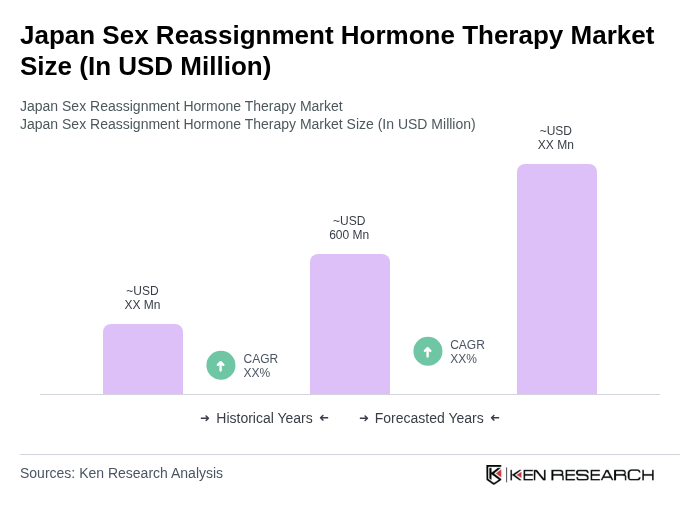
- The Japan Sex Reassignment Hormone Therapy market is valued at USD 600 million, based on a five-year historical analysis of the broader hormone replacement therapy market and the proportion attributable to gender-affirming indications. This growth is primarily driven by increasing awareness and acceptance of transgender and gender-diverse rights, alongside advancements in medical technology that facilitate safer and more effective hormone therapies. The rising number of individuals seeking gender-affirming treatments, supported by expanding access to hormone therapy within Japan’s hospital and clinic networks, has significantly contributed to the market's expansion.
- Tokyo, Osaka, and Yokohama are the dominant cities in the Japan Sex Reassignment Hormone Therapy market. These cities fall within the Kanto and Kansai regions, which together account for a major share of Japan’s hormone therapy service capacity and advanced healthcare infrastructure. These urban centers have a higher concentration of large hospitals, university medical centers, and specialized clinics that provide hormone-related and gender-affirming care to the transgender community. Additionally, urban areas tend to have more progressive social attitudes and better access to specialized mental health and endocrinology services, leading to increased demand for hormone therapy services.
- In Japan, access to medical transition, including hormone therapy, is framed within legal and clinical guidelines that emphasize psychiatric and psychological assessment before initiating gender-affirming treatment. The Gender Identity Disorder Special Cases Act, 2003, issued by the National Diet of Japan, together with the Japanese Society of Psychiatry and Neurology “Guidelines for the Diagnosis and Treatment of Gender Identity Disorder”, requires that individuals undergo comprehensive mental health evaluation and diagnosis by qualified specialists prior to medical interventions such as hormone therapy. These frameworks aim to ensure that patients receive appropriate psychosocial support, informed consent, and multidisciplinary follow-up throughout their transition process, thereby enhancing the overall quality of care in the sex reassignment hormone therapy sector.
Japan Sex Reassignment Hormone Therapy Market Segmentation
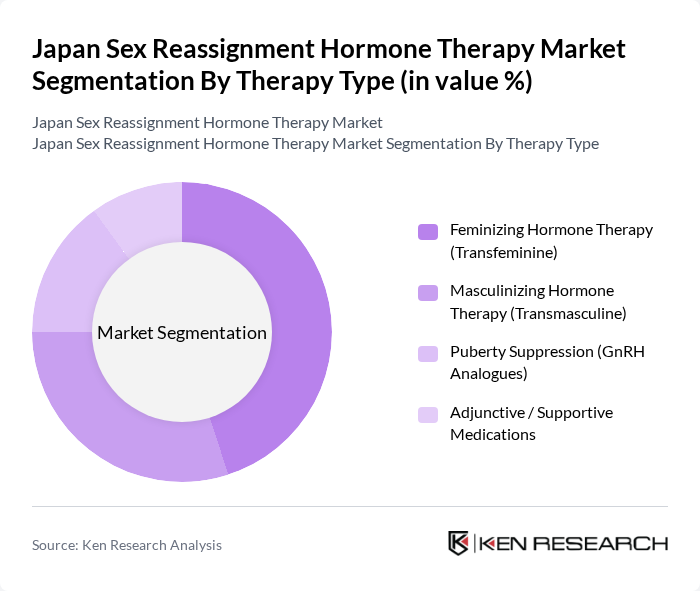
By Therapy Type:The therapy type segmentation includes various approaches to hormone therapy, each catering to different patient needs. The subsegments are Feminizing Hormone Therapy (Transfeminine), Masculinizing Hormone Therapy (Transmasculine), Puberty Suppression (GnRH Analogues), and Adjunctive / Supportive Medications. Among these, Feminizing Hormone Therapy is the leading subsegment, supported by clinical practice patterns in Japan and globally where estrogen-based regimens for transfeminine patients represent a substantial share of gender-affirming hormone prescriptions. The increasing acceptance of transgender identities, growing visibility of transgender women, and the availability of specialized clinics and hospital-based gender clinics have further fueled this demand.
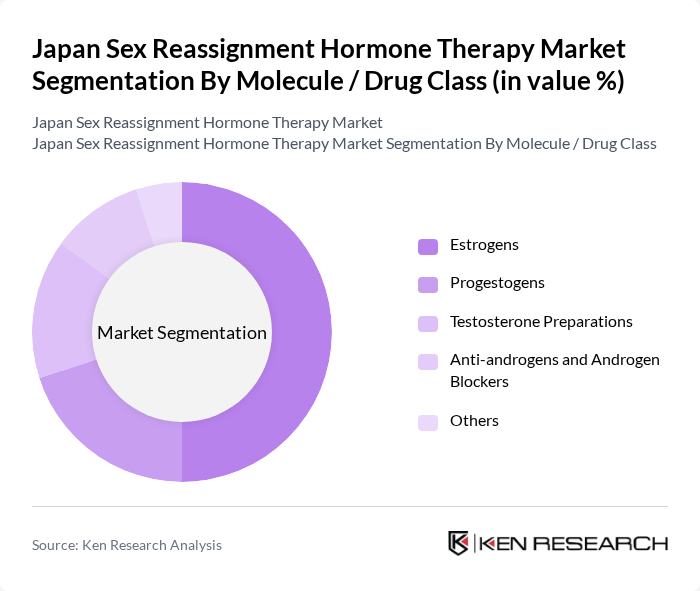
By Molecule / Drug Class:This segmentation focuses on the specific drugs used in hormone therapy, including Estrogens, Progestogens, Testosterone Preparations, Anti-androgens and Androgen Blockers, and Others. Estrogens dominate this segment, as they are essential for feminizing hormone therapy regimens that combine oral, transdermal, or injectable estrogen with anti-androgens. The increasing number of prescriptions for estrogen-based therapies in hormone replacement and gender-affirming contexts reflects the growing demand for these treatments among transgender women, making it a critical component of the market.
Japan Sex Reassignment Hormone Therapy Market Competitive Landscape
The Japan Sex Reassignment Hormone Therapy Market is characterized by a dynamic mix of regional and international players. Leading participants such as Chugai Pharmaceutical Co., Ltd., Takeda Pharmaceutical Company Limited, Astellas Pharma Inc., Daiichi Sankyo Company, Limited, Otsuka Pharmaceutical Co., Ltd., Mitsubishi Tanabe Pharma Corporation contribute to innovation, geographic expansion, and service delivery in this space through their broader hormone therapy, endocrinology, and related product portfolios.
Japan Sex Reassignment Hormone Therapy Market Industry Analysis
Growth Drivers
- Increasing Awareness and Acceptance of Gender Identity:The growing societal acceptance of diverse gender identities in Japan has led to a significant increase in individuals seeking sex reassignment hormone therapy. According to a recent survey by the Japan Gender and Sexuality Association, approximately 1.2 million people identify as transgender, with 30% expressing interest in hormone therapy. This rising awareness is supported by educational campaigns, contributing to a more inclusive environment and driving demand for related healthcare services.
- Advancements in Medical Technology:The continuous evolution of medical technology has improved the safety and efficacy of hormone therapies. In future, the Japanese healthcare system is expected to adopt new hormonal formulations that enhance patient outcomes. For instance, the introduction of bioidentical hormones has shown a 25% increase in patient satisfaction rates, as reported by the Japan Society of Endocrinology. These advancements are crucial in attracting more individuals to seek treatment.
- Supportive Government Policies:The Japanese government has made strides in supporting LGBTQ+ rights, including access to healthcare. In future, the Ministry of Health, Labour and Welfare allocated ¥2 billion (approximately $18 million) to enhance healthcare services for transgender individuals. This funding aims to improve access to hormone therapy and related mental health services, fostering a more supportive environment for those seeking gender-affirming treatments.
Market Challenges
- Limited Access to Healthcare Services:Despite advancements, many regions in Japan still face significant barriers to accessing hormone therapy. A recent report from the Japan Medical Association indicated that over 40% of rural areas lack specialized clinics for transgender healthcare. This limited access can deter individuals from pursuing necessary treatments, leading to unmet healthcare needs and potential mental health issues among the transgender population.
- Stigma and Discrimination:Stigma surrounding transgender identities remains a pervasive challenge in Japan. A recent study by the Tokyo University of Social Welfare found that 60% of transgender individuals reported experiencing discrimination in healthcare settings. This stigma can discourage individuals from seeking hormone therapy, impacting their overall well-being and mental health, and creating a barrier to accessing essential medical services.
Japan Sex Reassignment Hormone Therapy Market Future Outlook
The future of the Japan sex reassignment hormone therapy market appears promising, driven by increasing societal acceptance and advancements in medical technology. As government policies continue to evolve, more funding will likely be directed toward enhancing healthcare access for transgender individuals. Additionally, the integration of mental health services into hormone therapy programs is expected to improve patient outcomes, fostering a more supportive healthcare environment that encourages individuals to seek necessary treatments.
Market Opportunities
- Expansion of Telehealth Services:The rise of telehealth services presents a significant opportunity for the hormone therapy market. In future, it is projected that telehealth consultations will increase by 40%, allowing individuals in remote areas to access specialized care. This expansion can enhance treatment accessibility and reduce the stigma associated with in-person visits, ultimately improving patient engagement and satisfaction.
- Development of New Hormonal Therapies:The ongoing research and development of innovative hormonal therapies offer substantial market potential. In future, pharmaceutical companies are expected to invest over ¥1 billion (approximately $9 million) in developing new formulations that cater to diverse patient needs. These advancements can lead to improved treatment options, attracting more individuals to seek hormone therapy and enhancing overall market growth.
Scope of the Report
| Segment | Sub-Segments |
|---|---|
| By Therapy Type | Feminizing Hormone Therapy (Transfeminine) Masculinizing Hormone Therapy (Transmasculine) Puberty Suppression (GnRH Analogues) Adjunctive / Supportive Medications |
| By Molecule / Drug Class | Estrogens Progestogens Testosterone Preparations Anti-androgens and Androgen Blockers Others |
| By Route of Administration | Oral Injectable Transdermal (Patches, Gels) Implantable & Others |
| By Care Setting | Hospitals Specialized Gender Clinics Ambulatory / Outpatient Clinics Telehealth and Digital Health Platforms |
| By Patient Profile | Transgender Women Transgender Men Non-binary and Gender Diverse Individuals Others |
| By Age Group | Adolescents Adults Older Adults Others |
| By Payer / Reimbursement Type | National Health Insurance Employer / Private Insurance Self-pay / Out-of-pocket NGO / Charity / Other Schemes |
Key Target Audience
Investors and Venture Capitalist Firms
Government and Regulatory Bodies (e.g., Ministry of Health, Labour and Welfare)
Pharmaceutical Manufacturers
Healthcare Providers and Clinics specializing in transgender health
Insurance Companies and Health Insurers
Medical Device Manufacturers
Patient Advocacy Groups and Non-Profit Organizations
Biotechnology Firms
Players Mentioned in the Report:
Chugai Pharmaceutical Co., Ltd.
Takeda Pharmaceutical Company Limited
Astellas Pharma Inc.
Daiichi Sankyo Company, Limited
Otsuka Pharmaceutical Co., Ltd.
Mitsubishi Tanabe Pharma Corporation
Kyowa Kirin Co., Ltd.
Eisai Co., Ltd.
Santen Pharmaceutical Co., Ltd.
Sumitomo Pharma Co., Ltd.
Hoya Corporation
Fujifilm Holdings Corporation
Sysmex Corporation
Terumo Corporation
Nipro Corporation
Table of Contents
Market Assessment Phase
1. Executive Summary and Approach
2. Japan Sex Reassignment Hormone Therapy Market Overview
2.1 Key Insights and Strategic Recommendations
2.2 Japan Sex Reassignment Hormone Therapy Market Overview
2.3 Definition and Scope
2.4 Evolution of Market Ecosystem
2.5 Timeline of Key Regulatory Milestones
2.6 Value Chain & Stakeholder Mapping
2.7 Business Cycle Analysis
2.8 Policy & Incentive Landscape
3. Japan Sex Reassignment Hormone Therapy Market Analysis
3.1 Growth Drivers
3.1.1 Increasing Awareness and Acceptance of Gender Identity
3.1.2 Advancements in Medical Technology
3.1.3 Supportive Government Policies
3.1.4 Rising Demand for Mental Health Support
3.2 Market Challenges
3.2.1 Limited Access to Healthcare Services
3.2.2 Stigma and Discrimination
3.2.3 Regulatory Hurdles
3.2.4 High Cost of Treatment
3.3 Market Opportunities
3.3.1 Expansion of Telehealth Services
3.3.2 Development of New Hormonal Therapies
3.3.3 Increased Funding for LGBTQ+ Health Initiatives
3.3.4 Collaborations with Non-Profit Organizations
3.4 Market Trends
3.4.1 Growing Popularity of Personalized Medicine
3.4.2 Integration of Mental Health Services
3.4.3 Rise of Online Support Communities
3.4.4 Focus on Patient-Centric Care Models
3.5 Government Regulation
3.5.1 National Health Insurance Coverage for Hormone Therapy
3.5.2 Guidelines for Medical Professionals
3.5.3 Legal Recognition of Gender Identity
3.5.4 Regulations on Pharmaceutical Advertising
4. SWOT Analysis
5. Stakeholder Analysis
6. Porter's Five Forces Analysis
7. Japan Sex Reassignment Hormone Therapy Market Market Size, 2019-2024
7.1 By Value
7.2 By Volume
7.3 By Average Selling Price
8. Japan Sex Reassignment Hormone Therapy Market Segmentation
8.1 By Therapy Type
8.1.1 Feminizing Hormone Therapy (Transfeminine)
8.1.2 Masculinizing Hormone Therapy (Transmasculine)
8.1.3 Puberty Suppression (GnRH Analogues)
8.1.4 Adjunctive / Supportive Medications
8.2 By Molecule / Drug Class
8.2.1 Estrogens
8.2.2 Progestogens
8.2.3 Testosterone Preparations
8.2.4 Anti-androgens and Androgen Blockers
8.2.5 Others
8.3 By Route of Administration
8.3.1 Oral
8.3.2 Injectable
8.3.3 Transdermal (Patches, Gels)
8.3.4 Implantable & Others
8.4 By Care Setting
8.4.1 Hospitals
8.4.2 Specialized Gender Clinics
8.4.3 Ambulatory / Outpatient Clinics
8.4.4 Telehealth and Digital Health Platforms
8.5 By Patient Profile
8.5.1 Transgender Women
8.5.2 Transgender Men
8.5.3 Non-binary and Gender Diverse Individuals
8.5.4 Others
8.6 By Age Group
8.6.1 Adolescents
8.6.2 Adults
8.6.3 Older Adults
8.6.4 Others
8.7 By Payer / Reimbursement Type
8.7.1 National Health Insurance
8.7.2 Employer / Private Insurance
8.7.3 Self-pay / Out-of-pocket
8.7.4 NGO / Charity / Other Schemes
9. Japan Sex Reassignment Hormone Therapy Market Competitive Analysis
9.1 Market Share of Key Players
9.2 Cross Comparison of Key Players
9.2.1 Company Name
9.2.2 Japan Sex Reassignment Hormone Therapy Revenue (USD Million)
9.2.3 Japan Sex Reassignment Hormone Therapy Revenue CAGR, 2019-2024 (%)
9.2.4 Share of Japan Sex Reassignment Hormone Therapy in Total Company Japan Pharma Revenue (%)
9.2.5 Number of Active Products / SKUs in Sex Reassignment Hormone Therapy Portfolio
9.2.6 Number of New Product Launches / Line Extensions (Last 5 Years)
9.2.7 R&D Spend on Hormone / Endocrine and Gender-affirming Therapies (% of Total R&D)
9.2.8 Geographic Coverage within Japan (No. of Prefectures / Regions Served)
9.2.9 Distribution Reach (Hospitals / Clinics / Pharmacies Covered)
9.2.10 Average Selling Price Positioning vs Market Average
9.2.11 EBITDA Margin for Sex Reassignment Hormone Therapy Segment (%)
9.2.12 Customer / Prescriber Concentration (Top 10 Customers’ Share of Segment Revenue, %)
9.2.13 Digital Engagement Metrics (Telehealth Partnerships, e-Prescription Share, etc.)
9.3 SWOT Analysis of Top Players
9.4 Pricing Analysis
9.5 Detailed Profile of Major Companies
9.5.1 Chugai Pharmaceutical Co., Ltd.
9.5.2 Takeda Pharmaceutical Company Limited
9.5.3 Astellas Pharma Inc.
9.5.4 Daiichi Sankyo Company, Limited
9.5.5 Otsuka Pharmaceutical Co., Ltd.
9.5.6 Mitsubishi Tanabe Pharma Corporation
9.5.7 Kyowa Kirin Co., Ltd.
9.5.8 Eisai Co., Ltd.
9.5.9 Santen Pharmaceutical Co., Ltd.
9.5.10 Sumitomo Pharma Co., Ltd.
9.5.11 Hoya Corporation
9.5.12 Fujifilm Holdings Corporation
9.5.13 Sysmex Corporation
9.5.14 Terumo Corporation
9.5.15 Nipro Corporation
10. Japan Sex Reassignment Hormone Therapy Market End-User Analysis
10.1 Procurement Behavior of Key Ministries
10.1.1 Ministry of Health, Labour and Welfare
10.1.2 Ministry of Education, Culture, Sports, Science and Technology
10.1.3 Ministry of Internal Affairs and Communications
10.1.4 Others
10.2 Corporate Spend on Infrastructure & Energy
10.2.1 Healthcare Infrastructure Investments
10.2.2 Research and Development Funding
10.2.3 Training and Education Programs
10.2.4 Others
10.3 Pain Point Analysis by End-User Category
10.3.1 Access to Treatment
10.3.2 Affordability of Medications
10.3.3 Quality of Care
10.3.4 Others
10.4 User Readiness for Adoption
10.4.1 Awareness Levels
10.4.2 Attitude Towards Hormone Therapy
10.4.3 Availability of Support Systems
10.4.4 Others
10.5 Post-Deployment ROI and Use Case Expansion
10.5.1 Treatment Outcomes
10.5.2 Patient Satisfaction
10.5.3 Long-term Health Benefits
10.5.4 Others
11. Japan Sex Reassignment Hormone Therapy Market Future Size, 2025-2030
11.1 By Value
11.2 By Volume
11.3 By Average Selling Price
Go-To-Market Strategy Phase
1. Whitespace Analysis + Business Model Canvas
1.1 Market Gaps Identification
1.2 Business Model Framework
2. Marketing and Positioning Recommendations
2.1 Branding Strategies
2.2 Product USPs
3. Distribution Plan
3.1 Urban Retail Strategies
3.2 Rural NGO Tie-ups
4. Channel & Pricing Gaps
4.1 Underserved Routes
4.2 Pricing Bands
5. Unmet Demand & Latent Needs
5.1 Category Gaps
5.2 Consumer Segments
6. Customer Relationship
6.1 Loyalty Programs
6.2 After-sales Service
7. Value Proposition
7.1 Sustainability
7.2 Integrated Supply Chains
8. Key Activities
8.1 Regulatory Compliance
8.2 Branding
8.3 Distribution Setup
9. Entry Strategy Evaluation
9.1 Domestic Market Entry Strategy
9.1.1 Product Mix
9.1.2 Pricing Band
9.1.3 Packaging
9.2 Export Entry Strategy
9.2.1 Target Countries
9.2.2 Compliance Roadmap
10. Entry Mode Assessment
10.1 Joint Ventures
10.2 Greenfield Investments
10.3 Mergers & Acquisitions
10.4 Distributor Model
11. Capital and Timeline Estimation
11.1 Capital Requirements
11.2 Timelines
12. Control vs Risk Trade-Off
12.1 Ownership vs Partnerships
13. Profitability Outlook
13.1 Breakeven Analysis
13.2 Long-term Sustainability
14. Potential Partner List
14.1 Distributors
14.2 Joint Ventures
14.3 Acquisition Targets
15. Execution Roadmap
15.1 Phased Plan for Market Entry
15.1.1 Market Setup
15.1.2 Market Entry
15.1.3 Growth Acceleration
15.1.4 Scale & Stabilize
15.2 Key Activities and Milestones
15.2.1 Activity Timeline
15.2.2 Milestone Tracking
Research Methodology
Phase 1: Approach1
Desk Research
- Analysis of existing market reports and publications on hormone therapy in Japan
- Review of government health statistics and demographic data related to transgender populations
- Examination of academic journals and articles focusing on sex reassignment and hormone therapy trends
Primary Research
- Interviews with endocrinologists and healthcare providers specializing in transgender health
- Surveys conducted with patients undergoing hormone therapy to gather insights on experiences and preferences
- Focus groups with LGBTQ+ advocacy organizations to understand community needs and barriers
Validation & Triangulation
- Cross-validation of findings through multiple expert interviews and patient surveys
- Triangulation of data from healthcare providers, patient feedback, and market reports
- Sanity checks through consultations with industry experts and stakeholders in the healthcare sector
Phase 2: Market Size Estimation1
Top-down Assessment
- Estimation of total addressable market based on national healthcare expenditure on transgender health
- Segmentation of market size by therapy type, including estrogen and testosterone treatments
- Incorporation of trends in insurance coverage and government policies affecting hormone therapy access
Bottom-up Modeling
- Collection of data on the number of clinics and healthcare providers offering hormone therapy
- Estimation of average treatment costs and frequency of therapy sessions
- Volume estimates based on patient demographics and projected growth rates in the transgender population
Forecasting & Scenario Analysis
- Multi-factor regression analysis incorporating social acceptance, healthcare policy changes, and economic factors
- Scenario modeling based on potential shifts in public health initiatives and insurance coverage
- Development of baseline, optimistic, and pessimistic forecasts through 2030
Phase 3: CATI Sample Composition1
| Scope Item/Segment | Sample Size | Target Respondent Profiles |
|---|---|---|
| Endocrinologists and Healthcare Providers | 80 | Endocrinologists, General Practitioners, Mental Health Professionals |
| Patients Undergoing Hormone Therapy | 140 | Transgender Individuals, Non-binary Patients, Support Group Members |
| LGBTQ+ Advocacy Organizations | 60 | Advocacy Leaders, Community Organizers, Health Policy Experts |
| Pharmaceutical Distributors | 50 | Pharmaceutical Sales Representatives, Distribution Managers |
| Insurance Providers | 40 | Health Insurance Underwriters, Policy Analysts, Claims Adjusters |
Frequently Asked Questions
What is the current value of the Japan Sex Reassignment Hormone Therapy market?
The Japan Sex Reassignment Hormone Therapy market is valued at approximately USD 600 million, reflecting a significant growth driven by increased awareness and acceptance of transgender rights, as well as advancements in medical technology.
Which cities are the primary hubs for Sex Reassignment Hormone Therapy in Japan?
What are the main types of hormone therapy available in Japan?
What legal frameworks govern access to hormone therapy in Japan?
Other Regional/Country Reports
Other Adjacent Reports
KSA Gender Reassignment Surgery Market
South Africa Transgender Healthcare Market
Bahrain Endocrinology Pharmaceuticals Market
Saudi Arabia Mental Health Services Market Size, Share, Growth Drivers, Trends, Opportunities & Forecast 2025–2030Egypt Reproductive Medicine Market
Thailand Biotechnology Therapeutics Market
Ksa Telehealth Services Market Report Size, Share, Growth Drivers, Trends, Opportunities & Forecast 2025–2030Oman Cosmetic Surgery Market
Saudi Arabia Pharmaceutical Distribution Market Size, Share, Growth Drivers, Trends, Opportunities & Forecast 2025–2030Why Buy From Us?

What makes us stand out is that our consultants follow Robust, Refine and Result (RRR) methodology. Robust for clear definitions, approaches and sanity checking, Refine for differentiating respondents' facts and opinions, and Result for presenting data with story.

We have set a benchmark in the industry by offering our clients with syndicated and customized market research reports featuring coverage of entire market as well as meticulous research and analyst insights.

While we don't replace traditional research, we flip the method upside down. Our dual approach of Top Bottom & Bottom Top ensures quality deliverable by not just verifying company fundamentals but also looking at the sector and macroeconomic factors.

With one step in the future, our research team constantly tries to show you the bigger picture. We help with some of the tough questions you may encounter along the way: How is the industry positioned? Best marketing channel? KPI's of competitors? By aligning every element, we help maximize success.

Our report gives you instant access to the answers and sources that other companies might choose to hide. We elaborate each steps of research methodology we have used and showcase you the sample size to earn your trust.

If you need any support, we are here! We pride ourselves on universe strength, data quality, and quick, friendly, and professional service.