About the Report
Base Year 2024KSA Educational Toys Market Overview
- The KSA Educational Toys Market is valued at USD 200 million, based on a five-year historical analysis. This growth is primarily driven by increasing parental awareness of the importance of educational play, coupled with a rising population of children aged 0-12 years, growing disposable incomes, and rising demand for STEM toys that promote cognitive and motor skills, reflecting a shift towards more interactive and educational products.
- Key cities such as Riyadh, Jeddah, and Dammam dominate the KSA Educational Toys Market due to their high population density and economic activity. These urban centers are home to a large number of families with children, leading to increased spending on educational toys. Additionally, the presence of major retail outlets and online platforms in these cities facilitates easy access to a wide range of educational toys.
- The Technical Regulation for the Safety of Toys, 2018 issued by the Saudi Standards, Metrology and Quality Organization (SASO) mandates that all toys sold in the market must comply with specific safety guidelines, including the use of non-toxic materials, mechanical and physical property requirements, flammability standards, and age-appropriate designs with clear labeling for choking hazards and intended age groups. This regulation requires manufacturers and importers to obtain SASO certification through product testing at accredited labs, ensuring compliance for market access and protecting children from potential hazards associated with poorly manufactured toys, thereby boosting consumer confidence in the market.

KSA Educational Toys Market Segmentation
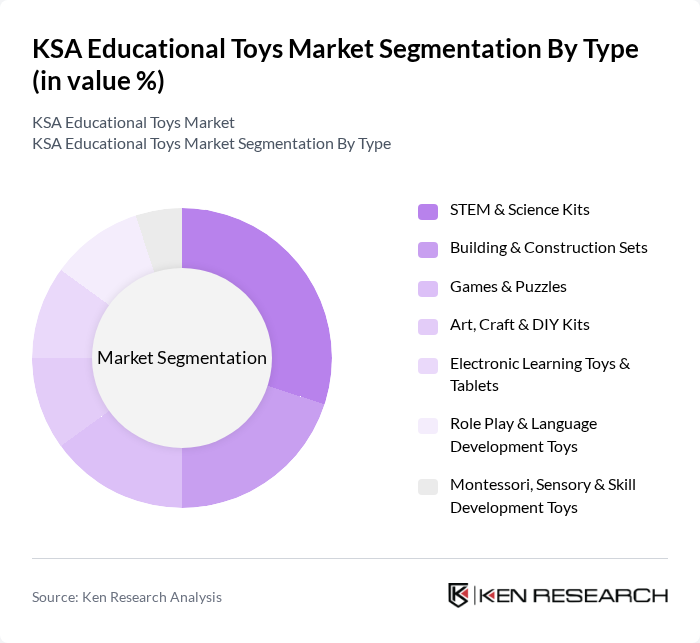
By Type:The KSA Educational Toys Market can be segmented into various types, including STEM & Science Kits, Building & Construction Sets, Games & Puzzles, Art, Craft & DIY Kits, Electronic Learning Toys & Tablets, Role Play & Language Development Toys, and Montessori, Sensory & Skill Development Toys. Among these, STEM & Science Kits are gaining significant traction due to the increasing emphasis on science and technology education in schools. Parents are increasingly investing in toys that not only entertain but also educate their children, making this sub-segment a leader in the market.
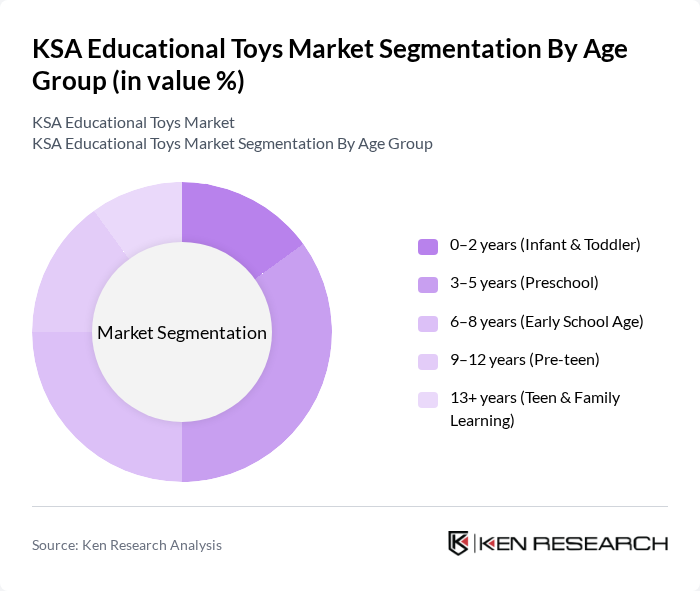
By Age Group:The market is also segmented by age group, which includes 0–2 years (Infant & Toddler), 3–5 years (Preschool), 6–8 years (Early School Age), 9–12 years (Pre-teen), and 13+ years (Teen & Family Learning). The Preschool age group is particularly dominant, as parents are increasingly recognizing the importance of early childhood education. This segment is characterized by a high demand for toys that promote language development and social skills, making it a key focus for manufacturers.
KSA Educational Toys Market Competitive Landscape
The KSA Educational Toys Market is characterized by a dynamic mix of regional and international players. Leading participants such as LEGO Group, Mattel, Inc., Hasbro, Inc., VTech Holdings Limited, LeapFrog Enterprises, Inc., Clementoni S.p.A., Ravensburger AG, Hape International AG, Learning Resources Ltd, Toy Triangle Co. Ltd. (Saudi Arabia), Jarir Marketing Company (Jarir Bookstore), Panda Retail Company, Abdullah Al Othaim Markets Company, Bin Salman Factory for Plastic & Toys, Noon AD Holdings (Noon.com – KSA) contribute to innovation, geographic expansion, and service delivery in this space.
KSA Educational Toys Market Industry Analysis
Growth Drivers
- Increasing Parental Awareness of Educational Benefits:The KSA educational toys market is significantly driven by a surge in parental awareness regarding the cognitive and developmental benefits of educational toys. In future, approximately 75% of parents in KSA are expected to prioritize educational value when purchasing toys, reflecting a growing trend towards informed consumerism. This shift is supported by educational campaigns and workshops, which have increased awareness among parents, leading to a projected increase in sales of educational toys by 17% annually.
- Rising Disposable Incomes:The rise in disposable incomes in KSA, projected to reach an average of SAR 13,500 per month in future, is a crucial growth driver for the educational toys market. As families experience increased financial flexibility, they are more inclined to invest in high-quality educational toys that promote learning and development. This trend is further supported by the overall economic growth in the region, with GDP growth expected to be around 4%, enhancing consumer spending power.
- Government Initiatives Promoting Early Childhood Education:The KSA government has launched several initiatives aimed at enhancing early childhood education, which directly benefits the educational toys market. In future, the government plans to allocate SAR 1.5 billion towards educational programs and resources for children under six. This investment is expected to stimulate demand for educational toys, as parents seek products that align with government-endorsed educational frameworks, thereby increasing market growth by an estimated 25%.
Market Challenges
- High Competition from Digital Alternatives:The KSA educational toys market faces significant challenges from the increasing popularity of digital alternatives, such as educational apps and online learning platforms. In future, it is estimated that over 65% of children in KSA will have access to digital learning tools, which may divert spending away from traditional educational toys. This shift poses a threat to market growth, as parents may prioritize digital solutions over physical toys, impacting sales negatively.
- Limited Awareness of Product Benefits:Despite the growing market, there remains a challenge due to limited awareness among some segments of the population regarding the benefits of educational toys. In future, surveys indicate that only 45% of parents are fully aware of how educational toys can enhance learning outcomes. This lack of awareness can hinder market penetration, as parents may opt for conventional toys instead, limiting the growth potential of educational toy manufacturers in KSA.
KSA Educational Toys Market Future Outlook
The KSA educational toys market is poised for significant transformation, driven by evolving consumer preferences and technological advancements. As parents increasingly seek toys that foster learning, the demand for STEM-focused products is expected to rise. Additionally, the integration of technology into traditional toys will likely enhance engagement and educational value. With government support for early childhood education, the market is set to expand, creating a favorable environment for innovative product development and strategic partnerships with educational institutions.
Market Opportunities
- Growth in E-commerce Platforms:The rise of e-commerce in KSA presents a significant opportunity for the educational toys market. With online sales projected to increase by 30% in future, manufacturers can leverage digital platforms to reach a broader audience, enhancing visibility and accessibility of educational toys. This shift allows for targeted marketing strategies that can effectively engage tech-savvy parents.
- Development of Innovative Product Lines:There is a growing demand for innovative educational toys that incorporate technology and sustainability. In future, the market for eco-friendly toys is expected to grow by 35%, driven by consumer preference for sustainable products. Companies that invest in developing unique, environmentally friendly educational toys can capture this emerging market segment, positioning themselves as leaders in sustainability.
Scope of the Report
| Segment | Sub-Segments |
|---|---|
| By Type | STEM & Science Kits Building & Construction Sets Games & Puzzles Art, Craft & DIY Kits Electronic Learning Toys & Tablets Role Play & Language Development Toys Montessori, Sensory & Skill Development Toys |
| By Age Group | –2 years (Infant & Toddler) –5 years (Preschool) –8 years (Early School Age) –12 years (Pre-teen) + years (Teen & Family Learning) |
| By Distribution Channel | Online Marketplaces (e.g., Noon, Amazon.sa) Supermarkets/Hypermarkets Bookstores & Stationery Chains Specialty Toy & Hobby Stores School & Institutional Supply Channels |
| By Material | Plastic Wood & Bamboo Fabric & Plush Paper & Cardboard Others (Metal, Silicone, Hybrid) |
| By Educational Focus | Cognitive & Problem-Solving Skills Motor & Sensory Skills Development STEM & Coding Skills Language, Literacy & Communication Social, Emotional & Values Education |
| By Brand Positioning | Premium International Brands Mid-range Mass Brands Value & Private Label Brands Eco-conscious & Niche Brands |
| By Market Segment | Public Schools & Kindergartens Private Schools & Nurseries Home Use Learning Centers, Clinics & Community Programs |
Key Target Audience
Investors and Venture Capitalist Firms
Government and Regulatory Bodies (e.g., Ministry of Education, Saudi Standards, Metrology and Quality Organization)
Manufacturers and Producers
Distributors and Retailers
Importers and Exporters
Non-Governmental Organizations (NGOs) focused on child development
Market Analysts and Industry Experts
Trade Associations and Chambers of Commerce
Players Mentioned in the Report:
LEGO Group
Mattel, Inc.
Hasbro, Inc.
VTech Holdings Limited
LeapFrog Enterprises, Inc.
Clementoni S.p.A.
Ravensburger AG
Hape International AG
Learning Resources Ltd
Toy Triangle Co. Ltd. (Saudi Arabia)
Jarir Marketing Company (Jarir Bookstore)
Panda Retail Company
Abdullah Al Othaim Markets Company
Bin Salman Factory for Plastic & Toys
Noon AD Holdings (Noon.com KSA)
Table of Contents
Market Assessment Phase
1. Executive Summary and Approach
2. KSA Educational Toys Market Overview
2.1 Key Insights and Strategic Recommendations
2.2 KSA Educational Toys Market Overview
2.3 Definition and Scope
2.4 Evolution of Market Ecosystem
2.5 Timeline of Key Regulatory Milestones
2.6 Value Chain & Stakeholder Mapping
2.7 Business Cycle Analysis
2.8 Policy & Incentive Landscape
3. KSA Educational Toys Market Analysis
3.1 Growth Drivers
3.1.1 Increasing parental awareness of educational benefits
3.1.2 Rising disposable incomes
3.1.3 Government initiatives promoting early childhood education
3.1.4 Expansion of retail channels
3.2 Market Challenges
3.2.1 High competition from digital alternatives
3.2.2 Limited awareness of product benefits
3.2.3 Regulatory compliance issues
3.2.4 Economic fluctuations affecting consumer spending
3.3 Market Opportunities
3.3.1 Growth in e-commerce platforms
3.3.2 Development of innovative product lines
3.3.3 Collaborations with educational institutions
3.3.4 Increasing demand for eco-friendly toys
3.4 Market Trends
3.4.1 Shift towards STEM-focused educational toys
3.4.2 Rise of subscription-based toy services
3.4.3 Integration of technology in traditional toys
3.4.4 Growing popularity of multicultural and inclusive toys
3.5 Government Regulation
3.5.1 Safety standards for children's toys
3.5.2 Import regulations on educational toys
3.5.3 Tax incentives for local manufacturers
3.5.4 Guidelines for marketing to children
4. SWOT Analysis
5. Stakeholder Analysis
6. Porter's Five Forces Analysis
7. KSA Educational Toys Market Market Size, 2019-2024
7.1 By Value
7.2 By Volume
7.3 By Average Selling Price
8. KSA Educational Toys Market Segmentation
8.1 By Type
8.1.1 STEM & Science Kits
8.1.2 Building & Construction Sets
8.1.3 Games & Puzzles
8.1.4 Art, Craft & DIY Kits
8.1.5 Electronic Learning Toys & Tablets
8.1.6 Role Play & Language Development Toys
8.1.7 Montessori, Sensory & Skill Development Toys
8.2 By Age Group
8.2.1 0–2 years (Infant & Toddler)
8.2.2 3–5 years (Preschool)
8.2.3 6–8 years (Early School Age)
8.2.4 9–12 years (Pre-teen)
8.2.5 13+ years (Teen & Family Learning)
8.3 By Distribution Channel
8.3.1 Online Marketplaces (e.g., Noon, Amazon.sa)
8.3.2 Supermarkets/Hypermarkets
8.3.3 Bookstores & Stationery Chains
8.3.4 Specialty Toy & Hobby Stores
8.3.5 School & Institutional Supply Channels
8.4 By Material
8.4.1 Plastic
8.4.2 Wood & Bamboo
8.4.3 Fabric & Plush
8.4.4 Paper & Cardboard
8.4.5 Others (Metal, Silicone, Hybrid)
8.5 By Educational Focus
8.5.1 Cognitive & Problem-Solving Skills
8.5.2 Motor & Sensory Skills Development
8.5.3 STEM & Coding Skills
8.5.4 Language, Literacy & Communication
8.5.5 Social, Emotional & Values Education
8.6 By Brand Positioning
8.6.1 Premium International Brands
8.6.2 Mid-range Mass Brands
8.6.3 Value & Private Label Brands
8.6.4 Eco-conscious & Niche Brands
8.7 By Market Segment
8.7.1 Public Schools & Kindergartens
8.7.2 Private Schools & Nurseries
8.7.3 Home Use
8.7.4 Learning Centers, Clinics & Community Programs
9. KSA Educational Toys Market Competitive Analysis
9.1 Market Share of Key Players
9.2 Cross Comparison of Key Players
9.2.1 Company Name
9.2.2 Scale of Operations in KSA (Stores / Online Presence / Institutional Reach)
9.2.3 KSA Educational Toys Revenue & 3-year CAGR
9.2.4 Share of Educational Toys in Total Toys Portfolio
9.2.5 Market Penetration in Key Cities (Riyadh, Jeddah, Dammam, Others)
9.2.6 Average Selling Price Positioning (Value / Mid / Premium)
9.2.7 Product Portfolio Breadth (STEM, Preschool, Montessori, Digital, Arabic Content)
9.2.8 Omnichannel Coverage (Offline Stores, E-commerce, Marketplaces, School Channels)
9.2.9 Brand Awareness & Preference Scores among Parents/Educators
9.2.10 Customer Satisfaction & Repeat Purchase Index
9.3 SWOT Analysis of Top Players
9.4 Pricing Analysis
9.5 Detailed Profile of Major Companies
9.5.1 LEGO Group
9.5.2 Mattel, Inc.
9.5.3 Hasbro, Inc.
9.5.4 VTech Holdings Limited
9.5.5 LeapFrog Enterprises, Inc.
9.5.6 Clementoni S.p.A.
9.5.7 Ravensburger AG
9.5.8 Hape International AG
9.5.9 Learning Resources Ltd
9.5.10 Toy Triangle Co. Ltd. (Saudi Arabia)
9.5.11 Jarir Marketing Company (Jarir Bookstore)
9.5.12 Panda Retail Company
9.5.13 Abdullah Al Othaim Markets Company
9.5.14 Bin Salman Factory for Plastic & Toys
9.5.15 Noon AD Holdings (Noon.com – KSA)
10. KSA Educational Toys Market End-User Analysis
10.1 Procurement Behavior of Key Ministries
10.1.1 Ministry of Education
10.1.2 Ministry of Social Affairs
10.1.3 Ministry of Health
10.1.4 Others
10.2 Corporate Spend on Infrastructure & Energy
10.2.1 Educational Institutions
10.2.2 Non-Profit Organizations
10.2.3 Private Sector Companies
10.2.4 Others
10.3 Pain Point Analysis by End-User Category
10.3.1 Educational Institutions
10.3.2 Parents
10.3.3 Retailers
10.3.4 Others
10.4 User Readiness for Adoption
10.4.1 Awareness Levels
10.4.2 Training Needs
10.4.3 Resource Availability
10.4.4 Others
10.5 Post-Deployment ROI and Use Case Expansion
10.5.1 Measurement of Educational Outcomes
10.5.2 Feedback Mechanisms
10.5.3 Scalability of Solutions
10.5.4 Others
11. KSA Educational Toys Market Future Size, 2025-2030
11.1 By Value
11.2 By Volume
11.3 By Average Selling Price
Go-To-Market Strategy Phase
1. Whitespace Analysis + Business Model Canvas
1.1 Market Gaps Identification
1.2 Value Proposition Development
1.3 Revenue Streams
1.4 Cost Structure Analysis
1.5 Key Partnerships
1.6 Customer Segments
1.7 Channels
2. Marketing and Positioning Recommendations
2.1 Branding Strategies
2.2 Product USPs
3. Distribution Plan
3.1 Urban Retail vs Rural NGO Tie-ups
4. Channel & Pricing Gaps
4.1 Underserved Routes
4.2 Pricing Bands
5. Unmet Demand & Latent Needs
5.1 Category Gaps
5.2 Consumer Segments
6. Customer Relationship
6.1 Loyalty Programs
6.2 After-sales Service
7. Value Proposition
7.1 Sustainability
7.2 Integrated Supply Chains
8. Key Activities
8.1 Regulatory Compliance
8.2 Branding
8.3 Distribution Setup
9. Entry Strategy Evaluation
9.1 Domestic Market Entry Strategy
9.1.1 Product Mix
9.1.2 Pricing Band
9.1.3 Packaging
9.2 Export Entry Strategy
9.2.1 Target Countries
9.2.2 Compliance Roadmap
10. Entry Mode Assessment
10.1 JV
10.2 Greenfield
10.3 M&A
10.4 Distributor Model
11. Capital and Timeline Estimation
11.1 Capital Requirements
11.2 Timelines
12. Control vs Risk Trade-Off
12.1 Ownership vs Partnerships
13. Profitability Outlook
13.1 Breakeven Analysis
13.2 Long-term Sustainability
14. Potential Partner List
14.1 Distributors
14.2 JVs
14.3 Acquisition Targets
15. Execution Roadmap
15.1 Phased Plan for Market Entry
15.1.1 Market Setup
15.1.2 Market Entry
15.1.3 Growth Acceleration
15.1.4 Scale & Stabilize
15.2 Key Activities and Milestones
15.2.1 Activity Planning
15.2.2 Milestone Tracking
Research Methodology
Phase 1: Approach1
Desk Research
- Analysis of market reports from educational toy associations and industry publications
- Review of government statistics on toy imports and exports in Saudi Arabia
- Examination of consumer behavior studies related to children's educational products
Primary Research
- Interviews with educational toy manufacturers and distributors in the KSA market
- Surveys conducted with parents and educators regarding purchasing preferences
- Focus groups with children to understand engagement and play patterns
Validation & Triangulation
- Cross-validation of findings through multiple data sources including sales data and consumer feedback
- Triangulation of insights from industry experts and market analysts
- Sanity checks through expert panel reviews to ensure data reliability
Phase 2: Market Size Estimation1
Top-down Assessment
- Estimation of total market size based on national education spending and toy market trends
- Segmentation of the market by product type, age group, and educational focus
- Incorporation of demographic data to assess potential market growth
Bottom-up Modeling
- Collection of sales data from leading educational toy retailers in KSA
- Estimation of average price points for various educational toy categories
- Volume estimates based on historical sales trends and projected growth rates
Forecasting & Scenario Analysis
- Multi-factor regression analysis incorporating economic indicators and educational trends
- Scenario modeling based on potential changes in consumer preferences and regulatory impacts
- Development of baseline, optimistic, and pessimistic market forecasts through 2030
Phase 3: CATI Sample Composition1
| Scope Item/Segment | Sample Size | Target Respondent Profiles |
|---|---|---|
| Retail Sector Educational Toys | 120 | Store Managers, Product Buyers |
| Parents of Children Aged 3-10 | 150 | Parents, Guardians |
| Educators in Preschools and Kindergartens | 100 | Teachers, Curriculum Coordinators |
| Child Psychologists and Developmental Experts | 60 | Child Psychologists, Educational Consultants |
| Distributors and Wholesalers of Educational Toys | 70 | Distribution Managers, Sales Representatives |
Frequently Asked Questions
What is the current value of the KSA Educational Toys Market?
The KSA Educational Toys Market is valued at approximately USD 200 million, driven by increasing parental awareness of educational play, a growing population of children aged 0-12 years, and rising disposable incomes.
Which cities dominate the KSA Educational Toys Market?
What types of educational toys are popular in KSA?
What age groups are targeted in the KSA Educational Toys Market?
Other Regional/Country Reports
Indonesia Educational Toys Market
Malaysia Educational Toys Market
Other Adjacent Reports
Oman Educational Software Market
Oman STEM Toys Market
Kuwait Childrens Books Market
Mexico Online Learning Platforms Market
Philippines Preschool Education Market
South Korea Child Development Services Market
Belgium Toy Manufacturing Market
KSA E-commerce Toys Market
KSA Parenting Products Market
Malaysia Sustainable Toys Market
Why Buy From Us?

What makes us stand out is that our consultants follow Robust, Refine and Result (RRR) methodology. Robust for clear definitions, approaches and sanity checking, Refine for differentiating respondents' facts and opinions, and Result for presenting data with story.

We have set a benchmark in the industry by offering our clients with syndicated and customized market research reports featuring coverage of entire market as well as meticulous research and analyst insights.

While we don't replace traditional research, we flip the method upside down. Our dual approach of Top Bottom & Bottom Top ensures quality deliverable by not just verifying company fundamentals but also looking at the sector and macroeconomic factors.

With one step in the future, our research team constantly tries to show you the bigger picture. We help with some of the tough questions you may encounter along the way: How is the industry positioned? Best marketing channel? KPI's of competitors? By aligning every element, we help maximize success.

Our report gives you instant access to the answers and sources that other companies might choose to hide. We elaborate each steps of research methodology we have used and showcase you the sample size to earn your trust.

If you need any support, we are here! We pride ourselves on universe strength, data quality, and quick, friendly, and professional service.