About the Report
Base Year 2024Kuwait Fiber Optics Market Overview
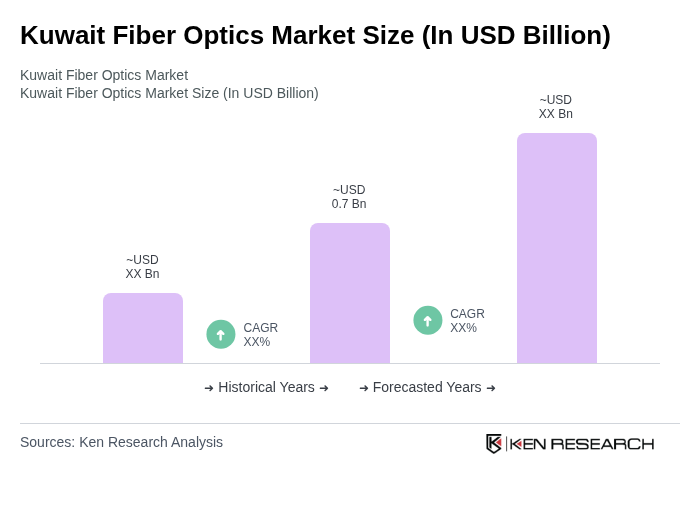
- The Kuwait Fiber Optics Market is valued at USD 0.7 billion, based on a five-year historical analysis of Kuwait’s share in the Middle East optical fiber cable market and its leading position by value in the region. This growth is primarily driven by the increasing demand for high-speed internet, the rollout of advanced broadband infrastructure, and sustained investments by telecom operators and the government in fiber networks to support digital transformation and 5G backhaul. The rise in digital services, cloud adoption, data centers, and smart city initiatives across Kuwait further accelerates fiber optic deployment in residential, commercial, industrial, and public-sector applications.
- Kuwait City is the dominant region in the fiber optics market due to its role as the capital and primary economic hub, hosting the headquarters of major telecom operators, government ministries, and large enterprises that drive bandwidth demand and network investments. The concentration of telecommunications infrastructure, data centers, and digital government projects in the metropolitan area underpins its market leadership, while other governorates such as Hawalli and Al Ahmadi are also seeing extensive fiber rollouts linked to residential expansions, oil and gas facilities, and industrial zones.
- In 2023, Kuwait reinforced its broadband policy framework through measures under the State of Kuwait National Broadband Plan issued by the Ministry of Communications and the Communication and Information Technology Regulatory Authority, which requires new developments and major infrastructure projects to be provisioned with next-generation broadband, including fiber-based access, as part of building and telecom permitting and compliance. These requirements aim to ensure that new residential and commercial areas are fiber-ready, supporting nationwide high-speed internet access, digital inclusion, and the country’s vision for a knowledge-based and technologically advanced economy.
Kuwait Fiber Optics Market Segmentation
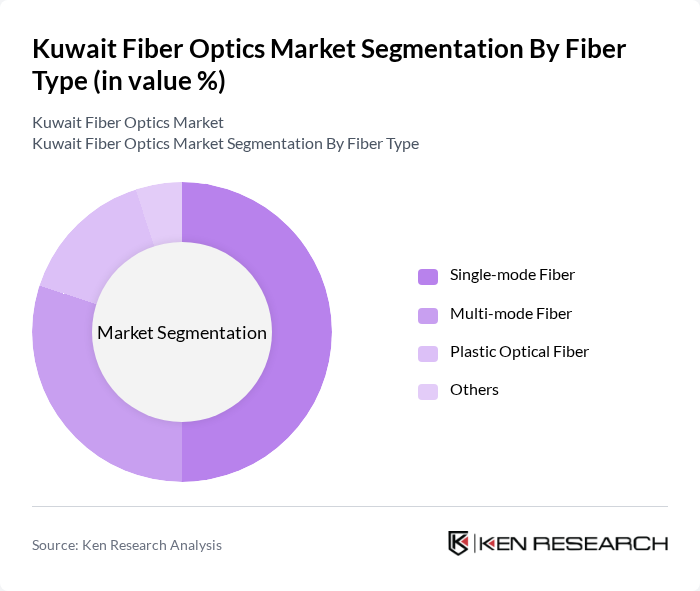
By Fiber Type:The fiber type segmentation includes Single-mode Fiber, Multi-mode Fiber, Plastic Optical Fiber, and Others. Single-mode fiber is widely used for long-distance communication and backbone networks due to its low attenuation, high bandwidth capabilities, and suitability for national and international links as well as 5G backhaul. Multi-mode fiber is preferred for shorter distances, particularly in data centers, campus networks, and local area networks, where high capacity is needed over limited reaches. Plastic optical fiber is gaining traction in certain consumer, automotive, and in-building applications due to its flexibility, ease of installation, and resistance to tight bending, although its share remains smaller than glass fiber. The "Others" category includes specialized fibers such as dispersion-shifted, bend-insensitive, and armored or specialty fibers used in niche applications including oil and gas sensing, industrial automation, and defense communications.
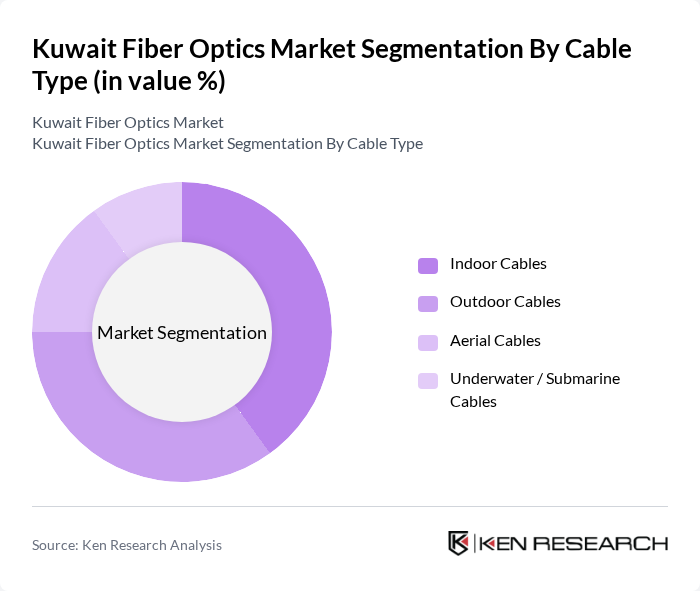
By Cable Type:The cable type segmentation encompasses Indoor Cables, Outdoor Cables, Aerial Cables, and Underwater/Submarine Cables. Indoor cables are primarily used within buildings, data centers, and campuses for telecommunications and networking, benefiting from growing FTTH/FTTB penetration and enterprise LAN upgrades. Outdoor cables are designed for duct, direct-buried, and access network deployments and represent a substantial share of new rollouts as operators extend fiber deeper into access and last?mile networks. Aerial cables are often used in overhead installations where rapid deployment and lower civil works are required, particularly in selected distribution and last?mile segments. Underwater/submarine cables are critical for international and regional data transmission, with Kuwait connected to multiple submarine cable systems to support growing international bandwidth demand from cloud services, content streaming, and enterprise traffic, driving steady demand for this segment.
Kuwait Fiber Optics Market Competitive Landscape
The Kuwait Fiber Optics Market is characterized by a dynamic mix of regional and international players. Leading participants such as Ooredoo Kuwait, Zain Kuwait, stc Kuwait (Kuwait Telecommunications Company), Gulf Cable & Electrical Industries Company, KEMS Zajil Telecom, Qualitynet (solutions by stc), FASTtelco, Mada Communications, Huawei Technologies Kuwait, Nokia Kuwait, Kuwait Oil Company (KOC), Kuwait National Petroleum Company (KNPC), Ministry of Communications – Kuwait, Central Agency for Information Technology (CAIT), Other Emerging Local System Integrators & ISPs contribute to innovation, geographic expansion, and service delivery in this space.
Kuwait Fiber Optics Market Industry Analysis
Growth Drivers
- Increasing Demand for High-Speed Internet:The demand for high-speed internet in Kuwait is surging, with the number of broadband subscriptions reaching approximately 1.7 million in future. This growth is driven by a 25% annual increase in data consumption, as reported by the Communications and Information Technology Regulatory Authority (CITRA). The rise in remote work and online education has further accelerated this trend, necessitating robust fiber optic infrastructure to meet consumer expectations for speed and reliability.
- Government Initiatives for Digital Transformation:The Kuwaiti government has committed to investing over $1.5 billion in digital transformation initiatives in future. This includes the National Digital Strategy, which aims to enhance connectivity and promote smart city projects. As part of this strategy, the government is prioritizing fiber optic deployment, with plans to connect 95% of households to high-speed internet in future, significantly boosting market growth and infrastructure development.
- Expansion of Telecommunications Infrastructure:Kuwait's telecommunications sector is undergoing significant expansion, with the Ministry of Communications reporting a 20% increase in fiber optic network coverage in future. This expansion is supported by investments from major telecom operators, who are allocating approximately $600 million annually to enhance their infrastructure. The growing number of fiber optic installations is crucial for supporting the increasing demand for high-speed internet and advanced telecommunications services.
Market Challenges
- High Installation Costs:The initial costs associated with fiber optic installation in Kuwait can be prohibitive, averaging around $35,000 per kilometer. This financial barrier poses a significant challenge for smaller service providers and limits the overall market growth. Additionally, the need for specialized equipment and skilled labor further exacerbates these costs, making it difficult for new entrants to compete effectively in the market.
- Limited Skilled Workforce:The fiber optics sector in Kuwait faces a shortage of skilled technicians, with only about 2,500 certified professionals available in future. This shortage hampers the ability of companies to expand their services and maintain existing infrastructure. The lack of training programs and educational initiatives in fiber optics further complicates the situation, limiting the industry's capacity to meet growing demand and innovate effectively.
Kuwait Fiber Optics Market Future Outlook
The future of the Kuwait fiber optics market appears promising, driven by ongoing government investments and technological advancements. As the demand for high-speed internet continues to rise, the market is expected to see increased fiber-to-the-home (FTTH) deployments and the integration of advanced technologies like AI in network management. Additionally, the expansion of 5G networks will further enhance connectivity, paving the way for innovative applications and services that leverage high-speed fiber optic infrastructure.
Market Opportunities
- Growth in IoT Applications:The proliferation of Internet of Things (IoT) devices in Kuwait presents a significant opportunity for fiber optics. With an estimated 1.5 million IoT devices expected to be deployed in future, the demand for reliable, high-speed connectivity will drive investments in fiber optic infrastructure, enabling seamless communication and data transfer across various sectors.
- Expansion into Rural Areas:There is a growing opportunity to expand fiber optic services into rural areas of Kuwait, where connectivity remains limited. The government’s initiative to enhance digital access in underserved regions aims to connect an additional 400,000 households in future. This expansion will not only improve internet access but also stimulate local economies and promote digital inclusion.
Scope of the Report
| Segment | Sub-Segments |
|---|---|
| By Fiber Type | Single-mode Fiber Multi-mode Fiber Plastic Optical Fiber Others |
| By Cable Type | Indoor Cables Outdoor Cables Aerial Cables Underwater / Submarine Cables |
| By Application | Telecommunications & FTTH / FTTx Data Centers & Cloud Connectivity Oil & Gas and Industrial Automation Government, Defense & Smart City Projects Broadcast and Media Others |
| By Installation Environment | Underground Installation Aerial Installation Duct & Conduit Installation Indoor / In-building Installation |
| By End-User | Telecom Operators & ISPs Enterprises & Commercial Users Industrial & Oil & Gas Government, Utilities & Public Sector Residential |
| By Offering | Fiber Optic Cables Fiber Optic Components & Connectivity (Connectors, Splitters, Patch Panels) Installation & Integration Services Operation & Maintenance Services |
| By Region | Capital Governorate Hawalli Governorate Al Ahmadi Governorate Farwaniya & Al Jahra Governorates Mubarak Al-Kabeer Governorate |
Key Target Audience
Investors and Venture Capitalist Firms
Government and Regulatory Bodies (e.g., Ministry of Communications, Kuwait Communications and Information Technology Regulatory Authority)
Telecommunications Service Providers
Network Infrastructure Providers
Fiber Optic Cable Manufacturers
Construction and Engineering Firms
Utility Companies
Real Estate Developers
Players Mentioned in the Report:
Ooredoo Kuwait
Zain Kuwait
stc Kuwait (Kuwait Telecommunications Company)
Gulf Cable & Electrical Industries Company
KEMS Zajil Telecom
Qualitynet (solutions by stc)
FASTtelco
Mada Communications
Huawei Technologies Kuwait
Nokia Kuwait
Kuwait Oil Company (KOC)
Kuwait National Petroleum Company (KNPC)
Ministry of Communications Kuwait
Central Agency for Information Technology (CAIT)
Other Emerging Local System Integrators & ISPs
Table of Contents
Market Assessment Phase
1. Executive Summary and Approach
2. Kuwait Fiber Optics Market Overview
2.1 Key Insights and Strategic Recommendations
2.2 Kuwait Fiber Optics Market Overview
2.3 Definition and Scope
2.4 Evolution of Market Ecosystem
2.5 Timeline of Key Regulatory Milestones
2.6 Value Chain & Stakeholder Mapping
2.7 Business Cycle Analysis
2.8 Policy & Incentive Landscape
3. Kuwait Fiber Optics Market Analysis
3.1 Growth Drivers
3.1.1 Increasing demand for high-speed internet
3.1.2 Government initiatives for digital transformation
3.1.3 Expansion of telecommunications infrastructure
3.1.4 Rising adoption of smart technologies
3.2 Market Challenges
3.2.1 High installation costs
3.2.2 Limited skilled workforce
3.2.3 Regulatory hurdles
3.2.4 Competition from alternative technologies
3.3 Market Opportunities
3.3.1 Growth in IoT applications
3.3.2 Expansion into rural areas
3.3.3 Partnerships with tech companies
3.3.4 Development of 5G networks
3.4 Market Trends
3.4.1 Increasing fiber-to-the-home (FTTH) deployments
3.4.2 Adoption of cloud-based services
3.4.3 Focus on sustainability and eco-friendly solutions
3.4.4 Integration of AI in network management
3.5 Government Regulation
3.5.1 Telecommunications regulatory framework
3.5.2 Licensing requirements for service providers
3.5.3 Standards for fiber optic installations
3.5.4 Incentives for infrastructure development
4. SWOT Analysis
5. Stakeholder Analysis
6. Porter's Five Forces Analysis
7. Kuwait Fiber Optics Market Market Size, 2019-2024
7.1 By Value
7.2 By Volume
7.3 By Average Selling Price
8. Kuwait Fiber Optics Market Segmentation
8.1 By Fiber Type
8.1.1 Single-mode Fiber
8.1.2 Multi-mode Fiber
8.1.3 Plastic Optical Fiber
8.1.4 Others
8.2 By Cable Type
8.2.1 Indoor Cables
8.2.2 Outdoor Cables
8.2.3 Aerial Cables
8.2.4 Underwater / Submarine Cables
8.3 By Application
8.3.1 Telecommunications & FTTH / FTTx
8.3.2 Data Centers & Cloud Connectivity
8.3.3 Oil & Gas and Industrial Automation
8.3.4 Government, Defense & Smart City Projects
8.3.5 Broadcast and Media
8.3.6 Others
8.4 By Installation Environment
8.4.1 Underground Installation
8.4.2 Aerial Installation
8.4.3 Duct & Conduit Installation
8.4.4 Indoor / In-building Installation
8.5 By End-User
8.5.1 Telecom Operators & ISPs
8.5.2 Enterprises & Commercial Users
8.5.3 Industrial & Oil & Gas
8.5.4 Government, Utilities & Public Sector
8.5.5 Residential
8.6 By Offering
8.6.1 Fiber Optic Cables
8.6.2 Fiber Optic Components & Connectivity (Connectors, Splitters, Patch Panels)
8.6.3 Installation & Integration Services
8.6.4 Operation & Maintenance Services
8.7 By Region
8.7.1 Capital Governorate
8.7.2 Hawalli Governorate
8.7.3 Al Ahmadi Governorate
8.7.4 Farwaniya & Al Jahra Governorates
8.7.5 Mubarak Al-Kabeer Governorate
9. Kuwait Fiber Optics Market Competitive Analysis
9.1 Market Share of Key Players
9.2 Cross Comparison of Key Players
9.2.1 Company Name
9.2.2 Kuwait Fiber Optics Revenue (USD Million)
9.2.3 Kuwait Fiber Optics Revenue CAGR (Historical & Forecast)
9.2.4 Market Share in Kuwait Fiber Optics (%)
9.2.5 Fiber Network Coverage (% of Households / Enterprises Passed)
9.2.6 FTTH / FTTx Subscribers (Number)
9.2.7 ARPU from Fiber-based Services (USD per Month)
9.2.8 Capex Intensity in Fiber (Fiber Capex as % of Total Capex)
9.2.9 EBITDA Margin for Fiber-related Services (%)
9.2.10 Average Bandwidth per Subscriber (Mbps / Gbps)
9.2.11 Service Level Agreement (SLA) Compliance Rate (%)
9.2.12 Churn Rate of Fiber Subscribers (%)
9.3 SWOT Analysis of Top Players
9.4 Pricing Analysis
9.5 Detailed Profile of Major Companies
9.5.1 Ooredoo Kuwait
9.5.2 Zain Kuwait
9.5.3 stc Kuwait (Kuwait Telecommunications Company)
9.5.4 Gulf Cable & Electrical Industries Company
9.5.5 KEMS Zajil Telecom
9.5.6 Qualitynet (solutions by stc)
9.5.7 FASTtelco
9.5.8 Mada Communications
9.5.9 Huawei Technologies Kuwait
9.5.10 Nokia Kuwait
9.5.11 Kuwait Oil Company (KOC)
9.5.12 Kuwait National Petroleum Company (KNPC)
9.5.13 Ministry of Communications – Kuwait
9.5.14 Central Agency for Information Technology (CAIT)
9.5.15 Other Emerging Local System Integrators & ISPs
10. Kuwait Fiber Optics Market End-User Analysis
10.1 Procurement Behavior of Key Ministries
10.1.1 Ministry of Communications
10.1.2 Ministry of Electricity and Water
10.1.3 Ministry of Information
10.1.4 Others
10.2 Corporate Spend on Infrastructure & Energy
10.2.1 Telecommunications Sector
10.2.2 Government Projects
10.2.3 Private Sector Investments
10.2.4 Others
10.3 Pain Point Analysis by End-User Category
10.3.1 Residential Users
10.3.2 Commercial Users
10.3.3 Industrial Users
10.3.4 Government Users
10.4 User Readiness for Adoption
10.4.1 Awareness Levels
10.4.2 Infrastructure Readiness
10.4.3 Financial Readiness
10.4.4 Others
10.5 Post-Deployment ROI and Use Case Expansion
10.5.1 Performance Metrics
10.5.2 User Feedback
10.5.3 Scalability Potential
10.5.4 Others
11. Kuwait Fiber Optics Market Future Size, 2025-2030
11.1 By Value
11.2 By Volume
11.3 By Average Selling Price
Go-To-Market Strategy Phase
1. Whitespace Analysis + Business Model Canvas
1.1 Market Gaps Identification
1.2 Business Model Development
2. Marketing and Positioning Recommendations
2.1 Branding Strategies
2.2 Product USPs
3. Distribution Plan
3.1 Urban Retail Strategies
3.2 Rural NGO Tie-ups
4. Channel & Pricing Gaps
4.1 Underserved Routes
4.2 Pricing Bands
5. Unmet Demand & Latent Needs
5.1 Category Gaps
5.2 Consumer Segments
6. Customer Relationship
6.1 Loyalty Programs
6.2 After-sales Service
7. Value Proposition
7.1 Sustainability Initiatives
7.2 Integrated Supply Chains
8. Key Activities
8.1 Regulatory Compliance
8.2 Branding Efforts
8.3 Distribution Setup
9. Entry Strategy Evaluation
9.1 Domestic Market Entry Strategy
9.1.1 Product Mix
9.1.2 Pricing Band
9.1.3 Packaging
9.2 Export Entry Strategy
9.2.1 Target Countries
9.2.2 Compliance Roadmap
10. Entry Mode Assessment
10.1 Joint Ventures
10.2 Greenfield Investments
10.3 Mergers & Acquisitions
10.4 Distributor Model
11. Capital and Timeline Estimation
11.1 Capital Requirements
11.2 Timelines
12. Control vs Risk Trade-Off
12.1 Ownership vs Partnerships
13. Profitability Outlook
13.1 Breakeven Analysis
13.2 Long-term Sustainability
14. Potential Partner List
14.1 Distributors
14.2 Joint Ventures
14.3 Acquisition Targets
15. Execution Roadmap
15.1 Phased Plan for Market Entry
15.1.1 Market Setup
15.1.2 Market Entry
15.1.3 Growth Acceleration
15.1.4 Scale & Stabilize
15.2 Key Activities and Milestones
15.2.1 Activity Planning
15.2.2 Milestone Tracking
Research Methodology
Phase 1: Approach1
Desk Research
- Analysis of industry reports from telecommunications authorities in Kuwait
- Review of market studies published by regional fiber optics associations
- Examination of government publications on infrastructure development and digital transformation initiatives
Primary Research
- Interviews with key stakeholders in telecommunications companies operating in Kuwait
- Surveys conducted with network engineers and technical managers in the fiber optics sector
- Field interviews with project managers involved in fiber optic installation projects
Validation & Triangulation
- Cross-validation of findings through multiple data sources including trade publications and expert opinions
- Triangulation of market data with insights from industry conferences and seminars
- Sanity checks performed through expert panel reviews comprising industry veterans
Phase 2: Market Size Estimation1
Top-down Assessment
- Estimation of market size based on national telecommunications expenditure and growth rates
- Segmentation of the market by application areas such as residential, commercial, and industrial
- Incorporation of government initiatives aimed at enhancing digital infrastructure
Bottom-up Modeling
- Collection of data on fiber optic cable production volumes from local manufacturers
- Estimation of installation costs based on project case studies and historical data
- Volume x cost analysis for different segments including urban and rural deployments
Forecasting & Scenario Analysis
- Multi-factor regression analysis incorporating factors such as internet penetration and technological advancements
- Scenario modeling based on potential regulatory changes and market entry of new players
- Development of baseline, optimistic, and pessimistic forecasts through 2030
Phase 3: CATI Sample Composition1
| Scope Item/Segment | Sample Size | Target Respondent Profiles |
|---|---|---|
| Residential Fiber Optic Installations | 120 | Homeowners, Property Managers |
| Commercial Fiber Optic Deployments | 90 | IT Managers, Facility Directors |
| Industrial Fiber Optic Applications | 80 | Operations Managers, Engineering Leads |
| Government Infrastructure Projects | 70 | Public Sector Officials, Project Coordinators |
| Telecommunications Service Providers | 100 | Network Engineers, Business Development Managers |
Frequently Asked Questions
What is the current value of the Kuwait Fiber Optics Market?
The Kuwait Fiber Optics Market is valued at approximately USD 0.7 billion. This valuation reflects Kuwait's significant position in the Middle East optical fiber cable market, driven by increasing demand for high-speed internet and government investments in fiber networks.
What factors are driving the growth of the fiber optics market in Kuwait?
Which regions in Kuwait are leading in fiber optics deployment?
What is the role of the Kuwaiti government in the fiber optics market?
Other Regional/Country Reports
Indonesia Pacific Fiber Optics Market
Malaysia Pacific Fiber Optics Market
KSA Pacific Fiber Optics Market
APAC Pacific Fiber Optics Market
SEA Pacific Fiber Optics Market
Vietnam Pacific Fiber Optics Market
Other Adjacent Reports
Oman Broadband Infrastructure Market
Vietnam 5G Technology Market
Philippines Data Center Market Size, Share & Forecast, By Facility Type, End-Use Sector & Technology, 2025-2032India Cloud Computing Market Size, Share & Forecast, By Service Model, Deployment Model & End-Use Industry, 2026-2031Germany Smart City Technology Market
India Internet of Things Market Size, Share & Forecast, By Solution Type, End-Use Industry & Application, 2026-2031Philippines Optical Components Market
Brazil Submarine Cable Market
India Network Equipment Market Size, Share & Forecast, By Product Type, Application & Network Solution, 2025-2032Why Buy From Us?

What makes us stand out is that our consultants follow Robust, Refine and Result (RRR) methodology. Robust for clear definitions, approaches and sanity checking, Refine for differentiating respondents' facts and opinions, and Result for presenting data with story.

We have set a benchmark in the industry by offering our clients with syndicated and customized market research reports featuring coverage of entire market as well as meticulous research and analyst insights.

While we don't replace traditional research, we flip the method upside down. Our dual approach of Top Bottom & Bottom Top ensures quality deliverable by not just verifying company fundamentals but also looking at the sector and macroeconomic factors.

With one step in the future, our research team constantly tries to show you the bigger picture. We help with some of the tough questions you may encounter along the way: How is the industry positioned? Best marketing channel? KPI's of competitors? By aligning every element, we help maximize success.

Our report gives you instant access to the answers and sources that other companies might choose to hide. We elaborate each steps of research methodology we have used and showcase you the sample size to earn your trust.

If you need any support, we are here! We pride ourselves on universe strength, data quality, and quick, friendly, and professional service.