








Ken Research Logo

Kuwait In Vehicle Payment Services Market Size, Share, Growth Drivers, Trends, Opportunities & Forecast 2025–2030

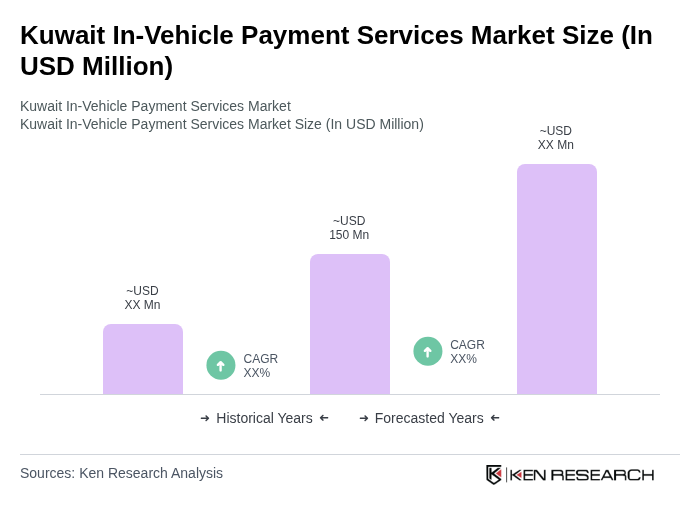
The Kuwait In-Vehicle Payment Services Market, worth USD 150 million, is expanding due to rising digital payments, NFC tech, and demand in Kuwait City for seamless vehicle transactions.

Region:Middle East

Author(s):Shubham

Product Code:KRAD4588

Pages:92

Published On:December 2025
About the Report

Base Year 2024

Kuwait In-Vehicle Payment Services Market Overview

  • The Kuwait In-Vehicle Payment Services Market is valued at approximately USD 150 million, based on a five-year historical analysis. This growth is primarily driven by the increasing adoption of digital payment solutions, the rise in vehicle ownership, and the growing demand for seamless payment experiences in transportation; these drivers are consistent with Kuwait’s broader vehicle payment and digital payments landscape. The integration of advanced technologies such as NFC, mobile wallets, and contactless cards integrated with fuel, parking, and toll services is further accelerating market expansion.
  • Kuwait City and the Capital Governorate remain the core demand centers due to their high population concentration, higher income levels, and dense mix of retail, fuel, parking, and mobility services, which all benefit from faster digital payments. Additionally, regions like Hawalli and Farwaniya are significant contributors, reflecting their role as major residential and commercial corridors with heavy daily vehicle traffic and rising use of app?based payments at fuel stations, parking facilities, and ride?hailing services.
  • Kuwait is actively promoting cashless payments and upgrading payments infrastructure, including support for contactless cards and mobile wallets in transport?related services (such as tolling, parking, and fuel) in line with wider Gulf digitalization trends.
Kuwait In-Vehicle Payment Services Market Size

Kuwait In-Vehicle Payment Services Market Segmentation

By Type (Form Factor):The market is segmented into four key types: Embedded in-vehicle payment platforms, Tethered (smartphone-connected) payment solutions, Integrated infotainment and navigation payment systems, and Aftermarket devices and dongle-based solutions. Among these, embedded in-vehicle payment platforms are leading due to their seamless integration into vehicles, providing users with a convenient and efficient payment experience. The trend towards smart vehicles and connected technologies is driving the adoption of these platforms.
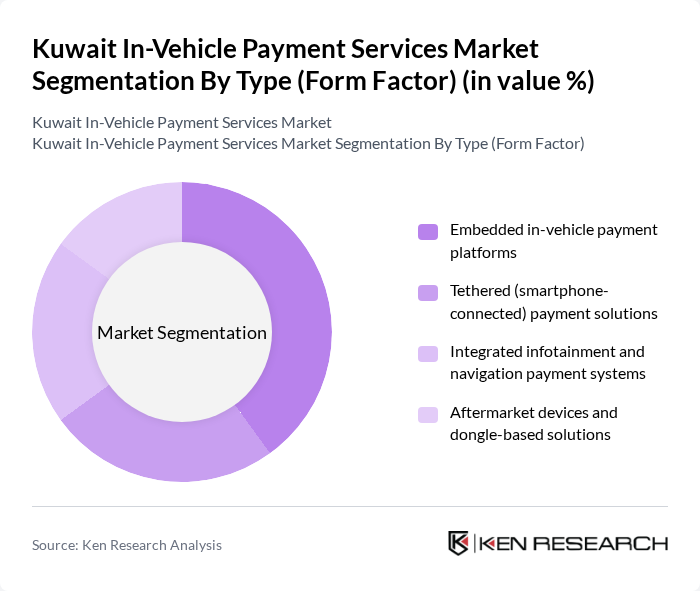
Kuwait In-Vehicle Payment Services Market segmentation by Type (Form Factor).

By End-User:The end-user segmentation includes Individual private vehicle owners, Fleet and logistics operators, Ride-hailing and taxi operators, and Public transport and government fleets. Fleet and logistics operators are currently the dominant segment, driven by the need for efficient payment solutions to manage fuel and toll expenses. The increasing trend of digitization in fleet management is further propelling this segment's growth.
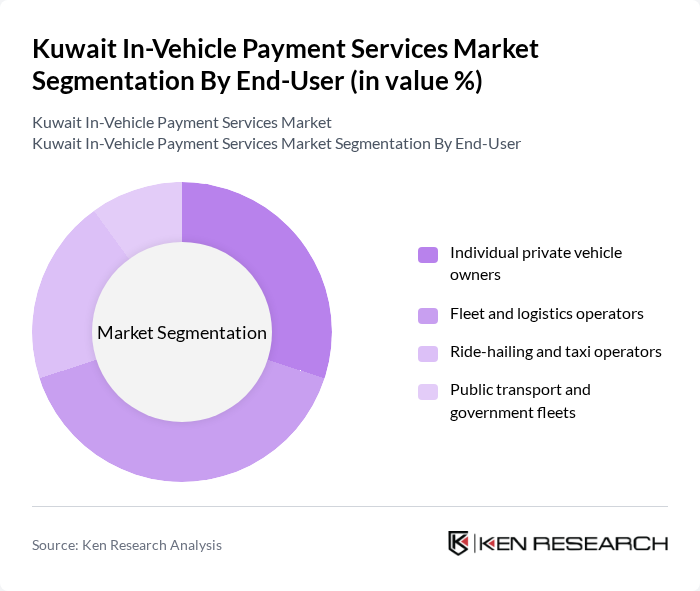
Kuwait In-Vehicle Payment Services Market segmentation by End-User.

Kuwait In-Vehicle Payment Services Market Competitive Landscape

The Kuwait In-Vehicle Payment Services Market is characterized by a dynamic mix of regional and international players. Leading participants such as Shared Electronic Banking Services Company (KNET), National Bank of Kuwait (NBK), Kuwait Finance House (KFH), Boubyan Bank, Gulf Bank, Al Ahli Bank of Kuwait (ABK), Zain Kuwait (Zain Pay and digital wallet services), Ooredoo Kuwait (Ooredoo digital payment services), stc Kuwait (stc Pay and digital wallet services), Visa Inc., Mastercard Incorporated, TAP Payments, One Global (PayIt and OG Money), Kuwait Oil Company & fuel station operators (fuel and EV charging payment integration), Leading parking and smart mobility operators in Kuwait contribute to innovation, geographic expansion, and service delivery in this space.

Kuwait Finance House (KFH)

1977

Kuwait City, Kuwait

National Bank of Kuwait (NBK)

1952

Kuwait City, Kuwait

Shared Electronic Banking Services Company (KNET)

2001

Kuwait City, Kuwait

Zain Kuwait

1983

Kuwait City, Kuwait

Ooredoo Kuwait

1999

Kuwait City, Kuwait

Company

Establishment Year

Headquarters

Primary role in value chain (issuer, network, acquirer, telco, mobility, fuel/parking)

Active in-vehicle payment use cases covered (fuel, toll, parking, in-car commerce)

Number of active users / wallets linked to vehicles

Number of enabled merchants and acceptance points (fuel stations, parking sites, toll plazas)

Annual in-vehicle payment transaction value in Kuwait

Annual in-vehicle payment transaction volume in Kuwait

Kuwait In-Vehicle Payment Services Market Industry Analysis

Growth Drivers

  • Increasing Adoption of Digital Payment Solutions:The digital payment sector in Kuwait is projected to reach approximately KWD 1.8 billion in future, driven by a surge in smartphone penetration, which is expected to exceed 95%. This growth is supported by the World Bank's report indicating that 70% of the adult population in Kuwait is now using digital payment methods, reflecting a significant shift towards cashless transactions. Enhanced internet connectivity further facilitates this trend, making digital payments more accessible.
  • Rising Demand for Contactless Payment Methods:In future, contactless payment transactions in Kuwait are anticipated to surpass KWD 600 million, fueled by consumer preferences for convenience and hygiene. The Central Bank of Kuwait reported a 50% increase in contactless payment usage in future, indicating a strong consumer shift. This trend is further supported by the growing number of merchants adopting contactless payment terminals, which are expected to reach 25,000 in future, enhancing transaction speed and efficiency.
  • Government Initiatives Promoting Smart Transportation:The Kuwaiti government has allocated KWD 250 million for smart transportation initiatives in future, aiming to integrate advanced payment systems into public transport. This investment aligns with the Kuwait Vision 2035, which emphasizes digital transformation. The Ministry of Communications reported that 80% of public transport vehicles will be equipped with in-vehicle payment systems in future, facilitating seamless transactions and enhancing user experience in urban mobility.

Market Challenges

  • Security Concerns Regarding Digital Transactions:Security remains a significant challenge in the Kuwaiti digital payment landscape, with cybercrime incidents increasing by 35% in future. The Central Bank of Kuwait has noted that 30% of consumers express concerns about the safety of their financial data during digital transactions. This apprehension can hinder the adoption of in-vehicle payment systems, as consumers prioritize security over convenience, necessitating robust cybersecurity measures to build trust.
  • Limited Infrastructure for In-Vehicle Payment Systems:The current infrastructure for in-vehicle payment systems in Kuwait is underdeveloped, with only 20% of vehicles equipped for such technologies in future. The Ministry of Interior has highlighted that the lack of standardized payment terminals in vehicles poses a barrier to widespread adoption. Additionally, only 15% of gas stations currently support in-vehicle payment options, limiting consumer access and convenience in utilizing these services.

Kuwait In-Vehicle Payment Services Market Future Outlook

The future of the in-vehicle payment services market in Kuwait appears promising, driven by technological advancements and increasing consumer acceptance. As the government continues to invest in smart transportation initiatives, the integration of IoT and AI technologies is expected to enhance payment security and user experience. Furthermore, the growing trend of subscription-based services will likely reshape consumer payment preferences, making in-vehicle payment systems more appealing and accessible to a broader audience in the coming years.

Market Opportunities

  • Integration of IoT with Payment Systems:The integration of IoT technology into in-vehicle payment systems presents a significant opportunity, with an estimated KWD 150 million investment expected in future. This integration can enhance transaction efficiency and security, allowing for real-time data processing and improved user experiences, ultimately driving adoption rates among consumers and businesses alike.
  • Partnerships with Automotive Manufacturers:Collaborating with automotive manufacturers can unlock new market potential, as partnerships are projected to generate KWD 75 million in revenue in future. These alliances can facilitate the development of vehicles equipped with built-in payment systems, streamlining the payment process and enhancing consumer convenience, thereby accelerating market growth in Kuwait.

Scope of the Report

SegmentSub-Segments
By Type (Form Factor)

Embedded in-vehicle payment platforms

Tethered (smartphone-connected) payment solutions

Integrated infotainment and navigation payment systems

Aftermarket devices and dongle-based solutions

By End-User

Individual private vehicle owners

Fleet and logistics operators

Ride-hailing and taxi operators

Public transport and government fleets

By Vehicle Type

Passenger cars

Light commercial vehicles (LCVs)

Heavy commercial vehicles (HCVs) and buses

Electric vehicles and plug-in hybrids

By Payment Method

KNET and card-based payments (credit/debit)

Mobile wallets and telco wallets

QR code and RFID / tag-based payments

OEM / in-app tokenized payments

By Region

Kuwait City and Capital Governorate

Hawalli and Farwaniya

Ahmadi (including oil and industrial corridors)

Jahra and emerging development corridors

By Technology

NFC-enabled in-vehicle payments

RFID / DSRC tag-based tolling and access control

Cloud-based and API-integrated payment platforms

Biometric and tokenization-based authentication

By Application

Toll and road usage payments

On-street and off-street parking payments

Fuel and EV charging payments

Drive?through, food & retail and other in-car commerce

Key Target Audience

Investors and Venture Capitalist Firms

Government and Regulatory Bodies (e.g., Kuwait Ministry of Communications, Kuwait Central Statistical Bureau)

Automobile Manufacturers

Payment Solution Providers

Telecommunications Companies

Transport and Logistics Companies

Insurance Companies

Smart City Development Agencies

Players Mentioned in the Report:

Shared Electronic Banking Services Company (KNET)

National Bank of Kuwait (NBK)

Kuwait Finance House (KFH)

Boubyan Bank

Gulf Bank

Al Ahli Bank of Kuwait (ABK)

Zain Kuwait (Zain Pay and digital wallet services)

Ooredoo Kuwait (Ooredoo digital payment services)

stc Kuwait (stc Pay and digital wallet services)

Visa Inc.

Mastercard Incorporated

TAP Payments

One Global (PayIt and OG Money)

Kuwait Oil Company & fuel station operators (fuel and EV charging payment integration)

Leading parking and smart mobility operators in Kuwait

Table of Contents

Market Assessment Phase

1. Executive Summary and Approach


2. Kuwait In-Vehicle Payment Services Market Overview

2.1 Key Insights and Strategic Recommendations

2.2 Kuwait In-Vehicle Payment Services Market Overview

2.3 Definition and Scope

2.4 Evolution of Market Ecosystem

2.5 Timeline of Key Regulatory Milestones

2.6 Value Chain & Stakeholder Mapping

2.7 Business Cycle Analysis

2.8 Policy & Incentive Landscape


3. Kuwait In-Vehicle Payment Services Market Analysis

3.1 Growth Drivers

3.1.1 Increasing adoption of digital payment solutions
3.1.2 Rising demand for contactless payment methods
3.1.3 Government initiatives promoting smart transportation
3.1.4 Expansion of e-commerce and mobile payment platforms

3.2 Market Challenges

3.2.1 Security concerns regarding digital transactions
3.2.2 Limited infrastructure for in-vehicle payment systems
3.2.3 Regulatory hurdles and compliance issues
3.2.4 Consumer resistance to adopting new payment technologies

3.3 Market Opportunities

3.3.1 Integration of IoT with payment systems
3.3.2 Partnerships with automotive manufacturers
3.3.3 Development of mobile wallet applications
3.3.4 Expansion into underserved markets

3.4 Market Trends

3.4.1 Growth of subscription-based payment models
3.4.2 Increasing focus on user experience and convenience
3.4.3 Adoption of blockchain technology for secure transactions
3.4.4 Rise of AI-driven payment solutions

3.5 Government Regulation

3.5.1 Implementation of data protection laws
3.5.2 Regulations on electronic payment systems
3.5.3 Standards for cybersecurity in payment processing
3.5.4 Incentives for adopting smart payment technologies

4. SWOT Analysis


5. Stakeholder Analysis


6. Porter's Five Forces Analysis


7. Kuwait In-Vehicle Payment Services Market Market Size, 2019-2024

7.1 By Value

7.2 By Volume

7.3 By Average Selling Price


8. Kuwait In-Vehicle Payment Services Market Segmentation

8.1 By Type (Form Factor)

8.1.1 Embedded in-vehicle payment platforms
8.1.2 Tethered (smartphone-connected) payment solutions
8.1.3 Integrated infotainment and navigation payment systems
8.1.4 Aftermarket devices and dongle-based solutions

8.2 By End-User

8.2.1 Individual private vehicle owners
8.2.2 Fleet and logistics operators
8.2.3 Ride-hailing and taxi operators
8.2.4 Public transport and government fleets

8.3 By Vehicle Type

8.3.1 Passenger cars
8.3.2 Light commercial vehicles (LCVs)
8.3.3 Heavy commercial vehicles (HCVs) and buses
8.3.4 Electric vehicles and plug-in hybrids

8.4 By Payment Method

8.4.1 KNET and card-based payments (credit/debit)
8.4.2 Mobile wallets and telco wallets
8.4.3 QR code and RFID / tag-based payments
8.4.4 OEM / in-app tokenized payments

8.5 By Region

8.5.1 Kuwait City and Capital Governorate
8.5.2 Hawalli and Farwaniya
8.5.3 Ahmadi (including oil and industrial corridors)
8.5.4 Jahra and emerging development corridors

8.6 By Technology

8.6.1 NFC-enabled in-vehicle payments
8.6.2 RFID / DSRC tag-based tolling and access control
8.6.3 Cloud-based and API-integrated payment platforms
8.6.4 Biometric and tokenization-based authentication

8.7 By Application

8.7.1 Toll and road usage payments
8.7.2 On-street and off-street parking payments
8.7.3 Fuel and EV charging payments
8.7.4 Drive?through, food & retail and other in-car commerce

9. Kuwait In-Vehicle Payment Services Market Competitive Analysis

9.1 Market Share of Key Players

9.2 Cross Comparison of Key Players

9.2.1 Company name
9.2.2 Primary role in value chain (issuer, network, acquirer, telco, mobility, fuel/parking)
9.2.3 Active in-vehicle payment use cases covered (fuel, toll, parking, in-car commerce)
9.2.4 Number of active users / wallets linked to vehicles
9.2.5 Number of enabled merchants and acceptance points (fuel stations, parking sites, toll plazas)
9.2.6 Annual in-vehicle payment transaction value in Kuwait
9.2.7 Annual in-vehicle payment transaction volume in Kuwait
9.2.8 Average transaction value per in-vehicle payment
9.2.9 Take rate / revenue per transaction (basis points or % fee)
9.2.10 Payment processing latency (authorization time) and uptime SLA
9.2.11 Integration depth with OEMs, navigation and telematics platforms
9.2.12 Customer retention / active user rate for in-vehicle services

9.3 SWOT Analysis of Top Players

9.4 Pricing Analysis

9.5 Detailed Profile of Major Companies

9.5.1 Shared Electronic Banking Services Company (KNET)
9.5.2 National Bank of Kuwait (NBK)
9.5.3 Kuwait Finance House (KFH)
9.5.4 Boubyan Bank
9.5.5 Gulf Bank
9.5.6 Al Ahli Bank of Kuwait (ABK)
9.5.7 Zain Kuwait (Zain Pay and digital wallet services)
9.5.8 Ooredoo Kuwait (Ooredoo digital payment services)
9.5.9 stc Kuwait (stc Pay and digital wallet services)
9.5.10 Visa Inc.
9.5.11 Mastercard Incorporated
9.5.12 TAP Payments
9.5.13 One Global (PayIt and OG Money)
9.5.14 Kuwait Oil Company & fuel station operators (fuel and EV charging payment integration)
9.5.15 Leading parking and smart mobility operators in Kuwait

10. Kuwait In-Vehicle Payment Services Market End-User Analysis

10.1 Procurement Behavior of Key Ministries

10.1.1 Ministry of Interior
10.1.2 Ministry of Finance
10.1.3 Ministry of Communications
10.1.4 Others

10.2 Corporate Spend on Infrastructure & Energy

10.2.1 Investment in Smart Transportation
10.2.2 Budget Allocation for Digital Payment Solutions
10.2.3 Partnerships with Tech Firms
10.2.4 Others

10.3 Pain Point Analysis by End-User Category

10.3.1 Individual Users
10.3.2 Fleet Managers
10.3.3 Public Transport Authorities
10.3.4 Others

10.4 User Readiness for Adoption

10.4.1 Awareness of Digital Payment Options
10.4.2 Trust in Payment Security
10.4.3 Accessibility of Payment Solutions
10.4.4 Others

10.5 Post-Deployment ROI and Use Case Expansion

10.5.1 Cost Savings from Digital Transactions
10.5.2 Increased Efficiency in Payment Processing
10.5.3 User Satisfaction Metrics
10.5.4 Others

11. Kuwait In-Vehicle Payment Services Market Future Size, 2025-2030

11.1 By Value

11.2 By Volume

11.3 By Average Selling Price


Go-To-Market Strategy Phase

1. Whitespace Analysis + Business Model Canvas

1.1 Market Gaps Identification

1.2 Business Model Development


2. Marketing and Positioning Recommendations

2.1 Branding Strategies

2.2 Product USPs


3. Distribution Plan

3.1 Urban Retail vs Rural NGO Tie-ups


4. Channel & Pricing Gaps

4.1 Underserved Routes

4.2 Pricing Bands


5. Unmet Demand & Latent Needs

5.1 Category Gaps

5.2 Consumer Segments


6. Customer Relationship

6.1 Loyalty Programs

6.2 After-sales Service


7. Value Proposition

7.1 Sustainability

7.2 Integrated Supply Chains


8. Key Activities

8.1 Regulatory Compliance

8.2 Branding

8.3 Distribution Setup


9. Entry Strategy Evaluation

9.1 Domestic Market Entry Strategy

9.1.1 Product Mix
9.1.2 Pricing Band
9.1.3 Packaging

9.2 Export Entry Strategy

9.2.1 Target Countries
9.2.2 Compliance Roadmap

10. Entry Mode Assessment

10.1 JV

10.2 Greenfield

10.3 M&A

10.4 Distributor Model


11. Capital and Timeline Estimation

11.1 Capital Requirements

11.2 Timelines


12. Control vs Risk Trade-Off

12.1 Ownership vs Partnerships


13. Profitability Outlook

13.1 Breakeven Analysis

13.2 Long-term Sustainability


14. Potential Partner List

14.1 Distributors

14.2 JVs

14.3 Acquisition Targets


15. Execution Roadmap

15.1 Phased Plan for Market Entry

15.1.1 Market Setup
15.1.2 Market Entry
15.1.3 Growth Acceleration
15.1.4 Scale & Stabilize

15.2 Key Activities and Milestones

15.2.1 Activity Timeline
15.2.2 Milestone Tracking

Research Methodology

ApproachModellingSample

Phase 1: Approach1

Desk Research

  • Analysis of government reports on digital payment adoption in Kuwait
  • Review of industry publications and white papers on in-vehicle payment technologies
  • Examination of market trends and forecasts from financial institutions and consultancy firms

Primary Research

  • Interviews with key stakeholders in the automotive and payment processing sectors
  • Surveys targeting consumers using in-vehicle payment systems
  • Focus groups with automotive manufacturers and technology providers

Validation & Triangulation

  • Cross-validation of findings through multiple data sources, including market reports and expert opinions
  • Triangulation of consumer feedback with industry insights to ensure accuracy
  • Sanity checks conducted through expert panel reviews and feedback loops

Phase 2: Market Size Estimation1

Top-down Assessment

  • Estimation of total addressable market based on national vehicle registration statistics
  • Segmentation of market size by vehicle type and payment method
  • Incorporation of growth rates from related sectors such as e-commerce and mobile payments

Bottom-up Modeling

  • Collection of data on transaction volumes from leading in-vehicle payment service providers
  • Estimation of average transaction values based on consumer spending patterns
  • Analysis of service adoption rates across different demographics and vehicle categories

Forecasting & Scenario Analysis

  • Multi-factor regression analysis incorporating economic indicators and technology adoption rates
  • Scenario modeling based on potential regulatory changes and consumer behavior shifts
  • Development of baseline, optimistic, and pessimistic forecasts through 2030

Phase 3: CATI Sample Composition1

Scope Item/SegmentSample SizeTarget Respondent Profiles
Consumer Adoption of In-Vehicle Payment Systems150Vehicle Owners, Tech-Savvy Consumers
Automotive Industry Stakeholders100Automakers, Payment Solution Providers
Regulatory Bodies and Policy Makers50Government Officials, Regulatory Analysts
Market Analysts and Consultants80Industry Analysts, Market Researchers
Retailers and Service Providers70Retail Managers, Service Station Owners

Frequently Asked Questions

What is the current value of the Kuwait In-Vehicle Payment Services Market?

The Kuwait In-Vehicle Payment Services Market is valued at approximately USD 150 million, driven by the increasing adoption of digital payment solutions and the rise in vehicle ownership, reflecting a growing demand for seamless payment experiences in transportation.

What are the main drivers of growth in the Kuwait In-Vehicle Payment Services Market?

Which regions in Kuwait are the primary demand centers for in-vehicle payment services?

What types of in-vehicle payment solutions are available in Kuwait?

Other Regional/Country Reports

Indonesia In Vehicle Payment Services Market

Malaysia In Vehicle Payment Services Market

KSA In Vehicle Payment Services Market

APAC In Vehicle Payment Services Market

SEA In Vehicle Payment Services Market

Vietnam In Vehicle Payment Services Market

Other Adjacent Reports

Kuwait Connected Car Technology Market

Bahrain digital payment solutions market size, share, growth drivers, trends, opportunities & forecast 2025–2030

Germany Contactless Payment Systems Market

South Africa Automotive Infotainment Market

KSA Fleet Management Software Market

Germany Ride-Hailing Services Market

Kuwait Smart Transportation Infrastructure Market

KSA Mobile Wallet Applications Market

Bahrain NFC Technology Market

UAE EV Charging Payment Market

Why Buy From Us?

Refine Robust Result (RRR) Framework

What makes us stand out is that our consultants follow Robust, Refine and Result (RRR) methodology. Robust for clear definitions, approaches and sanity checking, Refine for differentiating respondents' facts and opinions, and Result for presenting data with story.

Our Reach Is Unmatched

We have set a benchmark in the industry by offering our clients with syndicated and customized market research reports featuring coverage of entire market as well as meticulous research and analyst insights.

Shifting the Research Paradigm

While we don't replace traditional research, we flip the method upside down. Our dual approach of Top Bottom & Bottom Top ensures quality deliverable by not just verifying company fundamentals but also looking at the sector and macroeconomic factors.

More Insights-Better Decisions

With one step in the future, our research team constantly tries to show you the bigger picture. We help with some of the tough questions you may encounter along the way: How is the industry positioned? Best marketing channel? KPI's of competitors? By aligning every element, we help maximize success.

Transparency and Trust

Our report gives you instant access to the answers and sources that other companies might choose to hide. We elaborate each steps of research methodology we have used and showcase you the sample size to earn your trust.

Round the Clock Support

If you need any support, we are here! We pride ourselves on universe strength, data quality, and quick, friendly, and professional service.

Why Clients Choose Us?

400000+
Reports in repository
150+
Consulting projects a year
100+
Analysts
8000+
Client Queries in 2022