About the Report
Base Year 2024Kuwait Space Situational Awareness Market Overview
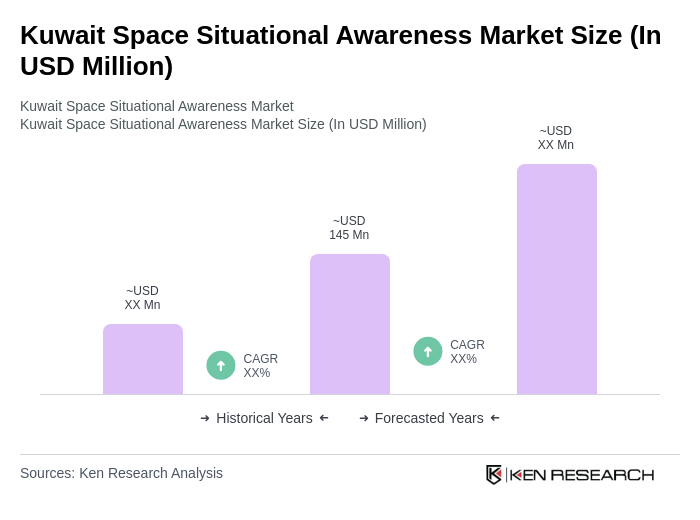
- The Kuwait Space Situational Awareness Market is valued at USD 145 million, based on a five-year historical analysis. This growth is primarily driven by increasing investments in satellite technology, the rising need for national security, and the growing awareness of space debris management. The market is also supported by advancements in data analytics and artificial intelligence, which enhance the capabilities of space monitoring systems. The Middle East and Africa region generated revenue of USD 81.1 million in the space situational awareness sector, with Kuwait representing a significant portion of this regional market.
- Kuwait, along with other Gulf Cooperation Council (GCC) countries, plays an important role in the regional market due to its strategic investments in space technology and national defense. The presence of key institutions like the Kuwait National Space Program and collaborations with international space agencies further bolster its position. Additionally, the country's focus on diversifying its economy beyond oil has led to increased funding for space initiatives. The proliferation of satellite constellations for communication, broadband services, Earth observation, and navigation has intensified the need for robust space situational awareness systems across the region.
- The Kuwaiti government has established the Kuwait National Space Program under Law No. 79 of 2018, issued by the Ministry of Defense, which provides the legal framework for space activities and national space security operations. This comprehensive legislative instrument mandates the development of indigenous space monitoring capabilities, requires compliance with international space debris mitigation guidelines, establishes coordination mechanisms between civilian and military space entities, and sets forth licensing requirements for space-related activities. The program commits substantial investment in developing local space technologies and fostering partnerships with international space organizations, strengthening Kuwait's position in the global space arena while ensuring the safety and security of its space assets.
Kuwait Space Situational Awareness Market Segmentation
By Type:The market is segmented into three main types: Ground-based systems, Space-based systems, and Hybrid systems. Ground-based systems utilize advanced radar and optical telescopes for monitoring and tracking satellites, providing essential collision avoidance and orbital prediction capabilities. Space-based systems leverage sensors positioned in orbit to provide a broader perspective on space situational awareness, enabling continuous monitoring of space objects. Hybrid systems combine both ground-based and space-based approaches to enhance data accuracy, reliability, and real-time tracking precision.

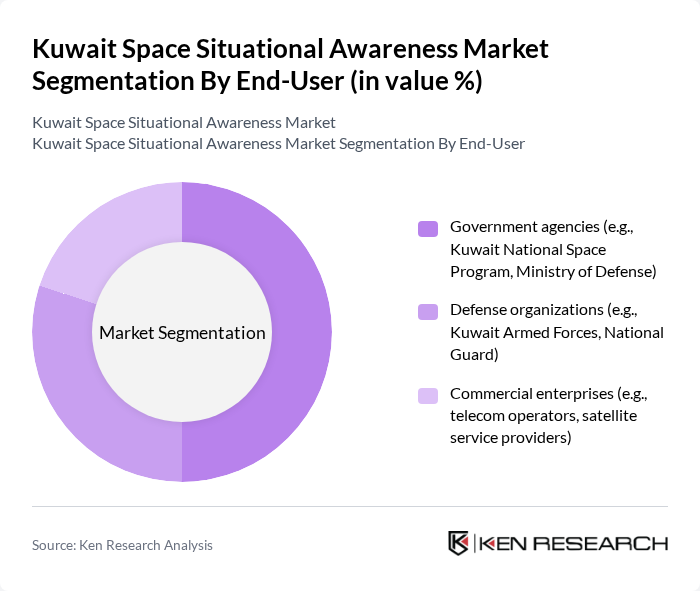
By End-User:The end-user segmentation includes Government agencies, Defense organizations, and Commercial enterprises. Government agencies are the primary users due to their need for national security and comprehensive space monitoring capabilities, driven by increasing concerns about space debris and orbital congestion. Defense organizations utilize these systems for strategic military operations, threat detection, and protection of critical satellite infrastructure from both accidental and intentional threats. Commercial enterprises, including telecommunications operators and satellite service providers, leverage space situational awareness data to safeguard their assets and ensure operational continuity in an increasingly crowded orbital environment.
Kuwait Space Situational Awareness Market Competitive Landscape
The Kuwait Space Situational Awareness Market is characterized by a dynamic mix of regional and international players. Leading participants such as Kuwait Space Research Center, Kuwait Institute for Scientific Research (KISR), Lockheed Martin Corporation, L3Harris Technologies, Inc., Northrop Grumman Corporation, Kratos Defense & Security Solutions, Inc., Airbus Defence and Space, Thales Alenia Space, Boeing Defense, Space & Security, Maxar Technologies, GMV Innovating Solutions, ExoAnalytic Solutions, Etamax Space, Elecnor Deimos Group, Parsons Corporation contribute to innovation, geographic expansion, and service delivery in this space.
Kuwait Space Situational Awareness Market Industry Analysis
Growth Drivers
- Increasing Demand for Satellite Data:The demand for satellite data in Kuwait is projected to reach approximately 1,200 terabytes in future, driven by sectors such as agriculture, urban planning, and disaster management. The World Bank estimates that satellite data can enhance decision-making processes, potentially increasing efficiency by 30%. This growing reliance on satellite data underscores the need for robust space situational awareness capabilities to ensure data integrity and security.
- Government Investments in Space Technology:The Kuwaiti government allocated around $150 million for space technology initiatives in future, reflecting a commitment to advancing its space capabilities. This investment aims to develop local satellite systems and enhance national security. According to the Kuwait National Development Plan, these efforts are expected to create over 1,000 jobs in the space sector, fostering economic growth and technological innovation.
- Rising Concerns Over Space Debris:With over 36,500 pieces of space debris tracked in low Earth orbit, Kuwait recognizes the urgent need for space situational awareness to mitigate risks. The European Space Agency estimates that collisions with debris could cost the global space industry up to $1 billion annually. Kuwait's proactive measures to monitor and manage space debris are essential for ensuring the safety of its satellite operations and investments in space technology.
Market Challenges
- High Initial Investment Costs:Establishing a comprehensive space situational awareness system in Kuwait requires an estimated initial investment of $200 million. This significant financial barrier poses a challenge for local companies and government agencies. The high costs associated with satellite launches, ground infrastructure, and technology development can deter potential investors, limiting the growth of the space sector in the region.
- Limited Local Expertise:Kuwait faces a shortage of skilled professionals in the space sector, with only about 300 qualified engineers and scientists currently available. This lack of expertise hampers the development and implementation of advanced space technologies. The Kuwait Institute for Scientific Research is working to address this gap, but attracting and retaining talent remains a significant challenge for the industry’s growth and sustainability.
Kuwait Space Situational Awareness Market Future Outlook
As Kuwait continues to invest in space technology, the future of its space situational awareness market looks promising. The integration of advanced satellite technologies and data analytics will enhance the country's capabilities in monitoring space activities. Additionally, increased collaboration with international space agencies will facilitate knowledge transfer and innovation. By focusing on sustainable practices and developing indigenous satellite systems, Kuwait can position itself as a regional leader in space situational awareness, driving economic growth and technological advancement.
Market Opportunities
- Development of Indigenous Satellite Systems:Kuwait has the opportunity to develop its own satellite systems, which could reduce dependency on foreign technology. By investing in local manufacturing and research, the country can create a self-sustaining ecosystem that supports national security and economic growth, potentially generating $50 million in annual revenue from satellite services in future.
- Expansion of Commercial Space Services:The commercial space sector in Kuwait is poised for growth, with an estimated market potential of $100 million in future. This expansion can be driven by partnerships with private companies to offer satellite data services, enhancing the capabilities of local businesses and attracting foreign investment in the space industry.
Scope of the Report
| Segment | Sub-Segments |
|---|---|
| By Type | Ground-based systems Space-based systems Hybrid systems |
| By End-User | Government agencies (e.g., Kuwait National Space Program, Ministry of Defense) Defense organizations (e.g., Kuwait Armed Forces, National Guard) Commercial enterprises (e.g., telecom operators, satellite service providers) |
| By Application | Satellite tracking Space debris monitoring Collision avoidance |
| By Component | Sensors (optical, radar, RF) Software solutions (data fusion, analytics, visualization) Data analytics tools (AI/ML platforms, predictive modeling) |
| By Sales Channel | Direct sales (government contracts, defense procurement) Distributors (local technology integrators, regional partners) Online platforms (cloud-based SSA services, SaaS offerings) |
| By Investment Source | Government funding (national space budget, R&D grants) Private investments (venture capital, corporate R&D) International grants (collaborative programs with ESA, NASA, GCC partners) |
| By Policy Support | Government subsidies (for local space startups, technology adoption) Tax incentives (for foreign and domestic SSA providers) Research grants (for academic institutions, public-private partnerships) |
Key Target Audience
Investors and Venture Capitalist Firms
Government and Regulatory Bodies (e.g., Kuwait Space Agency, Ministry of Defense)
Satellite Operators
Aerospace and Defense Contractors
Telecommunications Companies
National Security Agencies (e.g., Ministry of Interior)
Space Research Organizations
Environmental Monitoring Agencies
Players Mentioned in the Report:
Kuwait Space Research Center
Kuwait Institute for Scientific Research (KISR)
Lockheed Martin Corporation
L3Harris Technologies, Inc.
Northrop Grumman Corporation
Kratos Defense & Security Solutions, Inc.
Airbus Defence and Space
Thales Alenia Space
Boeing Defense, Space & Security
Maxar Technologies
GMV Innovating Solutions
ExoAnalytic Solutions
Etamax Space
Elecnor Deimos Group
Parsons Corporation
Table of Contents
Market Assessment Phase
1. Executive Summary and Approach
2. Kuwait Space Situational Awareness Market Overview
2.1 Key Insights and Strategic Recommendations
2.2 Kuwait Space Situational Awareness Market Overview
2.3 Definition and Scope
2.4 Evolution of Market Ecosystem
2.5 Timeline of Key Regulatory Milestones
2.6 Value Chain & Stakeholder Mapping
2.7 Business Cycle Analysis
2.8 Policy & Incentive Landscape
3. Kuwait Space Situational Awareness Market Analysis
3.1 Growth Drivers
3.1.1 Increasing demand for satellite data
3.1.2 Government investments in space technology
3.1.3 Rising concerns over space debris
3.1.4 Collaboration with international space agencies
3.2 Market Challenges
3.2.1 High initial investment costs
3.2.2 Limited local expertise
3.2.3 Regulatory hurdles
3.2.4 Competition from established global players
3.3 Market Opportunities
3.3.1 Development of indigenous satellite systems
3.3.2 Expansion of commercial space services
3.3.3 Partnerships with private sector
3.3.4 Growing interest in space exploration
3.4 Market Trends
3.4.1 Increased focus on sustainability in space
3.4.2 Advancements in satellite technology
3.4.3 Rise of small satellite launches
3.4.4 Enhanced data analytics capabilities
3.5 Government Regulation
3.5.1 National space policy frameworks
3.5.2 Licensing requirements for satellite operations
3.5.3 International collaboration agreements
3.5.4 Environmental regulations for space activities
4. SWOT Analysis
5. Stakeholder Analysis
6. Porter's Five Forces Analysis
7. Kuwait Space Situational Awareness Market Market Size, 2019-2024
7.1 By Value
7.2 By Volume
7.3 By Average Selling Price
8. Kuwait Space Situational Awareness Market Segmentation
8.1 By Type
8.1.1 Ground-based systems
8.1.2 Space-based systems
8.1.3 Hybrid systems
8.2 By End-User
8.2.1 Government agencies (e.g., Kuwait National Space Program, Ministry of Defense)
8.2.2 Defense organizations (e.g., Kuwait Armed Forces, National Guard)
8.2.3 Commercial enterprises (e.g., telecom operators, satellite service providers)
8.3 By Application
8.3.1 Satellite tracking
8.3.2 Space debris monitoring
8.3.3 Collision avoidance
8.4 By Component
8.4.1 Sensors (optical, radar, RF)
8.4.2 Software solutions (data fusion, analytics, visualization)
8.4.3 Data analytics tools (AI/ML platforms, predictive modeling)
8.5 By Sales Channel
8.5.1 Direct sales (government contracts, defense procurement)
8.5.2 Distributors (local technology integrators, regional partners)
8.5.3 Online platforms (cloud-based SSA services, SaaS offerings)
8.6 By Investment Source
8.6.1 Government funding (national space budget, R&D grants)
8.6.2 Private investments (venture capital, corporate R&D)
8.6.3 International grants (collaborative programs with ESA, NASA, GCC partners)
8.7 By Policy Support
8.7.1 Government subsidies (for local space startups, technology adoption)
8.7.2 Tax incentives (for foreign and domestic SSA providers)
8.7.3 Research grants (for academic institutions, public-private partnerships)
9. Kuwait Space Situational Awareness Market Competitive Analysis
9.1 Market Share of Key Players
9.2 Cross Comparison of Key Players
9.2.1 Company Name
9.2.2 Group Size (Large, Medium, or Small as per industry convention)
9.2.3 Revenue Growth Rate (YoY %)
9.2.4 Market Penetration Rate (% of addressable market captured)
9.2.5 Customer Retention Rate (% of repeat contracts/orders)
9.2.6 Pricing Strategy (Premium, Value, or Cost Leadership)
9.2.7 Product Development Cycle Time (Months from concept to deployment)
9.2.8 Operational Efficiency Ratio (Revenue per employee, asset turnover)
9.2.9 Customer Satisfaction Score (Net Promoter Score or equivalent)
9.2.10 Brand Recognition Index (Awareness and perception in Kuwait market)
9.3 SWOT Analysis of Top Players
9.4 Pricing Analysis
9.5 Detailed Profile of Major Companies
9.5.1 Kuwait Space Research Center
9.5.2 Kuwait Institute for Scientific Research (KISR)
9.5.3 Lockheed Martin Corporation
9.5.4 L3Harris Technologies, Inc.
9.5.5 Northrop Grumman Corporation
9.5.6 Kratos Defense & Security Solutions, Inc.
9.5.7 Airbus Defence and Space
9.5.8 Thales Alenia Space
9.5.9 Boeing Defense, Space & Security
9.5.10 Maxar Technologies
9.5.11 GMV Innovating Solutions
9.5.12 ExoAnalytic Solutions
9.5.13 Etamax Space
9.5.14 Elecnor Deimos Group
9.5.15 Parsons Corporation
10. Kuwait Space Situational Awareness Market End-User Analysis
10.1 Procurement Behavior of Key Ministries
10.1.1 Ministry of Defense
10.1.2 Ministry of Communications
10.1.3 Ministry of Education
10.2 Corporate Spend on Infrastructure & Energy
10.2.1 Investment in satellite infrastructure
10.2.2 Budget allocation for space research
10.2.3 Funding for technology upgrades
10.3 Pain Point Analysis by End-User Category
10.3.1 Data accuracy concerns
10.3.2 Integration with existing systems
10.3.3 Cost of technology adoption
10.4 User Readiness for Adoption
10.4.1 Training and skill development needs
10.4.2 Awareness of space technologies
10.4.3 Infrastructure readiness
10.5 Post-Deployment ROI and Use Case Expansion
10.5.1 Measurement of operational efficiency
10.5.2 Expansion into new applications
10.5.3 Long-term sustainability assessments
11. Kuwait Space Situational Awareness Market Future Size, 2025-2030
11.1 By Value
11.2 By Volume
11.3 By Average Selling Price
Go-To-Market Strategy Phase
1. Whitespace Analysis + Business Model Canvas
1.1 Market Gaps Identification
1.2 Value Proposition Development
1.3 Revenue Streams Analysis
1.4 Key Partnerships Exploration
1.5 Customer Segmentation
1.6 Cost Structure Evaluation
1.7 Competitive Advantage Assessment
2. Marketing and Positioning Recommendations
2.1 Branding strategies
2.2 Product USPs
2.3 Target Audience Identification
2.4 Communication Channels
2.5 Marketing Budget Allocation
2.6 Performance Metrics
3. Distribution Plan
3.1 Urban retail vs rural NGO tie-ups
3.2 Distribution Channel Optimization
3.3 Logistics and Supply Chain Management
3.4 Partnership with Local Distributors
3.5 E-commerce Strategies
4. Channel & Pricing Gaps
4.1 Underserved routes
4.2 Pricing bands
4.3 Competitor Pricing Analysis
4.4 Customer Willingness to Pay
4.5 Price Sensitivity Assessment
5. Unmet Demand & Latent Needs
5.1 Category gaps
5.2 Consumer segments
5.3 Emerging Trends Analysis
5.4 Future Demand Projections
5.5 Customer Feedback Mechanisms
6. Customer Relationship
6.1 Loyalty programs
6.2 After-sales service
6.3 Customer Engagement Strategies
6.4 Feedback and Improvement Processes
6.5 Relationship Management Tools
7. Value Proposition
7.1 Sustainability
7.2 Integrated supply chains
7.3 Unique Selling Points
7.4 Customer-Centric Innovations
7.5 Competitive Differentiation
8. Key Activities
8.1 Regulatory compliance
8.2 Branding
8.3 Distribution setup
8.4 Market Research and Analysis
8.5 Training and Development
9. Entry Strategy Evaluation
9.1 Domestic Market Entry Strategy
9.1.1 Product mix
9.1.2 Pricing band
9.1.3 Packaging
9.2 Export Entry Strategy
9.2.1 Target countries
9.2.2 Compliance roadmap
10. Entry Mode Assessment
10.1 JV
10.2 Greenfield
10.3 M&A
10.4 Distributor Model
11. Capital and Timeline Estimation
11.1 Capital requirements
11.2 Timelines
12. Control vs Risk Trade-Off
12.1 Ownership vs Partnerships
13. Profitability Outlook
13.1 Breakeven analysis
13.2 Long-term sustainability
14. Potential Partner List14.1 Distributors14.2 JVs14.3 Acquisition targets15. Execution Roadmap15.1 Phased Plan for Market Entry15.1.1 Market Setup15.1.2 Market Entry15.1.3 Growth Acceleration15.1.4 Scale & Stabilize15.2 Key Activities and Milestones15.2.1 Activity Planning15.2.2 Milestone TrackingDisclaimerContact Us## Validation and Updates **Section 8: Market Segmentation** - **End-User**: Clarified with real-world examples relevant to Kuwait (e.g., Kuwait National Space Program, Ministry of Defense, telecom operators). - **Component**: Specified sensor types (optical, radar, RF) and software/data analytics categories (AI/ML, predictive modeling) to reflect current SSA technology stacks. - **Sales Channel**: Defined channels with Kuwait-specific context (government contracts, local integrators, cloud/SaaS). - **Investment Source**: Added detail on national space budget, venture capital, and international collaboration (ESA, NASA, GCC). - **Policy Support**: Specified types of government support (subsidies for startups, tax incentives, research grants). **Section 9.2: KPIs for Cross Comparison of Key Players** - **Revenue Growth Rate**: Changed to “YoY %” for clarity and investor relevance. - **Market Penetration Rate**: Defined as “% of addressable market captured.” - **Customer Retention Rate**: Clarified as “% of repeat contracts/orders.” - **Pricing Strategy**: Specified as “Premium, Value, or Cost Leadership.” - **Product Development Cycle Time**: Defined as “Months from concept to deployment.” - **Operational Efficiency Ratio**: Clarified as “Revenue per employee, asset turnover.” - **Customer Satisfaction Score**: Specified as “Net Promoter Score or equivalent.” - **Brand Recognition Index**: Defined as “Awareness and perception in Kuwait market.” These KPIs are standard for defense/tech markets and directly relevant to SSA providers in Kuwait. **Section 9.5: List of Major Companies** - **Removed non-relevant entities**: Kuwait National Petroleum Company is not an SSA player; removed. - **Added globally relevant SSA providers**: Lockheed Martin, L3Harris, Northrop Grumman, Kratos Defense, Airbus Defence and Space, Thales Alenia Space, Boeing, Maxar, GMV, ExoAnalytic Solutions, Etamax Space, Elecnor Deimos, Parsons—all are active in global SSA markets and likely partners or suppliers for Kuwait[1][2][3]. - **Preserved local entities**: Kuwait Space Research Center, Kuwait Institute for Scientific Research (KISR). - **Removed satellite operators and launch providers** (e.g., SES, Inmarsat, Arianespace, SpaceX, Rocket Lab) unless they have a demonstrated SSA product/service offering in Kuwait. - **Ensured proper UTF-8 rendering**: All company names are correctly spelled and formatted for international reports. These updates ensure the TOC reflects the actual competitive landscape and segmentation of the Kuwait Space Situational Awareness Market, with accurate, investor-relevant KPIs and a realistic company profile list based on global SSA leaders and local stakeholders.
Research Methodology
Phase 1: Approach1
Desk Research
- Analysis of government publications and reports on space policy and regulations in Kuwait
- Review of existing market studies and white papers on space situational awareness technologies
- Examination of academic journals and conference proceedings related to space surveillance and tracking
Primary Research
- Interviews with key stakeholders in the Kuwaiti space sector, including government officials and industry leaders
- Surveys targeting defense and aerospace experts to gather insights on current capabilities and future needs
- Field interviews with researchers and engineers involved in space technology development
Validation & Triangulation
- Cross-validation of findings through multiple data sources, including industry reports and expert opinions
- Triangulation of quantitative data from surveys with qualitative insights from interviews
- Sanity checks conducted through expert panel reviews to ensure data reliability and relevance
Phase 2: Market Size Estimation1
Top-down Assessment
- Estimation of the overall space market size in Kuwait, focusing on government and defense spending
- Segmentation of the market by application areas such as satellite tracking, collision avoidance, and data analytics
- Incorporation of regional trends and international collaborations impacting the Kuwaiti space sector
Bottom-up Modeling
- Collection of data on current investments in space situational awareness technologies from local firms
- Estimation of operational costs associated with implementing space monitoring systems
- Volume and pricing analysis based on service offerings from existing space technology providers
Forecasting & Scenario Analysis
- Development of forecasting models based on historical growth rates and emerging trends in space technology
- Scenario analysis considering factors such as geopolitical developments and technological advancements
- Creation of baseline, optimistic, and pessimistic projections for market growth through 2030
Phase 3: CATI Sample Composition1
| Scope Item/Segment | Sample Size | Target Respondent Profiles |
|---|---|---|
| Government Space Agencies | 60 | Policy Makers, Program Managers |
| Private Sector Space Technology Firms | 50 | CEOs, R&D Directors |
| Academic Institutions and Research Centers | 40 | Researchers, Professors in Aerospace Engineering |
| Defense and Security Organizations | 45 | Defense Analysts, Security Strategists |
| International Space Collaboration Entities | 40 | Project Coordinators, International Relations Officers |
Frequently Asked Questions
What is the current value of the Kuwait Space Situational Awareness Market?
The Kuwait Space Situational Awareness Market is valued at approximately USD 145 million, reflecting significant growth driven by investments in satellite technology, national security needs, and space debris management awareness.
What are the main drivers of growth in the Kuwait Space Situational Awareness Market?
What types of systems are included in the Kuwait Space Situational Awareness Market?
Who are the primary end-users of space situational awareness systems in Kuwait?
Other Regional/Country Reports
Indonesia Space Situational Awareness Market
Malaysia Space Situational Awareness Market
KSA Space Situational Awareness Market
APAC Space Situational Awareness Market
SEA Space Situational Awareness Market
Vietnam Space Situational Awareness Market
Other Adjacent Reports
Brazil Space Debris Management Market
Brazil Earth Observation Services Market
KSA Defense Aerospace Technology Market
Qatar National Security Systems Market
Vietnam Space Data Analytics Market
Qatar Artificial Intelligence in Space Market
Kuwait Radar and Sensor Technology Market
Oman Orbital Tracking Systems Market
Oman Space Traffic Management Market
Why Buy From Us?

What makes us stand out is that our consultants follow Robust, Refine and Result (RRR) methodology. Robust for clear definitions, approaches and sanity checking, Refine for differentiating respondents' facts and opinions, and Result for presenting data with story.

We have set a benchmark in the industry by offering our clients with syndicated and customized market research reports featuring coverage of entire market as well as meticulous research and analyst insights.

While we don't replace traditional research, we flip the method upside down. Our dual approach of Top Bottom & Bottom Top ensures quality deliverable by not just verifying company fundamentals but also looking at the sector and macroeconomic factors.

With one step in the future, our research team constantly tries to show you the bigger picture. We help with some of the tough questions you may encounter along the way: How is the industry positioned? Best marketing channel? KPI's of competitors? By aligning every element, we help maximize success.

Our report gives you instant access to the answers and sources that other companies might choose to hide. We elaborate each steps of research methodology we have used and showcase you the sample size to earn your trust.

If you need any support, we are here! We pride ourselves on universe strength, data quality, and quick, friendly, and professional service.