About the Report
Base Year 2024Malaysia Food Antioxidants Market Overview
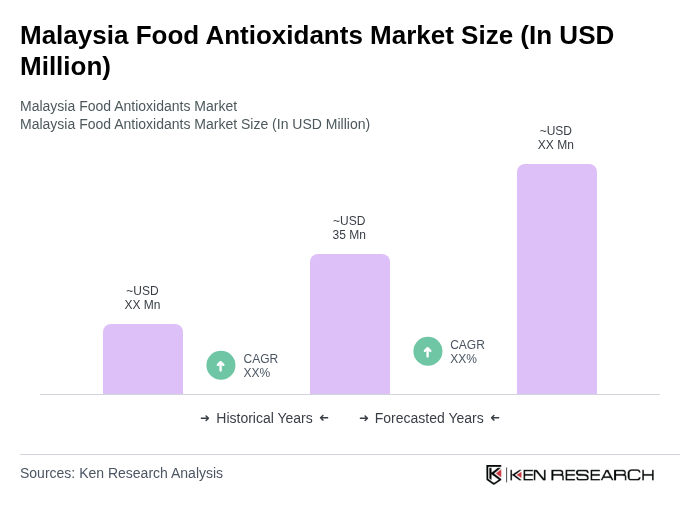
- The Malaysia Food Antioxidants Market is valued at USD 35 million, based on a five-year historical analysis and its share within the broader Asia Pacific food antioxidants market, which exceeded USD 865 million in 2019. This growth is primarily driven by increasing consumer awareness regarding health benefits, the rising demand for natural food preservatives, and the expanding food and beverage industry in Southeast Asia. The market has seen a significant shift towards natural antioxidants such as tocopherols, vitamin C, plant extracts, and polyphenols, aligned with clean?label and “better?for?you” trends that favor natural ingredients over synthetic alternatives.
- Key demand hubs for food antioxidants in Malaysia include Kuala Lumpur (Greater Klang Valley), Penang, and Johor Bahru. These areas host a high concentration of food and beverage manufacturing, processing, cold-chain logistics, and export-oriented facilities, supported by industrial parks and ports such as Port Klang, Penang Port, and Johor’s Pasir Gudang and Tanjung Pelepas. These cities dominate the market due to their robust food processing industries, strategic locations for domestic distribution and exports to ASEAN and global markets, and a growing urban consumer base that is increasingly health-conscious. The presence of major food manufacturers, contract manufacturers, and supporting R&D institutions in these corridors further enhances their market position.
- Regulation of food antioxidants in Malaysia is primarily governed by the Food Regulations 1985 issued under the Food Act 1983 by the Ministry of Health Malaysia, which specify permitted antioxidants (including BHA, BHT, TBHQ, and others), maximum usage levels, and labelling requirements for food additives. These rules require that food additives, including synthetic antioxidants, be declared on labels by their class name and specific additive name or code, and set conditions of use by food category to ensure safety and quality. Recent clean?label and health?driven reformulation by manufacturers, in line with Ministry of Health nutrition policies, is encouraging a gradual increase in the use of natural antioxidants as alternatives or complements to synthetic options in processed foods and beverages.
Malaysia Food Antioxidants Market Segmentation
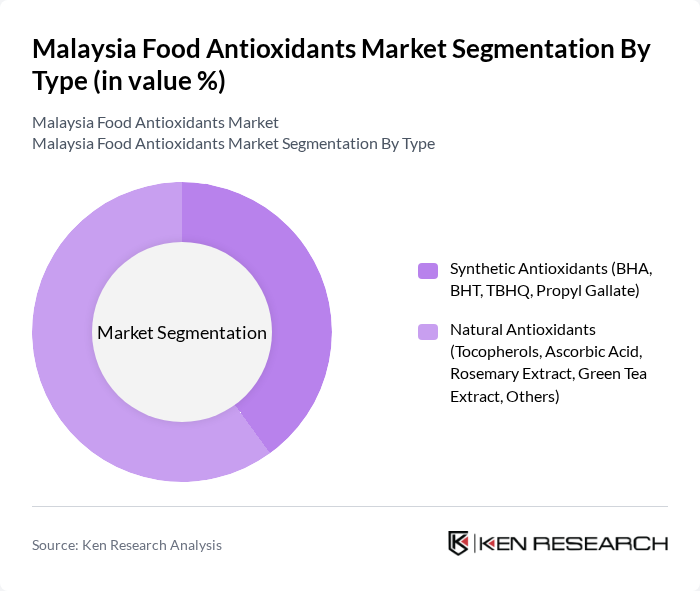
By Type:The market is segmented into two main types: Synthetic Antioxidants and Natural Antioxidants. Synthetic Antioxidants include BHA, BHT, TBHQ, and Propyl Gallate, which are widely used in fats and oils, processed meat, snacks, and bakery products to delay lipid oxidation and extend shelf life. Natural Antioxidants encompass Tocopherols, Ascorbic Acid, Rosemary Extract, Green Tea Extract, and others, increasingly preferred in clean?label, functional, and premium products owing to their association with anti?aging, anti?inflammatory, and cardioprotective benefits. The demand for natural antioxidants is on the rise in Asia Pacific and Malaysia as food and beverage companies reformulate toward plant?derived and naturally sourced solutions to meet consumer expectations and retailer standards.
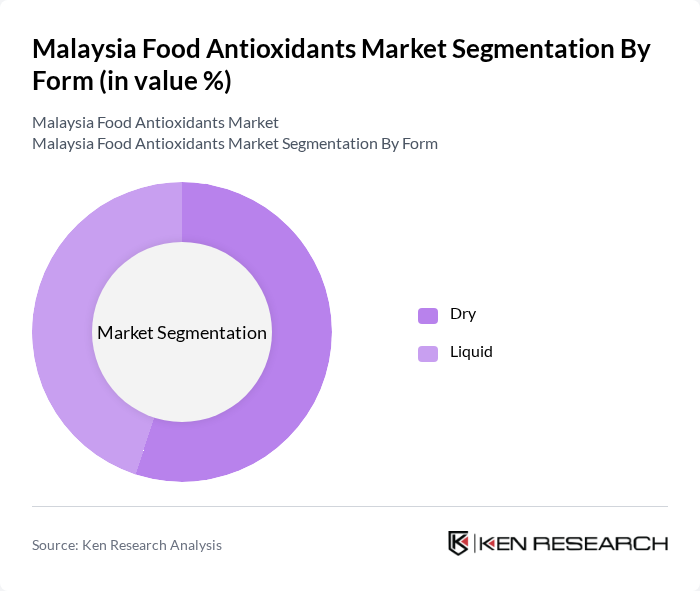
By Form:The market is categorized into Dry and Liquid forms. Dry forms (including powders, granules, and encapsulated formats) are often preferred for their longer shelf life, ease of handling, stability in high?temperature processes, and compatibility with dry mixes, bakery premixes, instant foods, and snack seasonings. Liquid forms are favored for their versatility in emulsions, beverages, oils and fats, dressings, and meat marinades, where dispersion and solubility in lipid or aqueous phases are critical. The choice between these forms often depends on the specific application (such as bakery, meat, edible oils, beverages, or processed foods) and manufacturer preferences regarding processing conditions and dosing systems.
Malaysia Food Antioxidants Market Competitive Landscape
The Malaysia Food Antioxidants Market is characterized by a dynamic mix of regional and international players. Leading participants such as BASF SE, Archer Daniels Midland Company (ADM), Kemin Industries, Inc., Cargill, Incorporated, DSM Nutritional Products, DuPont (IFF Nutrition & Biosciences), Camlin Fine Sciences Ltd., Eastman Chemical Company, Kalsec Inc., Chr. Hansen Holding A/S, Olam International, Sensient Technologies Corporation, Naturex S.A. (Givaudan), Frutarom Ltd. (IFF), Local & Regional Players (Malaysia and ASEAN) contribute to innovation, geographic expansion, and service delivery in this space.
Malaysia Food Antioxidants Market Industry Analysis
Growth Drivers
- Increasing Health Awareness:The Malaysian population is becoming increasingly health-conscious, with 80% of consumers actively seeking healthier food options. This trend is supported by the Ministry of Health's initiatives promoting balanced diets and nutrition. The rise in lifestyle-related diseases, such as diabetes and hypertension, has further fueled demand for food antioxidants, which are perceived to enhance health and longevity. As a result, the food antioxidants market is experiencing significant growth driven by this heightened awareness.
- Rising Demand for Natural Ingredients:The demand for natural ingredients in food products is surging, with the natural food market in Malaysia projected to reach MYR 12 billion in future. Consumers are increasingly avoiding synthetic additives, leading to a 20% annual growth in the natural food segment. This shift is driving food manufacturers to incorporate natural antioxidants, such as tocopherols and polyphenols, into their products, thereby expanding the food antioxidants market significantly.
- Growth in Functional Foods Market:The functional foods market in Malaysia is expected to grow to MYR 10 billion in future, driven by consumer interest in foods that provide health benefits beyond basic nutrition. Antioxidants play a crucial role in this segment, as they are often marketed for their health-promoting properties. The increasing availability of fortified foods and beverages containing antioxidants is further propelling market growth, as consumers seek products that support overall well-being.
Market Challenges
- Regulatory Compliance Issues:The food antioxidants market in Malaysia faces significant regulatory compliance challenges, particularly concerning food safety and quality standards. The Food Safety and Quality Act mandates strict adherence to safety protocols, which can be costly and time-consuming for manufacturers. Non-compliance can lead to penalties and product recalls, creating a barrier for new entrants and hindering market growth. This regulatory landscape necessitates ongoing investment in compliance measures.
- High Production Costs:The production of natural antioxidants often involves high costs due to sourcing raw materials and advanced extraction technologies. For instance, the cost of sourcing high-quality plant extracts can reach up to MYR 600 per kilogram. These elevated production costs can limit profit margins for manufacturers and deter investment in the sector. Consequently, companies may struggle to compete with cheaper synthetic alternatives, impacting market dynamics negatively.
Malaysia Food Antioxidants Market Future Outlook
The future of the food antioxidants market in Malaysia appears promising, driven by increasing consumer demand for health-oriented products and natural ingredients. As the market evolves, innovations in extraction technologies and product formulations are expected to enhance the efficacy and appeal of antioxidants. Additionally, the growing trend of e-commerce is likely to facilitate wider distribution of antioxidant-rich products, making them more accessible to consumers. This dynamic environment presents opportunities for growth and expansion in the sector.
Market Opportunities
- Development of Innovative Products:There is a significant opportunity for manufacturers to develop innovative antioxidant-rich products tailored to specific health needs. For example, products targeting aging and skin health are gaining traction, with the market for such items projected to grow by MYR 1.5 billion in future. This innovation can attract health-conscious consumers and differentiate brands in a competitive landscape.
- Growing E-commerce Platforms:The rise of e-commerce platforms presents a lucrative opportunity for the food antioxidants market. Online sales of health products are expected to increase by 40% annually, driven by convenience and a broader reach. Companies can leverage digital marketing strategies to promote antioxidant products, enhancing visibility and accessibility to a wider audience, thus driving sales growth.
Scope of the Report
| Segment | Sub-Segments |
|---|---|
| By Type | Synthetic Antioxidants (BHA, BHT, TBHQ, Propyl Gallate) Natural Antioxidants (Tocopherols, Ascorbic Acid, Rosemary Extract, Green Tea Extract, Others) |
| By Form | Dry Liquid |
| By Source | Fruits & Vegetables Oils Spices & Herbs Botanical Extracts Petroleum-Derived / Gallic Acid |
| By Application | Fats & Oils Prepared Meat & Poultry Bakery & Confectionery Beverages Prepared / Processed Foods Nutraceuticals & Dietary Supplements Other Food Applications |
| By End-Use Industry | Food & Beverage Manufacturers Nutraceutical & Dietary Supplement Producers Foodservice & HORECA Others |
| By Region | Central Region Northern Region Southern Region Eastern Region |
Key Target Audience
Investors and Venture Capitalist Firms
Government and Regulatory Bodies (e.g., Ministry of Health Malaysia, Malaysian Food Safety and Quality Division)
Manufacturers and Producers
Distributors and Retailers
Food and Beverage Companies
Health and Wellness Brands
Industry Associations (e.g., Malaysian Food Manufacturers' Association)
Financial Institutions
Players Mentioned in the Report:
BASF SE
Archer Daniels Midland Company (ADM)
Kemin Industries, Inc.
Cargill, Incorporated
DSM Nutritional Products
DuPont (IFF Nutrition & Biosciences)
Camlin Fine Sciences Ltd.
Eastman Chemical Company
Kalsec Inc.
Chr. Hansen Holding A/S
Olam International
Sensient Technologies Corporation
Naturex S.A. (Givaudan)
Frutarom Ltd. (IFF)
Local & Regional Players (Malaysia and ASEAN)
Table of Contents
Market Assessment Phase
1. Executive Summary and Approach
2. Malaysia Food Antioxidants Market Overview
2.1 Key Insights and Strategic Recommendations
2.2 Malaysia Food Antioxidants Market Overview
2.3 Definition and Scope
2.4 Evolution of Market Ecosystem
2.5 Timeline of Key Regulatory Milestones
2.6 Value Chain & Stakeholder Mapping
2.7 Business Cycle Analysis
2.8 Policy & Incentive Landscape
3. Malaysia Food Antioxidants Market Analysis
3.1 Growth Drivers
3.1.1 Increasing Health Awareness
3.1.2 Rising Demand for Natural Ingredients
3.1.3 Growth in Functional Foods Market
3.1.4 Expansion of Food and Beverage Industry
3.2 Market Challenges
3.2.1 Regulatory Compliance Issues
3.2.2 High Production Costs
3.2.3 Limited Consumer Awareness
3.2.4 Competition from Synthetic Alternatives
3.3 Market Opportunities
3.3.1 Development of Innovative Products
3.3.2 Growing E-commerce Platforms
3.3.3 Export Potential to ASEAN Markets
3.3.4 Collaborations with Health Institutions
3.4 Market Trends
3.4.1 Shift Towards Organic and Natural Products
3.4.2 Increasing Use of Antioxidants in Personal Care
3.4.4 Technological Advancements in Extraction Methods
3.5 Government Regulation
3.5.1 Food Safety and Quality Regulations
3.5.2 Labeling Requirements for Antioxidants
3.5.3 Import and Export Regulations
3.5.4 Support for Research and Development
4. SWOT Analysis
5. Stakeholder Analysis
6. Porter's Five Forces Analysis
7. Malaysia Food Antioxidants Market Market Size, 2019-2024
7.1 By Value
7.2 By Volume
7.3 By Average Selling Price
8. Malaysia Food Antioxidants Market Segmentation
8.1 By Type
8.1.1 Synthetic Antioxidants (BHA, BHT, TBHQ, Propyl Gallate)
8.1.2 Natural Antioxidants (Tocopherols, Ascorbic Acid, Rosemary Extract, Green Tea Extract, Others)
8.2 By Form
8.2.1 Dry
8.2.2 Liquid
8.3 By Source
8.3.1 Fruits & Vegetables
8.3.2 Oils
8.3.3 Spices & Herbs
8.3.4 Botanical Extracts
8.3.5 Petroleum-Derived / Gallic Acid
8.4 By Application
8.4.1 Fats & Oils
8.4.2 Prepared Meat & Poultry
8.4.3 Bakery & Confectionery
8.4.4 Beverages
8.4.5 Prepared / Processed Foods
8.4.6 Nutraceuticals & Dietary Supplements
8.4.7 Other Food Applications
8.5 By End-Use Industry
8.5.1 Food & Beverage Manufacturers
8.5.2 Nutraceutical & Dietary Supplement Producers
8.5.3 Foodservice & HORECA
8.5.4 Others
8.6 By Region
8.6.1 Central Region
8.6.2 Northern Region
8.6.3 Southern Region
8.6.4 Eastern Region
9. Malaysia Food Antioxidants Market Competitive Analysis
9.1 Market Share of Key Players
9.2 Cross Comparison of Key Players
9.2.1 Company Name
9.2.2 Malaysia Food Antioxidants Revenue (USD, Latest Year)
9.2.3 3-Year Revenue CAGR in Malaysia Food Antioxidants
9.2.4 Market Share in Malaysia Food Antioxidants (%)
9.2.5 Gross Margin from Food Antioxidants (%)
9.2.6 R&D Spend on Antioxidants (% of Segment Revenue)
9.2.7 Average Realized Price per Kg (MYR/Kg)
9.2.8 Capacity Utilization Rate (%)
9.2.9 Distribution Reach (Number of Major F&B Customers / Channels)
9.2.10 New Product Launches in Last 3 Years (Count)
9.3 SWOT Analysis of Top Players
9.4 Pricing Analysis
9.5 Detailed Profile of Major Companies
9.5.1 BASF SE
9.5.2 Archer Daniels Midland Company (ADM)
9.5.3 Kemin Industries, Inc.
9.5.4 Cargill, Incorporated
9.5.5 DSM Nutritional Products
9.5.6 DuPont (IFF Nutrition & Biosciences)
9.5.7 Camlin Fine Sciences Ltd.
9.5.8 Eastman Chemical Company
9.5.9 Kalsec Inc.
9.5.10 Chr. Hansen Holding A/S
9.5.11 Olam International
9.5.12 Sensient Technologies Corporation
9.5.13 Naturex S.A. (Givaudan)
9.5.14 Frutarom Ltd. (IFF)
9.5.15 Local & Regional Players (Malaysia and ASEAN)
10. Malaysia Food Antioxidants Market End-User Analysis
10.1 Procurement Behavior of Key Ministries
10.1.1 Government Procurement Policies
10.1.2 Budget Allocations for Health Initiatives
10.1.3 Collaboration with Private Sector
10.1.4 Others
10.2 Corporate Spend on Infrastructure & Energy
10.2.1 Investment in Food Safety Technologies
10.2.2 Expenditure on Research and Development
10.2.3 Budget for Marketing and Promotion
10.2.4 Others
10.3 Pain Point Analysis by End-User Category
10.3.1 Quality Assurance Challenges
10.3.2 Supply Chain Disruptions
10.3.3 Cost Management Issues
10.3.4 Others
10.4 User Readiness for Adoption
10.4.1 Awareness of Antioxidant Benefits
10.4.2 Willingness to Pay for Quality
10.4.3 Availability of Alternatives
10.4.4 Others
10.5 Post-Deployment ROI and Use Case Expansion
10.5.1 Measurement of Effectiveness
10.5.2 Customer Feedback Mechanisms
10.5.3 Opportunities for Product Line Expansion
10.5.4 Others
11. Malaysia Food Antioxidants Market Future Size, 2025-2030
11.1 By Value
11.2 By Volume
11.3 By Average Selling Price
Go-To-Market Strategy Phase
1. Whitespace Analysis + Business Model Canvas
1.1 Market Gaps Identification
1.2 Value Proposition Development
1.3 Revenue Streams Analysis
1.4 Cost Structure Evaluation
1.5 Key Partnerships Exploration
1.6 Customer Segmentation
1.7 Competitive Advantage Assessment
2. Marketing and Positioning Recommendations
2.1 Branding Strategies
2.2 Product USPs
2.3 Target Market Identification
2.4 Communication Strategy
2.5 Digital Marketing Approaches
2.6 Customer Engagement Tactics
2.7 Performance Metrics
3. Distribution Plan
3.1 Urban Retail Strategies
3.2 Rural NGO Tie-ups
3.3 E-commerce Integration
3.4 Logistics and Supply Chain Management
3.5 Distribution Partnerships
3.6 Inventory Management
3.7 Performance Tracking
4. Channel & Pricing Gaps
4.1 Underserved Routes
4.2 Pricing Bands Analysis
4.3 Competitor Pricing Strategies
4.4 Customer Price Sensitivity
4.5 Value-Based Pricing Models
4.6 Discount Strategies
4.7 Pricing Optimization Techniques
5. Unmet Demand & Latent Needs
5.1 Category Gaps Identification
5.2 Consumer Segments Analysis
5.3 Product Development Opportunities
5.4 Market Entry Strategies
5.5 Customer Feedback Utilization
5.6 Trend Analysis
5.7 Future Demand Projections
6. Customer Relationship
6.1 Loyalty Programs
6.2 After-sales Service
6.3 Customer Support Channels
6.4 Feedback Mechanisms
6.5 Community Engagement
6.6 Relationship Management Tools
6.7 Performance Metrics
7. Value Proposition
7.1 Sustainability Initiatives
7.2 Integrated Supply Chains
7.3 Customer-Centric Approaches
7.4 Innovation in Product Offerings
7.5 Competitive Differentiation
7.6 Value Communication Strategies
7.7 Performance Metrics
8. Key Activities
8.1 Regulatory Compliance
8.2 Branding Initiatives
8.3 Distribution Setup
8.4 Marketing Campaigns
8.5 Training and Development
8.6 Performance Monitoring
8.7 Continuous Improvement Processes
9. Entry Strategy Evaluation
9.1 Domestic Market Entry Strategy
9.1.1 Product Mix
9.1.2 Pricing Band
9.1.3 Packaging Strategies
9.2 Export Entry Strategy
9.2.1 Target Countries
9.2.2 Compliance Roadmap
10. Entry Mode Assessment
10.1 Joint Ventures
10.2 Greenfield Investments
10.3 Mergers & Acquisitions
10.4 Distributor Model
10.5 Risk Assessment
10.6 Strategic Fit Evaluation
10.7 Performance Metrics
11. Capital and Timeline Estimation
11.1 Capital Requirements
11.2 Timelines for Implementation
11.3 Financial Projections
11.4 Funding Sources
11.5 Risk Management Strategies
11.6 Performance Metrics
12. Control vs Risk Trade-Off
12.1 Ownership vs Partnerships
12.2 Risk Mitigation Strategies
12.3 Control Mechanisms
12.4 Performance Metrics
13. Profitability Outlook
13.1 Breakeven Analysis
13.2 Long-term Sustainability
13.3 Financial Health Indicators
13.4 Performance Metrics
14. Potential Partner List
14.1 Distributors
14.2 Joint Ventures
14.3 Acquisition Targets
14.4 Strategic Alliances
14.5 Performance Metrics
15. Execution Roadmap
15.1 Phased Plan for Market Entry
15.1.1 Market Setup
15.1.2 Market Entry
15.1.3 Growth Acceleration
15.1.4 Scale & Stabilize
15.2 Key Activities and Milestones
15.2.1 Activity Planning
15.2.2 Milestone Tracking
15.2.3 Performance Metrics
Research Methodology
Phase 1: Approach1
Desk Research
- Analysis of market reports from Malaysian agricultural and food authorities
- Review of academic journals focusing on food science and antioxidant research
- Compilation of data from industry publications and trade associations related to food antioxidants
Primary Research
- Interviews with food scientists and researchers specializing in antioxidants
- Surveys conducted with food manufacturers and processors in Malaysia
- Focus group discussions with health and nutrition experts regarding consumer preferences
Validation & Triangulation
- Cross-validation of findings through multiple data sources including government and industry reports
- Triangulation of qualitative insights from interviews with quantitative data from surveys
- Sanity checks performed by a panel of experts in food technology and market analysis
Phase 2: Market Size Estimation1
Top-down Assessment
- Estimation of market size based on national food consumption statistics and antioxidant usage
- Segmentation of the market by product type, including natural and synthetic antioxidants
- Incorporation of trends in health consciousness and dietary supplement consumption
Bottom-up Modeling
- Collection of sales data from leading food manufacturers and distributors in Malaysia
- Estimation of market share based on product volume and pricing strategies
- Analysis of growth rates from historical data to project future market trends
Forecasting & Scenario Analysis
- Utilization of time-series analysis to forecast market growth over the next five years
- Scenario modeling based on potential regulatory changes affecting food additives
- Development of best-case, worst-case, and most-likely market scenarios
Phase 3: CATI Sample Composition1
| Scope Item/Segment | Sample Size | Target Respondent Profiles |
|---|---|---|
| Food Manufacturing Sector | 120 | Production Managers, Quality Control Officers |
| Retail and Distribution Channels | 90 | Supply Chain Managers, Retail Buyers |
| Health and Wellness Industry | 70 | Nutritionists, Health Product Developers |
| Research Institutions and Universities | 50 | Food Scientists, Academic Researchers |
| Consumer Insights | 110 | Health-conscious Consumers, Dietary Supplement Users |
Frequently Asked Questions
What is the current value of the Malaysia Food Antioxidants Market?
The Malaysia Food Antioxidants Market is valued at approximately USD 35 million, reflecting its share within the broader Asia Pacific food antioxidants market, which exceeded USD 865 million in 2019. This growth is driven by increasing health awareness and demand for natural preservatives.
What are the main types of antioxidants used in Malaysia?
Which regions in Malaysia are key demand hubs for food antioxidants?
What regulatory framework governs food antioxidants in Malaysia?
Other Regional/Country Reports
Other Adjacent Reports
Kuwait Natural Ingredients Market
Malaysia Functional Foods MarketGCC Nutraceuticals MarketSaudi Arabia South Korea Dietary Supplements Market Report Size, Share, Growth Drivers, Trends, Opportunities & Forecast 2025–2030Germany Plant Extracts Market
Bahrain Vitamins MarketSouth Africa Beverage Ingredients Market
Bahrain Bakery Ingredients Market
Why Buy From Us?

What makes us stand out is that our consultants follow Robust, Refine and Result (RRR) methodology. Robust for clear definitions, approaches and sanity checking, Refine for differentiating respondents' facts and opinions, and Result for presenting data with story.

We have set a benchmark in the industry by offering our clients with syndicated and customized market research reports featuring coverage of entire market as well as meticulous research and analyst insights.

While we don't replace traditional research, we flip the method upside down. Our dual approach of Top Bottom & Bottom Top ensures quality deliverable by not just verifying company fundamentals but also looking at the sector and macroeconomic factors.

With one step in the future, our research team constantly tries to show you the bigger picture. We help with some of the tough questions you may encounter along the way: How is the industry positioned? Best marketing channel? KPI's of competitors? By aligning every element, we help maximize success.

Our report gives you instant access to the answers and sources that other companies might choose to hide. We elaborate each steps of research methodology we have used and showcase you the sample size to earn your trust.

If you need any support, we are here! We pride ourselves on universe strength, data quality, and quick, friendly, and professional service.