About the Report
Base Year 2024Mena Architectural Services Market Overview
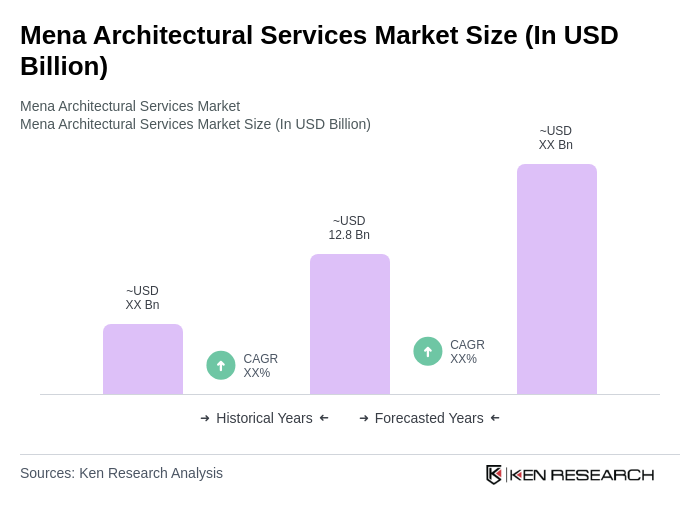
- The Mena Architectural Services Market is valued at USD 12.8 billion, based on a five-year historical analysis. This demand is supported by sustained infrastructure spending, mega-project pipelines, and real estate development across GCC and North Africa, alongside growing adoption of sustainable and smart building design practices .
- Key national markets include the UAE, Saudi Arabia, and Qatar, underpinned by large-scale urban development and diversification agendas. The UAE (notably Dubai) is associated with high-profile towers and luxury mixed-use projects; Saudi Arabia’s Vision 2030 is driving giga-projects and infrastructure expansion; and Qatar’s World Cup-related investments accelerated building programs and architectural commissions .
- Policy drivers in the UAE continue to push green building uptake—Dubai has mandated green building regulations for government buildings since 2011 and all new buildings since 2014—while Abu Dhabi’s Estidama and federal strategies reinforce energy efficiency and sustainable materials use; updates and enforcement actions have continued, aligning the market with regional decarbonization goals .
Mena Architectural Services Market Segmentation
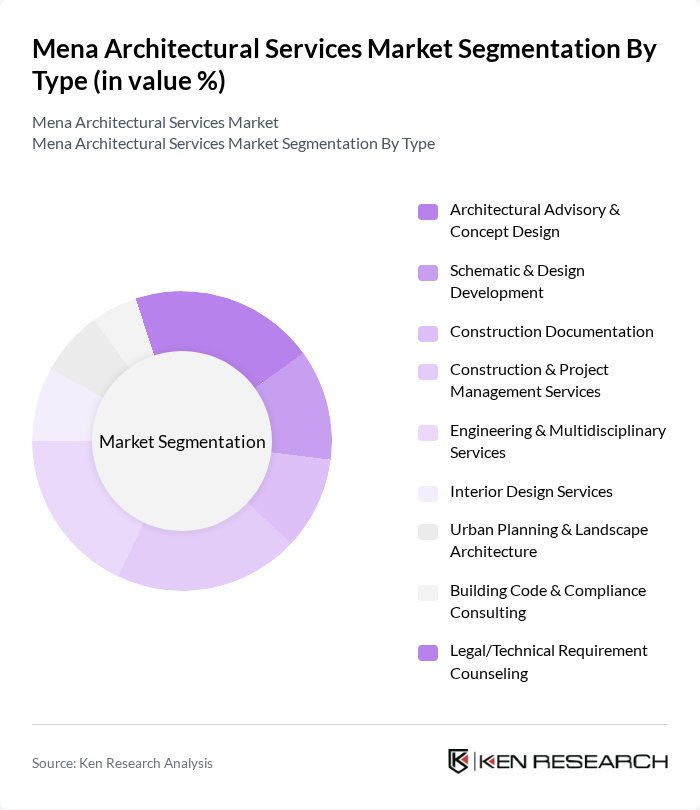
By Type:The architectural services market can be segmented into various types, including Architectural Advisory & Concept Design, Schematic & Design Development, Construction Documentation, Construction & Project Management Services, Engineering & Multidisciplinary Services, Interior Design Services, Urban Planning & Landscape Architecture, Building Code & Compliance Consulting, and Legal/Technical Requirement Counseling. Each of these subsegments plays a crucial role in the overall market dynamics.
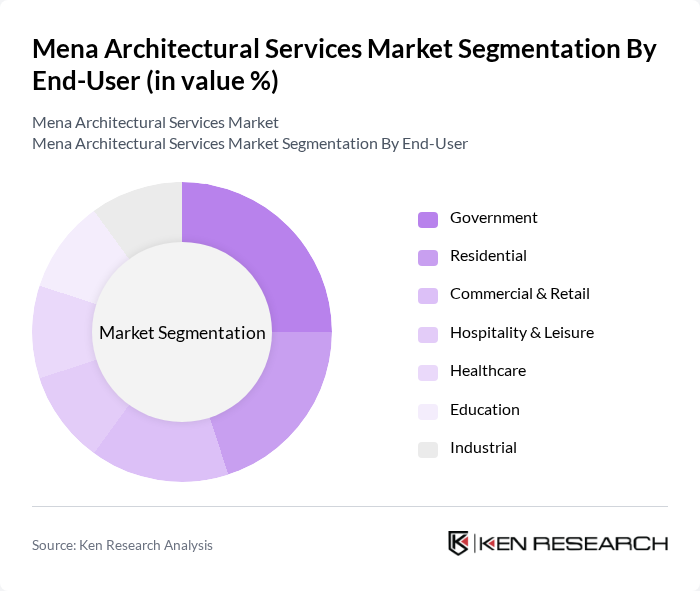
By End-User:The market can also be segmented by end-user categories, which include Government, Residential, Commercial & Retail, Hospitality & Leisure, Healthcare, Education, and Industrial. Each of these segments has unique requirements and contributes differently to the overall market.
Mena Architectural Services Market Competitive Landscape
The Mena Architectural Services Market is characterized by a dynamic mix of regional and international players. Leading participants such as AECOM Middle East, Gensler Middle East, Perkins&Will, HOK, Zaha Hadid Architects, Foster + Partners, Kohn Pedersen Fox (KPF), Skidmore, Owings & Merrill (SOM), Buro Happold, Arup, HDR, Stantec, CallisonRTKL, AtkinsRéalis (formerly Atkins), Dar Al-Handasah (Shair and Partners), KEO International Consultants, SSH Design, Dewan Architects + Engineers, Godwin Austen Johnson (GAJ), RMJM contribute to innovation, geographic expansion, and service delivery in this space.
Mena Architectural Services Market Industry Analysis
Growth Drivers
- Increasing Urbanization:The MENA region is experiencing rapid urbanization, with urban populations projected to reach 70% in future, up from 58% in 2020. This shift translates to approximately 100 million people moving to urban areas, driving demand for architectural services. Cities like Riyadh and Cairo are expanding, necessitating innovative designs and infrastructure. The World Bank estimates that urbanization contributes significantly to GDP growth, with urban areas generating 80% of economic output, further fueling architectural service needs.
- Government Infrastructure Investments:Governments in the MENA region are investing heavily in infrastructure, with an estimated $1.5 trillion earmarked for projects in future. Initiatives like Saudi Arabia's Vision 2030 and the UAE's National Agenda are pivotal, focusing on transportation, housing, and public facilities. For instance, the UAE plans to invest $100 billion in infrastructure in future, creating substantial opportunities for architectural firms. These investments are expected to enhance connectivity and urban development, driving demand for architectural services.
- Demand for Sustainable Design:The push for sustainability is reshaping the architectural landscape in MENA, with a projected 30% increase in green building projects in future. The UAE's Green Building Code aims for 100% compliance in new constructions, while Saudi Arabia's commitment to sustainable practices is evident in its NEOM project. The global green building market is expected to reach $1.2 trillion, with MENA's share growing as governments and private sectors prioritize eco-friendly designs, thus boosting architectural service demand.
Market Challenges
- Economic Fluctuations:The MENA region faces economic volatility, primarily due to fluctuating oil prices, which can impact government spending on infrastructure. For instance, oil prices fell to $40 per barrel in early 2023, leading to budget cuts in several countries. This uncertainty can hinder architectural projects, as firms may face delays or cancellations. The IMF projects a modest growth rate of 3.5% for the region in future, indicating a cautious economic environment that could challenge architectural service demand.
- Skilled Labor Shortages:The architectural sector in MENA is grappling with a shortage of skilled labor, particularly in advanced design and sustainable practices. According to the World Economic Forum, the region requires an additional 1.5 million skilled workers in future to meet growing demands. This gap can lead to project delays and increased costs, as firms struggle to find qualified professionals. The lack of training programs and educational institutions exacerbates this issue, posing a significant challenge for the industry.
Mena Architectural Services Market Future Outlook
The MENA architectural services market is poised for significant transformation, driven by urbanization and sustainability trends. As cities expand, the demand for innovative and eco-friendly designs will intensify, prompting firms to adopt advanced technologies like Building Information Modeling (BIM). Additionally, public-private partnerships are expected to play a crucial role in funding infrastructure projects, enhancing collaboration between government and private sectors. This evolving landscape will create new opportunities for architectural firms to innovate and thrive in a competitive environment.
Market Opportunities
- Growth in Green Building Projects:The increasing focus on sustainability presents a lucrative opportunity for architectural firms. With the global green building market projected to reach $1.2 trillion, MENA's commitment to eco-friendly designs will drive demand for specialized architectural services. This trend is supported by government initiatives promoting energy-efficient buildings, creating a favorable environment for firms to capitalize on sustainable architecture.
- Integration of Smart Technologies:The integration of smart technologies in architectural design is gaining traction, with investments in smart city initiatives expected to exceed $500 billion in future. This trend offers architectural firms the chance to innovate by incorporating IoT and AI into their designs. As cities like Dubai and Riyadh embrace smart solutions, firms that adapt to these technologies will enhance their competitive edge and meet evolving client demands.
Scope of the Report
| Segment | Sub-Segments |
|---|---|
| By Type | Architectural Advisory & Concept Design Schematic & Design Development Construction Documentation Construction & Project Management Services Engineering & Multidisciplinary Services Interior Design Services Urban Planning & Landscape Architecture Building Code & Compliance Consulting Legal/Technical Requirement Counseling |
| By End-User | Government Residential Commercial & Retail Hospitality & Leisure Healthcare Education Industrial |
| By Region | GCC (Saudi Arabia, UAE, Qatar, Kuwait, Oman, Bahrain) North Africa (Egypt, Morocco, Algeria, Tunisia, Others) Levant (Jordan, Lebanon, Palestine, Iraq, Others) |
| By Application | New Construction Renovation & Restoration Urban Regeneration & Masterplanning |
| By Investment Source | Government Funding Private Investments International Aid & Development Finance |
| By Policy Support | Green Building Incentives & Energy Codes Grants/Tax Credits for Sustainable Projects Regulatory Support for Innovation & BIM |
| By Project Size | Small Projects Medium Projects Large & Mega Projects |
Key Target Audience
Investors and Venture Capitalist Firms
Government and Regulatory Bodies (e.g., Ministry of Housing, Ministry of Urban Development)
Real Estate Developers
Construction Companies
Architectural Firms
Urban Planners
Property Management Companies
Infrastructure Development Agencies
Players Mentioned in the Report:
AECOM Middle East
Gensler Middle East
Perkins&Will
HOK
Zaha Hadid Architects
Foster + Partners
Kohn Pedersen Fox (KPF)
Skidmore, Owings & Merrill (SOM)
Buro Happold
Arup
HDR
Stantec
CallisonRTKL
AtkinsRealis (formerly Atkins)
Dar Al-Handasah (Shair and Partners)
KEO International Consultants
SSH Design
Dewan Architects + Engineers
Godwin Austen Johnson (GAJ)
RMJM
Table of Contents
Market Assessment Phase
1. Executive Summary and Approach
2. Mena Architectural Services Market Overview
2.1 Key Insights and Strategic Recommendations
2.2 Mena Architectural Services Market Overview
2.3 Definition and Scope
2.4 Evolution of Market Ecosystem
2.5 Timeline of Key Regulatory Milestones
2.6 Value Chain & Stakeholder Mapping
2.7 Business Cycle Analysis
2.8 Policy & Incentive Landscape
3. Mena Architectural Services Market Analysis
3.1 Growth Drivers
3.1.1 Increasing Urbanization
3.1.2 Government Infrastructure Investments
3.1.3 Demand for Sustainable Design
3.1.4 Technological Advancements in Design Tools
3.2 Market Challenges
3.2.1 Economic Fluctuations
3.2.2 Regulatory Compliance Issues
3.2.3 Competition from Global Firms
3.2.4 Skilled Labor Shortages
3.3 Market Opportunities
3.3.1 Growth in Green Building Projects
3.3.2 Expansion into Emerging Markets
3.3.3 Integration of Smart Technologies
3.3.4 Public-Private Partnerships
3.4 Market Trends
3.4.1 Rise of Modular Construction
3.4.2 Increased Focus on Sustainability
3.4.3 Adoption of BIM (Building Information Modeling)
3.4.4 Shift Towards Mixed-Use Developments
3.5 Government Regulation
3.5.1 Building Codes and Standards
3.5.2 Environmental Regulations
3.5.3 Zoning Laws
3.5.4 Licensing Requirements for Architects
4. SWOT Analysis
5. Stakeholder Analysis
6. Porter's Five Forces Analysis
7. Mena Architectural Services Market Market Size, 2019-2024
7.1 By Value
7.2 By Volume
7.3 By Average Selling Price
8. Mena Architectural Services Market Segmentation
8.1 By Type
8.1.1 Architectural Advisory & Concept Design
8.1.2 Schematic & Design Development
8.1.3 Construction Documentation
8.1.4 Construction & Project Management Services
8.1.5 Engineering & Multidisciplinary Services
8.1.6 Interior Design Services
8.1.7 Urban Planning & Landscape Architecture
8.1.8 Building Code & Compliance Consulting
8.1.9 Legal/Technical Requirement Counseling
8.2 By End-User
8.2.1 Government
8.2.2 Residential
8.2.3 Commercial & Retail
8.2.4 Hospitality & Leisure
8.2.5 Healthcare
8.2.6 Education
8.2.7 Industrial
8.3 By Region
8.3.1 GCC (Saudi Arabia, UAE, Qatar, Kuwait, Oman, Bahrain)
8.3.2 North Africa (Egypt, Morocco, Algeria, Tunisia, Others)
8.3.3 Levant (Jordan, Lebanon, Palestine, Iraq, Others)
8.4 By Application
8.4.1 New Construction
8.4.2 Renovation & Restoration
8.4.3 Urban Regeneration & Masterplanning
8.5 By Investment Source
8.5.1 Government Funding
8.5.2 Private Investments
8.5.3 International Aid & Development Finance
8.6 By Policy Support
8.6.1 Green Building Incentives & Energy Codes
8.6.2 Grants/Tax Credits for Sustainable Projects
8.6.3 Regulatory Support for Innovation & BIM
8.7 By Project Size
8.7.1 Small Projects
8.7.2 Medium Projects
8.7.3 Large & Mega Projects
9. Mena Architectural Services Market Competitive Analysis
9.1 Market Share of Key Players
9.2 Cross Comparison of Key Players
9.2.1 Company Name
9.2.2 Group Size (Large, Medium, or Small as per industry convention)
9.2.3 Regional Revenue (MENA, USD, latest fiscal year)
9.2.4 MENA Project Backlog (number/value)
9.2.5 Win Rate in Competitive Tenders (%)
9.2.6 On-time Project Delivery Rate (%)
9.2.7 Share of Work by Sector (Residential/Commercial/Industrial/Govt, %)
9.2.8 Average Project Fee Margin (%)
9.2.9 Repeat Client Ratio (%)
9.2.10 BIM/Digital Adoption Level (e.g., % projects on BIM)
9.2.11 Sustainability Credentials (e.g., LEED/BREEAM projects count)
9.2.12 Cross-border Presence (No. of MENA countries served)
9.3 SWOT Analysis of Top Players
9.4 Pricing Analysis
9.5 Detailed Profile of Major Companies
9.5.1 AECOM Middle East
9.5.2 Gensler Middle East
9.5.3 Perkins&Will
9.5.4 HOK
9.5.5 Zaha Hadid Architects
9.5.6 Foster + Partners
9.5.7 Kohn Pedersen Fox (KPF)
9.5.8 Skidmore, Owings & Merrill (SOM)
9.5.9 Buro Happold
9.5.10 Arup
9.5.11 HDR
9.5.12 Stantec
9.5.13 CallisonRTKL
9.5.14 AtkinsRéalis (formerly Atkins)
9.5.15 Dar Al-Handasah (Shair and Partners)
9.5.16 KEO International Consultants
9.5.17 SSH Design
9.5.18 Dewan Architects + Engineers
9.5.19 Godwin Austen Johnson (GAJ)
9.5.20 RMJM
10. Mena Architectural Services Market End-User Analysis
10.1 Procurement Behavior of Key Ministries
10.1.1 Ministry of Housing
10.1.2 Ministry of Urban Development
10.1.3 Ministry of Infrastructure
10.2 Corporate Spend on Infrastructure & Energy
10.2.1 Corporate Investments in Real Estate
10.2.2 Budget Allocations for Public Projects
10.2.3 Funding for Sustainable Initiatives
10.3 Pain Point Analysis by End-User Category
10.3.1 Cost Overruns
10.3.2 Delays in Project Delivery
10.3.3 Compliance with Regulations
10.4 User Readiness for Adoption
10.4.1 Awareness of Sustainable Practices
10.4.2 Training and Skill Development
10.4.3 Technology Adoption Rates
10.5 Post-Deployment ROI and Use Case Expansion
10.5.1 Performance Metrics Evaluation
10.5.2 Long-term Maintenance Costs
10.5.3 Opportunities for Upgrades
11. Mena Architectural Services Market Future Size, 2025-2030
11.1 By Value
11.2 By Volume
11.3 By Average Selling Price
Go-To-Market Strategy Phase
1. Whitespace Analysis + Business Model Canvas
1.1 Market Gaps Identification
1.2 Value Proposition Development
1.3 Revenue Streams Analysis
1.4 Cost Structure Evaluation
1.5 Key Partnerships Exploration
1.6 Customer Segments Definition
1.7 Channels for Delivery
2. Marketing and Positioning Recommendations
2.1 Branding Strategies
2.2 Product USPs
2.3 Target Market Identification
2.4 Communication Strategies
3. Distribution Plan
3.1 Urban Retail Strategies
3.2 Rural NGO Tie-ups
3.3 Online Distribution Channels
4. Channel & Pricing Gaps
4.1 Underserved Routes
4.2 Pricing Bands Analysis
4.3 Competitor Pricing Comparison
5. Unmet Demand & Latent Needs
5.1 Category Gaps
5.2 Consumer Segments Analysis
5.3 Emerging Trends Identification
6. Customer Relationship
6.1 Loyalty Programs
6.2 After-sales Service
6.3 Customer Feedback Mechanisms
7. Value Proposition
7.1 Sustainability Initiatives
7.2 Integrated Supply Chains
7.3 Competitive Advantages
8. Key Activities
8.1 Regulatory Compliance
8.2 Branding Efforts
8.3 Distribution Setup
9. Entry Strategy Evaluation
9.1 Domestic Market Entry Strategy
9.1.1 Product Mix Considerations
9.1.2 Pricing Band Strategy
9.1.3 Packaging Options
9.2 Export Entry Strategy
9.2.1 Target Countries
9.2.2 Compliance Roadmap
10. Entry Mode Assessment
10.1 Joint Ventures
10.2 Greenfield Investments
10.3 Mergers & Acquisitions
10.4 Distributor Model
11. Capital and Timeline Estimation
11.1 Capital Requirements
11.2 Timelines for Implementation
12. Control vs Risk Trade-Off
12.1 Ownership Considerations
12.2 Partnerships Evaluation
13. Profitability Outlook
13.1 Breakeven Analysis
13.2 Long-term Sustainability
14. Potential Partner List
14.1 Distributors
14.2 Joint Ventures
14.3 Acquisition Targets
15. Execution Roadmap
15.1 Phased Plan for Market Entry
15.1.1 Market Setup
15.1.2 Market Entry
15.1.3 Growth Acceleration
15.1.4 Scale & Stabilize
15.2 Key Activities and Milestones
15.2.1 Milestone Planning
15.2.2 Activity Tracking
Research Methodology
Phase 1: Approach1
Desk Research
- Analysis of industry reports from MENA architectural associations and government publications
- Review of market trends and forecasts from real estate and construction market studies
- Examination of demographic and economic data from national statistics offices across MENA countries
Primary Research
- Interviews with architects and project managers from leading architectural firms in the MENA region
- Surveys with construction industry stakeholders, including contractors and suppliers
- Field visits to ongoing architectural projects to gather firsthand insights on market dynamics
Validation & Triangulation
- Cross-validation of findings through multiple data sources, including trade publications and expert opinions
- Triangulation of qualitative insights from interviews with quantitative data from market reports
- Sanity checks through expert panel discussions to ensure data reliability and relevance
Phase 2: Market Size Estimation1
Top-down Assessment
- Estimation of market size based on national construction spending and architectural service fees
- Segmentation of the market by key sectors such as residential, commercial, and public infrastructure
- Incorporation of growth rates from government infrastructure initiatives and urban development plans
Bottom-up Modeling
- Collection of project-level data from major architectural firms to establish service pricing benchmarks
- Estimation of service demand based on historical project completions and future pipeline analysis
- Volume x pricing model to calculate total market value across different architectural services
Forecasting & Scenario Analysis
- Multi-factor regression analysis incorporating economic indicators, population growth, and urbanization rates
- Scenario planning based on potential regulatory changes and shifts in consumer preferences
- Development of baseline, optimistic, and pessimistic forecasts through 2030
Phase 3: CATI Sample Composition1
| Scope Item/Segment | Sample Size | Target Respondent Profiles |
|---|---|---|
| Residential Architectural Services | 120 | Architects, Home Builders, Interior Designers |
| Commercial Building Design | 90 | Project Managers, Real Estate Developers, Urban Planners |
| Public Infrastructure Projects | 80 | Government Officials, Civil Engineers, Contractors |
| Sustainable Architecture Initiatives | 60 | Sustainability Consultants, Architects, Policy Makers |
| Renovation and Retrofitting Services | 100 | Renovation Specialists, Building Managers, Architects |
Frequently Asked Questions
What is the current value of the Mena Architectural Services Market?
The Mena Architectural Services Market is valued at approximately USD 12.8 billion, driven by significant infrastructure spending, mega-project pipelines, and real estate development across the GCC and North Africa, alongside a growing emphasis on sustainable and smart building designs.
Which countries are the key players in the Mena Architectural Services Market?
What are the main growth drivers for the Mena Architectural Services Market?
How is urbanization impacting the Mena Architectural Services Market?
Other Regional/Country Reports
Indonesia Architectural Services Market
Malaysia Architectural Services Market
Why Buy From Us?

What makes us stand out is that our consultants follow Robust, Refine and Result (RRR) methodology. Robust for clear definitions, approaches and sanity checking, Refine for differentiating respondents' facts and opinions, and Result for presenting data with story.

We have set a benchmark in the industry by offering our clients with syndicated and customized market research reports featuring coverage of entire market as well as meticulous research and analyst insights.

While we don't replace traditional research, we flip the method upside down. Our dual approach of Top Bottom & Bottom Top ensures quality deliverable by not just verifying company fundamentals but also looking at the sector and macroeconomic factors.

With one step in the future, our research team constantly tries to show you the bigger picture. We help with some of the tough questions you may encounter along the way: How is the industry positioned? Best marketing channel? KPI's of competitors? By aligning every element, we help maximize success.

Our report gives you instant access to the answers and sources that other companies might choose to hide. We elaborate each steps of research methodology we have used and showcase you the sample size to earn your trust.

If you need any support, we are here! We pride ourselves on universe strength, data quality, and quick, friendly, and professional service.