About the Report
Base Year 2024Mexico Car Rental & Fleet Leasing Market Overview
- The Mexico Car Rental & Fleet Leasing Market is valued at USD 3.8 billion, based on a five-year historical analysis. This growth is primarily driven by the increasing demand for mobility solutions in urban areas, the rise in tourism—Mexico welcomed over 45 million international tourists recently—and the expansion of e-commerce and logistics sectors, which has further fueled the need for fleet leasing services. The market is also benefiting from the surge in domestic road trips, the adoption of technology, and the growing popularity of online booking platforms, flexible mobility solutions, and premium vehicle options .
- Key cities such asMexico City, Guadalajara, and Monterreydominate the market due to their high population density, robust economic activity, and significant tourism influx. Mexico City, as the capital, serves as a major hub for both business and tourism, while Guadalajara and Monterrey are recognized as important industrial centers, further contributing to the demand for car rentals and fleet leasing services .
- In 2023, the Mexican government introduced measures to promote electric vehicle adoption within the car rental and fleet leasing sectors. Under the“Ley de Transición Energética” (Energy Transition Law), issued by the Congress of the Union in 2015 and updated with fiscal incentives in 2023, companies integrating electric vehicles into their fleets are eligible for tax deductions and accelerated depreciation benefits. These incentives are designed to reduce carbon emissions and enhance sustainability in urban transportation, with compliance requirements including minimum fleet electrification thresholds and annual reporting to the Secretaría de Medio Ambiente y Recursos Naturales (SEMARNAT) .

Mexico Car Rental & Fleet Leasing Market Segmentation
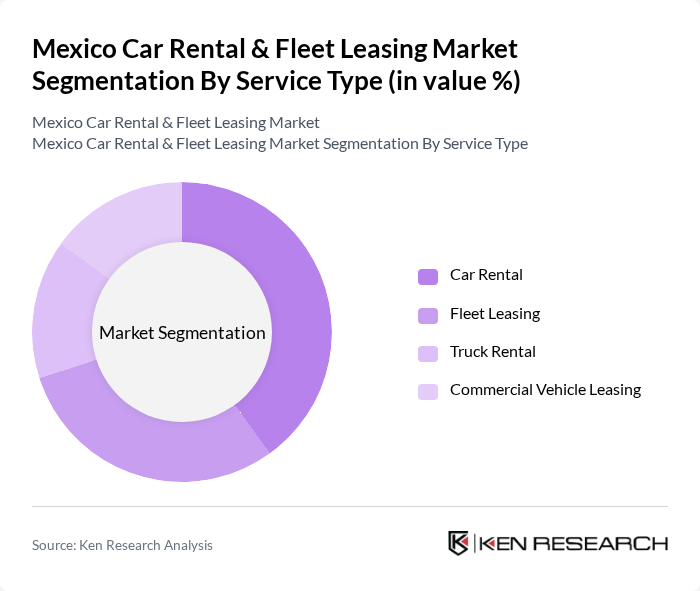
By Service Type:The service type segmentation includes car rental, fleet leasing, truck rental, and commercial vehicle leasing. Car rental remains popular among tourists and business travelers seeking flexibility, while fleet leasing is favored by corporations for operational efficiency and cost management. Truck rental and commercial vehicle leasing are increasingly utilized by logistics, e-commerce, and last-mile delivery operators to meet fluctuating demand and optimize fleet utilization .
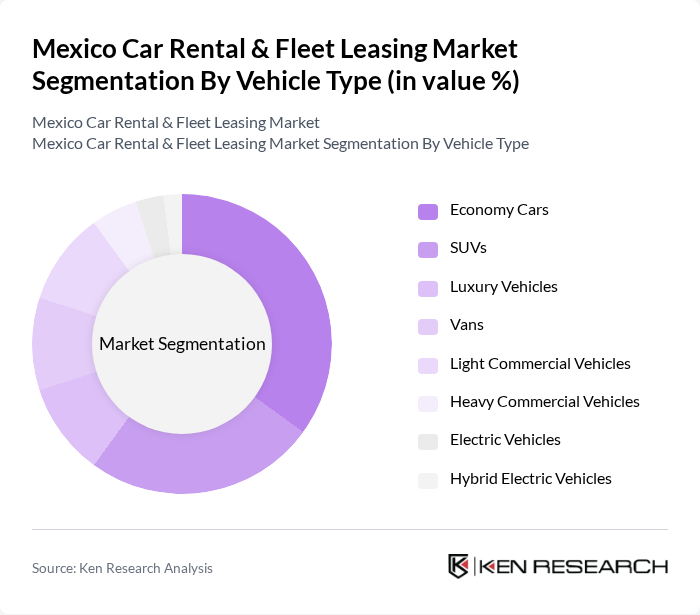
By Vehicle Type:The vehicle type segmentation covers economy cars, SUVs, luxury vehicles, vans, light commercial vehicles, heavy commercial vehicles, electric vehicles, and hybrid electric vehicles.Economy carsrepresent the largest segment, driven by cost-conscious travelers and corporate clients.SUVsandluxury vehiclesare gaining traction among tourists and executives seeking comfort and premium experiences. The adoption ofelectric and hybrid vehiclesis rising, supported by government incentives and growing environmental awareness .
Mexico Car Rental & Fleet Leasing Market Competitive Landscape
The Mexico Car Rental & Fleet Leasing Market is characterized by a dynamic mix of regional and international players. Leading participants such as Hertz Global Holdings, Inc., Avis Budget Group, Inc., Enterprise Holdings, Inc., Sixt SE, Alamo Rent A Car, Budget Truck Rental, Penske Truck Leasing, Ryder System, Inc., U-Haul International, Inc., Localiza Rent a Car S.A., Grupo Lala (Fleet Services), Traxion (Fleet Management), Movex (Logistics & Fleet), DHL Supply Chain Mexico, and Transfar (Commercial Vehicle Rental) contribute to innovation, geographic expansion, and service delivery in this space.
Mexico Car Rental & Fleet Leasing Market Industry Analysis
Growth Drivers
- Increasing Tourism and Business Travel:In future, Mexico is projected to welcome over 50 million international tourists, contributing approximately $27 billion to the economy. This surge in tourism, coupled with a 6% annual increase in business travel, drives demand for car rentals. The influx of visitors necessitates flexible transportation options, particularly in popular destinations like Cancun and Mexico City, where rental services are essential for mobility and convenience.
- Rising Demand for Flexible Transportation Solutions:The Mexican car rental market is experiencing a shift towards flexible transportation solutions, with a reported 35% increase in short-term rentals in urban areas. This trend is fueled by changing consumer preferences for convenience and cost-effectiveness, particularly among millennials and business travelers. As urban populations grow, the need for accessible and adaptable transport options continues to rise, further driving market growth.
- Growth of E-commerce and Last-Mile Delivery Services:The e-commerce sector in Mexico is expected to reach $45 billion in future, leading to a significant increase in last-mile delivery services. This growth creates a demand for fleet leasing solutions, as businesses seek efficient logistics options. Companies are increasingly turning to rental services to manage their delivery fleets, resulting in a projected 25% increase in fleet leasing contracts in urban centers, enhancing overall market dynamics.
Market Challenges
- High Competition Among Rental Companies:The Mexican car rental market is characterized by intense competition, with over 250 rental companies operating nationwide. This saturation leads to price wars, reducing profit margins for established players. In future, the average daily rental rate is expected to decline by 12%, pressuring companies to innovate and differentiate their services to maintain market share amidst fierce rivalry.
- Regulatory Hurdles and Compliance Issues:Rental companies in Mexico face stringent regulatory requirements, including licensing and safety standards. In future, compliance costs are projected to increase by 18% due to new government regulations aimed at enhancing vehicle safety and emissions standards. These challenges can hinder operational efficiency and increase the financial burden on rental companies, impacting their ability to compete effectively in the market.
Mexico Car Rental & Fleet Leasing Market Future Outlook
The Mexico car rental and fleet leasing market is poised for significant transformation driven by technological advancements and changing consumer preferences. The increasing adoption of digital booking platforms is expected to streamline operations, while the focus on sustainability will push companies to invest in eco-friendly vehicles. Additionally, the rise of shared mobility solutions will reshape traditional rental models, creating new opportunities for growth and innovation in the sector, particularly in urban areas.
Market Opportunities
- Growth in Electric Vehicle Rentals:With the Mexican government aiming for 30% of new vehicle sales to be electric in future, the demand for electric vehicle rentals is set to rise. This shift presents a lucrative opportunity for rental companies to diversify their fleets and attract environmentally conscious consumers, potentially increasing market share in a rapidly evolving landscape.
- Partnerships with Ride-Sharing Platforms:Collaborations with ride-sharing services like Uber and Didi can enhance rental companies' visibility and customer reach. By providing vehicles for these platforms, rental firms can tap into the growing gig economy, potentially increasing fleet utilization rates and generating additional revenue streams in a competitive market.
Scope of the Report
| Segment | Sub-Segments |
|---|---|
| By Service Type | Car Rental Fleet Leasing Truck Rental Commercial Vehicle Leasing |
| By Vehicle Type | Economy Cars SUVs Luxury Vehicles Vans Light Commercial Vehicles Heavy Commercial Vehicles Electric Vehicles Hybrid Electric Vehicles |
| By End-User | Individual Consumers Corporate Clients Logistics Companies E-commerce Companies Delivery Services Government Agencies Tourism Industry |
| By Rental Duration | Short-term (Daily/Weekly) Medium-term (Monthly) Long-term (Annual) Flexible Lease Contracts |
| By Distribution Channel | Online Platforms Mobile Applications Direct Bookings Travel Agencies Corporate Contracts Airport Locations |
| By Lease Type | Closed-end Leases Open-end Leases Operating Leases Finance Leases |
| By Fleet Size | Small Fleet (1-50 vehicles) Medium Fleet (51-200 vehicles) Large Fleet (200+ vehicles) |
Key Target Audience
Investors and Venture Capitalist Firms
Government and Regulatory Bodies (e.g., Secretaría de Comunicaciones y Transportes, Comisión Nacional de Seguridad)
Car Rental Companies
Fleet Management Service Providers
Automobile Manufacturers
Insurance Companies
Logistics and Transportation Companies
Financial Institutions
Players Mentioned in the Report:
Hertz Global Holdings, Inc.
Avis Budget Group, Inc.
Enterprise Holdings, Inc.
Sixt SE
Alamo Rent A Car
Budget Truck Rental
Penske Truck Leasing
Ryder System, Inc.
U-Haul International, Inc.
Localiza Rent a Car S.A.
Grupo Lala (Fleet Services)
Traxion (Fleet Management)
Movex (Logistics & Fleet)
DHL Supply Chain Mexico
Transfar (Commercial Vehicle Rental)
Table of Contents
Market Assessment Phase
1. Executive Summary and Approach
2. Mexico Car Rental & Fleet Leasing Market Overview
2.1 Key Insights and Strategic Recommendations
2.2 Mexico Car Rental & Fleet Leasing Market Overview
2.3 Definition and Scope
2.4 Evolution of Market Ecosystem
2.5 Timeline of Key Regulatory Milestones
2.6 Value Chain & Stakeholder Mapping
2.7 Business Cycle Analysis
2.8 Policy & Incentive Landscape
3. Mexico Car Rental & Fleet Leasing Market Analysis
3.1 Growth Drivers
3.1.1 Increasing tourism and business travel
3.1.2 Rising demand for flexible transportation solutions
3.1.3 Growth of e-commerce and last-mile delivery services
3.1.4 Expansion of urban infrastructure and mobility services
3.2 Market Challenges
3.2.1 High competition among rental companies
3.2.2 Regulatory hurdles and compliance issues
3.2.3 Fluctuating fuel prices impacting operational costs
3.2.4 Economic instability affecting consumer spending
3.3 Market Opportunities
3.3.1 Growth in electric vehicle rentals
3.3.2 Partnerships with ride-sharing platforms
3.3.3 Development of subscription-based rental models
3.3.4 Expansion into underserved rural markets
3.4 Market Trends
3.4.1 Increasing adoption of digital booking platforms
3.4.2 Focus on sustainability and eco-friendly vehicles
3.4.3 Integration of telematics and fleet management technology
3.4.4 Rise of shared mobility solutions
3.5 Government Regulation
3.5.1 Vehicle safety and emissions standards
3.5.2 Licensing requirements for rental companies
3.5.3 Tax incentives for electric vehicle adoption
3.5.4 Consumer protection laws affecting rental agreements
4. SWOT Analysis
5. Stakeholder Analysis
6. Porter's Five Forces Analysis
7. Mexico Car Rental & Fleet Leasing Market Market Size, 2019-2024
7.1 By Value
7.2 By Volume
7.3 By Average Selling Price
8. Mexico Car Rental & Fleet Leasing Market Segmentation
8.1 By Service Type
8.1.1 Car Rental
8.1.2 Fleet Leasing
8.1.3 Truck Rental
8.1.4 Commercial Vehicle Leasing
8.2 By Vehicle Type
8.2.1 Economy Cars
8.2.2 SUVs
8.2.3 Luxury Vehicles
8.2.4 Vans
8.2.5 Light Commercial Vehicles
8.2.6 Heavy Commercial Vehicles
8.2.7 Electric Vehicles
8.2.8 Hybrid Electric Vehicles
8.3 By End-User
8.3.1 Individual Consumers
8.3.2 Corporate Clients
8.3.3 Logistics Companies
8.3.4 E-commerce Companies
8.3.5 Delivery Services
8.3.6 Government Agencies
8.3.7 Tourism Industry
8.4 By Rental Duration
8.4.1 Short-term (Daily/Weekly)
8.4.2 Medium-term (Monthly)
8.4.3 Long-term (Annual)
8.4.4 Flexible Lease Contracts
8.5 By Distribution Channel
8.5.1 Online Platforms
8.5.2 Mobile Applications
8.5.3 Direct Bookings
8.5.4 Travel Agencies
8.5.5 Corporate Contracts
8.5.6 Airport Locations
8.6 By Lease Type
8.6.1 Closed-end Leases
8.6.2 Open-end Leases
8.6.3 Operating Leases
8.6.4 Finance Leases
8.7 By Fleet Size
8.7.1 Small Fleet (1-50 vehicles)
8.7.2 Medium Fleet (51-200 vehicles)
8.7.3 Large Fleet (200+ vehicles)
9. Mexico Car Rental & Fleet Leasing Market Competitive Analysis
9.1 Market Share of Key Players
9.2 Cross Comparison of Key Players
9.2.1 Company Name
9.2.2 Fleet Size
9.2.3 Revenue Growth Rate (%)
9.2.4 Market Share (%)
9.2.5 Fleet Utilization Rate (%)
9.2.6 Average Daily Rate (ADR) in USD
9.2.7 Customer Satisfaction Score
9.2.8 Geographic Coverage
9.2.9 Digital Platform Adoption
9.2.10 Electric Vehicle Portfolio (%)
9.2.11 Revenue per Vehicle (USD)
9.2.12 Operational Efficiency Ratio
9.3 SWOT Analysis of Top Players
9.4 Pricing Analysis
9.5 Detailed Profile of Major Companies
9.5.1 Hertz Global Holdings, Inc.
9.5.2 Avis Budget Group, Inc.
9.5.3 Enterprise Holdings, Inc.
9.5.4 Sixt SE
9.5.5 Alamo Rent A Car
9.5.6 Budget Truck Rental
9.5.7 Penske Truck Leasing
9.5.8 Ryder System, Inc.
9.5.9 U-Haul International, Inc.
9.5.10 Localiza Rent a Car S.A.
9.5.11 Grupo Lala (Fleet Services)
9.5.12 Traxion (Fleet Management)
9.5.13 Movex (Logistics & Fleet)
9.5.14 DHL Supply Chain Mexico
9.5.15 Transfar (Commercial Vehicle Rental)
10. Mexico Car Rental & Fleet Leasing Market End-User Analysis
10.1 Procurement Behavior of Key Ministries
10.1.1 Government vehicle procurement policies
10.1.2 Budget allocation for transportation services
10.1.3 Evaluation criteria for rental contracts
10.2 Corporate Spend on Infrastructure & Energy
10.2.1 Investment in fleet expansion
10.2.2 Budgeting for operational costs
10.2.3 Spending on technology integration
10.3 Pain Point Analysis by End-User Category
10.3.1 High rental costs for businesses
10.3.2 Limited availability of vehicles in peak seasons
10.3.3 Concerns over vehicle maintenance and reliability
10.4 User Readiness for Adoption
10.4.1 Awareness of rental options
10.4.2 Acceptance of digital booking systems
10.4.3 Interest in electric vehicle rentals
10.5 Post-Deployment ROI and Use Case Expansion
10.5.1 Cost savings from fleet leasing
10.5.2 Increased operational efficiency
10.5.3 Expansion of service offerings
11. Mexico Car Rental & Fleet Leasing Market Future Size, 2025-2030
11.1 By Value
11.2 By Volume
11.3 By Average Selling Price
Go-To-Market Strategy Phase
1. Whitespace Analysis + Business Model Canvas
1.1 Market gaps and opportunities
1.2 Business model components
1.3 Value proposition analysis
1.4 Revenue streams
1.5 Cost structure
1.6 Key partnerships
1.7 Customer segments
2. Marketing and Positioning Recommendations
2.1 Branding strategies
2.2 Product USPs
2.3 Target audience identification
2.4 Marketing channels
2.5 Promotional tactics
3. Distribution Plan
3.1 Urban retail strategies
3.2 Rural NGO tie-ups
3.3 Online vs offline distribution
3.4 Partnerships with travel agencies
4. Channel & Pricing Gaps
4.1 Underserved routes
4.2 Pricing bands analysis
4.3 Competitor pricing strategies
5. Unmet Demand & Latent Needs
5.1 Category gaps
5.2 Consumer segments
5.3 Emerging trends
6. Customer Relationship
6.1 Loyalty programs
6.2 After-sales service
6.3 Customer feedback mechanisms
7. Value Proposition
7.1 Sustainability initiatives
7.2 Integrated supply chains
7.3 Unique selling points
8. Key Activities
8.1 Regulatory compliance
8.2 Branding efforts
8.3 Distribution setup
9. Entry Strategy Evaluation
9.1 Domestic Market Entry Strategy
9.1.1 Product mix considerations
9.1.2 Pricing band analysis
9.1.3 Packaging strategies
9.2 Export Entry Strategy
9.2.1 Target countries
9.2.2 Compliance roadmap
10. Entry Mode Assessment
10.1 Joint Ventures
10.2 Greenfield investments
10.3 Mergers & Acquisitions
10.4 Distributor Model
11. Capital and Timeline Estimation
11.1 Capital requirements
11.2 Timelines for market entry
12. Control vs Risk Trade-Off
12.1 Ownership considerations
12.2 Partnerships vs control
13. Profitability Outlook
13.1 Breakeven analysis
13.2 Long-term sustainability
14. Potential Partner List
14.1 Distributors
14.2 Joint Ventures</h
Research Methodology
Phase 1: Approach1
Desk Research
- Analysis of industry reports from government agencies and trade associations related to car rental and fleet leasing in Mexico
- Review of market trends and consumer behavior studies published by automotive and travel research firms
- Examination of economic indicators, including tourism statistics and vehicle registration data from Mexican authorities
Primary Research
- Interviews with executives from leading car rental companies and fleet leasing firms operating in Mexico
- Surveys conducted with customers to understand preferences, usage patterns, and satisfaction levels
- Field interviews with local travel agencies and corporate clients to gather insights on fleet leasing needs
Validation & Triangulation
- Cross-validation of findings through comparison with historical data and market forecasts
- Triangulation of insights from primary interviews with secondary data sources to ensure consistency
- Sanity checks through expert panel reviews involving industry veterans and market analysts
Phase 2: Market Size Estimation1
Top-down Assessment
- Estimation of total market size based on national transportation expenditure and tourism growth rates
- Segmentation of the market by vehicle type, rental duration, and customer demographics
- Incorporation of government policies promoting electric vehicle rentals and sustainability initiatives
Bottom-up Modeling
- Collection of data on fleet sizes and rental rates from major car rental companies in Mexico
- Operational cost analysis based on vehicle maintenance, insurance, and depreciation rates
- Volume x cost calculations to derive revenue estimates for different segments of the market
Forecasting & Scenario Analysis
- Multi-factor regression analysis incorporating variables such as economic growth, fuel prices, and consumer preferences
- Scenario modeling based on potential impacts of regulatory changes and shifts in travel behavior post-pandemic
- Development of baseline, optimistic, and pessimistic forecasts through 2030
Phase 3: CATI Sample Composition1
| Scope Item/Segment | Sample Size | Target Respondent Profiles |
|---|---|---|
| Leisure Car Rentals | 100 | Travelers, Vacation Planners |
| Corporate Fleet Leasing | 80 | Corporate Fleet Managers, Procurement Officers |
| Tourism Sector Rentals | 60 | Tour Operators, Hotel Managers |
| Long-term Rentals | 50 | Business Executives, Long-term Renters |
| Electric Vehicle Rentals | 40 | Environmentally Conscious Consumers, Tech-savvy Renters |
Frequently Asked Questions
What is the current value of the Mexico Car Rental & Fleet Leasing Market?
The Mexico Car Rental & Fleet Leasing Market is valued at approximately USD 3.8 billion, driven by increasing demand for mobility solutions, tourism growth, and the expansion of e-commerce and logistics sectors.
Which cities are the main hubs for car rental services in Mexico?
What are the main drivers of growth in the Mexico car rental market?
What challenges do car rental companies face in Mexico?
Other Regional/Country Reports
Indonesia Car Rental & Fleet Leasing Market
Malaysia Car Rental & Fleet Leasing Market
KSA Car Rental & Fleet Leasing Market
APAC Car Rental & Fleet Leasing Market
SEA Car Rental & Fleet Leasing Market
Other Adjacent Reports
South Africa Ride-Sharing Services Market
South Korea Tourism and Travel Market
UK E-Commerce Logistics MarketBelgium Electric Vehicle Rental Market
Philippines Automotive Insurance Market
KSA Fleet Management Software MarketMalaysia Vehicle Maintenance and Repair Market
Kuwait Mobility as a Service Market
Thailand Commercial Vehicle Leasing Market
South Africa Sustainable Transportation Market
Why Buy From Us?

What makes us stand out is that our consultants follow Robust, Refine and Result (RRR) methodology. Robust for clear definitions, approaches and sanity checking, Refine for differentiating respondents' facts and opinions, and Result for presenting data with story.

We have set a benchmark in the industry by offering our clients with syndicated and customized market research reports featuring coverage of entire market as well as meticulous research and analyst insights.

While we don't replace traditional research, we flip the method upside down. Our dual approach of Top Bottom & Bottom Top ensures quality deliverable by not just verifying company fundamentals but also looking at the sector and macroeconomic factors.

With one step in the future, our research team constantly tries to show you the bigger picture. We help with some of the tough questions you may encounter along the way: How is the industry positioned? Best marketing channel? KPI's of competitors? By aligning every element, we help maximize success.

Our report gives you instant access to the answers and sources that other companies might choose to hide. We elaborate each steps of research methodology we have used and showcase you the sample size to earn your trust.

If you need any support, we are here! We pride ourselves on universe strength, data quality, and quick, friendly, and professional service.