About the Report
Base Year 2024Middle East And Africa Construction Equipment Market Overview
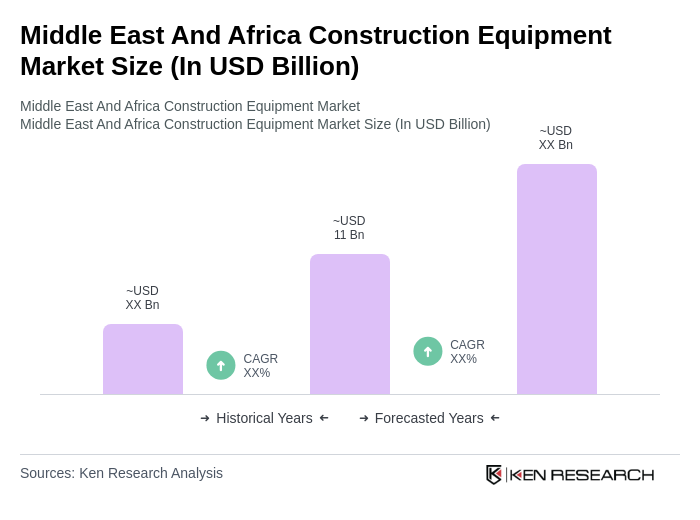
- The Middle East and Africa construction equipment market is valued at USD 11 billion, based on a five-year historical analysis. This growth is primarily driven by rapid urbanization, increased infrastructure investments, and a surge in construction activities across various sectors, including residential, commercial, and industrial projects.
- Key players in this market include Saudi Arabia, the United Arab Emirates, and South Africa. These countries dominate due to their substantial investments in infrastructure development, ongoing mega-projects, and favorable government policies that encourage construction and real estate development.
- In 2023, the South African government implemented a new regulation mandating the use of eco-friendly construction equipment in public projects. This regulation aims to reduce carbon emissions and promote sustainable practices in the construction industry, thereby influencing equipment purchasing decisions and driving demand for greener technologies.
Middle East And Africa Construction Equipment Market Segmentation
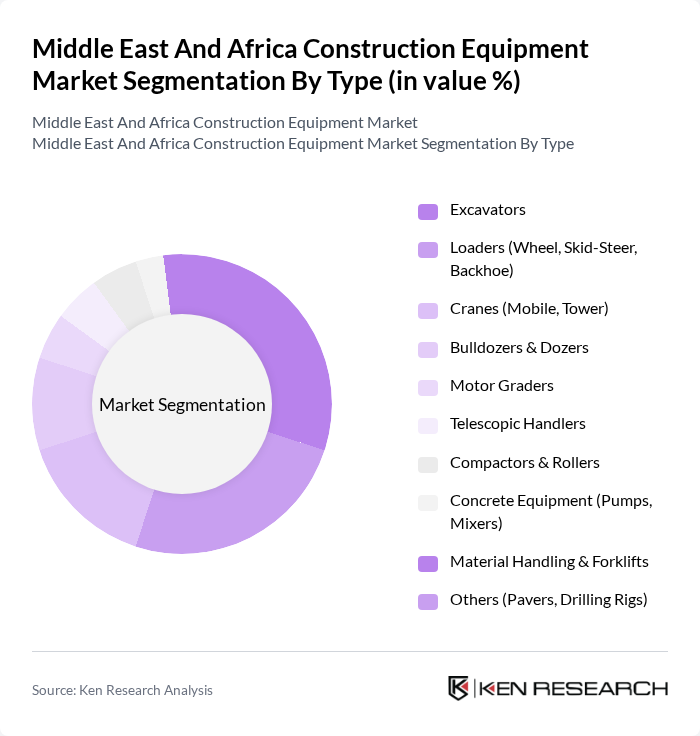
By Type:The construction equipment market can be segmented into various types, including excavators, loaders, cranes, bulldozers, motor graders, telescopic handlers, compactors, concrete equipment, material handling equipment, and others. Among these, excavators and loaders are the most widely used due to their versatility and essential roles in various construction activities.
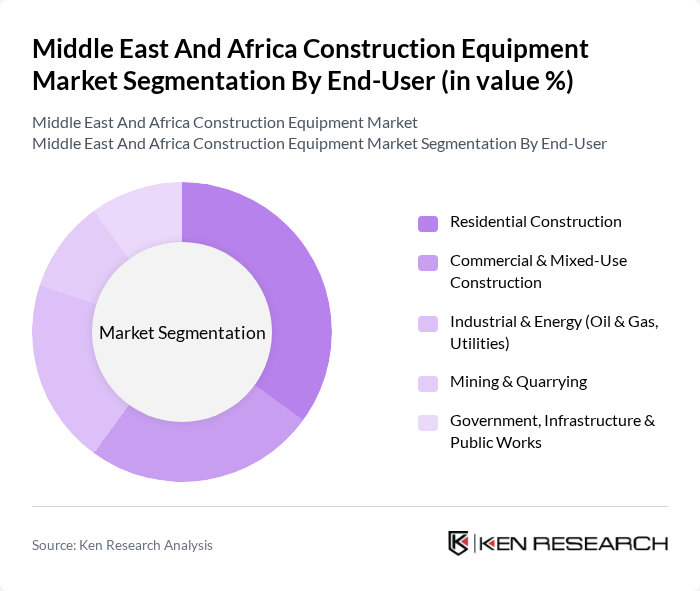
By End-User:The end-user segmentation includes residential construction, commercial and mixed-use construction, industrial and energy sectors, mining and quarrying, and government infrastructure projects. The residential construction segment is currently leading the market due to the increasing demand for housing and urban development initiatives.
Middle East And Africa Construction Equipment Market Competitive Landscape
The Middle East And Africa construction equipment market is characterized by a dynamic mix of regional and international players. Leading participants such as Caterpillar Inc., Komatsu Ltd., Volvo Construction Equipment, Hitachi Construction Machinery, JCB, Liebherr Group, HD Hyundai Construction Equipment, CNH Industrial (CASE Construction Equipment), SANY Group, XCMG, Zoomlion Heavy Industry, Manitou Group, Bobcat Company, Wacker Neuson SE, Doosan Bobcat (ME&A), Terex Corporation, BEML Limited, Bell Equipment (South Africa), Shandong Lingong Construction Machinery (SDLG), Tata Hitachi Construction Machinery contribute to innovation, geographic expansion, and service delivery in this space.
Middle East And Africa Construction Equipment Market Industry Analysis
Growth Drivers
- Increasing Infrastructure Development:The Middle East and Africa region is witnessing significant infrastructure investments, with the World Bank estimating that infrastructure spending will reach $1 trillion in future. Major projects include the NEOM city in Saudi Arabia, which alone is projected to cost $500 billion. This surge in infrastructure development is driving demand for construction equipment, as governments prioritize modernization and expansion of transport, energy, and urban facilities to support economic growth.
- Urbanization and Population Growth:The region's urban population is expected to grow from 50% in 2020 to 65% in future, according to UN-Habitat. This rapid urbanization is leading to increased demand for housing, transportation, and public services, necessitating the use of advanced construction equipment. With an estimated 1.5 billion people projected to live in urban areas in future, the construction sector must adapt to meet these growing needs, further driving equipment demand.
- Government Investments in Construction:Governments across the Middle East and Africa are committing substantial resources to construction projects, with total public spending expected to exceed $300 billion in future. Initiatives like the African Union's Programme for Infrastructure Development aim to enhance regional connectivity. Such investments not only stimulate economic growth but also create a robust market for construction equipment, as public projects require advanced machinery and technology to meet ambitious timelines and standards.
Market Challenges
- High Initial Capital Investment:The construction equipment market faces significant barriers due to the high initial capital required for purchasing advanced machinery. For instance, a single excavator can cost upwards of $100,000, which poses a challenge for small to medium-sized enterprises. This financial burden can limit market entry and expansion, particularly in developing regions where access to financing is constrained, thereby impacting overall market growth.
- Fluctuating Raw Material Prices:The construction equipment industry is heavily influenced by the volatility of raw material prices, particularly steel and aluminum. In future, steel prices fluctuated between $600 and $800 per ton, affecting production costs for manufacturers. Such price instability can lead to increased equipment costs, making it difficult for construction companies to budget effectively and potentially slowing down project timelines and equipment procurement.
Middle East And Africa Construction Equipment Market Future Outlook
The future of the construction equipment market in the Middle East and Africa appears promising, driven by ongoing infrastructure projects and urbanization trends. As governments continue to invest in large-scale developments, the demand for advanced machinery is expected to rise. Additionally, the integration of smart technologies and eco-friendly practices will likely shape the market landscape, enhancing operational efficiency and sustainability. This evolving environment presents opportunities for innovation and growth within the sector, positioning it for a robust future.
Market Opportunities
- Expansion of Renewable Energy Projects:The shift towards renewable energy is creating new opportunities for construction equipment manufacturers. With investments in solar and wind energy projected to reach $50 billion in future, there is a growing need for specialized equipment to support these projects. This trend not only promotes sustainability but also drives demand for innovative construction solutions tailored to renewable energy infrastructure.
- Adoption of Smart Construction Technologies:The increasing adoption of smart construction technologies, such as Building Information Modeling (BIM) and drones, is revolutionizing the industry. By future, the smart construction market is expected to grow significantly, with investments in technology-driven solutions enhancing project efficiency and safety. This trend presents a lucrative opportunity for equipment manufacturers to develop and integrate advanced technologies into their offerings, meeting evolving market demands.
Scope of the Report
| Segment | Sub-Segments |
|---|---|
| By Type | Excavators Loaders (Wheel, Skid-Steer, Backhoe) Cranes (Mobile, Tower) Bulldozers & Dozers Motor Graders Telescopic Handlers Compactors & Rollers Concrete Equipment (Pumps, Mixers) Material Handling & Forklifts Others (Pavers, Drilling Rigs) |
| By End-User | Residential Construction Commercial & Mixed-Use Construction Industrial & Energy (Oil & Gas, Utilities) Mining & Quarrying Government, Infrastructure & Public Works |
| By Application | Road & Highway Construction Building Construction Earthmoving & Excavation Mining & Material Handling Demolition & Recycling |
| By Sales Channel | Direct Sales (OEMs) Authorized Dealers/Distributors Rental/Leasing Online & E-commerce |
| By Distribution Mode | Retail (Dealerships) Wholesale/B2B Rental Services (Short- and Long-Term) |
| By Price Range | Low-End Equipment Mid-Range Equipment High-End Equipment |
| By Region | GCC (Saudi Arabia, UAE, Qatar, Kuwait, Oman, Bahrain) Levant (Israel, Jordan, Lebanon) North Africa (Egypt, Morocco, Algeria, Tunisia) Sub-Saharan Africa (South Africa, Nigeria, Kenya, etc.) |
Key Target Audience
Investors and Venture Capitalist Firms
Government and Regulatory Bodies (e.g., Ministry of Infrastructure, Ministry of Housing)
Manufacturers and Producers
Distributors and Retailers
Construction Companies and Contractors
Real Estate Developers
Industry Associations (e.g., Middle East Concrete Association)
Financial Institutions (e.g., Development Banks)
Players Mentioned in the Report:
Caterpillar Inc.
Komatsu Ltd.
Volvo Construction Equipment
Hitachi Construction Machinery
JCB
Liebherr Group
HD Hyundai Construction Equipment
CNH Industrial (CASE Construction Equipment)
SANY Group
XCMG
Zoomlion Heavy Industry
Manitou Group
Bobcat Company
Wacker Neuson SE
Doosan Bobcat (ME&A)
Terex Corporation
BEML Limited
Bell Equipment (South Africa)
Shandong Lingong Construction Machinery (SDLG)
Tata Hitachi Construction Machinery
Table of Contents
Market Assessment Phase
1. Executive Summary and Approach
2. Middle East And Africa Construction Equipment Market Overview
2.1 Key Insights and Strategic Recommendations
2.2 Middle East And Africa Construction Equipment Market Overview
2.3 Definition and Scope
2.4 Evolution of Market Ecosystem
2.5 Timeline of Key Regulatory Milestones
2.6 Value Chain & Stakeholder Mapping
2.7 Business Cycle Analysis
2.8 Policy & Incentive Landscape
3. Middle East And Africa Construction Equipment Market Analysis
3.1 Growth Drivers
3.1.1 Increasing Infrastructure Development
3.1.2 Urbanization and Population Growth
3.1.3 Government Investments in Construction
3.1.4 Technological Advancements in Equipment
3.2 Market Challenges
3.2.1 High Initial Capital Investment
3.2.2 Fluctuating Raw Material Prices
3.2.3 Regulatory Compliance Issues
3.2.4 Skilled Labor Shortage
3.3 Market Opportunities
3.3.1 Expansion of Renewable Energy Projects
3.3.2 Adoption of Smart Construction Technologies
3.3.3 Growth in Public-Private Partnerships
3.3.4 Increasing Demand for Rental Equipment
3.4 Market Trends
3.4.1 Shift Towards Eco-Friendly Equipment
3.4.2 Rise of Automation in Construction
3.4.3 Integration of IoT in Equipment Management
3.4.4 Focus on Safety and Compliance Standards
3.5 Government Regulation
3.5.1 Environmental Regulations
3.5.2 Safety Standards for Construction Equipment
3.5.3 Import Tariffs and Trade Policies
3.5.4 Licensing and Certification Requirements
4. SWOT Analysis
5. Stakeholder Analysis
6. Porter's Five Forces Analysis
7. Middle East And Africa Construction Equipment Market Market Size, 2019-2024
7.1 By Value
7.2 By Volume
7.3 By Average Selling Price
8. Middle East And Africa Construction Equipment Market Segmentation
8.1 By Type
8.1.1 Excavators
8.1.2 Loaders (Wheel, Skid-Steer, Backhoe)
8.1.3 Cranes (Mobile, Tower)
8.1.4 Bulldozers & Dozers
8.1.5 Motor Graders
8.1.6 Telescopic Handlers
8.1.7 Compactors & Rollers
8.1.8 Concrete Equipment (Pumps, Mixers)
8.1.9 Material Handling & Forklifts
8.1.10 Others (Pavers, Drilling Rigs)
8.2 By End-User
8.2.1 Residential Construction
8.2.2 Commercial & Mixed-Use Construction
8.2.3 Industrial & Energy (Oil & Gas, Utilities)
8.2.4 Mining & Quarrying
8.2.5 Government, Infrastructure & Public Works
8.3 By Application
8.3.1 Road & Highway Construction
8.3.2 Building Construction
8.3.3 Earthmoving & Excavation
8.3.4 Mining & Material Handling
8.3.5 Demolition & Recycling
8.4 By Sales Channel
8.4.1 Direct Sales (OEMs)
8.4.2 Authorized Dealers/Distributors
8.4.3 Rental/Leasing
8.4.4 Online & E-commerce
8.5 By Distribution Mode
8.5.1 Retail (Dealerships)
8.5.2 Wholesale/B2B
8.5.3 Rental Services (Short- and Long-Term)
8.6 By Price Range
8.6.1 Low-End Equipment
8.6.2 Mid-Range Equipment
8.6.3 High-End Equipment
8.7 By Region
8.7.1 GCC (Saudi Arabia, UAE, Qatar, Kuwait, Oman, Bahrain)
8.7.2 Levant (Israel, Jordan, Lebanon)
8.7.3 North Africa (Egypt, Morocco, Algeria, Tunisia)
8.7.4 Sub-Saharan Africa (South Africa, Nigeria, Kenya, etc.)
9. Middle East And Africa Construction Equipment Market Competitive Analysis
9.1 Market Share of Key Players
9.2 Cross Comparison of Key Players
9.2.1 Company Name
9.2.2 Regional Revenue (MEA) and YoY Growth
9.2.3 Installed Fleet/Units in Operation (MEA)
9.2.4 Market Share by Equipment Type (e.g., excavators, loaders)
9.2.5 Dealer Network Coverage (Countries, Outlets)
9.2.6 After-Sales & Service KPIs (response time, parts fill rate)
9.2.7 Rental Penetration and OEM Finance Availability
9.2.8 Average Selling Price (ASP) and Discount Bands
9.2.9 Product Portfolio Breadth (ICE vs. Electric/Hybrid)
9.2.10 Telematics Adoption/Connected Fleet Share
9.2.11 Order Backlog and Lead Times
9.2.12 Warranty Terms and Total Cost of Ownership (TCO) Benchmarks
9.3 SWOT Analysis of Top Players
9.4 Pricing Analysis
9.5 Detailed Profile of Major Companies
9.5.1 Caterpillar Inc.
9.5.2 Komatsu Ltd.
9.5.3 Volvo Construction Equipment
9.5.4 Hitachi Construction Machinery
9.5.5 JCB
9.5.6 Liebherr Group
9.5.7 HD Hyundai Construction Equipment
9.5.8 CNH Industrial (CASE Construction Equipment)
9.5.9 SANY Group
9.5.10 XCMG
9.5.11 Zoomlion Heavy Industry
9.5.12 Manitou Group
9.5.13 Bobcat Company
9.5.14 Wacker Neuson SE
9.5.15 Doosan Bobcat (ME&A)
9.5.16 Terex Corporation
9.5.17 BEML Limited
9.5.18 Bell Equipment (South Africa)
9.5.19 Shandong Lingong Construction Machinery (SDLG)
9.5.20 Tata Hitachi Construction Machinery
10. Middle East And Africa Construction Equipment Market End-User Analysis
10.1 Procurement Behavior of Key Ministries
10.1.1 Ministry of Infrastructure
10.1.2 Ministry of Energy
10.1.3 Ministry of Housing
10.2 Corporate Spend on Infrastructure & Energy
10.2.1 Major Corporate Investments
10.2.2 Budget Allocations
10.2.3 Project Financing Trends
10.3 Pain Point Analysis by End-User Category
10.3.1 Delays in Project Approvals
10.3.2 Cost Overruns
10.3.3 Equipment Availability
10.4 User Readiness for Adoption
10.4.1 Training and Skill Development Needs
10.4.2 Technology Adoption Rates
10.5 Post-Deployment ROI and Use Case Expansion
10.5.1 Performance Metrics
10.5.2 Case Studies of Successful Deployments
11. Middle East And Africa Construction Equipment Market Future Size, 2025-2030
11.1 By Value
11.2 By Volume
11.3 By Average Selling Price
Go-To-Market Strategy Phase
1. Whitespace Analysis + Business Model Canvas
1.1 Market Gaps Identification
1.2 Value Proposition Development
1.3 Revenue Streams Analysis
1.4 Cost Structure Evaluation
1.5 Key Partnerships Exploration
1.6 Customer Segmentation
1.7 Channels of Distribution
2. Marketing and Positioning Recommendations
2.1 Branding Strategies
2.2 Product USPs
3. Distribution Plan
3.1 Urban Retail vs Rural NGO Tie-ups
4. Channel & Pricing Gaps
4.1 Underserved Routes
4.2 Pricing Bands
5. Unmet Demand & Latent Needs
5.1 Category Gaps
5.2 Consumer Segments
6. Customer Relationship
6.1 Loyalty Programs
6.2 After-sales Service
7. Value Proposition
7.1 Sustainability
7.2 Integrated Supply Chains
8. Key Activities
8.1 Regulatory Compliance
8.2 Branding
8.3 Distribution Setup
9. Entry Strategy Evaluation
9.1 Domestic Market Entry Strategy
9.1.1 Product Mix
9.1.2 Pricing Band
9.1.3 Packaging
9.2 Export Entry Strategy
9.2.1 Target Countries
9.2.2 Compliance Roadmap
10. Entry Mode Assessment
10.1 JV
10.2 Greenfield
10.3 M&A
10.4 Distributor Model
11. Capital and Timeline Estimation
11.1 Capital Requirements
11.2 Timelines
12. Control vs Risk Trade-Off
12.1 Ownership vs Partnerships
13. Profitability Outlook
13.1 Breakeven Analysis
13.2 Long-term Sustainability
14. Potential Partner List
14.1 Distributors
14.2 JVs
14.3 Acquisition Targets
15. Execution Roadmap
15.1 Phased Plan for Market Entry
15.1.1 Market Setup
15.1.2 Market Entry
15.1.3 Growth Acceleration
15.1.4 Scale & Stabilize
15.2 Key Activities and Milestones
15.2.1 Milestone Planning
15.2.2 Activity Tracking
Research Methodology
Phase 1: Approach1
Desk Research
- Industry reports from regional construction associations and market research firms
- Government publications on infrastructure spending and construction permits
- Academic journals and white papers on construction technology trends in the Middle East and Africa
Primary Research
- Interviews with project managers and procurement officers in major construction firms
- Surveys with equipment rental companies and distributors across the region
- Field visits to construction sites to gather firsthand insights on equipment usage
Validation & Triangulation
- Cross-validation of data from multiple sources including trade publications and government statistics
- Triangulation of findings from primary interviews with secondary data trends
- Sanity checks through expert panels comprising industry veterans and analysts
Phase 2: Market Size Estimation1
Top-down Assessment
- Analysis of total construction spending in the Middle East and Africa as a baseline
- Segmentation of market size by equipment type (e.g., excavators, cranes, loaders)
- Incorporation of growth rates from regional infrastructure development plans
Bottom-up Modeling
- Estimation of equipment sales based on historical sales data from key manufacturers
- Operational metrics from rental companies to gauge market demand
- Volume x average selling price calculations for each equipment category
Forecasting & Scenario Analysis
- Multi-variable forecasting models incorporating GDP growth, urbanization rates, and government initiatives
- Scenario analysis based on potential shifts in regulatory frameworks and investment climates
- Baseline, optimistic, and pessimistic projections through 2030 based on historical trends
Phase 3: CATI Sample Composition1
| Scope Item/Segment | Sample Size | Target Respondent Profiles |
|---|---|---|
| Heavy Machinery Sales | 140 | Sales Managers, Regional Distributors |
| Construction Equipment Rentals | 110 | Rental Fleet Managers, Operations Directors |
| Infrastructure Development Projects | 90 | Project Managers, Civil Engineers |
| Government Procurement Policies | 60 | Government Officials, Policy Advisors |
| Emerging Technologies in Construction | 70 | Technology Officers, Innovation Managers |
Frequently Asked Questions
What is the current value of the Middle East and Africa construction equipment market?
The Middle East and Africa construction equipment market is valued at approximately USD 11 billion, driven by rapid urbanization, increased infrastructure investments, and a surge in construction activities across various sectors, including residential, commercial, and industrial projects.
Which countries are the key players in the Middle East and Africa construction equipment market?
What are the main types of construction equipment used in the Middle East and Africa?
What are the primary end-user segments in the construction equipment market?
Other Regional/Country Reports
Why Buy From Us?

What makes us stand out is that our consultants follow Robust, Refine and Result (RRR) methodology. Robust for clear definitions, approaches and sanity checking, Refine for differentiating respondents' facts and opinions, and Result for presenting data with story.

We have set a benchmark in the industry by offering our clients with syndicated and customized market research reports featuring coverage of entire market as well as meticulous research and analyst insights.

While we don't replace traditional research, we flip the method upside down. Our dual approach of Top Bottom & Bottom Top ensures quality deliverable by not just verifying company fundamentals but also looking at the sector and macroeconomic factors.

With one step in the future, our research team constantly tries to show you the bigger picture. We help with some of the tough questions you may encounter along the way: How is the industry positioned? Best marketing channel? KPI's of competitors? By aligning every element, we help maximize success.

Our report gives you instant access to the answers and sources that other companies might choose to hide. We elaborate each steps of research methodology we have used and showcase you the sample size to earn your trust.

If you need any support, we are here! We pride ourselves on universe strength, data quality, and quick, friendly, and professional service.