About the Report
Base Year 2024United States Avian Flu Treatment Market Overview
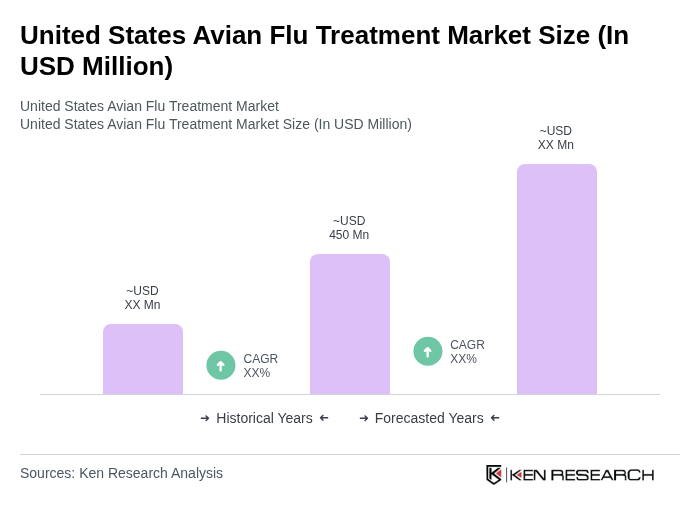
- The United States Avian Flu Treatment Market is valued at USD 450 million, based on a five-year historical analysis. This growth is primarily driven by increasing incidences of avian influenza outbreaks, heightened awareness regarding poultry health, and advancements in treatment methodologies. The market is also supported by government initiatives aimed at controlling the spread of avian flu and ensuring food safety.
- Key players in this market include major cities such as Chicago, Atlanta, and San Francisco, which dominate due to their robust healthcare infrastructure, research facilities, and proximity to poultry farming regions. These cities are also home to leading pharmaceutical companies that contribute significantly to the development and distribution of avian flu treatments.
- The USDA has implemented stringent biosecurity regulations requiring all poultry farms to adopt comprehensive disease prevention measures. These regulations mandate regular health checks and vaccination protocols, ensuring that poultry is monitored and treated effectively to mitigate the risks associated with avian flu outbreaks.
United States Avian Flu Treatment Market Segmentation
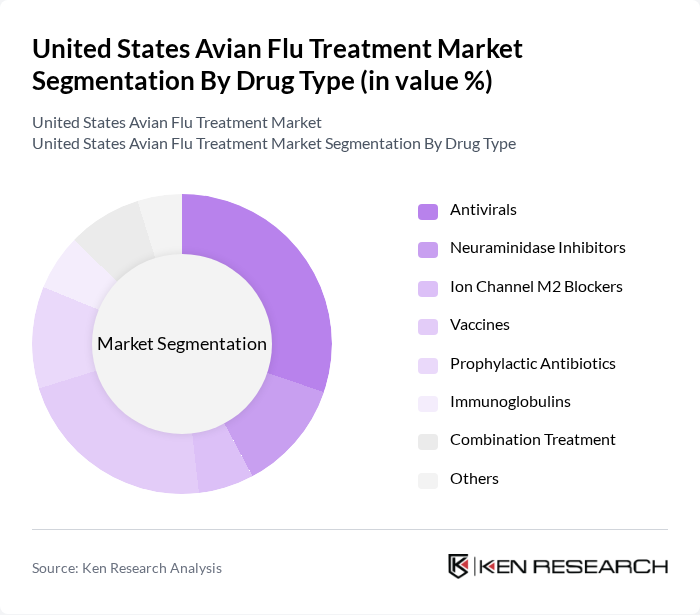
By Drug Type:The drug type segmentation includes various treatment options available for avian flu, which are crucial for managing outbreaks and ensuring the health of poultry. The subsegments include Antivirals, Neuraminidase Inhibitors, Ion Channel M2 Blockers, Vaccines, Prophylactic Antibiotics, Immunoglobulins, Combination Treatment, and Others. Among these, Antivirals are currently dominating the market, projected to hold 30.2% of market revenue due to their proven efficacy in reducing viral replication, limiting disease progression, and preventing severe complications.
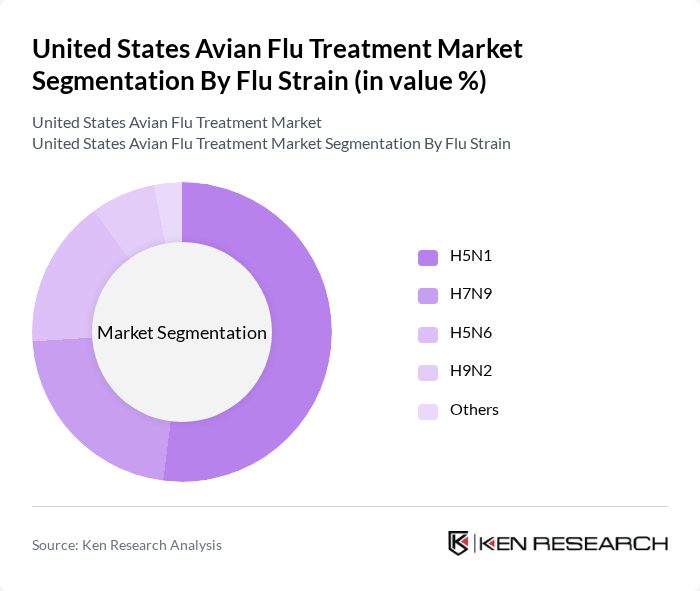
By Flu Strain:The flu strain segmentation categorizes the treatments based on the specific strains of avian influenza. The subsegments include H5N1, H7N9, H5N6, H9N2, and Others. The H5N1 strain is currently the most prevalent and poses significant threats to poultry health, leading to a higher demand for targeted treatments and vaccines. This strain's severity and impact on the poultry industry make it a focal point for research and development in avian flu treatments.
United States Avian Flu Treatment Market Competitive Landscape
The United States Avian Flu Treatment Market is characterized by a dynamic mix of regional and international players. Leading participants such as Zoetis Inc., Merck Animal Health, Boehringer Ingelheim, Elanco Animal Health, Ceva Santé Animale, Bayer Animal Health, Virbac, Vetoquinol, Phibro Animal Health, IDEXX Laboratories, Neogen Corporation, Alltech, Kemin Industries, Huvepharma, Vetmedin contribute to innovation, geographic expansion, and service delivery in this space.
United States Avian Flu Treatment Market Industry Analysis
Growth Drivers
- Increasing Prevalence of Avian Flu Outbreaks:The United States has experienced significant avian flu outbreaks, with over 58 million birds affected in the most recent major outbreak period, according to the USDA. This alarming trend has heightened the urgency for effective treatments, driving demand for antiviral medications. The economic impact of these outbreaks, estimated at about USD 3 billion in losses, underscores the necessity for robust treatment options to safeguard poultry health and ensure food security.
- Rising Demand for Effective Antiviral Treatments:The need for effective antiviral treatments is escalating, driven by the increasing incidence of avian flu. In future, the market for antiviral drugs in veterinary medicine was valued at approximately USD 1.2 billion, reflecting a growing recognition of the importance of timely interventions. This demand is further fueled by the poultry industry's efforts to maintain productivity and minimize economic losses associated with disease outbreaks.
- Government Initiatives for Poultry Health Management:The U.S. government has implemented various initiatives to enhance poultry health management, including funding of USD 200 million for biosecurity measures in future. These initiatives aim to bolster the poultry sector's resilience against avian flu, promoting the development and distribution of effective treatments. Such government support is crucial in fostering innovation and ensuring that poultry farmers have access to necessary resources for disease management.
Market Challenges
- High Costs of Research and Development:The avian flu treatment market faces significant challenges due to the high costs associated with research and development, which can exceed USD 1 billion for new veterinary drugs. This financial burden often deters smaller companies from entering the market, limiting innovation and the availability of diverse treatment options. Consequently, the reliance on established players may stifle competition and slow the introduction of new therapies.
- Regulatory Hurdles in Drug Approval:Navigating the regulatory landscape for veterinary pharmaceuticals can be complex and time-consuming, with the FDA requiring extensive clinical trials that can take several years. In future, the average time for drug approval was approximately 10 years, which poses a significant barrier to market entry. These regulatory challenges can delay the availability of critical treatments, impacting the overall effectiveness of avian flu management strategies.
United States Avian Flu Treatment Market Future Outlook
The future of the avian flu treatment market in the United States appears promising, driven by advancements in vaccine technology and increased investment in veterinary healthcare. As the poultry industry continues to prioritize biosecurity and preventive measures, the demand for innovative treatments is expected to rise. Additionally, collaborations between pharmaceutical companies and research institutions are likely to accelerate the development of effective therapies, enhancing the overall resilience of the poultry sector against avian flu outbreaks.
Market Opportunities
- Expansion of Veterinary Healthcare Services:The growing emphasis on animal health is creating opportunities for expanding veterinary healthcare services. With an estimated 30% increase in veterinary clinics focusing on poultry health in future, there is a significant potential for enhanced treatment options and preventive care, ultimately improving the overall health of poultry populations.
- Collaborations with Research Institutions:Partnerships between pharmaceutical companies and research institutions are becoming increasingly vital. In future, over 15 collaborative projects aimed at developing avian flu treatments were initiated, highlighting the potential for innovation. These collaborations can lead to breakthroughs in treatment efficacy and safety, addressing the urgent needs of the poultry industry.
Scope of the Report
| Segment | Sub-Segments |
|---|---|
| By Drug Type | Antivirals Neuraminidase Inhibitors Ion Channel M2 Blockers Vaccines Prophylactic Antibiotics Immunoglobulins Combination Treatment Others |
| By Flu Strain | H5N1 H7N9 H5N6 H9N2 Others |
| By End-User | Hospitals Institutional Health Centers Clinics Poultry Farms Veterinary Clinics |
| By Distribution Channel | Online Pharmacies Offline Pharmacies Direct Sales Distributors |
| By Region | Northeast Midwest South West |
Key Target Audience
Investors and Venture Capitalist Firms
Government and Regulatory Bodies (e.g., Centers for Disease Control and Prevention, U.S. Department of Agriculture)
Pharmaceutical Manufacturers
Veterinary Product Distributors
Animal Health Organizations
Biotechnology Firms
Public Health Agencies
Insurance Companies
Players Mentioned in the Report:
Zoetis Inc.
Merck Animal Health
Boehringer Ingelheim
Elanco Animal Health
Ceva Sante Animale
Bayer Animal Health
Virbac
Vetoquinol
Phibro Animal Health
IDEXX Laboratories
Neogen Corporation
Alltech
Kemin Industries
Huvepharma
Vetmedin
Table of Contents
Market Assessment Phase
1. Executive Summary and Approach
2. United States Avian Flu Treatment Market Overview
2.1 Key Insights and Strategic Recommendations
2.2 United States Avian Flu Treatment Market Overview
2.3 Definition and Scope
2.4 Evolution of Market Ecosystem
2.5 Timeline of Key Regulatory Milestones
2.6 Value Chain & Stakeholder Mapping
2.7 Business Cycle Analysis
2.8 Policy & Incentive Landscape
3. United States Avian Flu Treatment Market Analysis
3.1 Growth Drivers
3.1.1 Increasing prevalence of avian flu outbreaks
3.1.2 Rising demand for effective antiviral treatments
3.1.3 Government initiatives for poultry health management
3.1.4 Advancements in vaccine development
3.2 Market Challenges
3.2.1 High costs of research and development
3.2.2 Regulatory hurdles in drug approval
3.2.3 Limited awareness among poultry farmers
3.2.4 Competition from alternative treatments
3.3 Market Opportunities
3.3.1 Expansion of veterinary healthcare services
3.3.2 Collaborations with research institutions
3.3.3 Development of combination therapies
3.3.4 Growing export potential of avian flu treatments
3.4 Market Trends
3.4.1 Increasing focus on biosecurity measures
3.4.2 Shift towards preventive healthcare in poultry
3.4.3 Rise in organic and sustainable farming practices
3.4.4 Adoption of digital health solutions in veterinary care
3.5 Government Regulation
3.5.1 USDA guidelines for avian flu management
3.5.2 FDA regulations on veterinary pharmaceuticals
3.5.3 State-level poultry health regulations
3.5.4 International trade regulations affecting avian flu treatments
4. SWOT Analysis
5. Stakeholder Analysis
6. Porter's Five Forces Analysis
7. United States Avian Flu Treatment Market Size, 2019-2024
7.1 By Value
7.2 By Volume
7.3 By Average Selling Price
8. United States Avian Flu Treatment Market Segmentation
8.1 By Drug Type
8.1.1 Antivirals
8.1.2 Neuraminidase Inhibitors
8.1.3 Ion Channel M2 Blockers
8.1.4 Vaccines
8.1.5 Prophylactic Antibiotics
8.1.6 Immunoglobulins
8.1.7 Combination Treatment
8.1.8 Others
8.2 By Flu Strain
8.2.1 H5N1
8.2.2 H7N9
8.2.3 H5N6
8.2.4 H9N2
8.2.5 Others
8.3 By End-User
8.3.1 Hospitals
8.3.2 Institutional Health Centers
8.3.3 Clinics
8.3.4 Poultry Farms
8.3.5 Veterinary Clinics
8.4 By Distribution Channel
8.4.1 Online Pharmacies
8.4.2 Offline Pharmacies
8.4.3 Direct Sales
8.4.4 Distributors
8.5 By Region
8.5.1 Northeast
8.5.2 Midwest
8.5.3 South
8.5.4 West
9. United States Avian Flu Treatment Market Competitive Analysis
9.1 Market Share of Key Players
9.2 Cross Comparison of Key Players
9.2.1 Company Name
9.2.2 Market Revenue (USD Million)
9.2.3 Revenue Growth Rate (CAGR %)
9.2.4 Market Share (%)
9.2.5 Product Portfolio Breadth
9.2.6 Geographic Presence
9.2.7 R&D Investment as % of Revenue
9.2.8 Regulatory Approvals Count
9.2.9 Distribution Network Reach
9.2.10 Customer Satisfaction Score
9.3 SWOT Analysis of Top Players
9.4 Pricing Analysis
9.5 Detailed Profile of Major Companies
9.5.1 Zoetis Inc.
9.5.2 Merck Animal Health
9.5.3 Boehringer Ingelheim
9.5.4 Elanco Animal Health
9.5.5 Ceva Santé Animale
9.5.6 Bayer Animal Health
9.5.7 Virbac
9.5.8 Vetoquinol
9.5.9 Phibro Animal Health
9.5.10 IDEXX Laboratories
9.5.11 Neogen Corporation
9.5.12 Alltech
9.5.13 Kemin Industries
9.5.14 Huvepharma
9.5.15 Vetmedin
10. United States Avian Flu Treatment Market End-User Analysis
10.1 Procurement Behavior of Key Ministries
10.1.1 Federal Procurement Policies
10.1.2 State-Level Procurement Trends
10.1.3 Budget Allocations for Avian Health
10.1.4 Collaboration with Private Sector
10.2 Corporate Spend on Infrastructure & Energy
10.2.1 Investment in Biosecurity Measures
10.2.2 Funding for Research Initiatives
10.2.3 Expenditure on Treatment Solutions
10.2.4 Budget for Training and Awareness Programs
10.3 Pain Point Analysis by End-User Category
10.3.1 Challenges Faced by Poultry Farmers
10.3.2 Issues in Veterinary Practices
10.3.3 Regulatory Compliance Difficulties
10.3.4 Financial Constraints in Treatment Adoption
10.4 User Readiness for Adoption
10.4.1 Awareness Levels Among Farmers
10.4.2 Training Needs for Veterinary Professionals
10.4.3 Accessibility of Treatment Options
10.4.4 Perceived Efficacy of Treatments
10.5 Post-Deployment ROI and Use Case Expansion
10.5.1 Evaluation of Treatment Effectiveness
10.5.2 Long-term Cost Savings Analysis
10.5.3 Expansion into New Markets
10.5.4 Feedback Mechanisms for Continuous Improvement
11. United States Avian Flu Treatment Market Future Size, 2025-2030
11.1 By Value
11.2 By Volume
11.3 By Average Selling Price
Go-To-Market Strategy Phase
1. Whitespace Analysis + Business Model Canvas
1.1 Market Gaps Identification
1.2 Business Model Framework
2. Marketing and Positioning Recommendations
2.1 Branding Strategies
2.2 Product USPs
3. Distribution Plan
3.1 Urban Retail Strategies
3.2 Rural NGO Tie-ups
4. Channel & Pricing Gaps
4.1 Underserved Routes
4.2 Pricing Bands
5. Unmet Demand & Latent Needs
5.1 Category Gaps
5.2 Consumer Segments
6. Customer Relationship
6.1 Loyalty Programs
6.2 After-sales Service
7. Value Proposition
7.1 Sustainability
7.2 Integrated Supply Chains
8. Key Activities
8.1 Regulatory Compliance
8.2 Branding
8.3 Distribution Setup
9. Entry Strategy Evaluation
9.1 Domestic Market Entry Strategy
9.1.1 Product Mix
9.1.2 Pricing Band
9.1.3 Packaging
9.2 Export Entry Strategy
9.2.1 Target Countries
9.2.2 Compliance Roadmap
10. Entry Mode Assessment
10.1 Joint Ventures
10.2 Greenfield Investments
10.3 Mergers & Acquisitions
10.4 Distributor Model
11. Capital and Timeline Estimation
11.1 Capital Requirements
11.2 Timelines
12. Control vs Risk Trade-Off
12.1 Ownership vs Partnerships
13. Profitability Outlook
13.1 Breakeven Analysis
13.2 Long-term Sustainability
14. Potential Partner List
14.1 Distributors
14.2 Joint Ventures
14.3 Acquisition Targets
15. Execution Roadmap
15.1 Phased Plan for Market Entry
15.1.1 Market Setup
15.1.2 Market Entry
15.1.3 Growth Acceleration
15.1.4 Scale & Stabilize
15.2 Key Activities and Milestones
15.2.1 Milestone Planning
15.2.2 Activity Tracking
Research Methodology
Phase 1: Approach1
Desk Research
- Analysis of avian flu treatment guidelines from the Centers for Disease Control and Prevention (CDC)
- Review of market reports and publications from the World Health Organization (WHO) on avian influenza
- Examination of industry white papers and research articles from veterinary and medical journals
Primary Research
- Interviews with veterinarians specializing in avian diseases and treatments
- Surveys with pharmaceutical companies involved in avian flu vaccine development
- Field interviews with poultry farm managers regarding treatment protocols and challenges
Validation & Triangulation
- Cross-validation of findings through multiple expert interviews and secondary data sources
- Triangulation of market data from veterinary associations and health organizations
- Sanity checks through feedback from a panel of industry experts and stakeholders
Phase 2: Market Size Estimation1
Top-down Assessment
- Estimation of the avian flu treatment market size based on national poultry production statistics
- Analysis of government spending on avian health initiatives and disease control
- Incorporation of historical data on avian flu outbreaks and treatment expenditures
Bottom-up Modeling
- Collection of sales data from leading avian flu treatment manufacturers
- Estimation of treatment costs based on veterinary service pricing and product sales
- Volume estimates derived from poultry population and treatment frequency data
Forecasting & Scenario Analysis
- Multi-factor regression analysis incorporating factors such as poultry industry growth and disease prevalence
- Scenario modeling based on potential future outbreaks and regulatory changes
- Development of baseline, optimistic, and pessimistic market projections through 2030
Phase 3: CATI Sample Composition1
| Scope Item/Segment | Sample Size | Target Respondent Profiles |
|---|---|---|
| Poultry Farm Management | 120 | Poultry Farm Owners, Veterinary Advisors |
| Veterinary Pharmaceutical Sales | 80 | Sales Representatives, Product Managers |
| Public Health Officials | 60 | Health Policy Makers, Epidemiologists |
| Veterinary Clinics | 50 | Veterinarians, Clinic Managers |
| Research Institutions | 45 | Research Scientists, Academic Professors |
Frequently Asked Questions
What is the current value of the United States Avian Flu Treatment Market?
The United States Avian Flu Treatment Market is valued at approximately USD 450 million, reflecting a significant growth driven by increasing avian influenza outbreaks, heightened awareness of poultry health, and advancements in treatment methodologies.
What are the main drivers of growth in the Avian Flu Treatment Market?
Which cities are leading in the Avian Flu Treatment Market?
What types of drugs are used in avian flu treatment?
Other Regional/Country Reports
Other Adjacent Reports
South Korea Veterinary Vaccine Market
Singapore Animal Antiviral Market
Brazil Poultry Health Market
Indonesia Veterinary Diagnostics Market Size, Share, Growth Drivers, Trends, Opportunities & Forecast 2025–2030Brazil Biosecurity Equipment Market
Indonesia Animal Pharmaceuticals Market Outlook to 2030KSA Livestock Health Market
UAE Poultry Feed MarketGCC veterinary services market report size, share, growth drivers, trends, opportunities & forecast 2025–2030Global Animal Biotechnology Market Report Size, Share, Growth Drivers, Trends, Opportunities & Forecast 2025–2030Why Buy From Us?

What makes us stand out is that our consultants follow Robust, Refine and Result (RRR) methodology. Robust for clear definitions, approaches and sanity checking, Refine for differentiating respondents' facts and opinions, and Result for presenting data with story.

We have set a benchmark in the industry by offering our clients with syndicated and customized market research reports featuring coverage of entire market as well as meticulous research and analyst insights.

While we don't replace traditional research, we flip the method upside down. Our dual approach of Top Bottom & Bottom Top ensures quality deliverable by not just verifying company fundamentals but also looking at the sector and macroeconomic factors.

With one step in the future, our research team constantly tries to show you the bigger picture. We help with some of the tough questions you may encounter along the way: How is the industry positioned? Best marketing channel? KPI's of competitors? By aligning every element, we help maximize success.

Our report gives you instant access to the answers and sources that other companies might choose to hide. We elaborate each steps of research methodology we have used and showcase you the sample size to earn your trust.

If you need any support, we are here! We pride ourselves on universe strength, data quality, and quick, friendly, and professional service.