About the Report
Base Year 2024Middle East Cable Management System Market Overview
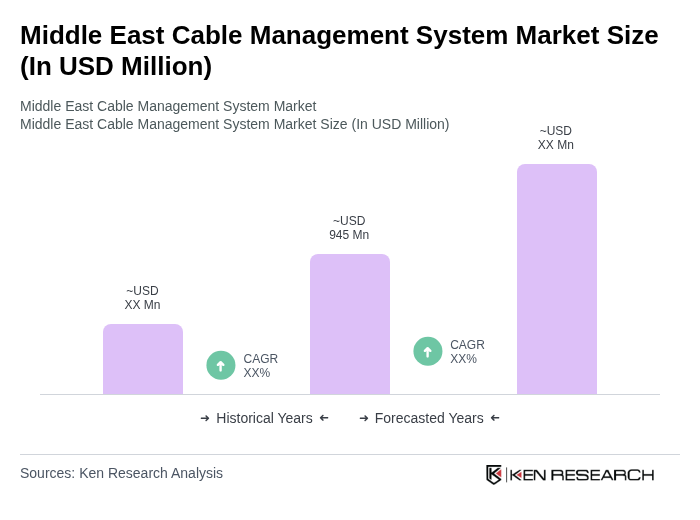
- The Middle East Cable Management System Market is valued at USD 945 million based on a five-year historical analysis. This growth is primarily driven by rapid infrastructure expansion, modernization of telecom networks, especially in Gulf countries, and large-scale energy and transportation investments, with demand for sustainable, modular, and fire-resistant cable management solutions.
- Key players in this market include Legrand SA, Prysmian SpA, Nexans SA, Riyadh Cables Group, and Furukawa Electric. These companies are instrumental in driving growth through their multinational expertise and regional integration strategies, particularly in urban and industrial megaprojects across the GCC, with Saudi Arabia and UAE leading the charge.
- In 2024, the Middle East government announced regulations emphasizing safety and standardization in cable management systems. These regulations mandate adherence to international frameworks such as IEC and UL, ensuring that fire-resistant and quality-certified materials are used in construction and infrastructure projects, thereby promoting durable and high-integrity systems.
Middle East Cable Management System Market Segmentation
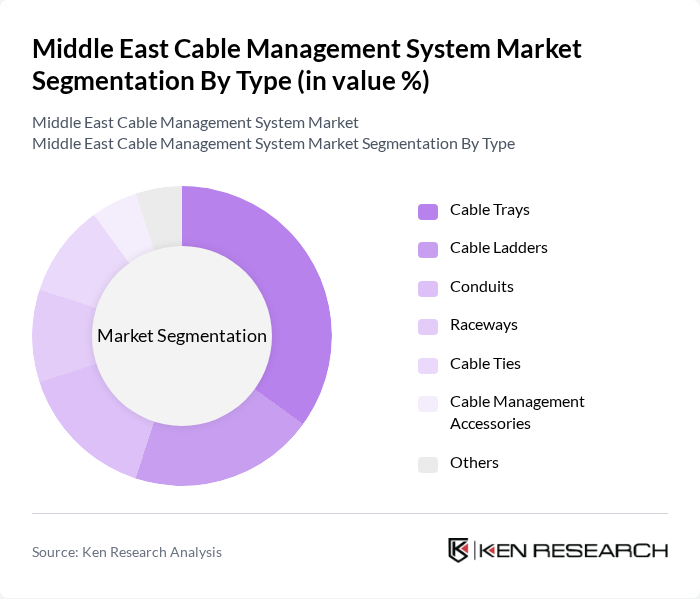
By Type:The cable management system market is segmented into various types, including cable trays, cable ladders, conduits, raceways, cable ties, cable management accessories, and others. Among these, cable trays are the most dominant segment due to their versatility and widespread application in both commercial and industrial settings. The increasing demand for organized and efficient cable management solutions in data centers and telecommunications is driving the growth of this segment.
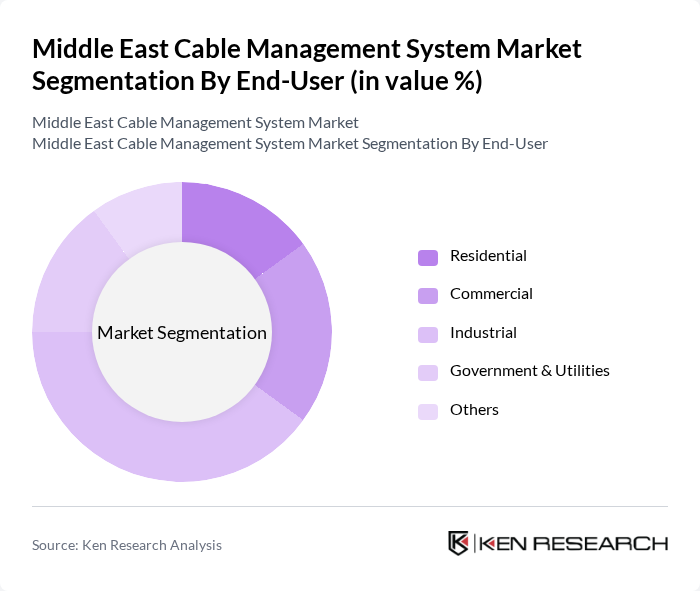
By End-User:The end-user segmentation includes residential, commercial, industrial, government & utilities, and others. The industrial segment is the leading end-user, driven by the increasing need for efficient cable management in manufacturing and processing facilities. The growth of smart factories and automation technologies is further propelling the demand for robust cable management solutions in this sector.
Middle East Cable Management System Market Competitive Landscape
The Middle East Cable Management System Market is characterized by a dynamic mix of regional and international players. Leading participants such as Schneider Electric, Legrand, ABB, Eaton, Panduit, HellermannTyton, Thomas & Betts, Nexans, Southwire, Cantex Inc., Chatsworth Products, Wiremold, 3M, Rittal, and Unistrut contribute to innovation, geographic expansion, and service delivery in this space.
Middle East Cable Management System Market Industry Analysis
Growth Drivers
- Social Infrastructure Investment Expansion:The value of social infrastructure projects in the Middle East reached USD 1.6 billion, with projections indicating growth to USD 2 billion in the future. This surge is driven by urbanization and population growth, prompting governments to invest heavily in healthcare, education, and housing. Such investments indirectly stimulate demand for cable management systems, essential for these developments
- UAE Infrastructure Spending:In the future, the UAE allocated over AED 27 billion (USD 7.4 billion) for infrastructure upgrades. With a population growth rate of approximately 4% annually, the reliance on public-private partnership (PPP) models is expanding infrastructure projects. This trend significantly increases the demand for cable management systems in public infrastructure, ensuring efficient electrical and data distribution
- Underground Transport Infrastructure Pipeline:The MENA region's tunnel construction pipeline is valued at USD 128.6 billion, encompassing metro and sewer systems in cities like Riyadh, Doha, and Dubai. These extensive projects necessitate advanced cable management solutions to ensure safety and efficiency, creating significant demand for specialized products in the sector
Market Challenges
- High Competition in Procurement:Approximately 30% of professionals in the EMEA region report experiencing very high competition during the bidding process for infrastructure projects. This elevated competition can pressure profit margins and increase supplier bargaining power, making it challenging for cable management system providers to maintain profitability while competing for contracts
- Global Infrastructure Asset Impairments:In the future, the Saudi Public Investment Fund (PIF) recorded USD 8 billion in impairments related to its giga-projects. These impairments, resulting from cost overruns and investment losses, may slow down downstream spending on components like cable management systems, as stakeholders reassess their financial commitments to ongoing projects
Middle East Cable Management System Market Future Outlook
The future of the Middle East cable management system market appears promising, driven by a growing emphasis on sustainability and digital transformation. Investments in renewable energy and smart city initiatives are expected to create a demand for innovative cable management solutions that integrate eco-friendly materials and advanced technologies. Additionally, the trend towards public-private partnerships will likely facilitate collaborative infrastructure planning, enhancing the integration of cable management systems into large-scale projects across the region
Market Opportunities
- Smart City and Mega-Urban Developments:The NEOM project spans 26,500 km², while Diriyah's development includes a USD 1.53 billion arena. These large-scale, technology-driven projects necessitate extensive and modern cable management infrastructure, presenting significant opportunities for specialized providers to meet the unique demands of such initiatives
- Transport Infrastructure Expansion:With USD 128.6 billion allocated to tunnel-based transport systems, urban rail and tunnel projects in Riyadh, Doha, and Dubai are set to create substantial demand for high-capacity, safe cable management systems tailored to sub-surface environments. This presents a lucrative opportunity for manufacturers and suppliers in the sector
Scope of the Report
| Segment | Sub-Segments |
|---|---|
| By Type | Cable Trays Cable Ladders Conduits Raceways Cable Ties Cable Management Accessories Others |
| By End-User | Residential Commercial Industrial Government & Utilities Others |
| By Application | Data Centers Telecommunications Power Generation Transportation Others |
| By Material | Metal Plastic Composite Others |
| By Region | GCC Countries Levant Region North Africa Others |
| By Installation Type | Indoor Outdoor Others |
| By Distribution Channel | Direct Sales Distributors Online Sales Others |
Key Target Audience
Investors and Venture Capitalist Firms
Government and Regulatory Bodies (e.g., Ministry of Communications and Information Technology, Telecommunications Regulatory Authority)
Manufacturers and Producers
Distributors and Retailers
Telecommunication Service Providers
Construction and Infrastructure Development Companies
Industry Associations (e.g., Middle East Cable Manufacturers Association)
Financial Institutions
Players Mentioned in the Report:
Schneider Electric
Legrand
ABB
Eaton
Panduit
HellermannTyton
Thomas & Betts
Nexans
Southwire
Cantex Inc.
Chatsworth Products
Wiremold
3M
Rittal
Unistrut
Table of Contents
Market Assessment Phase
1. Executive Summary and Approach
2. Middle East Cable Management System Market Overview
2.1 Key Insights and Strategic Recommendations
2.2 Middle East Cable Management System Market Overview
2.3 Definition and Scope
2.4 Evolution of Market Ecosystem
2.5 Timeline of Key Regulatory Milestones
2.6 Value Chain & Stakeholder Mapping
2.7 Business Cycle Analysis
2.8 Policy & Incentive Landscape
3. Middle East Cable Management System Market Analysis
3.1 Growth Drivers
3.1.1 Increasing demand for organized cable management solutions
3.1.2 Rapid urbanization and infrastructure development
3.1.3 Rising awareness of safety and compliance standards
3.1.4 Technological advancements in cable management systems
3.2 Market Challenges
3.2.1 High initial investment costs
3.2.2 Lack of standardization across products
3.2.3 Competition from alternative solutions
3.2.4 Limited awareness among end-users
3.3 Market Opportunities
3.3.1 Expansion in renewable energy sectors
3.3.2 Growth in data centers and IT infrastructure
3.3.3 Increasing government initiatives for smart cities
3.3.4 Potential for innovative product development
3.4 Market Trends
3.4.1 Shift towards sustainable and eco-friendly materials
3.4.2 Integration of IoT in cable management systems
3.4.3 Customization and modular solutions gaining popularity
3.4.4 Focus on aesthetic designs in cable management
3.5 Government Regulation
3.5.1 Compliance with safety standards and regulations
3.5.2 Incentives for using sustainable materials
3.5.3 Regulations on waste management and recycling
3.5.4 Standards for installation and maintenance practices
4. SWOT Analysis
5. Stakeholder Analysis
6. Porter's Five Forces Analysis
7. Middle East Cable Management System Market Market Size, 2019-2024
7.1 By Value
7.2 By Volume
7.3 By Average Selling Price
8. Middle East Cable Management System Market Segmentation
8.1 By Type
8.1.1 Cable Trays
8.1.2 Cable Ladders
8.1.3 Conduits
8.1.4 Raceways
8.1.5 Cable Ties
8.1.6 Cable Management Accessories
8.1.7 Others
8.2 By End-User
8.2.1 Residential
8.2.2 Commercial
8.2.3 Industrial
8.2.4 Government & Utilities
8.2.5 Others
8.3 By Application
8.3.1 Data Centers
8.3.2 Telecommunications
8.3.3 Power Generation
8.3.4 Transportation
8.3.5 Others
8.4 By Material
8.4.1 Metal
8.4.2 Plastic
8.4.3 Composite
8.4.4 Others
8.5 By Region
8.5.1 GCC Countries
8.5.2 Levant Region
8.5.3 North Africa
8.5.4 Others
8.6 By Installation Type
8.6.1 Indoor
8.6.2 Outdoor
8.6.3 Others
8.7 By Distribution Channel
8.7.1 Direct Sales
8.7.2 Distributors
8.7.3 Online Sales
8.7.4 Others
9. Middle East Cable Management System Market Competitive Analysis
9.1 Market Share of Key Players
9.2 Cross Comparison of Key Players
9.2.1 Company Name
9.2.2 Group Size (Large, Medium, or Small as per industry convention)
9.2.3 Revenue Growth Rate
9.2.4 Market Penetration Rate
9.2.5 Customer Retention Rate
9.2.6 Product Innovation Rate
9.2.7 Pricing Strategy
9.2.8 Distribution Efficiency
9.2.9 Brand Recognition
9.2.10 Customer Satisfaction Score
9.3 SWOT Analysis of Top Players
9.4 Pricing Analysis
9.5 Detailed Profile of Major Companies
9.5.1 Schneider Electric
9.5.2 Legrand
9.5.3 ABB
9.5.4 Eaton
9.5.5 Panduit
9.5.6 HellermannTyton
9.5.7 Thomas & Betts
9.5.8 Nexans
9.5.9 Southwire
9.5.10 Cantex Inc.
9.5.11 Chatsworth Products
9.5.12 Wiremold
9.5.13 3M
9.5.14 Rittal
9.5.15 Unistrut
10. Middle East Cable Management System Market End-User Analysis
10.1 Procurement Behavior of Key Ministries
10.1.1 Key procurement processes
10.1.2 Budget allocation trends
10.1.3 Preferred suppliers
10.1.4 Compliance requirements
10.2 Corporate Spend on Infrastructure & Energy
10.2.1 Investment trends
10.2.2 Major projects
10.2.3 Budget priorities
10.2.4 Future spending forecasts
10.3 Pain Point Analysis by End-User Category
10.3.1 Common challenges faced
10.3.2 Solutions sought
10.3.3 Impact of regulations
10.3.4 Technology adoption barriers
10.4 User Readiness for Adoption
10.4.1 Awareness levels
10.4.2 Training needs
10.4.3 Infrastructure readiness
10.4.4 Support requirements
10.5 Post-Deployment ROI and Use Case Expansion
10.5.1 Measurement of ROI
10.5.2 Case studies of successful implementations
10.5.3 Expansion opportunities
10.5.4 Long-term benefits
11. Middle East Cable Management System Market Future Size, 2025-2030
11.1 By Value
11.2 By Volume
11.3 By Average Selling Price
Go-To-Market Strategy Phase
1. Whitespace Analysis + Business Model Canvas
1.1 Market gaps identification
1.2 Value proposition development
1.3 Revenue model exploration
1.4 Customer segmentation analysis
1.5 Competitive landscape overview
1.6 Key partnerships identification
1.7 Operational framework design
2. Marketing and Positioning Recommendations
2.1 Branding strategies
2.2 Product USPs
2.3 Target audience identification
2.4 Communication strategies
2.5 Digital marketing tactics
2.6 Trade show participation
2.7 Customer engagement initiatives
3. Distribution Plan
3.1 Urban retail strategies
3.2 Rural NGO tie-ups
3.3 E-commerce integration
3.4 Logistics and supply chain management
3.5 Distributor partnerships
3.6 Inventory management practices
3.7 Customer service protocols
4. Channel & Pricing Gaps
4.1 Underserved routes
4.2 Pricing bands analysis
4.3 Competitor pricing strategies
4.4 Value-based pricing models
4.5 Discounting strategies
4.6 Bundling opportunities
4.7 Customer feedback incorporation
5. Unmet Demand & Latent Needs
5.1 Category gaps identification
5.2 Consumer segments analysis
5.3 Product development opportunities
5.4 Market entry barriers
5.5 Customer pain points
5.6 Future trends anticipation
5.7 Innovation opportunities
6. Customer Relationship
6.1 Loyalty programs
6.2 After-sales service
6.3 Customer feedback mechanisms
6.4 Relationship management strategies
6.5 Community engagement initiatives
6.6 Customer education programs
6.7 Retention strategies
7. Value Proposition
7.1 Sustainability initiatives
7.2 Integrated supply chains
7.3 Cost-saving measures
7.4 Quality assurance practices
7.5 Customer-centric innovations
7.6 Competitive advantages
7.7 Long-term partnerships
8. Key Activities
8.1 Regulatory compliance
8.2 Branding efforts
8.3 Distribution setup
8.4 Market research activities
8.5 Training and development
8.6 Performance monitoring
8.7 Stakeholder engagement
9. Entry Strategy Evaluation
9.1 Domestic Market Entry Strategy
9.1.1 Product mix considerations
9.1.2 Pricing band analysis
9.1.3 Packaging strategies
9.2 Export Entry Strategy
9.2.1 Target countries identification
9.2.2 Compliance roadmap development
10. Entry Mode Assessment
10.1 Joint Ventures
10.2 Greenfield Investments
10.3 Mergers & Acquisitions
10.4 Distributor Model
10.5 Risk assessment
10.6 Strategic fit evaluation
10.7 Long-term sustainability considerations
11. Capital and Timeline Estimation
11.1 Capital requirements
11.2 Timelines for market entry
11.3 Resource allocation
11.4 Financial projections
11.5 Risk management strategies
11.6 Milestone tracking
11.7 Contingency planning
12. Control vs Risk Trade-Off
12.1 Ownership considerations
12.2 Partnership dynamics
12.3 Risk mitigation strategies
12.4 Control mechanisms
12.5 Long-term relationship management
12.6 Performance evaluation
12.7 Exit strategies
13. Profitability Outlook
13.1 Breakeven analysis
13.2 Long-term sustainability
13.3 Profit margin optimization
13.4 Revenue diversification
13.5 Cost management strategies
13.6 Financial health assessment
13.7 Market positioning for profitability
14. Potential Partner List
14.1 Distributors
14.2 Joint Ventures
14.3 Acquisition targets
14.4 Strategic alliances
14.5 Industry collaborations
14.6 Research partnerships
14.7 Technology providers
15. Execution Roadmap
15.1 Phased Plan for Market Entry
15.1.1 Market Setup
15.1.2 Market Entry
15.1.3 Growth Acceleration
15.1.4 Scale & Stabilize
15.2 Key Activities and Milestones
15.2.1 Activity tracking
15.2.2 Milestone achievement
15.2.3 Performance reviews
15.2.4 Adjustments and pivots
Research Methodology
Phase 1: Approach1
Desk Research
- Industry reports from regional trade associations and market research firms
- Government publications on infrastructure development and cable management regulations
- Technical papers and whitepapers from leading cable management solution providers
Primary Research
- Interviews with project managers in construction and infrastructure firms
- Surveys with electrical engineers and consultants specializing in cable management
- Field visits to major construction sites to observe cable management practices
Validation & Triangulation
- Cross-validation of data from multiple sources including industry reports and expert interviews
- Triangulation of market trends with historical data and future projections
- Sanity checks through feedback from industry experts and stakeholders
Phase 2: Market Size Estimation1
Top-down Assessment
- Analysis of total construction spending in the Middle East as a proxy for cable management demand
- Segmentation of market size by end-user industries such as commercial, residential, and industrial
- Incorporation of regional infrastructure projects and government initiatives into market forecasts
Bottom-up Modeling
- Estimation of cable management product volumes based on project specifications and requirements
- Cost analysis of cable management systems based on supplier pricing and installation costs
- Volume x cost calculations to derive total market value for each segment
Forecasting & Scenario Analysis
- Multi-variable regression analysis incorporating economic indicators and construction trends
- Scenario modeling based on potential shifts in regulatory frameworks and technological advancements
- Development of baseline, optimistic, and pessimistic market forecasts through 2030
Phase 3: CATI Sample Composition1
| Scope Item/Segment | Sample Size | Target Respondent Profiles |
|---|---|---|
| Commercial Building Projects | 100 | Project Managers, Architects |
| Industrial Cable Management Solutions | 80 | Facility Managers, Electrical Engineers |
| Residential Wiring Systems | 70 | Home Builders, Electrical Contractors |
| Telecommunications Infrastructure | 60 | Network Engineers, IT Managers |
| Government Infrastructure Projects | 90 | Public Works Officials, Procurement Officers |
Frequently Asked Questions
What is the current value of the Middle East Cable Management System Market?
The Middle East Cable Management System Market is valued at approximately USD 945 million, driven by rapid infrastructure expansion and modernization of telecom networks, particularly in Gulf countries, alongside significant investments in energy and transportation sectors.
What are the key drivers of growth in the Middle East Cable Management System Market?
Who are the major players in the Middle East Cable Management System Market?
What types of cable management systems are most commonly used in the Middle East?
Other Regional/Country Reports
Indonesia Cable Management System Market
Malaysia Cable Management System Market
KSA Cable Management System Market
APAC Cable Management System Market
SEA Cable Management System Market
Vietnam Cable Management System Market
Other Adjacent Reports
Singapore Telecommunications Infrastructure Market
Bahrain Energy Infrastructure Market
Belgium Transportation Infrastructure Market
India Construction Materials Market Size, Share & Forecast, By Material Type, Application & End User, 2026-2031Qatar Fire-Resistant Materials Market
Singapore Smart City Solutions Market
APAC Renewable Energy Market Size, Share & Forecast, By Energy Source, Application & Project Scale, 2025-2032India Industrial Automation Market Size, Share & Forecast, By Solution Type, Deployment Model & End-Use Industry, 2026-2031Mexico Data Center Solutions Market
Singapore Building Safety Systems Market
Why Buy From Us?

What makes us stand out is that our consultants follow Robust, Refine and Result (RRR) methodology. Robust for clear definitions, approaches and sanity checking, Refine for differentiating respondents' facts and opinions, and Result for presenting data with story.

We have set a benchmark in the industry by offering our clients with syndicated and customized market research reports featuring coverage of entire market as well as meticulous research and analyst insights.

While we don't replace traditional research, we flip the method upside down. Our dual approach of Top Bottom & Bottom Top ensures quality deliverable by not just verifying company fundamentals but also looking at the sector and macroeconomic factors.

With one step in the future, our research team constantly tries to show you the bigger picture. We help with some of the tough questions you may encounter along the way: How is the industry positioned? Best marketing channel? KPI's of competitors? By aligning every element, we help maximize success.

Our report gives you instant access to the answers and sources that other companies might choose to hide. We elaborate each steps of research methodology we have used and showcase you the sample size to earn your trust.

If you need any support, we are here! We pride ourselves on universe strength, data quality, and quick, friendly, and professional service.