About the Report
Base Year 2024Middle East Cancer Supportive Care Drugs Market Overview
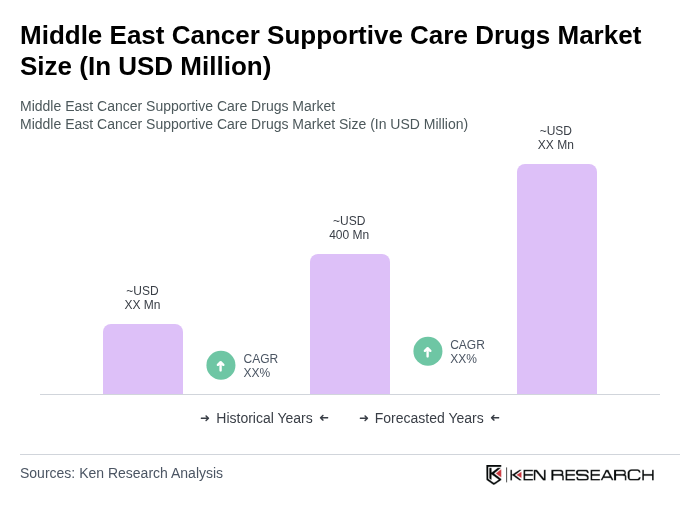
- The Middle East Cancer Supportive Care Drugs Market is valued at USD 400 million, based on a five-year historical analysis. This growth is primarily driven by the increasing prevalence of cancer, advancements in treatment protocols, a growing focus on improving the quality of life for patients undergoing cancer therapies, and expanding healthcare infrastructure with government initiatives under programs like Saudi Vision 2030. The rising awareness of supportive care options among healthcare providers and patients has also contributed significantly to market expansion.
- Countries such as Saudi Arabia, the United Arab Emirates, and Israel dominate the Middle East Cancer Supportive Care Drugs Market due to their advanced healthcare infrastructure, high investment in oncology research, and a growing number of cancer treatment centers. These nations have established comprehensive cancer care programs, which include supportive care drugs, thereby enhancing patient outcomes and driving market growth.
- The Saudi Food and Drug Authority (SFDA) Medical Devices Interim Regulation, 2022 issued by the SFDA requires manufacturers of cancer supportive care drugs to submit comprehensive clinical data and conduct local stability testing for approvals, ensuring compliance through post-marketing surveillance and mandatory registration for all imported pharmaceuticals with thresholds for bioequivalence studies. This initiative is designed to expedite access to essential medications for patients, ensuring that innovative therapies are available in a timely manner. The regulation emphasizes the importance of patient safety and efficacy in drug approval, thereby fostering a more responsive healthcare environment.
Middle East Cancer Supportive Care Drugs Market Segmentation
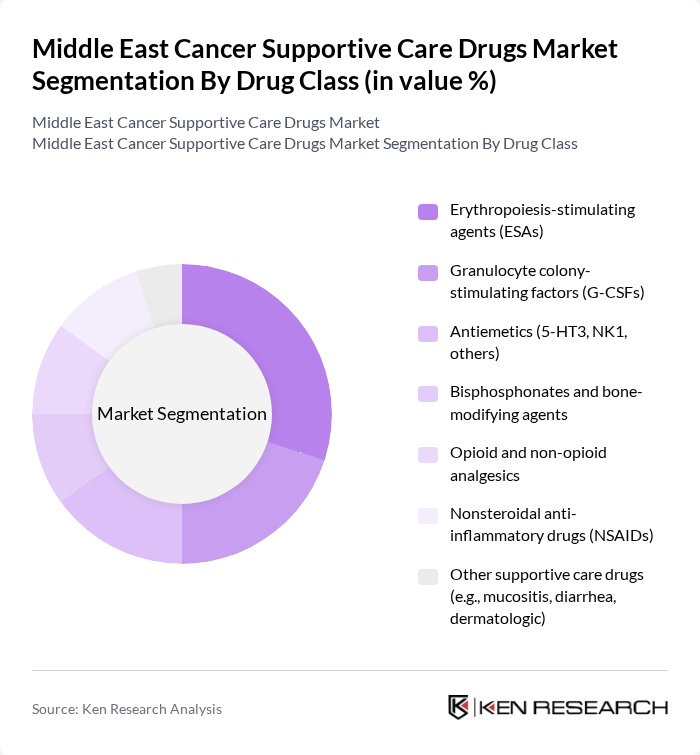
By Drug Class:The drug class segmentation includes various categories of supportive care drugs that are essential for managing the side effects of cancer treatments. The leading sub-segment in this category is the Erythropoiesis-stimulating agents (ESAs), which are crucial for treating anemia in cancer patients. The increasing incidence of chemotherapy-induced anemia has driven the demand for ESAs, making them a significant focus for healthcare providers and pharmaceutical companies.
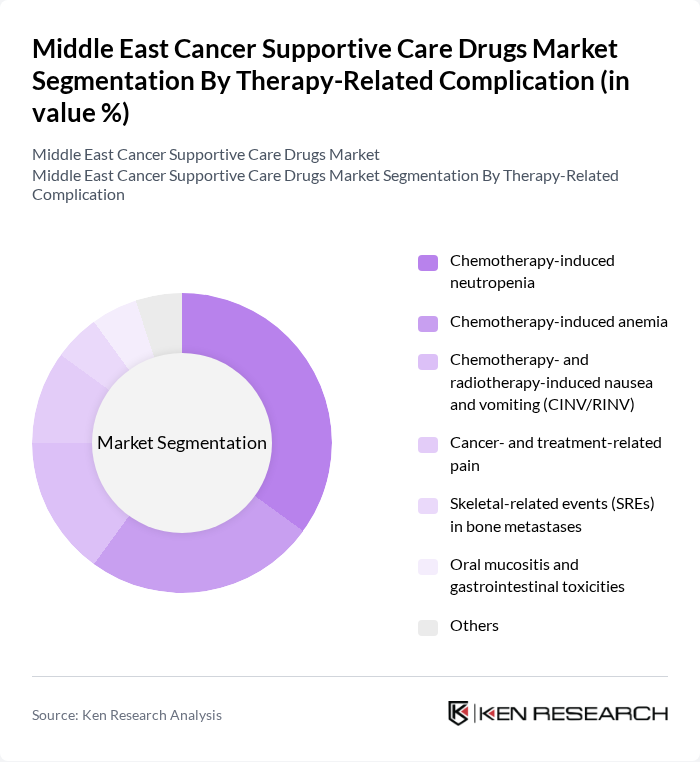
By Therapy-Related Complication:This segmentation focuses on the various complications arising from cancer treatments, with chemotherapy-induced neutropenia being the most prevalent. The demand for drugs addressing this complication has surged due to the increasing use of chemotherapy regimens, which often lead to severe side effects. As healthcare providers prioritize patient safety and treatment efficacy, the market for supportive care drugs targeting these complications continues to expand.
Middle East Cancer Supportive Care Drugs Market Competitive Landscape
The Middle East Cancer Supportive Care Drugs Market is characterized by a dynamic mix of regional and international players. Leading participants such as F. Hoffmann-La Roche Ltd, Amgen Inc., Novartis AG (including Sandoz), Pfizer Inc., Sanofi, GlaxoSmithKline plc (GSK), Merck & Co., Inc. (MSD), Bristol Myers Squibb Company, Eli Lilly and Company, Teva Pharmaceutical Industries Ltd, Hikma Pharmaceuticals plc, Julphar – Gulf Pharmaceutical Industries, SPIMACO Addwaeih – Saudi Pharmaceutical Industries & Medical Appliances Corporation, Tabuk Pharmaceuticals Manufacturing Company, Aspen Pharmacare Holdings Limited contribute to innovation, geographic expansion, and service delivery in this space.
Middle East Cancer Supportive Care Drugs Market Industry Analysis
Growth Drivers
- Increasing Prevalence of Cancer:The Middle East has witnessed a significant rise in cancer cases, with the World Health Organization reporting over 600,000 new cancer cases in recent years. By the future, this number is projected to exceed 700,000, driven by factors such as population growth and lifestyle changes. This alarming trend necessitates the development and availability of supportive care drugs, creating a robust market demand for effective treatment options in the region.
- Rising Awareness about Supportive Care:Increased public and professional awareness regarding the importance of supportive care in cancer treatment has been observed. In the future, approximately 80% of healthcare professionals in the region acknowledged the role of supportive care in improving patient outcomes. This growing recognition is expected to drive demand for supportive care drugs, as patients and families seek comprehensive treatment options that enhance quality of life during cancer therapy.
- Advancements in Drug Formulations:The pharmaceutical industry in the Middle East is experiencing rapid advancements in drug formulations, particularly in supportive care. In the future, it is anticipated that over 40 new supportive care drugs will be introduced to the market, focusing on symptom management and improving patient comfort. These innovations are crucial in addressing the diverse needs of cancer patients, thereby propelling market growth and enhancing treatment efficacy across the region.
Market Challenges
- High Cost of Supportive Care Drugs:The financial burden associated with supportive care drugs remains a significant challenge in the Middle East. The average cost of these drugs can reach up to $6,000 per patient annually, which poses affordability issues for many patients. This high cost can limit access to essential medications, ultimately affecting treatment adherence and patient outcomes, thereby hindering market growth.
- Limited Access to Healthcare Facilities:Access to healthcare facilities in the Middle East is uneven, with rural areas facing significant shortages. According to the World Bank, approximately 35% of the population in these regions lacks access to essential health services. This disparity restricts patients' ability to receive timely supportive care, creating a barrier to market expansion and limiting the reach of supportive care drugs to those in need.
Middle East Cancer Supportive Care Drugs Market Future Outlook
The future of the Middle East cancer supportive care drugs market appears promising, driven by ongoing advancements in healthcare infrastructure and increased investment in research and development. As governments prioritize cancer care, the integration of innovative technologies and personalized medicine is expected to enhance treatment efficacy. Furthermore, collaborations with international pharmaceutical companies will likely facilitate the introduction of new therapies, ultimately improving patient outcomes and expanding market reach in the region.
Market Opportunities
- Expansion of Healthcare Infrastructure:The Middle East is investing heavily in healthcare infrastructure, with over $60 billion allocated for new hospitals and clinics in the future. This expansion will improve access to supportive care drugs, enabling more patients to receive timely treatment and enhancing overall market growth potential.
- Increasing Investment in R&D:With a projected increase of 20% in R&D spending in the pharmaceutical sector in the future, the Middle East is poised to foster innovation in supportive care drugs. This investment will lead to the development of more effective therapies, addressing unmet needs and driving market growth as new products enter the market.
Scope of the Report
| Segment | Sub-Segments |
|---|---|
| By Drug Class | Erythropoiesis-stimulating agents (ESAs) Granulocyte colony-stimulating factors (G-CSFs) Antiemetics (5-HT3, NK1, others) Bisphosphonates and bone-modifying agents Opioid and non-opioid analgesics Nonsteroidal anti-inflammatory drugs (NSAIDs) Other supportive care drugs (e.g., mucositis, diarrhea, dermatologic) |
| By Therapy-Related Complication | Chemotherapy-induced neutropenia Chemotherapy-induced anemia Chemotherapy- and radiotherapy-induced nausea and vomiting (CINV/RINV) Cancer- and treatment-related pain Skeletal-related events (SREs) in bone metastases Oral mucositis and gastrointestinal toxicities Others |
| By End-User | Hospitals Specialty oncology centers Home care settings Palliative care centers and hospices Others |
| By Distribution Channel | Hospital pharmacies Retail pharmacies Online pharmacies Specialty pharmacies Wholesalers and distributors Others |
| By Route of Administration | Oral Intravenous Subcutaneous Transdermal Others |
| By Patient Demographics | Pediatric Adult Geriatric Others |
| By Cancer Type | Breast cancer Lung cancer Colorectal cancer Prostate cancer Liver and stomach cancers Others |
| By Region | GCC countries Levant Iran Rest of Middle East |
Key Target Audience
Investors and Venture Capitalist Firms
Government and Regulatory Bodies (e.g., Ministry of Health, Food and Drug Administration of
Pharmaceutical Manufacturers and Producers
Distributors and Wholesalers
Healthcare Providers and Hospitals
Health Insurance Companies
Pharmacy Chains and Retail Pharmacies
Biotechnology Firms
Players Mentioned in the Report:
F. Hoffmann-La Roche Ltd
Amgen Inc.
Novartis AG (including Sandoz)
Pfizer Inc.
Sanofi
GlaxoSmithKline plc (GSK)
Merck & Co., Inc. (MSD)
Bristol Myers Squibb Company
Eli Lilly and Company
Teva Pharmaceutical Industries Ltd
Hikma Pharmaceuticals plc
Julphar Gulf Pharmaceutical Industries
SPIMACO Addwaeih Saudi Pharmaceutical Industries & Medical Appliances Corporation
Tabuk Pharmaceuticals Manufacturing Company
Aspen Pharmacare Holdings Limited
Table of Contents
Market Assessment Phase
1. Executive Summary and Approach
2. Middle East Cancer Supportive Care Drugs Market Overview
2.1 Key Insights and Strategic Recommendations
2.2 Middle East Cancer Supportive Care Drugs Market Overview
2.3 Definition and Scope
2.4 Evolution of Market Ecosystem
2.5 Timeline of Key Regulatory Milestones
2.6 Value Chain & Stakeholder Mapping
2.7 Business Cycle Analysis
2.8 Policy & Incentive Landscape
3. Middle East Cancer Supportive Care Drugs Market Analysis
3.1 Growth Drivers
3.1.1 Increasing prevalence of cancer in the region
3.1.2 Rising awareness about supportive care
3.1.3 Advancements in drug formulations
3.1.4 Government initiatives for cancer care
3.2 Market Challenges
3.2.1 High cost of supportive care drugs
3.2.2 Limited access to healthcare facilities
3.2.3 Regulatory hurdles
3.2.4 Lack of trained healthcare professionals
3.3 Market Opportunities
3.3.1 Expansion of healthcare infrastructure
3.3.2 Increasing investment in R&D
3.3.3 Collaborations with international pharmaceutical companies
3.3.4 Growing demand for personalized medicine
3.4 Market Trends
3.4.1 Shift towards home-based care
3.4.2 Integration of technology in treatment
3.4.3 Focus on holistic patient care
3.4.4 Rise of biosimilars in the market
3.5 Government Regulation
3.5.1 Drug approval processes
3.5.2 Pricing regulations
3.5.3 Quality control standards
3.5.4 Patient safety regulations
4. SWOT Analysis
5. Stakeholder Analysis
6. Porter's Five Forces Analysis
7. Middle East Cancer Supportive Care Drugs Market Market Size, 2019-2024
7.1 By Value
7.2 By Volume
7.3 By Average Selling Price
8. Middle East Cancer Supportive Care Drugs Market Segmentation
8.1 By Drug Class
8.1.1 Erythropoiesis-stimulating agents (ESAs)
8.1.2 Granulocyte colony-stimulating factors (G-CSFs)
8.1.3 Antiemetics (5-HT3, NK1, others)
8.1.4 Bisphosphonates and bone-modifying agents
8.1.5 Opioid and non-opioid analgesics
8.1.6 Nonsteroidal anti-inflammatory drugs (NSAIDs)
8.1.7 Other supportive care drugs (e.g., mucositis, diarrhea, dermatologic)
8.2 By Therapy-Related Complication
8.2.1 Chemotherapy-induced neutropenia
8.2.2 Chemotherapy-induced anemia
8.2.3 Chemotherapy- and radiotherapy-induced nausea and vomiting (CINV/RINV)
8.2.4 Cancer- and treatment-related pain
8.2.5 Skeletal-related events (SREs) in bone metastases
8.2.6 Oral mucositis and gastrointestinal toxicities
8.2.7 Others
8.3 By End-User
8.3.1 Hospitals
8.3.2 Specialty oncology centers
8.3.3 Home care settings
8.3.4 Palliative care centers and hospices
8.3.5 Others
8.4 By Distribution Channel
8.4.1 Hospital pharmacies
8.4.2 Retail pharmacies
8.4.3 Online pharmacies
8.4.4 Specialty pharmacies
8.4.5 Wholesalers and distributors
8.4.6 Others
8.5 By Route of Administration
8.5.1 Oral
8.5.2 Intravenous
8.5.3 Subcutaneous
8.5.4 Transdermal
8.5.5 Others
8.6 By Patient Demographics
8.6.1 Pediatric
8.6.2 Adult
8.6.3 Geriatric
8.6.4 Others
8.7 By Cancer Type
8.7.1 Breast cancer
8.7.2 Lung cancer
8.7.3 Colorectal cancer
8.7.4 Prostate cancer
8.7.5 Liver and stomach cancers
8.7.6 Others
8.8 By Region
8.8.1 GCC countries
8.8.2 Levant
8.8.3 Iran
8.8.4 Rest of Middle East
9. Middle East Cancer Supportive Care Drugs Market Competitive Analysis
9.1 Market Share of Key Players
9.2 Cross Comparison of Key Players
9.2.1 Company name
9.2.2 Presence in Middle East oncology & supportive care (number of countries / key markets)
9.2.3 Regional cancer supportive care drugs revenue and 3–5 year CAGR
9.2.4 Portfolio breadth in supportive care drug classes (ESAs, G-CSFs, antiemetics, analgesics, bone agents, others)
9.2.5 Share of biosimilars in supportive care portfolio
9.2.6 Registration footprint (number of approved SKUs / indications in Middle East)
9.2.7 Market access strength (tender wins, formulary inclusion rate, reimbursement coverage)
9.2.8 Distribution and partnership depth (number of distributors / local partners, in-market affiliates)
9.2.9 R&D and lifecycle investment in supportive care (as % of oncology revenue)
9.2.10 Average price positioning vs originator / biosimilar peers
9.2.11 Brand recognition and KOL engagement index in oncology supportive care
9.3 SWOT Analysis of Top Players
9.4 Pricing Analysis
9.5 Detailed Profile of Major Companies
9.5.1 F. Hoffmann-La Roche Ltd
9.5.2 Amgen Inc.
9.5.3 Novartis AG (including Sandoz)
9.5.4 Pfizer Inc.
9.5.5 Sanofi
9.5.6 GlaxoSmithKline plc (GSK)
9.5.7 Merck & Co., Inc. (MSD)
9.5.8 Bristol Myers Squibb Company
9.5.9 Eli Lilly and Company
9.5.10 Teva Pharmaceutical Industries Ltd
9.5.11 Hikma Pharmaceuticals plc
9.5.12 Julphar – Gulf Pharmaceutical Industries
9.5.13 SPIMACO Addwaeih – Saudi Pharmaceutical Industries & Medical Appliances Corporation
9.5.14 Tabuk Pharmaceuticals Manufacturing Company
9.5.15 Aspen Pharmacare Holdings Limited
10. Middle East Cancer Supportive Care Drugs Market End-User Analysis
10.1 Procurement Behavior of Key Ministries
10.1.1 Budget allocation for cancer care
10.1.2 Decision-making processes
10.1.3 Supplier selection criteria
10.1.4 Contract management practices
10.2 Corporate Spend on Infrastructure & Energy
10.2.1 Investment in healthcare facilities
10.2.2 Funding for research initiatives
10.2.3 Partnerships with NGOs
10.2.4 Technology adoption in healthcare
10.3 Pain Point Analysis by End-User Category
10.3.1 Access to medications
10.3.2 Affordability of treatments
10.3.3 Availability of healthcare professionals
10.3.4 Quality of care
10.4 User Readiness for Adoption
10.4.1 Awareness of supportive care options
10.4.2 Training needs for healthcare providers
10.4.3 Patient education initiatives
10.4.4 Technology readiness
10.5 Post-Deployment ROI and Use Case Expansion
10.5.1 Measurement of treatment outcomes
10.5.2 Cost-effectiveness analysis
10.5.3 Patient satisfaction surveys
10.5.4 Opportunities for service expansion
11. Middle East Cancer Supportive Care Drugs Market Future Size, 2025-2030
11.1 By Value
11.2 By Volume
11.3 By Average Selling Price
Go-To-Market Strategy Phase
1. Whitespace Analysis + Business Model Canvas
1.1 Market gaps identification
1.2 Value proposition development
1.3 Revenue model exploration
1.4 Customer segmentation analysis
1.5 Competitive landscape assessment
1.6 Key partnerships identification
1.7 Risk assessment
2. Marketing and Positioning Recommendations
2.1 Branding strategies
2.2 Product USPs
2.3 Target audience identification
2.4 Communication strategies
2.5 Digital marketing initiatives
2.6 Event marketing strategies
2.7 Feedback mechanisms
3. Distribution Plan
3.1 Urban retail strategies
3.2 Rural NGO tie-ups
3.3 Online distribution channels
3.4 Partnerships with healthcare providers
3.5 Logistics and supply chain management
3.6 Inventory management strategies
3.7 Distribution efficiency improvements
4. Channel & Pricing Gaps
4.1 Underserved routes
4.2 Pricing bands analysis
4.3 Competitor pricing strategies
4.4 Customer willingness to pay
4.5 Value-based pricing models
4.6 Discounting strategies
4.7 Price elasticity analysis
5. Unmet Demand & Latent Needs
5.1 Category gaps identification
5.2 Consumer segments analysis
5.3 Emerging trends exploration
5.4 Customer feedback analysis
5.5 Market research findings
5.6 Innovation opportunities
5.7 Future demand forecasting
6. Customer Relationship
6.1 Loyalty programs
6.2 After-sales service
6.3 Customer engagement strategies
6.4 Feedback collection mechanisms
6.5 Relationship management tools
6.6 Community building initiatives
6.7 Customer education programs
7. Value Proposition
7.1 Sustainability initiatives
7.2 Integrated supply chains
7.3 Unique selling propositions
7.4 Customer-centric approaches
7.5 Competitive advantages
7.6 Value delivery mechanisms
7.7 Long-term benefits
8. Key Activities
8.1 Regulatory compliance
8.2 Branding efforts
8.3 Distribution setup
8.4 Marketing campaigns
8.5 Training and development
8.6 Performance monitoring
8.7 Stakeholder engagement
9. Entry Strategy Evaluation
9.1 Domestic Market Entry Strategy
9.1.1 Product mix considerations
9.1.2 Pricing band analysis
9.1.3 Packaging strategies
9.2 Export Entry Strategy
9.2.1 Target countries identification
9.2.2 Compliance roadmap development
10. Entry Mode Assessment
10.1 Joint Ventures
10.2 Greenfield investments
10.3 Mergers & Acquisitions
10.4 Distributor Model
10.5 Risk assessment
10.6 Market entry barriers
10.7 Strategic fit analysis
11. Capital and Timeline Estimation
11.1 Capital requirements
11.2 Timelines for market entry
11.3 Financial projections
11.4 Funding sources
11.5 Budget allocation
11.6 Cost management strategies
11.7 Investment return expectations
12. Control vs Risk Trade-Off
12.1 Ownership considerations
12.2 Partnership dynamics
12.3 Risk management strategies
12.4 Control mechanisms
12.5 Long-term sustainability
12.6 Exit strategies
12.7 Performance metrics
13. Profitability Outlook
13.1 Breakeven analysis
13.2 Long-term sustainability
13.3 Profit margin expectations
13.
Research Methodology
Phase 1: Approach1
Desk Research
- Analysis of published reports from health organizations and cancer research institutes in the Middle East
- Review of market studies and white papers focusing on supportive care drugs and oncology
- Examination of government health expenditure reports and pharmaceutical market regulations
Primary Research
- Interviews with oncologists and healthcare professionals specializing in cancer treatment
- Surveys with pharmacists and hospital procurement managers regarding drug availability and usage
- Focus groups with patients and caregivers to understand needs and preferences in supportive care
Validation & Triangulation
- Cross-validation of findings through multiple expert interviews and secondary data sources
- Triangulation of market data with clinical trial outcomes and patient feedback
- Sanity checks through peer reviews and expert panel discussions
Phase 2: Market Size Estimation1
Top-down Assessment
- Estimation of market size based on national healthcare spending and cancer prevalence rates
- Segmentation of the market by drug type, including antiemetics, analgesics, and nutritional supplements
- Incorporation of demographic trends and regional healthcare access disparities
Bottom-up Modeling
- Collection of sales data from leading pharmaceutical distributors and manufacturers
- Estimation of drug consumption rates based on treatment protocols and patient demographics
- Volume and pricing analysis to derive revenue projections for supportive care drugs
Forecasting & Scenario Analysis
- Multi-factor regression analysis incorporating factors such as population growth and healthcare policy changes
- Scenario modeling based on potential shifts in drug approval processes and market entry of new therapies
- Development of baseline, optimistic, and pessimistic forecasts through 2030
Phase 3: CATI Sample Composition1
| Scope Item/Segment | Sample Size | Target Respondent Profiles |
|---|---|---|
| Oncologists in Major Hospitals | 100 | Medical Oncologists, Hematologists |
| Pharmacists in Cancer Treatment Centers | 80 | Clinical Pharmacists, Pharmacy Directors |
| Patients Receiving Supportive Care | 150 | Cancer Patients, Caregivers |
| Healthcare Administrators | 70 | Hospital Administrators, Procurement Officers |
| Clinical Researchers in Oncology | 60 | Clinical Research Coordinators, Oncological Researchers |
Frequently Asked Questions
What is the current value of the Middle East Cancer Supportive Care Drugs Market?
The Middle East Cancer Supportive Care Drugs Market is valued at approximately USD 400 million, reflecting a significant growth driven by the increasing prevalence of cancer and advancements in treatment protocols.
Which countries dominate the Middle East Cancer Supportive Care Drugs Market?
What are the key growth drivers for the Middle East Cancer Supportive Care Drugs Market?
What challenges does the Middle East Cancer Supportive Care Drugs Market face?
Other Regional/Country Reports
Indonesia Cancer Supportive Care Drugs Market
Malaysia Cancer Supportive Care Drugs Market
KSA Cancer Supportive Care Drugs Market
APAC Cancer Supportive Care Drugs Market
SEA Cancer Supportive Care Drugs Market
Vietnam Cancer Supportive Care Drugs Market
Other Adjacent Reports
Kuwait Oncology Pharmaceuticals Market
UAE Chemotherapy Drugs Market
Belgium Anti-Emetics Market
Mexico Pain Management Drugs Market
Indonesia Erythropoiesis-Stimulating Agents Market
Bahrain Granulocyte Colony-Stimulating Factors Market
Saudi Arabia Cancer Diagnostics Market Size, Share, Growth Drivers, Trends, Opportunities & Forecast 2025–2030South Africa Palliative Care Services Market
Kuwait biosimilars market Size, Share, Growth Drivers, Trends, Opportunities & Forecast 2025–2030South Korea Radiation Therapy Market
Why Buy From Us?

What makes us stand out is that our consultants follow Robust, Refine and Result (RRR) methodology. Robust for clear definitions, approaches and sanity checking, Refine for differentiating respondents' facts and opinions, and Result for presenting data with story.

We have set a benchmark in the industry by offering our clients with syndicated and customized market research reports featuring coverage of entire market as well as meticulous research and analyst insights.

While we don't replace traditional research, we flip the method upside down. Our dual approach of Top Bottom & Bottom Top ensures quality deliverable by not just verifying company fundamentals but also looking at the sector and macroeconomic factors.

With one step in the future, our research team constantly tries to show you the bigger picture. We help with some of the tough questions you may encounter along the way: How is the industry positioned? Best marketing channel? KPI's of competitors? By aligning every element, we help maximize success.

Our report gives you instant access to the answers and sources that other companies might choose to hide. We elaborate each steps of research methodology we have used and showcase you the sample size to earn your trust.

If you need any support, we are here! We pride ourselves on universe strength, data quality, and quick, friendly, and professional service.