About the Report
Base Year 2024Middle East Glass Curtain Wall Market Overview
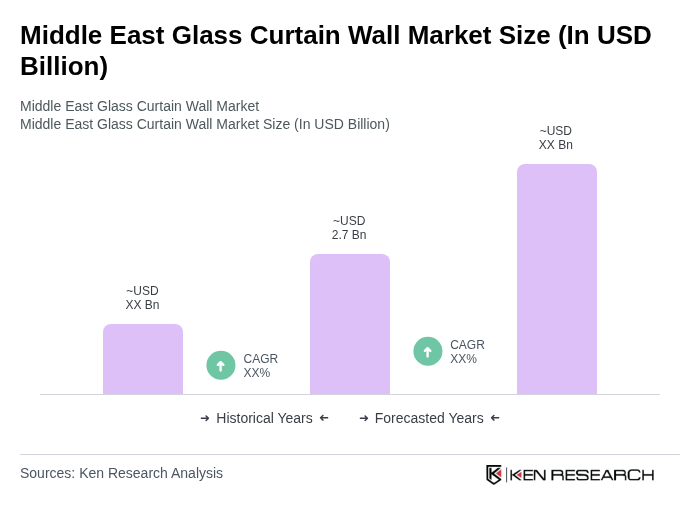
- The Middle East Glass Curtain Wall Market is valued at USD 2.7 billion, based on a five-year historical analysis and regional share of the global glass curtain wall industry. This growth is primarily driven by the rapid urbanization and infrastructural development across the region, particularly in the construction of high-rise buildings, mixed-use complexes, and commercial spaces such as malls, hotels, and offices. The increasing demand for energy-efficient and aesthetically pleasing building facades, supported by wider adoption of low?emissivity coatings, high?performance glazing, and thermally broken framing systems, has further propelled the market as architects and builders seek innovative solutions to enhance building performance and reduce operational energy use.
- Key country markets in this region include the United Arab Emirates, Saudi Arabia, and Turkey. The UAE leads due to its booming real estate sector and numerous mega?projects in Dubai and Abu Dhabi, including premium hospitality, office, and residential towers that extensively use glass curtain wall systems. Saudi Arabia's Vision 2030 initiative is driving significant investments in infrastructure and giga?projects such as NEOM, the Red Sea Project, and Qiddiya, which are fueling demand for advanced façade solutions. Turkey’s strategic location between Europe and Asia and its sizable construction industry, particularly in urban regeneration, commercial buildings, and export?oriented façade manufacturing, also contribute to its importance in the regional glass curtain wall supply chain.
- In 2023, the UAE government strengthened its framework for energy?efficient construction through instruments such as the UAE Energy Efficiency Policy, together with emirate?level building regulations including the Abu Dhabi International Building Code and the Estidama Pearl Rating System issued by the Abu Dhabi Department of Municipalities and Transport, and the Dubai Green Building Regulations and Specifications issued by Dubai Municipality. These instruments set minimum performance requirements for building envelopes, including thermal transmittance limits and glazing performance, encourage or require the use of energy?efficient materials, and link compliance to building permits and rating certifications, thereby increasing the demand for high?performance glass curtain wall systems that meet these standards.
Middle East Glass Curtain Wall Market Segmentation
By System Type:
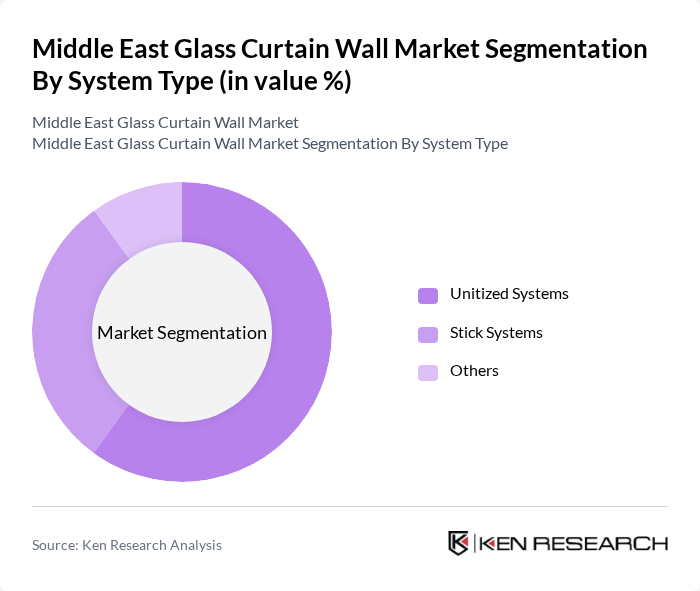
The system type segmentation includes Unitized Systems, Stick Systems, and Others. Among these, Unitized Systems dominate the market due to their ease of installation, factory?controlled quality, and superior performance in terms of thermal insulation, air?tightness, and weather resistance, which are critical under the region’s harsh climatic conditions. These systems are increasingly preferred for high?rise and large?scale projects where speed, reduced on?site labor, and façade performance are priorities. Stick Systems, while still relevant, are more labor?intensive and are often selected for projects requiring high on?site customization, complex geometries, or smaller façades. The Others category includes semi?unitized, hybrid, and specialized systems that cater to niche architectural concepts, refurbishments, and performance requirements, but they hold a smaller market share compared to the leading types.
By Glazing Application:
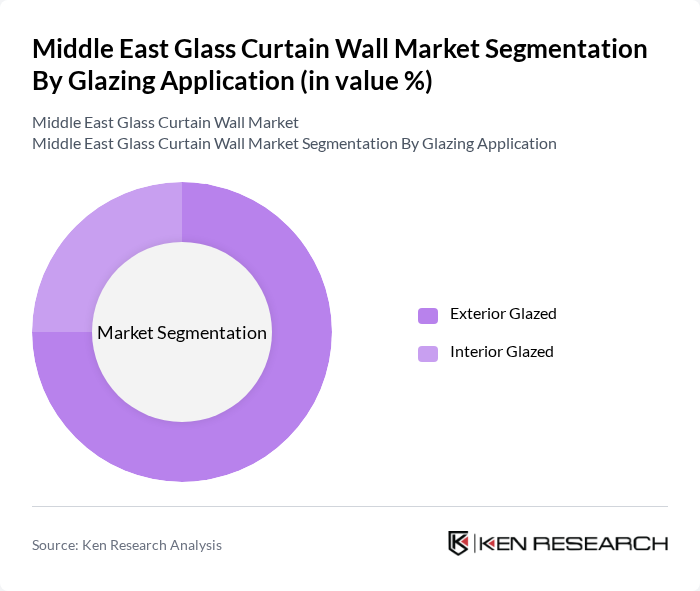
This segmentation includes Exterior Glazed and Interior Glazed applications. The Exterior Glazed segment is the leading category, driven by the demand for visually appealing, fully glazed façades that deliver daylight access and energy efficiency in commercial, hospitality, and high?end residential buildings across the Middle East. As urban areas expand and city skylines densify, the need for modern architectural designs featuring large glass surfaces and integrated shading or high?performance coatings has surged. Interior Glazed applications, including internal partitions, atrium glazing, and shopfronts, are important for aesthetics, acoustic control, and spatial transparency within buildings, but they do not match the volume of exterior applications, which dominate in new construction and large redevelopment projects.
Middle East Glass Curtain Wall Market Competitive Landscape
The Middle East Glass Curtain Wall Market is characterized by a dynamic mix of regional and international players. Leading participants such as Al Abbar Group, Gulf Glass Industries, Emirates Glass, Saint-Gobain, Schüco International KG, Kawneer Company, Inc., Al-Futtaim Engineering & Technologies, AGC Inc., Guardian Glass (Guardian Industries), Nippon Sheet Glass Co., Ltd. (NSG Group), Reynaers Aluminium, Jangho Group, Elicc Group, Al Ghurair Construction – Aluminium, Technical Glass & Aluminium Company LLC contribute to innovation, geographic expansion, and service delivery in this space.
Middle East Glass Curtain Wall Market Industry Analysis
Growth Drivers
- Increasing Urbanization:The Middle East is experiencing rapid urbanization, with urban populations projected to reach 85% in future, up from 75% in 2020. This surge is driving demand for modern infrastructure, including glass curtain walls, which enhance aesthetic appeal and functionality. Cities like Dubai and Riyadh are leading this trend, with significant investments in high-rise buildings. The urban population growth translates to an increased need for innovative building solutions, further propelling the glass curtain wall market.
- Rising Demand for Energy-Efficient Buildings:The push for energy-efficient buildings is gaining momentum, with the Middle East aiming for a 30% reduction in energy consumption in future. This is supported by the UAE's Energy Strategy 2050, which emphasizes sustainable construction practices. Glass curtain walls, known for their thermal insulation properties, are increasingly favored in new developments. In future, the energy-efficient building segment is expected to account for approximately $2.5 billion in investments, highlighting the market's growth potential.
- Government Initiatives for Sustainable Construction:Governments across the Middle East are implementing initiatives to promote sustainable construction. For instance, Saudi Arabia's Vision 2030 aims to diversify the economy and enhance sustainability in the construction sector. In future, government spending on sustainable building projects is projected to exceed $1.8 billion. These initiatives are fostering a favorable environment for glass curtain wall adoption, as they align with national goals for reducing carbon footprints and enhancing energy efficiency.
Market Challenges
- High Initial Investment Costs:The installation of glass curtain walls involves significant upfront costs, often exceeding $200 per square meter. This financial barrier can deter developers, especially in a region where budget constraints are common. Additionally, the high costs associated with advanced glass technologies and installation processes can limit market penetration. As a result, many projects may opt for less expensive alternatives, hindering the growth of the glass curtain wall market in the region.
- Regulatory Compliance Issues:Navigating the complex regulatory landscape poses a challenge for the glass curtain wall market. Compliance with building codes and safety regulations can be cumbersome, particularly in countries with stringent requirements. For instance, the UAE mandates adherence to the Abu Dhabi International Building Code, which can delay project timelines and increase costs. In future, approximately 40% of construction projects are expected to face regulatory hurdles, impacting the timely adoption of glass curtain walls.
Middle East Glass Curtain Wall Market Future Outlook
The future of the Middle East glass curtain wall market appears promising, driven by urbanization and sustainability trends. As cities expand, the demand for innovative building solutions will likely increase, particularly in high-rise developments. Furthermore, advancements in glass technology, such as smart glass and energy-efficient coatings, will enhance product offerings. In future, the integration of these technologies is expected to reshape the market landscape, fostering collaborations between manufacturers and architects to create aesthetically pleasing and functional designs.
Market Opportunities
- Expansion in Emerging Economies:Emerging economies in the Middle East, such as Iraq and Oman, present significant growth opportunities for glass curtain wall manufacturers. With urban development projects on the rise, investments in infrastructure are expected to reach $1.2 billion in future. This expansion will create a demand for modern building materials, including glass curtain walls, as these countries seek to modernize their urban landscapes.
- Integration of Smart Technologies:The integration of smart technologies into glass curtain walls is a burgeoning opportunity. Innovations such as self-tinting glass and energy-generating windows are gaining traction. In future, the market for smart glass solutions is projected to grow to $500 million in the Middle East. This trend aligns with the increasing focus on energy efficiency and sustainability, making it a lucrative area for investment and development.
Scope of the Report
| Segment | Sub-Segments |
|---|---|
| By System Type | Unitized Systems Stick Systems Others |
| By Glazing Application | Exterior Glazed Interior Glazed |
| By End-Use | Commercial Public Residential Others |
| By Sales Type | Direct Indirect |
| By Country | Saudi Arabia Turkey United Arab Emirates Qatar Egypt Rest of Middle East |
Key Target Audience
Investors and Venture Capitalist Firms
Government and Regulatory Bodies (e.g., Ministry of Housing, Ministry of Urban Development)
Manufacturers and Producers
Architectural and Design Firms
Construction Companies
Real Estate Developers
Building Material Suppliers
Financial Institutions
Players Mentioned in the Report:
Al Abbar Group
Gulf Glass Industries
Emirates Glass
Saint-Gobain
Schuco International KG
Kawneer Company, Inc.
Al-Futtaim Engineering & Technologies
AGC Inc.
Guardian Glass (Guardian Industries)
Nippon Sheet Glass Co., Ltd. (NSG Group)
Reynaers Aluminium
Jangho Group
Elicc Group
Al Ghurair Construction Aluminium
Technical Glass & Aluminium Company LLC
Table of Contents
Market Assessment Phase
1. Executive Summary and Approach
2. Middle East Glass Curtain Wall Market Overview
2.1 Key Insights and Strategic Recommendations
2.2 Middle East Glass Curtain Wall Market Overview
2.3 Definition and Scope
2.4 Evolution of Market Ecosystem
2.5 Timeline of Key Regulatory Milestones
2.6 Value Chain & Stakeholder Mapping
2.7 Business Cycle Analysis
2.8 Policy & Incentive Landscape
3. Middle East Glass Curtain Wall Market Analysis
3.1 Growth Drivers
3.1.1 Increasing Urbanization
3.1.2 Rising Demand for Energy-Efficient Buildings
3.1.3 Government Initiatives for Sustainable Construction
3.1.4 Technological Advancements in Glass Manufacturing
3.2 Market Challenges
3.2.1 High Initial Investment Costs
3.2.2 Regulatory Compliance Issues
3.2.3 Competition from Alternative Building Materials
3.2.4 Fluctuating Raw Material Prices
3.3 Market Opportunities
3.3.1 Expansion in Emerging Economies
3.3.2 Integration of Smart Technologies
3.3.3 Increasing Focus on Aesthetic Building Designs
3.3.4 Collaborations with Architects and Designers
3.4 Market Trends
3.4.1 Growing Popularity of Green Building Certifications
3.4.2 Shift Towards Modular Construction Techniques
3.4.3 Enhanced Focus on Thermal Performance
3.4.4 Adoption of Lightweight Glass Materials
3.5 Government Regulation
3.5.1 Building Code Compliance
3.5.2 Energy Efficiency Standards
3.5.3 Environmental Impact Assessments
3.5.4 Safety Regulations for High-Rise Buildings
4. SWOT Analysis
5. Stakeholder Analysis
6. Porter's Five Forces Analysis
7. Middle East Glass Curtain Wall Market Market Size, 2019-2024
7.1 By Value
7.2 By Volume
7.3 By Average Selling Price
8. Middle East Glass Curtain Wall Market Segmentation
8.1 By System Type
8.1.1 Unitized Systems
8.1.2 Stick Systems
8.1.3 Others
8.2 By Glazing Application
8.2.1 Exterior Glazed
8.2.2 Interior Glazed
8.3 By End-Use
8.3.1 Commercial
8.3.2 Public
8.3.3 Residential
8.3.4 Others
8.4 By Sales Type
8.4.1 Direct
8.4.2 Indirect
8.5 By Country
8.5.1 Saudi Arabia
8.5.2 Turkey
8.5.3 United Arab Emirates
8.5.4 Qatar
8.5.5 Egypt
8.5.6 Rest of Middle East
9. Middle East Glass Curtain Wall Market Competitive Analysis
9.1 Market Share of Key Players
9.2 Cross Comparison of Key Players
9.2.1 Company Name
9.2.2 Regional Revenue (USD Million)
9.2.3 3-Year CAGR in the Middle East (%)
9.2.4 EBITDA Margin (%)
9.2.5 Market Share in Middle East Glass Curtain Wall (%)
9.2.6 Order Backlog / Project Pipeline (Value or Months of Coverage)
9.2.7 Average Project Size (USD Million)
9.2.8 Win Rate in Competitive Bids (%)
9.2.9 Revenue Mix by System Type (Unitized vs Stick, %)
9.2.10 Revenue Mix by End-Use (Commercial/Public/Residential, %)
9.2.11 R&D / Capex Intensity (% of Revenue)
9.2.12 On-time Project Delivery Rate (%)
9.2.13 Days Sales Outstanding (DSO)
9.2.14 Return on Invested Capital (ROIC, %)
9.3 SWOT Analysis of Top Players
9.4 Pricing Analysis
9.5 Detailed Profile of Major Companies
9.5.1 Al Abbar Group
9.5.2 Gulf Glass Industries
9.5.3 Emirates Glass
9.5.4 Saint-Gobain
9.5.5 Schüco International KG
9.5.6 Kawneer Company, Inc.
9.5.7 Al-Futtaim Engineering & Technologies
9.5.8 AGC Inc.
9.5.9 Guardian Glass (Guardian Industries)
9.5.10 Nippon Sheet Glass Co., Ltd. (NSG Group)
9.5.11 Reynaers Aluminium
9.5.12 Jangho Group
9.5.13 Elicc Group
9.5.14 Al Ghurair Construction – Aluminium
9.5.15 Technical Glass & Aluminium Company LLC
10. Middle East Glass Curtain Wall Market End-User Analysis
10.1 Procurement Behavior of Key Ministries
10.1.1 Ministry of Housing
10.1.2 Ministry of Urban Development
10.1.3 Ministry of Energy
10.1.4 Ministry of Environment
10.2 Corporate Spend on Infrastructure & Energy
10.2.1 Investment Trends
10.2.2 Budget Allocations
10.3 Pain Point Analysis by End-User Category
10.3.1 Cost Management
10.3.2 Quality Assurance
10.3.3 Timely Delivery
10.3.4 Compliance with Standards
10.4 User Readiness for Adoption
10.4.1 Awareness Levels
10.4.2 Training Needs
10.5 Post-Deployment ROI and Use Case Expansion
10.5.1 Performance Metrics
10.5.2 Future Expansion Plans
11. Middle East Glass Curtain Wall Market Future Size, 2025-2030
11.1 By Value
11.2 By Volume
11.3 By Average Selling Price
Go-To-Market Strategy Phase
1. Whitespace Analysis + Business Model Canvas
1.1 Market Gaps Identification
1.2 Business Model Development
2. Marketing and Positioning Recommendations
2.1 Branding Strategies
2.2 Product USPs
3. Distribution Plan
3.1 Urban Retail vs Rural NGO Tie-ups
4. Channel & Pricing Gaps
4.1 Underserved Routes
4.2 Pricing Bands
5. Unmet Demand & Latent Needs
5.1 Category Gaps
5.2 Consumer Segments
6. Customer Relationship
6.1 Loyalty Programs
6.2 After-sales Service
7. Value Proposition
7.1 Sustainability
7.2 Integrated Supply Chains
8. Key Activities
8.1 Regulatory Compliance
8.2 Branding
8.3 Distribution Setup
9. Entry Strategy Evaluation
9.1 Domestic Market Entry Strategy
9.1.1 Product Mix
9.1.2 Pricing Band
9.1.3 Packaging
9.2 Export Entry Strategy
9.2.1 Target Countries
9.2.2 Compliance Roadmap
10. Entry Mode Assessment
10.1 JV
10.2 Greenfield
10.3 M&A
10.4 Distributor Model
11. Capital and Timeline Estimation
11.1 Capital Requirements
11.2 Timelines
12. Control vs Risk Trade-Off
12.1 Ownership vs Partnerships
13. Profitability Outlook
13.1 Breakeven Analysis
13.2 Long-term Sustainability
14. Potential Partner List
14.1 Distributors
14.2 JVs
14.3 Acquisition Targets
15. Execution Roadmap
15.1 Phased Plan for Market Entry
15.1.1 Market Setup
15.1.2 Market Entry
15.1.3 Growth Acceleration
15.1.4 Scale & Stabilize
15.2 Key Activities and Milestones
15.2.1 Milestone Tracking
15.2.2 Activity Scheduling
Research Methodology
Phase 1: Approach1
Desk Research
- Industry reports from regional construction and architecture associations
- Market analysis publications focusing on glass and façade technologies
- Government publications on infrastructure development and urbanization trends
Primary Research
- Interviews with architects and designers specializing in curtain wall systems
- Surveys with project managers from leading construction firms
- Field interviews with suppliers and manufacturers of glass products
Validation & Triangulation
- Cross-validation of data from multiple industry sources and reports
- Triangulation of insights from primary interviews and secondary data
- Sanity checks through expert panels comprising industry veterans
Phase 2: Market Size Estimation1
Top-down Assessment
- Analysis of total construction spending in the Middle East region
- Segmentation of market size by building type (commercial, residential, etc.)
- Incorporation of government initiatives promoting sustainable building practices
Bottom-up Modeling
- Volume estimates based on historical data from major construction projects
- Cost analysis derived from supplier pricing and installation expenses
- Estimation of market share based on firm-level sales data
Forecasting & Scenario Analysis
- Multi-factor regression analysis considering economic growth and urbanization rates
- Scenario modeling based on potential regulatory changes and market disruptions
- Baseline, optimistic, and pessimistic forecasts through 2030
Phase 3: CATI Sample Composition1
| Scope Item/Segment | Sample Size | Target Respondent Profiles |
|---|---|---|
| Commercial Building Projects | 120 | Project Managers, Architects |
| Residential Development Initiatives | 100 | Developers, Construction Managers |
| Public Infrastructure Projects | 80 | Government Officials, Urban Planners |
| Green Building Certifications | 70 | Sustainability Consultants, Compliance Officers |
| Facade Engineering Firms | 90 | Facade Engineers, Technical Directors |
Frequently Asked Questions
What is the current value of the Middle East Glass Curtain Wall Market?
The Middle East Glass Curtain Wall Market is valued at approximately USD 2.7 billion, driven by rapid urbanization and infrastructural development, particularly in high-rise buildings and commercial spaces across the region.
Which countries are key players in the Middle East Glass Curtain Wall Market?
What are the main drivers of growth in the Middle East Glass Curtain Wall Market?
What types of systems are used in the Middle East Glass Curtain Wall Market?
Other Regional/Country Reports
Other Adjacent Reports
Singapore Architectural Glass Market
Brazil Building Facade Systems Market
Vietnam Africa Aluminum Extrusion Market Size Share Growth Drivers Trends Opportunities & Forecast 2025–2030Qatar Energy-Efficient Windows Market Size, Share, Growth Trends & Forecast 2025–2030South Korea Sustainable Building Materials Market
Bahrain High-Performance Coatings Market
Saudi Arabia smart glass market size, share, growth drivers, trends, opportunities & forecast 2025–2030Oman Thermal Insulation Market
US Commercial Construction MarketEgypt Structural Glazing Market
Why Buy From Us?

What makes us stand out is that our consultants follow Robust, Refine and Result (RRR) methodology. Robust for clear definitions, approaches and sanity checking, Refine for differentiating respondents' facts and opinions, and Result for presenting data with story.

We have set a benchmark in the industry by offering our clients with syndicated and customized market research reports featuring coverage of entire market as well as meticulous research and analyst insights.

While we don't replace traditional research, we flip the method upside down. Our dual approach of Top Bottom & Bottom Top ensures quality deliverable by not just verifying company fundamentals but also looking at the sector and macroeconomic factors.

With one step in the future, our research team constantly tries to show you the bigger picture. We help with some of the tough questions you may encounter along the way: How is the industry positioned? Best marketing channel? KPI's of competitors? By aligning every element, we help maximize success.

Our report gives you instant access to the answers and sources that other companies might choose to hide. We elaborate each steps of research methodology we have used and showcase you the sample size to earn your trust.

If you need any support, we are here! We pride ourselves on universe strength, data quality, and quick, friendly, and professional service.