About the Report
Base Year 2024US Commercial Construction Market Overview
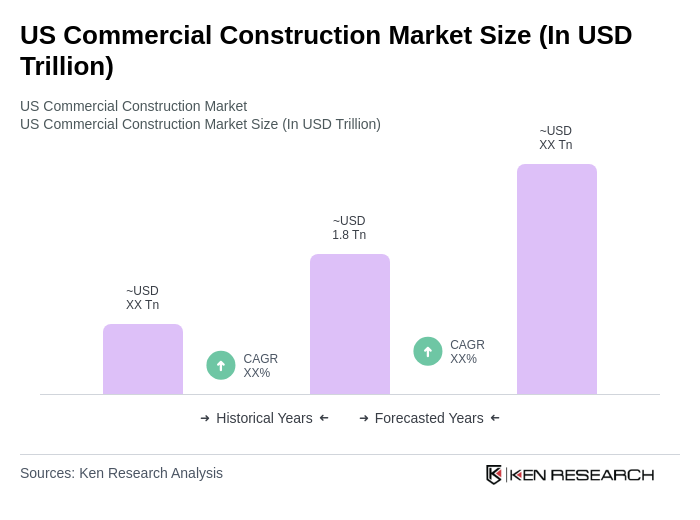
- The US Commercial Construction Market is valued at USD 1.8 trillion, based on a five-year historical analysis of non-residential and engineering construction activity. This growth is primarily driven by increasing demand for office buildings, retail establishments, healthcare facilities, and data centers, alongside significant investments in infrastructure and urban development. The market has seen a resurgence post-pandemic, with a pronounced focus on sustainable building practices, digital technologies such as Building Information Modeling (BIM), artificial intelligence, and smart construction solutions, which are reshaping the construction landscape.
- Key cities such asNew York, Los Angeles, and Chicagocontinue to dominate the US Commercial Construction Market due to robust economic activities, high population density, and ongoing urbanization. These metropolitan areas serve as major hubs for finance, technology, and healthcare, driving continuous demand for commercial spaces. Additionally, government initiatives and private investments in infrastructure, including large-scale projects in transportation and energy, further bolster their market presence.
- In 2021, the US government enacted theInfrastructure Investment and Jobs Act (IIJA), allocatingUSD 1.2 trillionto enhance the nation’s infrastructure. This legislation, administered by the US Department of Transportation, aims to improve transportation, broadband, and energy systems, significantly impacting the commercial construction sector by increasing project funding and creating job opportunities, thereby stimulating economic growth.
US Commercial Construction Market Segmentation
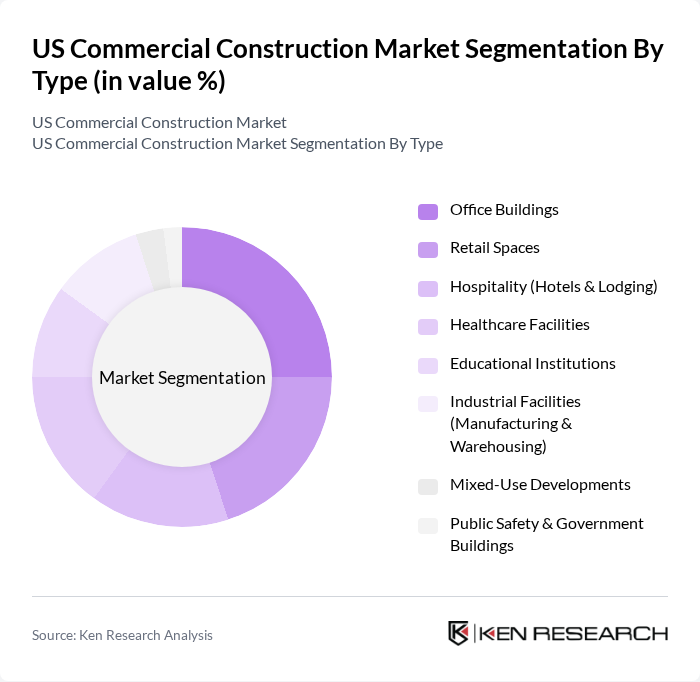
By Type:The commercial construction market is segmented into office buildings, retail spaces, hospitality, healthcare facilities, educational institutions, industrial facilities, mixed-use developments, and public safety buildings. Each segment addresses specific market demands, with data centers and healthcare facilities experiencing notable growth due to digital transformation and demographic shifts. Industrial facilities, particularly warehousing, have seen increased activity driven by e-commerce, while mixed-use developments reflect evolving urban planning trends.
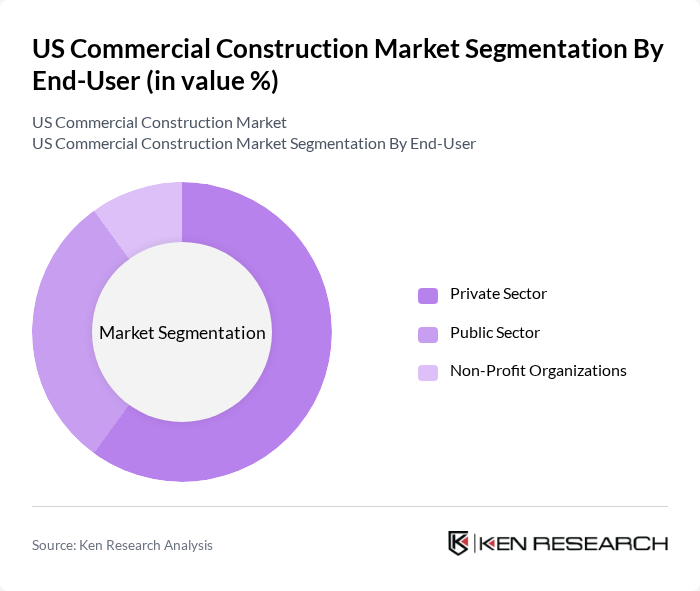
By End-User:The end-user segmentation includes private sector, public sector, and non-profit organizations. Private sector demand is led by commercial real estate developers and corporations, while public sector projects are driven by federal, state, and municipal investments in infrastructure and civic facilities. Non-profit organizations focus on educational, healthcare, and community-oriented developments, each segment influencing project types and funding sources.
US Commercial Construction Market Competitive Landscape
The US Commercial Construction Market is characterized by a dynamic mix of regional and international players. Leading participants such as Turner Construction Company, Bechtel Corporation, Skanska USA, Kiewit Corporation, The Whiting-Turner Contracting Company, Jacobs Engineering Group Inc., Clark Construction Group, LLC, PCL Construction Enterprises, Inc., Hensel Phelps Construction Co., Gilbane Building Company, Mortenson Construction, McCarthy Building Companies, Inc., DPR Construction, Balfour Beatty US, Structure Tone contribute to innovation, geographic expansion, and service delivery in this space.
US Commercial Construction Market Industry Analysis
Growth Drivers
- Increased Infrastructure Spending:The US government allocated approximately $1.2 trillion for infrastructure improvements under the Infrastructure Investment and Jobs Act. This funding is expected to enhance roads, bridges, and public transit systems, directly impacting commercial construction. In future, infrastructure spending is projected to reach $200 billion, stimulating demand for construction services and materials, thereby driving growth in the commercial construction sector significantly.
- Urbanization Trends:In future, urban areas in the US are expected to house over 82% of the population, leading to increased demand for commercial spaces such as offices, retail, and mixed-use developments. The urban population is projected to grow by approximately 1 million annually, necessitating new construction projects. This trend is driving developers to invest in urban commercial properties, thereby fueling growth in the construction market.
- Technological Advancements in Construction:The adoption of advanced technologies, such as Building Information Modeling (BIM) and prefabrication, is revolutionizing the construction process. In future, the market for construction technology is expected to exceed $1.5 billion, enhancing efficiency and reducing project timelines. These innovations are attracting investments and improving project delivery, thus acting as a significant growth driver in the commercial construction sector.
Market Challenges
- Labor Shortages:The US construction industry faces a significant labor shortage, with an estimated 300,000 to 400,000 positions unfilled in future. This shortage is exacerbated by an aging workforce and insufficient training programs for new workers. As a result, project delays and increased labor costs are becoming common, posing a substantial challenge to the growth of the commercial construction market.
- Rising Material Costs:In future, construction material costs are projected to increase by between 5% and 10% due to supply chain disruptions and inflationary pressures. Key materials such as steel and lumber have seen price hikes of over 30% in recent years. These rising costs are squeezing profit margins for construction firms and may lead to project cancellations or delays, presenting a significant challenge to the industry.
US Commercial Construction Market Future Outlook
The US commercial construction market is poised for growth, driven by increased infrastructure spending and urbanization trends. As cities expand, the demand for innovative construction solutions will rise, particularly in sustainable and smart building technologies. Additionally, the integration of digital tools will enhance project efficiency. However, challenges such as labor shortages and rising material costs will require strategic management. Overall, the market is expected to adapt and evolve, presenting new opportunities for stakeholders in the coming years.
Market Opportunities
- Green Building Initiatives:The demand for sustainable construction practices is increasing, with the green building market projected to reach approximately $100 billion in future. This shift towards eco-friendly materials and energy-efficient designs presents significant opportunities for construction firms to differentiate themselves and attract environmentally conscious clients.
- Smart Building Technologies:The market for smart building technologies is expected to grow to approximately $50 billion in future. This includes automation systems that enhance energy efficiency and occupant comfort. Construction firms that invest in these technologies can capitalize on the growing trend of smart cities, positioning themselves as leaders in the evolving commercial construction landscape.
Scope of the Report
| Segment | Sub-Segments |
|---|---|
| By Type | Office Buildings Retail Spaces Hospitality (Hotels & Lodging) Healthcare Facilities Educational Institutions Industrial Facilities (Manufacturing & Warehousing) Mixed-Use Developments Public Safety & Government Buildings |
| By End-User | Private Sector Public Sector Non-Profit Organizations |
| By Application | New Construction Renovation Maintenance |
| By Investment Source | Private Investment Government Funding Foreign Direct Investment |
| By Project Size | Small Projects (Under $10M) Medium Projects ($10M–$100M) Large Projects (Over $100M) |
| By Construction Method | Traditional (Design-Bid-Build) Design-Build Construction Management at Risk (CMAR) Integrated Project Delivery (IPD) |
| By Policy Support | Tax Incentives Grants Subsidies |
Key Target Audience
Investors and Venture Capitalist Firms
Government and Regulatory Bodies (e.g., U.S. Department of Housing and Urban Development, Occupational Safety and Health Administration)
Construction Project Owners
Architectural and Engineering Firms
Real Estate Developers
Material Suppliers and Manufacturers
Construction Equipment Rental Companies
Insurance Providers and Underwriters
Players Mentioned in the Report:
Turner Construction Company
Bechtel Corporation
Skanska USA
Kiewit Corporation
The Whiting-Turner Contracting Company
Jacobs Engineering Group Inc.
Clark Construction Group, LLC
PCL Construction Enterprises, Inc.
Hensel Phelps Construction Co.
Gilbane Building Company
Mortenson Construction
McCarthy Building Companies, Inc.
DPR Construction
Balfour Beatty US
Structure Tone
Table of Contents
Market Assessment Phase
1. Executive Summary and Approach
2. US Commercial Construction Market Overview
2.1 Key Insights and Strategic Recommendations
2.2 US Commercial Construction Market Overview
2.3 Definition and Scope
2.4 Evolution of Market Ecosystem
2.5 Timeline of Key Regulatory Milestones
2.6 Value Chain & Stakeholder Mapping
2.7 Business Cycle Analysis
2.8 Policy & Incentive Landscape
3. US Commercial Construction Market Analysis
3.1 Growth Drivers
3.1.1 Increased Infrastructure Spending
3.1.2 Urbanization Trends
3.1.3 Technological Advancements in Construction
3.1.4 Demand for Sustainable Building Practices
3.2 Market Challenges
3.2.1 Labor Shortages
3.2.2 Rising Material Costs
3.2.3 Regulatory Compliance Issues
3.2.4 Economic Uncertainty
3.3 Market Opportunities
3.3.1 Green Building Initiatives
3.3.2 Smart Building Technologies
3.3.3 Public-Private Partnerships
3.3.4 Expansion into Emerging Markets
3.4 Market Trends
3.4.1 Modular Construction
3.4.2 Digital Twin Technology
3.4.3 Increased Focus on Safety Standards
3.4.4 Use of Drones in Construction
3.5 Government Regulation
3.5.1 Building Codes and Standards
3.5.2 Environmental Regulations
3.5.3 Labor Laws
3.5.4 Zoning Laws
4. SWOT Analysis
5. Stakeholder Analysis
6. Porter's Five Forces Analysis
7. US Commercial Construction Market Market Size, 2019-2024
7.1 By Value
7.2 By Volume
7.3 By Average Selling Price
8. US Commercial Construction Market Segmentation
8.1 By Type
8.1.1 Office Buildings
8.1.2 Retail Spaces
8.1.3 Hospitality (Hotels & Lodging)
8.1.4 Healthcare Facilities
8.1.5 Educational Institutions
8.1.6 Industrial Facilities (Manufacturing & Warehousing)
8.1.7 Mixed-Use Developments
8.1.8 Public Safety & Government Buildings
8.2 By End-User
8.2.1 Private Sector
8.2.2 Public Sector
8.2.3 Non-Profit Organizations
8.3 By Application
8.3.1 New Construction
8.3.2 Renovation
8.3.3 Maintenance
8.4 By Investment Source
8.4.1 Private Investment
8.4.2 Government Funding
8.4.3 Foreign Direct Investment
8.5 By Project Size
8.5.1 Small Projects (Under $10M)
8.5.2 Medium Projects ($10M–$100M)
8.5.3 Large Projects (Over $100M)
8.6 By Construction Method
8.6.1 Traditional (Design-Bid-Build)
8.6.2 Design-Build
8.6.3 Construction Management at Risk (CMAR)
8.6.4 Integrated Project Delivery (IPD)
8.7 By Policy Support
8.7.1 Tax Incentives
8.7.2 Grants
8.7.3 Subsidies
9. US Commercial Construction Market Competitive Analysis
9.1 Market Share of Key Players
9.2 Cross Comparison of Key Players
9.2.1 Company Name
9.2.2 Group Size (Large, Medium, or Small as per industry convention)
9.2.3 Annual Revenue (USD)
9.2.4 Revenue Growth Rate (%)
9.2.5 Number of Projects Completed (Annual)
9.2.6 Average Project Value (USD)
9.2.7 Backlog Value (USD)
9.2.8 Market Penetration Rate (%)
9.2.9 Customer Satisfaction Index
9.2.10 Safety Incident Rate (per 100 FTEs)
9.2.11 Employee Turnover Rate (%)
9.2.12 LEED-Certified Projects (%)
9.2.13 Digital Adoption Index
9.2.14 EBITDA Margin (%)
9.2.15 Innovation Index
9.3 SWOT Analysis of Top Players
9.4 Pricing Analysis
9.5 Detailed Profile of Major Companies
9.5.1 Turner Construction Company
9.5.2 Bechtel Corporation
9.5.3 Skanska USA
9.5.4 Kiewit Corporation
9.5.5 The Whiting-Turner Contracting Company
9.5.6 Jacobs Engineering Group Inc.
9.5.7 Clark Construction Group, LLC
9.5.8 PCL Construction Enterprises, Inc.
9.5.9 Hensel Phelps Construction Co.
9.5.10 Gilbane Building Company
9.5.11 Mortenson Construction
9.5.12 McCarthy Building Companies, Inc.
9.5.13 DPR Construction
9.5.14 Balfour Beatty US
9.5.15 Structure Tone
10. US Commercial Construction Market End-User Analysis
10.1 Procurement Behavior of Key Ministries
10.1.1 Federal Government
10.1.2 State Governments
10.1.3 Local Governments
10.2 Corporate Spend on Infrastructure & Energy
10.2.1 Corporate Investments
10.2.2 Budget Allocations
10.2.3 Infrastructure Priorities
10.3 Pain Point Analysis by End-User Category
10.3.1 Cost Overruns
10.3.2 Delays in Project Timelines
10.3.3 Quality Assurance Issues
10.4 User Readiness for Adoption
10.4.1 Technology Adoption Rates
10.4.2 Training and Skill Development
10.5 Post-Deployment ROI and Use Case Expansion
10.5.1 Performance Metrics
10.5.2 Long-term Benefits
11. US Commercial Construction Market Future Size, 2025-2030
11.1 By Value
11.2 By Volume
11.3 By Average Selling Price
Go-To-Market Strategy Phase
1. Whitespace Analysis + Business Model Canvas
1.1 Market Gaps Identification
1.2 Business Model Framework
2. Marketing and Positioning Recommendations
2.1 Branding Strategies
2.2 Product USPs
3. Distribution Plan
3.1 Urban Retail Strategies
3.2 Rural NGO Tie-ups
4. Channel & Pricing Gaps
4.1 Underserved Routes
4.2 Pricing Bands
5. Unmet Demand & Latent Needs
5.1 Category Gaps
5.2 Consumer Segments
6. Customer Relationship
6.1 Loyalty Programs
6.2 After-sales Service
7. Value Proposition
7.1 Sustainability Initiatives
7.2 Integrated Supply Chains
8. Key Activities
8.1 Regulatory Compliance
8.2 Branding Efforts
8.3 Distribution Setup
9. Entry Strategy Evaluation
9.1 Domestic Market Entry Strategy
9.1.1 Product Mix
9.1.2 Pricing Band
9.1.3 Packaging
9.2 Export Entry Strategy
9.2.1 Target Countries
9.2.2 Compliance Roadmap
10. Entry Mode Assessment
10.1 Joint Ventures
10.2 Greenfield Investments
10.3 Mergers & Acquisitions
10.4 Distributor Model
11. Capital and Timeline Estimation
11.1 Capital Requirements
11.2 Timelines
12. Control vs Risk Trade-Off
12.1 Ownership vs Partnerships
13. Profitability Outlook
13.1 Breakeven Analysis
13.2 Long-term Sustainability
14. Potential Partner List
14.1 Distributors
14.2 Joint Ventures
14.3 Acquisition Targets
15. Execution Roadmap
15.1 Phased Plan for Market Entry
15.1.1 Market Setup
15.1.2 Market Entry
15.1.3 Growth Acceleration
15.1.4 Scale & Stabilize
15.2 Key Activities and Milestones
15.2.1 Milestone Planning
15.2.2 Activity Tracking
Research Methodology
Phase 1: Approach1
Desk Research
- Analysis of industry reports from the American Institute of Architects (AIA) and the Associated General Contractors of America (AGC)
- Review of government publications, including the U.S. Census Bureau's construction spending data
- Examination of market trends and forecasts from construction trade journals and economic outlook reports
Primary Research
- Interviews with project managers and executives from leading construction firms
- Surveys targeting architects and engineers involved in commercial projects
- Field interviews with contractors and subcontractors on-site to gather insights on operational challenges
Validation & Triangulation
- Cross-validation of findings through multiple data sources, including financial reports and industry publications
- Triangulation of qualitative insights from interviews with quantitative data from surveys
- Sanity checks conducted through expert panel reviews comprising industry veterans
Phase 2: Market Size Estimation1
Top-down Assessment
- Estimation of total market size based on national construction expenditure data
- Segmentation of the market by commercial sectors such as retail, office, and hospitality
- Incorporation of macroeconomic indicators such as GDP growth and urbanization rates
Bottom-up Modeling
- Collection of project-level data from major construction projects across the U.S.
- Estimation of average project costs based on historical data and current market rates
- Volume calculations based on the number of projects initiated and completed annually
Forecasting & Scenario Analysis
- Multi-factor regression analysis incorporating variables such as interest rates, labor costs, and material prices
- Scenario modeling based on potential changes in government infrastructure spending and policy shifts
- Development of baseline, optimistic, and pessimistic forecasts through 2030
Phase 3: CATI Sample Composition1
| Scope Item/Segment | Sample Size | Target Respondent Profiles |
|---|---|---|
| Commercial Office Construction | 100 | Project Managers, Architects |
| Retail Space Development | 80 | Construction Executives, Real Estate Developers |
| Hospitality Sector Projects | 60 | General Contractors, Hotel Development Managers |
| Industrial Facility Construction | 50 | Operations Managers, Facility Planners |
| Public Infrastructure Projects | 70 | Government Officials, Civil Engineers |
Frequently Asked Questions
What is the current value of the US Commercial Construction Market?
The US Commercial Construction Market is valued at approximately USD 1.8 trillion, reflecting a comprehensive analysis of non-residential and engineering construction activities over the past five years. This valuation highlights the sector's significant growth and ongoing demand for various commercial spaces.
What are the main drivers of growth in the US Commercial Construction Market?
Which cities are leading in the US Commercial Construction Market?
How has the Infrastructure Investment and Jobs Act impacted the construction sector?
Other Regional/Country Reports
Indonesia Commercial Construction Market
Malaysia Commercial Construction Market
APAC Commercial Construction Market
Other Adjacent Reports
Philippines Infrastructure Construction Market
Middle East Building Materials Market Size, Share, Trends & Forecast, By Material Type, Application & Distribution Channel, 2026–2031Europe Construction Equipment Market Size, Share & Forecast, By Equipment Type, Propulsion & End-Use Industry, 2026-2032Kuwait Real Estate Development Market
India Architectural Services Market Size, Share & Forecast, By Service Type, Customer Type & End-Use Industry, 2026-2031Saudi Arabia Engineering Services Market Size, Share & Forecast, By Service Type, End-Use Industry & Delivery Model, 2026–2032South Korea Sustainable Building Market
Smart Building Technology MarketGermany Construction Software Market
Why Buy From Us?

What makes us stand out is that our consultants follow Robust, Refine and Result (RRR) methodology. Robust for clear definitions, approaches and sanity checking, Refine for differentiating respondents' facts and opinions, and Result for presenting data with story.

We have set a benchmark in the industry by offering our clients with syndicated and customized market research reports featuring coverage of entire market as well as meticulous research and analyst insights.

While we don't replace traditional research, we flip the method upside down. Our dual approach of Top Bottom & Bottom Top ensures quality deliverable by not just verifying company fundamentals but also looking at the sector and macroeconomic factors.

With one step in the future, our research team constantly tries to show you the bigger picture. We help with some of the tough questions you may encounter along the way: How is the industry positioned? Best marketing channel? KPI's of competitors? By aligning every element, we help maximize success.

Our report gives you instant access to the answers and sources that other companies might choose to hide. We elaborate each steps of research methodology we have used and showcase you the sample size to earn your trust.

If you need any support, we are here! We pride ourselves on universe strength, data quality, and quick, friendly, and professional service.