CHAPTER 1 - MARKET SUMMARY
Market Overview
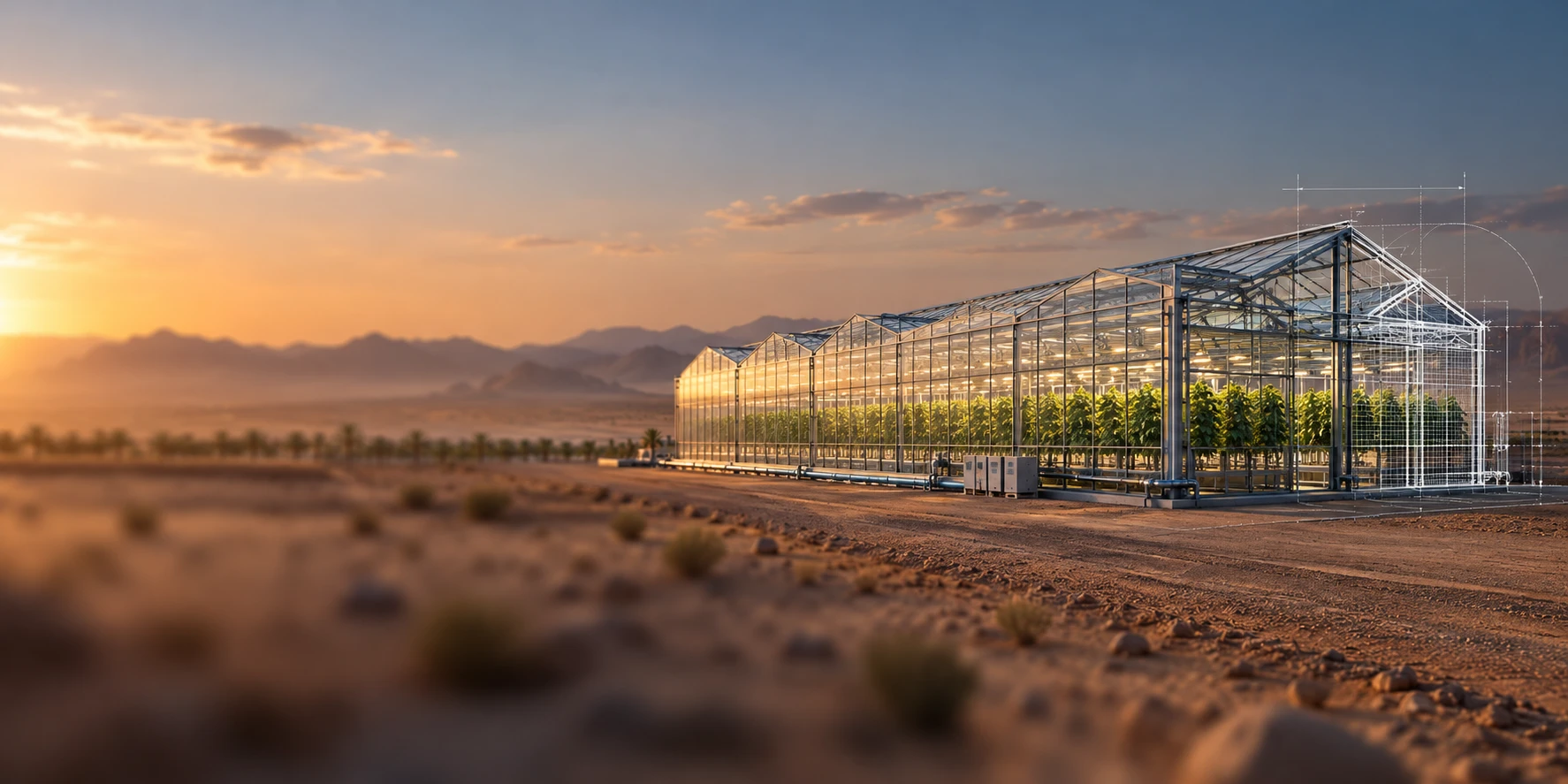
The Middle East Greenhouse Market covers commercial structures, climate-control equipment, irrigation, growing systems, and associated automation used for protected crop cultivation. Saudi Arabia produced 797,000 tons of greenhouse vegetables across 7,800 hectares in 2024, illustrating the scale of demand for structures, replacement equipment, and operating technology. High crop yields and year-round output improve asset utilization for commercial growers.
Saudi Arabia and the UAE form the principal high-technology investment hubs, while Türkiye, Israel, Jordan, Oman, Qatar, Kuwait, and Bahrain broaden the regional installed base. Saudi Arabia operated more than 121,000 vegetable greenhouses in 2024. This concentration supports specialized installation, maintenance, irrigation, cooling, and agronomy networks, creating procurement scale for integrated greenhouse suppliers.
Market Value
USD 4,600 million
2025
Dominant Region
Gulf Cooperation Council
2025
Dominant Segment
Climate-Controlled Greenhouses
fastest growing, 2025-2032
Total Number of Players
85
Future Outlook
The Middle East Greenhouse Market is forecast to increase from USD 4,600 Mn in 2025 to USD 10,013 Mn by 2032, representing an 11.75% CAGR over seven years. This follows a historical CAGR of 10.05% during 2020-2025. Expansion will be led by climate-controlled projects, hydroponic cultivation, evaporative cooling, automated fertigation, and sensor-based crop management. Commercial demand will remain concentrated in vegetables and high-value fruits, where import substitution and year-round supply provide clearer revenue visibility. Supplier profit pools should progressively shift from basic structures toward integrated systems, software, commissioning, crop-support services, and recurring maintenance contracts.
Growth will nevertheless vary by project economics. High electricity requirements, water-treatment costs, imported equipment exposure, and limited technical labor can constrain returns for poorly designed facilities. Successful operators will combine energy-efficient cooling with crop selection, yield management, reliable retail or hospitality offtake, and localized maintenance. Saudi Arabia and the UAE should remain the principal investment destinations, while Oman, Qatar, Kuwait, Jordan, and other markets develop smaller food-security projects. Modular structures and retrofit solutions will widen the addressable customer base by lowering initial capital requirements. By 2032, technology-enabled greenhouses should command a larger proportion of regional equipment and service expenditure.
11.75%
Forecast CAGR
$10,013 Mn
2030 Projection
Base Year
2025
Historical Period
2020-2025
Forecast Period
2025-2032
Historical CAGR
10.05%
CHAPTER 2 - SCOPE OF REPORT
Scope of the Market
CHAPTER 3 - Key Stakeholders
Key Target Audience
Key stakeholders who can leverage this market analysis for investment, strategy, and operational planning.
Investors
CAGR, project returns, capex intensity, technology risk
Corporates
procurement cost, yield stability, offtake, localization strategy
Government
food security, water efficiency, compliance, domestic production
Operators
crop yield, energy use, uptime, pack-out rate
Financial institutions
project finance, covenants, offtake quality, cash flow
CHAPTER 4 - Market Size & Growth
Market Size, Growth Forecast and Trends
This section evaluates the historical market size, analyzes year-over-year growth dynamics, and presents forecast projections supported by market performance indicators and demand-side drivers.
Historical & Projected Market Size ($ Million)
Year-over-Year Growth Rate (%)
Market Value vs Volume Growth (%)
Historical Market Performance, 2020-2025
Market value increased by USD 1,750 Mn during 2020-2025. Growth moderated to 7.37% in 2021 before accelerating above 10% annually from 2022. The 2023 inflection reflected renewed capital deployment, food-security programs, and greater demand for hydroponic and cooling equipment. By 2025, higher-technology installations and retrofit spending lifted annual growth to 11.38%, ahead of installed-capacity expansion.
Forecast Market Outlook, 2025-2032
Annual market additions are projected to expand from USD 541 Mn in 2026 to USD 1,054 Mn in 2032. The value-to-capacity growth premium reflects increasing equipment content per greenhouse, including environmental controls, water treatment, automated fertigation, and software. The market is forecast to add USD 5,413 Mn over seven years, with climate-controlled and hydroponic systems capturing a rising share of investment.
CHAPTER 5 - Market Data
Market Breakdown
The market’s double-digit trajectory reflects both expansion of protected cultivation and higher technology expenditure per installed hectare. Investors should evaluate revenue quality through installed capacity, controlled-environment penetration, and greenhouse vegetable output.
Year | Market Size (USD Mn) | YoY Growth (%) | Installed Capacity Index | Climate-Controlled Share (%) | Greenhouse Output Index | Period |
|---|---|---|---|---|---|---|
| 2020 | $2,850 Mn | +- | 100 | 38% | Forecast | |
| 2021 | $3,060 Mn | +7.37% | 105 | 39% | Forecast | |
| 2022 | $3,370 Mn | +10.13% | 113 | 41% | Forecast | |
| 2023 | $3,740 Mn | +10.98% | 122 | 43% | Forecast | |
| 2024 | $4,130 Mn | +10.43% | 131 | 45% | Forecast | |
| 2025 | $4,600 Mn | +11.38% | 142 | 47% | Forecast | |
| 2026 | $5,141 Mn | +11.76% | 154 | 49% | Forecast | |
| 2027 | $5,745 Mn | +11.75% | 168 | 51% | Forecast | |
| 2028 | $6,420 Mn | +11.75% | 183 | 53% | Forecast | |
| 2029 | $7,174 Mn | +11.74% | 199 | 55% | Forecast | |
| 2030 | $8,017 Mn | +11.75% | 217 | 57% | Forecast | |
| 2031 | $8,959 Mn | +11.75% | 237 | 59% | Forecast | |
| 2032 | $10,013 Mn | +11.76% | 259 | 61% | Forecast |
Installed Capacity Index
142 (2025, Middle East). Capacity expansion enlarges the serviceable base for replacement covers, cooling equipment, irrigation, and maintenance. Saudi Arabia recorded approximately 7,800 hectares of greenhouse vegetables in 2024.
Climate-Controlled Share
47% (2025, Middle East). Greater technology content supports higher project value and recurring service revenue. The four-hectare Topian facility demonstrates commercial testing of climate-resilient systems in Saudi Arabia.
Greenhouse Output Index
146 (2025, Middle East). Output growth above capacity growth indicates yield improvement and greater asset productivity. Saudi protected vegetable output increased 10.6% in 2024.
CHAPTER 6 - Segmentation
Market Segmentation Framework
Comprehensive analysis across key dimensions providing insights into market structure, grower requirements, technology adoption, and geographic investment patterns.
No of Segments
7
Dominant Segment
Crop Type
Fastest Growing Segment
Technology
Greenhouse Type
Covering Material
Technology
Crop Type
Equipment
End User
Geography
Key Segmentation Takeaways
Comprehensive analysis across all extracted segmentation dimensions provides insight into crop economics, infrastructure requirements, procurement behavior, and regional investment priorities.
Crop Type
Vegetables dominate commercial greenhouse utilization because tomatoes, cucumbers, peppers, and leafy greens combine short production cycles with consistent retail and hospitality demand. Tomatoes and cucumbers form the principal Level-2 revenue pool, supporting repeat expenditure on covers, irrigation, crop supports, cooling, nutrients, and biological crop protection.
Technology
Technology is the fastest-growing dimension as operators move toward climate-controlled systems, hydroponics, automated fertigation, and environmental monitoring. Climate-Controlled Systems should lead incremental expenditure because heat management determines yield stability across much of the region. Integrated controls also enable suppliers to capture software, commissioning, maintenance, and optimization revenue after installation.
CHAPTER 7 - Regional Analysis
Regional Analysis
Saudi Arabia ranks first among selected Middle Eastern peers by 2025 greenhouse market expenditure, supported by its large protected-vegetable base and food-security investment. The UAE is a smaller but technology-intensive market, while Türkiye and Israel combine established production or greenhouse-technology capabilities.
Regional Ranking
1st, Saudi Arabia
Saudi Arabia Market Size
USD 1,242 Mn (2025)
Saudi Arabia CAGR (2025-2032)
12.60%
Regional Ranking
1st, Saudi Arabia
Saudi Arabia Market Size
USD 1,242 Mn (2025)
Saudi Arabia CAGR (2025-2032)
12.60%
Regional Analysis (Current Year)
Regional Analysis Comparison
Market Position
Saudi Arabia ranks first in the selected peer set with USD 1,242 Mn in 2025 expenditure, supported by 7,800 hectares of greenhouse vegetables.
Growth Advantage
Saudi Arabia’s 12.60% forecast CAGR exceeds Türkiye’s 9.80%, while the UAE leads at 13.40% through higher technology intensity and new controlled-environment projects.
Competitive Strengths
Saudi Arabia combines more than 121,000 vegetable greenhouses with government-backed water-efficiency programs, providing scale for installers, irrigation suppliers, and maintenance providers.
CHAPTER 8 - INDUSTRY ANALYSIS
Growth Drivers, Challenges & Opportunities
Comprehensive analysis of key factors shaping the Middle East Greenhouse Market, including growth catalysts, operational challenges, and emerging opportunities across production, distribution, and consumer segments.
Growth Drivers
Food-Security Investment and Import Substitution
- Protected production grew 10.6% (2024, Saudi Arabia), expanding demand for structures, irrigation, cooling, and replacement components.
- More than 121,000 greenhouses (2024, Saudi Arabia) create a substantial maintenance and retrofit opportunity for equipment suppliers.
- A four-hectare facility (2024, Saudi Arabia) at Oxagon supports validation and commercialization of climate-resilient production systems.
Water-Efficiency Requirements
- Irrigation efficiency increased from 50% to more than 92% (Saudi Arabia), strengthening the business case for sensors and automated dosing.
- Greenhouses permit precise root-zone delivery, allowing producers to allocate scarce water toward crops with stronger yield and price realization. 7,800 hectares (2024, Saudi Arabia) already use protected vegetable cultivation.
- Closed-loop hydroponics creates recurring demand for filtration, dosing, monitoring, and sanitation equipment across a regional market forecast to grow 11.75% annually (2025-2032, Middle East).
Technology-Led Yield Improvement
- Tomato production reached 329,000 tons (2024, Saudi Arabia), supporting crop-specific climate recipes and harvesting automation.
- Cucumber output exceeded 232,000 tons (2024, Saudi Arabia), creating scale for standardized trellising, fertigation, and post-harvest integration.
- Technology spending is projected to lift market value faster than physical capacity, producing a 2.45-percentage-point growth premium (2032, Middle East) for integrated suppliers.
Market Challenges
Cooling and Energy Economics
- Cooling, circulation, and water treatment raise unit costs during peak summer conditions; the 2025-2032 investment horizon therefore favors energy-efficient systems.
- High-technology assets require sufficient utilization and crop margins, creating downside risk for facilities lacking contracted offtake across four seasons annually.
- Solar integration can mitigate electricity exposure, but additional capital and storage requirements complicate financing for smaller growers serving sub-10-hectare projects.
Imported Equipment and Technical Dependency
- Long procurement cycles increase construction and commissioning risk for integrated projects containing four major equipment categories (2025, Middle East).
- Currency and freight exposure can weaken returns because structures, climate systems, and automation represent a material share of initial project expenditure over the 2025 base year.
- Limited local service capability creates downtime risk, especially where environmental controls operate continuously for up to 24 hours daily.
Crop Economics and Operational Execution
- Pest exclusion, disease control, pollination, and nutrient management require specialized agronomy throughout each crop cycle, affecting returns across more than 121,000 structures (2024, Saudi Arabia).
- Production concentration in tomatoes and cucumbers, totaling over 561,000 tons (2024, Saudi Arabia), can expose growers to seasonal price compression.
- Operators require yield, grade, pack-out, and sales discipline to justify investments expected to compound at 11.75% (2025-2032, Middle East).
Market Opportunities
Greenhouse Retrofit and Recurring Services
- Suppliers can monetize replacement films, cooling pads, pumps, sensors, and controllers across a base spanning 7,800 hectares (2024, Saudi Arabia).
- Growers benefit from lower downtime and improved water productivity, with demonstration projects recording 24% water savings (Saudi Arabia).
- Realization requires local technicians, spare-parts inventories, and service-level contracts capable of supporting systems throughout the 2025-2032 forecast period.
Water-Efficient Hydroponic Expansion
- Integrated vendors can earn revenue from structures, nutrient delivery, filtration, controls, and agronomy rather than relying on a single equipment sale.
- Commercial growers and retailers gain more predictable output and traceability, supporting contracts across 12 months annually.
- Adoption requires trained operators and reliable water chemistry management to protect yield across a market projected at USD 10,013 Mn (2032, Middle East).
Localized Climate Technology and Components
- Investors can target cooling, netting, film conversion, irrigation skids, and controls, reducing delivery time across 10 regional markets.
- Growers benefit from faster maintenance and equipment adapted to heat, salinity, dust, and local crop economics across four principal crop groups.
- Localization requires certification, field testing, component quality control, and partnerships with agronomy teams, as demonstrated by the four-hectare Oxagon project (2024, Saudi Arabia).
CHAPTER 9 - Competitive Landscape
Competitive Landscape Overview
The market combines global greenhouse engineering and control-system providers with regional growers and integrators. Technical capability, project references, localization, crop performance, and after-sales coverage form the principal entry barriers.
Market Share Distribution
Top 5 Players
Market Dynamics
8 new entrants in the past 5 years, indicating strong market attractiveness and growth potential.
Company Name | Market Share | Headquarters | Founding Year | Core Market Focus |
|---|---|---|---|---|
Netafim Ltd. | - | Hatzerim, Israel | 1965 | Drip irrigation and fertigation systems |
Priva B.V. | - | De Lier, Netherlands | 1959 | Greenhouse climate and process controls |
Richel Group | - | Eygalières, France | 1964 | Commercial greenhouse structures and systems |
Certhon | - | Poeldijk, Netherlands | 1896 | Turnkey controlled-environment horticulture |
Ridder | - | Maasdijk, Netherlands | 1953 | Automation, climate screens, and water systems |
Pure Harvest Smart Farms | - | Abu Dhabi, UAE | 2016 | Technology-enabled greenhouse production |
RedSea | - | Riyadh, Saudi Arabia | 2018 | Heat-adapted controlled-environment agriculture |
Emirates Hydroponics Farms | - | Abu Dhabi, UAE | 2005 | Hydroponic vegetable cultivation |
Al Dahra | - | Abu Dhabi, UAE | 1995 | Integrated agriculture and protected cultivation |
Topian | - | Riyadh, Saudi Arabia | 2022 | Climate-resilient food systems and greenhouse innovation |
Cross Comparison Parameters
The report provides detailed cross-comparison of key players across 10 performance parameters to identify competitive strengths and weaknesses.
Installed Greenhouse Area
Water-Use Efficiency
Regional Greenhouse Revenue Growth
Project Gross Margin
Analysis Covered
Market Share Analysis:
Compares estimated in-scope regional revenue across verified active competitors
Cross Comparison Matrix:
Benchmarks technology, localization, service coverage, scale, and project execution
SWOT Analysis:
Assesses capabilities, vulnerabilities, growth options, and competitive market threats
Pricing Strategy Analysis:
Evaluates turnkey pricing, equipment bundles, subscriptions, and maintenance contracts
Company Profiles:
Reviews ownership, footprint, specialization, projects, and strategic positioning
CHAPTER 10 - REPORT TOC
Table of Contents
Market Assessment Phase
Supply-side and competitive intelligence covering market sizing, segmentation, competitive dynamics, regulatory landscape, and future forecasts.
Go-To-Market Strategy Phase
1 chapters
Entry strategy evaluation, execution roadmap, partner recommendations, and profitability outlook.
Survey Phase
6 chapters
Demand-side primary research conducted through structured interviews and online surveys with end users across priority metros and Tier 2/3 cities to capture consumption behavior, unmet needs, and purchase drivers.
Complete Report Coverage
201+ detailed sections covering every aspect of the market
143
Assessment Sections
58
Strategy Sections
CHAPTER 11 - Our Approach
Research Methodology
Desk Research
- Mapped protected cultivation statistics
- Reviewed food-security investment programs
- Analyzed greenhouse equipment specifications
- Benchmarked regional crop economics
Primary Research
- Interviewed greenhouse operations directors
- Consulted controlled-environment agronomists
- Surveyed irrigation procurement managers
- Engaged fresh-produce commercial directors
Validation and Triangulation
- Validated findings across 322 respondents
- Reconciled supplier and grower estimates
- Checked installed-area unit economics
- Tested annual growth model closure
CHAPTER 12 - FAQ
FAQs
Still have questions?
Our research team is here to help you find the right solution
CHAPTER 13 - Related Research
Explore Related Reports
Expand your market intelligence with complementary research across regions and adjacent markets.
Regional/Country ReportsRelated market analysis across key regions
Related market analysis across key regions
No regional reports found.
Adjacent ReportsRelated markets and complementary research
Related markets and complementary research
No adjacent reports found.
500+
Market Research Reports
50+
Countries Covered
15+
Industry Verticals