About the Report
Base Year 2024Middle East Halloysite Market Overview
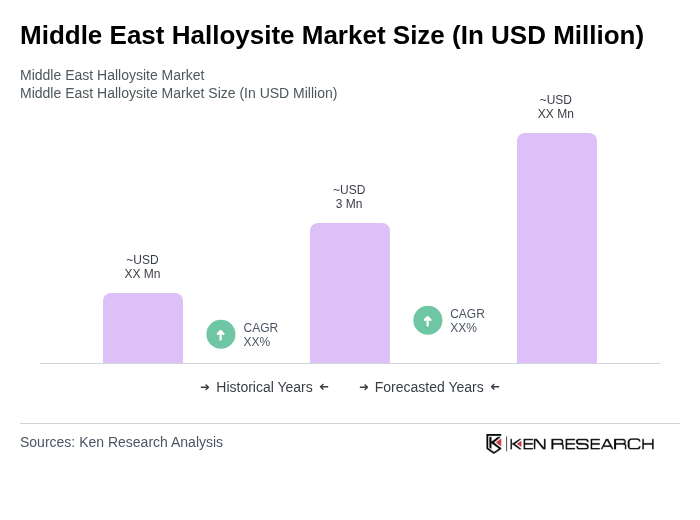
- The Middle East Halloysite Market is valued at USD 3 million, based on recent analysis. The market growth is driven by increased adoption of halloysite as a nanomaterial in medical, cosmetic, and ceramic applications. Demand is further supported by the rising use of eco-friendly and high-performance materials in construction and personal care, reflecting a broader shift toward sustainable and multifunctional components based on recent analysis — halloysite’s unique tubular morphology and biocompatibility underpin its appeal.
- Key contributors to the Middle East Halloysite Market include South Africa, the UAE, and Saudi Arabia, driven by growing use in ceramics, environmental remediation, and cosmetics in these markets. These countries are leveraging their mineral resources and technological advancements to enhance production capabilities and meet the increasing demand for halloysite in various applications.
- In the UAE, mining operations require environmental permits and must obtain annual environmental compliance certification, with air quality monitoring mandated at extraction sites. These regulatory measures aim to ensure sustainable practices and minimize ecological impact in halloysite and other mineral extraction activities.
Middle East Halloysite Market Segmentation
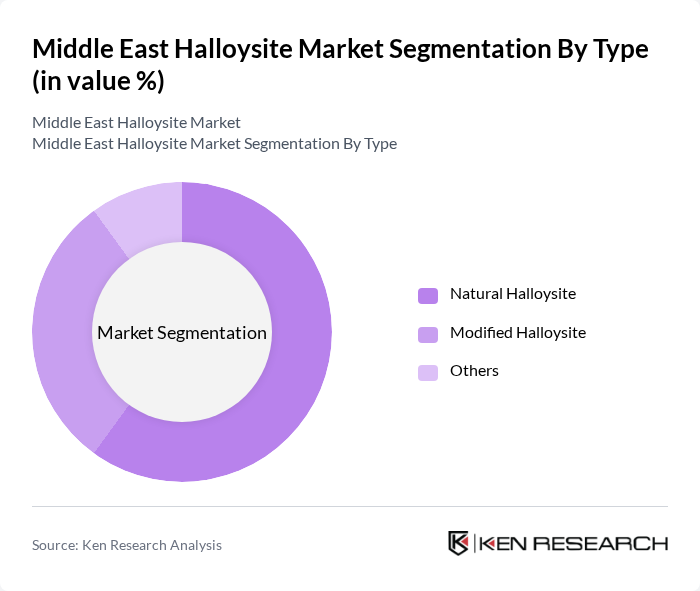
By Type:The halloysite market is segmented into three main types: Natural Halloysite, Modified Halloysite, and Others. Natural Halloysite is the most widely used due to its unique properties and applications in various industries, particularly ceramics and cosmetics. Modified Halloysite is gaining traction as manufacturers seek enhanced performance characteristics for specific applications. The Others category includes less common forms of halloysite that cater to niche markets.
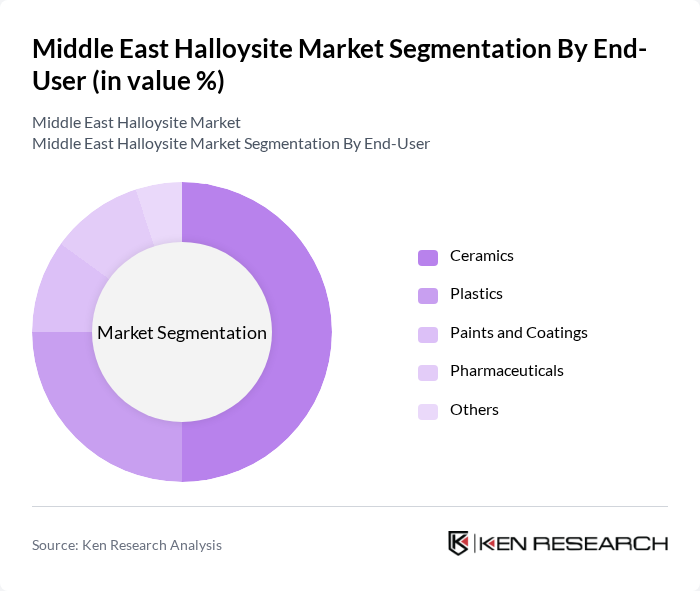
By End-User:The end-user segmentation includes Ceramics, Plastics, Paints and Coatings, Pharmaceuticals, and Others. Ceramics dominate the market due to the high demand for halloysite in the production of high-performance ceramic materials. The Plastics segment is also significant, as halloysite is increasingly used as a reinforcing agent in polymer composites. The Pharmaceuticals segment is growing, driven by the material's biocompatibility and potential applications in drug delivery systems.
Middle East Halloysite Market Competitive Landscape
The Middle East Halloysite Market is characterized by a dynamic mix of regional and international players. Leading participants such as Imerys, KaMin LLC, BASF SE, Ashapura Minechem Ltd., Newpark Resources, Inc., Applied Minerals Inc., Halloysite Clay Products, Eczac?ba??-Monrol Nuclear Products, Sibelco, Thiele Kaolin Company, Arawali Minerals, K-Tek, Huber Engineered Materials, KMG Chemicals, ACG Materials contribute to innovation, geographic expansion, and service delivery in this space.
Middle East Halloysite Market Industry Analysis
Growth Drivers
- Rising Regional GDP:The Middle East & North Africa (MENA) region's GDP reached approximately $5.09 trillion in future, with a GDP per capita of $6,265. This robust economic backdrop supports industrial growth, including halloysite applications in various sectors. The increasing household income levels provide a solid foundation for demand in high-performance materials, particularly in construction and ceramics, where halloysite is increasingly utilized. Source: World Bank data.
- Growing Non-Oil Sector Activity:In future, real GDP in GCC countries grew by 3.3 percent, with non-oil sectors contributing over 70 percent to both real and nominal GDP. This diversification from oil dependency fosters industrial applications, enhancing the demand for halloysite in ceramics, construction, and advanced materials. The shift towards a more varied economic base is crucial for sustaining halloysite market growth. Sources: Reuters and Times of India.
- High Internet Penetration:In future, 62 percent of the Middle East population accessed the Internet, indicating strong digital infrastructure. This connectivity facilitates modernization and tech-enabled industrial processes, potentially accelerating the adoption of halloysite-based innovations. Enhanced digital capabilities can lead to increased efficiency in production and application of halloysite in various industries, including biomedical and eco-friendly materials. Source: World Bank digital access data.
Market Challenges
- Subdued Regional Growth:The World Bank forecasts MENA GDP growth at only 2.7 percent in future, up from 1.9 percent in previous. This sluggish growth limits overall industrial expansion and reduces demand for specialized materials like halloysite. Economic uncertainty can hinder investments in sectors that utilize halloysite, affecting market dynamics and potential growth opportunities. Source: World Bank MENA economic update.
- Exposure to Oil Price Volatility:The IMF projects regional growth declines of 2–4.5 percent due to Brent crude prices remaining between $65–$69 per barrel in future. This dependence on oil revenue creates vulnerabilities for industrial sectors requiring halloysite, as fluctuations in oil prices can impact investment reliability and overall economic stability. Source: AP News summarizing IMF warnings.
Middle East Halloysite Market Future Outlook
The Middle East halloysite market is poised for growth driven by enhanced non-oil sector expansion and increasing urbanization. As GCC countries continue to diversify their economies, the demand for halloysite in construction and advanced materials is expected to rise. Additionally, the ongoing digitalization efforts and smart infrastructure deployment will likely lead to innovative applications of halloysite, particularly in eco-friendly and high-performance materials, fostering a sustainable industrial landscape.
Market Opportunities
- Construction and Ceramics in Urban Development:With Cairo's urban population projected to exceed 22.68 million in future, the demand for ceramic tiles and building materials is set to increase. Halloysite additives can enhance the thermal and mechanical performance of these materials, making them more appealing in urban construction projects. Source: Demographia data on Cairo.
- Diversification Projects in GCC Member States:Non-oil sectors now account for over 70 percent of GDP in GCC countries, indicating significant industrial demand. Investment in diversified industrial capacity presents opportunities for halloysite integration into new manufacturing value chains, particularly in advanced ceramics and eco-materials. Sources: Times of India and Reuters.
Scope of the Report
| Segment | Sub-Segments |
|---|---|
| By Type | Natural Halloysite Modified Halloysite Others |
| By End-User | Ceramics Plastics Paints and Coatings Pharmaceuticals Others |
| By Application | Reinforcement Material Additive in Polymer Composites Catalyst Support Others |
| By Region | GCC Countries Levant Region North Africa |
| By Product Form | Powder Granules Others |
| By Distribution Channel | Direct Sales Distributors Online Sales Others |
| By Pricing Strategy | Premium Pricing Competitive Pricing Value-Based Pricing Others |
Key Target Audience
Investors and Venture Capitalist Firms
Government and Regulatory Bodies (e.g., Ministry of Industry and Advanced Technology, Saudi Arabian Standards Organization)
Manufacturers and Producers
Distributors and Retailers
Mining and Extraction Companies
Construction and Building Material Suppliers
Industry Associations (e.g., Middle East Mining Association)
Financial Institutions
Players Mentioned in the Report:
Imerys
KaMin LLC
BASF SE
Ashapura Minechem Ltd.
Newpark Resources, Inc.
Applied Minerals Inc.
Halloysite Clay Products
Eczacbas-Monrol Nuclear Products
Sibelco
Thiele Kaolin Company
Arawali Minerals
K-Tek
Huber Engineered Materials
KMG Chemicals
ACG Materials
Table of Contents
Market Assessment Phase
1. Executive Summary and Approach
2. Middle East Halloysite Market Overview
2.1 Key Insights and Strategic Recommendations
2.2 Middle East Halloysite Market Overview
2.3 Definition and Scope
2.4 Evolution of Market Ecosystem
2.5 Timeline of Key Regulatory Milestones
2.6 Value Chain & Stakeholder Mapping
2.7 Business Cycle Analysis
2.8 Policy & Incentive Landscape
3. Middle East Halloysite Market Analysis
3.1 Growth Drivers
3.1.1 Increasing demand for high-performance materials
3.1.2 Expansion of the ceramics and plastics industries
3.1.3 Rising investments in nanotechnology
3.1.4 Growing awareness of sustainable materials
3.2 Market Challenges
3.2.1 Limited availability of high-quality halloysite
3.2.2 High production costs
3.2.3 Regulatory hurdles in mining operations
3.2.4 Competition from alternative materials
3.3 Market Opportunities
3.3.1 Development of new applications in various industries
3.3.2 Collaborations with research institutions
3.3.3 Export potential to emerging markets
3.3.4 Technological advancements in extraction processes
3.4 Market Trends
3.4.1 Increasing use of halloysite in biomedical applications
3.4.2 Growth in eco-friendly product demand
3.4.3 Innovations in halloysite-based composites
3.4.4 Rising focus on circular economy practices
3.5 Government Regulation
3.5.1 Environmental protection regulations
3.5.2 Mining and extraction permits
3.5.3 Trade policies affecting mineral exports
3.5.4 Safety standards in mining operations
4. SWOT Analysis
5. Stakeholder Analysis
6. Porter's Five Forces Analysis
7. Middle East Halloysite Market Market Size, 2019-2024
7.1 By Value
7.2 By Volume
7.3 By Average Selling Price
8. Middle East Halloysite Market Segmentation
8.1 By Type
8.1.1 Natural Halloysite
8.1.2 Modified Halloysite
8.1.3 Others
8.2 By End-User
8.2.1 Ceramics
8.2.2 Plastics
8.2.3 Paints and Coatings
8.2.4 Pharmaceuticals
8.2.5 Others
8.3 By Application
8.3.1 Reinforcement Material
8.3.2 Additive in Polymer Composites
8.3.3 Catalyst Support
8.3.4 Others
8.4 By Region
8.4.1 GCC Countries
8.4.2 Levant Region
8.4.3 North Africa
8.5 By Product Form
8.5.1 Powder
8.5.2 Granules
8.5.3 Others
8.6 By Distribution Channel
8.6.1 Direct Sales
8.6.2 Distributors
8.6.3 Online Sales
8.6.4 Others
8.7 By Pricing Strategy
8.7.1 Premium Pricing
8.7.2 Competitive Pricing
8.7.3 Value-Based Pricing
8.7.4 Others
9. Middle East Halloysite Market Competitive Analysis
9.1 Market Share of Key Players
9.2 Cross Comparison of Key Players
9.2.1 Company Name
9.2.2 Group Size (Large, Medium, or Small as per industry convention)
9.2.3 Revenue Growth Rate
9.2.4 Market Penetration Rate
9.2.5 Customer Retention Rate
9.2.6 Pricing Strategy
9.2.7 Product Diversification Index
9.2.8 Supply Chain Efficiency
9.2.9 Innovation Rate
9.2.10 Brand Equity Score
9.3 SWOT Analysis of Top Players
9.4 Pricing Analysis
9.5 Detailed Profile of Major Companies
9.5.1 Imerys
9.5.2 KaMin LLC
9.5.3 BASF SE
9.5.4 Ashapura Minechem Ltd.
9.5.5 Newpark Resources, Inc.
9.5.6 Applied Minerals Inc.
9.5.7 Halloysite Clay Products
9.5.8 Eczac?ba??-Monrol Nuclear Products
9.5.9 Sibelco
9.5.10 Thiele Kaolin Company
9.5.11 Arawali Minerals
9.5.12 K-Tek
9.5.13 Huber Engineered Materials
9.5.14 KMG Chemicals
9.5.15 ACG Materials
10. Middle East Halloysite Market End-User Analysis
10.1 Procurement Behavior of Key Ministries
10.1.1 Government contracts and tenders
10.1.2 Budget allocation for materials
10.1.3 Supplier evaluation criteria
10.1.4 Compliance with local regulations
10.2 Corporate Spend on Infrastructure & Energy
10.2.1 Investment trends in construction
10.2.2 Energy efficiency initiatives
10.2.3 Budgeting for sustainable materials
10.3 Pain Point Analysis by End-User Category
10.3.1 Quality assurance issues
10.3.2 Supply chain disruptions
10.3.3 Cost management challenges
10.4 User Readiness for Adoption
10.4.1 Awareness of halloysite benefits
10.4.2 Training and support needs
10.5 Post-Deployment ROI and Use Case Expansion
10.5.1 Measurement of performance metrics
10.5.2 Case studies of successful implementations
11. Middle East Halloysite Market Future Size, 2025-2030
11.1 By Value
11.2 By Volume
11.3 By Average Selling Price
Go-To-Market Strategy Phase
1. Whitespace Analysis + Business Model Canvas
1.1 Market gaps and opportunities
2. Marketing and Positioning Recommendations
2.1 Branding strategies
2.2 Product USPs
3. Distribution Plan
3.1 Urban retail vs rural NGO tie-ups
4. Channel & Pricing Gaps
4.1 Underserved routes
4.2 Pricing bands
5. Unmet Demand & Latent Needs
5.1 Category gaps
5.2 Consumer segments
6. Customer Relationship
6.1 Loyalty programs
6.2 After-sales service
7. Value Proposition
7.1 Sustainability
7.2 Integrated supply chains
8. Key Activities
8.1 Regulatory compliance
8.2 Branding
8.3 Distribution setup
9. Entry Strategy Evaluation
9.1 Domestic Market Entry Strategy
9.1.1 Product mix
9.1.2 Pricing band
9.1.3 Packaging
9.2 Export Entry Strategy
9.2.1 Target countries
9.2.2 Compliance roadmap
10. Entry Mode Assessment
10.1 JV
10.2 Greenfield
10.3 M&A
10.4 Distributor Model
11. Capital and Timeline Estimation
11.1 Capital requirements
11.2 Timelines
12. Control vs Risk Trade-Off
12.1 Ownership vs Partnerships
13. Profitability Outlook
13.1 Breakeven analysis
13.2 Long-term sustainability
14. Potential Partner List
14.1 Distributors
14.2 JVs
14.3 Acquisition targets
15. Execution Roadmap
15.1 Phased Plan for Market Entry
15.1.1 Market Setup
15.1.2 Market Entry
15.1.3 Growth Acceleration
15.1.4 Scale & Stabilize
15.2 Key Activities and Milestones
15.2.1 Milestone tracking
15.2.2 Activity scheduling
Research Methodology
Phase 1: Approach1
Desk Research
- Analysis of market reports from industry associations such as the Middle East Chemical Association
- Review of academic journals and publications focusing on halloysite applications and market trends
- Examination of trade statistics and import/export data from regional customs authorities
Primary Research
- Interviews with key stakeholders in the halloysite supply chain, including miners and distributors
- Surveys targeting manufacturers utilizing halloysite in ceramics, plastics, and pharmaceuticals
- Field visits to production facilities to gather insights on operational challenges and innovations
Validation & Triangulation
- Cross-validation of findings through multiple data sources, including trade publications and expert opinions
- Triangulation of market size estimates using both qualitative and quantitative data
- Sanity checks conducted through expert panel discussions to ensure data reliability
Phase 2: Market Size Estimation1
Top-down Assessment
- Estimation of the overall mineral market size in the Middle East, focusing on halloysite's share
- Segmentation of the market by application areas such as ceramics, plastics, and pharmaceuticals
- Incorporation of regional economic indicators and growth forecasts to project market trends
Bottom-up Modeling
- Collection of production data from major halloysite mining companies in the region
- Estimation of average selling prices based on market transactions and pricing strategies
- Calculation of market size based on production volume and pricing data across different applications
Forecasting & Scenario Analysis
- Development of forecasting models incorporating macroeconomic factors and industry growth rates
- Scenario analysis based on potential regulatory changes affecting mining and usage of halloysite
- Creation of baseline, optimistic, and pessimistic forecasts through 2030 to assess market dynamics
Phase 3: CATI Sample Composition1
| Scope Item/Segment | Sample Size | Target Respondent Profiles |
|---|---|---|
| Ceramics Industry Utilization | 100 | Production Managers, Material Scientists |
| Plastics Manufacturing Applications | 80 | Product Development Engineers, Quality Assurance Managers |
| Pharmaceuticals Sector Insights | 70 | Regulatory Affairs Specialists, R&D Managers |
| Construction Materials Sector | 60 | Project Managers, Procurement Officers |
| Research Institutions and Academia | 50 | Research Scientists, Professors in Material Science |
Frequently Asked Questions
What is the current value of the Middle East Halloysite Market?
The Middle East Halloysite Market is valued at approximately USD 3 million, driven by the increasing adoption of halloysite in various applications, including medical, cosmetic, and ceramic sectors, reflecting a growing demand for sustainable materials.
Which countries are the key contributors to the Middle East Halloysite Market?
What are the main applications of halloysite in the Middle East?
How does halloysite contribute to sustainable practices?
Other Regional/Country Reports
Indonesia Halloysite Market
Malaysia Halloysite Market
KSA Halloysite Market
APAC Halloysite Market
SEA Halloysite Market
Vietnam Halloysite Market
Other Adjacent Reports
Oman Nanomaterials Market
South Korea Ceramics Market
UAE Cosmetics Market Report Size Share Growth Drivers Trends Opportunities & Forecast 2025–2030India Construction Materials Market Outlook to 2030GCC Pharmaceuticals Market Report Size Share Growth Drivers Trends Opportunities & Forecast 2025–2030Malaysia Plastics MarketUnited States Paints and Coatings Market Outlook to 2030: Size, Share, Growth and TrendsOman Environmental Remediation Market
India Advanced Materials Market Outlook to 2030Bahrain Eco-Friendly Materials Market
Why Buy From Us?

What makes us stand out is that our consultants follow Robust, Refine and Result (RRR) methodology. Robust for clear definitions, approaches and sanity checking, Refine for differentiating respondents' facts and opinions, and Result for presenting data with story.

We have set a benchmark in the industry by offering our clients with syndicated and customized market research reports featuring coverage of entire market as well as meticulous research and analyst insights.

While we don't replace traditional research, we flip the method upside down. Our dual approach of Top Bottom & Bottom Top ensures quality deliverable by not just verifying company fundamentals but also looking at the sector and macroeconomic factors.

With one step in the future, our research team constantly tries to show you the bigger picture. We help with some of the tough questions you may encounter along the way: How is the industry positioned? Best marketing channel? KPI's of competitors? By aligning every element, we help maximize success.

Our report gives you instant access to the answers and sources that other companies might choose to hide. We elaborate each steps of research methodology we have used and showcase you the sample size to earn your trust.

If you need any support, we are here! We pride ourselves on universe strength, data quality, and quick, friendly, and professional service.