About the Report
Base Year 2024Middle East Ion Exchange Membrane Market Overview
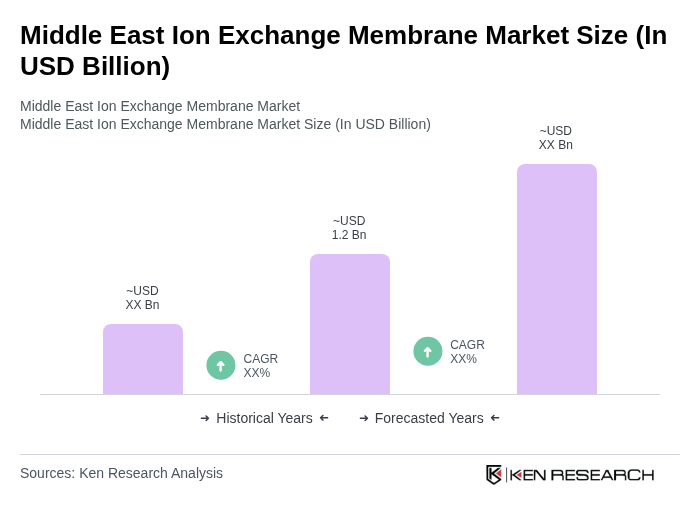
- The Middle East Ion Exchange Membrane Market is valued at USD 1.2 billion, based on a five-year historical analysis. This growth is primarily driven by increasing demand for water treatment solutions in arid regions, the rising need for efficient desalination processes, and significant investments in water infrastructure. The market is further supported by advancements in membrane technology, which enhance operational efficiency and reduce costs, as well as the adoption of energy-efficient desalination methods across the region .
- Key players in this market include Saudi Arabia, the United Arab Emirates, and Qatar, which lead due to substantial investments in water infrastructure and large-scale desalination projects. These countries are also prioritizing sustainable water management practices and the deployment of advanced water treatment technologies to address chronic water scarcity and support industrial growth .
- In 2023, the Saudi Arabian government issued the "Regulations for the Rationalization and Reuse of Water in Industrial Facilities," under the Ministry of Environment, Water and Agriculture. This regulation mandates the implementation of advanced water treatment technologies, including membrane-based systems, in all new industrial projects to improve water quality, ensure compliance with national standards, and promote sustainable industrial practices .
Middle East Ion Exchange Membrane Market Segmentation
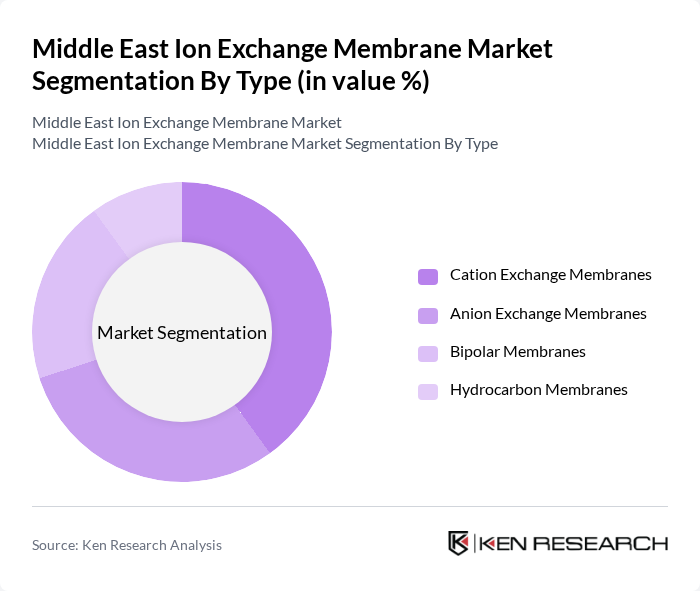
By Type:The market is segmented into various types of ion exchange membranes, including Cation Exchange Membranes, Anion Exchange Membranes, Bipolar Membranes, and Hydrocarbon Membranes. Cation Exchange Membranes are widely used in water treatment and desalination processes due to their high ion selectivity and durability. Anion Exchange Membranes are essential for applications in chemical processing and electrochemical energy systems. Bipolar Membranes are gaining traction for their role in electrodialysis and acid/base generation, while Hydrocarbon Membranes are preferred for their cost-effectiveness and chemical resistance in industrial applications .
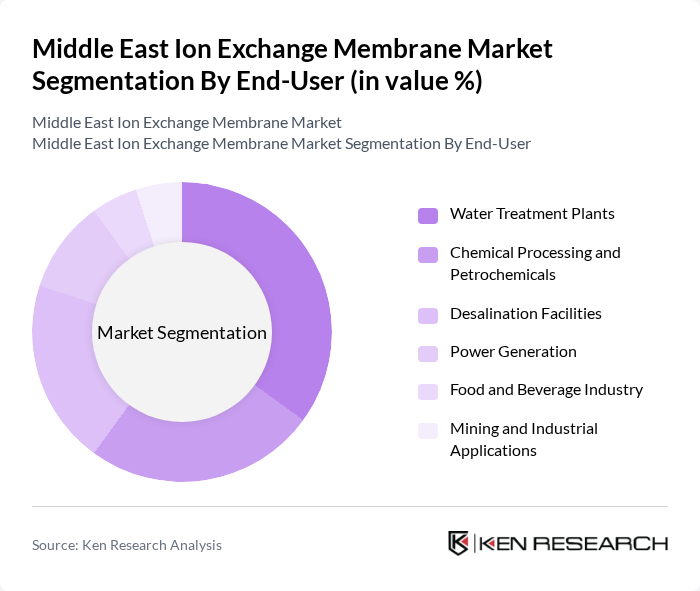
By End-User:The end-user segmentation includes Water Treatment Plants, Chemical Processing and Petrochemicals, Desalination Facilities, Power Generation, Food and Beverage Industry, and Mining and Industrial Applications. Water Treatment Plants represent the largest consumer segment, driven by the region's urgent need for potable water and stringent regulatory standards. Desalination Facilities are significant users, as ion exchange membranes are integral to seawater desalination processes. Chemical Processing and Petrochemicals utilize these membranes for product purification and process efficiency, while Power Generation, Food and Beverage, and Mining sectors leverage them for specialized water and chemical management needs .
Middle East Ion Exchange Membrane Market Competitive Landscape
The Middle East Ion Exchange Membrane Market is characterized by a dynamic mix of regional and international players. Leading participants such as Dow Chemical Company, DuPont de Nemours, Inc., Toray Industries, Inc., Hydranautics (A Nitto Denko Company), Membrane Technology and Research, Inc. (MTR), SUEZ Water Technologies & Solutions, Koch Membrane Systems, Inc., 3M Company, Asahi Kasei Corporation, Mitsubishi Chemical Corporation, Pall Corporation (A Danaher Company), Veolia Water Technologies, Membrana GmbH, Alfa Laval AB, Xylem Inc., Aqua Metals (Regional Distributor), Desalination Company of Saudi Arabia (ACWA Power Partnership) contribute to innovation, geographic expansion, and service delivery in this space.
Middle East Ion Exchange Membrane Market Industry Analysis
Growth Drivers
- Increasing Demand for Water Treatment Solutions:The Middle East faces severe water scarcity, with the World Bank reporting that over 60% of the region's population lacks access to safe drinking water. This has led to a surge in demand for advanced water treatment solutions, including ion exchange membranes. The market for water treatment is projected to reach $12 billion in future, driven by the need for sustainable water management practices and improved public health outcomes.
- Rising Industrial Applications:The industrial sector in the Middle East is expanding rapidly, with the manufacturing output expected to grow by 5% annually through future. Industries such as petrochemicals, pharmaceuticals, and food processing are increasingly adopting ion exchange membranes for efficient separation and purification processes. This trend is supported by the region's strategic investments in industrial diversification, which aim to reduce reliance on oil and gas revenues.
- Government Initiatives for Sustainable Practices:Governments across the Middle East are implementing policies to promote sustainable practices, with investments in water infrastructure projected to exceed $25 billion in future. Initiatives such as the UAE's Water Security Strategy 2036 aim to enhance water quality and availability. These efforts are driving the adoption of ion exchange membranes, which are essential for meeting stricter water quality standards and achieving sustainability goals.
Market Challenges
- High Initial Investment Costs:The adoption of ion exchange membrane technology often requires significant upfront capital investment, which can deter potential users. For instance, the installation of advanced membrane systems can cost upwards of $1.2 million, depending on the scale and complexity of the project. This financial barrier is particularly challenging for small and medium-sized enterprises (SMEs) in the region, limiting their access to cutting-edge water treatment solutions.
- Limited Awareness Among End-Users:Despite the benefits of ion exchange membranes, there remains a lack of awareness among end-users regarding their advantages and applications. A survey by the Middle East Water Association indicated that over 45% of industrial operators are unfamiliar with membrane technologies. This knowledge gap hinders market growth, as potential customers may opt for traditional methods that are less efficient and environmentally friendly.
Middle East Ion Exchange Membrane Market Future Outlook
The future of the Middle East ion exchange membrane market appears promising, driven by increasing investments in water infrastructure and technological advancements. As governments prioritize sustainable water management, the integration of smart technologies and IoT in membrane systems is expected to enhance operational efficiency. Furthermore, the growing emphasis on recycling and waste management will likely create new avenues for membrane applications, fostering innovation and collaboration within the industry.
Market Opportunities
- Expansion in Emerging Markets:Emerging markets within the Middle East, such as Iraq and Yemen, present significant opportunities for growth. With increasing urbanization and industrialization, the demand for efficient water treatment solutions is expected to rise, creating a favorable environment for ion exchange membrane technologies to flourish.
- Development of Innovative Membrane Materials:Research and development in membrane technology are paving the way for innovative materials that enhance performance and reduce costs. Collaborations with research institutions can lead to breakthroughs in membrane efficiency, making them more accessible to a broader range of industries and applications in the region.
Scope of the Report
| Segment | Sub-Segments |
|---|---|
| By Type | Cation Exchange Membranes Anion Exchange Membranes Bipolar Membranes Hydrocarbon Membranes |
| By End-User | Water Treatment Plants Chemical Processing and Petrochemicals Desalination Facilities Power Generation Food and Beverage Industry Mining and Industrial Applications |
| By Application | Desalination Wastewater Treatment Electrodialysis and Electrodialysis Reversal (ED/EDI) Brine Valorization and Salt-Splitting Hydrogen Production and Fuel Cells Industrial Water Reuse |
| By Material | Polymeric Membranes Ceramic Membranes Composite Membranes Proton Exchange Membranes (PEM) Alkaline Membranes |
| By Region | GCC Countries (Saudi Arabia, UAE, Qatar, Kuwait, Bahrain, Oman) Levant Region (Syria, Lebanon, Jordan, Palestine) North Africa (Egypt, Morocco, Algeria, Tunisia) Iraq and Iran |
| By Technology | Electrodialysis (ED) Reverse Osmosis (RO) Nanofiltration (NF) Proton Exchange Membrane (PEM) Electrolysis Alkaline Electrolysis |
| By Investment Source | Private Sector Investments Government Funding and Public-Private Partnerships International Development Aid and Multilateral Funding Sovereign Wealth Funds |
Key Target Audience
Investors and Venture Capitalist Firms
Government and Regulatory Bodies (e.g., Ministry of Environment, Ministry of Water Resources)
Manufacturers and Producers of Ion Exchange Membranes
Water Treatment and Desalination Companies
Industrial Process Companies
Environmental Agencies (e.g., Environmental Protection Agency)
Energy Sector Companies
Utility Companies and Water Supply Authorities
Players Mentioned in the Report:
Dow Chemical Company
DuPont de Nemours, Inc.
Toray Industries, Inc.
Hydranautics (A Nitto Denko Company)
Membrane Technology and Research, Inc. (MTR)
SUEZ Water Technologies & Solutions
Koch Membrane Systems, Inc.
3M Company
Asahi Kasei Corporation
Mitsubishi Chemical Corporation
Pall Corporation (A Danaher Company)
Veolia Water Technologies
Membrana GmbH
Alfa Laval AB
Xylem Inc.
Aqua Metals (Regional Distributor)
Desalination Company of Saudi Arabia (ACWA Power Partnership)
Table of Contents
Market Assessment Phase
1. Executive Summary and Approach
2. Middle East Ion Exchange Membrane Market Overview
2.1 Key Insights and Strategic Recommendations
2.2 Middle East Ion Exchange Membrane Market Overview
2.3 Definition and Scope
2.4 Evolution of Market Ecosystem
2.5 Timeline of Key Regulatory Milestones
2.6 Value Chain & Stakeholder Mapping
2.7 Business Cycle Analysis
2.8 Policy & Incentive Landscape
3. Middle East Ion Exchange Membrane Market Analysis
3.1 Growth Drivers
3.1.1 Increasing demand for water treatment solutions
3.1.2 Rising industrial applications
3.1.3 Government initiatives for sustainable practices
3.1.4 Technological advancements in membrane technology
3.2 Market Challenges
3.2.1 High initial investment costs
3.2.2 Limited awareness among end-users
3.2.3 Regulatory compliance complexities
3.2.4 Competition from alternative technologies
3.3 Market Opportunities
3.3.1 Expansion in emerging markets
3.3.2 Development of innovative membrane materials
3.3.3 Collaborations with research institutions
3.3.4 Increasing focus on recycling and waste management
3.4 Market Trends
3.4.1 Growing adoption of smart water management systems
3.4.2 Shift towards eco-friendly materials
3.4.3 Integration of IoT in membrane monitoring
3.4.4 Rising investments in desalination projects
3.5 Government Regulation
3.5.1 Stricter water quality standards
3.5.2 Incentives for renewable energy usage
3.5.3 Regulations on industrial wastewater discharge
3.5.4 Policies promoting sustainable water management
4. SWOT Analysis
5. Stakeholder Analysis
6. Porter's Five Forces Analysis
7. Middle East Ion Exchange Membrane Market Size, 2019-2024
7.1 By Value
7.2 By Volume
7.3 By Average Selling Price
8. Middle East Ion Exchange Membrane Market Segmentation
8.1 By Type
8.1.1 Cation Exchange Membranes
8.1.2 Anion Exchange Membranes
8.1.3 Bipolar Membranes
8.1.4 Hydrocarbon Membranes
8.2 By End-User
8.2.1 Water Treatment Plants
8.2.2 Chemical Processing and Petrochemicals
8.2.3 Desalination Facilities
8.2.4 Power Generation
8.2.5 Food and Beverage Industry
8.2.6 Mining and Industrial Applications
8.3 By Application
8.3.1 Desalination
8.3.2 Wastewater Treatment
8.3.3 Electrodialysis and Electrodialysis Reversal (ED/EDI)
8.3.4 Brine Valorization and Salt-Splitting
8.3.5 Hydrogen Production and Fuel Cells
8.3.6 Industrial Water Reuse
8.4 By Material
8.4.1 Polymeric Membranes
8.4.2 Ceramic Membranes
8.4.3 Composite Membranes
8.4.4 Proton Exchange Membranes (PEM)
8.4.5 Alkaline Membranes
8.5 By Region
8.5.1 GCC Countries (Saudi Arabia, UAE, Qatar, Kuwait, Bahrain, Oman)
8.5.2 Levant Region (Syria, Lebanon, Jordan, Palestine)
8.5.3 North Africa (Egypt, Morocco, Algeria, Tunisia)
8.5.4 Iraq and Iran
8.6 By Technology
8.6.1 Electrodialysis (ED)
8.6.2 Reverse Osmosis (RO)
8.6.3 Nanofiltration (NF)
8.6.4 Proton Exchange Membrane (PEM) Electrolysis
8.6.5 Alkaline Electrolysis
8.7 By Investment Source
8.7.1 Private Sector Investments
8.7.2 Government Funding and Public-Private Partnerships
8.7.3 International Development Aid and Multilateral Funding
8.7.4 Sovereign Wealth Funds
9. Middle East Ion Exchange Membrane Market Competitive Analysis
9.1 Market Share of Key Players
9.2 Cross Comparison of Key Players
9.2.1 Company Name
9.2.2 Company Size Classification (Large, Medium, Small)
9.2.3 Year-over-Year Revenue Growth Rate (%)
9.2.4 Middle East Market Penetration Rate (%)
9.2.5 Customer Retention Rate (%)
9.2.6 Pricing Strategy (Premium, Mid-Market, Cost Leadership)
9.2.7 New Product Launch Frequency (Products/Year)
9.2.8 Operational Efficiency Ratio (EBITDA Margin %)
9.2.9 Brand Recognition Score (Regional Awareness %)
9.2.10 Distribution Network Coverage (Number of Regional Partners)
9.3 SWOT Analysis of Top Players
9.4 Pricing Analysis
9.5 Detailed Profile of Major Companies
9.5.1 Dow Chemical Company
9.5.2 DuPont de Nemours, Inc.
9.5.3 Toray Industries, Inc.
9.5.4 Hydranautics (A Nitto Denko Company)
9.5.5 Membrane Technology and Research, Inc. (MTR)
9.5.6 SUEZ Water Technologies & Solutions
9.5.7 Koch Membrane Systems, Inc.
9.5.8 3M Company
9.5.9 Asahi Kasei Corporation
9.5.10 Mitsubishi Chemical Corporation
9.5.11 Pall Corporation (A Danaher Company)
9.5.12 Veolia Water Technologies
9.5.13 Membrana GmbH
9.5.14 Alfa Laval AB
9.5.15 Xylem Inc.
9.5.16 Aqua Metals (Regional Distributor)
9.5.17 Desalination Company of Saudi Arabia (ACWA Power Partnership)
10. Middle East Ion Exchange Membrane Market End-User Analysis
10.1 Procurement Behavior of Key Ministries
10.1.1 Government procurement policies and tender requirements
10.1.2 Budget allocation for water and desalination projects
10.1.3 Collaboration with private sector and PPP models
10.1.4 Evaluation criteria for suppliers and localization requirements
10.2 Corporate Spend on Infrastructure & Energy
10.2.1 Investment trends in water infrastructure and desalination
10.2.2 Corporate sustainability initiatives and ESG commitments
10.2.3 Budgeting for energy-efficient and green hydrogen solutions
10.2.4 Long-term contracts with suppliers and service agreements
10.3 Pain Point Analysis by End-User Category
10.3.1 Cost of maintenance and membrane replacement
10.3.2 Reliability of supply and local availability
10.3.3 Compliance with regulations and water quality standards
10.3.4 Technology integration challenges and operational expertise
10.4 User Readiness for Adoption
10.4.1 Awareness of advanced membrane technologies
10.4.2 Training and technical support requirements
10.4.3 Financial readiness for capital investment
10.4.4 Infrastructure readiness and integration capabilities
10.5 Post-Deployment ROI and Use Case Expansion
10.5.1 Measurement of performance metrics and KPIs
10.5.2 Case studies of successful implementations in the region
10.5.3 Scalability of solutions across multiple facilities
10.5.4 Feedback mechanisms and continuous improvement processes
11. Middle East Ion Exchange Membrane Market Future Size, 2025-2030
11.1 By Value
11.2 By Volume
11.3 By Average Selling Price
Go-To-Market Strategy Phase
1. Whitespace Analysis + Business Model Canvas
1.1 Market gaps and opportunities
2. Marketing and Positioning Recommendations
2.1 Branding strategies
2.2 Product USPs
3. Distribution Plan
3.1 Urban retail vs rural NGO tie-ups
4. Channel & Pricing Gaps
4.1 Underserved routes
4.2 Pricing bands
5. Unmet Demand & Latent Needs
5.1 Category gaps
5.2 Consumer segments
6. Customer Relationship
6.1 Loyalty programs
6.2 After-sales service
7. Value Proposition
7.1 Sustainability
7.2 Integrated supply chains
8. Key Activities
8.1 Regulatory compliance
8.2 Branding
8.3 Distribution setup
9. Entry Strategy Evaluation
9.1 Domestic Market Entry Strategy
9.1.1 Product mix
9.1.2 Pricing band
9.1.3 Packaging
9.2 Export Entry Strategy
9.2.1 Target countries
9.2.2 Compliance roadmap
10. Entry Mode Assessment
10.1 JV
10.2 Greenfield
10.3 M&A
10.4 Distributor Model
11. Capital and Timeline Estimation
11.1 Capital requirements
11.2 Timelines
12. Control vs Risk Trade-Off
12.1 Ownership vs Partnerships
13. Profitability Outlook
13.1 Breakeven analysis
13.2 Long-term sustainability
14. Potential Partner List
14.1 Distributors
14.2 JVs
14.3 Acquisition targets
15. Execution Roadmap
Research Methodology
Phase 1: Approach1
Desk Research
- Industry reports from the Middle East Chemical Manufacturers Association
- Market analysis publications from regional trade organizations
- Government publications on environmental regulations affecting ion exchange membranes
Primary Research
- Interviews with technical experts from membrane manufacturing companies
- Surveys with end-users in water treatment and chemical processing sectors
- Field interviews with project managers in desalination plants
Validation & Triangulation
- Cross-validation of market data with industry expert insights
- Triangulation of findings from trade publications and primary interviews
- Sanity checks through feedback from a panel of industry specialists
Phase 2: Market Size Estimation1
Top-down Assessment
- Analysis of regional water scarcity and its impact on membrane demand
- Breakdown of market size by application sectors such as wastewater treatment and desalination
- Incorporation of government initiatives promoting sustainable water solutions
Bottom-up Modeling
- Volume estimates based on production capacities of leading membrane manufacturers
- Cost analysis derived from pricing models of ion exchange membranes
- Estimation of market share based on sales data from key players
Forecasting & Scenario Analysis
- Multi-variable regression analysis considering population growth and industrial demand
- Scenario modeling based on potential regulatory changes and technological advancements
- Baseline, optimistic, and pessimistic forecasts through 2035
Phase 3: CATI Sample Composition1
| Scope Item/Segment | Sample Size | Target Respondent Profiles |
|---|---|---|
| Water Treatment Facilities | 85 | Plant Managers, Environmental Engineers |
| Desalination Projects | 65 | Project Engineers, Operations Directors |
| Chemical Processing Plants | 60 | Procurement Managers, Process Engineers |
| Research Institutions | 45 | Research Scientists, Academic Researchers |
| Government Regulatory Bodies | 40 | Policy Makers, Environmental Analysts |
Frequently Asked Questions
What is the current value of the Middle East Ion Exchange Membrane Market?
The Middle East Ion Exchange Membrane Market is valued at approximately USD 1.2 billion, driven by increasing demand for water treatment solutions, efficient desalination processes, and significant investments in water infrastructure across the region.
What factors are driving the growth of the Ion Exchange Membrane Market in the Middle East?
Which countries are leading the Middle East Ion Exchange Membrane Market?
What types of ion exchange membranes are available in the market?
Other Regional/Country Reports
Indonesia Ion Exchange Membrane Market
Malaysia Ion Exchange Membrane Market
KSA Ion Exchange Membrane Market
APAC Ion Exchange Membrane Market
SEA Ion Exchange Membrane Market
Vietnam Ion Exchange Membrane Market
Other Adjacent Reports
Malaysia Water Treatment Membrane Market
Egypt Desalination Technology Market
UAE Reverse Osmosis Membrane MarketIndonesia Ultrafiltration Membrane Market
Singapore Nanofiltration Membrane Market
Oman Electrodialysis System Market
United States Industrial Filtration MarketPhilippines Wastewater Management Market
Indonesia Chemical Processing Membrane Market
Bahrain Power Generation Water Treatment Market
Why Buy From Us?

What makes us stand out is that our consultants follow Robust, Refine and Result (RRR) methodology. Robust for clear definitions, approaches and sanity checking, Refine for differentiating respondents' facts and opinions, and Result for presenting data with story.

We have set a benchmark in the industry by offering our clients with syndicated and customized market research reports featuring coverage of entire market as well as meticulous research and analyst insights.

While we don't replace traditional research, we flip the method upside down. Our dual approach of Top Bottom & Bottom Top ensures quality deliverable by not just verifying company fundamentals but also looking at the sector and macroeconomic factors.

With one step in the future, our research team constantly tries to show you the bigger picture. We help with some of the tough questions you may encounter along the way: How is the industry positioned? Best marketing channel? KPI's of competitors? By aligning every element, we help maximize success.

Our report gives you instant access to the answers and sources that other companies might choose to hide. We elaborate each steps of research methodology we have used and showcase you the sample size to earn your trust.

If you need any support, we are here! We pride ourselves on universe strength, data quality, and quick, friendly, and professional service.