Middle East Irrigation Insurance Market Report Size Share Growth Drivers Trends Opportunities & Forecast 2025–2030

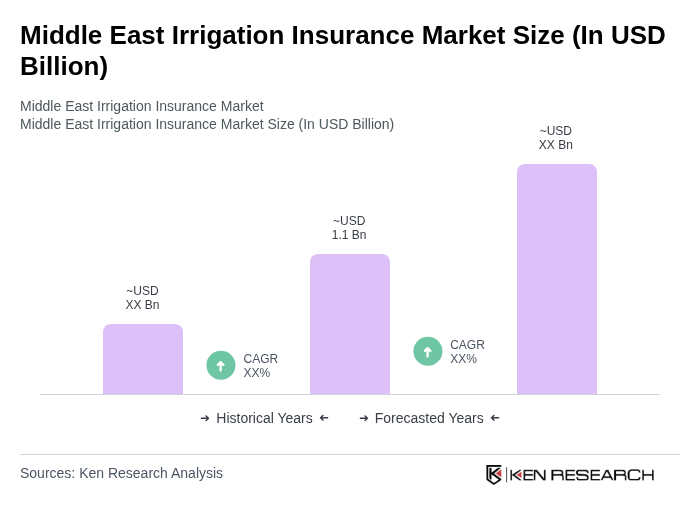
The Middle East Irrigation Insurance Market, worth USD 1.1 billion, grows amid rising agricultural activities, climate change awareness, and investments in efficient irrigation systems.

Region:Middle East

Author(s):Dev

Product Code:KRAA3751

Pages:95

Published On:January 2026
About the Report

Base Year 2024

Middle East Irrigation Insurance Market Overview

  • The Middle East Irrigation Insurance Market is valued at USD 1.1 billion, based on a five-year historical analysis, reflecting the expansion of irrigation systems and associated risk-transfer solutions alongside the growing Middle East and Africa drip and precision irrigation markets. This growth is primarily driven by increasing agricultural activities, the need for risk management in farming, and the rising awareness of climate change impacts on crop yields, particularly in water?scarce countries where extreme heat, prolonged droughts, and rainfall variability intensify production risks. The market is also supported by government initiatives aimed at enhancing agricultural productivity and sustainability, including subsidies for modern irrigation, national food?security strategies, and investments in precision irrigation technologies across Gulf countries and North Africa.
  • Key players in this market include the GCC countries, particularly Saudi Arabia and the UAE, which dominate due to their significant investments in agricultural technology, precision irrigation, and water?efficient infrastructure to support food security objectives. Additionally, countries like Egypt and Iran are also pivotal due to their large irrigated agricultural areas along major river basins and canal systems, and the necessity for irrigation?related risk transfer solutions to mitigate losses associated with water scarcity, salinity, and climate variability.
  • In the UAE, agricultural and climate?resilience policies encourage the use of insurance and risk?management tools around modern irrigation systems, supported by broader federal insurance and agriculture frameworks such as the Federal Law No. 6 of 2007 on the Establishment of the Insurance Authority and Regulation of the Insurance Business, which sets solvency, product, and consumer?protection requirements for all insurance providers, and the UAE National Food Security Strategy 2051, which promotes efficient irrigation and climate?smart agriculture.
Middle East Irrigation Insurance Market Size

Middle East Irrigation Insurance Market Segmentation

By Product Type:The product types in the irrigation insurance market include Crop Yield Insurance, Weather-based / Index-based Insurance, Irrigation Infrastructure Coverage, and Parametric Drought / Excess Rainfall Covers. Crop?related covers are generally the most widely used agricultural insurance solutions in emerging and water?stressed regions, as they protect farm income against yield losses stemming from drought, heat stress, and rainfall deviations. Within this, Crop Yield Insurance remains a core segment in the Middle East context, driven by the increasing need for farmers to secure their income against unpredictable weather patterns and crop failures. Weather?based / Index?based Insurance is gaining traction as insurers and agritech providers increasingly use climatic, satellite, and soil?moisture data to structure parametric triggers that can be settled quickly and transparently. The focus on Irrigation Infrastructure Coverage is also rising as farmers and agribusinesses invest in advanced drip, sprinkler, and pumping systems, which represent high?value assets that require protection against mechanical breakdown, electrical failures, and climate?induced damage, while Parametric Drought / Excess Rainfall Covers complement these products by providing rapid liquidity during severe hydrological shocks.
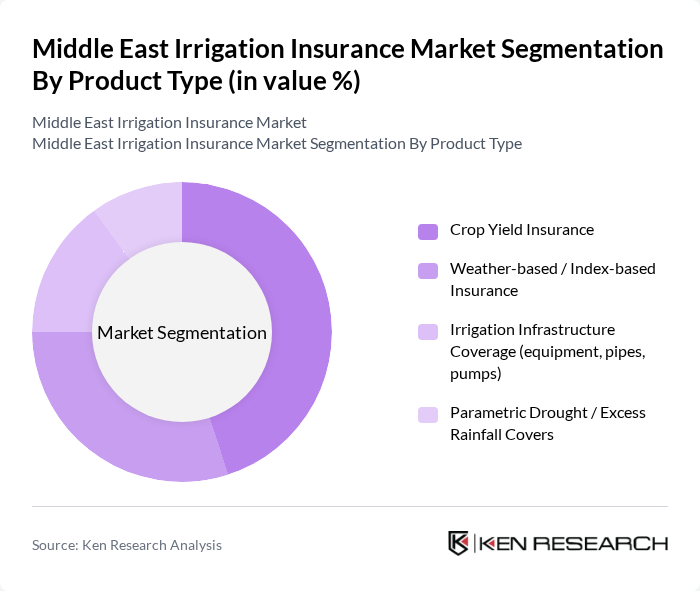
Middle East Irrigation Insurance Market segmentation by Product Type.

By Irrigation Method Insured:The irrigation methods insured include Drip and Micro-irrigation Systems, Sprinkler and Center Pivot Systems, Surface / Flood Irrigation, and Others. Drip and Micro?irrigation Systems are leading the market, in line with the rapid adoption of drip and precision irrigation across the Middle East and Africa to maximize water?use efficiency and crop productivity under arid and semi?arid conditions. Sprinkler and Center Pivot Systems also hold a significant share, particularly in large?scale farms and field crops where mechanized irrigation is prevalent. The demand for insurance covering Surface / Flood Irrigation is comparatively lower and gradually declining in relative terms, as policy incentives and water?scarcity pressures continue to accelerate the transition toward modern, water?saving irrigation technologies.
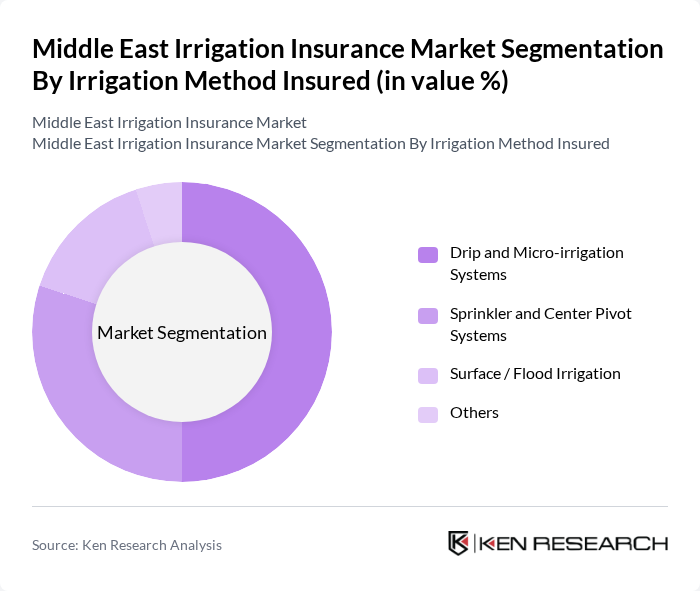
Middle East Irrigation Insurance Market segmentation by Irrigation Method Insured.

Middle East Irrigation Insurance Market Competitive Landscape

The Middle East Irrigation Insurance Market is characterized by a dynamic mix of regional and international players. Leading participants such as Allianz, AXA, Zurich Insurance Group, American International Group (AIG), MetLife, QBE Insurance Group, Chubb Limited, Arab Orient Insurance (GIG Jordan), Gulf Insurance Group (GIG), Takaful Emarat – Insurance PSC, Al Ain Ahlia Insurance Company, Oman Insurance Company P.S.C., National General Insurance Company (NGI), Emirates Insurance Company PJSC, Al Fujairah National Insurance Company (AFNIC) contribute to innovation, geographic expansion, and service delivery in this space, leveraging their broader experience in agricultural, property, and specialty insurance to design covers for irrigation assets and weather?linked crop risks.

Allianz

1890

Munich, Germany

AXA

1816

Paris, France

Zurich Insurance Group

1872

Zurich, Switzerland

American International Group (AIG)

1919

New York, USA

MetLife

1868

New York, USA

Company

Establishment Year

Headquarters

Gross Written Premiums (USD million)

Irrigation Insurance Premium CAGR (%)

Loss Ratio for Irrigation Insurance (%)

Combined Ratio (%)

Claims Settlement Turnaround Time (days)

Policyholder Retention Rate (%)

Middle East Irrigation Insurance Market Industry Analysis

Growth Drivers

  • Increasing Agricultural Productivity:The Middle East has seen a significant rise in agricultural productivity, with the region's agricultural output valued at approximately $120 billion. This growth is driven by enhanced farming techniques and increased crop yields, which are projected to rise by 4% annually. As farmers seek to protect their investments, the demand for irrigation insurance is expected to grow, providing a safety net against potential losses due to adverse weather conditions or crop failures.
  • Rising Awareness of Climate Risks:With climate change impacting weather patterns, farmers in the Middle East are increasingly aware of the risks associated with agricultural production. Reports indicate that 75% of farmers now recognize the importance of insurance in mitigating climate-related risks. This heightened awareness is leading to a surge in demand for irrigation insurance products, as farmers seek to safeguard their livelihoods against unpredictable climate events, such as droughts and floods.
  • Government Support for Sustainable Farming:Governments in the Middle East are actively promoting sustainable farming practices, with investments exceeding $6 billion in agricultural sustainability initiatives. This support includes subsidies for irrigation insurance, which encourages farmers to adopt insurance products. As a result, the integration of insurance into sustainable farming practices is becoming more prevalent, driving growth in the irrigation insurance market as farmers look to secure their investments.

Market Challenges

  • Limited Awareness of Insurance Products:Despite the growth potential, many farmers in the Middle East remain unaware of available irrigation insurance products. A survey revealed that only 35% of farmers understand the benefits of such insurance, limiting market penetration. This lack of awareness poses a significant challenge for insurers aiming to expand their customer base, as educational initiatives are necessary to inform farmers about the advantages of protecting their crops through insurance.
  • High Premium Costs for Farmers:The cost of premiums for irrigation insurance can be prohibitive for many farmers, particularly smallholders. Average premium costs were reported at $1,500 per policy, which is a substantial financial burden for farmers with limited resources. This challenge restricts access to insurance, as many farmers opt to forgo coverage, leaving them vulnerable to financial losses from climate-related events and other risks.

Middle East Irrigation Insurance Market Future Outlook

The future of the Middle East irrigation insurance market appears promising, driven by increasing agricultural productivity and government initiatives aimed at promoting sustainable practices. As awareness of climate risks continues to rise, more farmers are likely to seek insurance solutions to protect their investments. Additionally, advancements in technology, such as digital platforms and IoT integration, will enhance the efficiency of insurance offerings, making them more accessible and tailored to farmers' needs, thereby fostering market growth.

Market Opportunities

  • Expansion of Insurance Products:There is a significant opportunity for insurers to develop and expand their product offerings tailored to the unique needs of farmers in the Middle East. By creating specialized policies that address specific risks, insurers can attract a broader customer base, potentially increasing market penetration and revenue.
  • Partnerships with Agricultural Cooperatives:Collaborating with agricultural cooperatives presents a valuable opportunity for insurers to reach more farmers. By leveraging these partnerships, insurers can enhance their distribution channels and provide education on the benefits of irrigation insurance, ultimately driving adoption and increasing market share.

Scope of the Report

SegmentSub-Segments
By Product Type

Crop Yield Insurance

Weather-based / Index-based Insurance

Irrigation Infrastructure Coverage (equipment, pipes, pumps)

Parametric Drought / Excess Rainfall Covers

By Irrigation Method Insured

Drip and Micro-irrigation Systems

Sprinkler and Center Pivot Systems

Surface / Flood Irrigation

Others

By Insured Entity

Smallholder and Medium Farmers

Large Commercial Farms and Agribusinesses

Agricultural Cooperatives and Producer Organizations

Government and Public Irrigation Schemes

By Risk Covered

Drought and Water Shortage

Flooding and Excess Rainfall

Irrigation System Failure and Breakdown

Soil Salinity and Water Quality-related Losses

By Distribution Channel

Direct Insurer Sales

Bancassurance and MFIs

Brokers and Agents

Digital Platforms and AgriTech Partnerships

By Policy Structure

Indemnity-based Policies

Index-based / Parametric Policies

Public–Private Partnership (PPP) Schemes

Reinsurance-backed Programs

By Country / Sub-Region

GCC Countries

Levant

Iran

Rest of Middle East

Key Target Audience

Investors and Venture Capitalist Firms

Government and Regulatory Bodies (e.g., Ministry of Agriculture, Ministry of Water Resources)

Insurance Companies and Underwriters

Agricultural Cooperatives and Associations

Farmers and Agricultural Producers

Technology Providers for Irrigation Solutions

Environmental NGOs and Advocacy Groups

Financial Institutions and Banks

Players Mentioned in the Report:

Allianz

AXA

Zurich Insurance Group

American International Group (AIG)

MetLife

QBE Insurance Group

Chubb Limited

Arab Orient Insurance (GIG Jordan)

Gulf Insurance Group (GIG)

Takaful Emarat Insurance PSC

Al Ain Ahlia Insurance Company

Oman Insurance Company P.S.C.

National General Insurance Company (NGI)

Emirates Insurance Company PJSC

Al Fujairah National Insurance Company (AFNIC)

Table of Contents

Market Assessment Phase

1. Executive Summary and Approach


2. Middle East Irrigation Insurance Market Overview

2.1 Key Insights and Strategic Recommendations

2.2 Middle East Irrigation Insurance Market Overview

2.3 Definition and Scope

2.4 Evolution of Market Ecosystem

2.5 Timeline of Key Regulatory Milestones

2.6 Value Chain & Stakeholder Mapping

2.7 Business Cycle Analysis

2.8 Policy & Incentive Landscape


3. Middle East Irrigation Insurance Market Analysis

3.1 Growth Drivers

3.1.1 Increasing agricultural productivity
3.1.2 Rising awareness of climate risks
3.1.3 Government support for sustainable farming
3.1.4 Technological advancements in irrigation

3.2 Market Challenges

3.2.1 Limited awareness of insurance products
3.2.2 High premium costs for farmers
3.2.3 Regulatory complexities
3.2.4 Variability in climate conditions

3.3 Market Opportunities

3.3.1 Expansion of insurance products
3.3.2 Partnerships with agricultural cooperatives
3.3.3 Development of customized insurance solutions
3.3.4 Increased investment in irrigation infrastructure

3.4 Market Trends

3.4.1 Adoption of digital insurance platforms
3.4.2 Integration of IoT in irrigation management
3.4.3 Focus on sustainable agricultural practices
3.4.4 Growth of parametric insurance models

3.5 Government Regulation

3.5.1 Subsidies for irrigation insurance
3.5.2 Regulations on insurance product offerings
3.5.3 Compliance requirements for insurers
3.5.4 Support for climate-resilient agriculture

4. SWOT Analysis


5. Stakeholder Analysis


6. Porter's Five Forces Analysis


7. Middle East Irrigation Insurance Market Market Size, 2019-2024

7.1 By Value

7.2 By Volume

7.3 By Average Selling Price


8. Middle East Irrigation Insurance Market Segmentation

8.1 By Product Type

8.1.1 Crop Yield Insurance
8.1.2 Weather-based / Index-based Insurance
8.1.3 Irrigation Infrastructure Coverage (equipment, pipes, pumps)
8.1.4 Parametric Drought / Excess Rainfall Covers

8.2 By Irrigation Method Insured

8.2.1 Drip and Micro-irrigation Systems
8.2.2 Sprinkler and Center Pivot Systems
8.2.3 Surface / Flood Irrigation
8.2.4 Others

8.3 By Insured Entity

8.3.1 Smallholder and Medium Farmers
8.3.2 Large Commercial Farms and Agribusinesses
8.3.3 Agricultural Cooperatives and Producer Organizations
8.3.4 Government and Public Irrigation Schemes

8.4 By Risk Covered

8.4.1 Drought and Water Shortage
8.4.2 Flooding and Excess Rainfall
8.4.3 Irrigation System Failure and Breakdown
8.4.4 Soil Salinity and Water Quality-related Losses

8.5 By Distribution Channel

8.5.1 Direct Insurer Sales
8.5.2 Bancassurance and MFIs
8.5.3 Brokers and Agents
8.5.4 Digital Platforms and AgriTech Partnerships

8.6 By Policy Structure

8.6.1 Indemnity-based Policies
8.6.2 Index-based / Parametric Policies
8.6.3 Public–Private Partnership (PPP) Schemes
8.6.4 Reinsurance-backed Programs

8.7 By Country / Sub-Region

8.7.1 GCC Countries
8.7.2 Levant
8.7.3 Iran
8.7.4 Rest of Middle East

9. Middle East Irrigation Insurance Market Competitive Analysis

9.1 Market Share of Key Players

9.2 Cross Comparison of Key Players

9.2.1 Company Name
9.2.2 Gross Written Premiums (USD million)
9.2.3 Irrigation Insurance Premium CAGR (%)
9.2.4 Loss Ratio for Irrigation Insurance (%)
9.2.5 Combined Ratio (%)
9.2.6 Claims Settlement Turnaround Time (days)
9.2.7 Policyholder Retention Rate (%)
9.2.8 Average Sum Insured per Policy (USD)
9.2.9 Number of Policies in Force (Irrigation-related)
9.2.10 Geographic Footprint (Number of Middle East Countries Covered)
9.2.11 Product Mix Share from Parametric / Index Products (%)
9.2.12 Distribution Mix (share of digital / partnerships / bancassurance)

9.3 SWOT Analysis of Top Players

9.4 Pricing Analysis

9.5 Detailed Profile of Major Companies

9.5.1 Allianz
9.5.2 AXA
9.5.3 Zurich Insurance Group
9.5.4 American International Group (AIG)
9.5.5 MetLife
9.5.6 QBE Insurance Group
9.5.7 Chubb Limited
9.5.8 Arab Orient Insurance (GIG Jordan)
9.5.9 Gulf Insurance Group (GIG)
9.5.10 Takaful Emarat – Insurance PSC
9.5.11 Al Ain Ahlia Insurance Company
9.5.12 Oman Insurance Company P.S.C.
9.5.13 National General Insurance Company (NGI)
9.5.14 Emirates Insurance Company PJSC
9.5.15 Al Fujairah National Insurance Company (AFNIC)

10. Middle East Irrigation Insurance Market End-User Analysis

10.1 Procurement Behavior of Key Ministries

10.1.1 Ministry of Agriculture
10.1.2 Ministry of Environment
10.1.3 Ministry of Finance
10.1.4 Others

10.2 Corporate Spend on Infrastructure & Energy

10.2.1 Investment in Irrigation Projects
10.2.2 Funding for Agricultural Insurance
10.2.3 Budget Allocation for Climate Resilience
10.2.4 Others

10.3 Pain Point Analysis by End-User Category

10.3.1 Smallholder Farmers
10.3.2 Large Agricultural Enterprises
10.3.3 Agricultural Cooperatives
10.3.4 Others

10.4 User Readiness for Adoption

10.4.1 Awareness Levels
10.4.2 Financial Capability
10.4.3 Technological Adoption
10.4.4 Others

10.5 Post-Deployment ROI and Use Case Expansion

10.5.1 ROI Measurement Techniques
10.5.2 Use Case Scenarios
10.5.3 Long-term Benefits Analysis
10.5.4 Others

11. Middle East Irrigation Insurance Market Future Size, 2025-2030

11.1 By Value

11.2 By Volume

11.3 By Average Selling Price


Go-To-Market Strategy Phase

1. Whitespace Analysis + Business Model Canvas

1.1 Market Gaps Identification

1.2 Business Model Framework


2. Marketing and Positioning Recommendations

2.1 Branding Strategies

2.2 Product USPs


3. Distribution Plan

3.1 Urban Retail vs Rural NGO Tie-ups


4. Channel & Pricing Gaps

4.1 Underserved Routes

4.2 Pricing Bands


5. Unmet Demand & Latent Needs

5.1 Category Gaps

5.2 Consumer Segments


6. Customer Relationship

6.1 Loyalty Programs

6.2 After-sales Service


7. Value Proposition

7.1 Sustainability

7.2 Integrated Supply Chains


8. Key Activities

8.1 Regulatory Compliance

8.2 Branding

8.3 Distribution Setup


9. Entry Strategy Evaluation

9.1 Domestic Market Entry Strategy

9.1.1 Product Mix
9.1.2 Pricing Band
9.1.3 Packaging

9.2 Export Entry Strategy

9.2.1 Target Countries
9.2.2 Compliance Roadmap

10. Entry Mode Assessment

10.1 JV

10.2 Greenfield

10.3 M&A

10.4 Distributor Model


11. Capital and Timeline Estimation

11.1 Capital Requirements

11.2 Timelines


12. Control vs Risk Trade-Off

12.1 Ownership vs Partnerships


13. Profitability Outlook

13.1 Breakeven Analysis

13.2 Long-term Sustainability


14. Potential Partner List

14.1 Distributors

14.2 JVs

14.3 Acquisition Targets


15. Execution Roadmap

15.1 Phased Plan for Market Entry

15.1.1 Market Setup
15.1.2 Market Entry
15.1.3 Growth Acceleration
15.1.4 Scale & Stabilize

15.2 Key Activities and Milestones

15.2.1 Milestone Planning
15.2.2 Activity Tracking

Research Methodology

ApproachModellingSample

Phase 1: Approach1

Desk Research

  • Analysis of agricultural reports from the Food and Agriculture Organization (FAO) specific to the Middle East
  • Review of insurance market studies and white papers from regional insurance associations
  • Examination of government publications on irrigation policies and agricultural subsidies

Primary Research

  • Interviews with insurance underwriters specializing in agricultural policies
  • Surveys with farmers and agricultural cooperatives regarding their irrigation practices and insurance needs
  • Discussions with agricultural extension officers on the impact of climate change on irrigation

Validation & Triangulation

  • Cross-validation of findings through multiple data sources including market reports and expert opinions
  • Triangulation of data from insurance claims, agricultural yield reports, and irrigation technology adoption rates
  • Sanity checks conducted through expert panel reviews comprising industry veterans and academic researchers

Phase 2: Market Size Estimation1

Top-down Assessment

  • Estimation of total agricultural output in the Middle East to gauge potential insurance market size
  • Segmentation of the market by crop type and irrigation method to identify key areas of growth
  • Incorporation of regional climate data to assess risk factors influencing insurance uptake

Bottom-up Modeling

  • Collection of premium rates from leading insurance providers for various irrigation insurance products
  • Estimation of the number of insured farms based on agricultural census data
  • Calculation of total market value by multiplying the number of insured farms by average premium rates

Forecasting & Scenario Analysis

  • Multi-factor regression analysis incorporating variables such as climate change impact and technological advancements in irrigation
  • Scenario modeling based on potential regulatory changes and shifts in agricultural practices
  • Development of baseline, optimistic, and pessimistic forecasts through 2030

Phase 3: CATI Sample Composition1

Scope Item/SegmentSample SizeTarget Respondent Profiles
Irrigation Insurance for Crop Farmers120Farm Owners, Agricultural Insurance Agents
Insurance Providers in the Agricultural Sector90Underwriters, Risk Assessment Managers
Government Agricultural Policy Makers70Policy Analysts, Agricultural Economists
Technology Providers for Irrigation Solutions60Product Managers, Sales Directors
Research Institutions Focused on Agriculture50Research Scientists, Extension Officers

Frequently Asked Questions

What is the current value of the Middle East Irrigation Insurance Market?

The Middle East Irrigation Insurance Market is valued at approximately USD 1.1 billion, reflecting the growth of irrigation systems and risk-transfer solutions in response to increasing agricultural activities and climate change impacts in the region.

What are the main drivers of growth in the Middle East Irrigation Insurance Market?

What types of insurance products are available in the Middle East Irrigation Insurance Market?

Which countries are leading in the Middle East Irrigation Insurance Market?

Other Regional/Country Reports

Indonesia Irrigation Insurance Market

Malaysia Irrigation Insurance Market

KSA Irrigation Insurance Market

APAC Irrigation Insurance Market

SEA Irrigation Insurance Market

Vietnam Irrigation Insurance Market

Other Adjacent Reports

Bahrain drip irrigation market report size, share, growth drivers, trends, opportunities & forecast 2025–2030

Qatar Precision Irrigation Market

Oman Agricultural Insurance Market

Japan Crop Yield Insurance Market

Qatar Weather-based Insurance Market

Singapore Parametric Insurance Market

Thailand Irrigation Systems Market

Philippines Water Management Market

Brazil AgriTech Market

Germany Sustainable Agriculture Market

Why Buy From Us?

Refine Robust Result (RRR) Framework

What makes us stand out is that our consultants follow Robust, Refine and Result (RRR) methodology. Robust for clear definitions, approaches and sanity checking, Refine for differentiating respondents' facts and opinions, and Result for presenting data with story.

Our Reach Is Unmatched

We have set a benchmark in the industry by offering our clients with syndicated and customized market research reports featuring coverage of entire market as well as meticulous research and analyst insights.

Shifting the Research Paradigm

While we don't replace traditional research, we flip the method upside down. Our dual approach of Top Bottom & Bottom Top ensures quality deliverable by not just verifying company fundamentals but also looking at the sector and macroeconomic factors.

More Insights-Better Decisions

With one step in the future, our research team constantly tries to show you the bigger picture. We help with some of the tough questions you may encounter along the way: How is the industry positioned? Best marketing channel? KPI's of competitors? By aligning every element, we help maximize success.

Transparency and Trust

Our report gives you instant access to the answers and sources that other companies might choose to hide. We elaborate each steps of research methodology we have used and showcase you the sample size to earn your trust.

Round the Clock Support

If you need any support, we are here! We pride ourselves on universe strength, data quality, and quick, friendly, and professional service.

Why Clients Choose Us?

400000+
Reports in repository
150+
Consulting projects a year
100+
Analysts
8000+
Client Queries in 2022








