About the Report
Base Year 2024Listen to the audio summary
Middle East Medical Nonwoven Disposables Market Overview
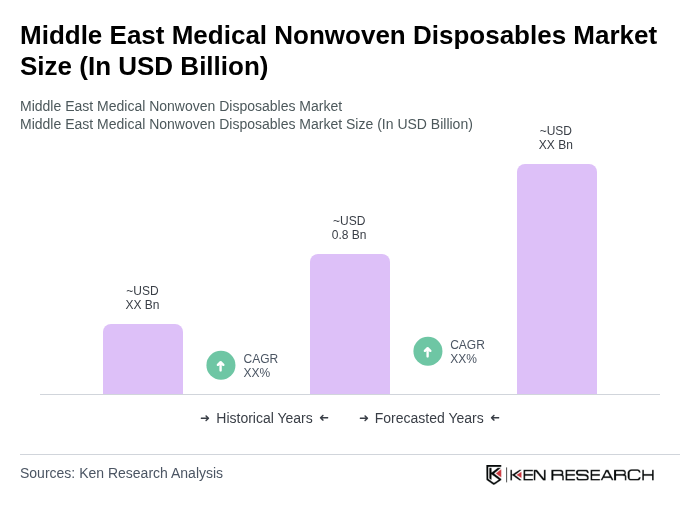
- The Middle East Medical Nonwoven Disposables Market is valued at USD 0.8 billion, based on a five-year historical analysis of regional medical nonwoven revenues and their share in the global market. This growth is primarily driven by the increasing demand for hygiene products in healthcare settings, the rise in surgical procedures, and the growing awareness of infection control measures across hospitals and clinics in the region. The market is also supported by advancements in nonwoven technology that improve barrier properties, fluid resistance, and breathability, enhancing product performance and safety for both patients and healthcare professionals.
- Key country-level demand centers for medical nonwoven disposables in the broader Middle East include Saudi Arabia, the United Arab Emirates, Turkey, Egypt, and Qatar, which together account for the bulk of regional medical nonwovens revenue, with Saudi Arabia and the United Arab Emirates among the largest contributors. These countries benefit from robust healthcare infrastructure, comparatively high healthcare expenditure, and a growing population that demands quality medical services, particularly in acute care and surgical settings. Additionally, government-backed programs to expand hospital capacity, upgrade infection prevention standards, and localize medical supplies manufacturing are further bolstering the adoption of medical nonwoven disposables in these markets.
- Saudi Arabian healthcare providers are required to follow national infection prevention and control standards that emphasize the use of appropriate single?use protective medical devices and barrier materials in clinical practice; for example, the “National Hospital Infection Prevention and Control Manual” issued by the Ministry of Health and the Saudi Center for Disease Prevention and Control (Saudi CDC) in 2018 sets operational requirements for personal protective equipment, surgical attire, and sterile barrier systems to reduce healthcare?associated infections. In parallel, the Saudi Food and Drug Authority (SFDA) regulates medical devices, including medical nonwoven disposables such as gowns, drapes, and masks, under the “Medical Devices Interim Regulation” and implementing rules, which establish classification, registration, quality, and safety requirements for importers and manufacturers supplying these products to healthcare facilities. These instruments collectively drive standardized hygiene practices across hospitals and clinics and support consistent use of compliant disposable nonwoven products in patient care.
Middle East Medical Nonwoven Disposables Market Segmentation
By Product Type:
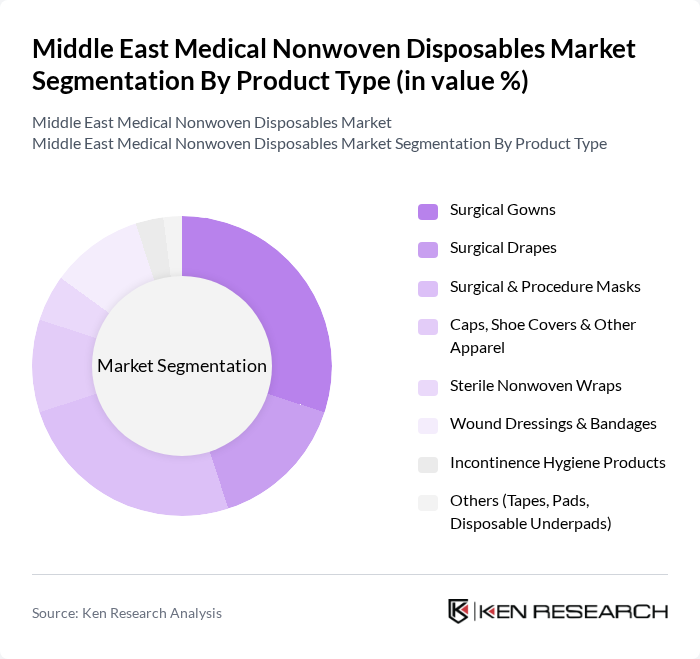
The product type segmentation includes various categories such as Surgical Gowns, Surgical Drapes, Surgical & Procedure Masks, Caps, Shoe Covers & Other Apparel, Sterile Nonwoven Wraps, Wound Dressings & Bandages, Incontinence Hygiene Products, and Others (Tapes, Pads, Disposable Underpads). Sterile nonwoven protective products such as gowns, drapes, and wraps collectively represent a major share of global medical nonwoven disposables demand due to their crucial role in creating sterile fields and reducing microbial transmission during invasive and surgical procedures. Within this, Surgical Gowns and Surgical & Procedure Masks remain leading categories in both global and Middle East usage, supported by the high and rising volume of surgeries, the continued application of enhanced infection prevention protocols after the COVID?19 pandemic, and hospital policies favoring single?use barrier products over reusable textiles. In addition, the growing emphasis on protection of healthcare workers, the need to prevent hospital?acquired infections, and ongoing technological improvements such as multilayer SMS (spunbond?meltblown?spunbond) fabrics and breathable laminates are further propelling demand for these segments.
By End-User:
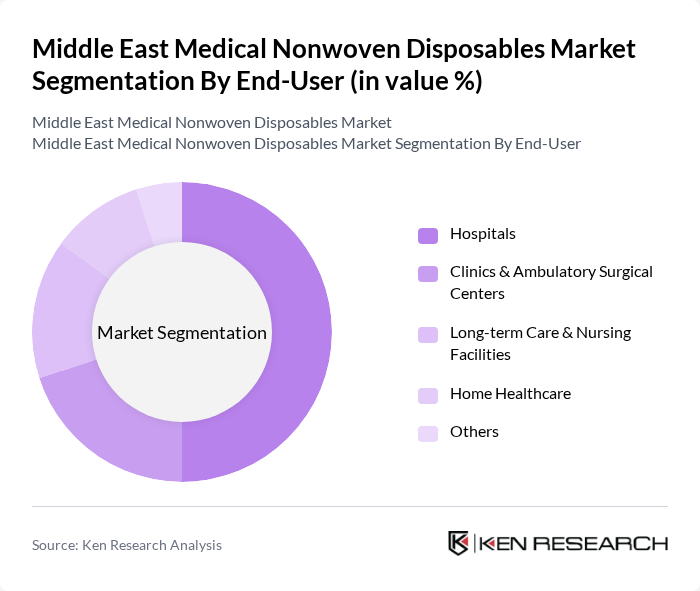
The end-user segmentation includes Hospitals, Clinics & Ambulatory Surgical Centers, Long-term Care & Nursing Facilities, Home Healthcare, and Others. Hospitals are the dominant segment, accounting for the largest share of medical nonwoven disposables consumption globally and in the Middle East, driven by high patient throughput, a large volume of surgical and interventional procedures, and strict infection prevention protocols in operating rooms and intensive care units. Clinics and ambulatory surgical centers are also increasing their usage of disposable gowns, drapes, and masks as more procedures shift to outpatient settings and as accreditation and quality standards emphasize single-use sterile products to minimize cross?contamination risks. The expanding elderly population and higher prevalence of chronic diseases in the region are supporting steady uptake of incontinence products and wound care nonwovens in long?term care, nursing facilities, and home healthcare, further diversifying end?user demand.
Middle East Medical Nonwoven Disposables Market Competitive Landscape
The Middle East Medical Nonwoven Disposables Market is characterized by a dynamic mix of regional and international players. Leading participants such as Medline Industries, LP, Kimberly-Clark Corporation, Mölnlycke Health Care AB, Cardinal Health, Inc., Owens & Minor, Inc. (Halyard Health), PAUL HARTMANN AG, Ahlstrom, Berry Global Group, Inc., DuPont de Nemours, Inc., 3M Company, Smith & Nephew plc, Stryker Corporation, B. Braun Melsungen AG, Convatec Group Plc, Ontex Group NV contribute to innovation, geographic expansion, and service delivery in this space.
Middle East Medical Nonwoven Disposables Market Industry Analysis
Growth Drivers
- Increasing Demand for Hygiene and Infection Control:The Middle East has seen a significant rise in healthcare-associated infections, prompting a surge in demand for medical nonwoven disposables. In future, the region's healthcare expenditure is projected to reach $250 billion, with a substantial portion allocated to infection control measures. This trend is driven by a growing awareness of hygiene standards, particularly in hospitals and clinics, where nonwoven products are essential for maintaining sterile environments.
- Growth in Surgical Procedures:The number of surgical procedures in the Middle East is expected to exceed 12 million in future, driven by an aging population and increased prevalence of chronic diseases. This surge necessitates the use of medical nonwoven disposables, such as surgical gowns and drapes, which are critical for ensuring patient safety and minimizing infection risks. The rising surgical volume directly correlates with the demand for high-quality disposable products in healthcare settings.
- Expansion of Healthcare Infrastructure:The Middle East is experiencing rapid healthcare infrastructure development, with over $60 billion invested in new hospitals and clinics in future. This expansion is particularly evident in countries like Saudi Arabia and the UAE, where government initiatives aim to enhance healthcare access. As new facilities open, the demand for medical nonwoven disposables will increase, as these products are integral to modern healthcare practices and infection control protocols.
Market Challenges
- High Competition Among Manufacturers:The Middle East medical nonwoven disposables market is characterized by intense competition, with over 120 manufacturers vying for market share. This saturation leads to price wars, which can erode profit margins. Companies must differentiate their products through innovation and quality to maintain a competitive edge, as the market becomes increasingly crowded with both local and international players.
- Fluctuating Raw Material Prices:The prices of raw materials used in nonwoven disposables, such as polypropylene and polyester, are subject to volatility due to global supply chain disruptions. In future, the price of polypropylene is projected to fluctuate between $1,300 and $1,700 per ton, impacting production costs for manufacturers. This unpredictability poses a significant challenge, as it complicates pricing strategies and can affect overall profitability in the market.
Middle East Medical Nonwoven Disposables Market Future Outlook
The future of the Middle East medical nonwoven disposables market appears promising, driven by ongoing advancements in technology and a heightened focus on sustainability. As healthcare providers increasingly adopt disposable products to enhance hygiene, the market is likely to witness a shift towards innovative, eco-friendly materials. Additionally, the expansion into emerging markets will provide new growth avenues, as healthcare systems evolve and demand for quality medical disposables rises in these regions.
Market Opportunities
- Technological Advancements in Product Development:Innovations in nonwoven technology, such as the development of antimicrobial fabrics, present significant opportunities for manufacturers. By investing in R&D, companies can create superior products that meet the evolving needs of healthcare providers, enhancing patient safety and satisfaction while capturing a larger market share.
- Increasing Focus on Sustainable Products:As environmental concerns grow, there is a rising demand for sustainable medical disposables. Manufacturers that prioritize eco-friendly materials and production processes can tap into this emerging market segment, appealing to healthcare facilities that aim to reduce their environmental footprint while maintaining high standards of hygiene and safety.
Scope of the Report
| Segment | Sub-Segments |
|---|---|
| By Product Type | Surgical Gowns Surgical Drapes Surgical & Procedure Masks Caps, Shoe Covers & Other Apparel Sterile Nonwoven Wraps Wound Dressings & Bandages Incontinence Hygiene Products Others (Tapes, Pads, Disposable Underpads) |
| By End-User | Hospitals Clinics & Ambulatory Surgical Centers Long-term Care & Nursing Facilities Home Healthcare Others |
| By Distribution Channel | Hospital & Institutional Procurement Retail Pharmacies Online Channels Distributors & Wholesalers Others |
| By Material Type | Polypropylene Polyethylene Rayon Polyamides & Polyesters Acrylic Others |
| By Application | Surgical & Interventional Procedures Wound Management Infection Prevention & Barrier Protection Incontinence Management Others |
| By Country | Saudi Arabia United Arab Emirates Qatar Kuwait Oman Bahrain Rest of Middle East |
Key Target Audience
Investors and Venture Capitalist Firms
Government and Regulatory Bodies (e.g., Ministry of Health, Food and Drug Administration)
Manufacturers and Producers
Distributors and Retailers
Healthcare Providers (e.g., Hospitals, Clinics)
Technology Providers
Industry Associations (e.g., Middle East Healthcare Association)
Financial Institutions
Players Mentioned in the Report:
Medline Industries, LP
Kimberly-Clark Corporation
Molnlycke Health Care AB
Cardinal Health, Inc.
Owens & Minor, Inc. (Halyard Health)
PAUL HARTMANN AG
Ahlstrom
Berry Global Group, Inc.
DuPont de Nemours, Inc.
3M Company
Smith & Nephew plc
Stryker Corporation
B. Braun Melsungen AG
Convatec Group Plc
Ontex Group NV
Table of Contents
Market Assessment Phase
1. Executive Summary and Approach
2. Middle East Medical Nonwoven Disposables Market Overview
2.1 Key Insights and Strategic Recommendations
2.2 Middle East Medical Nonwoven Disposables Market Overview
2.3 Definition and Scope
2.4 Evolution of Market Ecosystem
2.5 Timeline of Key Regulatory Milestones
2.6 Value Chain & Stakeholder Mapping
2.7 Business Cycle Analysis
2.8 Policy & Incentive Landscape
3. Middle East Medical Nonwoven Disposables Market Analysis
3.1 Growth Drivers
3.1.1 Increasing demand for hygiene and infection control
3.1.3 Growth in surgical procedures
3.1.4 Expansion of healthcare infrastructure
3.2 Market Challenges
3.2.1 High competition among manufacturers
3.2.2 Fluctuating raw material prices
3.2.3 Stringent regulatory requirements
3.2.4 Limited awareness in some regions
3.3 Market Opportunities
3.3.1 Technological advancements in product development
3.3.2 Increasing focus on sustainable products
3.3.3 Expansion into emerging markets
3.3.4 Collaborations and partnerships with healthcare providers
3.4 Market Trends
3.4.1 Shift towards disposable products in healthcare
3.4.2 Growing preference for eco-friendly materials
3.4.3 Rise in online sales channels
3.4.4 Increased investment in R&D for innovative solutions
3.5 Government Regulation
3.5.1 Compliance with international safety standards
3.5.2 Regulations on waste management and disposal
3.5.3 Guidelines for product labeling and marketing
3.5.4 Approval processes for new medical products
4. SWOT Analysis
5. Stakeholder Analysis
6. Porter's Five Forces Analysis
7. Middle East Medical Nonwoven Disposables Market Market Size, 2019-2024
7.1 By Value
7.2 By Volume
7.3 By Average Selling Price
8. Middle East Medical Nonwoven Disposables Market Segmentation
8.1 By Product Type
8.1.1 Surgical Gowns
8.1.2 Surgical Drapes
8.1.3 Surgical & Procedure Masks
8.1.4 Caps, Shoe Covers & Other Apparel
8.1.5 Sterile Nonwoven Wraps
8.1.6 Wound Dressings & Bandages
8.1.7 Incontinence Hygiene Products
8.1.8 Others (Tapes, Pads, Disposable Underpads)
8.2 By End-User
8.2.1 Hospitals
8.2.2 Clinics & Ambulatory Surgical Centers
8.2.3 Long-term Care & Nursing Facilities
8.2.4 Home Healthcare
8.2.5 Others
8.3 By Distribution Channel
8.3.1 Hospital & Institutional Procurement
8.3.2 Retail Pharmacies
8.3.3 Online Channels
8.3.4 Distributors & Wholesalers
8.3.5 Others
8.4 By Material Type
8.4.1 Polypropylene
8.4.2 Polyethylene
8.4.3 Rayon
8.4.4 Polyamides & Polyesters
8.4.5 Acrylic
8.4.6 Others
8.5 By Application
8.5.1 Surgical & Interventional Procedures
8.5.2 Wound Management
8.5.3 Infection Prevention & Barrier Protection
8.5.4 Incontinence Management
8.5.5 Others
8.6 By Country
8.6.1 Saudi Arabia
8.6.2 United Arab Emirates
8.6.3 Qatar
8.6.4 Kuwait
8.6.5 Oman
8.6.6 Bahrain
8.6.7 Rest of Middle East
9. Middle East Medical Nonwoven Disposables Market Competitive Analysis
9.1 Market Share of Key Players
9.2 Cross Comparison of Key Players
9.2.1 Company Name
9.2.2 Regional Revenue (USD Million, Latest Year)
9.2.3 3-year CAGR in Middle East Revenue (%)
9.2.4 Middle East Market Share (%)
9.2.5 EBITDA Margin (%) – Regional Operations
9.2.6 Capex Intensity (% of Revenue)
9.2.7 R&D Spend (% of Global Revenue)
9.2.8 Product Mix: Medical Nonwovens (% of Total Revenue)
9.2.9 Average Selling Price Index (vs. Market)
9.2.10 Contract Wins / Key Accounts in Last 12 Months (Number)
9.2.11 Distribution Footprint (Number of Countries / Key Distributors)
9.2.12 ESG / Sustainability Score (Where Reported)
9.3 SWOT Analysis of Top Players
9.4 Pricing Analysis
9.5 Detailed Profile of Major Companies
9.5.1 Medline Industries, LP
9.5.2 Kimberly-Clark Corporation
9.5.3 Mölnlycke Health Care AB
9.5.4 Cardinal Health, Inc.
9.5.5 Owens & Minor, Inc. (Halyard Health)
9.5.6 PAUL HARTMANN AG
9.5.7 Ahlstrom
9.5.8 Berry Global Group, Inc.
9.5.9 DuPont de Nemours, Inc.
9.5.10 3M Company
9.5.11 Smith & Nephew plc
9.5.12 Stryker Corporation
9.5.13 B. Braun Melsungen AG
9.5.14 Convatec Group Plc
9.5.15 Ontex Group NV
10. Middle East Medical Nonwoven Disposables Market End-User Analysis
10.1 Procurement Behavior of Key Ministries
10.1.1 Budget Allocation Trends
10.1.2 Procurement Processes
10.1.3 Supplier Selection Criteria
10.1.4 Contract Management Practices
10.2 Corporate Spend on Infrastructure & Energy
10.2.1 Investment Trends in Healthcare Infrastructure
10.2.2 Spending on Medical Equipment
10.2.3 Budgeting for Disposable Products
10.2.4 Others
10.3 Pain Point Analysis by End-User Category
10.3.1 Challenges Faced by Hospitals
10.3.2 Issues in Clinics
10.3.3 Concerns in Long-term Care Facilities
10.3.4 Others
10.4 User Readiness for Adoption
10.4.1 Awareness Levels
10.4.2 Training Needs
10.4.3 Adoption Barriers
10.4.4 Others
10.5 Post-Deployment ROI and Use Case Expansion
10.5.1 Measurement of ROI
10.5.2 Expansion Opportunities
10.5.3 User Feedback Mechanisms
10.5.4 Others
11. Middle East Medical Nonwoven Disposables Market Future Size, 2025-2030
11.1 By Value
11.2 By Volume
11.3 By Average Selling Price
Go-To-Market Strategy Phase
1. Whitespace Analysis + Business Model Canvas
1.1 Market Gaps Identification
1.2 Business Model Development
2. Marketing and Positioning Recommendations
2.1 Branding Strategies
2.2 Product USPs
3. Distribution Plan
3.1 Urban Retail Strategies
3.2 Rural NGO Tie-ups
4. Channel & Pricing Gaps
4.1 Underserved Routes
4.2 Pricing Bands Analysis
5. Unmet Demand & Latent Needs
5.1 Category Gaps
5.2 Consumer Segments
6. Customer Relationship
6.1 Loyalty Programs
6.2 After-sales Service
7. Value Proposition
7.1 Sustainability Initiatives
7.2 Integrated Supply Chains
8. Key Activities
8.1 Regulatory Compliance
8.2 Branding Efforts
8.3 Distribution Setup
9. Entry Strategy Evaluation
9.1 Domestic Market Entry Strategy
9.1.1 Product Mix Considerations
9.1.2 Pricing Band Strategy
9.1.3 Packaging Solutions
9.2 Export Entry Strategy
9.2.1 Target Countries Identification
9.2.2 Compliance Roadmap Development
10. Entry Mode Assessment
10.1 Joint Ventures
10.2 Greenfield Investments
10.3 Mergers & Acquisitions
10.4 Distributor Model
11. Capital and Timeline Estimation
11.1 Capital Requirements
11.2 Timelines for Implementation
12. Control vs Risk Trade-Off
12.1 Ownership Considerations
12.2 Partnerships Evaluation
13. Profitability Outlook
13.1 Breakeven Analysis
13.2 Long-term Sustainability Strategies
14. Potential Partner List
14.1 Distributors
14.2 Joint Ventures
14.3 Acquisition Targets
15. Execution Roadmap
15.1 Phased Plan for Market Entry
15.1.1 Market Setup
15.1.2 Market Entry
15.1.3 Growth Acceleration
15.1.4 Scale & Stabilize
15.2 Key Activities and Milestones
15.2.1 Milestone Planning
15.2.2 Activity Tracking
Research Methodology
Phase 1: Approach1
Desk Research
- Analysis of industry reports from healthcare associations and market research firms
- Review of government publications and health ministry statistics on medical disposables
- Examination of trade journals and articles focusing on nonwoven fabric technologies
Primary Research
- Interviews with hospital procurement managers and medical supply chain experts
- Surveys conducted with manufacturers of nonwoven medical disposables
- Field interviews with healthcare professionals using disposable products in clinical settings
Validation & Triangulation
- Cross-validation of data from multiple sources including trade associations and market players
- Triangulation of findings from primary interviews with secondary data insights
- Sanity checks through expert panel discussions and feedback sessions
Phase 2: Market Size Estimation1
Top-down Assessment
- Estimation of market size based on healthcare expenditure trends in the Middle East
- Segmentation of market data by product type, including surgical masks, gowns, and drapes
- Incorporation of demographic data and healthcare access statistics to refine estimates
Bottom-up Modeling
- Volume estimates derived from production capacities of leading nonwoven manufacturers
- Cost analysis based on pricing strategies of disposable medical products
- Calculation of market size using unit sales data from hospitals and clinics
Forecasting & Scenario Analysis
- Multi-variable forecasting models incorporating population growth and healthcare trends
- Scenario analysis based on potential regulatory changes and market disruptions
- Development of baseline, optimistic, and pessimistic market growth projections through 2030
Phase 3: CATI Sample Composition1
| Scope Item/Segment | Sample Size | Target Respondent Profiles |
|---|---|---|
| Hospital Procurement Departments | 140 | Procurement Managers, Supply Chain Coordinators |
| Manufacturers of Nonwoven Disposables | 90 | Production Managers, Quality Assurance Officers |
| Healthcare Professionals in Clinical Settings | 110 | Nurses, Surgeons, Medical Technologists |
| Distributors of Medical Supplies | 70 | Sales Managers, Logistics Coordinators |
| Regulatory Bodies and Health Authorities | 40 | Policy Makers, Compliance Officers |
Frequently Asked Questions
What is the current value of the Middle East Medical Nonwoven Disposables Market?
The Middle East Medical Nonwoven Disposables Market is valued at approximately USD 0.8 billion, reflecting a significant demand for hygiene products in healthcare settings, driven by increased surgical procedures and heightened awareness of infection control measures.
Which countries are the major contributors to the Middle East Medical Nonwoven Disposables Market?
What are the primary growth drivers for the Middle East Medical Nonwoven Disposables Market?
What challenges does the Middle East Medical Nonwoven Disposables Market face?
Other Regional/Country Reports
Other Adjacent Reports
Qatar Wound Care Products Market
UAE Incontinence Care Products Market
Germany Surgical Instruments Market
Oman Infection Control Products Market
Middle East Medical Textiles Market Size, Share, Growth Drivers, Trends, Opportunities & Forecast 2025–2030Vietnam Healthcare Packaging Market
Kuwait sterilization equipment market size, share, growth drivers, trends, opportunities & forecast 2025–2030Egypt Disposable Medical Supplies Market
UAE Hospital Supplies MarketWhy Buy From Us?

What makes us stand out is that our consultants follow Robust, Refine and Result (RRR) methodology. Robust for clear definitions, approaches and sanity checking, Refine for differentiating respondents' facts and opinions, and Result for presenting data with story.

We have set a benchmark in the industry by offering our clients with syndicated and customized market research reports featuring coverage of entire market as well as meticulous research and analyst insights.

While we don't replace traditional research, we flip the method upside down. Our dual approach of Top Bottom & Bottom Top ensures quality deliverable by not just verifying company fundamentals but also looking at the sector and macroeconomic factors.

With one step in the future, our research team constantly tries to show you the bigger picture. We help with some of the tough questions you may encounter along the way: How is the industry positioned? Best marketing channel? KPI's of competitors? By aligning every element, we help maximize success.

Our report gives you instant access to the answers and sources that other companies might choose to hide. We elaborate each steps of research methodology we have used and showcase you the sample size to earn your trust.

If you need any support, we are here! We pride ourselves on universe strength, data quality, and quick, friendly, and professional service.