About the Report
Base Year 2024Listen to the audio summary
Japan Medical Nonwoven Disposables Market Overview
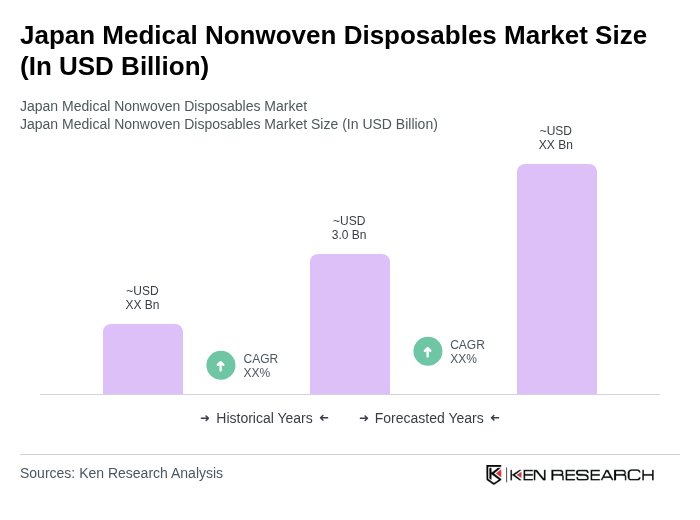
- The Japan Medical Nonwoven Disposables Market is valued at USD 3.0 billion, based on a five-year historical analysis and triangulation against the broader Japan medical disposables revenue base. This growth is primarily driven by the increasing demand for hygiene and safety in healthcare settings, particularly due to the rising prevalence of infectious diseases, a high procedure volume, and the aging population, as Japan is one of the most rapidly aging societies globally. The market is also supported by advancements in nonwoven technology, including polypropylene spunbond and SMS/SMMS composites, which enhance barrier performance, comfort, and safety for products such as gowns, drapes, and masks.
- Key regions dominating the market include Tokyo, Osaka, and Nagoya. These cities are significant due to their advanced healthcare infrastructure, high population density, and concentration of healthcare facilities, which aligns with national data showing a high density of large hospitals and university medical centers in major metropolitan areas. The presence of major hospitals, academic medical centers, and research institutions in these urban areas further drives the demand for medical nonwoven disposables through high surgical volumes and stringent infection-control practices.
- In 2023, the Japanese government implemented regulations mandating rigorous infection prevention practices and the preferred use of single-use medical devices and barrier materials in many clinical settings under the Act on Securing Quality, Efficacy and Safety of Products Including Pharmaceuticals and Medical Devices (PMD Act), administered by the Ministry of Health, Labour and Welfare, and related enforcement ordinances and guidelines. These legal instruments and associated infection-control guidance require healthcare institutions to comply with strict hygiene, sterilization, and device-use standards, which has significantly boosted the demand for medical nonwoven disposables, particularly for items such as surgical gowns, drapes, masks, and incontinence products used in hospitals and long-term care facilities.
Japan Medical Nonwoven Disposables Market Segmentation
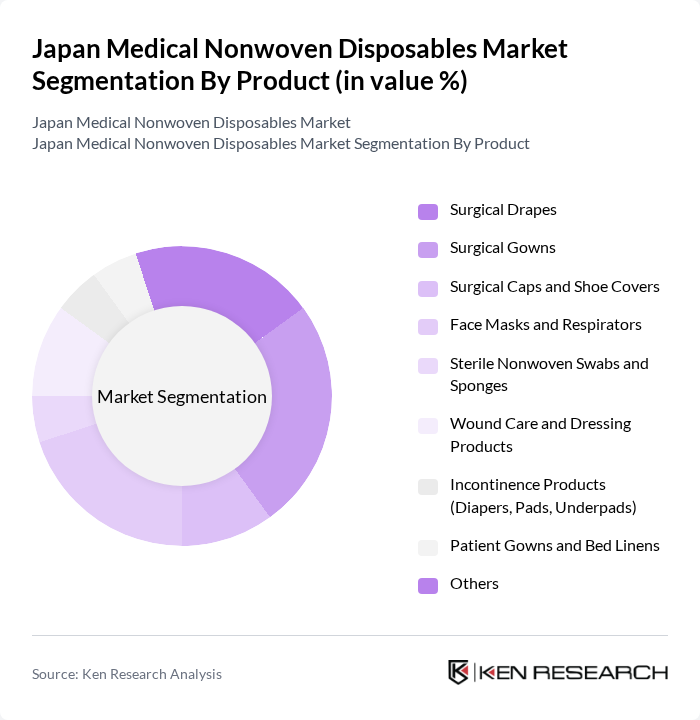
By Product:The product segmentation of the market includes various categories such as surgical drapes, surgical gowns, surgical caps and shoe covers, face masks and respirators, sterile nonwoven swabs and sponges, wound care and dressing products, incontinence products, patient gowns and bed linens, and others. These categories are consistent with leading global and regional taxonomies for medical nonwoven disposables, which group drapes, gowns, packs, swabs, wound dressings, and incontinence products as core subsegments. Among these, surgical gowns and face masks are particularly dominant in acute-care settings due to their essential role in infection control and patient and staff safety during surgical and interventional procedures, and because mask and respirator use has remained structurally higher in Japan following recent respiratory disease outbreaks.
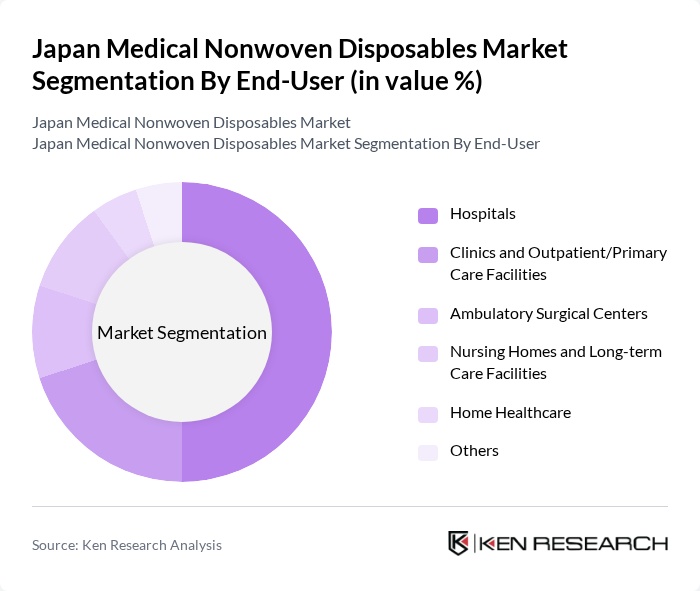
By End-User:The end-user segmentation includes hospitals, clinics and outpatient/primary care facilities, ambulatory surgical centers, nursing homes and long-term care facilities, home healthcare, and others. This structure aligns with standard end-user groupings used in medical disposables and medical nonwoven disposables analyses, where hospitals, home healthcare, outpatient/primary care facilities, and other institutional providers are core segments. Hospitals are the leading end-user segment, driven by the high volume of surgical procedures, intensive infection control requirements, and continuous use of gowns, drapes, masks, and wound dressings, while the increasing number of outpatient and day-surgery procedures contributes materially to demand from clinics and ambulatory surgical centers.
Japan Medical Nonwoven Disposables Market Competitive Landscape
The Japan Medical Nonwoven Disposables Market is characterized by a dynamic mix of regional and international players. Leading participants such as Unicharm Corporation, Asahi Kasei Corporation, Toray Industries, Inc., Kuraray Co., Ltd., Mitsui Chemicals, Inc., Daiwabo Holdings Co., Ltd., Medline Industries, Inc., Cardinal Health, Inc., Mölnlycke Health Care AB, Kimberly-Clark Corporation, Halyard Health, Inc., 3M Company, Smith & Nephew plc, Berry Global, Inc., Paul Hartmann AG contribute to innovation, geographic expansion, and service delivery in this space, particularly in nonwoven fabrics, surgical packs, incontinence products, and single-use protective apparel.
Japan Medical Nonwoven Disposables Market Industry Analysis
Growth Drivers
- Increasing Demand for Hygiene and Infection Control:The Japanese healthcare sector is witnessing a surge in demand for hygiene products, driven by a heightened focus on infection control. In future, Japan's healthcare expenditure is projected to reach ¥55 trillion (approximately $500 billion), reflecting a 5% increase from previous estimates. This growth is largely attributed to the ongoing emphasis on preventing healthcare-associated infections, which has led to a significant rise in the consumption of medical nonwoven disposables, such as surgical masks and gowns.
- Rising Healthcare Expenditure:Japan's healthcare expenditure is expected to grow significantly, reaching ¥55 trillion in future. This increase is driven by factors such as the aging population and advancements in medical technology. The government is investing heavily in healthcare infrastructure, with a focus on improving patient care and safety. As a result, the demand for medical nonwoven disposables is anticipated to rise, as these products are essential for maintaining hygiene and preventing infections in healthcare settings.
- Technological Advancements in Nonwoven Materials:The development of innovative nonwoven materials is propelling the market forward. In future, the introduction of advanced materials, such as antimicrobial and biodegradable nonwovens, is expected to enhance product performance and safety. The Japanese nonwoven fabric market is projected to grow to ¥1 trillion, with a significant portion dedicated to medical applications. These advancements are crucial for meeting the evolving needs of healthcare providers and improving patient outcomes.
Market Challenges
- Stringent Regulatory Requirements:The medical nonwoven disposables market in Japan faces significant challenges due to stringent regulatory requirements. Compliance with regulations set by the Pharmaceuticals and Medical Devices Agency (PMDA) is mandatory, which can lead to increased costs and longer timeframes for product approvals. In future, manufacturers must navigate complex guidelines to ensure product safety and efficacy, which can hinder market entry for new players and slow down innovation.
- High Competition Among Manufacturers:The Japanese market for medical nonwoven disposables is characterized by intense competition, with numerous established players vying for market share. In future, the top five manufacturers are expected to account for over 60% of the market, leading to price wars and reduced profit margins. This competitive landscape poses challenges for smaller companies attempting to enter the market, as they must differentiate their products and demonstrate unique value propositions to succeed.
Japan Medical Nonwoven Disposables Market Future Outlook
The future of the Japan medical nonwoven disposables market appears promising, driven by ongoing advancements in technology and a growing emphasis on sustainability. As healthcare providers increasingly prioritize infection prevention, the demand for innovative and eco-friendly products is expected to rise. Additionally, the integration of smart technologies into medical disposables will enhance functionality and user experience. These trends indicate a dynamic market landscape, with opportunities for growth and development in the coming years.
Market Opportunities
- Development of Eco-Friendly Products:There is a growing opportunity for manufacturers to develop eco-friendly medical nonwoven disposables. With increasing environmental awareness, products made from biodegradable materials are gaining traction. In future, the demand for sustainable options is expected to rise, providing a competitive edge for companies that prioritize environmental responsibility in their product offerings.
- Collaborations with Healthcare Providers:Collaborating with healthcare providers presents a significant opportunity for market players. By partnering with hospitals and clinics, manufacturers can better understand specific needs and tailor their products accordingly. In future, such collaborations are likely to enhance product development and lead to customized solutions that improve patient care and operational efficiency in healthcare settings.
Scope of the Report
| Segment | Sub-Segments |
|---|---|
| By Product | Surgical Drapes Surgical Gowns Surgical Caps and Shoe Covers Face Masks and Respirators Sterile Nonwoven Swabs and Sponges Wound Care and Dressing Products Incontinence Products (Diapers, Pads, Underpads) Patient Gowns and Bed Linens Others |
| By End-User | Hospitals Clinics and Outpatient/Primary Care Facilities Ambulatory Surgical Centers Nursing Homes and Long-term Care Facilities Home Healthcare Others |
| By Distribution Channel | Hospital Pharmacies Retail Pharmacies Online Retail Direct Sales and Tenders Distributors and Wholesalers Others |
| By Material Type | Polypropylene Polyester Rayon Polyethylene Others |
| By Application | Surgical Procedures Wound Care Infection Prevention and Barrier Protection Patient Hygiene and Incontinence Management Others |
| By Region | Kanto Kansai Chubu Hokkaido & Tohoku Chugoku & Shikoku Kyushu & Okinawa |
Key Target Audience
Investors and Venture Capitalist Firms
Government and Regulatory Bodies (e.g., Ministry of Health, Labour and Welfare)
Manufacturers and Producers
Distributors and Retailers
Healthcare Providers and Hospitals
Industry Associations (e.g., Japan Nonwoven Fabrics Association)
Medical Device Companies
Financial Institutions
Players Mentioned in the Report:
Unicharm Corporation
Asahi Kasei Corporation
Toray Industries, Inc.
Kuraray Co., Ltd.
Mitsui Chemicals, Inc.
Daiwabo Holdings Co., Ltd.
Medline Industries, Inc.
Cardinal Health, Inc.
Molnlycke Health Care AB
Kimberly-Clark Corporation
Halyard Health, Inc.
3M Company
Smith & Nephew plc
Berry Global, Inc.
Paul Hartmann AG
Table of Contents
Market Assessment Phase
1. Executive Summary and Approach
2. Japan Medical Nonwoven Disposables Market Overview
2.1 Key Insights and Strategic Recommendations
2.2 Japan Medical Nonwoven Disposables Market Overview
2.3 Definition and Scope
2.4 Evolution of Market Ecosystem
2.5 Timeline of Key Regulatory Milestones
2.6 Value Chain & Stakeholder Mapping
2.7 Business Cycle Analysis
2.8 Policy & Incentive Landscape
3. Japan Medical Nonwoven Disposables Market Analysis
3.1 Growth Drivers
3.1.1 Increasing demand for hygiene and infection control
3.1.2 Rising healthcare expenditure
3.1.3 Technological advancements in nonwoven materials
3.1.4 Growing aging population
3.2 Market Challenges
3.2.1 Stringent regulatory requirements
3.2.2 High competition among manufacturers
3.2.3 Fluctuating raw material prices
3.2.4 Environmental concerns regarding disposables
3.3 Market Opportunities
3.3.1 Expansion into emerging healthcare markets
3.3.2 Development of eco-friendly products
3.3.3 Increasing demand for customized solutions
3.3.4 Collaborations with healthcare providers
3.4 Market Trends
3.4.1 Shift towards sustainable and biodegradable materials
3.4.2 Integration of smart technologies in disposables
3.4.3 Growth of e-commerce in medical supplies
3.4.4 Rising awareness about infection prevention
3.5 Government Regulation
3.5.1 Compliance with ISO standards
3.5.2 Regulations on waste management
3.5.3 Guidelines for product safety and efficacy
3.5.4 Policies promoting healthcare accessibility
4. SWOT Analysis
5. Stakeholder Analysis
6. Porter's Five Forces Analysis
7. Japan Medical Nonwoven Disposables Market Market Size, 2019-2024
7.1 By Value
7.2 By Volume
7.3 By Average Selling Price
8. Japan Medical Nonwoven Disposables Market Segmentation
8.1 By Product
8.1.1 Surgical Drapes
8.1.2 Surgical Gowns
8.1.3 Surgical Caps and Shoe Covers
8.1.4 Face Masks and Respirators
8.1.5 Sterile Nonwoven Swabs and Sponges
8.1.6 Wound Care and Dressing Products
8.1.7 Incontinence Products (Diapers, Pads, Underpads)
8.1.8 Patient Gowns and Bed Linens
8.1.9 Others
8.2 By End-User
8.2.1 Hospitals
8.2.2 Clinics and Outpatient/Primary Care Facilities
8.2.3 Ambulatory Surgical Centers
8.2.4 Nursing Homes and Long-term Care Facilities
8.2.5 Home Healthcare
8.2.6 Others
8.3 By Distribution Channel
8.3.1 Hospital Pharmacies
8.3.2 Retail Pharmacies
8.3.3 Online Retail
8.3.4 Direct Sales and Tenders
8.3.5 Distributors and Wholesalers
8.3.6 Others
8.4 By Material Type
8.4.1 Polypropylene
8.4.2 Polyester
8.4.3 Rayon
8.4.4 Polyethylene
8.4.5 Others
8.5 By Application
8.5.1 Surgical Procedures
8.5.2 Wound Care
8.5.3 Infection Prevention and Barrier Protection
8.5.4 Patient Hygiene and Incontinence Management
8.5.5 Others
8.6 By Region
8.6.1 Kanto
8.6.2 Kansai
8.6.3 Chubu
8.6.4 Hokkaido & Tohoku
8.6.5 Chugoku & Shikoku
8.6.6 Kyushu & Okinawa
9. Japan Medical Nonwoven Disposables Market Competitive Analysis
9.1 Market Share of Key Players
9.2 Cross Comparison of Key Players
9.2.1 Company Name
9.2.2 Revenue (Japan, latest FY)
9.2.3 3-year Revenue CAGR (Japan)
9.2.4 EBITDA Margin (%)
9.2.5 Return on Invested Capital (ROIC)
9.2.6 Market Share in Japan Medical Nonwoven Disposables (%)
9.2.7 Product Portfolio Breadth (No. of SKUs / categories)
9.2.8 R&D Intensity (% of Revenue)
9.2.9 Average Selling Price Positioning (vs. market)
9.2.10 Distribution Coverage (No. of hospitals / facilities served)
9.2.11 Customer Retention / Contract Renewal Rate (%)
9.2.12 Inventory Turnover (x)
9.3 SWOT Analysis of Top Players
9.4 Pricing Analysis
9.5 Detailed Profile of Major Companies
9.5.1 Unicharm Corporation
9.5.2 Asahi Kasei Corporation
9.5.3 Toray Industries, Inc.
9.5.4 Kuraray Co., Ltd.
9.5.5 Mitsui Chemicals, Inc.
9.5.6 Daiwabo Holdings Co., Ltd.
9.5.7 Medline Industries, Inc.
9.5.8 Cardinal Health, Inc.
9.5.9 Mölnlycke Health Care AB
9.5.10 Kimberly-Clark Corporation
9.5.11 Halyard Health, Inc.
9.5.12 3M Company
9.5.13 Smith & Nephew plc
9.5.14 Berry Global, Inc.
9.5.15 Paul Hartmann AG
10. Japan Medical Nonwoven Disposables Market End-User Analysis
10.1 Procurement Behavior of Key Ministries
10.1.1 Budget Allocation Trends
10.1.2 Procurement Processes
10.1.3 Supplier Selection Criteria
10.1.4 Contract Management Practices
10.2 Corporate Spend on Infrastructure & Energy
10.2.1 Investment Trends in Healthcare Infrastructure
10.2.2 Spending on Medical Equipment
10.2.3 Budgeting for Disposable Products
10.2.4 Others
10.3 Pain Point Analysis by End-User Category
10.3.1 Challenges Faced by Hospitals
10.3.2 Issues in Long-term Care Facilities
10.3.3 Concerns of Home Healthcare Providers
10.3.4 Others
10.4 User Readiness for Adoption
10.4.1 Awareness Levels
10.4.2 Training Needs
10.4.3 Adoption Barriers
10.4.4 Others
10.5 Post-Deployment ROI and Use Case Expansion
10.5.1 Measurement of ROI
10.5.2 Case Studies of Successful Implementations
10.5.3 Future Use Case Opportunities
10.5.4 Others
11. Japan Medical Nonwoven Disposables Market Future Size, 2025-2030
11.1 By Value
11.2 By Volume
11.3 By Average Selling Price
Go-To-Market Strategy Phase
1. Whitespace Analysis + Business Model Canvas
1.1 Market Gaps Identification
1.2 Business Model Framework
2. Marketing and Positioning Recommendations
2.1 Branding Strategies
2.2 Product USPs
3. Distribution Plan
3.1 Urban Retail Strategies
3.2 Rural NGO Tie-ups
4. Channel & Pricing Gaps
4.1 Underserved Routes
4.2 Pricing Bands
5. Unmet Demand & Latent Needs
5.1 Category Gaps
5.2 Consumer Segments
6. Customer Relationship
6.1 Loyalty Programs
6.2 After-sales Service
7. Value Proposition
7.1 Sustainability Initiatives
7.2 Integrated Supply Chains
8. Key Activities
8.1 Regulatory Compliance
8.2 Branding Efforts
8.3 Distribution Setup
9. Entry Strategy Evaluation
9.1 Domestic Market Entry Strategy
9.1.1 Product Mix Considerations
9.1.2 Pricing Band Strategy
9.1.3 Packaging Solutions
9.2 Export Entry Strategy
9.2.1 Target Countries
9.2.2 Compliance Roadmap
10. Entry Mode Assessment
10.1 Joint Ventures
10.2 Greenfield Investments
10.3 Mergers & Acquisitions
10.4 Distributor Model
11. Capital and Timeline Estimation
11.1 Capital Requirements
11.2 Timelines for Implementation
12. Control vs Risk Trade-Off
12.1 Ownership Considerations
12.2 Partnerships Evaluation
13. Profitability Outlook
13.1 Breakeven Analysis
13.2 Long-term Sustainability
14. Potential Partner List
14.1 Distributors
14.2 Joint Ventures
14.3 Acquisition Targets
15. Execution Roadmap
15.1 Phased Plan for Market Entry
15.1.1 Market Setup
15.1.2 Market Entry
15.1.3 Growth Acceleration
15.1.4 Scale & Stabilize
15.2 Key Activities and Milestones
15.2.1 Milestone Planning
15.2.2 Activity Tracking
Research Methodology
Phase 1: Approach1
Desk Research
- Analysis of industry reports from Japanese healthcare associations and medical device organizations
- Review of government publications and healthcare expenditure reports from the Ministry of Health, Labour and Welfare
- Examination of market trends and forecasts from academic journals and medical nonwoven disposable studies
Primary Research
- Interviews with hospital procurement managers and supply chain coordinators in the healthcare sector
- Surveys conducted with manufacturers of nonwoven disposables to gather insights on production capacities and innovations
- Field interviews with healthcare professionals to understand usage patterns and preferences for nonwoven products
Validation & Triangulation
- Cross-validation of data through multiple sources including trade publications and industry expert insights
- Triangulation of findings from primary interviews with secondary data to ensure consistency
- Sanity checks through expert panel reviews comprising industry veterans and market analysts
Phase 2: Market Size Estimation1
Top-down Assessment
- Estimation of market size based on national healthcare spending and allocation towards disposable medical products
- Segmentation of the market by product type, including surgical masks, gowns, and drapes
- Incorporation of demographic data and healthcare access trends to refine market estimates
Bottom-up Modeling
- Collection of sales data from leading manufacturers of nonwoven disposables in Japan
- Estimation of market share based on production volumes and distribution channels
- Analysis of pricing strategies and cost structures to derive revenue projections
Forecasting & Scenario Analysis
- Multi-factor regression analysis incorporating variables such as population aging, healthcare reforms, and pandemic impacts
- Scenario modeling based on potential regulatory changes and shifts in consumer behavior towards disposable products
- Development of baseline, optimistic, and pessimistic forecasts through 2030
Phase 3: CATI Sample Composition1
| Scope Item/Segment | Sample Size | Target Respondent Profiles |
|---|---|---|
| Hospital Procurement Departments | 120 | Procurement Managers, Supply Chain Directors |
| Manufacturers of Nonwoven Disposables | 90 | Product Managers, Operations Heads |
| Healthcare Professionals (Doctors/Nurses) | 110 | Surgeons, Infection Control Specialists |
| Distributors of Medical Supplies | 70 | Sales Managers, Logistics Coordinators |
| Regulatory Bodies and Associations | 40 | Policy Makers, Compliance Officers |
Frequently Asked Questions
What is the current value of the Japan Medical Nonwoven Disposables Market?
The Japan Medical Nonwoven Disposables Market is valued at approximately USD 3.0 billion. This valuation is based on a five-year historical analysis and reflects the increasing demand for hygiene and safety in healthcare settings.
What factors are driving the growth of the Japan Medical Nonwoven Disposables Market?
Which regions in Japan dominate the Medical Nonwoven Disposables Market?
What types of products are included in the Japan Medical Nonwoven Disposables Market?
Other Regional/Country Reports
Other Adjacent Reports
Qatar Surgical Apparel Market
Global infection control market Size, Share, Growth Drivers, Trends, Opportunities & Forecast 2025–2030India Wound Care Market Size, Share & Forecast, By Product Type, Wound Type & End User, 2026-2031Oman Incontinence Products Market
Southeast Asia Personal Protective Equipment Market Outlook to 2030: Size, Share, Growth and TrendsBahrain nonwoven fabrics market size, share, growth drivers, trends, opportunities & forecast 2025–2030Singapore Healthcare Textiles Market
Indonesia Sterile Packaging Market
UAE Hospital Supplies MarketWhy Buy From Us?

What makes us stand out is that our consultants follow Robust, Refine and Result (RRR) methodology. Robust for clear definitions, approaches and sanity checking, Refine for differentiating respondents' facts and opinions, and Result for presenting data with story.

We have set a benchmark in the industry by offering our clients with syndicated and customized market research reports featuring coverage of entire market as well as meticulous research and analyst insights.

While we don't replace traditional research, we flip the method upside down. Our dual approach of Top Bottom & Bottom Top ensures quality deliverable by not just verifying company fundamentals but also looking at the sector and macroeconomic factors.

With one step in the future, our research team constantly tries to show you the bigger picture. We help with some of the tough questions you may encounter along the way: How is the industry positioned? Best marketing channel? KPI's of competitors? By aligning every element, we help maximize success.

Our report gives you instant access to the answers and sources that other companies might choose to hide. We elaborate each steps of research methodology we have used and showcase you the sample size to earn your trust.

If you need any support, we are here! We pride ourselves on universe strength, data quality, and quick, friendly, and professional service.