Middle East Mining Waste Management Market Report Size, Share, Growth Drivers, Trends, Opportunities & Forecast 2025–2030

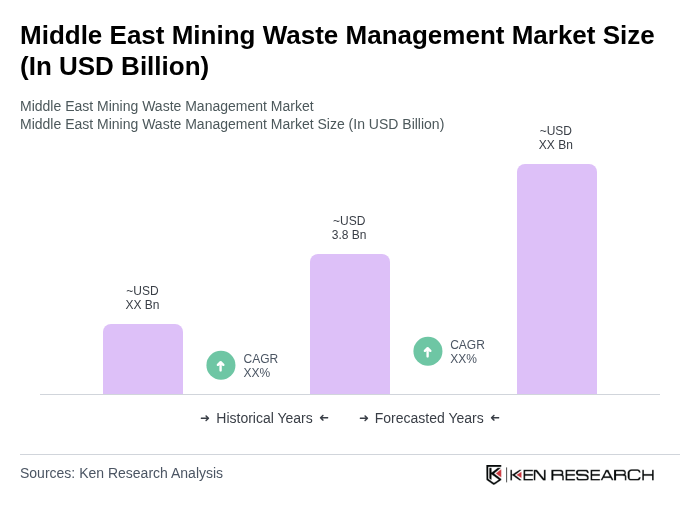
The Middle East mining waste management market, valued at USD 3.8 billion, is driven by increasing mining activities, environmental regulations, and investments in recycling and technology.

Region:Middle East

Author(s):Geetanshi

Product Code:KRAD6021

Pages:95

Published On:December 2025
About the Report

Base Year 2024

Middle East Mining Waste Management Market Overview

  • The Middle East Mining Waste Management Market is valued at USD 3.8 billion, based on a five-year historical analysis and its share within the broader Middle East and Africa mining waste management market. This growth is primarily driven by increasing mining activities in countries such as Saudi Arabia, the United Arab Emirates, Oman, and Qatar, along with stringent environmental regulations governing mine closure, tailings, and waste rock disposal. The rising need for sustainable waste management solutions, coupled with investments in mining infrastructure, tailings storage facilities, water recycling, and monitoring technologies, is enhancing waste management practices and promoting recycling and resource recovery initiatives across the region.
  • Key country-level contributors in this market include Saudi Arabia, the United Arab Emirates, and Oman, with additional mining-related activities in Qatar. Saudi Arabia is expanding its mining sector under the Vision 2030 diversification agenda, including phosphate, gold, copper, and other metals, which significantly increases waste generation and drives demand for specialized waste management solutions. The United Arab Emirates and Oman are focusing on industrial minerals, aggregates, and quarrying, supported by infrastructure and construction growth, while also deploying advanced technologies and environmental management systems to improve waste handling, recycling, and recovery, reinforcing their growing role in the regional mining waste management sector.
  • In 2023, the Saudi Arabian government advanced its comprehensive mining framework under the Mining Investment Law and its Implementing Regulations, issued by the Ministry of Industry and Mineral Resources in 2020, which include detailed provisions on environmental protection and waste management for mining projects. These rules require mining license holders to prepare and implement environmental management and rehabilitation plans, manage tailings and waste rock in accordance with approved designs and monitoring requirements, and set aside financial guarantees to ensure proper closure and post-closure waste management. Together with national sustainability goals under Vision 2030, this framework is driving wider adoption of environmentally responsible waste disposal methods and greater investment in recycling and treatment technologies across the Saudi mining sector.
Middle East Mining Waste Management Market Size

Middle East Mining Waste Management Market Segmentation

By Mining Method:

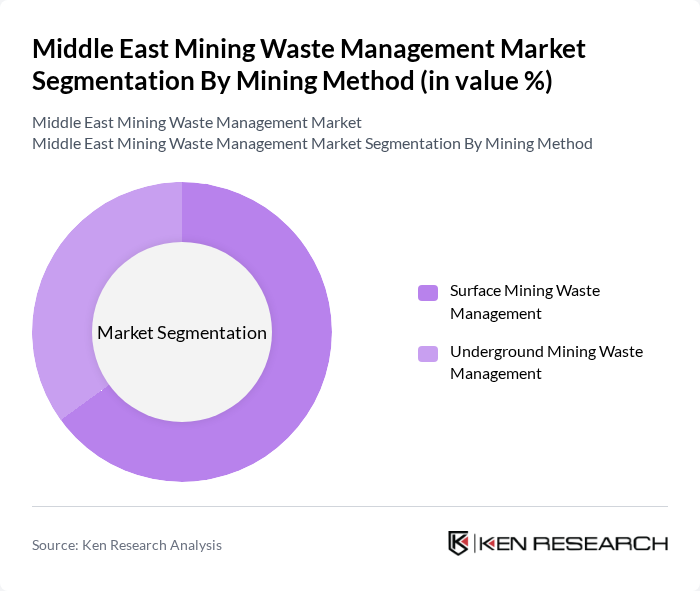
Middle East Mining Waste Management Market segmentation by Mining Method.

The mining method segmentation includes Surface Mining Waste Management and Underground Mining Waste Management. Surface mining, covering open-pit mines, quarries, and large-scale phosphate and industrial mineral operations, is currently the dominant method due to its cost-effectiveness, higher productivity, and suitability for the region’s near-surface ore bodies. This method generates substantial volumes of overburden, waste rock, and tailings, necessitating engineered storage facilities, water management systems, dust control, and progressive rehabilitation. Underground mining, while typically generating less waste per ton of ore, requires specialized waste management techniques such as backfilling, underground paste disposal, and careful ventilation and water treatment due to the complexities involved in subsurface waste handling and environmental protection. The increasing focus on sustainable practices is driving innovations in both segments, including filtered tailings, dry stacking, real-time monitoring, and closure planning, with surface mining leading the way in deployment of large-scale waste management solutions in the Middle East context.

By Mineral / Metal:
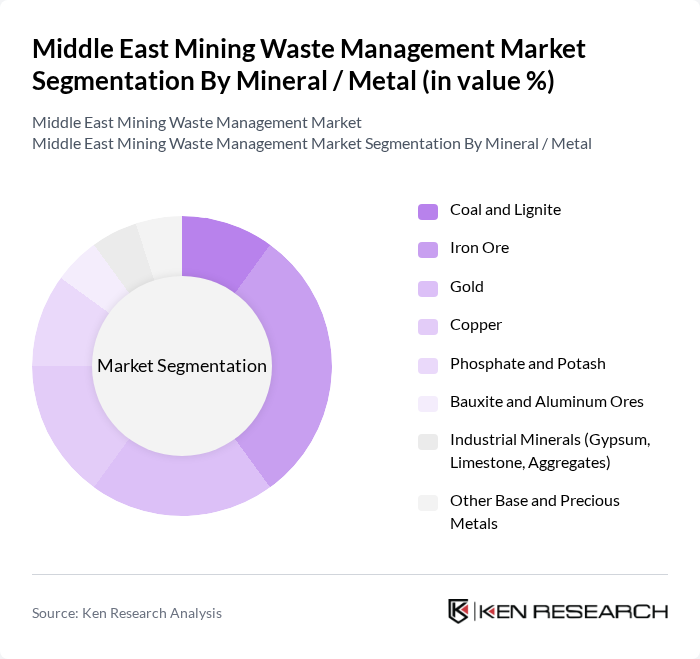
Middle East Mining Waste Management Market segmentation by Mineral / Metal.

This segmentation includes Coal and Lignite, Iron Ore, Gold, Copper, Phosphate and Potash, Bauxite and Aluminum Ores, Industrial Minerals (Gypsum, Limestone, Aggregates), and Other Base and Precious Metals. In the Middle East, phosphate, gold, copper, and industrial minerals represent the most relevant mining segments, with Saudi Arabia and other Gulf countries focusing on phosphates, gold, copper, and large quarrying operations rather than iron ore and coal. Phosphate and associated fertilizers are in high demand for agriculture, while gold and copper are critical for electronics, infrastructure, and energy transition technologies, leading to significant tailings and process waste that must be carefully managed. The increasing extraction of industrial minerals such as gypsum, limestone, and aggregates for construction and infrastructure projects also contributes substantially to overburden and waste rock volumes, requiring robust overburden handling, reclamation, and dust mitigation measures. The focus on recycling, water reuse, and circular economy practices—including reprocessing tailings, using waste rock in construction, and recovering metals from legacy waste—is driving growth across all mineral segments, with phosphate, gold, copper, and industrial minerals playing a particularly important role in the Middle East mining waste management landscape.

Middle East Mining Waste Management Market Competitive Landscape

The Middle East Mining Waste Management Market is characterized by a dynamic mix of regional and international players. Leading participants such as Veolia Environnement SA, SUEZ Group (including SUEZ Recycling and Recovery), Averda, Bee’ah (Sharjah Environmental Company), Tadweer Group (Abu Dhabi Waste Management Company), Dulsco, EnviroServe, Imdaad, Saudi Investment Recycling Company (SIRC), Al Dhafra Waste Management Company, Al Dhow Environmental Services, Gulf Environment & Waste FZE (GEW), Al Haya Enviro, SRK Consulting, and Worley contribute to innovation, geographic expansion, and service delivery in this space, including hazardous and industrial waste streams that are relevant to mining activities in the region.

Veolia Environnement SA

1853

Paris, France

SUEZ Group

1858

Paris, France

Averda

1964

Dubai, UAE

Bee’ah

2007

Sharjah, UAE

Tadweer Group

2008

Abu Dhabi, UAE

Company

Establishment Year

Headquarters

Regional Mining Waste Management Revenue (USD Million)

Share of Revenue from Mining Clients (%)

Number of Active Mining Waste Projects in the Middle East

Installed Tailings Storage Capacity (Million m³)

Managed Overburden / Waste Rock Volume per Year (Million Tons)

EBITDA Margin from Mining Waste Services (%)

Middle East Mining Waste Management Market Industry Analysis

Growth Drivers

  • Increasing Environmental Regulations:The Middle East has seen a rise in environmental regulations, with countries like Saudi Arabia implementing stricter laws to manage mining waste. In future, the region is expected to allocate approximately $1.8 billion towards compliance with these regulations, driven by the need to reduce pollution and protect natural resources. This regulatory push is fostering investment in advanced waste management technologies, which are essential for meeting these new standards and ensuring sustainable mining practices.
  • Rising Demand for Sustainable Practices:The demand for sustainable mining practices is surging, with the Middle East's mining sector projected to invest around $2.5 billion in sustainable waste management solutions in future. This shift is largely influenced by global trends towards sustainability, as companies seek to enhance their corporate social responsibility profiles. The increasing pressure from stakeholders, including investors and consumers, is driving mining firms to adopt eco-friendly waste management practices, thereby boosting market growth.
  • Technological Advancements in Waste Management:Technological innovations are transforming waste management in the mining sector, with investments in smart waste management systems expected to reach $1 billion in future. Technologies such as AI and IoT are being integrated to optimize waste processing and recycling. These advancements not only improve efficiency but also reduce operational costs, making it economically viable for mining companies to adopt modern waste management solutions, thus propelling market growth in the region.

Market Challenges

  • High Initial Investment Costs:One of the significant challenges facing the Middle East mining waste management market is the high initial investment required for advanced waste management systems. Companies may need to invest upwards of $1.2 million to implement state-of-the-art technologies. This financial barrier can deter smaller mining operations from adopting necessary waste management practices, ultimately hindering overall market growth and sustainability efforts in the region.
  • Lack of Awareness and Expertise:The mining sector in the Middle East often suffers from a lack of awareness regarding effective waste management practices. Many companies lack the necessary expertise, with only 35% of mining firms employing trained waste management professionals. This knowledge gap can lead to inefficient waste disposal methods, increasing environmental risks and regulatory non-compliance, which poses a significant challenge to the market's growth and sustainability initiatives.

Middle East Mining Waste Management Market Future Outlook

The future of the Middle East mining waste management market appears promising, driven by increasing environmental awareness and regulatory pressures. As countries in the region continue to prioritize sustainable practices, investments in innovative waste management technologies are expected to rise significantly. The integration of AI and IoT will enhance operational efficiencies, while public and private partnerships will likely foster collaborative efforts to address waste management challenges, paving the way for a more sustainable mining industry in the coming years.

Market Opportunities

  • Expansion of Recycling Initiatives:There is a growing opportunity for recycling initiatives within the mining sector, with an estimated $600 million earmarked for recycling projects in future. This expansion can significantly reduce waste and promote resource recovery, aligning with global sustainability goals and enhancing the sector's environmental footprint.
  • Partnerships with Technology Providers:Collaborations with technology providers present a lucrative opportunity for mining companies, potentially leading to investments of around $400 million in innovative waste management solutions. These partnerships can facilitate the adoption of cutting-edge technologies, improving waste processing efficiency and compliance with environmental regulations, ultimately benefiting the entire industry.

Scope of the Report

SegmentSub-Segments
By Mining Method

Surface Mining Waste Management

Underground Mining Waste Management

By Mineral / Metal

Coal and Lignite

Iron Ore

Gold

Copper

Phosphate and Potash

Bauxite and Aluminum Ores

Industrial Minerals (Gypsum, Limestone, Aggregates)

Other Base and Precious Metals

By Waste Type

Overburden and Waste Rock

Tailings

Mine Water and Process Effluents

Sludges and Filter Cakes

Acid Mine Drainage and Metal?contaminated Waste

By Management / Treatment Solution

Tailings Storage Facilities and Dams

Waste Rock and Overburden Management

Mine Water Treatment and Recycling

Backfilling and Paste Fill

Waste?to?Resource / Recycling and Valorization

Mine Closure, Remediation and Rehabilitation Services

By Service Provider Type

Integrated Environmental Service Companies

Specialized Mining Waste Management Contractors

Engineering, Procurement and Construction (EPC) Firms

Environmental Consulting and Design Firms

In?house Mining Company Operations

By Country

Saudi Arabia

United Arab Emirates

Qatar

Oman

Kuwait

Bahrain

Egypt

Jordan

Rest of Middle East

By Ownership & Project Stage

State?owned Mining Projects

Private / International Mining Operators

Exploration and Early?stage Projects

Operating Mines

Closure and Post?closure Sites

Key Target Audience

Investors and Venture Capitalist Firms

Government and Regulatory Bodies (e.g., Ministry of Energy and Mineral Resources, Environmental Protection Agency)

Mining Companies and Operators

Waste Management Service Providers

Environmental NGOs and Advocacy Groups

Mining Equipment Manufacturers

Local and Regional Authorities

Financial Institutions and Banks

Players Mentioned in the Report:

Veolia Environnement SA

SUEZ Group (including SUEZ Recycling and Recovery)

Averda

Beeah (Sharjah Environmental Company)

Tadweer Group (Abu Dhabi Waste Management Company)

Dulsco

EnviroServe

Imdaad

Saudi Investment Recycling Company (SIRC)

Al Dhafra Waste Management Company

Al Dhow Environmental Services

Gulf Environment & Waste FZE (GEW)

Al Haya Enviro

SRK Consulting

Worley

Table of Contents

Market Assessment Phase

1. Executive Summary and Approach


2. Middle East Mining Waste Management Market Overview

2.1 Key Insights and Strategic Recommendations

2.2 Middle East Mining Waste Management Market Overview

2.3 Definition and Scope

2.4 Evolution of Market Ecosystem

2.5 Timeline of Key Regulatory Milestones

2.6 Value Chain & Stakeholder Mapping

2.7 Business Cycle Analysis

2.8 Policy & Incentive Landscape


3. Middle East Mining Waste Management Market Analysis

3.1 Growth Drivers

3.1.1 Increasing Environmental Regulations
3.1.2 Rising Demand for Sustainable Practices
3.1.3 Technological Advancements in Waste Management
3.1.4 Growth in Mining Activities

3.2 Market Challenges

3.2.1 High Initial Investment Costs
3.2.2 Lack of Awareness and Expertise
3.2.3 Regulatory Compliance Issues
3.2.4 Limited Infrastructure for Waste Management

3.3 Market Opportunities

3.3.1 Expansion of Recycling Initiatives
3.3.2 Partnerships with Technology Providers
3.3.3 Government Incentives for Sustainable Practices
3.3.4 Development of Innovative Waste Treatment Solutions

3.4 Market Trends

3.4.1 Shift Towards Circular Economy
3.4.2 Increased Investment in Green Technologies
3.4.3 Growing Public Awareness of Environmental Issues
3.4.4 Integration of AI and IoT in Waste Management

3.5 Government Regulation

3.5.1 Stricter Emission Standards
3.5.2 Waste Management Licensing Requirements
3.5.3 Incentives for Recycling and Reuse
3.5.4 Regulations on Hazardous Waste Disposal

4. SWOT Analysis


5. Stakeholder Analysis


6. Porter's Five Forces Analysis


7. Middle East Mining Waste Management Market Market Size, 2019-2024

7.1 By Value

7.2 By Volume

7.3 By Average Selling Price


8. Middle East Mining Waste Management Market Segmentation

8.1 By Mining Method

8.1.1 Surface Mining Waste Management
8.1.2 Underground Mining Waste Management

8.2 By Mineral / Metal

8.2.1 Coal and Lignite
8.2.2 Iron Ore
8.2.3 Gold
8.2.4 Copper
8.2.5 Phosphate and Potash
8.2.6 Bauxite and Aluminum Ores
8.2.7 Industrial Minerals (Gypsum, Limestone, Aggregates)
8.2.8 Other Base and Precious Metals

8.3 By Waste Type

8.3.1 Overburden and Waste Rock
8.3.2 Tailings
8.3.3 Mine Water and Process Effluents
8.3.4 Sludges and Filter Cakes
8.3.5 Acid Mine Drainage and Metal?contaminated Waste

8.4 By Management / Treatment Solution

8.4.1 Tailings Storage Facilities and Dams
8.4.2 Waste Rock and Overburden Management
8.4.3 Mine Water Treatment and Recycling
8.4.4 Backfilling and Paste Fill
8.4.5 Waste?to?Resource / Recycling and Valorization
8.4.6 Mine Closure, Remediation and Rehabilitation Services

8.5 By Service Provider Type

8.5.1 Integrated Environmental Service Companies
8.5.2 Specialized Mining Waste Management Contractors
8.5.3 Engineering, Procurement and Construction (EPC) Firms
8.5.4 Environmental Consulting and Design Firms
8.5.5 In?house Mining Company Operations

8.6 By Country

8.6.1 Saudi Arabia
8.6.2 United Arab Emirates
8.6.3 Qatar
8.6.4 Oman
8.6.5 Kuwait
8.6.6 Bahrain
8.6.7 Egypt
8.6.8 Jordan
8.6.9 Rest of Middle East

8.7 By Ownership & Project Stage

8.7.1 State?owned Mining Projects
8.7.2 Private / International Mining Operators
8.7.3 Exploration and Early?stage Projects
8.7.4 Operating Mines
8.7.5 Closure and Post?closure Sites

9. Middle East Mining Waste Management Market Competitive Analysis

9.1 Market Share of Key Players

9.2 Cross Comparison of Key Players

9.2.1 Company Name
9.2.2 Regional Mining Waste Management Revenue (USD Million)
9.2.3 Share of Revenue from Mining Clients (%)
9.2.4 Number of Active Mining Waste Projects in the Middle East
9.2.5 Installed Tailings Storage Capacity (Million m³)
9.2.6 Managed Overburden / Waste Rock Volume per Year (Million Tons)
9.2.7 EBITDA Margin from Mining Waste Services (%)
9.2.8 Average Contract Tenure with Mining Clients (Years)
9.2.9 Geographic Footprint within the Middle East (Number of Countries Served)
9.2.10 HSE Performance (Lost Time Injury Frequency Rate – LTIFR)
9.2.11 Share of Projects with Certified Environmental Management Systems (ISO 14001, etc.)
9.2.12 Share of Mining Waste Recovered / Recycled (% of Total Managed)
9.2.13 R&D / Innovation Spend on Mining Waste Solutions (% of Revenue)

9.3 SWOT Analysis of Top Players

9.4 Pricing Analysis

9.5 Detailed Profile of Major Companies

9.5.1 Veolia Environnement SA
9.5.2 SUEZ Group (including SUEZ Recycling and Recovery)
9.5.3 Averda
9.5.4 Bee’ah (Sharjah Environmental Company)
9.5.5 Tadweer Group (Abu Dhabi Waste Management Company)
9.5.6 Dulsco
9.5.7 EnviroServe
9.5.8 Imdaad
9.5.9 Saudi Investment Recycling Company (SIRC)
9.5.10 Al Dhafra Waste Management Company
9.5.11 Al Dhow Environmental Services
9.5.12 Gulf Environment & Waste FZE (GEW)
9.5.13 Al Haya Enviro
9.5.14 SRK Consulting
9.5.15 Worley

10. Middle East Mining Waste Management Market End-User Analysis

10.1 Procurement Behavior of Key Ministries

10.1.1 Ministry of Environment
10.1.2 Ministry of Mining
10.1.3 Ministry of Industry
10.1.4 Ministry of Finance

10.2 Corporate Spend on Infrastructure & Energy

10.2.1 Investment Trends in Waste Management
10.2.2 Budget Allocations for Environmental Projects
10.2.3 Corporate Social Responsibility Initiatives
10.2.4 Partnerships with Private Sector

10.3 Pain Point Analysis by End-User Category

10.3.1 Mining Companies
10.3.2 Construction Firms
10.3.3 Government Agencies
10.3.4 Environmental Organizations

10.4 User Readiness for Adoption

10.4.1 Awareness of Waste Management Solutions
10.4.2 Training and Capacity Building Needs
10.4.3 Financial Readiness for Investment
10.4.4 Regulatory Compliance Preparedness

10.5 Post-Deployment ROI and Use Case Expansion

10.5.1 Measurement of Environmental Impact
10.5.2 Cost Savings Analysis
10.5.3 Expansion of Services Offered
10.5.4 Long-term Sustainability Goals

11. Middle East Mining Waste Management Market Future Size, 2025-2030

11.1 By Value

11.2 By Volume

11.3 By Average Selling Price


Go-To-Market Strategy Phase

1. Whitespace Analysis + Business Model Canvas

1.1 Market Gaps Identification

1.2 Business Model Development


2. Marketing and Positioning Recommendations

2.1 Branding Strategies

2.2 Product USPs


3. Distribution Plan

3.1 Urban Retail vs Rural NGO Tie-ups


4. Channel & Pricing Gaps

4.1 Underserved Routes

4.2 Pricing Bands


5. Unmet Demand & Latent Needs

5.1 Category Gaps

5.2 Consumer Segments


6. Customer Relationship

6.1 Loyalty Programs

6.2 After-sales Service


7. Value Proposition

7.1 Sustainability

7.2 Integrated Supply Chains


8. Key Activities

8.1 Regulatory Compliance

8.2 Branding

8.3 Distribution Setup


9. Entry Strategy Evaluation

9.1 Domestic Market Entry Strategy

9.1.1 Product Mix
9.1.2 Pricing Band
9.1.3 Packaging

9.2 Export Entry Strategy

9.2.1 Target Countries
9.2.2 Compliance Roadmap

10. Entry Mode Assessment

10.1 JV

10.2 Greenfield

10.3 M&A

10.4 Distributor Model


11. Capital and Timeline Estimation

11.1 Capital Requirements

11.2 Timelines


12. Control vs Risk Trade-Off

12.1 Ownership vs Partnerships


13. Profitability Outlook

13.1 Breakeven Analysis

13.2 Long-term Sustainability


14. Potential Partner List

14.1 Distributors

14.2 JVs

14.3 Acquisition Targets


15. Execution Roadmap

15.1 Phased Plan for Market Entry

15.1.1 Market Setup
15.1.2 Market Entry
15.1.3 Growth Acceleration
15.1.4 Scale & Stabilize

15.2 Key Activities and Milestones

15.2.1 Activity Planning
15.2.2 Milestone Tracking

Research Methodology

ApproachModellingSample

Phase 1: Approach1

Desk Research

  • Analysis of industry reports from regional mining associations and environmental agencies
  • Review of academic publications on mining waste management practices in the Middle East
  • Examination of government regulations and policies related to mining waste disposal and recycling

Primary Research

  • Interviews with environmental compliance officers at major mining companies
  • Surveys with waste management service providers specializing in mining waste
  • Field visits to mining sites to observe waste management practices and technologies

Validation & Triangulation

  • Cross-validation of findings through multiple data sources, including industry reports and expert opinions
  • Triangulation of quantitative data from surveys with qualitative insights from interviews
  • Sanity checks conducted through expert panel reviews to ensure data reliability

Phase 2: Market Size Estimation1

Top-down Assessment

  • Estimation of total mining waste generated in the Middle East based on production data
  • Segmentation of waste types (e.g., tailings, slag) and their respective management costs
  • Incorporation of regional environmental regulations impacting waste management practices

Bottom-up Modeling

  • Collection of operational data from leading mining companies regarding waste volumes and disposal methods
  • Cost analysis of waste management services provided by local firms
  • Volume x cost calculations to derive total market size for mining waste management

Forecasting & Scenario Analysis

  • Multi-factor regression analysis considering factors such as mining output, regulatory changes, and technological advancements
  • Scenario modeling based on potential shifts in environmental policies and market demand for sustainable practices
  • Development of baseline, optimistic, and pessimistic forecasts through 2030

Phase 3: CATI Sample Composition1

Scope Item/SegmentSample SizeTarget Respondent Profiles
Mining Waste Management Practices100Environmental Managers, Compliance Officers
Recycling and Reuse of Mining Waste80Waste Management Specialists, Sustainability Officers
Regulatory Compliance in Mining70Legal Advisors, Regulatory Affairs Managers
Technological Innovations in Waste Management60R&D Managers, Technology Officers
Market Trends and Future Outlook90Industry Analysts, Market Researchers

Frequently Asked Questions

What is the current value of the Middle East Mining Waste Management Market?

The Middle East Mining Waste Management Market is valued at approximately USD 3.8 billion, driven by increasing mining activities and stringent environmental regulations in countries like Saudi Arabia, the UAE, Oman, and Qatar.

What factors are driving growth in the Middle East Mining Waste Management Market?

Which countries are the main contributors to the Middle East Mining Waste Management Market?

What are the main mining methods affecting waste management in the region?

Other Regional/Country Reports

Indonesia Mining Waste Management Market

Malaysia Mining Waste Management Market

KSA Mining Waste Management Market

APAC Mining Waste Management Market

SEA Mining Waste Management Market

Vietnam Mining Waste Management Market

Other Adjacent Reports

Global Mining Equipment Market

Germany Environmental Services Market

Egypt Waste Recycling Market

Thailand Tailings Management Market

South Korea Water Treatment Market

Thailand Industrial Waste Disposal Market

Singapore Sustainable Mining Practices Market

Kuwait Resource Recovery Market

Saudi Arabia geotechnical engineering market report size, share, growth drivers, trends, opportunities & forecast 2025–2030

Mexico Pollution Control Technology Market

Why Buy From Us?

Refine Robust Result (RRR) Framework

What makes us stand out is that our consultants follow Robust, Refine and Result (RRR) methodology. Robust for clear definitions, approaches and sanity checking, Refine for differentiating respondents' facts and opinions, and Result for presenting data with story.

Our Reach Is Unmatched

We have set a benchmark in the industry by offering our clients with syndicated and customized market research reports featuring coverage of entire market as well as meticulous research and analyst insights.

Shifting the Research Paradigm

While we don't replace traditional research, we flip the method upside down. Our dual approach of Top Bottom & Bottom Top ensures quality deliverable by not just verifying company fundamentals but also looking at the sector and macroeconomic factors.

More Insights-Better Decisions

With one step in the future, our research team constantly tries to show you the bigger picture. We help with some of the tough questions you may encounter along the way: How is the industry positioned? Best marketing channel? KPI's of competitors? By aligning every element, we help maximize success.

Transparency and Trust

Our report gives you instant access to the answers and sources that other companies might choose to hide. We elaborate each steps of research methodology we have used and showcase you the sample size to earn your trust.

Round the Clock Support

If you need any support, we are here! We pride ourselves on universe strength, data quality, and quick, friendly, and professional service.

Why Clients Choose Us?

400000+
Reports in repository
150+
Consulting projects a year
100+
Analysts
8000+
Client Queries in 2022