About the Report
Base Year 2024Listen to the audio summary
Middle East Newspaper Market Overview
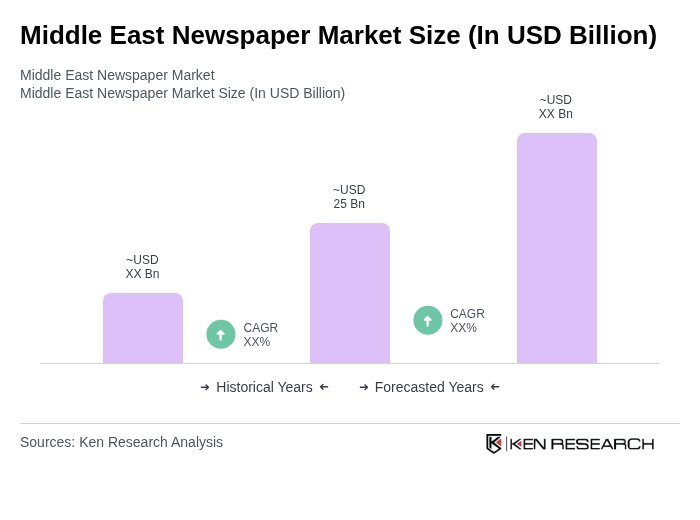
- The Middle East Newspaper Market is valued at USD 25 billion, based on a five-year historical analysis. This growth is primarily driven by the increasing demand for news and information, coupled with the rise of digital platforms that have transformed traditional media consumption. The market has seen a shift towards online news consumption, with print media adapting to the changing landscape by integrating digital strategies.
- Key players in this market include countries like Saudi Arabia, the UAE, and Turkey, which dominate due to their robust media infrastructure, high literacy rates, and significant investments in technology. These nations have established a strong presence in both print and digital formats, catering to diverse audiences and fostering a competitive environment that encourages innovation and quality journalism.
- The Media Regulatory Authority of Saudi Arabia, established under the Saudi Vision 2030 framework, oversees newspaper operations and enforces compliance with media standards including ownership disclosure requirements and editorial guidelines. This regulatory framework promotes ethical journalism and ensures transparency in media operations across the kingdom.
Middle East Newspaper Market Segmentation
By Type:
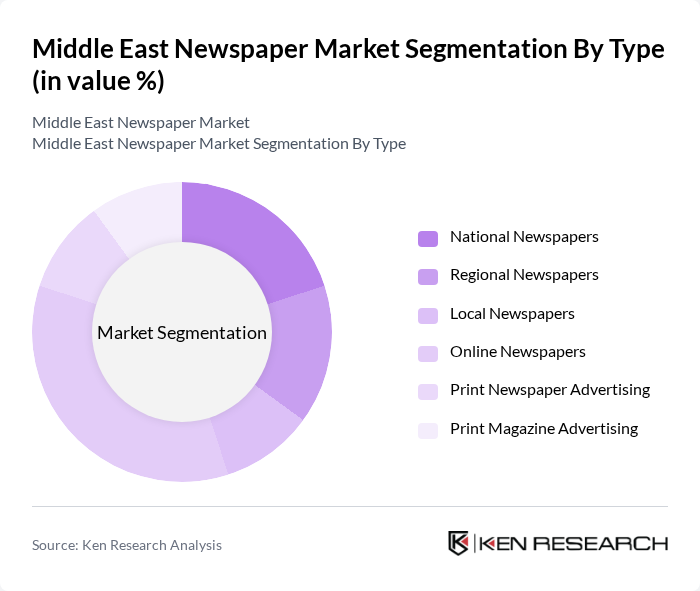
The newspaper market is segmented into various types, including National Newspapers, Regional Newspapers, Local Newspapers, Online Newspapers, Print Newspaper Advertising, and Print Magazine Advertising. Among these, Online Newspapers have emerged as the dominant segment, driven by the increasing penetration of the internet and mobile devices. Consumers are increasingly favoring digital platforms for their convenience and accessibility, leading to a decline in print circulation. This shift has prompted traditional newspapers to enhance their online presence, resulting in a significant transformation in the market landscape.
By Geography:
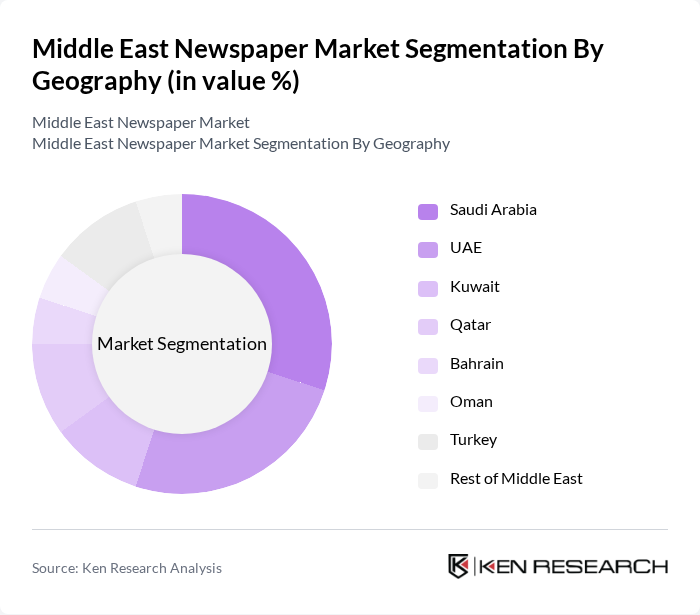
The geographical segmentation of the newspaper market includes Saudi Arabia, UAE, Kuwait, Qatar, Bahrain, Oman, Turkey, and the Rest of the Middle East. Saudi Arabia and the UAE are the leading markets due to their high literacy rates, significant advertising expenditures, and a growing population that consumes news across various platforms. The presence of major media houses and a favorable regulatory environment further bolster their dominance in the market.
Middle East Newspaper Market Competitive Landscape
The Middle East Newspaper Market is characterized by a dynamic mix of regional and international players. Leading participants such as Al-Ahram, Gulf News, The National, Arab News, Khaleej Times, Asharq Al-Awsat, Al-Masry Al-Youm, The Jordan Times, The Times of Oman, The Peninsula, Daily Star, The Arab Weekly contribute to innovation, geographic expansion, and service delivery in this space.
Middle East Newspaper Market Industry Analysis
Growth Drivers
- Increasing Digital Penetration:The Middle East has witnessed a significant rise in internet users, with over 100 million people online in future, representing a 11% increase from previous periods. This digital growth is driving the demand for online news platforms, as consumers increasingly prefer accessing news via mobile devices. The region's internet penetration rate is projected to reach 85% in future, further enhancing the accessibility of digital newspapers and encouraging traditional publishers to adapt their strategies to meet evolving consumer preferences.
- Rising Literacy Rates:The literacy rate in the Middle East has improved significantly, reaching approximately 97% in future, up from 93% in previous periods. This increase in literacy is fostering a more informed population that seeks quality news content. As more individuals become literate, the demand for newspapers—both print and digital—grows, as they seek reliable sources of information. This trend is particularly evident among younger demographics, who are increasingly engaging with news content, thereby expanding the market for newspapers.
- Demand for Localized Content:As cultural diversity in the Middle East continues to flourish, there is a growing demand for localized news content that resonates with specific communities. In future, over 65% of consumers expressed a preference for news that reflects their local context, according to regional surveys. This trend is prompting newspapers to invest in localized reporting and community-focused journalism, which not only enhances reader engagement but also strengthens brand loyalty among diverse audience segments across the region.
Market Challenges
- Competition from Digital Media:The rise of digital media platforms has intensified competition for traditional newspapers in the Middle East. In future, digital news consumption is expected to account for over 75% of total news consumption, leaving print newspapers struggling to maintain their readership. This shift is driven by the convenience and immediacy of online news, which poses a significant challenge for print media to adapt and innovate in order to retain their audience and advertising revenue.
- Declining Print Circulation:Print circulation in the Middle East has been on a downward trajectory, with an estimated decline of 12% in future compared to previous periods. Factors contributing to this decline include changing consumer habits and the increasing preference for digital formats. As more readers turn to online sources for news, traditional newspapers face the challenge of reimagining their business models to remain relevant and financially viable in a rapidly evolving media landscape.
Middle East Newspaper Market Future Outlook
The future of the Middle East newspaper market is poised for transformation as digital integration and innovative content strategies take center stage. With the ongoing shift towards multimedia content and the rise of mobile news consumption, traditional newspapers must adapt to meet the demands of a tech-savvy audience. Additionally, the integration of AI in news reporting is expected to enhance content personalization, while sustainability initiatives will play a crucial role in shaping the industry's future, ensuring that newspapers remain relevant and responsible in their operations.
Market Opportunities
- Expansion of Online Subscription Models:As digital readership grows, newspapers have the opportunity to develop robust online subscription models. In future, it is estimated that subscription revenues could increase by 25%, driven by consumers' willingness to pay for quality journalism. This shift presents a viable revenue stream for newspapers, allowing them to invest in quality content and technology enhancements.
- Growth in Niche Publications:The demand for niche publications is on the rise, with specialized content catering to specific interests and communities. In future, niche publications are projected to capture a market share of 20%, reflecting a growing trend among readers seeking tailored news experiences. This presents an opportunity for newspapers to diversify their offerings and engage targeted audiences effectively.
Scope of the Report
| Segment | Sub-Segments |
|---|---|
| By Type | National Newspapers Regional Newspapers Local Newspapers Online Newspapers Print Newspaper Advertising Print Magazine Advertising |
| By Geography | Saudi Arabia UAE Kuwait Qatar Bahrain Oman Turkey Rest of Middle East |
| By Distribution Channel | Direct Sales Retail Outlets Online Subscriptions Newsstands Others |
| By Language | Arabic English French Others |
| By Format | Digital Hybrid |
Key Target Audience
Investors and Venture Capitalist Firms
Government and Regulatory Bodies (e.g., Ministry of Culture and Knowledge Development, National Media Council)
Media Conglomerates
Advertising Agencies
Print and Digital Distribution Companies
Content Creators and Journalists
Public Relations Firms
Telecommunications Companies
Players Mentioned in the Report:
Al-Ahram
Gulf News
The National
Arab News
Khaleej Times
Asharq Al-Awsat
Al-Masry Al-Youm
The Jordan Times
The Times of Oman
The Peninsula
Daily Star
The Arab Weekly
Table of Contents
Market Assessment Phase
1. Executive Summary and Approach
2. Middle East Newspaper Market Overview
2.1 Key Insights and Strategic Recommendations
2.2 Middle East Newspaper Market Overview
2.3 Definition and Scope
2.4 Evolution of Market Ecosystem
2.5 Timeline of Key Regulatory Milestones
2.6 Value Chain & Stakeholder Mapping
2.7 Business Cycle Analysis
2.8 Policy & Incentive Landscape
3. Middle East Newspaper Market Analysis
3.1 Growth Drivers
3.1.1 Increasing digital penetration
3.1.2 Rising literacy rates
3.1.3 Demand for localized content
3.1.4 Government support for media initiatives
3.2 Market Challenges
3.2.1 Competition from digital media
3.2.2 Declining print circulation
3.2.3 Regulatory constraints
3.2.4 Economic fluctuations affecting advertising revenue
3.3 Market Opportunities
3.3.1 Expansion of online subscription models
3.3.2 Growth in niche publications
3.3.3 Partnerships with tech companies
3.3.4 Increased focus on investigative journalism
3.4 Market Trends
3.4.1 Shift towards multimedia content
3.4.2 Rise of mobile news consumption
3.4.3 Integration of AI in news reporting
3.4.4 Emphasis on sustainability in publishing
3.5 Government Regulation
3.5.1 Media ownership laws
3.5.2 Content censorship regulations
3.5.3 Advertising standards
3.5.4 Tax incentives for local publications
4. SWOT Analysis
5. Stakeholder Analysis
6. Porter's Five Forces Analysis
7. Middle East Newspaper Market Market Size, 2019-2024
7.1 By Value
7.2 By Volume
7.3 By Average Selling Price
8. Middle East Newspaper Market Segmentation
8.1 By Type
8.1.1 National Newspapers
8.1.2 Regional Newspapers
8.1.3 Local Newspapers
8.1.4 Online Newspapers
8.1.5 Print Newspaper Advertising
8.1.6 Print Magazine Advertising
8.2 By Geography
8.2.1 Saudi Arabia
8.2.2 UAE
8.2.3 Kuwait
8.2.4 Qatar
8.2.5 Bahrain
8.2.6 Oman
8.2.7 Turkey
8.2.8 Rest of Middle East
8.3 By Distribution Channel
8.3.1 Direct Sales
8.3.2 Retail Outlets
8.3.3 Online Subscriptions
8.3.4 Newsstands
8.3.5 Others
8.4 By Language
8.4.1 Arabic
8.4.2 English
8.4.3 French
8.4.4 Others
8.5 By Format
8.5.1 Print
8.5.2 Digital
8.5.3 Hybrid
9. Middle East Newspaper Market Competitive Analysis
9.1 Market Share of Key Players
9.2 Cross Comparison of Key Players
9.2.1 Company Name
9.2.2 Company Size Classification (Large, Medium, or Small)
9.2.3 Print Circulation Numbers
9.2.4 Digital Audience Reach and Monthly Active Users
9.2.5 Advertising Revenue Contribution
9.2.6 Subscription Growth Rate (Year-over-Year)
9.2.7 Content Localization Index
9.2.8 Pricing Strategy (Premium, Mid-Market, Budget)
9.2.9 Primary Reader Demographics (Age, Income, Education)
9.2.10 Market Penetration Rate by Country
9.3 SWOT Analysis of Top Players
9.4 Pricing Analysis
9.5 Detailed Profile of Major Companies
9.5.1 Al-Ahram
9.5.2 Gulf News
9.5.3 The National
9.5.4 Arab News
9.5.5 Khaleej Times
9.5.6 Asharq Al-Awsat
9.5.7 Al-Masry Al-Youm
9.5.8 The Jordan Times
9.5.9 The Times of Oman
9.5.10 The Peninsula
9.5.11 Daily Star
9.5.12 The Arab Weekly
10. Middle East Newspaper Market End-User Analysis
10.1 Procurement Behavior of Key Ministries
10.1.1 Ministry of Information
10.1.2 Ministry of Culture
10.1.3 Ministry of Education
10.1.4 Ministry of Finance
10.2 Corporate Spend on Infrastructure & Energy
10.2.1 Media Infrastructure Investments
10.2.2 Advertising Expenditure
10.2.3 Digital Transformation Budgets
10.2.4 Content Development Costs
10.3 Pain Point Analysis by End-User Category
10.3.1 Content Accessibility
10.3.2 Pricing Sensitivity
10.3.3 Quality of Reporting
10.3.4 Timeliness of News Delivery
10.4 User Readiness for Adoption
10.4.1 Digital Literacy Levels
10.4.2 Access to Technology
10.4.3 Willingness to Pay for Quality Content
10.4.4 Engagement with Social Media
10.5 Post-Deployment ROI and Use Case Expansion
10.5.1 Subscription Retention Rates
10.5.2 Revenue from Advertisements
10.5.3 User Engagement Metrics
10.5.4 Expansion into New Markets
11. Middle East Newspaper Market Future Size, 2025-2031
11.1 By Value
11.2 By Volume
11.3 By Average Selling Price
Go-To-Market Strategy Phase
1. Whitespace Analysis + Business Model Canvas
1.1 Market Gaps Identification
1.2 Value Proposition Development
1.3 Revenue Streams Analysis
1.4 Cost Structure Evaluation
1.5 Key Partnerships Exploration
1.6 Customer Segments Definition
1.7 Channels Strategy
2. Marketing and Positioning Recommendations
2.1 Branding Strategies
2.2 Product USPs
2.3 Target Audience Identification
2.4 Communication Strategy
2.5 Digital Marketing Tactics
2.6 Offline Marketing Approaches
2.7 Performance Metrics
3. Distribution Plan
3.1 Urban Retail Strategies
3.2 Rural NGO Tie-ups
3.3 Online Distribution Channels
3.4 Partnerships with Local Vendors
3.5 Logistics and Supply Chain Management
3.6 Customer Service Framework
3.7 Performance Tracking
4. Channel & Pricing Gaps
4.1 Underserved Routes
4.2 Pricing Bands Analysis
4.3 Competitor Pricing Comparison
4.4 Customer Willingness to Pay
4.5 Value-Based Pricing Strategies
4.6 Discount and Promotion Strategies
4.7 Pricing Model Evaluation
5. Unmet Demand & Latent Needs
5.1 Category Gaps Identification
5.2 Consumer Segments Analysis
5.3 Emerging Trends Exploration
5.4 Feedback Mechanisms
5.5 Product Development Opportunities
5.6 Market Research Insights
5.7 Future Demand Projections
6. Customer Relationship
6.1 Loyalty Programs
6.2 After-sales Service
6.3 Customer Feedback Systems
6.4 Community Engagement Initiatives
6.5 Customer Retention Strategies
6.6 Personalization Tactics
6.7 Performance Metrics
7. Value Proposition
7.1 Sustainability Initiatives
7.2 Integrated Supply Chains
7.3 Unique Selling Points
7.4 Customer-Centric Approach
7.5 Competitive Advantage Analysis
7.6 Market Differentiation Strategies
7.7 Performance Metrics
8. Key Activities
8.1 Regulatory Compliance
8.2 Branding Initiatives
8.3 Distribution Setup
8.4 Content Development
8.5 Marketing Campaigns
8.6 Performance Monitoring
8.7 Continuous Improvement Processes
9. Entry Strategy Evaluation
9.1 Domestic Market Entry Strategy
9.1.1 Product Mix
9.1.2 Pricing Band
9.1.3 Packaging
9.2 Export Entry Strategy
9.2.1 Target Countries
9.2.2 Compliance Roadmap
10. Entry Mode Assessment
10.1 JV
10.2 Greenfield
10.3 M&A
10.4 Distributor Model
11. Capital and Timeline Estimation
11.1 Capital Requirements
11.2 Timelines
12. Control vs Risk Trade-Off
12.1 Ownership vs Partnerships
13. Profitability Outlook
13.1
Research Methodology
Phase 1: Approach1
Desk Research
- Analysis of industry reports from regional media associations and market research firms
- Review of circulation data and readership statistics from major Middle Eastern newspapers
- Examination of advertising revenue trends and digital transformation reports in the newspaper sector
Primary Research
- Interviews with editors and publishers of leading newspapers in the Middle East
- Surveys targeting advertising agencies to understand their media buying preferences
- Focus groups with readers to gauge content preferences and consumption habits
Validation & Triangulation
- Cross-validation of findings with data from media regulatory bodies and industry associations
- Triangulation of insights from primary interviews with secondary data trends
- Sanity checks through expert panels comprising media analysts and academic researchers
Phase 2: Market Size Estimation1
Top-down Assessment
- Estimation of total advertising spend in the Middle East media landscape
- Segmentation of the newspaper market by print and digital formats
- Incorporation of demographic trends and urbanization rates affecting readership
Bottom-up Modeling
- Analysis of subscription and single-copy sales data from major newspapers
- Estimation of average revenue per user (ARPU) across different readership segments
- Calculation of operational costs and profit margins for leading newspaper firms
Forecasting & Scenario Analysis
- Multi-factor regression analysis incorporating digital adoption rates and economic indicators
- Scenario modeling based on potential shifts in consumer behavior and advertising spend
- Baseline, optimistic, and pessimistic forecasts for the newspaper market through 2030
Phase 3: CATI Sample Composition1
| Scope Item/Segment | Sample Size | Target Respondent Profiles |
|---|---|---|
| Print Newspaper Readership | 120 | Regular Readers, Occasional Readers |
| Digital Newspaper Subscribers | 85 | Online Subscribers, Mobile App Users |
| Advertising Agency Insights | 65 | Media Buyers, Account Managers |
| Content Preference Surveys | 95 | General Public, Niche Interest Groups |
| Industry Expert Interviews | 40 | Media Analysts, Academic Researchers |
Frequently Asked Questions
What is the current value of the Middle East Newspaper Market?
The Middle East Newspaper Market is valued at approximately USD 25 billion, reflecting a significant growth driven by the increasing demand for news and the rise of digital platforms that have transformed traditional media consumption.
Which countries dominate the Middle East Newspaper Market?
What regulatory body oversees newspaper operations in Saudi Arabia?
How has digital penetration affected the newspaper market in the Middle East?
Other Regional/Country Reports
Indonesia Newspaper Market Size, Share, Growth Drivers, Trends, Opportunities & Forecast 2025–2030
Malaysia Newspaper Market Size, Share, Growth Drivers, Trends, Opportunities & Forecast 2025–2030
APAC Newspaper Market Size, Share, Growth Drivers, Trends, Opportunities & Forecast 2025–2030
SEA Newspaper Market Size, Share, Growth Drivers, Trends, Opportunities & Forecast 2025–2030
Vietnam Newspaper Market Size, Share, Growth Drivers, Trends, Opportunities & Forecast 2025–2030
Other Adjacent Reports
Oman Broadcast Media Market
Singapore Publishing Software Market
UAE Content Distribution Market
Mexico Journalism Training Market
South Africa Printing Equipment Market
Mexico News Analytics Market
Germany Social Media Marketing Market
Germany Magazine Publishing Market
Why Buy From Us?

What makes us stand out is that our consultants follow Robust, Refine and Result (RRR) methodology. Robust for clear definitions, approaches and sanity checking, Refine for differentiating respondents' facts and opinions, and Result for presenting data with story.

We have set a benchmark in the industry by offering our clients with syndicated and customized market research reports featuring coverage of entire market as well as meticulous research and analyst insights.

While we don't replace traditional research, we flip the method upside down. Our dual approach of Top Bottom & Bottom Top ensures quality deliverable by not just verifying company fundamentals but also looking at the sector and macroeconomic factors.

With one step in the future, our research team constantly tries to show you the bigger picture. We help with some of the tough questions you may encounter along the way: How is the industry positioned? Best marketing channel? KPI's of competitors? By aligning every element, we help maximize success.

Our report gives you instant access to the answers and sources that other companies might choose to hide. We elaborate each steps of research methodology we have used and showcase you the sample size to earn your trust.

If you need any support, we are here! We pride ourselves on universe strength, data quality, and quick, friendly, and professional service.