Middle East northern lights tourism market report size, share, growth drivers, trends, opportunities & forecast 2025–2030

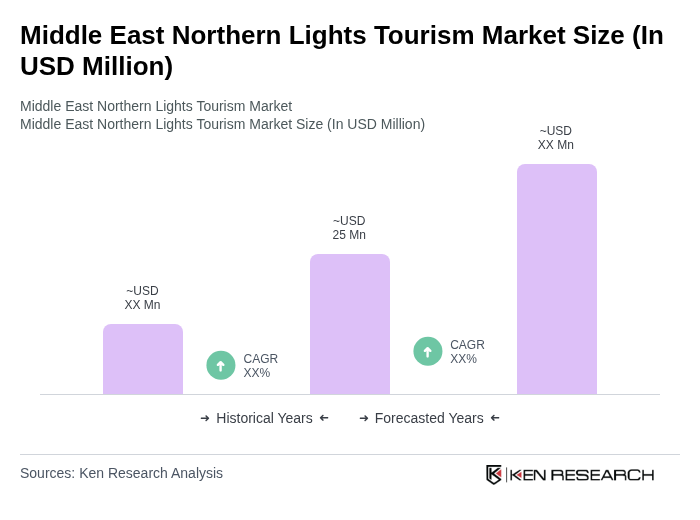
The Middle East Northern Lights Tourism Market, valued at USD 25 million, is growing due to rising demand for experiential travel, sustainable practices, and enhanced accessibility.

Region:Middle East

Author(s):Dev

Product Code:KRAA8289

Pages:82

Published On:November 2025
About the Report

Base Year 2024

Middle East Northern Lights Tourism Market Overview

  • The Middle East Northern Lights Tourism Market is valued at USD 25 million, based on a five-year historical analysis. This growth is primarily driven by increasing interest in unique travel experiences, particularly among adventure seekers and luxury travelers. The rise in disposable income, especially among affluent millennials and Gen X travelers, and the growing trend of experiential travel have further fueled demand for Northern Lights tourism in the region. Enhanced accessibility through improved infrastructure and digital aurora forecasting tools are also contributing to market expansion.
  • Countries such asIceland and Norwaydominate the Northern Lights tourism market due to their geographical advantages and established tourism infrastructure. These destinations offer optimal viewing conditions and a range of activities that enhance the overall experience, making them highly attractive to tourists seeking to witness the aurora borealis. The Nordic region, including Finland and Sweden, also benefits from strong marketing and seamless travel connections, further reinforcing its leadership in this sector.
  • The UAE government issued theUAE Sustainable Tourism Guidelines, 2023under the Ministry of Economy, establishing operational requirements for tour operators to minimize environmental impact and enhance visitor experiences. These guidelines mandate sustainability certifications, eco-friendly practices, and regular compliance audits for all licensed tourism operators, ensuring that sector growth aligns with ecological preservation and responsible tourism principles.
Middle East Northern Lights Tourism Market Size

Middle East Northern Lights Tourism Market Segmentation

By Type:The market is segmented into various types of tours that cater to different preferences and budgets. The subsegments includeAdventure Tours, Luxury Packages, Group Tours, Customized Tours, Family Tours, and Solo Traveler Packages. Each of these segments attracts distinct consumer demographics, with Adventure Tours being particularly popular among younger travelers seeking unique experiences, while Luxury Packages appeal to affluent tourists looking for exclusive offerings. The rise of digital booking platforms and personalized itineraries has further diversified these offerings, with customized and solo packages gaining traction among independent travelers.
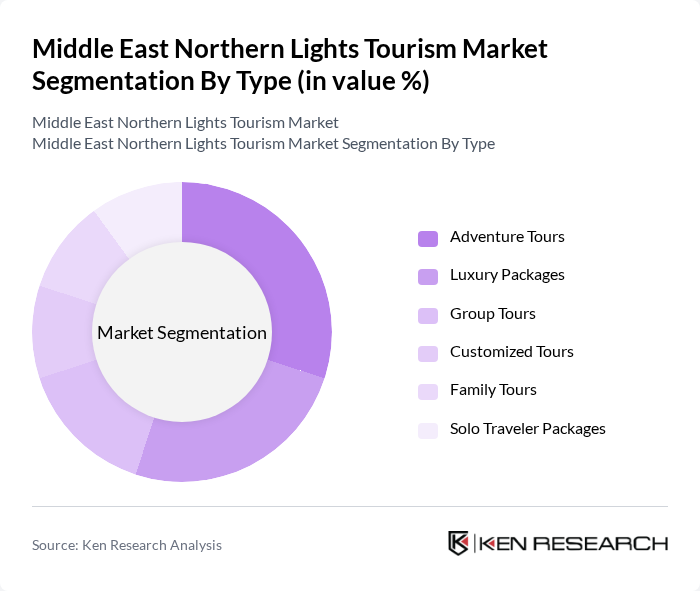
Middle East Northern Lights Tourism Market segmentation by Type.

By End-User:The end-user segmentation includesCouples, Solo Travelers, Families, and Friends/Groups. Couples represent a significant portion of the market, often seeking romantic getaways and unique experiences. Families are also a growing segment, as they look for inclusive packages that cater to all ages, while solo travelers are increasingly drawn to adventure and exploration. Notably, couples are the leading demographic in the Northern Lights tourism market, accounting for nearly half of all bookings, reflecting the appeal of aurora experiences as a romantic and memorable travel option.
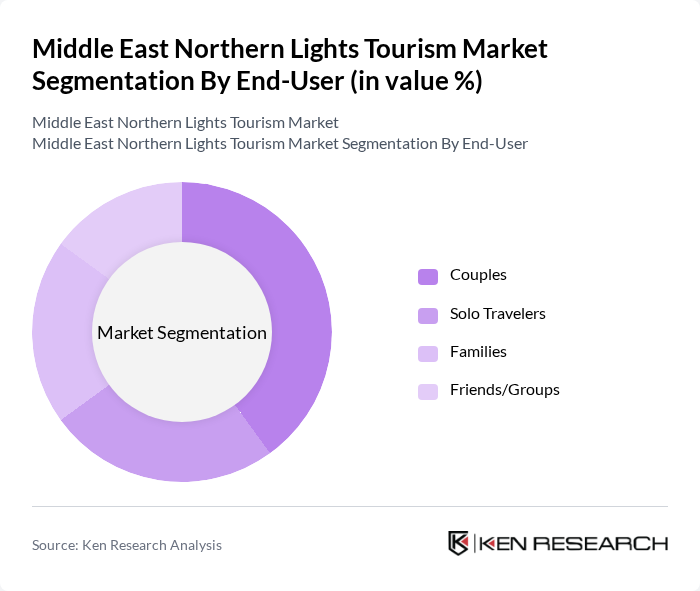
Middle East Northern Lights Tourism Market segmentation by End-User.

Middle East Northern Lights Tourism Market Competitive Landscape

The Middle East Northern Lights Tourism Market is characterized by a dynamic mix of regional and international players. Leading participants such as Emirates Holidays, Dnata Travel, Al Tayer Travel Agency, Arabian Adventures, Holiday Factory, Musafir.com, Cleartrip, MakeMyTrip, Booking.com, Expedia, TripAdvisor, Viator, GetYourGuide, Al Rostamani Travels, and Cox & Kings contribute to innovation, geographic expansion, and service delivery in this space.

Emirates Holidays

1987

Dubai, UAE

Dnata Travel

1959

Dubai, UAE

Al Tayer Travel Agency

1979

Dubai, UAE

Arabian Adventures

1992

Dubai, UAE

Holiday Factory

2011

Dubai, UAE

Company

Establishment Year

Headquarters

Group Size (Large, Medium, or Small as per industry convention)

Number of Northern Lights Packages Sold (Annual)

Customer Satisfaction Rate (NPS or equivalent)

Revenue from Northern Lights Tourism (USD, annual)

Market Penetration Rate (Share of Middle East outbound aurora tourists)

Average Booking Value (USD)

Middle East Northern Lights Tourism Market Industry Analysis

Growth Drivers

  • Increasing Awareness of Northern Lights Experiences:The Middle East is witnessing a surge in interest regarding Northern Lights tourism, with over 60% of potential travelers expressing a desire to experience this phenomenon. This interest is fueled by social media platforms, where travel influencers showcase their adventures. According to the World Travel Organization, the number of travelers seeking unique experiences has increased by 30% in the last year, indicating a growing market for Northern Lights tourism in the region.
  • Growth in Eco-Tourism and Sustainable Travel:Eco-tourism is projected to reach USD 1.2 trillion globally in future, with the Middle East aiming to capture a share of this market. The region's commitment to sustainable travel is evident, as 75% of tourists prioritize eco-friendly options. This trend aligns with the global shift towards responsible tourism, where travelers seek experiences that minimize environmental impact, thus enhancing the appeal of Northern Lights tours that emphasize sustainability and conservation.
  • Enhanced Travel Infrastructure in the Region:The Middle East has invested approximately USD 60 billion in improving travel infrastructure, including airports and transportation networks. This investment is expected to increase tourist arrivals by 20% annually. Enhanced connectivity facilitates easier access to Northern Lights viewing locations, making it more attractive for international tourists. Improved infrastructure not only supports tourism growth but also enhances the overall travel experience, encouraging longer stays and higher spending.

Market Challenges

  • Limited Awareness of the Northern Lights in the Middle East:Despite the growing interest in unique travel experiences, awareness of the Northern Lights remains low in the Middle East. A survey indicated that only 35% of potential tourists are familiar with the phenomenon. This lack of awareness poses a significant barrier to market growth, as effective marketing strategies are needed to educate potential travelers about the Northern Lights and their accessibility from the region.
  • Seasonal Fluctuations in Tourism:The Northern Lights are primarily visible during winter months, leading to significant seasonal fluctuations in tourism. Data from the Middle East Tourism Authority shows that winter months see a 45% increase in tourist arrivals, while summer months experience a 25% decline. This seasonality can create challenges for businesses reliant on consistent tourist traffic, necessitating strategies to attract visitors year-round through diverse offerings and events.

Middle East Northern Lights Tourism Market Future Outlook

The future of Northern Lights tourism in the Middle East appears promising, driven by increasing global interest in unique travel experiences and sustainable tourism. As infrastructure continues to improve, the region is likely to attract a more diverse range of international tourists. Additionally, the integration of technology in travel planning and marketing will enhance customer engagement, making it easier for potential travelers to discover and book Northern Lights experiences, thus fostering market growth.

Market Opportunities

  • Development of Specialized Tour Packages:There is a significant opportunity to create specialized tour packages that cater to niche markets, such as photography enthusiasts and adventure seekers. By offering tailored experiences, businesses can attract a broader audience, potentially increasing bookings by 25% during peak seasons. This approach not only enhances customer satisfaction but also promotes repeat visits and positive word-of-mouth.
  • Collaboration with Local Businesses for Unique Experiences:Partnering with local businesses can create unique, immersive experiences that enhance the appeal of Northern Lights tourism. Collaborations can include local cuisine, cultural events, and guided tours, which can increase tourist engagement. Such partnerships can lead to a 20% increase in customer satisfaction, fostering loyalty and encouraging tourists to explore more of the region beyond the Northern Lights.

Scope of the Report

SegmentSub-Segments
By Type

Adventure Tours

Luxury Packages

Group Tours

Customized Tours

Family Tours

Solo Traveler Packages

By End-User

Couples

Solo Travelers

Families

Friends/Groups

By Age Group

34 Years

49 Years

64 Years

+ Years

By Seasonality

Winter Season

Autumn Season

Off-Peak Season

By Duration of Stay

Short Trips (1-3 days)

Medium Trips (4-7 days)

Long Trips (8+ days)

By Travel Arrangement

Package Tours

Independent Travel

Group Travel

By Booking Channel

Online Travel Agencies

Direct Bookings

Travel Agents

By Source Country

GCC Countries

Turkey

Israel

North Africa

Rest of Middle East & Africa

Key Target Audience

Investors and Venture Capitalist Firms

Government and Regulatory Bodies (e.g., Ministry of Tourism, National Tourism Boards)

Tourism Operators and Travel Agencies

Hospitality and Accommodation Providers

Event Organizers and Festival Planners

Local Communities and Indigenous Groups

Environmental and Conservation Organizations

Media and Marketing Agencies

Players Mentioned in the Report:

Emirates Holidays

Dnata Travel

Al Tayer Travel Agency

Arabian Adventures

Holiday Factory

Musafir.com

Cleartrip

MakeMyTrip

Booking.com

Expedia

TripAdvisor

Viator

GetYourGuide

Al Rostamani Travels

Cox & Kings

Table of Contents

Market Assessment Phase

1. Executive Summary and Approach


2. Middle East Northern Lights Tourism Market Overview

2.1 Key Insights and Strategic Recommendations

2.2 Middle East Northern Lights Tourism Market Overview

2.3 Definition and Scope

2.4 Evolution of Market Ecosystem

2.5 Timeline of Key Regulatory Milestones

2.6 Value Chain & Stakeholder Mapping

2.7 Business Cycle Analysis

2.8 Policy & Incentive Landscape


3. Middle East Northern Lights Tourism Market Analysis

3.1 Growth Drivers

3.1.1 Increasing awareness of Northern Lights experiences
3.1.2 Growth in eco-tourism and sustainable travel
3.1.3 Enhanced travel infrastructure in the region
3.1.4 Rising disposable incomes among tourists

3.2 Market Challenges

3.2.1 Limited awareness of the Northern Lights in the Middle East
3.2.2 Seasonal fluctuations in tourism
3.2.3 Competition from established Northern Lights destinations
3.2.4 Regulatory hurdles in tourism operations

3.3 Market Opportunities

3.3.1 Development of specialized tour packages
3.3.2 Collaboration with local businesses for unique experiences
3.3.3 Investment in marketing campaigns targeting international tourists
3.3.4 Leveraging technology for enhanced customer experiences

3.4 Market Trends

3.4.1 Increasing use of social media for travel inspiration
3.4.2 Growth of adventure tourism
3.4.3 Focus on wellness and experiential travel
3.4.4 Rise in demand for personalized travel experiences

3.5 Government Regulation

3.5.1 Tourism promotion policies
3.5.2 Environmental protection regulations
3.5.3 Safety and security measures for tourists
3.5.4 Visa and travel facilitation policies

4. SWOT Analysis


5. Stakeholder Analysis


6. Porter's Five Forces Analysis


7. Middle East Northern Lights Tourism Market Size, 2019-2024

7.1 By Value

7.2 By Volume

7.3 By Average Selling Price


8. Middle East Northern Lights Tourism Market Segmentation

8.1 By Type

8.1.1 Adventure Tours
8.1.2 Luxury Packages
8.1.3 Group Tours
8.1.4 Customized Tours
8.1.5 Family Tours
8.1.6 Solo Traveler Packages

8.2 By End-User

8.2.1 Couples
8.2.2 Solo Travelers
8.2.3 Families
8.2.4 Friends/Groups

8.3 By Age Group

8.3.1 18-34 Years
8.3.2 35-49 Years
8.3.3 50-64 Years
8.3.4 65+ Years

8.4 By Seasonality

8.4.1 Winter Season
8.4.2 Autumn Season
8.4.3 Off-Peak Season

8.5 By Duration of Stay

8.5.1 Short Trips (1-3 days)
8.5.2 Medium Trips (4-7 days)
8.5.3 Long Trips (8+ days)

8.6 By Travel Arrangement

8.6.1 Package Tours
8.6.2 Independent Travel
8.6.3 Group Travel

8.7 By Booking Channel

8.7.1 Online Travel Agencies
8.7.2 Direct Bookings
8.7.3 Travel Agents

8.8 By Source Country

8.8.1 GCC Countries
8.8.2 Turkey
8.8.3 Israel
8.8.4 North Africa
8.8.5 Rest of Middle East & Africa

9. Middle East Northern Lights Tourism Market Competitive Analysis

9.1 Market Share of Key Players

9.2 Cross Comparison of Key Players

9.2.1 Company Name
9.2.2 Group Size (Large, Medium, or Small as per industry convention)
9.2.3 Number of Northern Lights Packages Sold (Annual)
9.2.4 Customer Satisfaction Rate (NPS or equivalent)
9.2.5 Revenue from Northern Lights Tourism (USD, annual)
9.2.6 Market Penetration Rate (Share of Middle East outbound aurora tourists)
9.2.7 Average Booking Value (USD)
9.2.8 Repeat Booking Rate (%)
9.2.9 Online Engagement Metrics (website visits, social media followers, reviews)
9.2.10 Partnerships with Nordic/Arctic Operators

9.3 SWOT Analysis of Top Players

9.4 Pricing Analysis

9.5 Detailed Profile of Major Companies

9.5.1 Emirates Holidays
9.5.2 Dnata Travel
9.5.3 Al Tayer Travel Agency
9.5.4 Arabian Adventures
9.5.5 Holiday Factory
9.5.6 Musafir.com
9.5.7 Cleartrip
9.5.8 MakeMyTrip
9.5.9 Booking.com
9.5.10 Expedia
9.5.11 TripAdvisor
9.5.12 Viator
9.5.13 GetYourGuide
9.5.14 Al Rostamani Travels
9.5.15 Cox & Kings

10. Middle East Northern Lights Tourism Market End-User Analysis

10.1 Procurement Behavior of Key Ministries

10.1.1 Budget Allocation for Tourism
10.1.2 Decision-Making Processes
10.1.3 Collaboration with Private Sector
10.1.4 Others

10.2 Corporate Spend on Infrastructure & Energy

10.2.1 Investment in Tourism Infrastructure
10.2.2 Spending on Marketing and Promotion
10.2.3 Partnerships with Local Businesses
10.2.4 Others

10.3 Pain Point Analysis by End-User Category

10.3.1 Accessibility Issues
10.3.2 Quality of Services
10.3.3 Safety Concerns
10.3.4 Others

10.4 User Readiness for Adoption

10.4.1 Awareness of Northern Lights Experiences
10.4.2 Willingness to Travel
10.4.3 Financial Readiness
10.4.4 Others

10.5 Post-Deployment ROI and Use Case Expansion

10.5.1 Customer Feedback Mechanisms
10.5.2 Expansion into New Markets
10.5.3 Long-term Customer Engagement Strategies
10.5.4 Others

11. Middle East Northern Lights Tourism Market Future Size, 2025-2030

11.1 By Value

11.2 By Volume

11.3 By Average Selling Price


Go-To-Market Strategy Phase

1. Whitespace Analysis + Business Model Canvas

1.1 Market Gaps Identification

1.2 Business Model Development


2. Marketing and Positioning Recommendations

2.1 Branding Strategies

2.2 Product USPs


3. Distribution Plan

3.1 Urban Retail vs Rural NGO Tie-ups


4. Channel & Pricing Gaps

4.1 Underserved Routes

4.2 Pricing Bands


5. Unmet Demand & Latent Needs

5.1 Category Gaps

5.2 Consumer Segments


6. Customer Relationship

6.1 Loyalty Programs

6.2 After-sales Service


7. Value Proposition

7.1 Sustainability

7.2 Integrated Supply Chains


8. Key Activities

8.1 Regulatory Compliance

8.2 Branding

8.3 Distribution Setup


9. Entry Strategy Evaluation

9.1 Domestic Market Entry Strategy

9.1.1 Product Mix
9.1.2 Pricing Band
9.1.3 Packaging

9.2 Export Entry Strategy

9.2.1 Target Countries
9.2.2 Compliance Roadmap

10. Entry Mode Assessment

10.1 JV

10.2 Greenfield

10.3 M&A

10.4 Distributor Model


11. Capital and Timeline Estimation

11.1 Capital Requirements

11.2 Timelines


12. Control vs Risk Trade-Off

12.1 Ownership vs Partnerships


13. Profitability Outlook

13.1 Breakeven Analysis

13.2 Long-term Sustainability


14. Potential Partner List

14.1 Distributors

14.2 JVs

14.3 Acquisition Targets


15. Execution Roadmap

15.1 Phased Plan for Market Entry

15.1.1 Market Setup
15.1.2 Market Entry
15.1.3 Growth Acceleration
15.1.4 Scale & Stabilize

15.2 Key Activities and Milestones

15.2.1 Milestone Planning
15.2.2 Activity Tracking

Research Methodology

ApproachModellingSample

Phase 1: Approach1

Desk Research

  • Analysis of tourism statistics from the Middle East Tourism Authority and relevant government agencies
  • Review of market reports and white papers from tourism boards and industry associations
  • Examination of academic journals and publications focusing on tourism trends in the Middle East

Primary Research

  • Interviews with tourism operators and travel agencies specializing in Northern Lights experiences
  • Surveys conducted with tourists who have visited Northern Lights destinations in the Middle East
  • Focus groups with local stakeholders, including hotel managers and tour guides

Validation & Triangulation

  • Cross-validation of findings through multiple data sources, including government reports and industry insights
  • Triangulation of qualitative insights from interviews with quantitative data from surveys
  • Sanity checks through expert panel reviews comprising tourism economists and market analysts

Phase 2: Market Size Estimation1

Top-down Assessment

  • Estimation of total tourism revenue in the Middle East, focusing on regions known for Northern Lights visibility
  • Segmentation of the market by traveler demographics, including age, nationality, and travel purpose
  • Incorporation of seasonal trends and peak travel periods for Northern Lights tourism

Bottom-up Modeling

  • Collection of data on average spending per tourist on Northern Lights tours and related activities
  • Estimation of the number of tourists visiting Northern Lights destinations based on historical data
  • Calculation of market size using a volume x average spend approach for targeted regions

Forecasting & Scenario Analysis

  • Multi-factor regression analysis incorporating variables such as climate change impact and travel restrictions
  • Scenario modeling based on potential shifts in tourism trends and consumer preferences
  • Development of baseline, optimistic, and pessimistic forecasts through 2030

Phase 3: CATI Sample Composition1

Scope Item/SegmentSample SizeTarget Respondent Profiles
Tour Operators Specializing in Northern Lights60Tour Managers, Product Development Managers
Travel Agencies Focused on Adventure Tourism50Travel Agents, Sales Executives
Tourists Who Have Experienced Northern Lights100Leisure Travelers, Adventure Seekers
Local Stakeholders in Tourism40Hotel Managers, Local Guides
Government Tourism Officials40Policy Makers, Tourism Development Officers

Frequently Asked Questions

What is the current value of the Middle East Northern Lights Tourism Market?

The Middle East Northern Lights Tourism Market is valued at approximately USD 25 million, reflecting a growing interest in unique travel experiences, particularly among adventure seekers and luxury travelers in the region.

Which countries are leading in Northern Lights tourism?

What are the key growth drivers for Northern Lights tourism in the Middle East?

What challenges does the Middle East Northern Lights tourism market face?

Other Regional/Country Reports

Indonesia northern lights tourism market

Malaysia northern lights tourism market

KSA northern lights tourism market

APAC northern lights tourism market

SEA northern lights tourism market

Vietnam northern lights tourism market

Other Adjacent Reports

UAE adventure tourism market report Size, Share, Growth Drivers, Trends, Opportunities & Forecast 2025–2030Philippines Pacific Luxury Travel Market Report Size Share Growth Drivers Trends Opportunities & Forecast 2025–2030

South Korea Eco-Tourism Market

UAE Sustainable Tourism Market

South Korea Winter Tourism Market

Mexico Experiential Travel Market

Bahrain Travel Technology Market

South Korea Tour Operator Market

South Korea Hospitality Services Market

Oman Cultural Tourism Market

Why Buy From Us?

Refine Robust Result (RRR) Framework

What makes us stand out is that our consultants follow Robust, Refine and Result (RRR) methodology. Robust for clear definitions, approaches and sanity checking, Refine for differentiating respondents' facts and opinions, and Result for presenting data with story.

Our Reach Is Unmatched

We have set a benchmark in the industry by offering our clients with syndicated and customized market research reports featuring coverage of entire market as well as meticulous research and analyst insights.

Shifting the Research Paradigm

While we don't replace traditional research, we flip the method upside down. Our dual approach of Top Bottom & Bottom Top ensures quality deliverable by not just verifying company fundamentals but also looking at the sector and macroeconomic factors.

More Insights-Better Decisions

With one step in the future, our research team constantly tries to show you the bigger picture. We help with some of the tough questions you may encounter along the way: How is the industry positioned? Best marketing channel? KPI's of competitors? By aligning every element, we help maximize success.

Transparency and Trust

Our report gives you instant access to the answers and sources that other companies might choose to hide. We elaborate each steps of research methodology we have used and showcase you the sample size to earn your trust.

Round the Clock Support

If you need any support, we are here! We pride ourselves on universe strength, data quality, and quick, friendly, and professional service.

Why Clients Choose Us?

400000+
Reports in repository
150+
Consulting projects a year
100+
Analysts
8000+
Client Queries in 2022








