About the Report
Base Year 2024Middle East Online Dating Market Overview
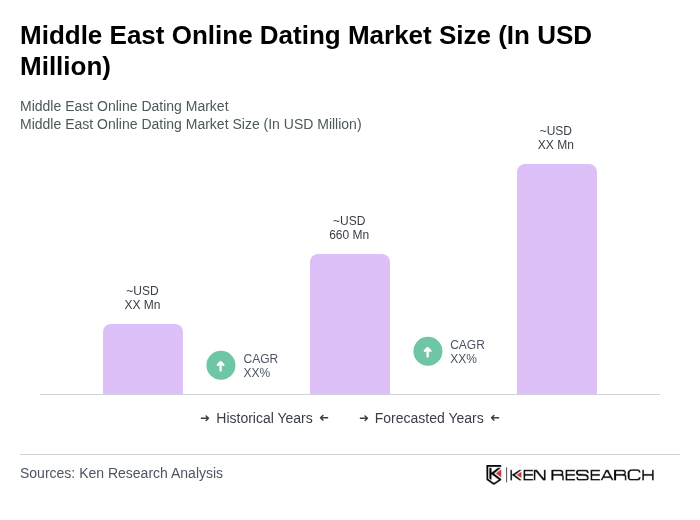
- The Middle East Online Dating Market is valued at USD 660 million, based on a five-year historical analysis and aligned with the wider Middle East & Africa online dating application market size reported at around USD 655 million. This growth is primarily driven by the increasing acceptance of online dating platforms, particularly among younger demographics, rapid smartphone adoption, and high social media usage, which facilitate easier access to these services. The market has seen a surge in user engagement, with more individuals seeking meaningful connections through digital means, supported by rising urbanization and busy lifestyles that reduce opportunities for traditional offline social interactions.
- Key players in this market include the UAE, Saudi Arabia, and Egypt, which dominate due to their large populations, high internet and smartphone penetration rates, and growing digital consumer bases. The cultural shift towards more liberal dating and social discovery practices, especially in major urban centers such as Dubai, Riyadh, and Cairo, has also contributed to the growth of online dating services in these countries. Additionally, the presence of a significant expatriate community in the UAE, where foreign residents represent a large majority of the population, further fuels the demand for diverse dating and matchmaking platforms that cater to both local and international users.
- In the UAE, online dating and social connection platforms operate within the broader federal framework on cybercrime, electronic transactions, and data protection, which sets clear expectations around user safety, identity misuse, and privacy. The Federal Decree-Law No. 45 of 2021 on the Protection of Personal Data issued by the UAE Cabinet establishes obligations for controllers and processors regarding lawful processing, user consent, data security, breach notification, and cross-border transfers, directly impacting how dating platforms handle personal and sensitive information. In parallel, the Federal Decree-Law No. 34 of 2021 on Combating Rumors and Cybercrimes governs online conduct, impersonation, fraud, and the misuse of electronic platforms, reinforcing requirements for platforms to implement robust verification, reporting, and safety mechanisms for users. These instruments collectively aim to foster a safer online environment and encourage wider uptake of digital services, including dating applications, while safeguarding users’ personal data and online interactions.
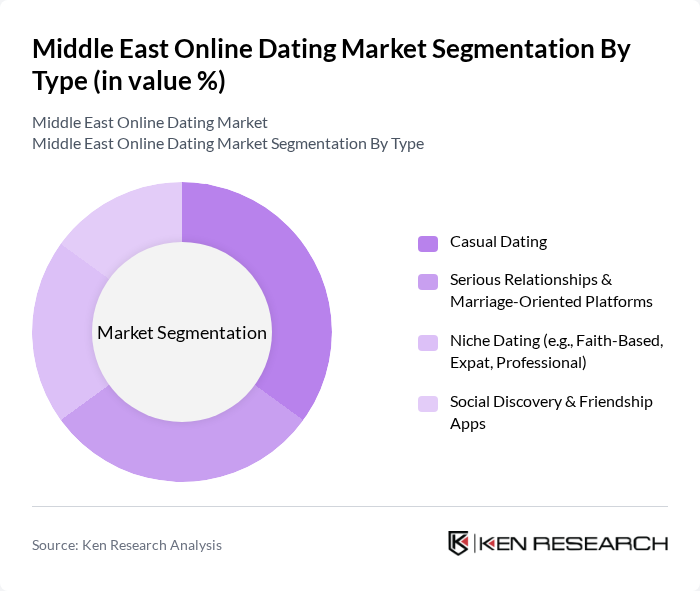
Middle East Online Dating Market Segmentation
By Type:The online dating market can be segmented into various types, including Casual Dating, Serious Relationships & Marriage-Oriented Platforms, Niche Dating (e.g., Faith-Based, Expat, Professional), and Social Discovery & Friendship Apps. Each of these segments caters to different user preferences and relationship goals, reflecting the diverse needs of the population and the popularity of both global apps (such as Tinder, Bumble, and Badoo) and faith- or culture-specific services (such as Muslim-focused and regional platforms) across the Middle East and Africa.
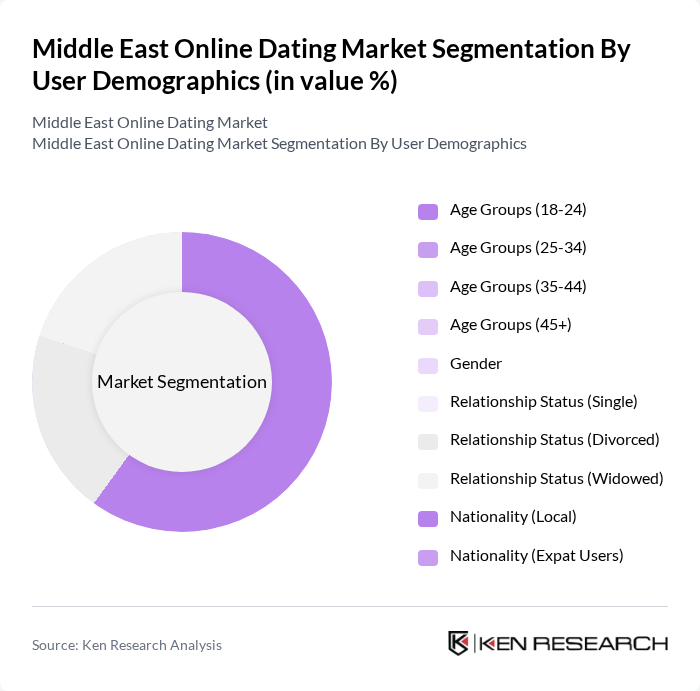
By User Demographics:This segmentation includes Age Groups (18-24, 25-34, 35-44, 45+), Gender, Relationship Status (Single, Divorced, Widowed), and Nationality (Local vs Expat Users). Understanding these demographics helps platforms tailor their services to meet the specific needs of different user groups, with adults in younger and middle age brackets forming a core user base and monthly subscription models widely used across the region.
Middle East Online Dating Market Competitive Landscape
The Middle East Online Dating Market is characterized by a dynamic mix of regional and international players. Leading participants such as Tinder (Match Group), Bumble, Badoo, OkCupid, Hinge, Hawaya (formerly Harmonica), Muzz (formerly Muzmatch), LoveHabibi, Muslima (Cupid Media), ArabLounge, Jdate & JSwipe, Minder, BuzzArab, Veil, Hayat – Muslim Dating & Marriage contribute to innovation, geographic expansion, and service delivery in this space, with several of these apps ranking among the top revenue-generating dating platforms in Middle Eastern app stores.
Middle East Online Dating Market Industry Analysis
Growth Drivers
- Increasing Smartphone Penetration:As of future, smartphone penetration in the Middle East is projected to reach 80%, with over 350 million smartphone users. This surge facilitates access to online dating platforms, enabling users to connect easily. The World Bank reports that mobile subscriptions in the region have increased by 10% annually, indicating a growing reliance on mobile technology for social interactions, including dating. This trend is crucial for the expansion of online dating services.
- Rising Internet Accessibility:Internet accessibility in the Middle East is expected to exceed 80% in future, driven by government initiatives and investments in infrastructure. The International Telecommunication Union (ITU) indicates that over 400 million people in the region will have internet access, significantly enhancing the potential user base for online dating platforms. This increased connectivity allows for greater engagement and interaction among users, fostering a more vibrant online dating environment.
- Changing Social Norms Regarding Dating:Cultural shifts in the Middle East are increasingly accepting online dating, particularly among younger demographics. A recent survey by the Arab Youth Survey found that 70% of respondents aged 18-24 view online dating positively. This change is supported by rising educational levels and urbanization, with 80% of the population living in urban areas, leading to more liberal attitudes towards dating and relationships, thus driving market growth.
Market Challenges
- Cultural Resistance to Online Dating:Despite growing acceptance, significant cultural resistance remains in many Middle Eastern societies. Traditional values often discourage online dating, with 30% of individuals in conservative regions expressing disapproval, according to a recent Pew Research study. This resistance can hinder user adoption and limit the growth potential of online dating platforms, as many individuals may prefer traditional matchmaking methods over digital alternatives.
- Privacy and Security Concerns:Privacy and security issues pose substantial challenges for online dating services in the Middle East. A recent report from Cybersecurity Ventures indicates that 50% of users are concerned about data breaches and personal safety while using dating apps. This apprehension can deter potential users from engaging with these platforms, impacting overall market growth and necessitating enhanced security measures to build user trust.
Middle East Online Dating Market Future Outlook
The Middle East online dating market is poised for significant evolution, driven by technological advancements and shifting societal attitudes. As smartphone and internet penetration continue to rise, platforms will increasingly integrate innovative features such as AI-driven matchmaking and enhanced user safety protocols. Additionally, the emergence of niche dating services catering to specific demographics will likely attract diverse user bases, fostering a more inclusive dating environment. These trends indicate a promising future for online dating in the region, with potential for substantial growth and user engagement.
Market Opportunities
- Expansion of Mobile Dating Applications:The growing smartphone user base presents a significant opportunity for mobile dating applications. With over 350 million users expected in future, developers can create tailored experiences that cater to local preferences, enhancing user engagement and satisfaction. This expansion can lead to increased revenue streams through subscriptions and in-app purchases, capitalizing on the rising demand for mobile connectivity.
- Integration of AI and Machine Learning:The integration of AI and machine learning technologies in dating platforms can enhance user experiences by providing personalized matches and improving safety features. As AI technology advances, platforms can analyze user behavior and preferences more effectively, leading to higher satisfaction rates. This innovation can attract a broader audience, positioning companies at the forefront of the evolving online dating landscape.
Scope of the Report
| Segment | Sub-Segments |
|---|---|
| By Type | Casual Dating Serious Relationships & Marriage-Oriented Platforms Niche Dating (e.g., Faith-Based, Expat, Professional) Social Discovery & Friendship Apps |
| By User Demographics | Age Groups (18-24, 25-34, 35-44, 45+) Gender Relationship Status (Single, Divorced, Widowed) Nationality (Local vs Expat Users) |
| By Geographic Location | GCC Countries (UAE, Saudi Arabia, Qatar, Kuwait, Bahrain, Oman) Levant (Jordan, Lebanon, etc.) North Africa (Egypt, Morocco, etc.) Other Middle East Countries |
| By Payment Model | Subscription-Based (Monthly, Quarterly, Annual) Freemium with In-App Purchases One-Time Premium Features / Boosts Advertising-Supported Free Access |
| By Marketing Channel | Social Media & Influencer Marketing Search Engine Marketing & App Store Optimization Referral & Affiliate Programs Offline & Event-Based Promotions |
| By User Engagement Features | Messaging, Chat, and Voice Notes Video Calling & Live Streaming Profile Verification & Safety Tools AI-Based Match Recommendations |
| By Customer Support Services | In-App Support & Help Center Moderation & Reporting Tools Email & Chat Support Localized Language Support (Arabic, English, Others) |
Key Target Audience
Investors and Venture Capitalist Firms
Government and Regulatory Bodies (e.g., Ministry of Communications and Information Technology, Telecommunications Regulatory Authority)
Online Dating Platform Operators
Mobile Application Developers
Digital Marketing Agencies
Payment Processing Companies
Telecommunications Companies
Advertising Agencies
Players Mentioned in the Report:
Tinder (Match Group)
Bumble
Badoo
OkCupid
Hinge
Hawaya (formerly Harmonica)
Muzz (formerly Muzmatch)
LoveHabibi
Muslima (Cupid Media)
ArabLounge
Jdate & JSwipe
Minder
BuzzArab
Veil
Hayat Muslim Dating & Marriage
Table of Contents
Market Assessment Phase
1. Executive Summary and Approach
2. Middle East Online Dating Market Overview
2.1 Key Insights and Strategic Recommendations
2.2 Middle East Online Dating Market Overview
2.3 Definition and Scope
2.4 Evolution of Market Ecosystem
2.5 Timeline of Key Regulatory Milestones
2.6 Value Chain & Stakeholder Mapping
2.7 Business Cycle Analysis
2.8 Policy & Incentive Landscape
3. Middle East Online Dating Market Analysis
3.1 Growth Drivers
3.1.1 Increasing smartphone penetration
3.1.2 Rising internet accessibility
3.1.3 Changing social norms regarding dating
3.1.4 Growth of niche dating platforms
3.2 Market Challenges
3.2.1 Cultural resistance to online dating
3.2.2 Privacy and security concerns
3.2.3 Regulatory hurdles
3.2.4 Competition from traditional dating methods
3.3 Market Opportunities
3.3.1 Expansion of mobile dating applications
3.3.2 Integration of AI and machine learning
3.3.3 Partnerships with local businesses
3.3.4 Development of virtual dating experiences
3.4 Market Trends
3.4.1 Increased focus on user safety features
3.4.2 Growth of video dating options
3.4.3 Emergence of dating apps for specific demographics
3.4.4 Use of gamification in dating apps
3.5 Government Regulation
3.5.1 Data protection laws
3.5.2 Age verification requirements
3.5.3 Content moderation regulations
3.5.4 Licensing requirements for dating services
4. SWOT Analysis
5. Stakeholder Analysis
6. Porter's Five Forces Analysis
7. Middle East Online Dating Market Market Size, 2019-2024
7.1 By Value
7.2 By Volume
7.3 By Average Selling Price
8. Middle East Online Dating Market Segmentation
8.1 By Type
8.1.1 Casual Dating
8.1.2 Serious Relationships & Marriage-Oriented Platforms
8.1.3 Niche Dating (e.g., Faith-Based, Expat, Professional)
8.1.4 Social Discovery & Friendship Apps
8.2 By User Demographics
8.2.1 Age Groups (18-24, 25-34, 35-44, 45+)
8.2.2 Gender
8.2.3 Relationship Status (Single, Divorced, Widowed)
8.2.4 Nationality (Local vs Expat Users)
8.3 By Geographic Location
8.3.1 GCC Countries (UAE, Saudi Arabia, Qatar, Kuwait, Bahrain, Oman)
8.3.2 Levant (Jordan, Lebanon, etc.)
8.3.3 North Africa (Egypt, Morocco, etc.)
8.3.4 Other Middle East Countries
8.4 By Payment Model
8.4.1 Subscription-Based (Monthly, Quarterly, Annual)
8.4.2 Freemium with In-App Purchases
8.4.3 One-Time Premium Features / Boosts
8.4.4 Advertising-Supported Free Access
8.5 By Marketing Channel
8.5.1 Social Media & Influencer Marketing
8.5.2 Search Engine Marketing & App Store Optimization
8.5.3 Referral & Affiliate Programs
8.5.4 Offline & Event-Based Promotions
8.6 By User Engagement Features
8.6.1 Messaging, Chat, and Voice Notes
8.6.2 Video Calling & Live Streaming
8.6.3 Profile Verification & Safety Tools
8.6.4 AI-Based Match Recommendations
8.7 By Customer Support Services
8.7.1 In-App Support & Help Center
8.7.2 Moderation & Reporting Tools
8.7.3 Email & Chat Support
8.7.4 Localized Language Support (Arabic, English, Others)
9. Middle East Online Dating Market Competitive Analysis
9.1 Market Share of Key Players
9.2 Cross Comparison of Key Players
9.2.1 Company Name
9.2.2 Scale (Global, Regional, or Local Player)
9.2.3 Monthly Active Users (MAU) in the Middle East
9.2.4 Paying Users / Conversion Rate to Paid
9.2.5 Average Revenue Per Paying User (ARPPU)
9.2.6 User Acquisition Cost (UAC) in the Region
9.2.7 Churn Rate (Monthly / Quarterly)
9.2.8 Average Session Frequency & Time Spent per User
9.2.9 Share of Revenue from the Middle East in Global Revenues
9.2.10 Localization Level (Language, Moderation, Cultural Fit)
9.3 SWOT Analysis of Top Players
9.4 Pricing Analysis
9.5 Detailed Profile of Major Companies
9.5.1 Tinder (Match Group)
9.5.2 Bumble
9.5.3 Badoo
9.5.4 OkCupid
9.5.5 Hinge
9.5.6 Hawaya (formerly Harmonica)
9.5.7 Muzz (formerly Muzmatch)
9.5.8 LoveHabibi
9.5.9 Muslima (Cupid Media)
9.5.10 ArabLounge
9.5.11 Jdate & JSwipe
9.5.12 Minder
9.5.13 BuzzArab
9.5.14 Veil
9.5.15 Hayat – Muslim Dating & Marriage
10. Middle East Online Dating Market End-User Analysis
10.1 Procurement Behavior of Key Ministries
10.1.1 Engagement with dating platforms
10.1.2 Budget allocation for digital services
10.1.3 Collaboration with tech companies
10.1.4 Others
10.2 Corporate Spend on Infrastructure & Energy
10.2.1 Investment in technology upgrades
10.2.2 Spending on marketing and outreach
10.2.3 Budget for user safety features
10.2.4 Others
10.3 Pain Point Analysis by End-User Category
10.3.1 User concerns about privacy
10.3.2 Difficulty in finding compatible matches
10.3.3 Frustration with fake profiles
10.3.4 Others
10.4 User Readiness for Adoption
10.4.1 Familiarity with technology
10.4.2 Willingness to pay for premium features
10.4.3 Openness to online dating
10.4.4 Others
10.5 Post-Deployment ROI and Use Case Expansion
10.5.1 User engagement metrics
10.5.2 Revenue growth from premium subscriptions
10.5.3 Expansion into new demographics
10.5.4 Others
11. Middle East Online Dating Market Future Size, 2025-2030
11.1 By Value
11.2 By Volume
11.3 By Average Selling Price
Go-To-Market Strategy Phase
1. Whitespace Analysis + Business Model Canvas
1.1 Market Gaps Identification
1.2 Business Model Development
2. Marketing and Positioning Recommendations
2.1 Branding Strategies
2.2 Product USPs
3. Distribution Plan
3.1 Urban Retail vs Rural NGO Tie-Ups
4. Channel & Pricing Gaps
4.1 Underserved Routes
4.2 Pricing Bands
5. Unmet Demand & Latent Needs
5.1 Category Gaps
5.2 Consumer Segments
6. Customer Relationship
6.1 Loyalty Programs
6.2 After-Sales Service
7. Value Proposition
7.1 Sustainability
7.2 Integrated Supply Chains
8. Key Activities
8.1 Regulatory Compliance
8.2 Branding
8.3 Distribution Setup
9. Entry Strategy Evaluation
9.1 Domestic Market Entry Strategy
9.1.1 Product Mix
9.1.2 Pricing Band
9.1.3 Packaging
9.2 Export Entry Strategy
9.2.1 Target Countries
9.2.2 Compliance Roadmap
10. Entry Mode Assessment
10.1 JV
10.2 Greenfield
10.3 M&A
10.4 Distributor Model
11. Capital and Timeline Estimation
11.1 Capital Requirements
11.2 Timelines
12. Control vs Risk Trade-Off
12.1 Ownership vs Partnerships
13. Profitability Outlook
13.1 Breakeven Analysis
13.2 Long-Term Sustainability
14. Potential Partner List
14.1 Distributors
14.2 JVs
14.3 Acquisition Targets
15. Execution Roadmap
15.1 Phased Plan for Market Entry
15.1.1 Market Setup
15.1.2 Market Entry
15.1.3 Growth Acceleration
15.1.4 Scale & Stabilize
15.2 Key Activities and Milestones
15.2.1 Milestone Planning
15.2.2 Activity Tracking
Research Methodology
Phase 1: Approach1
Desk Research
- Analysis of existing market reports and white papers on online dating trends in the Middle East
- Review of demographic and psychographic data from government publications and international organizations
- Examination of social media trends and user engagement metrics on popular dating platforms
Primary Research
- Interviews with founders and executives of leading online dating platforms operating in the region
- Surveys targeting users of online dating services to gather insights on preferences and behaviors
- Focus groups with diverse demographic segments to understand cultural attitudes towards online dating
Validation & Triangulation
- Cross-validation of findings through multiple data sources, including user statistics and market growth rates
- Triangulation of qualitative insights from interviews with quantitative data from surveys
- Sanity checks conducted through expert panel reviews comprising industry analysts and sociologists
Phase 2: Market Size Estimation1
Top-down Assessment
- Estimation of market size based on overall internet penetration and smartphone usage in the Middle East
- Analysis of revenue generated by major online dating platforms and their growth trajectories
- Incorporation of regional socio-economic factors influencing online dating adoption rates
Bottom-up Modeling
- Collection of user subscription data and average revenue per user (ARPU) from key players in the market
- Estimation of market share distribution among various dating services based on user demographics
- Volume x cost analysis based on user engagement and retention rates across platforms
Forecasting & Scenario Analysis
- Multi-factor regression analysis incorporating variables such as cultural shifts and technological advancements
- Scenario modeling based on potential regulatory changes and their impact on user behavior
- Baseline, optimistic, and pessimistic projections for market growth through 2030
Phase 3: CATI Sample Composition1
| Scope Item/Segment | Sample Size | Target Respondent Profiles |
|---|---|---|
| General User Base of Online Dating Platforms | 120 | Single Individuals Aged 18-35 |
| Premium Subscription Users | 90 | Users with Paid Memberships on Dating Apps |
| Users from Diverse Cultural Backgrounds | 80 | Individuals from Various Ethnic and Religious Groups |
| Users Engaged in Long-term Relationships | 70 | Couples Who Met Through Online Dating Services |
| Users Aged 36 and Above | 60 | Single Individuals Aged 36-55 |
Frequently Asked Questions
What is the current value of the Middle East online dating market?
The Middle East online dating market is valued at approximately USD 660 million, reflecting a growing trend towards digital matchmaking, particularly among younger demographics and urban populations, driven by smartphone adoption and increased internet accessibility.
Which countries dominate the Middle East online dating market?
What are the main types of online dating platforms in the Middle East?
How does smartphone penetration affect the online dating market in the Middle East?
Other Regional/Country Reports
Indonesia Online Dating Market
Malaysia Online Dating Market
KSA Online Dating Market
APAC Online Dating Market
Other Adjacent Reports
Mexico Social Media Market
Brazil Mobile Application Development Market
UAE Digital Advertising Market Size, Share & Forecast, By Ad Format, Platform & End-Use Industry, 2026-2032Indonesia Cybersecurity Market Size, Share & Forecast, By Solution Type, Deployment Model & End-Use Industry, 2025-2032Qatar Artificial Intelligence Market Size, Share & Forecast, By Solution Type, Deployment Model & End-Use Industry, 2026–2032Luxembourg E-Commerce MarketBelgium Telecommunication Services Market
Japan Data Privacy Solutions Market
UAE Entertainment Streaming Market
Indonesia Relationship Counseling Market
Why Buy From Us?

What makes us stand out is that our consultants follow Robust, Refine and Result (RRR) methodology. Robust for clear definitions, approaches and sanity checking, Refine for differentiating respondents' facts and opinions, and Result for presenting data with story.

We have set a benchmark in the industry by offering our clients with syndicated and customized market research reports featuring coverage of entire market as well as meticulous research and analyst insights.

While we don't replace traditional research, we flip the method upside down. Our dual approach of Top Bottom & Bottom Top ensures quality deliverable by not just verifying company fundamentals but also looking at the sector and macroeconomic factors.

With one step in the future, our research team constantly tries to show you the bigger picture. We help with some of the tough questions you may encounter along the way: How is the industry positioned? Best marketing channel? KPI's of competitors? By aligning every element, we help maximize success.

Our report gives you instant access to the answers and sources that other companies might choose to hide. We elaborate each steps of research methodology we have used and showcase you the sample size to earn your trust.

If you need any support, we are here! We pride ourselves on universe strength, data quality, and quick, friendly, and professional service.