About the Report
Base Year 2024Middle East Textile Market Overview
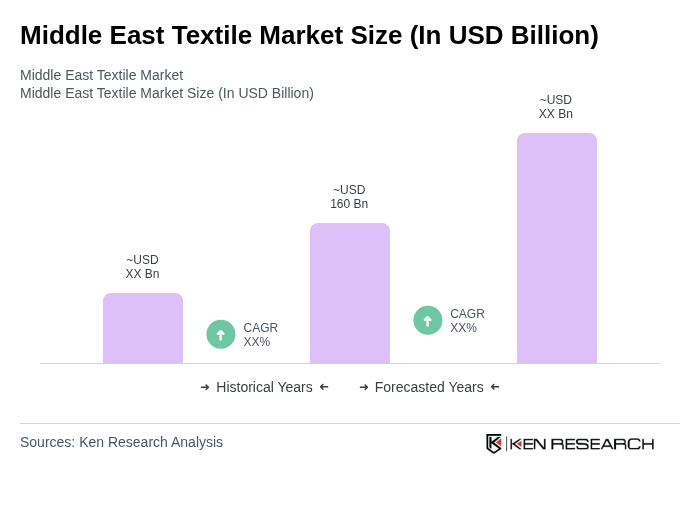
- The Middle East Textile Market is valued at USD 160 billion, based on a five-year historical analysis of the broader Middle East and Africa textile industry with the Middle East accounting for a significant share of regional demand and production. This growth is primarily driven by increasing consumer demand for both traditional and modern textiles, alongside a rise in disposable income, rapid urbanization, expansion of organized retail, and growth in e-commerce and fashion categories across the region. The market has also seen a clear shift towards sustainable and eco-friendly textiles, supported by increasing awareness of environmental impacts, interest in ethically produced garments, and adoption of innovative processes such as sustainable dyeing and recycling of fibers.
- Key players in this market include Saudi Arabia, the United Arab Emirates, and Turkey, along with other manufacturing and trading hubs such as Israel, Iran, and Qatar. These countries dominate due to their robust manufacturing capabilities (particularly Turkey as a major exporter to Europe and regional markets), strategic geographic locations along key trade routes, and strong export and re?export networks through hubs such as the UAE. Additionally, the presence of a well-established retail and fashion sector, growing demand for modest and traditional wear, and government initiatives to attract manufacturing investments further enhances their market position.
- In 2023, the UAE government strengthened its policy framework to promote sustainable practices and circularity in sectors including textiles through instruments such as the Cabinet Resolution No. 111 of 2023 on the Regulation of Integrated Waste Management, issued by the UAE Cabinet, which sets requirements on waste reduction, segregation, and treatment for industrial establishments and encourages recovery and recycling of materials. In parallel, implementation of the UAE Net Zero by 2050 strategic initiative and the UAE Climate-Responsible Companies Pledge led by the Ministry of Climate Change and Environment encourages manufacturers, including textile and apparel producers, to measure and reduce greenhouse gas emissions and adopt energy?efficient, low?carbon technologies. These policy measures support wider adoption of eco?friendly materials, cleaner production processes and waste minimization in the textile value chain, aligning the industry with global sustainability goals.
Middle East Textile Market Segmentation
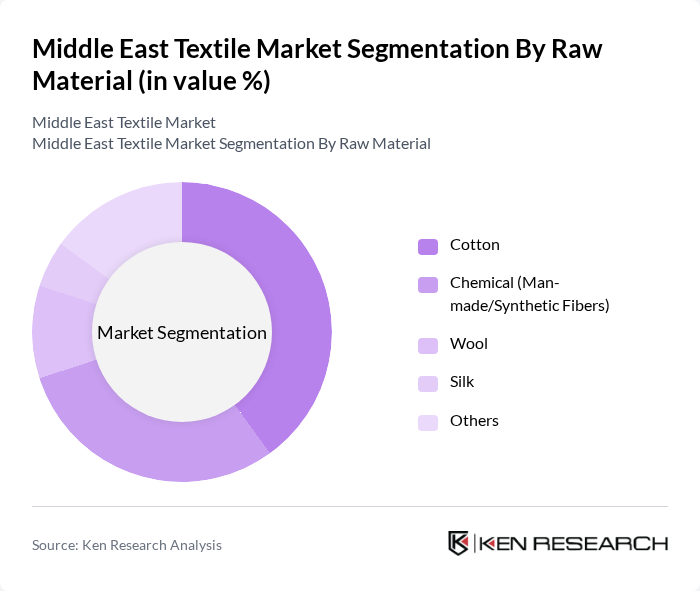
By Raw Material:The textile market is segmented into various raw materials, including Cotton, Chemical (Man-made/Synthetic Fibers), Wool, Silk, and Others. Cotton remains a dominant raw material for apparel and home textiles due to its natural properties, comfort, and widespread consumer preference, particularly in hotter climates. Chemical fibers (man?made/synthetic fibers such as polyester, viscose, and acrylic) are gaining traction due to their versatility, cost-effectiveness, and suitability for performance and technical applications, while wool and silk cater to niche markets focused on luxury, formalwear, and high-quality textiles.
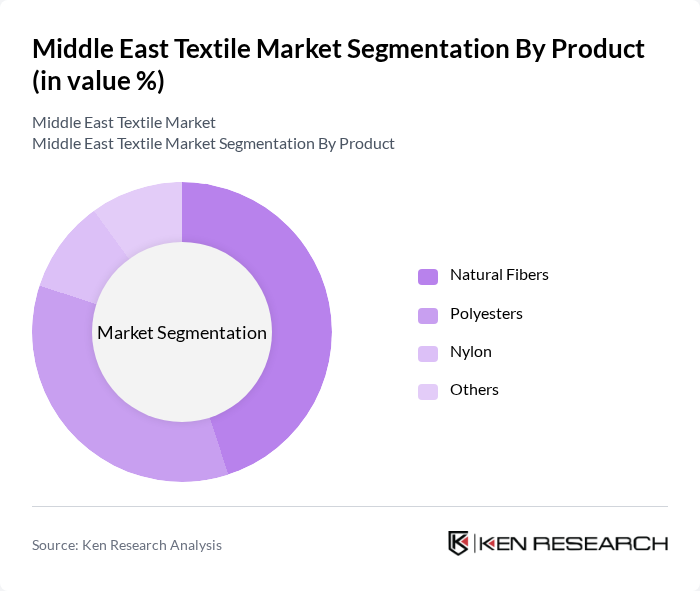
By Product:This segmentation includes Natural Fibers, Polyesters, Nylon, and Others, which is aligned with common product categorization in regional textile market analyses. Natural fibers, particularly cotton, dominate the market in core apparel and home textile categories due to their comfort, breathability, and cultural preference for natural fabrics in many Middle Eastern countries. Polyesters are increasingly popular across fashion, sportswear, and technical textile applications due to their durability, low maintenance, moisture management properties, and lower cost, while nylon is favored in segments requiring high strength, abrasion resistance, and elasticity such as activewear, hosiery, and certain technical textiles. The 'Others' category includes various innovative and specialty materials such as blends, elastane, recycled fibers, and technical textiles tailored to specific consumer and industrial needs, including protective, medical, and automotive applications.
Middle East Textile Market Competitive Landscape
The Middle East Textile Market is characterized by a dynamic mix of regional and international players. Leading participants such as Classic Fashion Apparel Industry Ltd. Co. (Jordan), Delta Galil Industries Ltd. (Israel), Noman Group (Middle East Operations), Arvind Limited (Middle East Presence), Reliance Industries Ltd. – Polyester & Textile Division (Regional Presence), Mafatlal Industries Ltd. (Export to Middle East), Turkish Home Textile Manufacturers (Representative Leading Players), Al Karam Textile Mills (Regional Distribution), Emirates Apparel (UAE), Si Fashion Group (UAE), Marhaba Textile Co. (UAE), Ivory Garments Factory LLC (UAE), Atlas Tex. & Garment Factory Ltd. (Middle East), Embee Readymade Garments Industry Ltd. (Regional Operations), Jobedu (Regional Apparel Brand) contribute to innovation, geographic expansion, and service delivery in this space.
Middle East Textile Market Industry Analysis
Growth Drivers
- Increasing Demand for Sustainable Textiles:The Middle East textile market is witnessing a significant shift towards sustainable textiles, driven by a growing consumer awareness of environmental issues. In future, the sustainable textile market is projected to reach $1.5 billion, reflecting a 20% increase from the previous year. This trend is supported by government initiatives promoting eco-friendly practices, with 60% of consumers in the region expressing a preference for sustainable products, according to a recent industry report by the World Bank.
- Growth in the Fashion and Apparel Industry:The fashion and apparel sector in the Middle East is expected to generate $50 billion in revenue in future, driven by a burgeoning middle class and increasing disposable incomes. The region's fashion market is expanding at a rate of 15% annually, with a notable rise in demand for both luxury and casual wear. This growth is further fueled by the influence of social media and celebrity endorsements, which have significantly shaped consumer preferences in recent years.
- Expansion of E-commerce Platforms:E-commerce in the Middle East is projected to reach $28 billion in future, with textiles and apparel accounting for a substantial portion of this growth. The rise of online shopping has been accelerated by the COVID-19 pandemic, leading to a 30% increase in online textile sales. Major platforms like Souq.com and Namshi are expanding their textile offerings, catering to the growing demand for convenience and variety among consumers in the region.
Market Challenges
- High Competition from Imported Textiles:The Middle East textile market faces intense competition from imported textiles, particularly from Asia and Europe. In future, imports are expected to account for 70% of the market share, with countries like China and India dominating the supply chain. This influx of cheaper textiles poses a significant challenge for local manufacturers, who struggle to compete on price while maintaining quality and sustainability standards.
- Fluctuating Raw Material Prices:The textile industry is heavily reliant on raw materials such as cotton and polyester, which have experienced price volatility due to global supply chain disruptions. In future, cotton prices are projected to fluctuate between $1.20 and $1.50 per pound, impacting production costs for manufacturers. This unpredictability complicates budgeting and pricing strategies, forcing companies to adapt quickly to maintain profitability in a competitive market.
Middle East Textile Market Future Outlook
The Middle East textile market is poised for transformative growth, driven by increasing consumer demand for sustainable and locally produced textiles. As e-commerce continues to expand, companies are likely to invest in digital platforms to enhance customer engagement. Additionally, the adoption of advanced technologies, such as digital printing and smart textiles, will reshape production processes. With a focus on sustainability and innovation, the market is expected to evolve, presenting new opportunities for both established and emerging players in the industry.
Market Opportunities
- Growth in Eco-Friendly Textile Production:The demand for eco-friendly textiles is creating opportunities for manufacturers to innovate. In future, the eco-friendly textile segment is expected to grow to $1 billion, driven by consumer preferences for organic and recycled materials. Companies investing in sustainable practices can differentiate themselves and capture a larger market share.
- Rising Consumer Interest in Local Brands:There is a notable shift towards supporting local brands, with 55% of consumers expressing a preference for locally produced textiles. This trend presents an opportunity for regional manufacturers to capitalize on national pride and cultural heritage, potentially increasing their market presence and fostering brand loyalty among consumers.
Scope of the Report
| Segment | Sub-Segments |
|---|---|
| By Raw Material | Cotton Chemical (Man-made/Synthetic Fibers) Wool Silk Others |
| By Product | Natural Fibers Polyesters Nylon Others |
| By Application | Household (Home Textiles) Technical Textiles Fashion and Clothing Others |
| By End-Use Industry | Apparel & Fashion Home & Hospitality Industrial & Technical Automotive & Transportation Healthcare & Medical Others |
| By Distribution Channel | Online Retail & Marketplaces Organized Offline Retail Wholesale & B2B Direct-to-Consumer (D2C) Others |
| By Country | Saudi Arabia United Arab Emirates Turkey Israel Iran Iraq Qatar Kuwait Oman Jordan Bahrain Others |
| By Sustainability Profile | Eco-friendly / Sustainable Textiles Conventional Textiles Recycled / Circular Textiles |
Key Target Audience
Investors and Venture Capitalist Firms
Government and Regulatory Bodies (e.g., Ministry of Industry and Advanced Technology, Ministry of Economy)
Manufacturers and Producers
Distributors and Retailers
Textile Export Promotion Councils
Trade Associations (e.g., Textile and Apparel Export Council)
Logistics and Supply Chain Companies
Financial Institutions (e.g., Development Banks)
Players Mentioned in the Report:
Classic Fashion Apparel Industry Ltd. Co. (Jordan)
Delta Galil Industries Ltd. (Israel)
Noman Group (Middle East Operations)
Arvind Limited (Middle East Presence)
Reliance Industries Ltd. Polyester & Textile Division (Regional Presence)
Mafatlal Industries Ltd. (Export to Middle East)
Turkish Home Textile Manufacturers (Representative Leading Players)
Al Karam Textile Mills (Regional Distribution)
Emirates Apparel (UAE)
Si Fashion Group (UAE)
Marhaba Textile Co. (UAE)
Ivory Garments Factory LLC (UAE)
Atlas Tex. & Garment Factory Ltd. (Middle East)
Embee Readymade Garments Industry Ltd. (Regional Operations)
Jobedu (Regional Apparel Brand)
Table of Contents
Market Assessment Phase
1. Executive Summary and Approach
2. Middle East Textile Market Overview
2.1 Key Insights and Strategic Recommendations
2.2 Middle East Textile Market Overview
2.3 Definition and Scope
2.4 Evolution of Market Ecosystem
2.5 Timeline of Key Regulatory Milestones
2.6 Value Chain & Stakeholder Mapping
2.7 Business Cycle Analysis
2.8 Policy & Incentive Landscape
3. Middle East Textile Market Analysis
3.1 Growth Drivers
3.1.1 Increasing demand for sustainable textiles
3.1.2 Growth in the fashion and apparel industry
3.1.3 Expansion of e-commerce platforms
3.1.4 Government initiatives to boost local manufacturing
3.2 Market Challenges
3.2.1 High competition from imported textiles
3.2.2 Fluctuating raw material prices
3.2.3 Regulatory compliance issues
3.2.4 Limited access to advanced technology
3.3 Market Opportunities
3.3.1 Growth in eco-friendly textile production
3.3.2 Rising consumer interest in local brands
3.3.3 Expansion into untapped regional markets
3.3.4 Investment in smart textile technologies
3.4 Market Trends
3.4.1 Shift towards digital textile printing
3.4.2 Increasing popularity of athleisure wear
3.4.3 Adoption of circular economy practices
3.4.4 Growth of online textile marketplaces
3.5 Government Regulation
3.5.1 Import tariffs on textile products
3.5.2 Environmental regulations for textile production
3.5.3 Labor laws affecting textile manufacturing
3.5.4 Standards for textile quality and safety
4. SWOT Analysis
5. Stakeholder Analysis
6. Porter's Five Forces Analysis
7. Middle East Textile Market Market Size, 2019-2024
7.1 By Value
7.2 By Volume
7.3 By Average Selling Price
8. Middle East Textile Market Segmentation
8.1 By Raw Material
8.1.1 Cotton
8.1.2 Chemical (Man-made/Synthetic Fibers)
8.1.3 Wool
8.1.4 Silk
8.1.5 Others
8.2 By Product
8.2.1 Natural Fibers
8.2.2 Polyesters
8.2.3 Nylon
8.2.4 Others
8.3 By Application
8.3.1 Household (Home Textiles)
8.3.2 Technical Textiles
8.3.3 Fashion and Clothing
8.3.4 Others
8.4 By End-Use Industry
8.4.1 Apparel & Fashion
8.4.2 Home & Hospitality
8.4.3 Industrial & Technical
8.4.4 Automotive & Transportation
8.4.5 Healthcare & Medical
8.4.6 Others
8.5 By Distribution Channel
8.5.1 Online Retail & Marketplaces
8.5.2 Organized Offline Retail
8.5.3 Wholesale & B2B
8.5.4 Direct-to-Consumer (D2C)
8.5.5 Others
8.6 By Country
8.6.1 Saudi Arabia
8.6.2 United Arab Emirates
8.6.3 Turkey
8.6.4 Israel
8.6.5 Iran
8.6.6 Iraq
8.6.7 Qatar
8.6.8 Kuwait
8.6.9 Oman
8.6.10 Jordan
8.6.11 Bahrain
8.6.12 Others
8.7 By Sustainability Profile
8.7.1 Eco-friendly / Sustainable Textiles
8.7.2 Conventional Textiles
8.7.3 Recycled / Circular Textiles
9. Middle East Textile Market Competitive Analysis
9.1 Market Share of Key Players
9.2 Cross Comparison of Key Players
9.2.1 Company Name
9.2.2 Revenue (USD Million)
9.2.3 Revenue CAGR (Last 3–5 Years)
9.2.4 EBITDA Margin (%)
9.2.5 Market Share (%) in Middle East Textile Market
9.2.6 Capacity Utilization Rate (%)
9.2.7 Average Selling Price Index
9.2.8 R&D Spend as % of Revenue
9.2.9 Export Share in Total Sales (%)
9.2.10 On-time Delivery Rate (%)
9.2.11 Customer Retention Rate (%)
9.2.12 ESG / Sustainability Score
9.3 SWOT Analysis of Top Players
9.4 Pricing Analysis
9.5 Detailed Profile of Major Companies
9.5.1 Classic Fashion Apparel Industry Ltd. Co. (Jordan)
9.5.2 Delta Galil Industries Ltd. (Israel)
9.5.3 Noman Group (Middle East Operations)
9.5.4 Arvind Limited (Middle East Presence)
9.5.5 Reliance Industries Ltd. – Polyester & Textile Division (Regional Presence)
9.5.6 Mafatlal Industries Ltd. (Export to Middle East)
9.5.7 Turkish Home Textile Manufacturers (Representative Leading Players)
9.5.8 Al Karam Textile Mills (Regional Distribution)
9.5.9 Emirates Apparel (UAE)
9.5.10 Si Fashion Group (UAE)
9.5.11 Marhaba Textile Co. (UAE)
9.5.12 Ivory Garments Factory LLC (UAE)
9.5.13 Atlas Tex. & Garment Factory Ltd. (Middle East)
9.5.14 Embee Readymade Garments Industry Ltd. (Regional Operations)
9.5.15 Jobedu (Regional Apparel Brand)
10. Middle East Textile Market End-User Analysis
10.1 Procurement Behavior of Key Ministries
10.1.1 Government procurement policies
10.1.2 Budget allocation for textile purchases
10.1.3 Supplier selection criteria
10.1.4 Contract management practices
10.2 Corporate Spend on Infrastructure & Energy
10.2.1 Investment in textile manufacturing facilities
10.2.2 Spending on energy-efficient technologies
10.2.3 Budget for R&D in textile innovations
10.2.4 Expenditure on workforce training
10.3 Pain Point Analysis by End-User Category
10.3.1 Quality assurance issues
10.3.2 Supply chain disruptions
10.3.3 Cost management challenges
10.3.4 Compliance with regulations
10.4 User Readiness for Adoption
10.4.1 Awareness of sustainable practices
10.4.2 Readiness to invest in new technologies
10.4.3 Training and skill development needs
10.4.4 Adoption of digital solutions
10.5 Post-Deployment ROI and Use Case Expansion
10.5.1 Measurement of ROI from textile investments
10.5.2 Expansion into new product lines
10.5.3 Customer feedback and improvement
10.5.4 Long-term sustainability practices
11. Middle East Textile Market Future Size, 2025-2030
11.1 By Value
11.2 By Volume
11.3 By Average Selling Price
Go-To-Market Strategy Phase
1. Whitespace Analysis + Business Model Canvas
1.1 Market gaps identification
1.2 Value proposition development
1.3 Revenue model exploration
1.4 Customer segmentation analysis
1.5 Competitive landscape overview
1.6 Key partnerships identification
1.7 Resource allocation strategy
2. Marketing and Positioning Recommendations
2.1 Branding strategies
2.2 Product USPs
2.3 Target audience definition
2.4 Marketing channels selection
2.5 Messaging and communication strategy
2.6 Performance metrics establishment
3. Distribution Plan
3.1 Urban retail strategies
3.2 Rural NGO tie-ups
3.3 E-commerce integration
3.4 Logistics and supply chain management
3.5 Distribution partnerships
4. Channel & Pricing Gaps
4.1 Underserved routes
4.2 Pricing bands analysis
4.3 Competitor pricing strategies
4.4 Customer willingness to pay
4.5 Price elasticity assessment
5. Unmet Demand & Latent Needs
5.1 Category gaps identification
5.2 Consumer segments analysis
5.3 Emerging trends exploration
5.4 Future demand forecasting
6. Customer Relationship
6.1 Loyalty programs design
6.2 After-sales service strategies
6.3 Customer feedback mechanisms
6.4 Relationship management tools
7. Value Proposition
7.1 Sustainability initiatives
7.2 Integrated supply chains
7.3 Unique selling points
7.4 Customer-centric approach
8. Key Activities
8.1 Regulatory compliance
8.2 Branding efforts
8.3 Distribution setup
8.4 Market research activities
9. Entry Strategy Evaluation
9.1 Domestic Market Entry Strategy
9.1.1 Product mix considerations
9.1.2 Pricing band analysis
9.1.3 Packaging strategies
9.2 Export Entry Strategy
9.2.1 Target countries selection
9.2.2 Compliance roadmap development
10. Entry Mode Assessment
10.1 Joint Ventures
10.2 Greenfield investments
10.3 Mergers & Acquisitions
10.4 Distributor Model
11. Capital and Timeline Estimation
11.1 Capital requirements analysis
11.2 Timelines for market entry
12. Control vs Risk Trade-Off
12.1 Ownership considerations
12.2 Partnerships evaluation
13. Profitability Outlook
13.1 Breakeven analysis
13.2 Long-term sustainability strategies
14. Potential Partner List
14.1 Distributors identification
14.2 Joint Ventures exploration
14.3 Acquisition targets
15. Execution Roadmap
15.1 Phased Plan for Market Entry
15.1.1 Market Setup
15.1.2 Market Entry
15.1.3 Growth Acceleration
15.1.4 Scale & Stabilize
15.2 Key Activities and Milestones
15.2.1 Activity timelines
15.2.2 Milestone tracking
Research Methodology
Phase 1: Approach1
Desk Research
- Analysis of industry reports from textile associations and trade bodies in the Middle East
- Review of market trends and forecasts from government publications and economic surveys
- Examination of import/export data and trade statistics from customs authorities
Primary Research
- Interviews with key stakeholders in textile manufacturing, including factory owners and managers
- Surveys targeting retailers and distributors to understand market dynamics and consumer preferences
- Field visits to textile markets and trade shows to gather firsthand insights and observations
Validation & Triangulation
- Cross-validation of findings through multiple data sources, including trade publications and expert opinions
- Triangulation of qualitative insights with quantitative data to ensure consistency and reliability
- Sanity checks conducted through expert panel discussions to validate assumptions and conclusions
Phase 2: Market Size Estimation1
Top-down Assessment
- Estimation of total market size based on national textile consumption and production statistics
- Segmentation of the market by product categories, such as apparel, home textiles, and technical textiles
- Incorporation of regional growth rates and demographic factors influencing textile demand
Bottom-up Modeling
- Collection of sales data from leading textile manufacturers and retailers in the region
- Estimation of average selling prices and production costs across different textile segments
- Volume analysis based on production capacity and market share of key players
Forecasting & Scenario Analysis
- Development of forecasting models using historical data and market trends to project future growth
- Scenario analysis based on potential economic shifts, consumer behavior changes, and regulatory impacts
- Creation of baseline, optimistic, and pessimistic forecasts to account for market volatility
Phase 3: CATI Sample Composition1
| Scope Item/Segment | Sample Size | Target Respondent Profiles |
|---|---|---|
| Apparel Manufacturing Insights | 120 | Factory Owners, Production Managers |
| Home Textiles Market Analysis | 90 | Retail Buyers, Merchandising Managers |
| Technical Textiles Applications | 60 | Product Development Engineers, R&D Managers |
| Textile Export Dynamics | 50 | Export Managers, Trade Compliance Officers |
| Consumer Preferences in Textiles | 100 | End Consumers, Market Researchers |
Frequently Asked Questions
What is the current value of the Middle East Textile Market?
The Middle East Textile Market is valued at approximately USD 160 billion, reflecting significant demand and production within the broader Middle East and Africa textile industry. This valuation is based on a comprehensive five-year historical analysis.
What factors are driving growth in the Middle East Textile Market?
Which countries are the major players in the Middle East Textile Market?
How is the demand for sustainable textiles impacting the market?
Other Regional/Country Reports
Other Adjacent Reports
Mexico Apparel Market
Bahrain Fashion Retail Market
Middle East technical textiles market size, share, growth drivers, trends, opportunities & forecast 2025–2030Brazil Home Furnishings Market
Indonesia Synthetic Fibers Market Size, Share, Growth Drivers, Trends, Opportunities & Forecast 2025–2030Qatar Cotton Production Market
Oman Sustainable Materials Market
Qatar Textile Recycling MarketIndonesia Garment Manufacturing Market
Bahrain E-commerce Fashion Market
Why Buy From Us?

What makes us stand out is that our consultants follow Robust, Refine and Result (RRR) methodology. Robust for clear definitions, approaches and sanity checking, Refine for differentiating respondents' facts and opinions, and Result for presenting data with story.

We have set a benchmark in the industry by offering our clients with syndicated and customized market research reports featuring coverage of entire market as well as meticulous research and analyst insights.

While we don't replace traditional research, we flip the method upside down. Our dual approach of Top Bottom & Bottom Top ensures quality deliverable by not just verifying company fundamentals but also looking at the sector and macroeconomic factors.

With one step in the future, our research team constantly tries to show you the bigger picture. We help with some of the tough questions you may encounter along the way: How is the industry positioned? Best marketing channel? KPI's of competitors? By aligning every element, we help maximize success.

Our report gives you instant access to the answers and sources that other companies might choose to hide. We elaborate each steps of research methodology we have used and showcase you the sample size to earn your trust.

If you need any support, we are here! We pride ourselves on universe strength, data quality, and quick, friendly, and professional service.